I yesterday passed a whole afternoon in the churchyard, the cloisters, and the church, amusing myself with the tombstones and inscriptions that I met with in those several regions of the dead. Most of them recorded nothing else of the buried person, but that he was born upon one day, and died upon another: the whole history of his life being comprehended in those two circumstances, that are common to all mankind. I could not but look upon these registers of existence, whether of brass or marble, as a kind of satire upon the departed persons; who had left no other memorial of them, but that they were born and that they died. They put me in mind of several persons mentioned in the battles of heroic poems, who have sounding names given them, for no other reason but that they may be killed, and are celebrated for nothing but being knocked on the head.
Joseph Addison (1672-1719) English essayist, poet, statesman
Essay (1711-03-30), “Thoughts in Westminster Abbey,” The Spectator, No. 26
(Source)
Quotations about:
birth
Note not all quotations have been tagged, so Search may find additional quotes on this topic.

DON LOUIS: No, no, birth is nothing where virtue is not. […] Know that a man of noble birth who leads an evil life is a monster in nature; virtue is the prime title of nobility; I care much less for the name a man signs than for the deeds he does; and I should feel more esteem for the son of a porter who was a true man, than for the son of a king who lived as you do.
[Non, non, la naissance n’est rien où la vertu n’est pas. […] Apprenez enfin qu’un gentilhomme qui vit mal est un monstre dans la nature ; que la vertu est le premier titre de noblesse ; que je regarde bien moins au nom qu’on signe, qu’aux actions qu’on fait, et que je ferais plus d’état du fils d’un crocheteur, qui serait honnête homme, que du fils d’un monarque qui vivrait comme vous.]
Molière (1622-1673) French playwright, actor [stage name for Jean-Baptiste Poquelin]
Don Juan [Dom Juan], Act 4, sc. 6 (1665) [tr. Page (1908)]
(Source)
Don Louis (Don Luis) speaking to his son, Don Juan.
(Source (French)). Other translations:No, no; Birth is nothing, where there's no Virtue. [...] Know, in short, that a Gentleman who lives ill, is a Monster in nature, that Virtue is the prime Title to Nobility, that I look much less upon the Name we subscribe, than the Actions that we perform, and that I shou'd value more being the Son of a Porter, who was an honest Man, than the Son of a Monarch who liv'd as you do.
[tr. Clitandre (1672)]No, no! Rank is nothing without virtue. [...] Know, finally, that a nobleman who leads a wicked life is a monster in nature; that virtue is the prime badge of nobility; that I regard much less the name which a man bears than the actions which he commits, and that I should value more highly a porter's son who was an honest man, than a monarch's son who led such a life as yours.
[tr. Van Laun (1876)]No, no; birth is nothing where virtue is not. [...] Know that a man of noble blood who leads a bad life is a monster in nature, and that virtue is the first title to nobility. I look less to the name that is signed, than to the actions; and I should be more proud of being the son of an honest porter than that of a monarch who lived your life.
[tr. Wall (1879)]No, no; where virtue is wanting birth does not signify anything. [...] Know, indeed, that a man of noble blood who leads a bad life is an unnatural monster; that virtue is the chief title to nobility; that I regard far less the name which one signs than the actions which one performs; and that I would rather be the son of a porter and honest than the son of a monarch and like you.
[tr. Waller (1904)]No, no, birth means nothing without virtue. [...] A nobleman who lives by evil is a natural monster. The first title to nobility is rectitude. For me the name a man signs counts for much less than the actions he performs, and I esteem a farm-laborer's honest son more highly than a king's son who lives as you do.
[tr. Bermel (1987)]

TAMBURLAINE: Your births shall be no blemish to your fame;
For virtue is the fount whence honour springs,
And they are worthy she investeth kings.

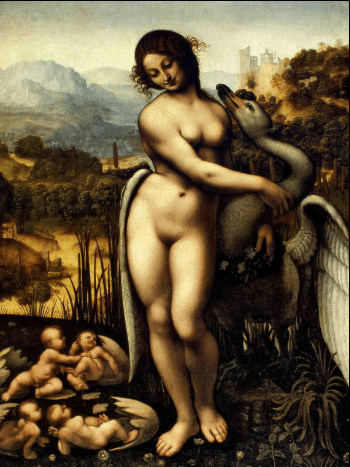
HELEN: From the moment my mother bore me I was pointed at for a freak. It’s not usual in Hellas or anywhere else for a woman to produce her young enclosed in a white shell — which is the way Leda is said to have borne me, with Zeus for my father!
[ἙΛΈΝΗ: ἆρ᾽ ἡ τεκοῦσά μ᾽ ἔτεκεν ἀνθρώποις τέρας;
γυνὴ γὰρ οὔθ᾽ Ἑλληνὶς οὔτε βάρβαρος
τεῦχος νεοσσῶν λευκὸν ἐκλοχεύεται,
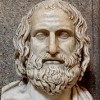
ἐν ᾧ με Λήδαν φασὶν ἐκ Διὸς τεκεῖν.]Euripides (485?-406? BC) Greek tragic dramatist
Helen [Ἑλένη], l. 256ff (412 BC) [tr. Vellacott (1954)]
(Source)
The egg-laying passage here is bracketed or elided by some translators, indicating it is possibly spurious or not in all manuscript traditions.Leda was Helen's mother, with Zeus, the father, having seduced/raped her while disguised as a swan. Leda then lay a clutch of eggs (one with Helen, one containing the twins Castor and Pollux, another Clytemnestra). The ravishment of Leda is a common theme in art; showing the resulting eggs is much more rare (da Vinci being an exception).
(Source (Greek)). Other translations:Was not my birth a prodigy to men?
For never Grecian or Barbaric dame
From the white shell her young ones gave to light,
As Leda brought me forth, fame says, to Jove.
[tr. Potter (1783), l. 286ff]Did not my mother, as a prodigy
Which wondering mortals gaze at, bring me forth?
For neither Greician nor barbaric dame
Till then produced an egg, in which her children
Enveloped lay, as they report, from Jove
Leda engendered.
[tr. Wodhull (1809)]Did not my mother bring me forth as a prodigy to men? For neither Greek nor barbarian woman has given birth to a white vessel of younglings, in which they say Leda begot me by Jove.
[tr. Buckley (1850)]Did my mother bear me as a wonder to mankind? [For no other woman, Hellene or barbarian, gives birth to a white vessel of chicks, in which they say Leda bore me to Zeus.]
[tr. Coleridge (1891)]Bore not my mother a portent unto men?
For never Hellene nor barbarian dame
Brought forth white vial of a fledgling brood,
Wherein to Zeus men say that Leda bare me.
[tr. Way (Loeb) (1912)]My very birth
A portent -- for it is not known in nature
That any woman, Greek or barbarous,
Should bear her children as they say that I
Was born to Zeus by Leda, cased about
In a white hollow shell.
[tr. Sheppard (1925)]And did my mother bear me as some kind of monster?
For certainly no Greek or foreign woman yet
travailed with the white circle of an egg for birds,
as Leda bore me, so they say, from Zeus.
[tr. Warner (1951)]Was I born a monster among mankind?
[No woman, neither in Greece nor yet in Barbary,
is hatched from the white envelope that contains young birds,
yet thus Leda bore me to Zeus, or so they say.]
[tr. Lattimore (1956)]Was I born to be some kind of freak,
carrion for men's scavenging eyes?
I am a freak ... a monster,
and I lead a monstrous life.
[tr. Meagher (1986)]Did my mother bring me into the world for people to stare at as a freak? My life has certainly been grotesque.
[tr. Davie (2002)]Did not my mother bear me to be a monster to the world? For no woman, Hellene or barbarian, gives birth to babes in eggs inclosed, as they say Leda bare me to Zeus.
[tr. Athenian Society (2006)]I've been handicapped -- to judge by the way people stare --
Since birth; and all my life I've lived under the shadow
Of my deformity.
[tr. A. Wilson (2007)]My mother has brought me to this world to be nothing more than a monstrous freak! No woman -- neither Greek nor barbarian -- has given birth to the egg of a white bird, yet, they say, that this is what my mother has done. Leda, they say, delivered me inside the shell of a bird’s egg. Zeus is my father.
[tr. Theodoridis (2011)]Did my mother bear me as a freak among mankind?
No woman -- no Greek, no barbarian -- gives birth to
her baby in an eggshell cask,
they say Leda bore me to Zeus.
[tr. Ambrose et al. (2018)]Did my mother bear me as a wonder to mankind? [For no other woman, Hellene or barbarian, gives birth to a white vessel of chicks, in which they say Leda bore me to Zeus.]
[tr. Coleridge / Helen Heroization Team]
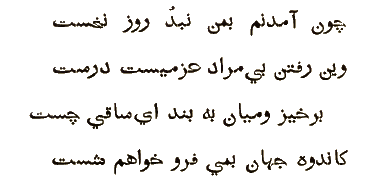
Thrust into life without my own consent,
Thrust back to death, with who knows what intent?
Arise, bright saki, fill the cup with wine
And drown the burden of my discontent.
Omar Khayyám (1048-1123) Persian poet, mathematician, philosopher, astronomer [عمر خیام]
Rubáiyát [رباعیات], Bod. # 21 [tr. Roe (1906), # 44]
(Source)
A saki or sāqī (ساقی) means "wine-server" or "bartender."
Alternate translations:My coming was not of mine own design,
And one day I must go, and no choice of mine;
Come, light-handed cupbearer, gird thee to serve,
We must wash down the care of this world with wine.
[tr. Cowell (1858), # 8]What, without asking, hither hurried whence
And, without asking, wither hurried hence!
Another and another Cup to drown
The Memory of this Impertinence!
[tr. FitzGerald, 1st ed. (1859), # 30]What, without asking, hither hurried whence
And, without asking, wither hurried hence!
Ah, contrite Heav'n endowed us with the Vine
To drug the memory of that insolence.
[tr. FitzGerald, 2nd ed. (1868), # 33]What, without asking, hither hurried Whence?
And, without asking, Whither hurried hence!
Oh, many a Cup of this forbidden Wine
Must drown the memory of that insolence!
[tr. FitzGerald, 3rd ed. (1872), # 30; 4th ed. (1879); 5th ed. (1889)]O Cup-Bearer, since Time lurks hard by ready to shatter you and me, this world can never be an abiding dwelling for you and me. But come what may, assure yourself that God is in our hands while this cup of wine stands between you and me.
[tr. McCarthy (1879), # 35]I came not hither of my own free will,
And go against my wish, a puppet still;
Cupbearer! gird thy loins and fetch some wine;
To purge the world's despite, my goblet fill.
[tr. Whinfield (1883), # 110; (1882) # 641]Since hither, willy nilly, I came the other day
And hence must soon be going, without my yea or nay,
Up, cupbearer! thy middle come gird without delay;
The world and all its troubles with wine I 'll wash away.
[tr. Payne (1898), # 94]Seeing that my coming was not for me the Day of Creation,
and that my undesired departure hence is a purpose fixed for me,
get up and gird well thy loins, O nimble Cup bearer,
for I will wash down the misery of the world in wine.
[tr. Heron-Allen (1898), # 21]As my first coming was no wish of mine
So my departure I can not devise.
Gird thyself, Saki! Fair bright Saki rise,
Lest time should fail to drink this skin of wine.
[tr. Cadell (1899), # 37]Since coming at the first was naught of mine,
And I unwilling go by fixed design,
Cupbearer, rise! and quickly gird thy loins!
For worldly sorrows I'll wash down in wine!
[tr. Thompson (1906), # 157]I was not asked to choose my natal morn,
I die as helplessly as I was born.
Bring wine, and I will strive to wash away
The recollection of Creation's scorn.
[tr. Talbot (1908), # 21]Since my coming was not of my own choosing from
the first day, and my going has been irrevocably fixed without my will,
arise and gird thy loins, o nimble Sáqí, for I will
wash down the grief of the world with wine.
[tr. Christensen (1927), # 32]Since here I came unwilling and perforce,
To go unplanning is my proper course;
Arise O Guide! and girdle up thy waist,
And with Thy Word absolve me from remorse.
[tr. Tirtha (1941), # 8.72]My presence here has been no choice of mine;
Fate hounds me most unwillingly away.
Rise, wrap a cloth about your loins, my Saki,
And swill away the misery of this world.
[tr. Graves & Ali-Shah (1967), # 32]Since at first my coming was not at my will,
And the going is involuntarily imposed,
Arise, fasten your belt brisk wine-boy,
I'll drown the world's sorrow in wine.
[tr. Avery/Heath-Stubbs (1979), # 94]
The drama of life begins with a wail and end with a sigh.
Minna Antrim (1861-1950) American epigrammatist, writer
Naked Truth and Veiled Allusions (1902)
(Source)
Life is a flame that is always burning itself out; but it catches fire again every time a child is born.
George Bernard Shaw (1856-1950) Irish playwright and critic
“The Adventures of the Black Girl in Her Search for God,” Short Stories, Scraps, and Shavings (1932)
(Source)
Having a baby is like trying to push a grand piano through a transom.
Alice Roosevelt Longworth (1884-1980) American writer and socialite
(Attributed)
(Source)
On the birth of her daughter. Though widely attributed to Longworth, she in turn (as she did with many of her attributed witticisms) attributed it to someone else.
Quoted in Michael Teague, ed., Mrs. L.: Conversations With Alice Roosevelt Longworth, Introduction (1981).

PRINCE: Your silence most offends me, and to be merry best becomes you; for, out o’ question, you were born in a merry hour.
BEATRICE: No, sure, my lord, my mother cried, but then there was a star danced, and under that was I born.
William Shakespeare (1564-1616) English dramatist and poet
Much Ado About Nothing, Act 2, sc. 1, l. 324ff (2.1.324-329) (1598)
(Source)

LEAR: When we are born, we cry that we are come
To this great stage of fools.William Shakespeare (1564-1616) English dramatist and poet
King Lear, Act 4, sc. 6, l. 200ff (4.6.200-201) (1606)
(Source)
Child, your first birthday presents will come from nature’s wild —
Small presents: earth will shower you with romping ivy, foxgloves,
Bouquets of gipsy lilies and sweetly-smiling acanthus.[At tibi prima, puer, nullo munuscula cultu
errantis hederas passim cum baccare tellus
20mixtaque ridenti colocasia fundet acantho.]Virgil (70-19 BC) Roman poet [b. Publius Vergilius Maro; also Vergil]
Eclogues [Eclogae, Bucolics, Pastorals], No. 4 “Pollio,” l. 18ff (4.18-20) (42-38 BC) [tr. Day Lewis (1963)]
(Source)
Celebrating the birth of Saloninus, a boy born in the consulship of his father and Virgil's patron C. Asinius Pollio. Or, possibly, writing of Marcellus, son of Augustus. Or maybe just a lot of veiled references to Augustus himself. Or, say some, divine prophecy of the future Jesus Christ. Lots of theories; some summaries here and here.
(Source (Latin)). Alternate translations:Which shall to thee (sweet childe) undrest, bring forth,
Berries, wilde Ivie, and shall pay first fruits
Of mixt Acanthus, with Egyptian roots.
[tr. Ogilby (1649)]Unbidden Earth shall wreathing Ivy bring,
And fragrant Herbs (the promises of Spring)
As her first Off'rings to her Infant King.
[tr. Dryden (1709), l. 22ff]Gladly to thee its natal gifts the field,
Till'd by no human hand, bright Boy, shall yield;
The baccar's stem with curling ivy twine.
And colocasia and acanthus join.
[tr. Wrangham (1830)]Meanwhile the earth, O boy, as her first offerings, shall pour thee forth every where, without culture, creeping ivy with lady's glove, and Egyptian beans with smiling acanthus intermixed.
[tr. Davidson (1854)]On thee, child, everywhere shall earth, untilled,
Show'r, her first baby-offerings, vagrant stems
Of ivy, foxglove, and gay briar, and bean.
[tr. Calverley (c. 1871)]Yes, for you, sweet boy, shall the earth untilled pour forth far and wide a child's simple gifts, the creeping ivy twined with foxglove, and Egyptian beans blended with the bright smile of acanthus.
[tr. Wilkins (1873)]To deck thy cradle earth spontaneous pours
The spikenard's perfume and the wealth of flowers,
Green ivy creeps around with graceful thread,
And bright acanthus smiles upon the bed.
[tr. King (1882), l. 282ff]Now, fairest boy, will the new-teeming earth
No culture wait, but pour to make thee mirth,
As toys of off'ring she can soonest bear,
Wild nard and errant ivy everywhere,
And with th' Egyptian lily twined in play,
Laughing acanthus.
[tr. Palmer (1883)]For thee, O boy,
first shall the earth, untilled, pour freely forth
her childish gifts, the gadding ivy-spray
with foxglove and Egyptian bean-flower mixed,
and laughing-eyed acanthus.
[tr. Greenough (1895)]Meanwhile the earth, O boy, as her first offerings, shall pour forth for you everywhere, without culture, creeping ivy with lady’s glove, and Egyptian beans with smiling acanthus intermixed.
[tr. Bryce (1897)]But on thee, O boy, untilled shall Earth first pour childish gifts, wandering ivy-tendrils and foxglove, and colocasia mingled with the laughing acanthus.
[tr. Mackail (1899)]To him shall bring
Uncultured earth her first small offerings,
Creeping wild ivy, arums, foxgloves too,
Smiling acanthus with bright polished leaf.
[tr. Mackail/Cardew, verse (1908)]For tributes at thy birth, O blessed babe.
The untilled earth with wandering ivies wild
Shall mingle spikenard, and from bounteous breast
Pour forth her lilies and Egyptian balm.
[tr. Williams (1915)]But for you, child, the earth untilled will pour forth its first pretty gifts, gadding ivy with foxglove everywhere, and the Egyptian bean blended with the laughing briar; unbidden it will pour forth for you a cradle of smiling flowers.
[tr. Fairclough (Loeb) (1916)]Free-roaming ivy, foxgloves in every dell, and smiling acanthus mingled with Egyptian lilies — these, little one, are the first modest gifts that earth, unprompted by the hoe, will lavish on you.
[tr. Rieu (1949)]But these, dear boy, are the first pretty gifts in plenty
Our Earth from effortless fields shall bring you: ivy
With foxglove wandering hither and thither, commingled
With lotus and laughing-eyed acanthus.
[tr. Johnson (1960)]Dear child, there will be new little gifts for you,
Springtime valerian, and trailing ivy,
Egyptian beans, and smiling acanthus, all
poured out profusely from the untilled earth.
[tr. Ferry (1999)]And for you, boy, the uncultivated earth will pour out
her first little gifts, straggling ivy and cyclamen everywhere
and the bean flower with the smiling acanthus.
[tr. Kline (2001)]And for you, little boy, the uncultivated earth will scatter its first small gifts, wandering ivy and cyclamens everywhere, beans mixed with laughing acanthus.
[tr. @sentantiq (2015)]
We are going to die, and that makes us the lucky ones. Most people are never going to die because they are never going to be born. The potential people who could have been here in my place but who will in fact never see the light of day outnumber the sand grains of Sahara. Certainly those unborn ghosts include greater poets than Keats, scientists greater than Newton. We know this because the set of possible people allowed by our DNA so massively outnumbers the set of actual people. In the teeth of these stupefying odds it is you and I, in our ordinariness, that are here.
Richard Dawkins (b. 1941) English ethologist, evolutionary biologist, author
Unweaving The Rainbow, ch. 1 “The Anaesthetic of Familiarity” (1998)
(Source)
Dawkins has said this passage will be read at his funeral.

I remember nothing of this, no ambulance rides, nothing. Nothing between switching out the bedside lamp and the sudden indignity of rebirth: the slaps, the brightness, the tubing, the speed, the urgent insistence that I be choked back into breathing life. I have felt so sorry for babies ever since.
Stephen Fry (b. 1957) British actor, writer, comedian
Moab Is My Washpot, “Breaking Out,” ch. 1 (1997)
(Source)
On his suicide attempt by drug overdose at age 17.

Probably no parent is truly born in the moment of birth; the miracle more likely happens in the moment the baby first curls its tiny hand around the parent’s large finger.
Marcelene Cox (1900-1998) American writer, columnist, aphorist
“Ask Any Woman” column, Ladies’ Home Journal (1963-01/02)
(Source)

A blossom must break the sheath it has been sheltered by.
Phyllis Bottome (1884-1963) British novelist and short story writer [mar. Phyllis Forbes Dennis]
The Mortal Storm, ch. 15 (1938)
(Source)
Yet, if nothing else, each time a new baby is born there is a possibility of reprieve. Each child is a new being, a potential prophet, a new spiritual prince, a new spark of light precipitated into the outer darkness. Who are we to decide that it is hopeless?
R. D. Laing (1927-1989) Scottish psychiatrist [Ronald David Laing]
The Politics of Experience, ch. 1 (1967)
(Source)

As many years as I have been listening to Easter sermons, I have never heard anyone talk about that part. Resurrection is always announced with Easter lilies, the sound of trumpets, bright streaming light. But it did not happen that way. If it happened in a cave, it happened in complete silence, in absolute darkness, with the smell of damp stone and dug earth in the air. Sitting deep in the heart of Organ Cave, I let this sink in: new life starts in the dark. Whether it is a seed in the ground, a baby in the womb, or Jesus in the tomb, it starts in the dark.
Barbara Brown Taylor (b. 1951) American minister, academic, author
Learning to Walk in the Dark, ch. 6 (2014)
(Source)

PERICLES: I see that Time’s the king of men,
For he’s their parent, and he is their grave,
And gives them what he will, not what they crave.William Shakespeare (1564-1616) English dramatist and poet
Pericles, Act 2, sc. 3, l. 49ff (2.3.49-51) (1607) [with George Wilkins]
(Source)
Without darkness, nothing comes to birth,
As without light, nothing flowers.May Sarton (1912-1995) Belgian-American poet, novelist, memoirist [pen name of Eleanore Marie Sarton]
“The Invocation to Kali,” Part 5, Poetry (Feb 1971)
(Source)
As is the generation of leaves, so is that of humanity.
The wind scatters the leaves on the ground, but the live timber
Burgeons with leaves again in the season of spring returning.
So one generation of men will grow while another dies.[Οἵη περ φύλλων γενεὴ τοίη δὲ καὶ ἀνδρῶν.
φύλλα τὰ μέν τ’ ἄνεμος χαμάδις χέει, ἄλλα δέ θ’ ὕλη
τηλεθόωσα φύει, ἔαρος δ’ ἐπιγίγνεται ὥρη·
ὣς ἀνδρῶν γενεὴ ἣ μὲν φύει ἣ δ’ ἀπολήγει.]Homer (fl. 7th-8th C. BC) Greek author
The Iliad [Ἰλιάς], Book 6, l. 146ff (6.146-149) (c. 750 BC) [tr. Lattimore (1951)]
(Source)Like the race of leaves
The race of man is, that deserves no question; nor receives
My being any other breath? The wind in autumn strows
The earth with old leaves, then the spring the woods with new endows;
And so death scatters men on earth, so life puts out again
Man’s leavy issue.
[tr. Chapman (1611), l. 141ff]Like leaves on trees the race of man is found,
Now green in youth, now withering on the ground:
Another race the following spring supplies,
They fall successive, and successive rise:
So generations in their course decay;
So flourish these, when those are past away.
[tr. Pope (1715-20)]For, as the leaves, such is the race of man.
The wind shakes down the leaves, the budding grove
Soon teems with others, and in spring they grow.
So pass mankind. One generation meets
Its destined period, and a new succeeds.
[tr. Cowper (1791), l. 175ff]As is the race of leaves, even such is the race of men. Some leaves the wind sheds upon the ground, but the fructifying wood produces others, and these grow up in the season of spring. Such is the generation of men; one produces, another ceases.
[tr. Buckley (1860)]The race of man is as the race of leaves:
Of leaves, one generation by the wind
Is scatter'd on the earth; another soon
In spring's luxuriant verdure bursts to light.
So with our race; these flourish, those decay.
[tr. Derby (1864)]Even as are the generations of leaves such are those likewise of men; the leaves that be the wind scattereth on the earth, and the forest buddeth and putteth forth more again, when the season of spring is at hand; so of the generations of men one putteth forth and another ceaseth.
[tr. Leaf/Lang/Myers (1891)]Men come and go as leaves year by year upon the trees. Those of autumn the wind sheds upon the ground, but when spring returns the forest buds forth with fresh vines. Even so is it with the generations of mankind, the new spring up as the old are passing away.
[tr. Butler (1898)]Even as are the generations of leaves, such are those also of men. As for the leaves, the wind scattereth some upon the earth, but the forest, as it bourgeons, putteth forth others when the season of spring is come; even so of men one generation springeth up and another passeth away.
[tr. Murray (1924)]Very like leaves upon this earth are the generations of men -- old leaves, cast on the ground by wind, young leaves the greening forest bears when spring comes in. So mortals pass; one generation flowers even as another dies away.
[tr. Fitzgerald (1974)]Like the generations of leaves, the lives of mortal men.
Now the wind scatters the old leaves across the earth,
now the living timber bursts with the new buds
and spring comes round again. And so with men:
as one generation comes to life, another dies away.
[tr. Fagles (1990), ll. 171-75]
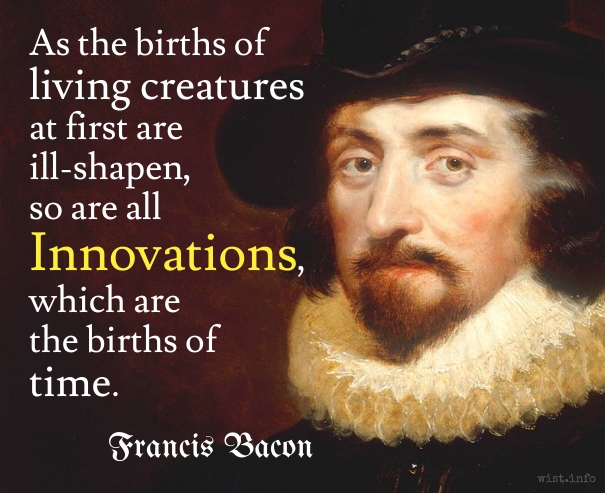
As the births of living creatures at first are ill-shapen, so are all Innovations, which are the births of time.
Francis Bacon (1561-1626) English philosopher, scientist, author, statesman
“Of Innovations,” Essays, No. 24 (1625)
(Source)

Why is it that we rejoice at a birth and grieve at a funeral? It is because we are not the person involved.
Mark Twain (1835-1910) American writer [pseud. of Samuel Clemens]
The Tragedy of Pudd’nhead Wilson, ch. 9 epigraph “Pudd’nhead Wilson’s Calendar” (1894)
(Source)
Some are born great, some achieve greatness, and some hire public relations officers.
Daniel J. Boorstin (1914-2004) American historian, professor, attorney, writer
(Attributed)
See Shakespeare.