
History does not long entrust the care of freedom to the weak or the timid.
Dwight David Eisenhower (1890–1969) American general, US President (1953–61)
Inaugural Address (20 Jan 1953)
Quotations about:
freedom
Note not all quotations have been tagged, so Search may find additional quotes on this topic.
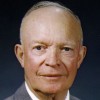
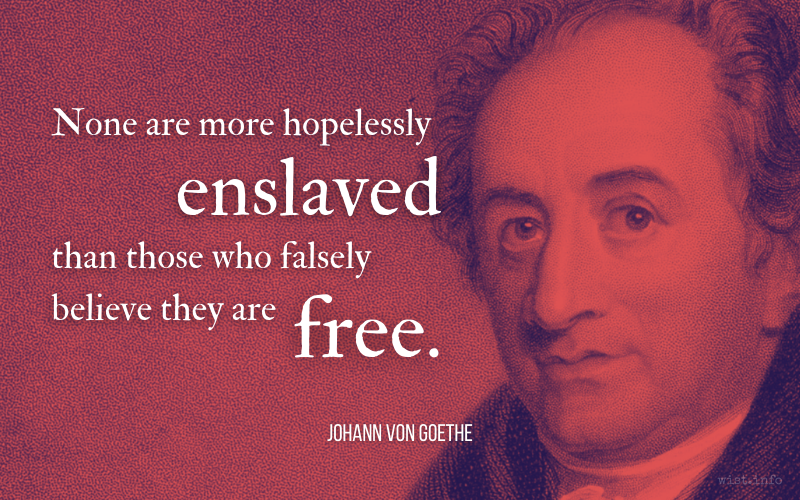
None are more hopelessly enslaved than those who falsely believe they are free.
[Niemand ist mehr Sklave als der sich für frei hält ohne es zu sein.]
Johann Wolfgang von Goethe (1749–1832) German poet, statesman, scientist
Elective Affinities [Die Wahlverwandtschaften], Part 2, ch. 5, “From Ottilie’s Journal [Aus Ottiliens Tagebuche]” (1809) [tr. Wenckstern (1853)]
(Source)
(Source (German)). Another translation:No one is more a slave than the man who thinks himself free while he is not.
[Niles ed. (1872)]No one is more a slave than he who thinks he is free without being so.
[tr. Hollingdale (1971)]
You don’t get to control any outcome, only every choice you make along the way.
(Other Authors and Sources)
Stephen C. Paul

The first measure of a free society is NOT that its government performs the will of the majority. That’s what we had in 1930s Germany, 1950s Georgia, and 1980s Iran. The FIRST measure of a free society is that its government protects the just freedoms of its minorities AGAINST the preferences, will and caprice of the majority.
Jim Warren (b. 1936) American mathematician, computer scientist, journalist, activist
(Attributed)

It is clear that thought is not free if the profession of certain opinions makes it impossible to earn a living.
Bertrand Russell (1872–1970) English mathematician and philosopher
“Free Thought and Official Propaganda,” lecture, South Place Institute, London (1922-03-24)
(Source)
Peace indeed is both sweet in name and wholesome in reality; but there is all the difference in the world between peace and slavery. Peace is the calmness of freedom, slavery the worst of all evils, to be kept off at the cost not only of war, but even of life itself.
[Et nomen pacis dulce est et ipsa res salutaris; sed inter pacem et servitutem plurimum interest. Pax est tranquilla libertas, servitus postremum malorum omnium, non modo bello sed morte etiam repellendum.]
Marcus Tullius Cicero (106–43 BC) Roman orator, statesman, philosopher
Philippics [Philippicae; Antonian Orations], No. 2, ch. 44 / sec. 113 (2,44/2.113) (44-10-24 BC) [tr. King (1877)]
(Source)
(Source (Latin)). Other translations:And the name of peace is sweet, and the thing itself wholesome, but between peace and servitude the difference is great. Peace is tranquil liberty, servitude the last of all evils, one to be repelled, not only by war but even by death.
[tr. Ker (1926)]The name of peace is sweet, the thing itself is most salutary. But between peace and slavery there is a wide difference. Peace is liberty in tranquility; slavery is the worst of all evils, -- to be repelled, if need be, not only by war, but even by death.
[tr. Yonge (1903)]Peace indeed is both sweet in name and wholesome in reality; but there is all the difference between peace and slavery. Peace is the calmness of freedom, slavery the worst of all evils, to be kept off at the cost not only of war, but even of life itself.
[ed. Harbottle (1906)]Even the name of peace is sweet, and peace itself a blessing; but there is all the difference in the world between peace and servitude. Peace is the quiet enjoyment of freedom, whereas servitude is the greatest of all evils, something to be resisted not just with war, but even with death.
[tr. Berry (2006)]There is sweetness in the name of peace, and living in peace is beneficial, but there is a great difference between peace and slavery. Slavery is the worst of all evils and must be driven off by war -- or even by death.
[tr. McElduff (2011)]
Only free men can negotiate; prisoners cannot enter into contracts. Your freedom and mine cannot be separated.
Nelson Mandela (1918–2013) South African revolutionary, politician, statesman
Letter from prison to Zindzi Mandela, given in Soweto speech (10 Feb 1985)
On refusing to bargain for freedom after 21 years in prison. Quoted in Time (25 Feb 1985).
If we don’t believe in freedom of expression for people we despise, we don’t believe in it at all.
Noam Chomsky (b. 1928) American linguist and activist
The Late Show, TV interview with John Pilger, BBC2 (25 Nov 1992)
Hereditary bondsmen! know ye not
Who would be free themselves must strike the blow?George Gordon, Lord Byron (1788–1824) English poet
Childe Harold’s Pilgrimage, Canto 2, st. 76 (1812)
(Source)
Speaking of the Greeks, whose nation was still controlled by the Ottoman Empire. The lines were used by W. E. B. DuBois, along with a line from st. 74, as the epigraph of ch. 3 of The Souls of Black Folks (1903).
Is life so dear, or peace so sweet, as to be purchased at the price of chains and slavery? Forbid it, Almighty God! I know not what course others may take, but as for me, give me liberty, or give me death!
I would rather be exposed to the inconveniencies attending too much liberty than those attending too small a degree of it.
Thomas Jefferson (1743–1826) American political philosopher, polymath, statesman, US President (1801–09)
Letter (1791-12-23) to Archibald Stuart
(Source)
Jefferson originally wrote "dangers" instead of "inconveniencies."
I wish men to be free
As much from mobs as kings — from you as me.
There is only one basic human right, the right to do as you damn well please. And with it comes the only basic human duty, the duty to take the consequences.
P. J. O'Rourke (b. 1947) American humorist, editor
“The Liberty Manifesto,” speech, Cato Institute, Washington, DC (1993-05-06)
(Source)
Reprinted in Age and Guile Beat Youth, Innocence, and a Bad Haircut (1995).

We are not afraid to entrust the American people with unpleasant facts, foreign ideas, alien philosophies, and competitive values. For a nation that is afraid to let its people judge the truth and falsehood in an open market is a nation that is afraid of its people.
John F. Kennedy (1917–1963) American politician, author, journalist, US President (1961–63)
“Remarks on the 20th Anniversary of the Voice of America” (speech), Washington, DC (26 Feb 1962)
(Source)
The history of liberty is the history of the observances of procedural safeguards.
Felix Frankfurter (1882–1965) American jurist, teacher; US Supreme Court Justice (1939–62)
McNabb v. United States, 318 U.S. 332, 347 (1943) [majority opinion]
(Source)
The ruling determined a defendant's confession was inadmissible as evidence in federal court if the government had disregarded the legal requirement to bring them promptly before a judge or magistrate.
Freedom of speech and freedom of action are meaningless without freedom to think. And there is no freedom of thought without doubt.
Bergen Evans (1904–1978) American educator, writer, lexicographer
The Natural History of Nonsense, ch. 19 (1946)
I often wonder whether we do not rest our hopes too much upon constitutions, upon laws and upon courts. These are false hopes; believe me, these are false hopes. Liberty lies in the hearts of men and women; when it dies there, no constitution, no law, no court can even do much to help it. While it lies there it needs no constitution, no law, no court to save it.
Learned Hand (1872–1961) American jurist
“The Spirit of Liberty,” speech, “I Am an American Day,” New York (1941-05-21)
(Source)
Think for yourselves and let others enjoy the privilege to do so, too.
Voltaire (1694–1778) French writer [pseud. of Francois-Marie Arouet]
Dictionnaire philosophique portatif, “Tolerance” (1764)