

Next in importance to freedom and justice is popular education, without which neither freedom nor justice can be permanently maintained.
James A. Garfield (1831–1881) US President (1881), lawyer, lay preacher, educator
Letter of Acceptance, Republican nomination for President (10 Jul 1880)
(Source)
Quotations about:
freedom
Note not all quotations have been tagged, so Search may find additional quotes on this topic.
See, free nations are peaceful nations. Free nations don’t attack each other. Free nations don’t develop weapons of mass destruction.
George W. Bush (b. 1946) US President (2001–2009)
Speech, Milwaukee (3 Oct 2003)
(Source)
Referring to insurgencies in Iraq.
There is freedom waiting for you,
On the breezes of the sky,
And you ask “What if I fall?”
Oh but my darling,
What if you fly?

I’ll clue you in on a secret: death is not the worst thing that could happen to you. I know we think that; we are the first society ever to think that. It’s not worse than dishonor; it’s not worse than losing your freedom; it’s not worse than losing a sense of personal responsibility.
William "Bill" Maher (b. 1956) American comedian, political commentator, critic, television host.
Be More Cynical (2000)

Freedom is worth paying for.
[La liberté vaut qu’on la paye.]
Jules Verne (1828–1905) French novelist, poet, playwright
Twenty Thousand Leagues Under the Sea, Part 2, ch. 8 “Vigo Bay” (1870)
(Source)
Americans, indeed, all free men, remember that in the final choice a soldier’s pack is not so heavy a burden as a prisoner’s chains.
Dwight David Eisenhower (1890–1969) American general, US President (1953–61)
Inaugural Address (20 Jan 1953)
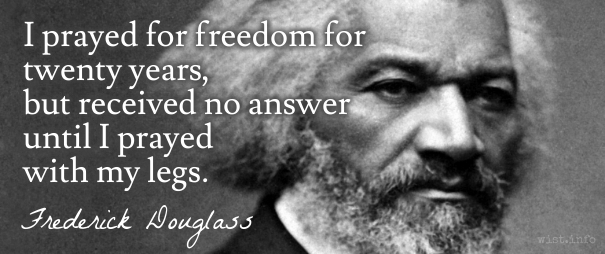
I prayed for freedom for twenty years, but received no answer until I prayed with my legs.
Frederick Douglass (1817–1895) American abolitionist, orator, writer
(Attributed)
Mentioned frequently as being part of his earlier speeches, but unsourced. Also found as "failed to see the slightest scintillation of an answer until I prayed with my legs."
I am inordinately proud these days of the quill, for it has shown itself, historically, to be the hypodermic which inoculates men and keeps the germ of freedom always in circulation, so that there are individuals in every time in every land who are the carriers, the Typhoid Mary’s, capable of infecting others by mere contact and example. These persons are feared by every tyrant — who shows his fear by burning the books and destroying the individuals.
E. B. White (1899–1985) American author, critic, humorist [Elwyn Brooks White]
“Freedom” (Jul 1940)
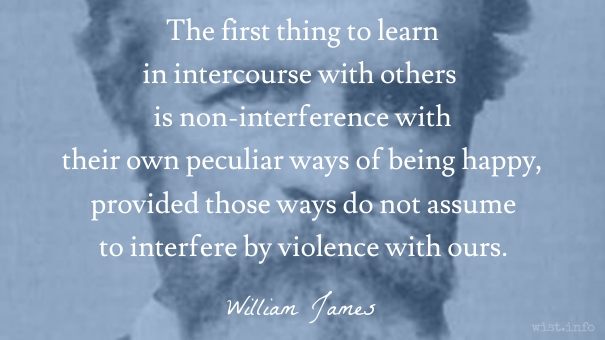
The first thing to learn in intercourse with others is non-interference with their own peculiar ways of being happy, provided those ways do not assume to interfere by violence with ours.
William James (1842–1910) American psychologist and philosopher
“What Makes a Life Significant,” Lecture, Harvard (1899)
Reprinted in Talks to Teachers on Psychology, Part 2, Lecture 3.
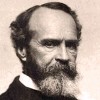
The doors of Hell are locked on the inside. I do not mean that the ghosts may not wish to come out of Hell, in the vague fashion wherein an envious man “wishes” to be happy: but they certainly do not will even the first preliminary stages of that self-abandonment through which alone the soul can reach any good. They enjoy forever the horrible freedom they have demanded, and are therefore self-enslaved: just as the blessed, forever submitting to obedience, become through all eternity more and more free.
C. S. Lewis (1898–1963) English writer, literary scholar, lay theologian [Clive Staples Lewis]
The Problem of Pain (1940)
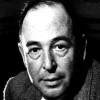
The conflict to different approaches to the liberty of man and mind or between different views of human dignity and the right of the individual is continuous. The dividing line goes within ourselves, within our own peoples, and also within other nations. It does not coincide with any political or geographical boundaries. The ultimate fight is one between the human and the subhuman. We are on dangerous ground if we believe that any individual, any nation, or any ideology has a monopoly on rightness, liberty, and human dignity.
Dag Hammarskjöld (1905–1961) Swedish diplomat, author, UN Secretary-General (1953–61)
“The Walls of Distrust,” speech, Cambridge University (5 Jun 1958)
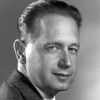
While democracy must have its organization and controls, its vital breath is individual liberty.
Charles Evans Hughes, Sr. (1862–1948) American statesman, politician, Supreme Court Justice (1910–1916, 1930–1941)
Speech (4 Mar 1939)
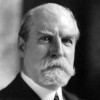
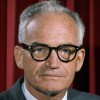
Equality, rightly understood, as our founding fathers understood it, leads to liberty and to the emancipation of creative differences. Wrongly understood, as it has been so tragically in our time, it leads first to conformity and then to despotism.
Barry Goldwater (1909–1998) American politician
Speech, accepting the GOP Presidential Nomination, San Francisco (16 Jul 1964)
Of what use is political liberty to those who have no bread?
Jean-Paul Marat (1743–1793) French physician, political theorist, scientist, journalist
Letter to Camille Desmoulins (24 Jun 1790)
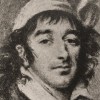
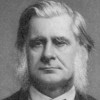
If individuality has no play, society does not advance; if individuality breaks out of all bounds, society perishes.
T. H. Huxley (1825–1895) English biologist [Thomas Henry Huxley]
“Administrative Nihilism” (1871)
Today’s so-called “conservatives” don’t even know what the word means. They think I’ve turned liberal because I believe a woman has a right to an abortion. That’s a decision that’s up to the pregnant woman, not up to the pope or some do-gooders or the Religious Right. It’s not a conservative issue at all.
Barry Goldwater (1909–1998) American politician
Interview, Los Angeles Times (1994)
There isn’t a way things should be. There’s just what happens, and what we do.
Terry Pratchett (1948–2015) English author
Discworld No. 32, A Hat Full of Sky [Miss Level] (2004)
(Source)

No matter how unpredictable the future may be, we don’t win freedom through security systems, cryptography, interrogations and spot searches. We win freedom by having the courage and the conviction to live every day freely and to act as a free society, no matter how great the threats are on the horizon.
Cory Doctorow (b. 1971) Canadian-British blogger, journalist, activist, author
Little Brother (2008)

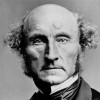
Whatever crushes individuality is despotism, by whatever name it may be called and whether it professes to be enforcing the will of God or the injunctions of men.
John Stuart Mill (1806–1873) English philosopher and economist
On Liberty, ch. 3 “Of Individuality, as One of the Elements of Well-Being” (1859)
(Source)
Whatever may be the immediate gains and losses, the dangers to our safety arising from political suppression are always greater than the dangers to that safety arising from political freedom. Suppression is always foolish. Freedom is always wise. That is the faith, the experimental faith, by which we Americans have undertaken to live. If we, the citizens of today, cannot shake ourselves free from the hysteria which blinds us to that faith, there is little hope for peace and security, either at home or abroad.
Alexander Meiklejohn (1872–1964) Philosopher, university administrator, civil libertarian
Testimony before the Senate Sub-Committee on Constitutional Rights (1955)
I believe in individualism. I believe in it in the arts, the sciences and professions. I believe in it in business. I believe in individualism in all of these things — up to the point where the individualist starts to operate at the expense of society.
Peace does not appear so distant as it did. I hope it will come soon, and come to stay; and so come as to be worth the keeping in all future time. It will then have been proved that, among free men, there can be no successful appeal from the ballot to the bullet; and that they who take such appeal are sure to lose their case, and pay the cost.
Abraham Lincoln (1809–1865) American lawyer, politician, US President (1861–65)
Letter (1863-08-26) to James C. Conkling
(Source)
Sent as a letter to Conkling to read to a rally of Union supporters in Springfield, Illionis (1863-09-03).
Lincoln used the juxtaposition of ballots and bullets a number of times (e.g., 1856, 1858).
I believe any man who takes the liberty of another into his keeping is bound to become a tyrant, and that any man who yields up his liberty, in however slight the measure, is bound to become a slave.
H. L. Mencken (1880–1956) American writer and journalist [Henry Lewis Mencken]
“Why Liberty?” Chicago Tribune (30 Jan 1927)
The sole end for which mankind are warranted, individually or collectively, in interfering with the liberty of action of any of their number, is self-protection. That the only purpose for which power can be rightfully exercised over any member of a civilised community, against his will, is to prevent harm to others. His own good, either physical or moral, is not a sufficient warrant. He cannot rightfully be compelled to do or forbear because it will be better for him to do so, because it will make him happier, because, in the opinions of others, to do so would be wise, or even right. These are good reasons for remonstrating with him, or reasoning with him, or persuading him, or entreating him, but not for compelling him, or visiting him with any evil in case he do otherwise. To justify that, the conduct from which it is desired to deter him must be calculated to produce evil to some one else. The only part of the conduct of any one, for which he is amenable to society, is that which concerns others. In the part which merely concerns himself, his independence is, of right, absolute. Over himself, over his own body and mind, the individual is sovereign.
The people never give up their liberties but under some delusion.
Edmund Burke (1729–1797) Anglo-Irish statesman, orator, philosopher
Speech, Buckinghamshire (1784)
A brave people will certainly prefer liberty, accompanied by virtuous poverty, to a depraved and wealthy servitude.
Edmund Burke (1729–1797) Anglo-Irish statesman, orator, philosopher
Reflections on the Revolution in France (1790)
Our liberty cannot be taken away unless the people are themselves accomplices.
Henry St John, 1st Viscount Bolingbroke (1678–1751) English politician, government official, political philosopher [Lord Bolingbroke]
A Dissertation upon Parties (1735)
Liberty, like charity, must begin at home.
James Bryant Conant (1893–1978) American chemist, academic, diplomat
“Our Fighting Faith, Our Unique Heritage,” address, Harvard (20 Jun 1942)
For to be free is not merely to cast off one’s chains, but to live in a way that respects and enhances the freedom of others
Nelson Mandela (1918–2013) South African revolutionary, politician, statesman
A Long Walk to Freedom, ch. 114 (1994)
(Source)
No woman can call herself free who cannot choose the time to be a mother or not as she sees fit.
Margaret Sanger (1879–1966) American birth control activist, sex educator, nurse
“The Case for Birth Control” Physical Culture (Apr 1917)

In addition to all the weaknesses, dilemmas and temptations that impede every pilgrim’s progress, the Catholic who holds political office in a pluralistic democracy — who is elected to serve Jews and Muslims, atheists and Protestants, as well as Catholics — bears special responsibility. He or she undertakes to help create conditions under which all can live with a maximum of dignity and with a reasonable degree of freedom; where everyone who chooses may hold beliefs different from specifically Catholic ones — sometimes contradictory to them; where the laws protect people’s right to divorce, to use birth control and even to choose abortion. In fact, Catholic public officials take an oath to preserve the Constitution that guarantees this freedom. And they do so gladly. Not because they love what others do with their freedom, but because they realize that in guaranteeing freedom for all, they guarantee our right to be Catholics: our right to pray, to use the sacraments, to refuse birth control devices, to reject abortion, not to divorce and remarry if we believe it to be wrong.
Mario Cuomo (1932–2015) American politician
“Religious Belief and Public Morality,” John A. O’Brien Lecture, U. of Notre Dame (13 Sep 1984)
(Source)

Unhappy it is though to reflect, that a Brother’s Sword has been sheathed in a Brother’s breast, and that, the once happy and peaceful plains of America are either to be drenched with Blood, or Inhabited by Slaves. Sad alternative! But can a virtuous Man hesitate in his choice?
George Washington (1732–1799) American military leader, Founding Father, US President (1789–1797)
Letter to George William Fairfax (31 May 1775)
(Source)
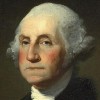
The Bill of Rights was designed trustfully to prohibit forever two of the favorite crimes of all known governments: the seizure of private property without adequate compensation and the invasion of the citizen’s liberty without justifiable cause and due process.
H. L. Mencken (1880–1956) American writer and journalist [Henry Lewis Mencken]
“On Government,” Prejudices: Fourth Series (1924)
It’s all about money, not freedom, y’all, okay? Nothing to do with fuckin’ freedom. If you think you’re free, try going somewhere without fucking money, okay?
Bill Hicks (1961–1994) American stand-up comedian, social critic, satirist, musician [William Melvin "Bill" Hicks]
In American: The Bill Hicks Story (2009)
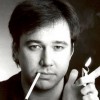
When things get so balled up that the people of a country got to cut loose from some other country, and go it on their own hook, without asking no permission from nobody, excepting maybe God Almighty, then they ought to let everybody know why they done it, so that everybody can see they are not trying to put nothing over on nobody. All we got to say on this proposition is this: first, me and you is as good as anybody else, and maybe a damn sight better; second, nobody ain’t got no right to take away none of our rights; third, everyman has got a right to live, to come and go as he pleases, and to have a good time whichever way he likes, so long as he don’t interfere with nobody else. That any government that don’t give a man them rights ain’t worth a damn; also, people ought to choose the kind of government they want themselves, and nobody else ought to have no say in the matter. That whenever any government don’t do this, then the people have got a right to give it the bum’s rush and put in one that will take care of their interests.
H. L. Mencken (1880–1956) American writer and journalist [Henry Lewis Mencken]
“Essay in American,” Baltimore Evening Sun (1921-11-07)
(Source)
Rewriting the beginning of the Declaration of Independence in the time's parlance.
I stand and rejoice every time I see a woman ride by on a wheel. It gives her a feeling of freedom, self-reliance and independence. The moment she takes her seat she knows she can’t get into harm while she is on her bicycle, and away she goes, the picture of free, untrammeled womanhood.
Susan B. Anthony (1820–1906) American reformer, aboltionist, sufferagist
Letter to the editor of “Sidepath” magazine (1898)
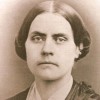
If the government can round up someone and never be required to explain why, then it’s no longer the United States of America as you and I always understood it. Our enemies have succeeded beyond their wildest dreams. They have made us become like them.
Garrison Keillor (b. 1942) American entertainer, author
“Congress’s Shameful Retreat From American Values,” Chicago Tribune (4 Oct 2006)
(Source)
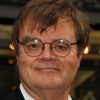
And of course this country is founded on the double standard, that’s our history! We were founded on a very basic double standard: this country was founded by slave owners who wanted to be free. Am I right? A group of slave owners who wanted to be free! So they killed a lot of white English people, in order to continue owning their black African people, so they could wipe out of the rest of the red Indian people, and move west and steal the rest of the land from the brown Mexican people, giving them a place to take off and drop their nuclear weapons on the yellow Japanese people. You know what the motto of this country ought to be? “You give us a color, we’ll wipe it out!”
George Carlin (1937–2008) American comedian
Show (1988-08-15), What Am I Doing in New Jersey?, Park Performing Arts Center, Union City, New Jersey (HBO)
(Source)
(Source (Video); dialog verified)
The welfare of the people in particular has always been the alibi of tyrants, and it provides the further advantage of giving the servants of tyranny a good conscience. It would be easy, however, to destroy that good conscience by shouting to them: if you want the happiness of the people, let them speak out and tell what kind of happiness they want and what kind they don’t want! But, in truth, the very ones who make use of such alibis know they are lies; they leave to their intellectuals on duty the chore of believing in them and of proving that religion, patriotism, and justice need for their survival the sacrifice of freedom.
Albert Camus (1913–1960) Algerian-French novelist, essayist, playwright
“Homage to an Exile” (1955)
Published as an essay in Actuelles III, originally a speech (7 Dec 1955) at a banquet in honor of President Eduardo Santos, editor of El Tiempo, driven out of Columbia by a dictatorship". Reprinted in Resistance, Rebellion, and Death (1960).
All Politeness is owing to Liberty. We polish one another, and rub off our Corners and rough Sides by a sort of amicable Collision. To restrain this, is inevitably to bring a Rust upon Men’s Understandings.
Anthony Cooper, 3rd Earl of Shaftesbury (1671–1713) English politician and philosopher
Characteristicks of Men, Manners, Opinions, Times, Vol. 1, “Sensus Communis” (1711)

Un-American activity cannot be prevented or routed out by employing un-American methods; to preserve freedom we must use the tools that freedom provides.
Dwight David Eisenhower (1890–1969) American general, US President (1953–61)
The White House Years: Mandate for Change: 1953-1956: A Personal Account (1963)
That all history shows the necessity, in order to the preservation of liberty, of every subjects having a watchful eye on the conduct of Kings, Ministers, and Parliament, and of every subjects being not only secured, but encouraged in alarming his fellow subjects on occasion of every attempt upon public liberty.
James Burgh (1714–1775) British politician and writer
Political Disquisitions, Book 1 “Of Government, briefly,” ch. 9 “Of the Liberty of Speech and Writing on Political Subjects” (1774)
(Source)
There is nothing in the world that renders a man more unlike to a saint, and more like to Satan — than to argue from God’s mercy to sinful liberty; from divine goodness to licentiousness.
Thomas Brooks (1608–1680) English Puritan divine, writer
Precious Remedies Against Satan’s Devices (1652)
There once was a time in history when the limitation of governmental power meant increasing liberty for the people. In the present day the limitation of governmental power, of governmental action, means the enslavement of the people by the great corporations who can only be held in check through the extension of governmental power.
Theodore Roosevelt (1858–1919) American politician, statesman, conservationist, writer; US President (1901–09)
Speech (1912-09-14), San Francisco
(Source)
That government only can be pronounced consistent with the design of all government, which allows to the governed the liberty of doing what, consistently with the general good, they may desire to do, and which only forbids their doing the contrary. Liberty does not exclude restraint; it only excludes unreasonable restraint. To determine precisely how far personal liberty is compatible with the general good, and of the propriety of social conduct in all cases, is a matter of great extent, and demands the united wisdom of a whole people. And the consent of the whole people, as far as it can be obtained, is indispensably necessary to every law, by which the whole people are to be bound; else the whole people are enslaved to the one, or the few, who frame the laws for them.
James Burgh (1714–1775) British politician and writer
Political Disquisitions, Book 1 “Of Government, briefly” (1774)
(Source)
I think the authors of that notable instrument intended to include all men, but they did not mean to declare all men equal in all respects. They did not mean to say all men were equal in color, size, intellect, moral development, or social capacity. They defined with tolerable distinctness in what they did consider all men created equal — equal in “certain inalienable rights, among which are life, liberty, and the pursuit of happiness.” This they said, and this they meant. They did not mean to assert the obvious untruth that all were then actually enjoying that equality, or yet that they were about to confer it immediately upon them. In fact, they had no power to confer such a boon. They meant simply to declare the right, so that the enforcement of it might follow as fast as circumstances should permit. They meant to set up a standard maxim for free society which should be familiar to all, constantly looked to, constantly labored for, and even, though never perfectly attained, constantly approximated, and thereby constantly spreading and deepening its influence, and augmenting the happiness and value of life to all people, of all colors, everywhere.
All do not develop in the same manner, or at the same pace. Nations, like men, often march to the beat of different drummers, and the precise solutions of the United States can neither be dictated nor transplanted to others. What is important is that all nations must march toward increasing freedom; toward justice for all; toward a society strong and flexible enough to meet the demands of all its own people, and a world of immense and dizzying change.
Robert Francis Kennedy (1925–1968) American politician
“Day of Affirmation,” address, University of Capetown, South Africa (6 Jun 1966)
(Source)
Poor and free rather than rich and enslaved. Of course, men want to be both rich and free, and this is what leads them at times to be poor and enslaved.
[Pauvre et libre plutôt que riche et asservi. Bien entendu les hommes veulent être et riches et libres et c’est ce qui les conduit quelquefois à être pauvres et esclaves.]
Albert Camus (1913–1960) Algerian-French novelist, essayist, playwright
Notebooks: 1942-1951, Notebook 4, Jan 1942 – Sep 1945 [tr. O’Brien/Thody (1963)
(Source)
Near eighty years ago we began by declaring that all men are created equal; but now from that beginning we have run down to the other declaration, that for some men to enslave others is a “sacred right of self-government.” These principles can not stand together. They are as opposite as God and mammon; and whoever holds to the one, must despise the other.
Abraham Lincoln (1809–1865) American lawyer, politician, US President (1861–65)
Speech (1854-10-16), “In Reply to Senator Douglas,” Peoria, Illinois
(Source)
Speaking on the 1854 Kansas-Nebraska Act, which repealed the Missouri Compromise and allowed as "self-government" for residents of those two territories to decide locally whether to allow slavery there.
Lincoln is referencing both the Declaration of Independence and the Bible (Luke 16:13).
At the heart of that Western freedom and democracy is the belief that the individual man, the child of God, is the touchstone of value, and all society, groups, the state, exist for his benefit. Therefore the enlargement of liberty for individual human beings must be the supreme goal and the abiding practice of any Western society.
Robert Francis Kennedy (1925–1968) American politician
“Day of Affirmation,” address, University of Capetown, South Africa (6 Jun 1966)
(Source)
MILNE: Junk journalism is the evidence of a society that has got at least one thing right, that there should be nobody with the power to dictate where responsible journalism begins.
Tom Stoppard (1937–2025) Czech-English playwright and screenwriter
Night and Day, Act 1 (1978)

Selective ignorance, a cornerstone of child rearing. You don’t put kids under surveillance: it might frighten you. Parents should sit tall in the saddle and look upon their troops with a noble and benevolent and extremely nearsighted gaze.
Garrison Keillor (b. 1942) American entertainer, author
Leaving Home? (1987)
In its main features the Declaration of Independence is a great spiritual document. It is a declaration not of material but of spiritual conceptions. Equality, liberty, popular sovereignty, the rights of man — these are not elements which we can see and touch. They are ideals. They have their source and their roots in the religious convictions. They belong to the unseen world. Unless the faith of the American people in these religious convictions is to endure, the principles of our Declaration will perish. We can not continue to enjoy the result if we neglect and abandon the cause.
Calvin Coolidge (1872–1933) American lawyer, politician, US President (1925–29)
“Speech on the Occasion of the 150th Anniversary of the Declaration of Independence” (5 Jul 1926)
(Source)
Great ideas do not burst upon the world unannounced. They are reached by a gradual development over a length of time usually proportionate to their importance. This is especially true of the principles laid down in the Declaration of Independence. Three very definite propositions were set out in its preamble regarding the nature of mankind and therefore of government. These were the doctrine that all men are created equal, that they are endowed with certain inalienable rights, and that therefore the source of the just powers of government must be derived from the consent of the governed. If no one is to be accounted as born into a superior station, if there is to be no ruling class, and if all possess rights which can neither be bartered away nor taken from them by any earthly power, it follows as a matter of course that the practical authority of the Government has to rest on the consent of the governed. While these principles were not altogether new in political action, and were very far from new in political speculation, they had never been assembled before and declared in such a combination.
Calvin Coolidge (1872–1933) American lawyer, politician, US President (1925–29)
“Speech on the Occasion of the 150th Anniversary of the Declaration of Independence” (5 Jul 1926)
(Source)
Absolute freedom mocks at justice. Absolute justice denies freedom. To be fruitful, the two ideas must find their limits in each other.
Albert Camus (1913–1960) Algerian-French novelist, essayist, playwright
“Historical Murder,” The Rebel (1951) [tr. Bower]
We must never cease to proclaim in fearless tones the great principles of freedom and the rights of man which are the joint inheritance of the English-speaking world and which through Magna Carta, the Bill of Rights, the Habeas Corpus, trial by jury, and the English common law find their most famous expression in the American Declaration of Independence.
Winston Churchill (1874–1965) British statesman and author
“The Sinews of Peace,” speech, Westminster College, Fulton, Missouri (5 Mar 1946)
A free press stands as one of the great interpreters between the government and the people. To allow it to be fettered is to fetter ourselves.
George Sutherland (1862–1942) Anglo-American jurist, Supreme Court Justice (1922–1938)
Grosjean v. American Press Co., 297 U.S. 233, 250 (1936)
The real test of any claim about freedom, I’ve decided, is how far you’re willing to go in letting people be wrong about it.
Bruce Baugh (b. 1965) American writer, game developer
(Attributed)

The free way of life proposes ends, but it does not prescribe means.
Robert Francis Kennedy (1925–1968) American politician
The Pursuit of Justice, “Berlin East and West” (1964)
Political sovereignty is but a mockery without the means of meeting poverty and illiteracy and disease. Self-determination is but a slogan if the future holds no hope.
John F. Kennedy (1917–1963) American politician, author, journalist, US President (1961–63)
Speech, UN General Assembly (25 Sep 1961)
(Source)
I believe we are descendid from the Puritins, who nobly fled from a land of despitism to a land of freedim, where they could not only enjoy their own religion, but prevent everybody else from enjoyin his.
[I believe we are descended from the Puritans, who nobly fled from a land of despotism to a land of freedom, where they could not only enjoy their own religion, but prevent everybody else from enjoying his.]
Artemus Ward (1834–1867) American humorist, editor, lecturer [pseud. of Charles Farrar Browne]
“Is Introduced at the Club,” The Complete Works of Artemus Ward (1898)
He has waged cruel war against human nature itself, violating it’s most sacred rights of life & liberty in the persons of a distant people who never offended him, captivating & carrying them into slavery in another hemisphere, or to incur miserable death in their transportation thither. this piratical warfare, the opprobrium of infidel powers, is the warfare of the christian king of Great Britain. determined to keep open a market where MEN should be bought & sold, he has prostituted his negative for suppressing every legislative attempt to prohibit or to restrain this execrable commerce and that this assemblage of horrors might want no fact of distinguished die, he is now exciting those very people to rise in arms among us, and to purchase that liberty of which he has deprived them, by murdering the people upon whom he also obtruded them; thus paying off former crimes committed against the liberties of one people, with crimes which he urges them to commit against the lives of another.
Thomas Jefferson (1743–1826) American political philosopher, polymath, statesman, US President (1801–09)
Document (1776-06), “Declaration of Independence,” original draft
(Source)
This anti-slavery clause was included in the submission to the Continental Congress. It was removed from the Declaration at the behest of the delegation from South Carolina, as a requirement for their vote.
Lock up your libraries if you like; but there is no gate, no lock, no bolt that you can set upon the freedom of my mind.
Virginia Woolf (1882–1941) English modernist writer [b. Adeline Virginia Stephen]
A Room of One’s Own, ch. 4 (1929)
(Source)

We seem to have forgotten that the expression “a liberal education” originally meant among the Romans one worthy of free men; while the learning of trades and professions by which to get your livelihood merely, was considered worthy of slaves only.
Henry David Thoreau (1817–1862) American philosopher and writer
Speech (1860-07-04), “The Last days of John Brown,” North Elba, Massachusetts
(Source)
Collected in A Yankee in Canada (1866).
Our nation was founded to perpetuate democratic principles. These principles are that each man is to be treated on his worth as a man without regard to the land from which his forefathers came and without regard to the creed which he professes. If the United States proves false to these principles of civil and religious liberty, it will have inflicted the greatest blow on the system of free popular government that has ever been inflicted.
Theodore Roosevelt (1858–1919) American politician, statesman, conservationist, writer; US President (1901–09)
Speech (1915-10-12), “Americanism,” Knights of Columbus, Carnegie Hall, New York City
(Source)
July 4, 1776 was a day of history in its high and true significance. Not because the underlying principles set out in the Declaration of Independence were new; they are older than the Christian religion, or Greek philosophy, nor was it because history is made by proclamation of declaration; history is made only by action. But it was an historic day because the representatives of three millions of people vocalized Concord, and Lexington, and Bunker Hill, which gave notice to the world that they proposed to establish an independent nation on the theory that “all men are created equal, that they are endowed by their creator with certain inalienable rights, that among these are life, liberty, and the pursuit of happiness.” The wonder and glory of the American people is not the ringing Declaration of that day, but the action then already begun, and in the process of being carried out, in spite of every obstacle that war could interpose, making the theory of freedom and equality a reality.
G’KAR: No dictator, no invader, can hold an imprisoned population by the force of arms forever. There is no greater power in the universe than the need for freedom. Against that power, governments, and tyrants, and armies can not stand.
J. Michael (Joe) Straczynski (b. 1954) American screenwriter, producer, author [a/k/a "JMS"]
Babylon 5, 2×20 “The Long, Twilight Struggle” (18 Oct 1995)

A free America, democratic in the sense that our forefathers intended it to be, means just this: individual freedom for all, rich or poor, or else this system of government we call “democracy” is only an expedient to enslave man to the machine and make him like it.
Frank Lloyd Wright (1867–1959) American architect, interior designer, writer, educator [b. Frank Lincoln Wright]
The Future of Architecture (1953)
I may stand alone,
But would not change my free thoughts for a throne.
Liberty is meaningless where the right to utter one’s thoughts and opinions has ceased to exist. That, of all rights, is the dread of tyrants. It is the right which they first of all strike down. They know its power. Thrones, dominions, principalities, and powers, founded in injustice and wrong, are sure to tremble, if men are allowed to reason of righteousness, temperance, and of a judgment to come in their presence.
Frederick Douglass (1817–1895) American abolitionist, orator, writer
“A Plea for Freedom of Speech in Boston,” speech (9 Dec 1860)
(Source)
But we ask neither for power nor for riches, the usual causes of wars and strife among mortals, but only for freedom, which no true man gives up except with his life.
[At nos non imperium neque divitias petimus, quarum rerum causa bella atque certamina omnia inter mortales sunt, sed libertatem, quam nemo bonus nisi cum anima simul amittit.]
Sallust (c. 86–35 BC) Roman historian and politician [Gaius Sallustius Crispus]
Bellum Catilinae [The War of Catiline; The Conspiracy of Catiline], ch. 33, sent. 5 [tr. Rolfe (1931)]
(Source)
Plea from Catiline's army to the Roman general Quintus Marcius. Original Latin. Other translations:"Our enterprise has no such object in view; we have neither ambition nor avarice, the two grand springs of human actions, the constant cause of all the strife, and all the wars that disturb the world. We demand a reform of the laws; we stand for the rights of man, and equal liberty; that liberty, which no good man will resign but with life itself." [tr. Murphy (1807)]"As for us, we neither desire power nor riches, which are the sources of all the wars and contests among men: liberty is our aim; that liberty which no brave man will lose but with his life." [tr. Rose (1831); ch. 34]"But we neither seek power nor riches, for the sake of which things wars and contests arise among men, but liberty, which no brave man loses but with his life." [Source (1841); ch. 34]"But at power or wealth, for the sake of which wars, and all kinds of strife, arise among mankind, we do not aim; we desire only our liberty, which no honorable man relinquishes but with life." [tr. Watson (1867)]"We, however, ask for neither rule nor riches, though these are the cause of every war and struggle among men; we ask only for that freedom which no brave man ever abandoned while life remained." [tr. Pollard (1882)]
To suppress free speech is a double wrong. It violates the rights of the hearer as well as those of the speaker.
Frederick Douglass (1817–1895) American abolitionist, orator, writer
“A Plea for Freedom of Speech in Boston,” speech (9 Dec 1860)
Mankind are apt to be strongly prejudiced in favor of whatever is countenanced by antiquity, enforced by authority, and recommended by custom. The pleasure of acquiescing in the decision of others is by most men so preferred to the toil and hazard of inquiry, and so few are either able or disposed to examine for themselves, that the voice of law will generally be taken for the dictates of justice.
I believe in an America where the rights that I have described are enjoyed by all, regardless of their race or their creed or their national origin — where every citizen is free to think and speak as he pleases and write and worship as he pleases — and where every citizen is free to vote as he pleases, without instructions from anyone, his employer, the union leader or his clergyman.
John F. Kennedy (1917–1963) American politician, author, journalist, US President (1961–63)
Speech, Philadelphia (31 Oct 1960)
(Source)
The real “haves” are they who can acquire freedom, self-confidence, and even riches without depriving others of them. They acquire all of these by developing and applying their potentialities.
On the other hand, the real “have nots” are those who cannot have aught except by depriving others of it. They can feel free only by diminishing the freedom of others, self-confident by spreading fear and dependence among others, and rich by making others poor.Eric Hoffer (1902–1983) American writer, philosopher, longshoreman
Passionate State of Mind, Aphorism 115 (1955)
(Source)
It was not the mere matter of the separation of the colonies from the motherland; but something in the Declaration giving liberty, not alone to the people of this country, but hope to the world for all future time. It was that which gave promise that in due time the weights should be lifted from the shoulders of all men, and that all should have an equal chance. This is the sentiment embodied in that Declaration of Independence.
Abraham Lincoln (1809–1865) American lawyer, politician, US President (1861–65)
Speech (1861-02-22), Independence Hall, Philadelphia, Pennsylvania
(Source)
Text as reported in the Philadelphia Inquirer (1861-02-23).
The New York Tribune account gave for the second clause, "but that sentiment in the Declaration of Independence which gave liberty."
A slave is one who waits for someone else to free him.
Ezra Pound (1885–1972) American expatriate poet, critic, intellectual
“Gists,” Impact: Essays on Ignorance and the Decline of American Civilization, ed. Noel Stock (1960)

You get to say the world is flat because we live in a country that guarantees your free speech, but it’s not a country that guarantees that anything you say is correct.
Neil deGrasse Tyson (b. 1958) American astrophysicist, author, orator
Interview, “The Colbert Report, (10 Mar 2014)
(Source)

By liberty I mean the assurance that every man shall be protected in doing what he believes his duty against the influence of authority and majorities, custom and opinion. The State is competent to assign duties and draw the line between good and evil only in its immediate sphere. Beyond the limits of things necessary for its well-being, it can only give indirect help to fight the battle of life by promoting the influences which prevail against temptation, — religion, education, and the distribution of wealth.
John Dalberg, Lord Acton (1834–1902) British historian, politician, writer
Speech (1877-02-28), “The History of Freedom in Antiquity,” Bridgenorth Institute
(Source)
The public use of a man’s reason must be free at all times, and this alone can bring enlightenment among men.
Immanuel Kant (1724–1804) German philosopher
“An Answer to the Question: What Is Enlightenment? Beantwortung der Frage: Was ist Aufklärung?]” (1784)
(Source)
If the people cannot govern themselves, they must be governed by somebody.
George Bernard Shaw (1856–1950) Irish playwright and critic
Annajanska (1919)
Liberty, next to religion, has been the motive of good deeds and the common pretext of crime.
John Dalberg, Lord Acton (1834–1902) British historian, politician, writer
Speech (1877-02-28), “The History of Freedom in Antiquity,” Bridgenorth Institute
(Source)
We are convinced that liberty without socialism is privilege, injustice; and that socialism without liberty is slavery and brutality.
Mikhail Bakunin (1814–1876) Russian anarchist, political theorist
“Federalism, Socialism, Anti-Theologism” (Sep 1867)
(Source)
Force can overcome force, but a free society cannot long steel itself to dominate another people by sheer force.
Dean Acheson (1893–1971) American statesman
Present at the Creation: My Years in the State Department (1969)
Our discontent begins by finding false villains whom we can accuse of deceiving us. Next we find false heroes whom we expect to liberate us. The hardest, most discomfiting discovery is that each of us must emancipate himself.
Daniel J. Boorstin (1914–2004) American historian, professor, attorney, writer
The Image: A Guide to Pseudo-Events in America, 6.5 (1961)
America wasn’t founded so that we could all be better. America was founded so that we could all be anything we damn well pleased.
P. J. O'Rourke (b. 1947) American humorist, editor
(Attributed)

Whenever a single definite object is made the supreme end of the State, be it the advantage of a class, the safety of the power of the country, the greatest happiness of the greatest number, or the support of any speculative idea, the State becomes for the time inevitably absolute. Liberty alone demands for its realisation the limitation of the public authority, for liberty is the only object which benefits all alike, and provokes no sincere opposition.
John Dalberg, Lord Acton (1834–1902) British historian, politician, writer
“Nationality,” Home and Foreign Review (1862-07)
(Source)
Everything that frees our spirit without giving us control of ourselves is ruinous.
[Alles, was unsern Geist befreit, ohne uns die Herrschaft über uns selbst zu geben, ist verderblich.]
Johann Wolfgang von Goethe (1749–1832) German poet, statesman, scientist
Sprüche in Prosa: Maximen und Reflexionen [Proverbs in Prose: Maxims and Reflections] (1833) [tr. Saunders (1893), “Life and Character,” #33]
(Source)
From Wilhelm Meister's Journeyman Years (1829). (Source (German)). Other translations:Every thing that frees our spirit without giving us the mastery over ourselves is pernicious.
[tr. Rönnfeldt (1900)]Everything that liberates our mind without at the same time imparting self-control is pernicious.
[tr. Stopp (1995), #504]
I believe each individual is naturally entitled to do as he pleases with himself and the fruit of his labor, so far as it in no wise interferes with any other man’s rights.
Abraham Lincoln (1809–1865) American lawyer, politician, US President (1861–65)
Speech (1858-07-10), Chicago, Illinois
(Source)
It is not difficult to show, by abundant instances, that to extend the bounds of what may be called moral police, until it encroaches on the most unquestionably legitimate liberty of the individual, is one of the most universal of all human propensities.
John Stuart Mill (1806–1873) English philosopher and economist
On Liberty, ch. 4 “Of the Limits to the Authority of Society Over the Individual” (1859)
(Source)
To preserve the freedom of the human mind, then, and freedom of the press, every spirit should be ready to devote itself to martyrdom; for as long as we may think as we will, and speak as we think, the condition of man will proceed in improvement.
Thomas Jefferson (1743–1826) American political philosopher, polymath, statesman, US President (1801–09)
Letter (1799-06-18) to William Green Mumford
(Source)
Do the people of this land — in the providence of God, favored, as they sometimes boast, above all others in the plenitude of their liberties — desire to preserve those so carefully protected by the First Amendment: liberty of religious worship, freedom of speech and of the press, and the right as freemen peaceably to assemble and petition their government for a redress of grievances? If so, let them withstand all beginnings of encroachment. For the saddest epitaph which can be carved in memory of a vanished liberty is that it was lost because its possessors failed to stretch forth a saving hand while yet there was time.
George Sutherland (1862–1942) Anglo-American jurist, Supreme Court Justice (1922–1938)
Associated Press v. National Labor Relations Board, 301 U.S. 141 (1938) [Dissent]
The central fact of American civilization — one so hard for others to understand — is that freedom and justice and the dignity of man are not just words to us. We believe in them. Under all the growth and the tumult and abundance, we believe. And so, as long as some among us are oppressed — and we are part of that oppression — it must blunt our faith and sap the strength of our high purpose.
Lyndon B. Johnson (1908–1973) American politician, educator, US President (1963–69)
Speech (1965-08-06), Signing of the Voting Rights Act, Washington, D.C.
(Source)
He had not learned that the majority in a democracy has no more right to tyrannize over a minority than, under a different system, the latter would have to oppress the former; and that, if there is a moral principle at stake, the saying that the voice of the people is the voice of God may be quite as untrue, and do quite as much mischief, as the old theory of the divine right of kings. The distinguishing feature of our American governmental system is the freedom of the individual; it is quite as important to prevent his being oppressed by many men as it is to save him from the tyranny of one.
Theodore Roosevelt (1858–1919) American politician, statesman, conservationist, writer; US President (1901–09)
Thomas Hart Benton, ch. 6 (1886)
(Source)
Until justice is blind to color, until education is unaware of race, until opportunity is unconcerned with the color of men’s skins, emancipation will be a proclamation but not a fact. To the extent that the Proclamation of Emancipation is not fulfilled in fact, to that extent we shall have fallen short of assuring freedom to the free.
Lyndon B. Johnson (1908–1973) American politician, educator, US President (1963–69)
Speech (1963-05-30), Memorial Day, Gettysburg, Pennsylvania
(Source)
(Source (Video))
Speaking during the 100th Anniversary of the (second) Emancipation Proclamation.
Though spoken while still Vice President, variations of these phrases became a rhetorical favorite of Johnson's through his presidency.
Anarchy is the sure consequence of tyranny.
Thomas Babington Macaulay (1800–1859) English writer and politician
“A Conversation Between Mr. Abraham Cowley and Mr. John Milton,” Knight’s Quarterly Journal (Aug 1824)
Freedom for the pike is death for the minnow.
R. H. Tawney (1880–1962) English writer, economist, historian, social critic [Richard Henry Tawney]
Equality (1931)
Sometimes cited an English proverb, or attributed to Isaiah Berlin.
In the middle ages of Christianity opposition to the State opinions was hushed. The consequence was, Christianity became loaded with all the Romish follies. Nothing but free argument, raillery, and even ridicule will preserve the purity of religion.
Thomas Jefferson (1743–1826) American political philosopher, polymath, statesman, US President (1801–09)
Essay (1776-10?), “Notes on Religion”
(Source)
Labeled by Jefferson "Scraps Early in the Revolution." Modern phrasing. Original:In the middle ages of Xty opposition to the State opins was hushed. The consequence was, Xty became loaded with all the Romish follies. Nothing but free argument, raillery & even ridicule will preserve the purity of religion.
On the one hand, security and justice require centralized governmental control, which must extend to the creation of a world government if it is to be effective. Progress, on the contrary, requires the utmost scope for personal initiative that is compatible with social order.
Bertrand Russell (1872–1970) English mathematician and philosopher
Lecture (1949-01-30), “Individual and Social Ethics,” Reith Lecture, “Authority and the Individual” No. 6, BBC Radio
(Source)
This passage was not included in the original broadcast (transcript), but only in the collected and edited version in Authority and the Individual (1949).
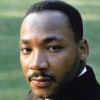
Communism reduces men to a cog in the wheel of the state. The communist may object, saying that in Marxian theory the state is an “interim reality” that will “wither away” when the classless society emerges. True — in theory; but it is also true that, while the state lasts, it is an end in itself. Man is a means to that end. He has no inalienable rights. His only rights are derived from, and conferred by, the state. Under such a system the fountain of freedom runs dry.
Martin Luther King, Jr. (1929–1968) American clergyman, civil rights leader, social activist, preacher
Where Do We Go from Here: Chaos or Community? (1967)
(Source)
There is no such thing as an achieved liberty; like electricity, there can be no substantial storage and it must be generated as it is enjoyed, or the lights go out.
Robert H. Jackson (1892–1954) US Supreme Court Justice (1941–54), lawyer, jurist, politician
“The Task of Maintaining Our Liberties: The Role of the Judiciary,” speech, Boston (24 Aug 1953)
(Source)
Dinner address at the American Bar Association Diamond Jubilee dinner. Reprinted in the American Bar Association Journal (Nov 1953) [citation 39 A.B.A. J. 961 (1953)].
The Bill of Rights is not a suicide pact.
Robert H. Jackson (1892–1954) US Supreme Court Justice (1941–54), lawyer, jurist, politician
Terminiello v. City of Chicago, 337 U.S. 37 (1949) [dissenting]
(Source)
Common paraphrase of Jackson's actual comment:This Court has gone far toward accepting the doctrine that civil liberty means the removal of all restraints from these crowds, and that all local attempts to maintain order are impairments of the liberty of the citizen. The choice is not between order and liberty. It is between liberty with order and anarchy without either. There is danger that, if the Court does not temper its doctrinaire logic with a little practical wisdom, it will convert the constitutional Bill of Rights into a suicide pact.
We know through painful experience that freedom is never voluntarily given by the oppressor; it must be demanded by the oppressed. Frankly, I have yet to engage in a direct action campaign that was “well timed” in the view of those who have not suffered unduly from the disease of segregation. For years now I have heard the word “Wait!” It rings in the ear of every Negro with piercing familiarity. This “Wait” has almost always meant “Never.” We must come to see, with one of our distinguished jurists, that “justice too long delayed is justice denied.”
When we lose the right to be different, we lose the privilege to be free.
Charles Evans Hughes, Sr. (1862–1948) American statesman, politician, Supreme Court Justice (1910–1916, 1930–1941)
Speech (1925-06-17), Battle of Bunker Hill 150th Anniversary, Faneuil Hall, Boston Massachusetts
(Source)
Sometimes misquoted, "... the right to be free."When we lose the right to be different, we lose the right to be free.
May it be to the world what I believe it will be, (to some parts sooner, to others later, but finally to all.) the Signal of arousing men to burst the chains, under which Monkish ignorance and superstition had persuaded them to bind themselves, and to assume the blessings & security of self government. The form which we have substituted restores the free right to the unbounded exercise of reason and freedom of opinion. All eyes are opened, or opening to the rights of man. The general spread of the light of science has already laid open to every view the palpable truth that the mass of mankind has not been born, with saddles on their backs, nor a favored few booted and spurred, ready to ride them legitimately, by the grace of god. These are grounds of hope for others.
Thomas Jefferson (1743–1826) American political philosopher, polymath, statesman, US President (1801–09)
Letter (1826-06-24) to Roger Chew Weightman
(Source)
The last letter he wrote.
The good citizen will demand liberty for himself, and as a matter of pride he will see to it that others receive the liberty which he thus claims as his own. Probably the best test of true love of liberty in any country is the way in which minorities are treated in that country.
Theodore Roosevelt (1858–1919) American politician, statesman, conservationist, writer; US President (1901–09)
Speech (1910-04-23), “Citizenship in a Republic [The Man in the Arena],” Sorbonne, Paris
(Source)
Twenty years from now you will be more disappointed by the things that you didn’t do than by the ones you did do. So throw off the bowlines. Sail away from the safe harbor. Catch the trade winds in your sails. Explore. Dream. Discover.
Mark Twain (1835–1910) American writer [pseud. of Samuel Clemens]
(Spurious)
A common "inspirational" quote, frequently attributed to Twain, but not found in writings. Earliest found is in H. Jackson Brown, P.S. I Love You (1990), attributed to Brown's mother. More info here.
How is it that we hear the loudest yelps for liberty among the drivers of negroes?
Samuel Johnson (1709–1784) English writer, lexicographer, critic
Essay (1775), “Taxation No Tyranny”
(Source)
On American (especially Virginian) demands for Independence.
I conceive of God, in fact, as a means of liberation and not a means to control others.
James Baldwin (1924–1987) American novelist, playwright, activist
“In Search of a Majority,” Speech, Kalamazoo College (Feb 1960)
Must a government, of necessity, be too strong for the liberties of its own people, or too weak to maintain its own existence?
Abraham Lincoln (1809–1865) American lawyer, politician, US President (1861–65)
Message (1861-07-04) to Congress, Special Message, Washington, D. C.
(Source)
Lincoln's Special Message to Congress was to discuss the Civil War that had broken out, its origins, and how it represented this fundamental question about representative government.
Lincoln repeated this phrasing at the beginning of his speech (1864-11-10) responding to serenaders celebrating his re-election.Franklin Roosevelt quoted Lincoln during a pre-WW2 Jackson Day radio address (1941-03-29).
As for the Republicans — how can one regard seriously a frightened, greedy, nostalgic huddle of tradesmen and lucky idlers who shut their yes to history and science, steel their emotions against decent human sympathy, cling to sordid and provincial ideals exalting sheer acquisitiveness and condoning artificial hardship for the non-materially-shrewd, dwell smugly and sentimentally in a distorted dream-cosmos of outmoded phrases and principles and attitudes based on the bygone agricultural-handicraft world, and revel in (consciously or unconsciously ) mendacious assumptions (such as the notion that real liberty is synonymous with the single detail of unrestricted economic license, or that a rational planning of resource-distribution would contravene some vague and mystical “American heritage” — economic oversight, price-fixing, “government in business”, etc. recur often in American colonial history) utterly contrary to fact and without the slightest foundation in human experience? Intellectually, the Republican idea deserves the tolerance and respect one gives to the dead.
H. P. Lovecraft (1890–1937) American fabulist [Howard Phillips Lovecraft]
Letter (1936-08) to Catherine L. Moore
(Source)
If a man has a genuine, sincere, hearty wish to get rid of his liberty, if he is really bent upon becoming a slave, nothing can stop him. And the temptation is to some natures a very great one.
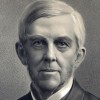
Goethe says that, if you plant an oak in a flower-vase, either the oak must wither or the vase crack; some men go for saving the vase. Too many nowadays have that anxiety; the Puritans would have let it crack. So say I. If there is anything that cannot bear free thought, let it crack.
Wendell Phillips (1811–1884) American abolitionist, orator, social activist
Speech, Pilgrim Society, Plymouth (21 Dec 1855)
(Source)
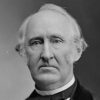
Fetters of Gold are still Fetters; and silken Cords pinch.
Thomas Fuller (1654–1734) English physician, preacher, aphorist, writer
Gnomologia: Adages and Proverbs (compiler), # 1522 (1732)
(Source)
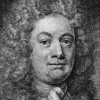
The only freedom which deserves the name, is that of pursuing our own good in our own way, so long as we do not attempt to deprive others of theirs, or impede their efforts to obtain it. Each is the proper guardian of his own health, whether bodily, or mental and spiritual. Mankind are greater gainers by suffering each other to live as seems good to themselves, than by compelling each to live as seems good to the rest.
John Stuart Mill (1806–1873) English philosopher and economist
On Liberty, ch. 1 “Introductory” (1859)
(Source)
The individual is not accountable to society for his actions in so far as these concern the interests of no person but himself. Advice, instruction, persuasion, and avoidance by other people, if thought necessary by them for their own good, are the only measures by which society can justifiably express its dislike or disapprobation of his conduct.
John Stuart Mill (1806–1873) English philosopher and economist
On Liberty, ch. 5 “Applications” (1859)
(Source)
When opinions are free, either in matters of government or religion, truth will finally and powerfully prevail.
Thomas Paine (1737–1809) American political philosopher and writer
The Age of Reason, Closing Words (1796)
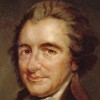
If there is any principle of the Constitution that more imperatively calls for attachment than any other, it is the principle of free thought — not free thought for those who agree with us but freedom for the thought that we hate.
Oliver Wendell Holmes, Jr. (1841–1935) American jurist, Supreme Court Justice
United States v. Schwimmer, 279 U.S. 644 (1929) [Dissent]
(Source)
When people are free to do as we please, they usually imitate each other.
Eric Hoffer (1902–1983) American writer, philosopher, longshoreman
Passionate State of Mind, Aphorism 33 (1955)
(Source)
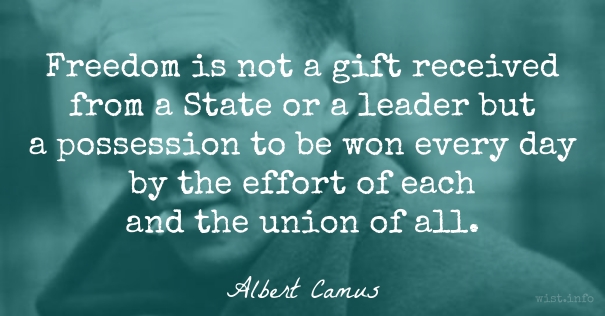
Freedom is not a gift received from a State or a leader but a possession to be won every day by the effort of each and the union of all.
Albert Camus (1913–1960) Algerian-French novelist, essayist, playwright
“Bread and Freedom” (1957), Resistance, Rebellion, and Death [tr. O’Brien (1961)]
You measure democracy by the freedom it gives its dissidents, not the freedom it gives its assimilated conformists.
Abbie Hoffman (1936–1989) American political activist
In Benny Avni, “An Interview with Abbie Hoffman” (1986), Tikkun (Jul-Aug 1989)
(Source)
Strive to be patient; bear with the faults and frailties of others, for you, too, have many faults which others have to bear. If you cannot mould yourself as you would wish, how can you expect other people to be entirely to your liking?
[Stude patiens esse in tolerando aliorum defectus, et qualescumque infirmitates, quia et tu multa habes, quæ ab aliis oportet tolerari. Si non potes te talem facere qualem vis, quomodo poteris alium habere ad beneplacitum tuum?]
Thomas à Kempis (c. 1380–1471) German-Dutch priest, author
The Imitation of Christ [De Imitatione Christi], Book 1, ch. 16, v. 2 (1.16.2) (c. 1418-27) [tr. Sherley-Price (1952)]
(Source)
(Source (Latin)). Other translations:Study always that thou mayest be patient in suffering of other men’s defaults, for thou hast many things in thee that others do suffer of thee: and if thou canst not make thyself to be as thou wouldst, how mayest thou then look to have another to be ordered in all things after thy will?
[tr. Whitford/Raynal (1530/1871)]Study always to be patient in bearing other men's defects, for you have many in yourself that others suffer from you, and if you cannot make yourself be as you would, how may you then look to have another regulated in all things to suit your will?
[tr. Whitford/Gardiner (1530/1955)]Endeavour thy selfe patiently to bear with any faults and infirmities of others, for that thou thy selfe hast many things that must be borne withall by others. If thou canst not make thy selfe such a one as thou wouldst be, how canst thou expect to have another to thy liking in all things?
[tr. Page (1639), 1.16.6-7]Remember, that You also have many Failings of your own, by which the Patience of other People will have its turn of being exercised. And if you do (as certainly you cannot but) see this, think how unreasonable it is, to expect you should make others in all particulars, what you would have them to be; when you cannot so much as make your self, what you are sensible you ought to be.
[tr. Stanhope (1696; 1706 ed.)]Endeavor, to be always patient of the faults and imperfections of others; for thou haft many faults and imperfections of thy own, that require a reciprocation of forbearance. If thou art not able to make thyself that which thou wishest to be, how canst thou expect to mould another in conformity to thy will?
[tr. Payne (1803), 1.16.3]Endeavour to be patient in bearing with the defects and infirmities of others, of what sort soever they be; for that thyself also hast many [failings] which must be borne with by others. If thou canst not make thyself such an one as thou wouldest, how canst thou expect to have another in all things to thy liking?
[ed. Parker (1841)]Endeavour to be always patient of the faults and imperfections of others, whatever they may be; for thou hast many faults and imperfection of thy own, that require forbearance from others. If thou art not able to make thyself that which thou wishest to be, how canst thou expect to mould another in conformity to thy will?
[tr. Dibdin (1851)]Endeavour to be patient in bearing with defects and infirmities in others, of what kind soever; because thou also hast many things which others must bear with. If thou canst not make thyself such as thou wouldst, how canst thou expect to have another according to thy liking?
[ed. Bagster (1860)]Endeavour to be patient in bearing with other men’s faults and infirmities whatsoever they be, for thou thyself also hast many things which have need to be borne with by others. If thou canst not make thine own self what thou desireth, how shalt thou be able to fashion another to thine own liking.
[tr. Benham (1874)]Endeavour to be patient in bearing with the defects and infirmities of others, of what sort soever they be; for that thyself also hast many failings which must be borne with by others. If thou canst not make thyself such an one as thou wouldst, how canst thou expect to have another in all things to thy liking?
[tr. Anon. (1901)]Try to bear patiently with the defects and infirmities of others, whatever they may be, because you also have many a fault which others must endure. If you cannot make yourself what you would wish to be, how can you bend others to your will?
[tr. Croft/Bolton (1940)]Try to be patient in bearing with others’ failings and all kinds of weaknesses, for you too have many which must be put up with by others. If you cannot mould yourself exactly as you would, how can you get another to be satisfying to you?
[tr. Daplyn (1952)]Yes, you do well to cultivate patience in putting up with the shortcomings, the various disabilities of other people; only think how much they have to put up with in you! When you make such a failure of organizing your own life, how can you expect everybody else to come up to your own standards?
[tr. Knox-Oakley (1959)]Try to be patient in bearing with the failings and weaknesses of other people, whatever they may be. You too have many faults, which others have to endure. If you cannot make yourself the kind of person you wish, how can you expect to have someone else to your liking?
[tr. Knott (1962)]Seek always to be tolerant of the shortcomings and failings of others. They also have much to tolerate in you. If you are unable to mould yourself as you wish, how can you expect others to conform to your liking?
[tr. Rooney (1979)]Take pains to be patient in bearing all the faults and weaknesses of others, for you too have many flaws that others must put up with. If you cannot make yourself as you would like to be, how can you expect to have another person entirely to your liking?
[tr. Creasy (1989)]

They who clamor loudest for freedom are often the ones least likely to be happy in a free society. The frustrated, oppressed by their shortcomings, blame their failure on existing restraints. Actually, their innermost desire is for an end to the “free for all.” They want to eliminate free competition and the ruthless testing to which the individual is continually subjected in a free society.
Eric Hoffer (1902–1983) American writer, philosopher, longshoreman
True Believer: Thoughts on the Nature of Mass Movements, Part 2, ch. 5, § 28 (2.5.28) (1951)
(Source)
I am unalterably opposed to communism because it exalts the state over the individual and the family, and because of the lack of freedom of speech, of protest, of religion, and of the press, which is the characteristic of totalitarian states. The way of opposition to communism is not to imitate its dictatorship, but to enlarge individual freedom, in our own countries and all over the globe. There are those in every land who would label as Communist every threat to their privilege. But as I have seen on my travels in all sections of the world, reform is not communism. And the denial of freedom, in whatever name, only strengthens the very communism it claims to oppose.
Robert Francis Kennedy (1925–1968) American politician
“Day of Affirmation,” address, University of Capetown, South Africa (6 Jun 1966)
(Source)
Unless a man has talents to make something of himself, freedom is an irksome burden. Of what avail is freedom to choose if the self be ineffectual? We join a mass movement to escape individual responsibility, or, in the words of the ardent young Nazi, “to be free from freedom.” It was not sheer hypocrisy when the rank-and-file Nazis declared themselves not guilty of all the enormities they had committed. They considered themselves cheated and maligned when made to shoulder responsibility for obeying orders. Had they not joined the Nazi movement in order to be free from responsibility?
Eric Hoffer (1902–1983) American writer, philosopher, longshoreman
True Believer: Thoughts on the Nature of Mass Movements, Part 2, ch. 5, § 26 (1951)
Progress generally begins in skepticism about accepted truths. Intellectual freedom means the right to reexamine much that has been long taken for granted. A free man must be a reasoning man, and he must dare to doubt what a legislative or electoral majority may most passionately assert. The danger that citizens will think wrongly is serious, but less dangerous than atrophy from not thinking at all.
Robert H. Jackson (1892–1954) US Supreme Court Justice (1941–54), lawyer, jurist, politician
American Communications Assn. v. Douds, 339 U.S. 382, 442 (1950) [concurrence and dissent]
(Source)
Freedom is not an ideal, it is not even a protection, if it means nothing more than freedom to stagnate, to live without dreams, to have no greater aim than a second car and another television set — and this in a world where half our fellow men have less than enough to eat.
Adlai Stevenson II (1900–1965) American politician, diplomat, statesman
“Putting First Things First”, Foreign Affairs (1960-01)
(Source)
Unreason and anti-intellectualism abominate thought. Thinking implies disagreement; and disagreement implies nonconformity; and nonconformity implies heresy; and heresy implies disloyalty — so, obviously, thinking must be stopped. But shouting is not a substitute for thinking and reason is not the subversion but the salvation of freedom.
Adlai Stevenson II (1900–1965) American politician, diplomat, statesman
Call to Greatness, ch. 3 “America’s Burden” (1954)
(Source)
Adapted from his "A Troubled World," Godkin Lectures, Harvard University (1954-03-17 - 1954-03-20)
The show in general we feel like is a privilege. Even the idea that we can sit in the back of the country and make wise cracks … which is really what we do. We sit in the back and throw spitballs — but never forgetting that it is a luxury in this country that allows us to do that. That is, a country that allows for open satire, and I know that sounds basic and it sounds like it goes without saying. But that’s really what this whole situation is about. It’s the difference between closed and open. The difference between free and … burdened. And we don’t take that for granted here, by any stretch of the imagination.
Jon Stewart (b. 1962) American satirist, comedian, and television host. [b. Jonathan Stuart Leibowitz]
The Daily Show (2001-09-20)
(Source)

If we value the pursuit of knowledge, we must be free to follow wherever that search may lead us. The free mind is not a barking dog, to be tethered on a ten-foot chain. It must be unrestricted in the play of its inquiry. If we insist on conclusions before the search is over, we are committed to playing the game of the mind with marked cards.
Adlai Stevenson II (1900–1965) American politician, diplomat, statesman
Speech (1952-10-08), “The Area of Freedom,” University of Wisconsin, Madison
(Source)
I will not attack your doctrines nor your creeds if they accord liberty to me. If they hold thought to be dangerous — if they aver that doubt is a crime, then I attack them one and all, because they enslave the minds of men.
Robert Green Ingersoll (1833–1899) American lawyer, freethinker, orator
“The Ghosts” (1877)
(Source)
My own belief is no rule for another.
John Wesley (1703–1791) English cleric, Christian theologian and evangelist, founder of Methodism
Sermon #39, “Catholic Spirit,” 1.11
(Source)
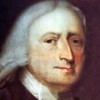
It matters not how strait the gate,
How charged with punishments the scroll,
I am the master of my fate:
I am the captain of my soul.
William Ernest Henley (1849–1903) English poet, critic, editor
“Invictus” (1875)

A hungry man is not a free man.
Adlai Stevenson II (1900–1965) American politician, diplomat, statesman
Speech (1952-09-06), “Farm Policy,” National Plowing Contest, Kasson, Minnesota
(Source)
The whole notion of loyalty inquisitions is a natural characteristic of the police state, not of democracy. Knowing his rule rests upon compulsion rather than consent, the dictator must always assume the disloyalty, not for a few but of many, and guard against it by continual inquisition and liquidation of the unreliable. The history of Soviet Russia is a modern example of this ancient practice.
The democratic state, on the other hand, is based on the consent of its members. The vast majority of our people are intensely loyal, as they have amply demonstrated. To question, even by implication, the loyalty and devotion of a large group of citizens is to create an atmosphere of suspicion and distrust which is neither justified, healthy, nor consistent with our traditions. […] I must, in good conscience, protest against any unnecessary suppression of our ancient rights of free men. Moreover, we will win the contest of ideas that afflicts the world not by suppressing those rights, but by their triumph. We must not burn down the house to kill the rats.Adlai Stevenson II (1900–1965) American politician, diplomat, statesman
Message (1951-06-26), Veto of Illinois State Senate Bill 102
(Source)
The Broyles Bill would have required all public workers, teachers, and officials, as well as candidates for office to sign loyalty oaths. Its veto by Stevenson, as Illinois Governor, was widely used by his political enemies during the Red Scare of the era.
This quote is widely misidentified as a more generic comment condemning the federal McCarran Internal Security Act of 1950. I've been unable to find any primary source connecting this quotation to that event.
This passage is often elided and paraphrased down, e.g.:The whole notion of loyalty inquisitions is a national characteristic of the police state, not of democracy. I must, in good conscience, protest against any unnecessary suppression of our rights as free men. We must not burn down the house to kill the rats.
We here highly resolve that these dead shall not have died in vain — that this nation, under God, shall have a new birth of freedom — and that government of the people, by the people, for the people, shall not vanish from this earth.
Abraham Lincoln (1809–1865) American lawyer, politician, US President (1861–65)
Speech (1863-11-19), “Dedication of the National Cemetery at Gettysburg [Gettysburg Address],” Pennsylvania
(Source)
Closing words of the speech.
HECUBA: Then no man on earth is truly free,
All are slaves of money or necessity.
Public opinion or fear of prosecution
forces each one, against his conscience,
to conform.ἙΚΆΒΗ:[φεῦ.
οὐκ ἔστι θνητῶν ὅστις ἔστ’ ἐλεύθερος·
ἢ χρημάτων γὰρ δοῦλός ἐστιν ἢ τύχης
ἢ πλῆθος αὐτὸν πόλεος ἢ νόμων γραφαὶ
εἴργουσι χρῆσθαι μὴ κατὰ γνώμην τρόποις.]Euripides (485?-406? BC) Greek tragic dramatist
Hecuba [Hekabe; Ἑκάβη], l. 864ff (c. 424 BC) [tr. Arrowsmith (1958)]
(Source)
When Agamemnon claims he cannot help her get revenge, as much as he'd like to if he were free to assist, because he has to pay attention to the sentiments of the Greek army.
(Source (Greek)). Other translations:Alas! there's no man free: for some are slaves
To gold, to fortune others, and the rest,
The multitude or written laws restrain
From acting as their better judgement dictates.
[tr. Wodhull (1809)]Alas! no mortal is there who is free. For either he is the slave of money or of fortune; or the populace of the city or the dictates of the law constrain him to adopt manners not accordant with his natural inclinations.
[tr. Edwards (1826)]Vain is the boast of liberty in man;
A slave to fortune, or a slave to wealth,
Or by the people or the laws restrain’d,
He dares not act the dictates of his will
[ed. Ramage (1864)]Ah, among mortals is there no man free!
To lucre or to fortune is he slave:
The city's rabble or the laws' impeachment
Constrains him into paths his soul abhors.
[tr. Way (Loeb) (1894)]Ah! there is not in the world a single man free; for he is a slave either to money or to fortune, or else the people in their thousands or the fear of public prosecution prevents him from following the dictates of his heart.
[tr. Coleridge (1938)]Show me the mortal man who's really free.
He's either a slave to money or to chance.
Or the pressure of the mob or legal code
curbs him from acting as his will dictates.
[tr. Harrison (2005)]Ah! But there’s no such thing as a free man! All men are slaves, Agamemnon! Slaves to money, to Fate, to the cries of the masses, to the written laws! They all stop him from doing what he wants.
[tr. Theodoridis (2007)]Then no one is free
in this world. He’s chained to money, or to luck, or to majority
opinion, or to law. Any way you look at it,
he’s still a slave.
[tr. Karden/Street (2011)]Alas!
there is not in the world a single man who is free;
for he is a slave either to money or to fortune,
or else the mob, or fear of law, prevents him
from following the dictates of his heart.
[ed. Yeroulanos (2016)]There is no mortal who is free. Either he is a slave to money or fortune, or the city’s mob or its laws make him live otherwise than he would wish.
[tr. @sentantiq (2016)]Ha!
No one who is mortal is free --
We are either the slave of money or chance;
Or the majority of people or the city’s laws
Keep us from living by our own judgment.
[tr. @sentantiq (2020)]
You ask, What makes it worth defending? and the only answer I can give is this: Freedom to write, freedom to read, freedom to own material that you believe is worth defending means you’re going to have to stand up for stuff you don’t believe is worth defending, even stuff you find actively distasteful, because laws are big blunt instruments that do not differentiate between what you like and what you don’t, because prosecutors are humans and bear grudges and fight for re-election, because one person’s obscenity is another person’s art. Because if you don’t stand up for the stuff you don’t like, when they come for the stuff you do like, you’ve already lost.
Neil Gaiman (b. 1960) British author, screenwriter, fabulist
Blog entry (2008-12-01), “Why defend freedom of icky speech?”
(Source)

And his hands would plait the priest’s entrails,
For want of a rope, to strangle kings.[Et ses mains ourdiraient les entrailles du prêtre,
Au défaut d’un cordon pour étrangler les rois.]Denis Diderot (1713–1784) French editor, philosopher
Poem (1772), “Les Éleuthéromanes”
(Source)
The work is also sometimes referred to as "Dithrambe sur fête de rois."
(Source (French)). Other translations:And his hands would plait a priest's entrails;
In lieu of a rope for strangling kings.
[Source]His hands would plait the priest’s guts,
if he had no rope, to strangle kings.
[E.g.]
Jean-François de La Harpe, Lycée, ou Cours de Littérature Ancienne et Moderne (1822), attributes this variant to Diderot as the "crowning touch" of his philosophy:With the guts of the last priest,
Let us strangle the last king
[Et des boyaux du dernier prêtre
Serrons le cou du dernier roi.]
Alternately:And [with] the guts of the last priest
Let's shake the neck of the last king.
[E.g.]
This phrasing of Diderot's is most likely derived from a passage by Jean Meslier (c. 1664–1733), a French priest. In his Testament [Common Sense], Vol. 1, ch. 2 [ed. Charles (1864)], he told (and approved) of an "ignorant, uneducated man" who said (English, French):He said he wished [...] that all the great men in the world and all the nobility could be hanged, and strangled with the guts of priests.
[Il souhaitoit [...] que tous les grands de la terre et que tous les nobles fussent pendus et étranglés avec les boïaux des prêtres.]
Other translations of Meslier:His wish was that all the rulers of the earth and all the nobles be hanged and strangled with the guts of priests.
[tr. Shreve (2009)]
Bill Brown, the 2007 translator of Veneigem's The Resistance to Christianity (1993), noted that Voltaire, who edited an early edition of Meslier's Testament, rewrote the passage to provide another French variant (with Brown's English translation):I would like, and this would be the last and most ardent of my wishes, I would like it that the last king was strangled with the guts of the last priest.
[Je voudrais, et ce sera le dernier et le plus ardent de mes souhaits, je voudrais que le dernier des rois fût etranglé avec les boyaux du dernier prêtre.]
Other variants, in general:
- "Men will never be free until the last king is strangled with the entrails of the last priest."
- "Humanity will only be happy when the last priest has been hung with the guts of the last prince."
No government has the right to decide on the truth of scientific principles, nor to prescribe in any way the character of the questions investigated. Neither may a government determine the aesthetic value of artistic creations, nor limit the forms of literacy or artistic expression. Nor should it pronounce on the validity of economic, historic, religious, or philosophical doctrines. Instead it has a duty to its citizens to maintain the freedom, to let those citizens contribute to the further adventure and the development of the human race.
Richard Feynman (1918–1988) American physicist
The Meaning of It All, “The Uncertainty of Values” (1999)
(Source)
It is high time that we stopped thinking politically as Republicans and Democrats about elections and started thinking patriotically as Americans about national security based on individual freedom. It is high time that we all stopped being tools and victims of totalitarian techniques — techniques that, if continued here unchecked, will surely end what we have come to cherish as the American Way of Life.
Margaret Chase Smith (1897–1965) American politician (US Senator, Maine)
“Declaration of Conscience,” Congressional Record, vol. 96, 81st Congress, 2d. sess. (1 Jun 1950)
(Source)

If ye love wealth better than liberty, the tranquility of servitude than the animated contest of freedom — go home from us in peace. We ask not your counsels or arms. Crouch down and lick the hands which feed you. May your chains sit lightly upon you, and may posterity forget that you were our countrymen!
Samuel Adams (1722–1803) American revolutionary, statesman
Speech, State House, Philadelphia (1776-08-01)
(Source)
Let the human Mind loose. It must be loose; it will be loose. Superstition and Despotism cannot confine it.
John Adams (1735–1826) American lawyer, Founding Father, statesman, US President (1797–1801)
Letter (1816-11-13) to John Quincy Adams
(Source)
We must not conclude merely upon a man’s haranguing upon liberty, and using the charming sound, that he is fit to be trusted with the liberties of his country. It is not unfrequent to hear men declaim loudly upon liberty, who, if we may judge by the whole tenor of their actions, mean nothing else by it but their own liberty, — to oppress without control or the restraint of laws all who are poorer or weaker than themselves.
Obsta principiis, nip the shoots of arbitrary power in the bud, is the only maxim which can ever preserve the liberties of any people. When the people give way, their deceivers, betrayers, and destroyers press upon them so fast, that there is no resisting afterwards.
John Adams (1735–1826) American lawyer, Founding Father, statesman, US President (1797–1801)
Essay (1775-02-06), “Novanglus,” No. 3, Boston Gazette
(Source)
The Latin means to resist the first approaches or encroachments of a problem.
This series of essays was written by Adams under the pseudonym of "Novanglus" (Latin for "New England") responding to essays from his past friend Daniel Leonard as "Massachusettensis" on colonial leadership and what the proper relationship was between the American colonies and Britain.
Cities may be rebuilt, and a People reduced to Poverty, may acquire fresh Property: But a Constitution of Government once changed from Freedom, can never be restored. Liberty once lost is lost forever. When the People once surrender their share in the Legislature, and their Right of defending the Limitations upon the Government, and of resisting every Encroachment upon them, they can never regain it.
John Adams (1735–1826) American lawyer, Founding Father, statesman, US President (1797–1801)
Letter (1775-07-07) to Abigail Adams
(Source)
On standing up to the British after the burning of Charleston, South Carolina.
Will we ever learn to use reason instead of force in the world, and will people ever be wise enough to refuse to follow bad leaders or to take away the freedom of other people?
Eleanor Roosevelt (1884–1962) American politician, diplomat, activist; First Lady of the US (1933–45)
Column (1939-10-16), “My Day”
(Source)

Power is so apt to be insolent and Liberty to be saucy, that they are very seldom upon good Terms.
George Savile, Marquis of Halifax (1633–1695) English politician and essayist
“Of Prerogative, Power and Liberty,” Political, Moral, and Miscellaneous Thoughts and Reflections (1750)
(Source)
There is Danger from all Men. The only Maxim of a free Government, ought to be to trust no Man living, with Power to endanger the public Liberty.
John Adams (1735–1826) American lawyer, Founding Father, statesman, US President (1797–1801)
Diary (1772, Spring), “Notes for a Oration Braintree”
(Source)
Therefore the good man, although he is a slave, is free; but the bad man, even if he reigns, is a slave, and that not of one man, but, what is far more grievous, of as many masters as he has vices.
[Proinde bonus etiamsi seruiat, liber est; malus autem etiamsi regnet, seruus est, nec unius hominis, sed, quod est grauius, tot dominorum, quot uitiorum.]
Augustine of Hippo (354–430) Christian church father, philosopher, saint [b. Aurelius Augustinus]
City of God [De Civitate Dei], Book 4, ch. 3 (4.3) (AD 412-416) [ed. Dods (1871)]
(Source)
See 2 Peter 2:19 "For people are slaves to whatever masters them." The idea of being a slave to vices was also a Stoic belief. Compare to La Bruyere.
(Source (Latin)). Other translations:And therefore he that is good is free though he be a slave, and he that is evil, a slave though he be a king. Nor is he slave to one man, but that which is worst of all, unto as many masters as he affects vices.
[tr. Healey (1610)]Thus, a good man, though a slave, is free; but a wicked man, though a king, is a slave. For he serves, not one man alone, but, what is worse, as many masters as he as vices.
[tr. Zema/Walsh (1950)]Hence even if a good man be a slave, he is free; whereas if a wicked man rule, he is a slave -- and a slave not to one man but, what is worse, to as many masters as he has vices.
[tr. Green (Loeb) (1963)]The good man, though a slave, is free; the wicked, though he reigns, is a slave, and not the slave of a single man, but -- what is far worse -- the slave of as many masters as he has vices.
[tr. Bettenson (1972)]Therefore the good man is free even if he is a slave, whereas the bad man is a slave even if he reigns: a slave, not to one man, but, what is worse, to as many masters as he has vices.
[tr. Dyson (1998)]Thus the good person is free, even if a slave, and the evil person is enslaved, even if a ruler -- enslaved not to one master but, what is far worse, to as many masters as he has vices.
[tr. Babcock (2012)]

It is not only in war, however, that we fight for freedom. One fights for freedom in personal contacts and in many phases of civilian life. When the war is over, the four freedoms will not have been won, we shall simply have dominated their more aggressive enemies. At all times, day by day, we have to continue fighting for freedom of religion, freedom of speech, freedom from fear, and freedom from want — for these are things that must be gained in peace as well as in war. At all times, day by day, we have to continue fighting for freedom of religion, freedom of speech, and freedom from want — for these are things that must be gained in peace as well as in war.
Eleanor Roosevelt (1884–1962) American politician, diplomat, activist; First Lady of the US (1933–45)
Column (1943-04-15), “My Day”
(Source)
There is only one cure for the evils which newly acquired freedom produces — and that cure is freedom!
Thomas Babington Macaulay (1800–1859) English writer and politician
“John Milton,” Edinburgh Review (Aug 1825)
(Source)
Review of John Milton, A Treatise on Christian Doctrine.
Why should my freedom be governed by somebody else’s conscience?
[ἱνατί γὰρ ἡ ἐλευθερία μου κρίνεται ὑπὸ ἄλλης συνειδήσεως]
The Bible (The New Testament) (AD 1st - 2nd C) Christian sacred scripture
Book 7. 1st Letter to the Corinthians 10:29 (1 Cor 10:29) [NJB (1985)]
(Source)
Paul on how it's okay to eat food that others think is religiously wrong to eat (but how you shouldn't be a dick about it, either).
(Source (Greek)). Other translations:For why is my liberty judged of another man's conscience?
[KJV (1611)]Why should my freedom depend on somebody else’s conscience?
[JB (1966)]“Well, then,” someone asks, “why should my freedom to act be limited by another person's conscience?"
[GNT (1976)]Why should my freedom be judged by someone else’s conscience?
[CEB (2011)]For why should my liberty be subject to the judgment of someone else’s conscience?
[NRSV (2021 ed.)]

The first principle of a free society is an untrammeled flow of words in an open forum.
Adlai Stevenson II (1900–1965) American politician, diplomat, statesman
Speech (1961-01-18), US Senate Committee on Foreign Relations, Washington, DC
(Source)
Statement given by Stevenson after his nomination by President-elect Kennedy to be ambassador to the United Nation, which office he held until his death in 1965. The speech (or this passage) is often cited to the New York Times coverage of it the following day, though often mistakenly dating it in 1962.
In context, he is addressing criticisms of the UN as a "debating society," noting that the US Congress often serves as such, from which he extends this principle.
You cannot change the conclusion of the brain by torture; nor by social ostracism. But I will tell you what you can do by these, and what you have done. You can make hypocrites by the million. You can make a man say that he has changed his mind; but he remains of the same opinion still. Put fetters all over him; crush his feet in iron boots; stretch him to the last gasp upon the holy rack; burn him, if you please, but his ashes will be of the same opinion still.
Robert Green Ingersoll (1833–1899) American lawyer, freethinker, orator
“The Liberty of Man, Woman, and Child” (1877)
(Source)
There is only one success … to be able to spend your life in your own way, and not to give others absurd maddening claims upon it.
Christopher Morley (1890–1957) American journalist, novelist, essayist, poet
Where the Blue Begins, ch. 8 (1922)
It is clear that the most elementary condition, if thought is to be free, is the absence of legal penalties for the expression of opinions. No great country has yet reached to this level, although most of them think they have. The opinions which are still persecuted strike the majority as so monstrous and immoral that the general principle of toleration can not be held to apply to them. But this is exactly the same view as that which made possible the tortures of the Inquisition. There was a time when Protestantism seemed as wicked as Bolshevism seems now.
Bertrand Russell (1872–1970) English mathematician and philosopher
“Free Thought and Official Propaganda,” lecture, South Place Institute, London (1922-03-24)
(Source)
Manhood begins when we have in any way made truce with Necessity; begins even when we have surrendered to Necessity, as the most part only do; but begins joyfully and hopefully only when we have reconciled ourselves to Necessity; and thus, in reality, triumphed over it, and felt that in Necessity we are free.
Thomas Carlyle (1795–1881) Scottish essayist and historian
“Burns,” Edinburgh Review No. 96, Art. 1 (1828-12)
(Source)
A review of Lockhart, The Life of Robert Burns (1828).
What constitutes the bulwark of our own liberty and independence? It is not our frowning battlements, our bristling sea coasts, the guns of our war steamers, or the strength of our gallant and disciplined army. These are not our reliance against a resumption of tyranny in our fair land. All of them may be turned against our liberties, without making us stronger or weaker for the struggle. Our reliance is in the love of liberty which God has planted in our bosoms. Our defense is in the preservation of the spirit which prizes liberty as the heritage of all men, in all lands, every where. Destroy this spirit, and you have planted the seeds of despotism around your own doors.
Abraham Lincoln (1809–1865) American lawyer, politician, US President (1861–65)
Speech (1858-09-11), Edwardsville, Illinois
(Source)
As reported in the Alton Weekly Courier (1858-09-16).
And what is this liberty which must lie in the hearts of men and women? It is not the ruthless, the unbridled will; it is not freedom to do as one likes. That is the denial of liberty, and leads straight to its overthrow. A society in which men recognize no check upon their freedom soon becomes a society where freedom is the possession of only a savage few; as we have learned to our sorrow.
Learned Hand (1872–1961) American jurist
“The Spirit of Liberty,” speech, “I Am an American Day,” New York (1941-05-21)
(Source)
Those of us who shout the loudest about Americanism in making character assassinations are all too frequently those who, by our own words and acts, ignore some of the basic principles of Americanism:
The right to criticize.
The right to hold unpopular beliefs.
The right to protest.
The right of independent thought.The exercise of these rights should not cost one single American citizen his reputation or his right to a livelihood, nor should he be in danger of losing his reputation or livelihood merely because he happens to know someone who holds unpopular beliefs. Who of us doesn’t? Otherwise none of us could call our souls our own. Otherwise thought control would have set in.
Margaret Chase Smith (1897–1965) American politician (US Senator, Maine)
“Declaration of Conscience” (1950-06-01)
(Source)
Speech given in the US Senate.
Those who expect to reap the blessings of freedom, must, like men, undergo the fatigues of supporting it.
Thomas Paine (1737–1809) American political philosopher and writer
“The American Crisis” #4 (12 Sep 1777)
(Source)
If the fires of freedom and civil liberties burn low in other lands, they must be made brighter in our own.
If in other lands the press and books and literature of all kinds are censored, we must redouble our efforts here to keep them free.
If in other lands the eternal truths of the past are threatened by intolerance we must provide a safe place for their perpetuation.Franklin Delano Roosevelt (1882–1945) American lawyer, politician, statesman; US President (1933–45)
Speech (1938-06-30), National Education Association, World’s Fair, New York City
(Source)
This is a world of compensation; and he who would be no slave must consent to have no slave. Those who deny freedom to others deserve it not for themselves, and, under a just God, cannot long retain it.
Abraham Lincoln (1809–1865) American lawyer, politician, US President (1861–65)
Letter (1859-04-06) to Henry L. Pierce, et al.
(Source)
The letter is quoted in Charles Sumner's Eulogy to Lincoln, printed in the City of Boston''s A Memorial of Abraham Lincoln, Late President of the United States (1865).
The letter was in response to an invitation from Boston for the celebration of Thomas Jefferson's birthday. Lincoln praised Jefferson, and warned against those who would "overthrow" the principles of freedom Jefferson wrote of so eloquently. Lincoln apparently saw no irony in this passage, even given Jefferson being a slave-holder.
I know a number of highly sensitive and intelligent people in my own communion who consider as a heresy my faith that God’s loving concern for his creation will outlast all our willfulness and pride. No matter how many eons it takes, he will not rest until all of creation, including Satan, is reconciled to him, until there is no creature who cannot return his look of love with a joyful response of love […] Some people feel it to be heresy because it appears to deny man his freedom to refuse to love God. But this, it seems to me, denies God his freedom to go on loving us beyond all our willfulness and pride. If the Word of God is the light of the world, and this light cannot be put out, ultimately it will brighten all the dark corners of our hearts and we will be able to see, and seeing, will be given the grace to respond with love — and of our own free will.
Madeleine L'Engle (1918–2007) American writer
The Irrational Season (1977)

We hold these truths to be sacred & undeniable; that all men are created equal & independant, that from that equal creation they derive rights inherent & inalienable, among which are the preservation of life, & liberty, & the pursuit of happiness; that to secure these ends, governments are instituted among men, deriving their just powers from the consent of the governed; that whenever any form of government shall become destructive of these ends, it is the right of the people to alter or to abolish it, & to institute new government, laying it’s foundation on such principles & organising it’s powers in such form, as to them shall seem most likely to effect their safety & happiness.
Thomas Jefferson (1743–1826) American political philosopher, polymath, statesman, US President (1801–09)
Document (1776-06), “Declaration of Independence” (original rough draft)
(Source)
Compare to the final version, as modified and adopted by the Continental Congress.
If we game players wanted to have an experience controlled by somebody else, we could rent a videotape. Gamewrights should try to empower us as players, not limit us unnecessarily. Someone at every game design company should have a fulltime job of saying, “Why aren’t we letting the player decide that?” […] When they let such unnecessary limitations creep into a game, gamewrights reveal that they don’t yet understand their own art. They’ve chosen to work with the most liberating of media — and yet they snatch back with their left hand the freedom they offered us with their right.
Remember, gamewrights, the power and beauty of the art of gamemaking is that you and the player collaborate to create the final story. Every freedom that you can give to the player is an artistic victory. And every needless boundary in your game should feel to you like failure.Orson Scott Card (b. 1951) American author
Essay (1991-03), “Games with No Limits,” Compute Magazine, No. 127
(Source)

The idea that any kind of free society can be constructed in which people will never be offended or insulted is absurd. So too is the notion that people should have the right to call on the law to defend them against being offended or insulted. A fundamental decision needs to be made: do we want to live in a free society or not? Democracy is not a tea party where people sit around making polite conversation. In democracies people get extremely upset with each other. They argue vehemently against each other’s positions. (But they don’t shoot.)
Salman Rushdie (b. 1947) Indian novelist
“Do we have to fight the battle for the Enlightenment all over again?” The Independent (22 Jan 2005)
(Source)

At Cambridge University I was taught a laudable method of argument: you never personalise, but you have absolutely no respect for people’s opinions. You are never rude to the person, but you can be savagely rude about what the person thinks. That seems to me a crucial distinction: people must be protected from discrimination by virtue of their race, but you cannot ring-fence their ideas. The moment you say that any idea system is sacred, whether it’s a religious belief system or a secular ideology, the moment you declare a set of ideas to be immune from criticism, satire, derision, or contempt, freedom of thought becomes impossible.
Salman Rushdie (b. 1947) Indian novelist
“Do we have to fight the battle for the Enlightenment all over again?” The Independent (22 Jan 2005)
(Source)
We who lived in concentration camps can remember the men who walked through the huts comforting others, giving away their last piece of bread. They may have been few in number, but they offer sufficient proof that everything can be taken away from a man but one thing: the last of the human freedoms — to choose one’s attitude in any given set of circumstances, to choose one’s own way.
Viktor Frankl (1905–1997) German-American psychologist, writer
Man’s Search for Meaning, Part 1 (1959)
(Source)
The rush and pressure of modern life are a form, perhaps the most common form, of its innate violence. To allow oneself to be carried away by a multitude of conflicting concerns, to surrender to too many demands, to commit oneself to too many projects, to want to help everyone in everything is to succumb to violence.
Thomas Merton (1915–1968) French-American religious and writer [a.k.a. Fr. M. Louis]
“Conjectures of a Guilty Bystander”

What is so advantageous to the people as liberty? which is sought out and preferred to everything, not only by men, but even by the beasts.
[Quid tam populare quam libertas? Quam non solum ab hominibus verum etiam a bestiis expeti atque omnibus rebus anteponi videtis.]
Marcus Tullius Cicero (106–43 BC) Roman orator, statesman, philosopher
De Lege Agraria [On the Agrarian Law], Oration 2 “Contra Rullum,” sec. 9 (63 BC) [tr. Yonge (1856)]
(Source)
(Source (Latin)). Another translation:What is so beneficial to the people as liberty, which we see not only to be greedily sought after by men, but also by beasts, and to be preferred to all things.
[Source (1884)]
Many politicians are in the habit of laying down as self-evident the proposition that no people ought to be free till they are fit to use their freedom. This maxim is worthy of the fool in the old story who resolved not to go into the water till he had learned to swim! If men are to wait for liberty till they become wise and good in slavery, they may indeed wait forever.
Thomas Babington Macaulay (1800–1859) English writer and politician
“John Milton,” Edinburgh Review (Aug 1825)
(Source)
As I would not be a slave, so I would not be a master. This expresses my idea of democracy. Whatever differs from this, to the extent of the difference, is no democracy.
Abraham Lincoln (1809–1865) American lawyer, politician, US President (1861–65)
Fragment (1858-08-01?), “Definition of Democracy”
(Source)
The title of this writing fragment, in Lincoln's hand, is notional. It is sometimes referred to as "On Slavery and Democracy." The date is also conjectural, and the manuscript is not connected with any known speech or occasion. The scrap of paper this solitary paragraph is on was given to Mary Todd Lincoln by her friend, Myra Bradwell on Mary's release from the asylum. It was unsigned, but a signature clipped from another document was pasted below the text.
Freedom is not free.
Martin Luther King, Jr. (1929–1968) American clergyman, civil rights leader, social activist, preacher
Speech, Institute on Nonviolence and Social Change, Bethel Baptist Church (3 Dec 1959)
(Source)
My definition of a free society is a society where it is safe to be unpopular.
Adlai Stevenson II (1900–1965) American politician, diplomat, statesman
Speech (1952-10-07), “Safeguards Against Communism,” Masonic Temple, Detroit, Michigan
(Source)
Liberty without learning is always in peril; learning without liberty is always in vain.
John F. Kennedy (1917–1963) American politician, author, journalist, US President (1961–63)
Speech (1963-05-18), Convocation, Vanderbilt University, Nashville
(Source)
The Framers knew, better perhaps than we do today, the risks they were taking. They knew that free speech might be the friend of change and revolution. But they also knew that it is always the deadliest enemy of tyranny. With this knowledge they still believed that the ultimate happiness and security of a nation lies in its ability to explore, to change, to grow and ceaselessly to adapt itself to new knowledge born of inquiry free from any kind of governmental control over the mind and spirit of man. Loyalty comes from love of good government, not fear of a bad one.
Hugo Black (1886–1971) American politician and jurist; US Supreme Court Justice (1937–71)
James Madison Lecture, NYU School of Law (1960-02-17)
(Source)
The inaugural Madison lecture. Reprinted as "The Bill of Rights," NYU Law Review, Vol. 35 (Apr 1960).
Be convinced that to be happy means to be free and that to be free means to be brave.
Thucydides (c. 460–400 BC) Greek historian
The Speeches of Pericles, “The Funeral Speech” [tr. Edinger (1979)Alt trans.:
- "The secret of happiness is freedom, and the secret of freedom is courage."
- "Happiness depends on being free, and freedom depends on being courageous."
[T]he price of freedom of religion or of speech or of the press is that we must put up with, and even pay for, a good deal of rubbish.
Robert H. Jackson (1892–1954) US Supreme Court Justice (1941–54), lawyer, jurist, politician
United States v. Ballard, 322 U.S. 78 (1944) [dissent]
(Source)
If the First Amendment means anything, it means that a State has no business telling a man, sitting alone in his own house, what books he may read or what films he may watch.
Thurgood Marshall (1908–1993) American lawyer, US Supreme Court Justice (1967–1991)
Stanley v. Georgia 394 U.S. 557 (1969) [Unanimous Opinion]
Which is the best government? That which teaches us to govern ourselves.
[Welche Regierung die beste sei? Diejenige, die uns lehrt, uns selbst zu regieren.]
Johann Wolfgang von Goethe (1749–1832) German poet, statesman, scientist
Sprüche in Prosa: Maximen und Reflexionen [Proverbs in Prose: Maxims and Reflections] (1833) [tr. Saunders (1893), “Life and Characters,” #225]
(Source)
From Art and Antiquity, Vol. 5, #3, Individual Points (1826).
(Source (German)). Other translations:I am asked: which is the best government? That which teaches us to govern ourselves.
[tr. Rönnfeldt (1900)]You ask which form of government is the best? Whichever teaches us to govern ourselves.
[tr. Stopp (1995), #353]
Let me give you a word of the philosophy of reform. The whole history of the progress of human liberty shows that all concessions yet made to her august claims, have been born of earnest struggle. The conflict has been exciting, agitating, all-absorbing, and for the time being, putting all other tumults to silence. It must do this or it does nothing. If there is no struggle, there is no progress.
Those who profess to favor freedom, and yet depreciate agitation, are men who want crops without plowing up the ground. They want rain without thunder and lightning. They want the ocean without the awful roar of its many waters. This struggle may be a moral one; or it may be a physical one; or it may be both moral and physical; but it must be a struggle.Frederick Douglass (1817–1895) American abolitionist, orator, writer
Speech (1857-08-04) on West India Emancipation, Ontario County Agricultural Society Fairgrounds, Canandaigua, New York
(Source)
If liberty means anything at all it means the right to tell people what they do not want to hear.
George Orwell (1903–1950) English journalist, essayist, writer [pseud. of Eric Arthur Blair]
Animal Farm, unpublished preface (1945)
(Source)
The original essay was written in 1945 as an introduction to the first edition of the book, but was left unpublished It was rediscovered in 1971, and finally published under Orwell's name as "The Freedom of the Press," Times Literary Supplement [of London] (1972-09-15).
More history of this quotation here: If Liberty Means Anything At All It Means the Right To Tell People What They Do Not Want To Hear – Quote Investigator®.
Those who would give up essential Liberty, to purchase a little temporary Safety, deserve neither Liberty nor Safety.
Benjamin Franklin (1706–1790) American statesman, scientist, philosopher, aphorist
Letter (1755-11-11) to Royal Governor Robert Hunter Morris, from the Pennsylvania Assembly
(Source)
Also given as, "They that can give up essential liberty to obtain a little temporary safety deserve neither liberty nor safety" (cited in the Historical Review of Pennsylvania (1759)).
The actual "Reply to the Governor" letter, a response to Morris' rejection of the Assembly's proposals for frontier defense, was written by a committee of which Franklin was a member. He is usually credited as largely being the author, and he used this phrase subsequent to this.

The most certain test by which we judge whether a country is really free is the amount of security enjoyed by minorities.
John Dalberg, Lord Acton (1834–1902) British historian, politician, writer
Speech (1877-02-28), “The History of Freedom in Antiquity,” Bridgenorth Institute
This clearly shows that we learn better in a free spirit of curiosity than under fear and compulsion.
[Hinc satis elucet maiorem habere vim ad discenda ista liberam curiositatem quam meticulosam necessitatem.]
Augustine of Hippo (354–430) Christian church father, philosopher, saint [b. Aurelius Augustinus]
Confessions, Book 1, ch. 14 / ¶ 23 (1.14.23) (c. AD 398) [tr. Pine-Coffin (1961)]
(Source)
(Source (Latin)). Other translations:No doubt, then, that a free curiosity has more force in our learning these things, than a frightful enforcement.
[tr. Pusey (1838)]Hereby it appears that free curiosity has more force in our learning of tongues than frightful enforcement.
[ed. Shedd (1860)]From this it is sufficiently clear that a free curiosity hath more influence in our learning these things than a necessity full of fear.
[tr. Pilkington (1876)]Whence it is sufficiently clear, that the free desire of knowledge has more power to make us learn these things than the urgency of fear.
[tr. Hutchings (1890)]It is plain then that the freedom of curiosity is a far better instructor in language than the compulsion of fear.
[tr. Bigg (1897)]All this goes to prove that free curiosity is of more value in learning than harsh discipline.
[tr. Sheed (1943)]From this it is sufficiently clear that a free curiosity is more effective in learning than a discipline based on fear.
[tr. Outler (1955)]Hence it is plain enough that for learning a language free interest has greater power than frightening constraint.
[tr. Ryan (1960)]It is clear enough from this that free curiosity is a more powerful aid to the learning of languages than a forced discipline.
[tr. Warner (1963)]By this it is clear that a free curiosity is a greater force in learning than a fear-ridden compulsion.
[tr. Blaiklock (1983)]
Liberty is the only thing you cannot have unless you are willing to give it to others.
William Allen White (1868–1944) American writer and journalist
“A Free Press in a Machine Age,” speech, U. of Pennsylvania (2 May 1938)
The basic test of freedom is perhaps less in what we are free to do than in what we are free not to do.
Eric Hoffer (1902–1983) American writer, philosopher, longshoreman
Passionate State of Mind, Aphorism 176 (1955)
(Source)
Since freedom of opinion can only exist when the government thinks itself secure, it is important that the government should have the approval of the great majority of the population and should deal with discontented minorities, wherever possible, in a manner calculated to allay their discontent. A government must possess force, but cannot be a satisfactory government unless force is seldom necessary.
Bertrand Russell (1872–1970) English mathematician and philosopher
“Freedom and Government,” in Ruth Nanda Anshen, ed., Freedom: Its Meaning (1940)
(Source)
History does not long entrust the care of freedom to the weak or the timid.
Dwight David Eisenhower (1890–1969) American general, US President (1953–61)
Inaugural Address (20 Jan 1953)
None are more hopelessly enslaved than those who falsely believe they are free.
[Niemand ist mehr Sklave als der sich für frei hält ohne es zu sein.]
Johann Wolfgang von Goethe (1749–1832) German poet, statesman, scientist
Elective Affinities [Die Wahlverwandtschaften], Part 2, ch. 5, “From Ottilie’s Journal [Aus Ottiliens Tagebuche]” (1809) [tr. Wenckstern (1853)]
(Source)
(Source (German)). Another translation:No one is more a slave than the man who thinks himself free while he is not.
[Niles ed. (1872)]No one is more a slave than he who thinks he is free without being so.
[tr. Hollingdale (1971)]
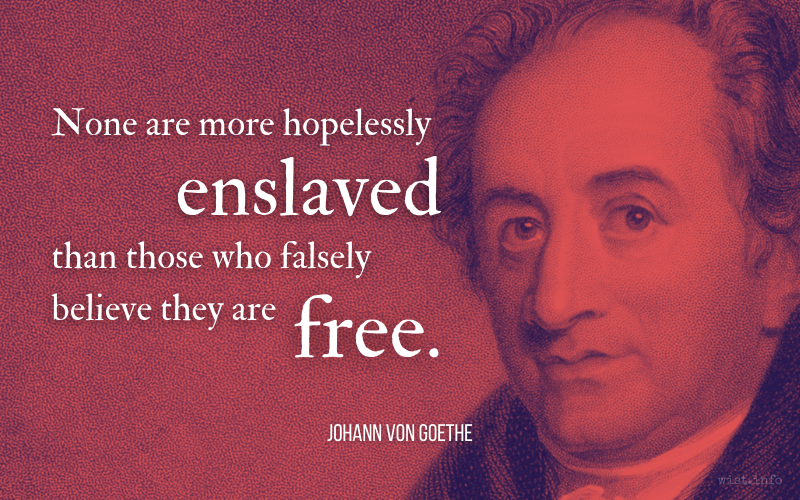
Peace indeed is both sweet in name and wholesome in reality; but there is all the difference in the world between peace and slavery. Peace is the calmness of freedom, slavery the worst of all evils, to be kept off at the cost not only of war, but even of life itself.
[Et nomen pacis dulce est et ipsa res salutaris; sed inter pacem et servitutem plurimum interest. Pax est tranquilla libertas, servitus postremum malorum omnium, non modo bello sed morte etiam repellendum.]
Marcus Tullius Cicero (106–43 BC) Roman orator, statesman, philosopher
Philippics [Philippicae; Antonian Orations], No. 2, ch. 44 / sec. 113 (2,44/2.113) (44-10-24 BC) [tr. King (1877)]
(Source)
(Source (Latin)). Other translations:And the name of peace is sweet, and the thing itself wholesome, but between peace and servitude the difference is great. Peace is tranquil liberty, servitude the last of all evils, one to be repelled, not only by war but even by death.
[tr. Ker (1926)]The name of peace is sweet, the thing itself is most salutary. But between peace and slavery there is a wide difference. Peace is liberty in tranquility; slavery is the worst of all evils, -- to be repelled, if need be, not only by war, but even by death.
[tr. Yonge (1903)]Peace indeed is both sweet in name and wholesome in reality; but there is all the difference between peace and slavery. Peace is the calmness of freedom, slavery the worst of all evils, to be kept off at the cost not only of war, but even of life itself.
[ed. Harbottle (1906)]Even the name of peace is sweet, and peace itself a blessing; but there is all the difference in the world between peace and servitude. Peace is the quiet enjoyment of freedom, whereas servitude is the greatest of all evils, something to be resisted not just with war, but even with death.
[tr. Berry (2006)]There is sweetness in the name of peace, and living in peace is beneficial, but there is a great difference between peace and slavery. Slavery is the worst of all evils and must be driven off by war -- or even by death.
[tr. McElduff (2011)]
You don’t get to control any outcome, only every choice you make along the way.
(Other Authors and Sources)
Stephen C. Paul

The first measure of a free society is NOT that its government performs the will of the majority. That’s what we had in 1930s Germany, 1950s Georgia, and 1980s Iran. The FIRST measure of a free society is that its government protects the just freedoms of its minorities AGAINST the preferences, will and caprice of the majority.
Jim Warren (b. 1936) American mathematician, computer scientist, journalist, activist
(Attributed)

It is clear that thought is not free if the profession of certain opinions makes it impossible to earn a living.
Bertrand Russell (1872–1970) English mathematician and philosopher
“Free Thought and Official Propaganda,” lecture, South Place Institute, London (1922-03-24)
(Source)
Is life so dear, or peace so sweet, as to be purchased at the price of chains and slavery? Forbid it, Almighty God! I know not what course others may take, but as for me, give me liberty, or give me death!
Only free men can negotiate; prisoners cannot enter into contracts. Your freedom and mine cannot be separated.
Nelson Mandela (1918–2013) South African revolutionary, politician, statesman
Letter from prison to Zindzi Mandela, given in Soweto speech (10 Feb 1985)
On refusing to bargain for freedom after 21 years in prison. Quoted in Time (25 Feb 1985).
If we don’t believe in freedom of expression for people we despise, we don’t believe in it at all.
Noam Chomsky (b. 1928) American linguist and activist
The Late Show, TV interview with John Pilger, BBC2 (25 Nov 1992)

Hereditary bondsmen! know ye not
Who would be free themselves must strike the blow?George Gordon, Lord Byron (1788–1824) English poet
Childe Harold’s Pilgrimage, Canto 2, st. 76 (1812)
(Source)
Speaking of the Greeks, whose nation was still controlled by the Ottoman Empire. The lines were used by W. E. B. DuBois, along with a line from st. 74, as the epigraph of ch. 3 of The Souls of Black Folks (1903).