It has long been a grave question whether any government, not too strong for the liberties of its people, can be strong enough to maintain its own existence, in great emergencies. […]
We can not have free government without elections; and if the rebellion could force us to forego, or postpone a national election, it might fairly claim to have already conquered and ruined us.Abraham Lincoln (1809-1865) American lawyer, politician, US President (1861-65)
Speech (1864-11-10), “Response to a Serenade,” Washington, D. C.
(Source)
Speech given from a White House window to a group of Pennsylvanians celebrating his re-election.
Quotations about:
elections
Note not all quotations have been tagged, so Search may find additional quotes on this topic.
In the midst of all my bitching, you might’ve noticed that I never complain about politicians. I leave that to others. And there’s no shortage of volunteers; everyone complains about politicians. Everyone says they suck.
But where do people think these politicians come from? They don’t fall out of the sky; they don’t pass through a membrane from a separate reality. They come from American homes, American families, American schools, American churches, and American businesses. And they’re elected by American voters. This is what our system produces, folks. This is the best we can do. Let’s face it, we have very little to work with. Garbage in, garbage out.
Ignorant citizens elect ignorant leaders, it’s as simple as that. And term limits don’t help. All you do is get a brand new bunch of ignorant leaders.George Carlin (1937-2008) American comedian
Book (2001), Napalm & Silly Putty, “Don’t Blame the Leaders”
(Source)
(Source (audio)). The audiobook version is trivially different (emphasis added):In the midst of all my bitching, you might've noticed that I never complain about politicians. I leave that to other people. There's no shortage of volunteers; everyone complains about politicians. Everyone says they suck.
But where do people think these politicians come from? They don't fall out of the sky; they don't pass through a membrane from a separate reality. They come from American homes, American families, American schools, American churches, and American businesses. And they're elected by American voters. This is what our system produces, folks. This is the best we can do. Let's face it, we have very little to work with in this country. Garbage in, garbage out.
Ignorant citizens elect ignorant leaders, it's as simple as that. And term limits don't help. All you do is get a brand new bunch of ignorant leaders.
The principal difficulty lies, and the greatest care should be employed in constituting this Representative Assembly. It should be in miniature, an exact portrait of the people at large. It should think, feel, reason, and act like them. That it may be the interest of this Assembly to do strict justice at all times, it should be an equal representation, or in other words equal interest among the people should have equal interest in it. Great care should be taken to effect this, and to prevent unfair, partial, and corrupt elections.
John Adams (1735–1826) American lawyer, Founding Father, statesman, US President (1797–1801)
Letter (1776-04) to George Wythe, “Thoughts on Government”
(Source)
This is taken from the printed edition of the influential essay, believed to be from the version Adams sent to George Wythe of Virginia.
All of the great freedoms which form the basis of our American democracy are part and parcel of that concept of free elections, with free expression of political choice between candidates of political parties. For such elections guarantee that there can be no possibility of stifling freedom of speech, freedom of the press and the air, freedom of worship.
Franklin Delano Roosevelt (1882–1945) American lawyer, politician, statesman, US President (1933–1945)
Speech (1941-03-29), Jackson Day Radio Broadcast, U.S.S. Potomac
(Source)
I will not say that we may not sooner or later be compelled to meet force by force; but the time has not yet come, and, if we are true to ourselves, may never come. Do not mistake that the ballot is stronger than the bullet. Therefore let the legions of slavery use bullets; but let us wait patiently till November and fire ballots at them in return; and by that peaceful policy I believe we shall ultimately win.
Abraham Lincoln (1809-1865) American lawyer, politician, US President (1861-65)
Speech (1856-05-29), Republican State Convention of Illinois, Bloomington [ed. Whitney]
(Source)
The speech is based on contemporaneous notes by William C. Whitney, who was present at the speech. The speech was reconstructed from the notes in 1896; Whitney said that it was not literal, but followed Lincoln's arguments and used many of his sentences.
Usually given in a shorter form: "The ballot is stronger than the bullet."
Lincoln used the juxtaposition of ballots and bullets a number of times (e.g., 1858, 1863). This is the earliest of the instances I can find.
We’re stronger because we’re democracies. We’re not afraid of free and fair elections, because true legitimacy can only come from one source — and that is the people. We’re not afraid of an independent judiciary, because no one is above the law. We’re not afraid of a free press or vibrant debate or a strong civil society, because leaders must be held accountable. We’re not afraid to let our young people go online to learn and discover and organize , because we know that countries are more successful when citizens are free to think for themselves.
Barack Obama (b. 1961) American politician, US President (2009-2017)
Speech, Nordea Concert Hall, Tallinn, Estonia (3 Sep 2014)
(Source)
Certainty has become a consumer product. It is marketed the world over — by insurance companies, investment advisers, election campaigns, and the medical industry.
Gerd Gigerenzer (b. 1947) German research psychologist
Reckoning with Risk (2003)

Pessimism about man serves to maintain the status quo. It is a luxury for the affluent, a sop to the guilt of the politically inactive, a comfort to those who continue to enjoy the amenities of privilege.
Leon Eisenberg (1922-2009) American psychiatrist and medical educator
“The Human Nature of Human Nature,” Science (14 Apr 1972)
(Source)
Based on an address at Faculty of Medicine Day, McGill University Sesquicentennial Celebration, Montreal, Canada (1 Oct 1971).
The English Constitution is founded, tis bottomed And grounded on the Knowledge and good sense of the People. The very Ground of our Liberties, is the freedom of Elections. Every Man has in Politicks as well as Religion, a Right to think and speak and Act for himself. No man either King or Subject, Clergyman or Layman has any Right to dictate to me the Person I shall choose for my Legislator and Ruler. I must judge for myself, but how can I judge, how can any Man judge, unless his Mind has been opened and enlarged by Reading.
John Adams (1735–1826) American lawyer, Founding Father, statesman, US President (1797–1801)
Diary (1761-08-01)
(Source)
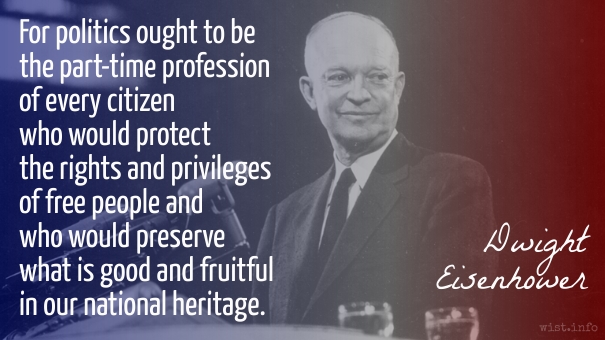
For politics ought to be the part-time profession of every citizen who would protect the rights and privileges of free people and who would preserve what is good and fruitful in our national heritage. Politics must be the concern of every citizen who wants to see our national well-being increased and our international leadership strengthened. In that combined sense, politics is the noblest of professions. In the ranks of that kind of politics, every American should be enrolled.
Dwight David Eisenhower (1890-1969) American general, US President (1953-61)
Speech, Republican Lincoln Day Dinners (28 Jan 1954)
(Source)
Often paraphrased: "Politics ought to be the part-time profession of every citizen who would protect the rights and privileges of free men."
The speech was filmed for the Republican National Committee and distributed to state and local committees to be shown at the Lincoln Day dinners.
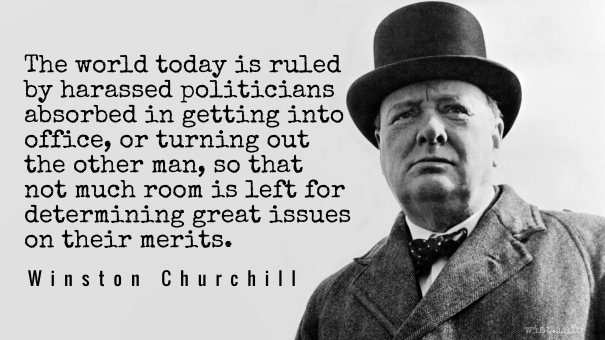
The world today is ruled by harassed politicians absorbed in getting into office or turning out the other man so that not much room is left for determining great issues on their merits.
Winston Churchill (1874-1965) British statesman and author
Speech, New York (25 Jan 1932)
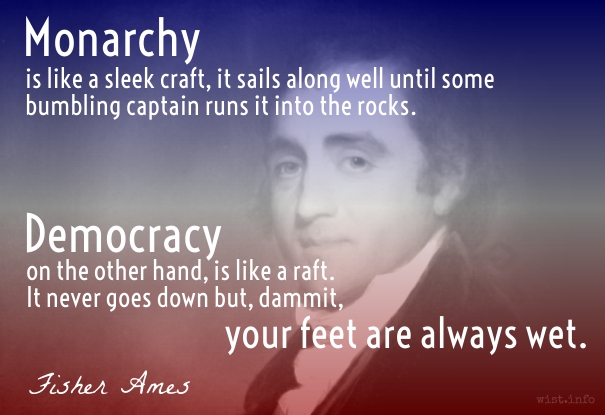
Monarchy is like a sleek craft, it sails along well until some bumbling captain runs it into the rocks. Democracy, on the other hand, is like a raft. It never goes down but, dammit, your feet are always wet.
Fisher Ames (1758-1808) American politician, orator
(Attributed)
This is the earliest reference I can find to this metaphor. Variants:
- "A monarchy is a merchantman which sails well, but will sometimes strike on a rock and go to the bottom; a republic is a raft which will never sink, but then your feet are always in the water." This variant is often attributed to a speech in the House of Representatives in 1795, but is not found in records of Ames' speeches.
- "A monarchy is like a man-of-war -- bad shots between wind and water hurt it exceedingly; there is danger of capsizing. But democracy is a raft. You cannot easily overturn it. It is a wet place, but it is a pretty safe one." -- Joseph Cook (1860-1947) Anglo-Australian politician
- "Dictatorship is like a big proud ship -- steaming away across the ocean with a great hulk and powerful engines driving it. It’s going fast and strong and looks like nothing could stop it. What happens? Your fine ship strikes something -- under the surface. Maybe it’s a mine or a reef, maybe it’s a torpedo or an iceberg. And your wonderful ship sinks. Now take democracy. It’s like riding on a raft, a rickety raft that was put together in a hurry. We get tossed about on the waves, it’s bad going and our feet are always wet. But that raft doesn’t sink … It’s the raft that will get to the shore at last." --- Roaldus Richmond (fl. 1940) American writer. In, ed., "A Yankee Businessman in New Hampshire," American Life Histories: Manuscripts from the Federal Writers Project, 1936-1940.
- "Democracy is like a raft: It won't sink, but you will always have your feet wet." -- Russell B. Long (1918-2003) American politician
- "But you have to understand, American democracy is not like the system you have. We're not an ocean liner that sails across the ocean from point A to point B at 30 knots. That's not American democracy. American democracy is kind of like a life raft that bobs around the ocean all the time. Your feet are always wet. Winds are always blowing. You're cold. You're wet. You're uncomfortable -- but you never sink." -- Colin Powell (b. 1937) American politician, diplomat, soldier
No one can govern who cannot afford to be unpopular, and no democratic official can afford to be unpopular. Sometimes he has to wink at flagrant injustice and oppression; at other times a fanatical agitation compels him to pass laws which forbid the citizen to indulge perfectly harmless tastes, or tax him to contribute to the pleasures of the majority.
William Ralph Inge (1860-1954) English prelate [Dean Inge]
“Our Present Discontents,” Outspoken Essays: First Series (1919)
Every honest and God-fearing man is a mighty factor in the future of the Republic. Educated men, business men, professional men, should be the last to shirk the responsibilities attaching to citizenship in a free government. They should be practical and helpful — mingling with the people — not selfish and exclusive. It is not necessary that every man should enter into politics, or adopt it as a profession, or seek political preferment, but it is the duty of every man to give personal attention to his political duties. They are as sacred and binding as any we have to perform.
William McKinley (1843-1901) US President (1897-1901)
Speech, Woodstock, Connecticut (4 July 1891)
(Source)
Peace does not appear so distant as it did. I hope it will come soon, and come to stay; and so come as to be worth the keeping in all future time. It will then have been proved that, among free men, there can be no successful appeal from the ballot to the bullet; and that they who take such appeal are sure to lose their case, and pay the cost.
Abraham Lincoln (1809-1865) American lawyer, politician, US President (1861-65)
Letter (1863-08-26) to James C. Conkling
(Source)
Sent as a letter to Conkling to read to a rally of Union supporters in Springfield, Illionis (1863-09-03).
Lincoln used the juxtaposition of ballots and bullets a number of times (e.g., 1856, 1858).
For in a democracy, every citizen, regardless of his interest in politics, “holds office”; every one of us is in a position of responsibility; and, in the final analysis, the kind of government we get depends upon how we fulfill those responsibilities. We, the people, are the boss, and we will get the kind of political leadership, be it good or bad, that we demand and deserve.
John F. Kennedy (1917-1963) American politician, author, journalist, US President (1961–63)
Profiles in Courage (1956; 1964 ed.)
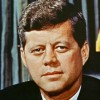
Today the challenge of political courage looms larger than ever before. … Our political life is becoming so expensive, so mechanized and so dominated by professional politicians and public relations men that the idealist who dreams of independent statesmanship is rudely awakened by the necessities of election and accomplishment.
John F. Kennedy (1917-1963) American politician, author, journalist, US President (1961–63)
Profiles in Courage, Introduction (1956)
When we went to school we were told that we were governed by laws, not men. As a result of that, many people think there is no need to pay any attention to judicial candidates because judges merely apply the law by some mathematical formula and a good judge and a bad judge all apply the same kind of law. The fact is that the most important part of a judge’s work is the exercise of judgment and that the law in a court is never better than the common sense judgment of the judge that is presiding.
Robert H. Jackson (1892-1954) US Supreme Court Justice (1941-54), lawyer, jurist, politician
Speech, Greater Buffalo Advertising Club, New York (1933)
(Source)
Quoted in Eugene Gerhart, America's Advocate: Robert H. Jackson, ch. 4 (1958).
By the frame of the Government under which we live this same people have wisely given their public servants but little power for mischief, and have with equal wisdom provided for the return of that little to their own hands at very short intervals. While the people retain their virtue and vigilance no Administration by any extreme of wickedness or folly can very seriously injure the Government in the short space of four years.
Abraham Lincoln (1809-1865) American lawyer, politician, US President (1861-65)
Speech (1861-03-04), Inaugural Address, Washington, D. C.
(Source)
Democracy is a device that ensures we shall be governed no better than we deserve.
George Bernard Shaw (1856-1950) Irish playwright and critic
(Attributed)
Sometimes cited with the Americanized "insures." Also given as "Democracy is a system ensuring that the people are governed no better than they deserve." Frequently quoted, but never sourced.
The punishment which the wise suffer who refuse to take part in the government is to live under the government of worse men.
Plato (c.428-347 BC) Greek philosopher
Republic, Book 1, 347c
In Ralph Waldo Emerson, "Eloquence," Society and Solitude (1870).
Alt. trans.:More discussion here.
- "One of the penalties for refusing to participate in politics, is that you end up being governed by your inferiors."
- The Constitution Party (1952-68) used on their letterhead the variant, "The penalty good men pay for indifference to public affairs is to be ruled by evil men."
- "The price of apathy is to be ruled by evil men."
- "Those who are too smart to engage in politics are punished by being governed by those who are dumber."
In context (Plato in Twelve Volumes, Vols. 5 & 6 [tr. Shorey (1969)]):[346e] "Then, Thrasymachus, is not this immediately apparent, that no art or office provides what is beneficial for itself -- but as we said long ago it provides and enjoins what is beneficial to its subject, considering the advantage of that, the weaker, and not the advantage the stronger? That was why, friend Thrasymachus, I was just now saying that no one of his own will chooses to hold rule and office and take other people's troubles in hand to straighten them out, but everybody expects pay for that, [347a] because he who is to exercise the art rightly never does what is best for himself or enjoins it when he gives commands according to the art, but what is best for the subject. That is the reason, it seems, why pay must be provided for those who are to consent to rule, either in form of money or honor or a penalty if they refuse." "What do you mean by that, Socrates?" said Glaucon. "The two wages I recognize, but the penalty you speak of and described as a form of wage I don't understand." "Then," said I, "you don't understand the wages of the best men [347b] for the sake of which the finest spirits hold office and rule when they consent to do so. Don't you know that to be covetous of honor and covetous of money is said to be and is a reproach?" "I do," he said. "Well, then," said I, "that is why the good are not willing to rule either for the sake of money or of honor. They do not wish to collect pay openly for their service of rule and be styled hirelings nor to take it by stealth from their office and be called thieves, nor yet for the sake of honor, [347c] for they are not covetous of honor. So there must be imposed some compulsion and penalty to constrain them to rule if they are to consent to hold office. That is perhaps why to seek office oneself and not await compulsion is thought disgraceful. But the chief penalty is to be governed by someone worse if a man will not himself hold office and rule. It is from fear of this, as it appears to me, that the better sort hold office when they do, and then they go to it not in the expectation of enjoyment nor as to a good thing, but as to a necessary evil and because they are unable to turn it over to better men than themselves [347d] or to their like. For we may venture to say that, if there should be a city of good men only, immunity from office-holding would be as eagerly contended for as office is now, and there it would be made plain that in very truth the true ruler does not naturally seek his own advantage but that of the ruled; so that every man of understanding would rather choose to be benefited by another than to be bothered with benefiting him. "