

But banish care, it’s no time for it now — on with the dance, let joy be unconfined is my motto, whether there’s any dance to dance; or any joy to unconfine — you’ll be the healthier for it every time, — every time, Washington — it’s my experience, and I’ve seen a good deal of this world.
Quotations by:
Twain, Mark
[S]he brought some of those apples. I was obliged to eat them, I was so hungry. It was against my principles, but I find that principles have no real force except when one is well-fed.
Mark Twain (1835–1910) American writer [pseud. of Samuel Clemens]
Story (1893), “Extracts from Adam’s Diary,” The Niagara Book
(Source)
This was first published as one of the stories and sketches from various authors in The Niagara Book: A Complete Souvenir of Niagara Falls (1893), mentioning the story as "The Earliest Authentic Mention of Niagara Falls" (so named by Eve on the first Tuesday).
The story was first collected in a Twain collection in 1903 (My Debut as a Literary Person with Other Essays and Stories), and published as an independent book with this title in 1904.
A sin takes on new and real terrors when there seems a chance that it is going to be found out. This gives it a fresh and most substantial and important aspect.
Mark Twain (1835–1910) American writer [pseud. of Samuel Clemens]
Story (1899-12), “The Man That Corrupted Hadleyburg,” ch. 4, Harper’s Monthly, Vol. 100, No. 595
(Source)
(Source (Alternate)). First collected in The Man That Corrupted Hadleyburg and Other Stories and Essays (1900).
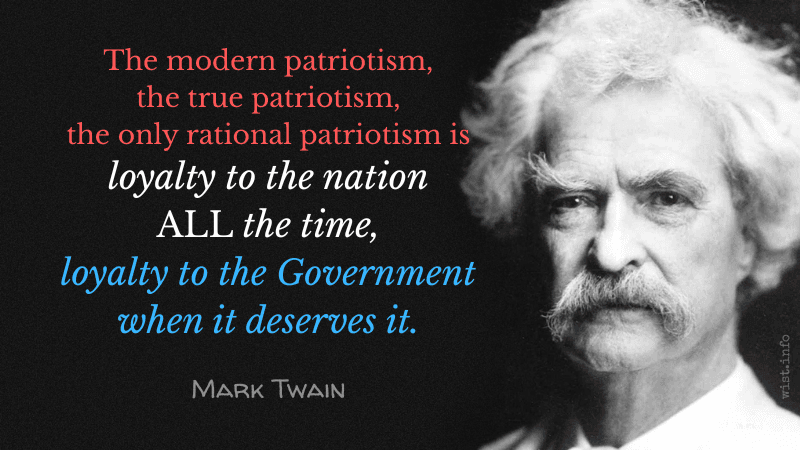
Remember this, take it to heart, live by it, die for it if necessary: that our patriotism is medieval, outworn, obsolete; that the modern patriotism, the true patriotism, the only rational patriotism is loyalty to the nation all the time, loyalty to the Government when it deserves it.
Mark Twain (1835–1910) American writer [pseud. of Samuel Clemens]
Story (1905-02-02), “The Czar’s Soliloquy,” North American Review, Vol. 180, No. 580 (1905-03)
(Source)
Advice that Russian mothers should be giving their children.
Sometimes paraphrased: "Patriotism is supporting your country all the time, and your government when it deserves it."
A strange thing, when one considers it: to wit, the world applies to Czar and System the same moral axioms that have vogue and acceptance in civilized countries! Because, in civilized countries, it is wrong to remove oppressors otherwise than by process of law, it is held that the same rule applies in Russia, where there is no such thing as law — except for our Family. Laws are merely restraints — they have no other function. In civilized countries they restrain all persons, and restrain them all alike, which is fair and righteous; but in Russia such laws as exist make an exception — our Family. We do as we please; we have done as we pleased for centuries. Our common trade has been crime, our common pastime murder, our common beverage blood — the blood of the nation. Upon our heads lie millions of murders. Yet the pious moralist says it is a crime to assassinate us. We and our uncles are a family of cobras set over a hundred and forty million rabbits, whom we torture and murder and feed upon all our days; yet the moralist urges that to kill us is a crime, not a duty.
Mark Twain (1835–1910) American writer [pseud. of Samuel Clemens]
Story (1905-02-02), “The Czar’s Soliloquy,” North American Review, Vol. 180, No. 580 (1905-03)
(Source)
Meant to be the musings of Czar Alexander III, whom Twain detested, about the morality of assassinating people such as himself.
Ah! what could our Family do without the moralist? He has always been our stay, our support, our friend; today he is our only friend. Whenever there has been dark talk of assassination, he has come forward and saved us with his impressive maxim, “Forbear: nothing politically valuable was ever yet achieved by violence.” He probably believes it. It is because he has by him no child’s book of world-history to teach him that his maxim lacks the backing of statistics. All thrones have been established by violence; no regal tyranny has ever been overthrown except by violence; by violence my fathers set up our throne; by murder, treachery, perjury, torture, banishment and prison they have held it for four centuries, and by these same arts I hold it today. There is no Romanoff of learning and experience but would reverse the maxim and say: “Nothing politically valuable was ever yet achieved except by violence.”
Mark Twain (1835–1910) American writer [pseud. of Samuel Clemens]
Story (1905-02-02), “The Czar’s Soliloquy,” North American Review, Vol. 180, No. 580 (1905-03)
(Source)
Meant to be the musings of Czar Alexander III, whom Twain detested, about the morality of assassinating people such as himself.
How little a thing can make us happy when we feel that we have earned it!
Mark Twain (1835–1910) American writer [pseud. of Samuel Clemens]
Story (1905-12), “Eve’s Diary,” Harper’s Magazine, Vol. 112, No. 1
(Source)
On Adam's admiration for her (Eve) having properly named the dodo.
Published in June, 1906, as its own (illustrated) book.
“You heard these words: ‘Grant us the victory, O Lord our God!’ That is sufficient. The whole of the uttered prayer is compact into those pregnant words. Elaborations were not necessary. When you have prayed for victory you have prayed for many unmentioned results which follow victory — must follow it, cannot help but follow it. Upon the listening spirit of God fell also the unspoken part of the prayer. He commandeth me to put it into words. Listen!
“O Lord our Father, our young patriots, idols of our hearts, go forth to battle — be Thou near them! With them — in spirit — we also go forth from the sweet peace of our beloved firesides to smite the foe. O Lord our God, help us to tear their soldiers to bloody shreds with our shells; help us to cover their smiling fields with the pale forms of their patriot dead; help us to drown the thunder of the guns with the shrieks of their wounded, writhing in pain; help us to lay waste their humble homes with a hurricane of fire; help us to wring the hearts of their unoffending widows with unavailing grief; help us to turn them out roofless with their little children to wander unfriended the wastes of their desolated land in rags and hunger and thirst, sports of the sun flames of summer and the icy winds of winter, broken in spirit, worn with travail, imploring Thee for the refuge of the grave and denied it — for our sakes who adore Thee, Lord, blast their hopes, blight their lives, protract their bitter pilgrimage, make heavy their steps, water their way with their tears, stain the white snow with the blood of their wounded feet! We ask it, in the spirit of love, of Him Who is the Source of Love, and Who is the ever-faithful refuge and friend of all that are sore beset and seek His aid with humble and contrite hearts. Amen.
(After a pause.) “Ye have prayed it; if ye still desire it, speak! The messenger of the Most High waits!”Mark Twain (1835–1910) American writer [pseud. of Samuel Clemens]
Story (1905), “The War Prayer”
(Source)
A mysterious man speaking to a church congregation gathered to pray for the victory of their local men going off to war.
The story was originally written after the Spanish-American War and during the Philippine-American War. It was rejected at the time by Harper's Bazaar on 1905-03-22 as "too radical" and "not quite suited to a woman's magazine." He was further discouraged by his family, friends, and publishers from publishing something so "sacrilegious."
It's frequently claimed that the story was eventually published in Harper's Magazine, Vol 80, No. 798 (1916-11), during World War I. In reality, that issue only contains Part 7 (the last installment) of his The Mysterious Stranger (a different story).
It was not published until collected in Europe and Elsewhere (1923) [ed. Paine].
For your race, in its poverty, has unquestionably one really effective weapon — laughter. Power, money, persuasion, supplication, persecution — these can lift at a colossal humbug — push it a little — weaken it a little, century by century; but only laughter can blow it to rags and atoms at a blast. Against the assault of laughter nothing can stand. You are always fussing and fighting with your other weapons. Do you ever use that one? No; you leave it lying rusting. As a race, do you ever use it at all? No; you lack sense and the courage.
Mark Twain (1835–1910) American writer [pseud. of Samuel Clemens]
Story (1916), The Mysterious Stranger, ch. 10
(Source)
Satan speaking. Often paraphrased: "The human race has one really effective weapon, and that is laughter."
The novella was published posthumously (and with significant alterations by Twain's executor).
The above is taken from the Paine-Duneka text. An earlier version (of this story and passage) appear in The Chronicle of Young Satan, ch. 10 (c. 1898-12):For your race, in its poverty, has unquestionably one really effective weapon -- laughter. Power, Money, Persuasion, Supplication, Persecution -- these can lift at a colossal humbug, -- push it a little -- crowd it a little -- weaken it a little, century by century: but only Laughter can blow it to rags and atoms at a blast. Against the assault of Laughter nothing can stand. You are always fussing and fighting with your other weapons: do you ever use that one? No, you leave it lying rusting. As a race, do you ever use it at all? No -- you lack sense and the courage.