What, am I to argue that it is wrong to make men brutes, to rob them of their liberty, to work them without wages, to keep them ignorant of their relations to their fellow men, to beat them with sticks, to flay their flesh with the lash, to load their limbs with irons, to hunt them with dogs, to sell them at auction, to sunder their families, to knock out their teeth, to burn their flesh, to starve them into obedience and submission to their masters? Must I argue that a system thus marked with blood, and stained with pollution, is wrong? No! I will not. I have better employment for my time and strength, than such arguments would imply.
Frederick Douglass (1817–1895) American abolitionist, orator, writer
Speech (1852-07-05), “What to the Slave is the Fourth of July?” Corinthian Hall, Rochester, New York
(Source)
Quotations about:
brutality
Note not all quotations have been tagged, so Search may find additional quotes on this topic.
Surely the idea of a “limited war” is one of the most dangerously self-deceiving verbal gimmicks ever invented. For though war makes use of reason, as a weapon, it is not reasonable in nature. Its nature is the nature of pride and anger. It follows the brute logic of violent emotion, which points directly toward the use of the greatest available power.
Wendell Berry (b. 1934) American farmer, educator, poet, conservationist
Speech (1968-02-10), “A Statement Against the War in Vietnam,” Kentucky Conference on the War and the Draft, University of Kentucky
(Source)
Collected in The Long-Legged House, Part 2 (1969).

I love the pure, peaceable, and impartial Christianity of Christ: I therefore hate the corrupt, slaveholding, women-whipping, cradle-plundering, partial and hypocritical Christianity of this land. Indeed, I can see no reason, but the most deceitful one, for calling the religion of this land Christianity. I look upon it as the climax of all misnomers, the boldest of all frauds, and the grossest of all libels.
Frederick Douglass (1817–1895) American abolitionist, orator, writer
Narrative of the Life of Frederick Douglass, An American Slave, Appendix (1845)
(Source)
The Rash, the Lazy, Lover, none’s so wild,
But may be tame, and may be wisely mild,
If they consult true Vertue’s Rules with care,
And lend to good advice a patient ear.[Invidus, iracundus, iners, vinosus, amator,
nemo adeo ferus est, ut non mitescere possit,
si modo culturae patientem commodet aurem.]Horace (65–8 BC) Roman poet, satirist, soldier, politician [Quintus Horatius Flaccus]
Epistles [Epistularum, Letters], Book 1, ep. 1 “To Maecenas,” l. 38ff (1.1.38-40) (20 BC) [tr. Creech (1684)]
(Source)
(Source (Latin)). Other translations:Th'envyouse, angrye, drunken, slowe, the lover lewde and wylde
None so outeragiouse, but in tyme he maye become full mylde.
If he to good advertisemente will retche his listenyng eare,
And meekely byde with pacience the counsaile he shall heare.
[tr. Drant (1567)]The Envious, Wrathful, Sluggish, Drunkard, Lover:
No Beast so wild, but may be tam'd, if he
Will unto Precepts listen patiently.
[tr. Fanshawe; ed. Brome (1666)]The slave to envy, anger, wine, or love,
The wretch of sloth, its excellence shall prove:
Fierceness itself shall hear its rage away.
When listening calmly to the instructive lay.
[tr. Francis (1747)]The heart with envy cold -- with anger hot,
The libertine, the sluggard and the sot --
No wretch so savage, but, if he resign
His soul to culture, wisdom can refine.
[tr. Howes (1845)]The envious, the choleric, the indolent, the slave to wine, to women -- none is so savage that he can not be tamed, if he will only lend a patient ear to discipline.
[tr. Smart/Buckley (1853)]Run through the list of faults; whate'er you be,
Coward, pickthank, spitfire, drunkard, debauchee,
Submit to culture patiently, you'll find
Her charms can humanize the rudest mind.
[tr. Conington (1874)]However coarse in grain a man may be,
Drone, brawler, makebate, drunkard, debauchee,
A patient ear to culture let him lend,
He's sure to turn out gentler in the end.
[tr. Martin (1881)]Are you envious, irascible, inert, given to wine or immorality? No person is so savage that he cannot grow milder, provided he lend a patient ear to civilization's culture.
[tr. Elgood (1893)]The slave to envy, anger, sloth, wine, lewdness -- no one is so savage that he cannot be tamed, if only he lend to treatment a patient ear.
[tr. Fairclough (Loeb) (1926)]The envious, passionate, slothful, drunken, lewd —
No man so savage but he drops the mood,
Lend he but patient ear to counsel good.
[tr. Murison, ed. Kraemer (1936)]The envious man,
The sorehead, the lazy lout, the drinker, the lover:
No one is such a beast as not to be tamed
By lending a patient ear to moral advice.
[tr. Palmer Bovie (1959)]Envious, wrathful, lazy, drunken men, lewd lovers too,
none is so thoroughly wild a beast he can't be tamed,
if only he'll lend for cultivation's sake an open ear.
[tr. Fuchs (1977)]Jealousy,
Anger, laziness, drunkenness, lust: everything
Can be cured, nothing is so wild
That patient teaching will ever fail you.
[tr. Raffel (1983)]Nobody's so far gone in savagery --
A slave of envy, wrath, lust, drunkenness, sloth --
That he can't be civilized, if he'll only listen
Patiently to the doctor's good advice.
[tr. Ferry (2001)]Whether he’s envious, choleric, indolent, drunken or lustful --
no one is so unruly that he can’t become more gentle,
if only he listens with care to what his trainer tells him.
[tr. Rudd (2005 ed.)]Envious, irascible, idle, drunken, lustful,
No man’s so savage he can’t be civilised,
If he’ll attend patiently to self-cultivation.
[tr. Kline (2015)]
It is characteristic of this form of punishment, inspired by all that is pitiless, that is to say brutalizing, that gradually, by a process of mindless erosion, it turns a man into an animal, sometimes a ferocious one.
[Le propre des peines de cette nature, dans lesquelles domine ce qui est impitoyable, c’est-à-dire ce qui est abrutissant, c’est de transformer peu à peu, par une sorte de transfiguration stupide, un homme en une bête fauve, quelquefois en une bête féroce.]Victor Hugo (1802–1885) French writer, journalist, human rights activist, politician
Les Misérables, Part 1 “Fantine,” Book 2 “The Fall,” ch. 7 (1.2.7) (1862) [tr. Denny (1976)]
(Source)
On the degradation of Jean Valjean while serving his hard labor sentence.
(Source (French)). Other translations:The peculiarity of punishment of this kind, in which what is pitiless, that is to say, what is brutalising, predominates, is to transform little by little, by a slow stupefaction, a man into an animal, sometimes into a wild beast.
[tr. Wilbour (1862)]The peculiarity of punishments of this nature, in which naught but what is pitiless, that is to say, brutalizing, prevails, is gradually, and by a species of stupid transfiguration, to transform a man into a wild beast, at times a ferocious beast.
[tr. Wraxall (1862)]The peculiarity of pains of this nature, in which that which is pitiless -- that is to say, that which is brutalizing -- predominates, is to transform a man, little by little, by a sort of stupid transfiguration, into a wild beast; sometimes into a ferocious beast.
[tr. Hapgood (1887)]The peculiarity of punishment of this kind, in which the pitiless or brutalizing part predominates, is to transform gradually by a slow numbing process a man into an animal, sometimes into a wild beast.
[tr. Wilbour/Fahnestock/MacAfee (1987)]It is in the nature of such punishment -- in which what prevails is the pitiless, in other words, the brutalizing -- to transform a man little by little, by a kind of stupid transfiguration, into a wild beast, sometimes a ferocious beast.
[tr. Donougher (2013)]
What the horrors of war are, no one can imagine — they are not wounds & blood & fever, spotted & low, or dysentery chronic & acute, cold & heat & famine. They are intoxication, drunken brutality, demoralization & disorder on the part of the inferior — jealousies, meanness, indifference, selfish brutality on the part of the superior.
Florence Nightingale (1820–1910) English social reformer, statistician, founder of modern nursing
Letter to her family (5 May 1855)
(Source)

I intend to do what little one man can do to awaken the public conscience, and in the meantime I am not frightened by your menaces. I am not a giant physically; I shrink from pain and filth and vermin and foul air, like any other man of refinement; also, I freely admit, when I see a line of a hundred policemen with drawn revolvers flung across a street to keep anyone from coming onto private property to hear my feeble voice, I am somewhat disturbed in my nerves. But I have a conscience and a religious faith, and I know that our liberties were not won without suffering, and may be lost again through our cowardice. I intend to do my duty to my country.
Upton Sinclair (1878–1968) American writer, journalist, activist, politician
Letter to the Louis D. Oaks, Los Angeles Chief of Police (17 May 1923)
(Source)
Reprinted in his Autobiography (1962).
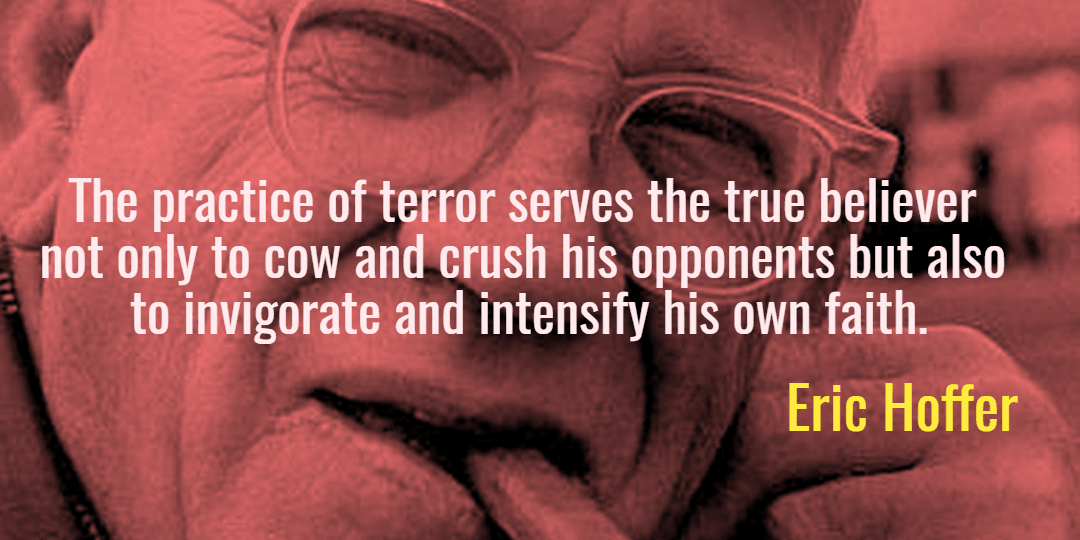
The practice of terror serves the true believer not only to cow and crush his opponents but also to invigorate and intensify his own faith.
Eric Hoffer (1902–1983) American writer, philosopher, longshoreman
True Believer: Thoughts on the Nature of Mass Movements, Part 3, ch. 14, § 85 (1951)
(Source)
When I found the first camp like that I think I never was so angry in my life. The bestiality displayed there was not merely piled up bodies of people that had starved to death, but to follow out the road and see where they tried to evacuate them so they could still work, you could see where they sprawled on the road. You could go to their burial pits and see horrors that really I wouldn’t even want to begin to describe. I think people ought to know about such things. It explains something of my attitude toward the German war criminal. I believe he must be punished, and I will hold out for that forever.
Dwight David Eisenhower (1890–1969) American general, US President (1953–61)
Press Conference (18 Jun 1945)
There are many humorous things in the world, among them the white man’s notion that he is less savage than the other savages.
Mark Twain (1835–1910) American writer [pseud. of Samuel Clemens]
Following the Equator, ch. 21 (1897)
(Source)