

Nice people made the best Nazis.
Or so I have been told. My mother was born in Munich in 1934, and spent her childhood in Nazi Germany surrounded by nice people who refused to make waves. When things got ugly, the people my mother lived alongside chose not to focus on “politics,” instead busying themselves with happier things. They were lovely, kind people who turned their heads as their neighbors were dragged away.Naomi Shulman (contemp.), American writer, essayist, editor
Essay (2016-11-17), “No Time To Be Nice: Now Is Not the Moment to Remain Silent,” WBUR, National Public Radio
(Source)
This is a revised version of the following, more commonly-seen quotation, which I have seen suggested was an earlier iteration of the above on her Facebook account (though it does not appear to be posted there any longer):Nice people made the best Nazis. My mom grew up next to them. They got along, refused to make waves, looked the other way when things got ugly and focused on happier things than “politics.” They were lovely people who turned their heads as their neighbors were dragged away. You know who weren’t nice people? Resisters.
The earliest quotation I can find of this earlier version is from 2016-11-13 (followed by these two from 2016-11-22).
Quotations about:
complicity
Note not all quotations have been tagged, so Search may find additional quotes on this topic.

Why were there so few? Was it that perilous to oppose evil? Was it really impossible to help? Was it really impossible to resist organized, systemitized, legalized cruelty and murder by showing concern for the victims, for one victim? Let us remember: What hurts the victim most is not the cruelty of the oppressor, but the silence of the bystander.
In the discussion of these matters, and especially in the general moral denunciation of the Nazi crimes, it is almost always overlooked that the true moral issue did not arise with the behavior of the Nazis but of those who only “coordinated” themselves and did not act out of conviction. It is not too difficult to see and even to understand how someone may decide “to prove a villain” and, given the opportunity, to try out a reversal of the Decalogue, starting with the command: “Thou shalt kill” and ending with a precept: “Thou shalt lie.”
If you see fraud and do not say fraud, you are a fraud.
Nassim Nicholas Taleb (b. 1960) Lebanese-American essayist, statistician, risk analyst, aphorist
Antifragile: Things That Gain from Disorder, Prologue (2012)
(Source)

It is not possible for the human imagination to conceive of the horrors of slavery. It has left no possible crime uncommitted, no possible cruelty unperpetrated. It has been practiced and defended by all nations in some form. It has been upheld by all religions. It has been defended by nearly every pulpit. From the profits derived from the slave trade churches have been built, cathedrals reared and priests paid. Slavery has been blessed by bishop, by cardinal, and by pope. It has received the sanction of statesmen, of kings, and of queens. It has been defended by the throne, the pulpit and the bench. Monarchs have shared in the profits. Clergymen have taken their part of the spoils, reciting passages of Scripture in its defence at the same time, and judges have taken their portion in the name of equity and law.
Robert Green Ingersoll (1833-1899) American lawyer, agnostic, orator
Speech (1876-07-04), “Centennial Oration [The Declaration of Independence],” Peoria, Illinois
(Source)
For soldiers, we use the term “mercenary,” but we absolve employees of responsibility with “everybody needs to make a living.”
Nassim Nicholas Taleb (b. 1960) Lebanese-American essayist, statistician, risk analyst, aphorist
The Bed of Procrustes: Philosophical and Practical Aphorisms, “Ethics” (2010)
(Source)
Men are accomplices to that which leaves them indifferent.
George Steiner (1929-2020) Franco-American literary critic, philosopher, writer, educator
“A Kind of Survivor” (1965), Language and Silence: Essays 1958-1966 (1967)
(Source)

If lawyers had followed the norm of no execution without trial, if doctors had accepted the rule of no surgery without consent, if businessmen had endorsed the prohibition of slavery, if bureaucrats had refused to handle paperwork involving murder, then the Nazi regime would have been much harder pressed to carry out the atrocities by which we remember it.
Timothy Snyder (b. 1969) American historian, author
On Tyranny: Twenty Lessons from the Twentieth Century (2017)
(Source)

The way of Providence is a little rude. The habit of snake and spider, the snap of the tiger and other leapers and bloody jumpers, the crackle of the bones of his prey in the coil of the anaconda, — these are in the system, and our habits are like theirs. You have just dined, and however scrupulously the slaughter-house is concealed in the graceful distance of miles, there is complicity, expensive races, — race living at the expense of race.
Ralph Waldo Emerson (1803-1882) American essayist, lecturer, poet
Essay (1860), “Fate,” The Conduct of Life, ch. 1
(Source)
Based on a course of lectures by that name first delivered in Pittsburg (1851-03).
BERNARD: But surely the citizens of a democracy have a right to know.
SIR HUMPHREY: No. They have a right to be ignorant. Knowledge only means complicity in guilt; ignorance has a certain dignity.Jonathan Lynn (b. 1943) English actor, comedy writer, director
Yes Minister, S1E1 “Open Government” (25 Feb 1980) [with Anthony Jay]
Silence in the face of evil is itself evil; God will not hold us guiltless. Not to speak is to speak. Not to act is to act.
Dietrich Bonhoeffer (1906-1945) German Lutheran pastor, theologian, martyr
(Spurious)
Frequently attributed to Bonhoeffer, but not found in his works. The origins of its attribution are discussed here, and the phrasing seems to more or less originate with Robert K. Hudnut, A Sensitive Man and the Christ (1971).
Historians have a word for Germans who joined the Nazi party, not because they hated Jews, but out of a hope for restored patriotism, or a sense of economic anxiety, or a hope to preserve their religious values, or dislike of their opponents, or raw political opportunism, or convenience, or ignorance, or greed.
That word is “Nazi.” Nobody cares about their motives any more.
They joined what they joined. They lent their support and their moral approval. And, in so doing, they bound themselves to everything that came after. Who cares any more what particular knot they used in the binding?Andrew R. Moxon (contemp.) American writer, critic [a.k.a. Julius Goat]
Essay (2017-01-16), “Sky,” Blogspot
(Source)
Frequently mis-attributed to Twitter, where Moxxon also posted under his @JuliusGoat handle. The original Julius Goat Blogspot site is no longer online.
The fact that the stupid person is often stubborn must not blind us to the fact that he is not independent. In conversation with him, one virtually feels that one is dealing not at all with him as a person, but with slogans, catchwords, and the like that have taken possession of him. He is under a spell, blinded, misused, and abused in his very being. Having thus become a mindless tool, the stupid person will also be capable of any evil and at the same time incapable of seeing that it is evil. This is where the danger of diabolical misuse lurks, for it is this that can once and for all destroy human beings.
Dietrich Bonhoeffer (1906-1945) German Lutheran pastor, theologian, martyr
“On Stupidity” (1942)
(Source)
He who holds the ladder is as guilty as the thief.
Proverbs, Sayings, and Adages
German proverb

My doctrine is this, that if we see cruelty or wrong that we have the power to stop, and do nothing, we make ourselves sharers in the guilt.
Anna Sewell (1820-1878) English novelist
Black Beauty, Part 3, ch. 33 “Dolly and a Real Gentleman” (1877)
(Source)

I know that we will be the sufferers if we let great wrongs occur without exerting ourselves to correct them.
Eleanor Roosevelt (1884-1962) First Lady of the US (1933-45), politician, diplomat, activist
Column (1943-08-13), “My Day”
(Source)
On the persecution of Jews in Europe.
Who, when he may, forbids not sin, commands it.
Seneca the Younger (c. 4 BC-AD 65) Roman statesman, philosopher, playwright [Lucius Annaeus Seneca]
Troades, l. 290 [tr. Miller (1917)]
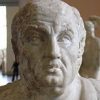
There are conditions of blindness so voluntary that they become complicity.

If you are neutral in situations of injustice, you have chosen the side of the oppressor. If an elephant has its foot on the tail of a mouse and you say that you are neutral, the mouse will not appreciate your neutrality.
Desmond Tutu (1931-2021) South African cleric, Anglican Archbishop of Cape Town, Nobel Laureate
(Attributed)
To ignore evil is to become an accomplice to it.
Martin Luther King, Jr. (1929-1968) American clergyman, civil rights leader, social activist, preacher
Where Do We Go from Here: Chaos or Community? (1967)
(Source)
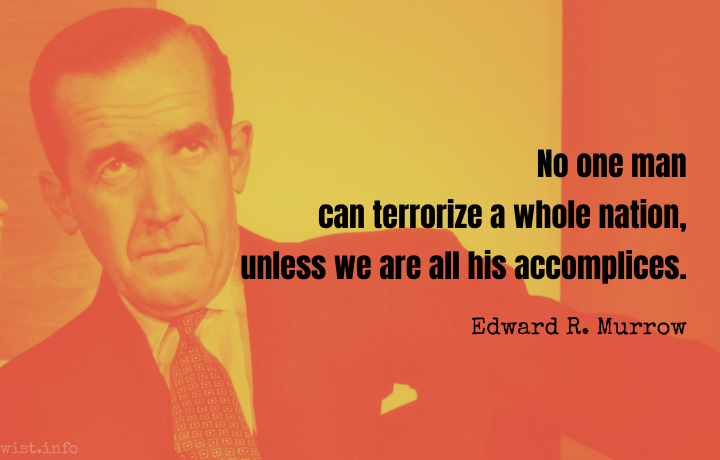
No one man can terrorize a whole nation, unless we are all his accomplices.
Edward R. Murrow (1908-1965) American journalist
See It Now (7 Mar 1954)
(Source)
Comment to the production team before the episode on Senator Joseph R McCarthy’s Communist witch hunt.
A man dies when he refuses to stand up for that which is right. A man dies when he refuses to stand up for justice. A man dies when he refuses to take a stand for that which is true.
Martin Luther King, Jr. (1929-1968) American clergyman, civil rights leader, social activist, preacher
Sermon, Selma, Alabama (8 Mar 1965)
Possibly the source of the uncited attributions (or variants) "Our lives begin to end the day we become silent about things that matter" and "The day we see the truth and cease to speak is the day we begin to die."