

My business, my art, is to live my life. If anyone forbids me to talk about it according to my own sense, experience and practice, let him also command an architect to talk about buildings not according to his own standard but his next-door neighbour’s, according to somebody else’s knowledge not his own.
[Mon mestier & mon art, c’est vivre. Qui me defend d’en parler selon mon sens, experience & usage : qu’il ordonne à l’architecte de parler des bastimens non selon soy, mais selon son voisin, selon la science d’un autre, non selon la sienne.]
Michel de Montaigne (1533-1592) French essayist
Essays, Book 2, ch. 6 (2.6), “Of Practice [De l’exercitation]” (1574?) [tr. Screech (1987)]
(Source)
(Source (French)). Alternate translations:My arte and profession, is to live. Who forbids mee to speake of it, according to my sense, experience, and custome? Let him appoint the Architect to speake of buildings, not according to himselfe, but his neighbours, according to anothers skill, and not his owne.
[tr. Florio (1603)]My art and business is to live. He that forbids me to speak according to my own sense, experience, and practice, may as well enjoin an architect to speak of buildings not in his own style, but in his neighbour's; not according to his own science, but according to another man's.
[tr. Cotton (1686)]My trade and art is to live; he that forbids me to speak according to my own sense, experience, and practice, may as well enjoin an architect not to speak of building according to his own knowledge, but according to that of his neighbor; according to the knowledge of another, and not according to his own.
[tr. Cotton/Hazlitt (1877)]My profession and my art is living. Whoever forbids me to speak of this according to my perceptions, experience, and habit, let him bid the architect talk about buildings, not according to his own ideas, but according to those of his neighbour; according to another's knowledge, not according to his own.
[tr. Ives (1925)]My trade and my art is to live. He that forbids me to speak of it according to my own sense, experience, and practice, let him command an architect to speak of buildings not in his own style but his neighbour's, according to another man's knowledge, not according to his own.
[tr. Zeitlin (1934)]My trade and my art is living. He who forbids me to speak about it according to my sense, experience, and practice, let him order the architect to speak of buildings not according to himself but according to his neighbor; according to another man’s knowledge, not according to his own.
[tr. Frame (1943)]Living is my job and my art.
[ed. Rat (1958)]Living is my work, and my art. Let anyone who forbids me to speak of it according to my understanding, experience, and practice order an architect to speak of his buildings according, not to himself, but to his neighbor; according to his knowledge, not his own.
[tr. Atkinson/Sices (2012)]
Quotations about:
expertise
Note not all quotations have been tagged, so Search may find additional quotes on this topic.

CHRYSALE: As for me, I’d prefer that, while peeling the veggies,
She misaligns a few subjects and verbs,
And repeats fifty times a low and vulgar word,
Than that she burns my meat or over-salts my stew.
I live on good soup, not on fine language.[J’aime bien mieux, pour moi, qu’en épluchant ses herbes,
Elle accommode mal les noms avec les verbes,
Et redise cent fois un bas ou méchant mot,
Que de brûler ma viande ou saler trop mon pot.
Je vis de bonne soupe, et non de beau langage.]Molière (1622-1673) French playwright, actor [stage name for Jean-Baptiste Poquelin]
Les Femmes Savantes [The Learned Ladies], Act 2, sc. 7, (1692) [tr. Marks (2018)]
(Source)
(Source (French)). Other translations:For my part, I had much rather that she join'd the Nouns and Verbs falsely, and repeated a servile bad Word a hundred times in picking her Herbs, than have her burn my Meat or oversalt my Broth. I live by good Soup, and not by fine Language.
[tr. Clitandre (1739)]I would rather, I would, that in cleaning the vegetables she should make the verbs agree ill with the nouns, and say a hundred times a low or bad word, than that she should burn my meat or put too much salt in my soup; I live on good soup;, and not on fine language.
[tr. Van Laun (1876)]I had much rather that while picking her herbs, she should join wrongly the nouns to the verbs, and repeat a hundred times a coarse or vulgar word, than that she should burn my roast, or put too much salt in my broth. I live on good soup, and not on fine language.
[tr. Wall (1879), The Learned Women]For my part, I had much rather that in picking her herbs she made the nouns and the verbs agree wrongly and repeated some outrageous word a hundred times, than have her burn my meat or oversalt my broth. I live by good soup, and not by fine language.
[tr. Matthew (1890), The Blue-Stockings]For my part, I'd rather she would make a mess of nouns and verbs, or use a low and vulgar word a dozen times a day, than burn my meat and oversalt my soup. Good food is what I live on, not fine language.
[tr. Wormeley (1895), The Female Pedants]Truly, I would much rather she failed to make her nouns agree with her verbs while washing her vegetables, and indulged in low or bad words a hundred times over, than burn my meat or oversalt my soup. I live by good soup, and not on fine language.
[tr. Waller (1903)]I'd rather have her, while she cleans her salad,
Make verbs and subjects disagree, and say
Some low or vulgar word a hundred times,
Than burn my roast or over-salt my broth.
I live on well-cooked food, and not fine language.
[tr. Page (1908)]For my part, I would rather that, while peeling her vegetables, she makes her verbs agree badly with her nouns and repeats a hundred times a low or bad word, than that she burns my meat or puts too much salt into my soup. I live by good soup and not by beautiful language.
[tr. Waldinger (1967)]If she makes a tasty salad, it seems to me
Her subjects and her verbs need not agree.
Let all her talk be barbarous, if she’ll not
Burn up my beef or over-salt the pot.
It’s food, not language, that I’m nourished by.
[tr. Wilbur (1977)]Her crudités for salad were sublime,
So if her verbal crudité's a crime
She has atoned for it in her cuisine.
Her language and her legumes may be green
But when my appetite rears up its voice,
The latter, not the former is its choice.
[tr. Thomas (2005 ed.)]
You will always find some Eskimos ready to instruct the Congolese on how to cope with heat waves.
Stanislaw Lec (1909-1966) Polish aphorist, poet, satirist
Unkempt Thoughts [Myśli nieuczesane] (1957) [tr. Gałązka (1962)]
(Source)

Some free advice for you: Never fight an old man. They’ve been there, done that, written the book, made and starred in the movie, designed the T-shirt, and they’ve got no ego at all about how the fight gets won.

Experts are never right or wrong; they win or lose. Right and wrong are decided by proof; winning and losing are decided by who is doing the talking or talks the loudest, has the last, latest, or only word, and is quoted by reporters.
(Other Authors and Sources)
M. A. Zeidner, “Experts: A Definition” Quarterly Review of Doublespeak (Oct 1988)

An expert is a man who has stopped thinking. Why? He knows.
Frank Lloyd Wright (1867-1959) American architect, interior designer, writer, educator [b. Frank Lincoln Wright]
In Geoffrey T Hellman, “Wright Revisited,” The New Yorker (8 Jun 1956)
(Source)
Wright used variations on this quotation throughout his life, e.g.:The expert is usually a man who has stopped thinking and so is perfectly able to be utterly wrong for at least the rest of his lifetime. He has made up his mind, not upon principle, but upon expedient practice.
[Source, Frank Lloyd Wright: An Autobiography, Book 5 "Form" (1943)]An expert? Generally a man who has stopped thinking because he knows!
[Source]An expert is a man who has stopped thinking -- he knows.
[Source, in Earl Nesbit, Taliesin Reflections (2006)]To me an expert is a man who has stopped thinking. He thinks he knows everything.
[Source, in Patrick J. Meehan, Truth Against the World (1987)]Now, an "expert" is a man who has stopped thinking. He has had to stop thinking or he would be no expert. You can't call a man an "authority" who is growing and so changing his mind about things, can you? No, the expert has got to know or profess he knows. He's got to stand there and be knowledgeable! Well, too bad, because there's no such human except he be somewhat a phoney.
[Source, in Patrick J. Meehan, Truth Against the World (1987)]An expert is a man who has stopped thinking because he knows and you can do nothing with him if you got a good idea.
[Source, in Patrick J. Meehan, The Master Architect (1984)
But don’t you know, there are some things that can beat smartness and foresight? Awkwardness and stupidity can. The best swordsman in the world doesn’t need to fear the second best swordsman in the world; no, the person for him to be afraid of is some ignorant antagonist who has never had a sword in his hand before; he doesn’t do the thing he ought to do, and so the expert isn’t prepared for him; he does the thing he ought not to do: and often it catches the expert out and ends him on the spot.
Mark Twain (1835-1910) American writer [pseud. of Samuel Clemens]
A Connecticut Yankee in King Arthur’s Court, ch. 34 (1889)
(Source)
Origin of more simplified versions of the phrase. More discussion: The Best Swordsman in the World Doesn’t Need To Fear the Second Best Swordsman – Quote Investigator.
Teaching takes skill and education and dedication. Home schooling as an idea is on a par with home dentistry.
Dick Cavett (b. 1936) American writer and critic
“Schooling Santorum,”New York Times (24 Feb 2012)
(Source)
I guess, when you get down to it, a loving touch compensates for an unskilled hand about everywhere except in an airplane cockpit.
Robert Brault (b. c. 1945) American aphorist, programmer
(Attributed)

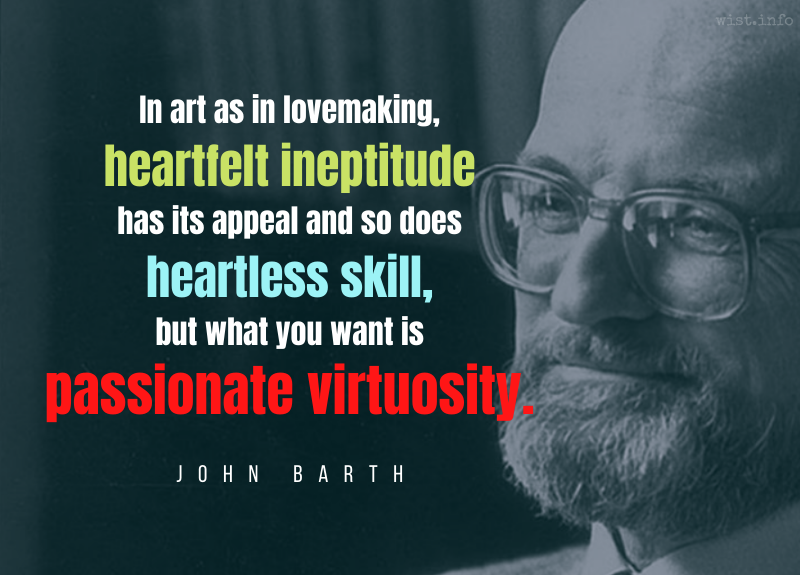
My feeling about technique in art is that it has about the same value as technique in love-making. That is to say, on the one hand, heartfelt ineptitude has its appeal and, on the other hand, so does heartless skill; but what you want is passionate virtuosity.
John Barth (1930-2024) American writer
“An Interview with John Barth,” by Alan Prince and Ian Carruthers, Prism (Spring 1968)
(Source)
The quotation from the interview (originally credited only to Prince) was also included in the inside dust cover of Barth's short story collection, Lost in the Funhouse (1968), and is sometimes cited to that book.
The longer quote was paraphrased to the form in the graphic above on the dust cover of Charles B. Harris, Passionate Virtuosity: The Fiction of John Barth (1983):In art as in lovemaking, heartfelt ineptitude has its appeal and so does heartless skill, but what you want is passionate virtuosity.
Harris later gives the full quotation inside his book.
Also used by Barth in "Dunyazadiad," Esquire (1972-07-01), reprinted in Chimera (1972):Heartfelt ineptitude has its appeal, Dunyazade; so does heartless skill. But what you want is passionate virtuosity.
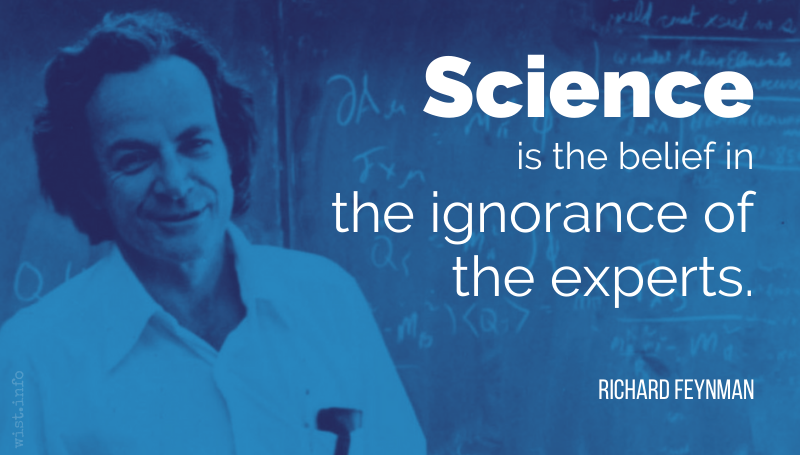
Science is the belief in the ignorance of the experts.
Richard Feynman (1918-1988) American physicist
“What Is Science?” address, National Science Teachers Association, New York (1966)
(Source)
If I want to stop a research program I can always do it by getting a few experts to sit in on the subject, because they know right away that it was a fool thing to try in the first place.
Charles F. Kettering (1876-1958) American inventor, engineer, researcher, businessman
(Attributed)
Those indeed who attain any excellence, commonly spend life in one pursuit; for excellence is not often gained upon easier terms.
Samuel Johnson (1709-1784) English writer, lexicographer, critic
Lives of the Most Eminent English Poets, “Pope” (1781)
(Source)
Also known as Lives of English Poets and Lives of the Poets.
Love what you do. Get good at it. Competence is a rare commodity in this day and age. And let the chips fall where they may.
Jon Stewart (b. 1962) American satirist, comedian, and television host. [b. Jonathan Stuart Leibowitz]
Commencement Address, College of William & Mary (2004-05-20)
(Source)


Where facts are few, experts are many.
(Other Authors and Sources)
Donald Gannon
The function of the expert is not to be more right than other people, but to be wrong for more sophisticated reasons.
David Butler (b. 1924) British social scientist, psephologist
The Observer (1969)