

The tendency of bureaucracy [is] to find purpose in whatever it is doing.
John Kenneth Galbraith (1908-2006) Canadian-American economist, diplomat, author
“Foreign Policy: The Plain Lessons of a Bad Decade,” Foreign Policy (Dec 1970)
Quotations by:
Galbraith, John Kenneth
Let’s begin with capitalism, a word that has gone largely out of fashion. The approved reference now is to the market system. This shift minimizes — indeed, deletes — the role of wealth in the economic and social system. And it sheds the adverse connotation going back to Marx. Instead of the owners of capital or their attendants in control, we have the admirably impersonal role of market forces. It would be hard to think of a change in terminology more in the interest of those to whom money accords power. They have now a functional anonymity.
John Kenneth Galbraith (1908-2006) Canadian-American economist, diplomat, author
“Free Market Fraud”, The Progressive (Jan 1999)
Much literary criticism comes from people for whom extreme specialization is a cover for either grave cerebral inadequacy or terminal laziness, the latter being a much cherished aspect of academic freedom.
John Kenneth Galbraith (1908-2006) Canadian-American economist, diplomat, author
“H.L. Mencken,” The Washington Post (14 Sep 1980)
Mr. David Stockman has said that supply-side economics was merely a cover for the trickle-down approach to economic policy — what an older and less elegant generation called the horse-and-sparrow theory: If you feed the horse enough oats, some will pass through to the road for the sparrows.
John Kenneth Galbraith (1908-2006) Canadian-American economist, diplomat, author
“Recession Economics,” New York Review of Books (1982-02-04)
(Source)
There are few ironclad rules of diplomacy, but to one there is no exception. When an official reports that talks were useful, it can safely be concluded that nothing was accomplished.
John Kenneth Galbraith (1908-2006) Canadian-American economist, diplomat, author
“The American Ambassador,” Foreign Service Journal (Jun 1969)
In the usual (though certainly not in every) public decision on economic policy, the choice is between courses that are almost equally good or equally bad. It is the narrowest decisions that are most ardently debated. If the world is lucky enough to enjoy peace, it may even one day make the discovery, to the horror of doctrinaire free-enterprisers and doctrinaire planners alike, that what is called capitalism and what is called socialism are both capable of working quite well.
John Kenneth Galbraith (1908-2006) Canadian-American economist, diplomat, author
“The American Economy: Its Substance and Myth” (1949)
A nuclear war does not defend a country and it does not defend a system. I’ve put it the same way many times; not even the most accomplished ideologue will be able to tell the difference between the ashes of capitalism and the ashes of communism.
John Kenneth Galbraith (1908-2006) Canadian-American economist, diplomat, author
“The Ashes of Capitalism and the Ashes of Communism,” interview (undated) with John M. Whiteley in Quest for Peace: an Introduction (1986)
There is something uniquely obscene about competition to promote weapons of mass destruction for the purposes of improving the stock market position of a corporation.
John Kenneth Galbraith (1908-2006) Canadian-American economist, diplomat, author
“The Big Defense Firms are Really Public Firms and Should Be Nationalized,” The New York Times Magazine (16 Nov 1969)
In a predatory economy, the rules imagined by the law and economics crowd don’t apply. There’s no market discipline. Predators compete not by following the rules but by breaking them. They take the business-school view of law: Rules are not designed to guide behavior but laid down to define the limits of unpunished conduct. Once one gets close to the line, stepping over it is easy. A predatory economy is criminogenic: It fosters and rewards criminal behavior.
John Kenneth Galbraith (1908-2006) Canadian-American economist, diplomat, author
“The Predator State,” Mother Jones (May/Jun 2006)
(Source)
Among all the world’s races, some obscure Bedouin tribes possibly apart, Americans are the most prone to misinformation. This is not the consequence of any special preference for mendacity, although at the higher levels of their public administration that tendency is impressive. It is rather that so much of what they themselves believe is wrong.
John Kenneth Galbraith (1908-2006) Canadian-American economist, diplomat, author
“The United States,” New York magazine (15 Nov 1971)
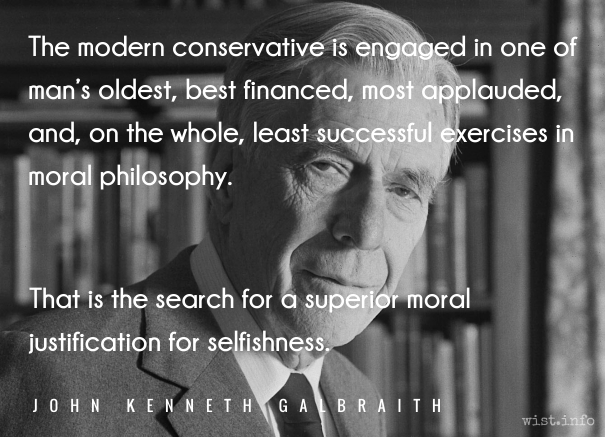
The modern conservative is not even especially modern. He is engaged, on the contrary, in one of man’s oldest, best financed, most applauded, and, on the whole, least successful exercises in moral philosophy. That is the search for a superior moral justification for selfishness. It is an exercise which always involves a certain number of internal contradictions and even a few absurdities. The conspicuously wealthy turn up urging the character-building value of privation for the poor. The man who has struck it rich in minerals, oil, or other bounties of nature is found explaining the debilitating effect of unearned income from the state. The corporate executive who is a superlative success as an organization man weighs in on the evils of bureaucracy. Federal aid to education is feared by those who live in suburbs that could easily forgo this danger, and by people whose children are in public schools. Socialized medicine is condemned by men emerging from Walter Reed Hospital. Social Security is viewed with alarm by those who have the comfortable cushion of an inherited income. Those who are immediately threatened by public efforts to meet their needs — whether widows, small farmers, hospitalized veterans, or the unemployed — are almost always oblivious to the danger.
John Kenneth Galbraith (1908-2006) Canadian-American economist, diplomat, author
“Wealth and Poverty,” speech, National Policy Committee on Pockets of Poverty (13 Dec 1963)
Galbraith used variations on this quote over the years.
- The above quotation was from a speech given, that was then entered into the Congressional Record, Vol. 109, Senate (18 Dec 1963).
- This material was reworked into an article "Let us begin: An invitation to action on poverty," in Harper's (March 1964), which was in turn again entered into the Congressional Record, Vol. 110 (1964).
- One of the last is most often cited: "The modern conservative is engaged in one of man’s oldest exercises in moral philosophy, that is the search for a superior moral justification for selfishness. It is an exercise which always involves a certain number of internal contradictions and even a few absurdities. The conspicuously wealthy turn up urging the character-building value of privation for the poor." ["Stop the Madness," Interview with Rupert Cornwell, Toronto Globe and Mail (6 Jul 2002)]
Despite considerable propaganda to the contrary, the greatest need of the moment is not a decision to be tender to the well-to-do. Their situation is not so desperate as popularly represented. Also one makes an economy work not by rewarding the rich but by rewarding all who contribute to its success.
John Kenneth Galbraith (1908-2006) Canadian-American economist, diplomat, author
“Wealth and Poverty,” speech, National Policy Committee on Pockets of Poverty (13 Dec 1963)
(Source)
Even the protective functions of the state are most important for those in the lower income brackets. Lethal serum and poison drugs do, one gathers, work rather democratically on rich and poor alike. But many of us could probably survive a certain amount of exploitation in our prescriptions, fraud in our food packaging, mendacity in our dental advertising, or thimblerigging in our securities. We live in parts of cities where epidemics are less likely. The family that struggles to make ends meet, the widow with life-insurance money around loose, the dwellers in urban tenements need the protection of an alert FTC, FDA, SEC, and Public Health Service.
John Kenneth Galbraith (1908-2006) Canadian-American economist, diplomat, author
“Wealth and Poverty,” Speech, National Policy Committee on Pockets of Poverty (13 Dec 1963)
See sourcing notes here.
Public services have, to use the economist’s word, a strong redistributional effect. And this effect is strongly in favor of those with lower incomes. Those who clamor the loudest for public economy are those for whom public services do the least. Tax reduction that curtails or limits public services has a double effect in comforting the comfortable and afflicting the poor.
John Kenneth Galbraith (1908-2006) Canadian-American economist, diplomat, author
“Wealth and Poverty,” Speech, National Policy Committee on Pockets of Poverty (13 Dec 1963)
See sourcing notes here.
Who’d have thought we were fighting this war against a bunch of jerks.
John Kenneth Galbraith (1908-2006) Canadian-American economist, diplomat, author
(Attributed, 1946)
On seeing the line-up of Nazi war criminals accused at Nuremburg. In Alex Ross, "Watching for a Judgment of Real Evil," New York Times (12 Nov 1995)
It is almost as important to know what is not serious as to know what is.
John Kenneth Galbraith (1908-2006) Canadian-American economist, diplomat, author
(Attributed)
We have two classes of forecasters: those who don’t know and those who know they don’t know.
John Kenneth Galbraith (1908-2006) Canadian-American economist, diplomat, author
(Attributed)
Variants:
- There are two classes of people who tell what is going to happen in the future: Those who don't know, and those who don't know they don't know.
- You can divide the world into those who don't know and those who don't know they don't know.
- There are those who don't know, and there are those who don't know they don't know.
- We have two kinds of forecasters: Those who don't know ... and those who don't know they don't know.
- There are two kinds of economists: those who don't know the future, and those who don't know they don't know.
The experience of being disastrously wrong is salutary; no economist should be denied it, and not many are.
John Kenneth Galbraith (1908-2006) Canadian-American economist, diplomat, author
A Life in Our Times, ch. 11 (1981)
Under capitalism, man exploits man. Under communism, it’s just the opposite.
John Kenneth Galbraith (1908-2006) Canadian-American economist, diplomat, author
A Life in Our Times, ch. 22 (1981)
Variant: "Under capitalism, man exploits man. And under Communism it is just the reverse." Galbraith refers to it as an old Polish joke.
Television newsmen are breathless on how the game is being played, largely silent on what the game is all about.
John Kenneth Galbraith (1908-2006) Canadian-American economist, diplomat, author
A Life in Our Times, ch. 3 (1981)
Then the shit hit the fan.
John Kenneth Galbraith (1908-2006) Canadian-American economist, diplomat, author
Ambassador’s Journal (1969)
Galbraith claims to have coined this phrase (see A Life In Our Times (1981))
Where humor is concerned there are no standards — no one can say what is good or bad, although you can be sure that everyone will.
John Kenneth Galbraith (1908-2006) Canadian-American economist, diplomat, author
Annals of an Abiding Liberal (1979)
The salary of the chief executive of the large corporation is not a market award for achievement. It is frequently in the nature of a warm personal gesture by the individual to himself.
John Kenneth Galbraith (1908-2006) Canadian-American economist, diplomat, author
Annals of an Abiding Liberal, ch. 6 (1979)
People are the common denominator of progress. So, paucis verbis, no improvement is possible with unimproved people, and advance is certain when people are liberated and educated. It would be wrong to dismiss the importance of roads, railroads, power plants, mills, and the other familiar furniture of economic development. At some stages of development — the stage that India and Pakistan have reached, for example — they are central to the strategy of development. But we are coming to realize, I think, that there is a certain sterility in economic monuments that stand alone in a sea of illiteracy. Conquest of illiteracy comes first.
John Kenneth Galbraith (1908-2006) Canadian-American economist, diplomat, author
Economic Development (1964)
Few things are more tempting for a writer than to repeat, admiringly, what he has said before.
John Kenneth Galbraith (1908-2006) Canadian-American economist, diplomat, author
Economics and the Public Purpose, Introduction (1973)
Faced with the choice between changing one’s mind and proving there is no need to do so, almost everyone gets busy on the proof.
John Kenneth Galbraith (1908-2006) Canadian-American economist, diplomat, author
Economics, Peace and Laughter (1971)
(Source)
(also called "Galbraith's Law")
The study of money, above all other fields in economics, is the one in which complexity is used to disguise truth or to evade truth, not to reveal it.
John Kenneth Galbraith (1908-2006) Canadian-American economist, diplomat, author
Money: Whence It Came, Where It Went, ch. 1 (1975)
If all else fails, immortality can always be assured by adequate error.
John Kenneth Galbraith (1908-2006) Canadian-American economist, diplomat, author
Money: Whence It Came, Where It Went, ch. 13 “The Self Inflicted Wounds” (1975)
Sometimes misquoted as "... by spectacular error".
The ability of the rich and their acolytes to see social virtue in what serves their interest and convenience and to depict as ridiculous or foolish what does not was never better manifested than in their support of gold and their condemnation of paper money.
John Kenneth Galbraith (1908-2006) Canadian-American economist, diplomat, author
Money: Whence It Came, Where It Went, ch. 9 (1975)
(Source)
In economics, hope and faith coexist with great scientific pretension and also a deep desire for respectability.
John Kenneth Galbraith (1908-2006) Canadian-American economist, diplomat, author
New York Times Magazine (7 Jun 1970)
Wealth is not without its advantages, and the case to the contrary, although it has often been made, has never proved widely persuasive.
John Kenneth Galbraith (1908-2006) Canadian-American economist, diplomat, author
The Affluent Society, ch. 1, sec. 1 (1958)
(Source)
It is a far, far better thing to have a firm anchor in nonsense than to put out on the troubled sea of thought.
John Kenneth Galbraith (1908-2006) Canadian-American economist, diplomat, author
The Affluent Society, ch. 11, sec. 4 (1958)
Few things are so immutable as the addiction of political groups to the ideas by which they have once won office.
John Kenneth Galbraith (1908-2006) Canadian-American economist, diplomat, author
The Affluent Society, ch. 13, sec. 4 (1958)
The enemy of the conventional wisdom is not ideas but the march of events.
John Kenneth Galbraith (1908-2006) Canadian-American economist, diplomat, author
The Affluent Society, ch. 2, sec. 4 (1958)
The rule of ideas is only powerful in a world that does not change. Ideas are inherently conservative. They yield not to the attack of other ideas but to the massive onslaught of circumstance with which they cannot contend.
John Kenneth Galbraith (1908-2006) Canadian-American economist, diplomat, author
The Affluent Society, ch. 2, sec. 6 (1958)
(Source)
In the affluent society no sharp distinction can be made between luxuries and necessaries.
John Kenneth Galbraith (1908-2006) Canadian-American economist, diplomat, author
The Affluent Society, ch. 21, sec. 4 (1998, 4th ed.)
(Source)
On sales taxes. Sometimes quoted (from other editions?) as "useful distinction."
“Poverty,” Pitt exclaimed, “is no disgrace but it is damned annoying.” In the contemporary United States it is not annoying but it is a disgrace.
John Kenneth Galbraith (1908-2006) Canadian-American economist, diplomat, author
The Affluent Society, ch. 23, sec. 6 (1958)
(Source)
Private enterprise did not get us atomic energy.
John Kenneth Galbraith (1908-2006) Canadian-American economist, diplomat, author
The Affluent Society, ch. 25, sec. 3 (1958)
Money is a singular thing. It ranks with love as man’s greatest source of joy. And with death as his greatest source of anxiety.
John Kenneth Galbraith (1908-2006) Canadian-American economist, diplomat, author
The Age of Anxiety, ch. 6 “The Rise and Fall of Money” (1977)
(Source)
All of the great leaders have had one characteristic in common: it was the willingness to confront unequivocally the major anxiety of their people in their time. This, and not much else, is the essence of leadership.
John Kenneth Galbraith (1908-2006) Canadian-American economist, diplomat, author
The Age of Uncertainty, ch. 12 (1977)
When people put their ballots in the boxes, they are, by that act, inoculated against the feeling that the government is not theirs. They then accept, in some measure, that its errors are their errors, its aberrations their aberrations, that any revolt will be against them. It’s a remarkably shrewd and rather conservative arrangement when one thinks of it.
John Kenneth Galbraith (1908-2006) Canadian-American economist, diplomat, author
The Age of Uncertainty, ch. 12 (1977)
(Source)
Do not be alarmed by simplification; complexity is often a device for claiming sophistication, or for evading simple truths.
John Kenneth Galbraith (1908-2006) Canadian-American economist, diplomat, author
The Age of Uncertainty (BBC TV) (1977)
People of privilege will always risk their complete destruction rather than surrender any material part of their advantage.
John Kenneth Galbraith (1908-2006) Canadian-American economist, diplomat, author
The Age of Uncertainty, ch. 1 (1977)
The privileged have regularly invited their own destruction with their greed.
John Kenneth Galbraith (1908-2006) Canadian-American economist, diplomat, author
The Age of Uncertainty, ch. 10 (1977)
The man who is admired for the ingenuity of his larceny is almost always rediscovering some earlier form of fraud. The basic forms are all known, have all been practiced. The manners of capitalism improve. The morals may not.
John Kenneth Galbraith (1908-2006) Canadian-American economist, diplomat, author
The Age of Uncertainty, ch. 2 (1977)
All successful revolutions are the kicking in of a rotten door.
John Kenneth Galbraith (1908-2006) Canadian-American economist, diplomat, author
The Age of Uncertainty, ch. 3 “The Massive Dissent of Karl Marx” (1977)
All successful revolutions are the kicking in of a rotten door.
John Kenneth Galbraith (1908-2006) Canadian-American economist, diplomat, author
The Age of Uncertainty, ch. 3 (1977)
The myth that holds that the great corporation is the puppet of the market, the powerless servant of the consumer, is, in fact one of the devices by which its power is perpetuated.
John Kenneth Galbraith (1908-2006) Canadian-American economist, diplomat, author
The Age of Uncertainty, ch. 9 (1977)
People of privilege will always risk their complete destruction rather than surrender any material part of their advantage. Intellectual myopia, often called stupidity, is no doubt a reason.
John Kenneth Galbraith (1908-2006) Canadian-American economist, diplomat, author
The Age of Uncertainty, Chapter 1, (1977)
Long run salvation by men of business has never been highly regarded if it means disturbance of orderly life and convenience in the present. So inaction will be advocated in the present even though it means deep trouble in the future. Here, at least equally with communism, lies the threat to capitalism. It is what causes men who know that things are going quite wrong to say that things are fundamentally sound.
John Kenneth Galbraith (1908-2006) Canadian-American economist, diplomat, author
The Great Crash, 1929, ch. 10 “Cause and Consequence” (1954)
The causes of the Great Depression are still far from certain. A lack of certainty, it may also be observed, is not evident in the contemporary writing on the subject. Much of it tells what went wrong and why with marked firmness. However, this paradoxically can itself be an indication of uncertainty. When people are least sure they are often most dogmatic.
John Kenneth Galbraith (1908-2006) Canadian-American economist, diplomat, author
The Great Crash, 1929, ch. 9 “Cause and Consequence,” sec. 3 (1954)
(Source)
Writing is a long and lonesome business; back of the problems in thought and composition hover always the awful questions: Is this the page that shows the empty shell? Is it here and now that they find me out?
John Kenneth Galbraith (1908-2006) Canadian-American economist, diplomat, author
The Great Crash, 1929, Introduction, Sec. 1 (1954)
We can safely abandon the doctrine of the eighties, namely that the rich were not working because they had too little money, the poor because they had much.
John Kenneth Galbraith (1908-2006) Canadian-American economist, diplomat, author
The Guardian (20 Nov 1991)
People who are in a fortunate position always attribute virtue to what makes them so happy.
John Kenneth Galbraith (1908-2006) Canadian-American economist, diplomat, author
The Guardian (23 May 1992)
There’s a certain part of the contented majority who love anybody who is worth a billion dollars.
John Kenneth Galbraith (1908-2006) Canadian-American economist, diplomat, author
The Guardian (23 May 1992)
The contented and economically comfortable have a very discriminating view of government. Nobody is ever indignant about bailing out failed banks and failed savings and loans associations. … But when taxes must be paid for the lower middle class and poor, the government assumes an aspect of wickedness.
John Kenneth Galbraith (1908-2006) Canadian-American economist, diplomat, author
The Guardian (25 May 1992)
In all life one should comfort the afflicted, but verily, also, one should afflict the comfortable, and especially when they are comfortably, contentedly, even happily wrong.
John Kenneth Galbraith (1908-2006) Canadian-American economist, diplomat, author
The Guardian (28 Jul 1989)
Also attributed to Clarence Darrow.
In any great organization it is far, far safer to be wrong with the majority than to be right alone.
John Kenneth Galbraith (1908-2006) Canadian-American economist, diplomat, author
The Guardian (28 Jul 1989)
There is something wonderful in seeing a wrong-headed majority assailed by truth.
John Kenneth Galbraith (1908-2006) Canadian-American economist, diplomat, author
The Guardian (28 Jul 1989)
There is something wonderful in seeing a wrong-headed majority assailed by truth.
John Kenneth Galbraith (1908-2006) Canadian-American economist, diplomat, author
The Guardian (28 Jul 1989)
That one never need to look beyond the love of money for explanation of human behavior is one of the most jealously guarded simplification of our culture.
John Kenneth Galbraith (1908-2006) Canadian-American economist, diplomat, author
The New Industrial State, ch. 12, sec. 1, (1967)
There is an insistent tendency among serious social scientists to think of any institution which features rhymed and singing commercials, intense and lachrymose voices urging highly improbable enjoyment, caricatures of the human esophagus in normal and impaired operation, and which hints implausibly at opportunities for antiseptic seduction as inherently trivial. This is a great mistake. The industrial system is profoundly dependent on commercial television and could not exist in its present form without it.
John Kenneth Galbraith (1908-2006) Canadian-American economist, diplomat, author
The New Industrial State, ch. 18, sec. 5 (1967)
Wealth, in even the most improbable cases, manages to convey the aspect of intelligence.
John Kenneth Galbraith (1908-2006) Canadian-American economist, diplomat, author
The Sydney Morning Herald (22 May 1982)
You will find that State is the kind of organization which, though it does big things badly, does small things badly, too.
John Kenneth Galbraith (1908-2006) Canadian-American economist, diplomat, author
Conversation with author, Charles Frankel, High on Foggy Bottom (1969)
Referring to the US State Department.
When you see reference to a new paradigm you should always, under all circumstances, take cover. Because ever since the great tulipmania in 1637, speculation has always been covered by a new paradigm. There was never a paradigm so new and so wonderful as the one that covered John Law and the South Sea Bubble – until the day of disaster.
John Kenneth Galbraith (1908-2006) Canadian-American economist, diplomat, author
In B. Laurance, W. Keegan, “Galbraith on crashes, Japan and Walking Sticks”, The Observer (21 Jun 1998)
The worst policy is one made in secrecy by the experts.
John Kenneth Galbraith (1908-2006) Canadian-American economist, diplomat, author
In Michael Leapman, Times (London) (17 Jun 1971)
I react to what is necessary. I would like to eschew any formula. There are some things where the government is absolutely inevitable, which we cannot get along without comprehensive state action. But there are many things — producing consumer goods, producing a wide range of entertainment, producing a wide level of cultural activity — where the market system, which independent activity is also important, so I react pragmatically. Where the market works, I’m for that. Where the government is necessary, I’m for that. I’m deeply suspicious of somebody who says, “I’m in favor of privatization,” or, “I’m deeply in favor of public ownership.” I’m in favor of whatever works in the particular case.
John Kenneth Galbraith (1908-2006) Canadian-American economist, diplomat, author
Interview with Brian Lamb, Booknotes, C-SPAN (13 Nov 1994)
(Source)
One must always have in mind one simple fact — there is no literate population in the world that is poor, and there is no illiterate population that is anything but poor.
John Kenneth Galbraith (1908-2006) Canadian-American economist, diplomat, author
Interview with John Newark (1990)
Recessions catch what the auditors miss.
John Kenneth Galbraith (1908-2006) Canadian-American economist, diplomat, author
Interview with Robert Cornwell, The Independent (1 Jul 2002)
Full text.
Politics is not the art of the possible. It consists in choosing between the disastrous and the unpalatable.
John Kenneth Galbraith (1908-2006) Canadian-American economist, diplomat, author
Letter to Pres. Kennedy (3 Mar 1962)
Quoted in Galbraith, Ambassador’s Journal (1969).