A man compensates for the lack of a talent by despising it. He removes the obstacle he finds between himself and merit, and so finds himself on a plane with those whose work he envies.
[Un homme à qui il manque un talent se dédommage en le méprisant: il ôte cet obstacle qu’il rencontroit entre le mérite et lui; et, par là, se trouve au niveau de celui dont il redoute les travaux.]Charles-Lewis de Secondat, Baron de Montesquieu (1689-1755) French political philosopher
Persian Letters [Lettres Persanes], Letter 145, Usbek to *** (1721) [tr. Healy (1964)]
(Source)
(Source (French)). Alternate translations:A man to whom a talent is wanting, makes himself amends by despising it: he removes that obstacle which was between merit and him, and thereby finds himself on a level with the man whose pen he dreads.
[tr. Ozell (1760 ed.), # 73]When a man is destitute of any particular talent, he indemnifies himself, by expressing his contempt for it; he removes that obstacle which stood between merit and him, and by that means, raises himself to a level with those whom he before feared as rivals.
[tr. Floyd (1762)]When a man lacks a particular talent, he indemnifies himself by despising it: he removes the impediment between him and merit; and in that way finds himself on a level with those of whose works he formerly stood in awe.
[tr. Davidson (1891)]A man who lacks a certain talent compensates himself by despising it: he removes the obstacle placed between him and merit, and thereby finds himself on an equality with the person whose labors he dreads.
[tr. Betts (1897)]A man who lacks a certain talent will compensate himself by despising it; he eliminates the obstacle which blocks his path to excellence, and, as a consequence, sees himself as the equal of the rival whose work he fears.
[tr. Mauldon (2008), # 156]
Quotations about:
scorn
Note not all quotations have been tagged, so Search may find additional quotes on this topic.
The fear of being laughed at makes cowards of us all.
Mignon McLaughlin (1913-1983) American journalist and author
The Neurotic’s Notebook, ch. 10 (1963)
(Source)

One half of the world laughs at the other, and fools are they all.
[La mitad del mundo se está riendo de la otra mitad, con necedad de todos.]
Baltasar Gracián y Morales (1601-1658) Spanish Jesuit priest, writer, philosopher
The Art of Worldly Wisdom [Oráculo Manual y Arte de Prudencia], § 101 (1647) [tr. Jacobs (1892)]
(Source)
(Source (Spanish)). Alternate translations:One part of the world laughs at the other, and both laugh at their common folly.
[Flescher ed. (1685)]Half the world laughs at the other half, even though the lot are fools.
[tr. Fischer (1937)]Half the world is laughing at the other half, and folly rules over all.
[tr. Maurer (1992)]

Oft to the town he turns his eyes,
Whence Dido’s fires already rise.
What cause has lit so fierce a flame
They know not: but the pangs of shame
From great love wronged, and what despair
Can make a baffled woman dare —
All this they know, and knowing tread
The paths of presage, vague and dread.[… moenia respiciens, quae iam infelicis Elissae
conlucent flammis. Quae tantum accenderit ignem,
causa latet; duri magno sed amore dolores
polluto, notumque, furens quid femina possit,
triste per augurium Teucrorum pectora ducunt.]Virgil (70-19 BC) Roman poet [b. Publius Vergilius Maro; also Vergil]
The Aeneid [Ænē̆is], Book 5, l. 4ff (5.4-8) (29-19 BC) [tr. Conington (1866)]
(Source)
Elissa is an alternate name for Dido.
(Source (Latin)). Alternate translations:Viewing unhappy Dido's wals, which shone
With flames, the cause such fire had rais'd, unknown;
But what a woman might in sorrow drown'd,
Struck deep with grief and burning love was found;
And by sad auguries Trojans understand.
[tr. Ogilby (1649)]Then, casting back his eyes, with dire amaze,
Sees on the Punic shore the mounting blaze.
The cause unknown; yet his presaging mind
The fate of Dido from the fire divin'd;
He knew the stormy souls of womankind,
What secret springs their eager passions move,
How capable of death for injur'd love.
Dire auguries from hence the Trojans draw;
Till neither fires nor shining shores they saw.
[tr. Dryden (1697)]... looking back at the walls which now glare with the flames of unfortunate Elisa. What cause may have kindled such a blaze is unknown; but the thought of those cruel agonies that arise from violent love when injured, and the knowledge of what frantic woman can do, led the minds of the Trojans through dismal forebodings.
[tr. Davidson/Buckley (1854)]He saw the city glaring with the flames
Of the unhappy Dido. What had lit
This fire, they knew not; but the cruel pangs
From outraged love, and what a woman's rage
Could do, they know; and through the Trojans' thoughts
Pass sad forebodings of the truth.
[tr. Cranch (1872)]... looking back on the city that even now gleams with hapless Elissa's funeral flame. Why the broad blaze is lit lies unknown; but the bitter pain of a great love trampled, and the knowledge of what woman can do in madness, draw the Teucrians' hearts to gloomy guesses.
[tr. Mackail (1885)]... Still looking back upon the walls now litten by the flame
Of hapless Dido: though indeed whence so great burning came
They knew not; but the thought of grief that comes of love defiled
How great it is, what deed may come of woman waxen wild,
Through woeful boding of the sooth the Teucrians' bosoms bore.
[tr. Morris (1900)]... And backward on the city bent his gaze,
Bright with the flames of Dido. Whence the blaze
Arose, they knew not; but the pangs they knew
When love is passionate, and man betrays,
And what a frantic woman scorned can do,
And many a sad surmise their boding thoughts pursue
[tr. Taylor (1907)]... but when his eyes
looked back on Carthage, they beheld the glare
of hapless Dido's fire. Not yet was known
what kindled the wild flames; but that the pang
of outraged love is cruel, and what the heart
of desperate woman dares, they knew too well,
and sad foreboding shook each Trojan soul.
[tr. Williams (1910)]... looking back on the city walls which now gleam with unhappy Elissa's funeral flames. What cause kindled so great a flame is unknown; but the cruel pangs when deep love is profaned, and knowledge of what a woman can do in frenzy, lead the hearts of the Trojans amid sad forebodings.
[tr. Fairclough (1916)]His gaze went back
To the walls of Carthage, glowing in the flame
Of Dido’s funeral pyre. What cause had kindled
So high a blaze, they did not know, but anguish
When love is wounded deep, and the way of a woman
With frenzy in her heart, they knew too well,
And dwelt on with foreboding.
[tr. Humphries (1951)]He looked back at Carthage's walls; they were lit up now by the death-fires
Of tragic Dido. Why so big a fire should be burning
Was a mystery: but knowing what a woman is capable of
When insane with the grief of having her love cruelly dishonoured
Started a train of uneasy conjecture in the Trojans' minds.
[tr. Day-Lewis (1952)]... gazing
back -- watching where the walls of Carthage glowed
with sad Elissa's flames. They cannot know
what caused so vast a blaze, and yet the Trojans
know well the pain when passion is profaned
and how a woman driven wild can act;
their hearts are drawn through dark presentiments.
[tr. Mandelbaum (1971)]But he kept his eyes
Upon the city far astern, now bright
With poor Elissa's pyre. What caused that blaze
Remained unknown to watchers out at sea,
But what they knew of a great love profaned
In anguish, and a desperate woman's nerve,
Led every Trojan heart into foreboding.
[tr. Fitzgerald (1981)]... looking back at the walls of Carthage, glowing now in the flames of poor Dido's pyre. No one understood what had lit such a blaze, but since they all knew what bitter suffering is caused when a great love is desecrated and what a woman is capable when driven to madness, the minds of the Trojans were filled with dark foreboding.
[tr. West (1990)]... looking back at the city walls that were glowing now with
unhappy Dido’s funeral flames. The reason that such a fire had
been lit was unknown: but the cruel pain when a great love is
profaned, and the knowledge of what a frenzied woman might do,
drove the minds of the Trojans to sombre forebodings.
[tr. Kline (2002)]... he glanced back at the walls of Carthage
set aglow by the fires of tragic Dido’s pyre.
What could light such a conflagration? A mystery --
but the Trojans know the pains of a great love
defiled, and the lengths a woman driven mad can go,
and it leads their hearts down ways of grim foreboding.
[tr. Fagles (2006)]... gazing back at city walls lit up by the flames -- poor Dido's pyre. No one knew what caused the blaze, but they knew the great grief of a love betrayed and what a woman's passion could unleash. Their hearts were somber with foreboding.
[tr. Bartsch (2021)]
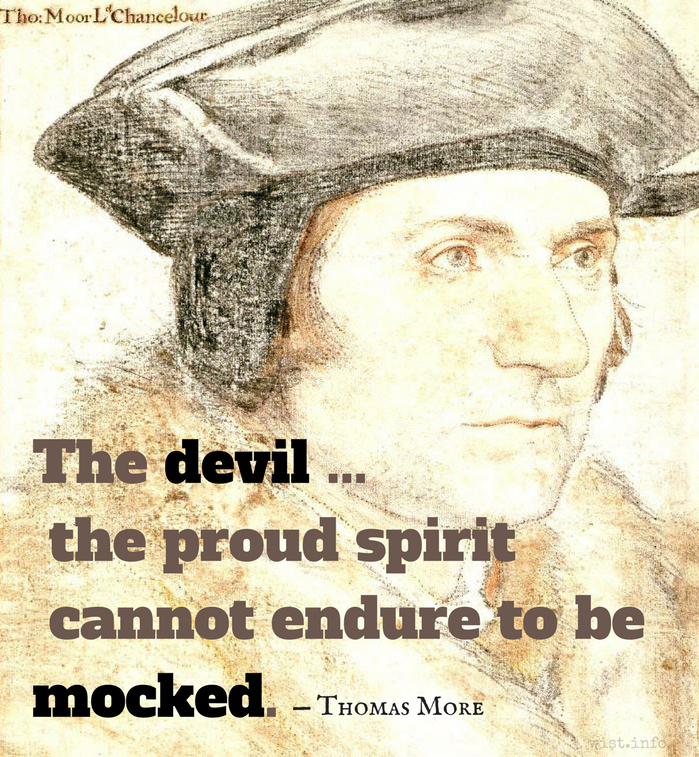
Some folk have been clearly rid of such pestilent fancies with very full contempt of them, making a cross upon their hearts and bidding the devil avaunt. And sometimes they laugh him to scorn, too, and then turn their mind unto some other matter. And when the devil hath seen that they have set so little by him, after certain essays, made in such times as he thought most fitting, he hath given that temptation quite over. And this he doth not only because the proud spirit cannot endure to be mocked, but also lest, with much tempting the man to the sin to which he could not in conclusion bring him, he should much increase his merit.
Thomas More (1478-1535) English lawyer, social philosopher, statesman, humanist, Christian martyr
Dialogue of Comfort Against Tribulation, Book 2, sec. 16 (1553)
(Source)
More often elided/paraphrased as "The devil ... the proud spirit cannot endure to be mocked" or "The devil, that proud spirit, cannot endure to be mocked."
C. S. Lewis used a mis-elided version as an epigraph to The Screwtape Letters (1942): "The devil ... the prowde spirit ... cannot endure to be mocked."
Sometimes given in the original (?) spellings: "The deuill ... the prowde spirit, cannot endure to be mock'd."

The best way to drive out the devil, if he will not yield to texts of Scripture, is to jeer and flout him, for he cannot bear scorn.
Martin Luther (1483-1546) German priest, theologian, writer, religious reformer
Table Talk
(Source)
Variations:
- "The best way to drive out the devil, if he will not go for texts of Scripture, is to jeer and flout him, for he cannot bear scorn."
- The best way to expel the devil, if he will not depart for texts from Holy Scripture, is to jeer and flout him. [Source]


There are few mortals so insensible that their affections cannot be gained by mildness; their confidence by sincerity; their hatred by scorn or neglect.
Johann Georg Zimmermann (1728-1795) Swiss philosophical writer, naturalist, physician
Aphorisms and Reflections on Men, Morals and Things (1800)
(Source)
To avoid dissensions we should ever be on our guard, more especially with those who drive us to argue with them, with those who vex and irritate us, and who say things likely to excite us to anger. When we find ourselves in company with quarrelsome, eccentric individuals, people who openly and unblushingly say the most shocking things, difficult to put up with, we should take refuge in silence, and the wisest plan is not to reply to people whose behavior is so preposterous.
Those who insult us and treat us contumeliously are anxious for a spiteful and sarcastic reply: the silence we then affect disheartens them, and they cannot avoid showing their vexation; they do all they can to provoke us and to elicit a reply, but the best way to baffle them is to say nothing, refuse to argue with them, and to leave them to chew the cud of their hasty anger. This method of bringing down their pride disarms them, and shows them plainly that we slight and despise them.[Sed etiam ille cavendus; est, qui videri potest, quicumque inritat, quicumque incitat, quicumque exasperat, quicumque incentiva luxuriae aut libidinis suggerit. Quando ergo aliquis nobis convitiatur, lacessit, ad violentiam provocat, ad iurgium vocat: tunc silentium exerceamus, tunc muti fieri non erubescamus. Peccator est enim qui nos provocat, qui iniuriam facit et nos similes sui fieri desiderat.
Denique si taceas, si dissimules, solet dicere: Quid taces? Loquere, si audes; sed non audes, mutus es, elinguem te feci. Si ergo taceas, plus rumpitur; victum sese putat, inrisum, posthabitum atque inlusum.]Ambrose of Milan (339-397) Roman theologian, statesman, Christian prelate, saint, Doctor of the Church [Aurelius Ambrosius]
De Officiis Ministrorum [On the Duties of the Clergy], Book 1, ch. 5, sec. 17-18 (AD 386)
(Source)
(Source (Latin)). Other translation:But he also is to be shunned which is visible whosoever he be that provoketh, whosoever he be that inciteth, whosoever he be that exaspereth, whosoever he be that giveth the first breath, that suggesteth the first blast to kindle the coales to luxurie, and lustfulnesse. When some one therefore doth raile at us, doth vexe, provoke to violence, stirre up to wrath, then let us exercise silence; then let us not be ashamed to be dumbe.
For hee is a very sinfull wretch, that provoking, that offering injurie is desirous therein to make us like himselfe. To shut up the matter if thou holdest thy peace, if thou seemest not to regard whatsoever he speakes, he is wont to say, why art thou mute? speake if thou darest? but thou darest not, thou art put to a non-plus, I have made thee lose thy tongue; If therefore thou be silent he is more molested, and ready to breake with anger, because he thinkes himselfe overcome, skorned, deluded, and contemned.
[tr. Humfrey (1637)]
Men are contented to be laughed at for their wit, but not for their folly.
Jonathan Swift (1667-1745) English writer and churchman
“Thoughts on Various Subjects” (1706)
(Source)

My note to you I certainly did not expect to see in print; yet I have not been much shocked by the newspaper comments on it. Those comments constitute a fair specimen of what has occurred to me through life. I have endured a great deal of ridicule without much malice; and have received a great deal of kindness, not quite free from ridicule. I am used to it.
Abraham Lincoln (1809-1865) American lawyer, politician, US President (1861-65)
Letter (1863-11-02) to James H. Hackett
(Source)
Lincoln's first letter (1863-08-17) to Hackett, a famous comedic stage actor, in which he talked about Shakespeare's plays, was published in the New York Herald, and drew criticism and mockery from Lincoln's detractors.

But he that touches me, (hands off! I cry, —
Avaunt, and at your peril come not nigh!)
Shall for his pains be chaunted up and down,
The jest and byeword of a chuckling Town.[At ille,
Qui me conmorit (melius non tangere, clamo),
Fiebit et insignis tota cantabitur urbe.]Horace (65–8 BC) Roman poet, satirist, soldier, politician [Quintus Horatius Flaccus]
Satires [Saturae, Sermones], Book 2, # 1, “Sunt quibus in Satira,” l. 44ff (2.2.44-46) (30 BC) [tr. Howes (1845)]
(Source)
On the dangers of antagonizing a satirist.
(Source (Latin)). Alternate translations:[...] that none woulde worke me wo.
But worke they doo, but who so does, though he be divelyshe fell,
I blason farre and nere his armes, and wanton touches tell.
He may go howle, and pule for wo, the citizens will scorn hym,
And cause him wyshe full many a tyme, his damme had never borne hym.
[tr. Drant (1567)]And none bereave
The peace I seek. But if there do, believe
Me they will rew't, when with my keen Stile stung,
Through the whole town they shall in pomp be sung.
[tr. Fanshawe; ed. Brome (1666)]Let none hurt Peaceful Me with envious Tongue,
For if he does, He shall repent the wrong:
The warning's fair, his Vices shall be shown,
And Life expos'd to all the Cens'ring Town.
[tr. Creech (1684)]But who provokes me, or attacks my fame,
"Better not touch me, friend," I loud exclaim,
His eyes shall weep the folly of his tongue.
By laughing crowds in rueful ballad sung.
[tr. Francis (1747)]But that man who shall provoke me (I give notice, that it is better not to touch me) shall weep [his folly], and as a notorious character shall be sung through all the streets of Rome.
[tr. Smart/Buckley (1853)]But he who shall have once provoked me -- 'twill be better that he touch me not, I cry -- shall rue it, and, become notorious, shall be the theme of jest, through all the town.
[tr. Millington (1870)]But should one seek
To quarrel with me, you shall hear him shriek:
Don't say I gave no warning: up and down
He shall be trolled and chorused through the town.
[tr. Conington (1874)]But if one stir me up ("Better not touch me!" I shout), he shall smart for it and have his name sung up and down the town.
[tr. Fairclough (Loeb) (1926)]But the man who provokes me will weep (HANDS OFF! I WARN YOU)
and his name will be widely rehearsed all over town.
[tr. Palmer Bovie (1959)]But any guy
who gives me any trouble (my motto is “Hands off!”)
will become a tearful celebrity, sung about all over town.
[tr. Fuchs (1977)]But attack -- it’s better not to, believe me -- and live
To regret it, your name paraded all over Rome!
[tr. Raffel (1983)]But he who attacks me (O I warn you!
keep your hands to yourself!)
will have cause enough for weeping.
He will be pointed out and ridiculed
by everyone in Rome.
[tr. Alexander (1999)]"Hands off" is my motto:
anybody who gives me any trouble, he'll be
swiftly famous for his pain and snuffling.
[tr. Matthews (2002)]But whoever stirs me up (better keep your distance, I’m telling you!)
will be sorry; he’ll become a thing of derision throughout the city.
[tr. Rudd (2005 ed.)]But he
Who provokes me (better not touch, I cry!) will suffer,
And his blemishes will be sung throughout the City.
[tr. Kline (2015)]
It is one of the most difficult yet necessary things in life to learn to disdain. Disdain protects and crushes. It is a breastplate and a club. You have enemies? Why, it is the story of every man who has done a great deed or created a new idea. It is the cloud which thunders around everything, which shines. Fame must have enemies, as light must have gnats. Do not bother yourself about it; disdain. Keep your mind serene as you keep your life clear. Do not give your enemies the satisfaction of thinking that they cause you grief or pain. Be happy, be cheerful, be disdainful, be firm.
[C’est une des choses les plus difficiles et les plus nécessaires de la vie que d’apprendre à dédaigner. Le dédain protège et écrase. C’est une cuirasse et une massue. Vous avez des ennemis? Mais c’est l’histoire de tout homme qui a fait une action grande ou créé une idée neuve. C’est la nuée qui bruit autour de tout ce qui brille. Il faut que la renommée ait des ennemis comme il faut que la lumière ait des moucherons. Ne vous en inquiétez pas; dédaignez! Ayez la sérénité dans votre esprit comme vous avez la limpidité dans votre vie. Ne donnez pas à vos ennemis cette joie de penser qu’ils vous affligent et qu’ils vous troublent. Soyez content, soyez joyeux, soyez dédaigneux, soyez fort.]
Victor Hugo (1802-1885) French writer
Diary (1845-12-07), “Villemain,” Things Seen [Choses Vues], Vol. 1 (1887)
(Source)
Dictated 1845-12-03 by Hugo to Juliette Drouet.
(Source (French)). Another translation:One of the hardest and most important things in life is learning to treat things with disdain. Disdain can protect, it can crush; it’s a breastplate and a club. You’ve got enemies? Why, that’s the story of every man who has done a great deed or come up with a new idea. It’s the thundercloud around everything that shines. Fame will attract enemies just as light will attract insects. Don’t fret about it. Treat it with disdain. Keep your mind calm, just as you keep your life clean. Don’t give your enemies the satisfaction of thinking that they’re hurting you and upsetting you. Be happy and cheerful and disdainful and strong.
[tr. Blackmore (2004)]

We are never so ridiculous through what we are as through what we pretend to be.
[On n’est jamais si ridicule par les qualités que l’on a que par celles que l’on affecte d’avoir.]
François VI, duc de La Rochefoucauld (1613-1680) French epigrammatist, memoirist, noble
Réflexions ou sentences et maximes morales [Reflections; or Sentences and Moral Maxims], ¶134 (1665-1678) [tr. FitzGibbon (1957)]
(Source)
Present in the 1st (1665) edition.
(Source (French)). Alternate translations:The Qualities a man really hath, make him not so ridiculous as those which out of pure affectation he pretends to have.
[tr. Davies (1669), ¶15]Men become Ridiculous, not so much for the Qualities they have, as those they would be thought to have, when they really have them not.
[tr. Stanhope (1694), ¶135]We are never made so ridiculous by the qualities we have, as by those we affect to have.
[pub. Donaldson (1783), ¶22; ed. Lepoittevin-Lacroix (1797), ¶130]Never are we made so ridiculous; by the qualities we have, as by those we affect to have.
[ed. Carvill (1835), ¶19]We are never so ridiculous from the qualities we have, as from those we affect to have.
[ed. Gowens (1851), ¶137]We are never so ridiculous from the habits we have as from those that we affect to have.
[tr. Bund/Friswell (1871), ¶134]Our true qualities never make us as ridiculous as those we affect.
[tr. Heard (1917), ¶134]Our real qualities never excite such ridicule as those we pretend to possess.
[tr. Stevens (1939), ¶134]We are never so ridiculous for the qualities we have as for those we pretend to.
[tr. Kronenberger (1959), ¶134]We are never so ridiculous through qualities we have as through those we pretend to have.
[tr. Tancock (1959), ¶134]One is never as ridiculous with the qualities one has, as with those one affects to have. [tr. Siniscalchi (c. 1994)]We are never so ridiculous in our personal qualities, as in those which we pretend to have.
[tr. Whichello (2016) ¶134]