

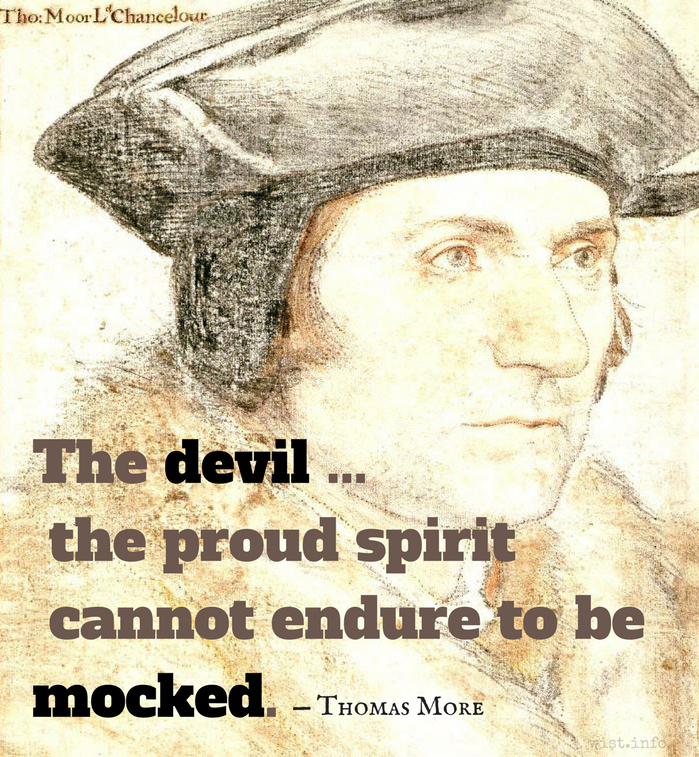
Some folk have been clearly rid of such pestilent fancies with very full contempt of them, making a cross upon their hearts and bidding the devil avaunt. And sometimes they laugh him to scorn, too, and then turn their mind unto some other matter. And when the devil hath seen that they have set so little by him, after certain essays, made in such times as he thought most fitting, he hath given that temptation quite over. And this he doth not only because the proud spirit cannot endure to be mocked, but also lest, with much tempting the man to the sin to which he could not in conclusion bring him, he should much increase his merit.
Thomas More (1478–1535) English lawyer, social philosopher, statesman, humanist, Christian martyr
Dialogue of Comfort Against Tribulation, Book 2, sec. 16 (1553)
(Source)
More often elided/paraphrased as "The devil ... the proud spirit cannot endure to be mocked" or "The devil, that proud spirit, cannot endure to be mocked."
C. S. Lewis used a mis-elided version as an epigraph to The Screwtape Letters (1942): "The devil ... the prowde spirit ... cannot endure to be mocked."
Sometimes given in the original (?) spellings: "The deuill ... the prowde spirit, cannot endure to be mock'd."
Quotations by:
More, Thomas

Will thou know what wonders strange be in the land that late was found?
Will thou learn thy life to lead, by divers ways that godly be?
Will thou of virtue and vice understand the very ground?
Will thou see this wretched world, how full it is of vanity?
[Vis nova monstra, novo dudum nunc orbe reperto?
Vivendi varia uis ratione modos?
Vis qui virtutum fontes, vis unde malorum
Principia? et quantum rebus inane latet?]Thomas More (1478–1535) English lawyer, social philosopher, statesman, humanist, Christian martyr
Utopia, “A Meter of Four Verses in the Utopian Tongue,” “Cornelius Graphey to the Reader” (1516 ed.) [tr. Open Utopia (Duncombe) (2012)]
(Source)
Included in an Appendix from the original (1516) edition, but not in the second (1518). As such, it only shows up in Robynson's translation (and in those who modernized it).
(Source (Latin)). Other translations:Wilt thou knowe what wonders straunge be in the lande that late was founde?
Wilte thou learne thy life to leade by divers ways that godly be?
Wilt thou of vertue and of vice understande the very grounde?
Wilt thou see this wretched world, how ful it is of vanitie?
[tr. Robynson (1551)]Wilt thou know what wonders strange be in the land that late was found?
Wilt thou learn thy life to lead by divers ways that godly be?
Wilt thou of virtue and of vice understand the very ground?
Wilt thou see this wretched world, how full it is of vanity?
[tr. Robynson/Lupton/Armes (1911)]
But doubtless Plato was right in foreseeing that unless kings became philosophical themselves, they would never take the advice of real philosophers, drenched as they are and infected with false values from boyhood on.
[Sed bene haud dubie praeuidit Plato, nisi reges philosophentur ipsi, nunquam futurum, ut peruersis opinionibus a pueris imbuti, atque infecti penitus philosophantium comprobent consilia.]
Thomas More (1478–1535) English lawyer, social philosopher, statesman, humanist, Christian martyr
Utopia, Book 1, ch. 1 “Discourses of Raphael Hythloday” (1518 ed.) [tr. Adams (1992 ed.)]
(Source)
(Source (Latin)). Other translations:But Plato doubtlesse dyd well foresee, oneless kynges themselves woulde applye their mindes to the studye of Philosophie, that elles they woulde never thoroughlye allowe the counsell of philosophers, beynge themselves before even from their tender age infected, and corrupt with perverse and evil opinions.
[tr. Robynson (1551)]But Plato judged right, that except Kings themselves became Philosophers, it could never be brought about, that they who from their Childhood are corrupted with false Notions, should fall in intirely with the Counsels of Philosophers.
[tr. Burnet (1684)]But Plato judged right, that except kings themselves become philosophers, they who from their childhood are corrupted with false notions, would never fall in intirely with the counsels of philosophers.
[tr. Warner (1758)]But Plato judged rightly, that except kings themselves became philosophers, being corrupted with false notions from their childhood, they would never consent entirely with the counsels of philosophers.
[tr. Cayley (1808)]But Plato doubtless did well foresee, unless kings themselves would apply their minds to the study of Philosophy, that else they would never thoroughly allow the counsel of philosophers; being themselves before even from their tender age infected and corrupt with perverse and evil opinions.
[tr. Robynson/Lupton/Armes (1911)]But doubtless Plato was right in foreseeing that if kings did not turn to philosophy themselves, they would never approve of the advice of real philosophers, being themselves from their youth infected and saturated with wrong ideas.
[tr. Richards (1923)]And that's doubtless what Plato meant. He realized that kings are too deeply infected with wrong ideas in childhood to take any philosopher's advice, unless they became philosophers themselves.
[tr. Turner (1965 ed.)]But, doubtless, Plato was right in foreseeing that if kings themselves did not turn to philosophy, they would never approve of the advice of real philosophers because they have been from their youth saturated and infected with wrong ideas.
[tr. Richards/Surtz (1964)]And that's doubtless what Plato meant. He realized that kings are too deeply infected with wrong ideas in childhood to take any philosopher's advice, unless they become philosophers themselves.
[tr. Turner (2003 ed.)]
God has said, “Thou shalt not kill”; shall we kill so readily for the theft of a bit of small change? Perhaps it will be argued that God’s law against killing does not apply where human laws allow it. But then what prevents men from making other laws in the same way — perhaps even laws legalizing rape, adultery, and perjury? God has taken from each person the right not only to kill another, but even to kill himself. If mutual consent to human laws on manslaughter entitles men freely to exempt their agents from divine law and allows them to kill where he has given no example, what is this but preferring the law of man to the law of God?
[Deus uetuit occidi quenquam, & nos tam facile occidimus ob ademptam pecuniolam! Quod si quis interpretetur, illo dei iussu interdictam necis potestatem, nisi quatenus humana lex declaret occidendum, quid obstat quo minus homines eodem modo constituant inter se, quatenus stuprum admittendum sit, adulterandum, peierandum! Siquidem quum deus non alienae modo, uerum etiam suae cuique mortis ius ademerit, si hominum inter se consensus de mutua cede, certis placitis consentientium, adeo debet ualere, ut illius praecepti uinculis eximat suos satellites, qui sine ullo exemplo dei, eos interemerint, quos humana sanctio iussit occidi; an non hoc pacto praeceptum illud dei tantum iuris est habiturum, quantum humana iura permiserint!]
Thomas More (1478–1535) English lawyer, social philosopher, statesman, humanist, Christian martyr
Utopia, Book 1, ch. 1 “Discourses of Raphael Hythloday” (1518 ed.) [tr. Adams (1992 ed.)]
(Source)
Regarding English laws that hung convicted thieves, and the Sixth Commandment to not kill.
(Source (Latin)). Other translations:God commanundeth us that we shall not kill. And be we then so hastie to kill a man for takinge a little money? And if any man woulde understande killing by this commaundement of God to be forbidden after no larger wise, then mans constitutions define killynge to be lawfull, then whye maye it not lykewise by mans constitutions be determined after what sort of whordome, fornication and perjurie may be lawfull? For whereas, by the permission of God, no man hath power to kil neither himself, nor yet anye other man: then yf a lawe made by the consent of men, concerninge slaughter of men, oughte to be of suche strengthe, force and vertue, that they which contrarie to the commaundement of God have killed those, whom this constitution of man commaunded to be killedy be cleane quite and exempte out of the bondes and daunger of Gods commaundement: shall it not then by this reason folow, that the power of Gods commaundemente shall extende no further, then mans lawe doeth define, and permitte?
[tr. Robynson (1551)]God has commanded us not to kill, and shall we kill so easiliy for a little Mony? But if one shall say, That by that Law we only forbid to kill any, except when the Laws of the Land allow of it; upon the same Grounds, Laws may be made to allow of Adultery and Perjury in some Cases: for God having taken from us the Right of disposing, either of our own, or ofhter Peoples Lives, if it is pretended that the mutual Consent of Men in making Laws, allowing of Manslaughter in Cases in which God has given us no Example, frees People from the Obligation of the Divine Law, and so makes Murder a lawful Action; What is this, but to give a preference to Humane Laws before the Divine?
[tr. Burnet (1684)]God hath commanded us not to kill; shall we then kill for a little money? And if it be said, the command extendeth not to cases where the laws of the land allow of killing, on the same ground laws may be made in some cases to allow of perjury and adultery. God having taken from us the right of disposing either of our own lives or those of others, if it be pretended that the mutual consent of makind in framing laws, can authorize death in cases where God hath given us no example, that it supersedeth the obligation of the divine law, and maketh murder lawful, what is this but to prefer human to divine laws?
[tr. Cayley (1808)]God has commanded us not to kill, and shall we kill so easily for a little money? But if one shall say, that by that law we are only forbid to kill any except when the laws of the land allow of it, upon the same grounds, laws may be made, in some cases, to allow of adultery and perjury: for God having taken from us the right of disposing either of our own or of other people’s lives, if it is pretended that the mutual consent of men in making laws can authorise man-slaughter in cases in which God has given us no example, that it frees people from the obligation of the divine law, and so makes murder a lawful action, what is this, but to give a preference to human laws before the divine?
[tr. Burnet/Morley (1901)]God commandeth us that we shall not kill. And be we then so hasty to kill a man for taking a little money? And if any man would understand killing by this commandment of God to be forbidden after no larger wise, than man’s constitutions define killing to be lawful, then why may it not likewise by man's constitutions be determined after what sort whoredom, fornication and perjury may be lawful? For whereas, by the permission of God, no man hath power to kill neither himself, nor yet any other man: then if a law made by the consent of men, concerning slaughter of men, ought to be of such strength, force and virtue, that they which, contrary to the commandment of God, have killed those, whom this constitution of man commanded to be killed, be clean quit and exempt out of the bonds and danger of God’s commandment: shall it not then by this reason follow, that the power of God’s commandment shall extend no further than man’s law doth define, and permit?
[tr. Robinson (1909 ed.)]God has said, "Thou shalt not kill," and shall we so lightly kill a man for taking a little money? But if the divine command be held not to apply where the law of man justifies killing, what prevents men equally from arranging with one another how far adultery, fornication and perjury are admissible? For God forbids a man not only to take the life of another but also his own; but if when men by mutual consent have agreed on definite cases where human life may be taken, their will ought to prevail so far as to exempt from the bonds of His law such of their followers who, without any example set by God, yet take the life of those whom human ordinance has commanded to be put to death, will not thus the law of God be valid only so far as the laws of man permit?
[tr. Richards (1923)]God said, “Thou shalt not kill" — does the theft of a little money make it quite all right for us to do so? If it’s said that this commandment applies only to illegal killing, what’s to prevent human beings from similarly agreeing among themselves to legalize certain types of rape, adultery, or perjury? Considering that God has forbidden us even to kill ourselves, can we really believe that purely human arrangements for the regulation of mutual slaughter are enough, without any divine authority, to exempt executioners from the sixth commandment? Isn’t that rather like saying that this particular commandment has no more validity than human laws allow it?
[tr. Turner (1965 ed.)]God has said, “Thou shalt not kill,” and shall we so lightly kill a man for taking a bit of small change? But if the divine command against killing be held not to apply where human law justifies killing, what prevents men equally from arranging with one another how far rape, adultery, and perjury are admissible? God has withdrawn from man the right to take not only another’s life but his own. Now, men by mutual consent agree on definite cases where they may take the life of one another. But if this agreement among men is to have such force as to exempt their henchmen from the obligation of the commandment, although without any precedent set by God they take the life of those who have been ordered by human enactment to be put to death, will not the law of God then be valid only so far as the law of man permits?
[tr. Richards/Surtz (1964)]
Well, those are my objections on moral grounds. From a practical point of view, surely it’s obvious that to punish thieves and murderers in precisely the same way is not only absurd but also highly dangerous for the public. If a thief knows that a conviction for murder will get him into no more trouble than a conviction for theft, he’s naturally impelled to kill the person that he’d otherwise merely have robbed. It’s no worse for him if he’s caught, and it gives him a better chance of not being caught, and of concealing the crime altogether by eliminating the only witness. So in our efforts to terrorize thieves we’re actually encouraging them to murder innocent people.
[Non licere putem. Quam uero sit absurdum, atque etiam perniciosum reipublicae furem, atque homicidam ex aequo puniri, nemo est, opinor, qui nesciat.
Nempe quum latro conspiciat non minus imminere discriminis duntaxat furti damnato, quam si praeterea conuincatur homicidij, hac una cogitatione impellitur in caedem eius, quem alioqui fuerat tantum spoliaturus. quippe praeterquam quod deprehenso nihil sit plus periculi, est etiam in caede securitas maior, & maior caelandi spes sublato facinoris indice.
Itaque dum fures nimis atrociter studemus perterrefacere, in bonorum incitamus perniciem.]Thomas More (1478–1535) English lawyer, social philosopher, statesman, humanist, Christian martyr
Utopia, Book 1, ch. 1 “Discourses of Raphael Hythloday” (1518 ed.) [tr. Turner (1965 ed.)]
(Source)
On the hanging of thieves under English law.
(Source (Latin)). Other translations:I am persuaded that this punishement is unlawful. Furthermore I thinke ther is no body that knoweth not, how unreasonable, yea, how pernitious a thinge it is to the weale publike, that a thefe and a homicide or murderer, should suffer equall and like punishment. For the thefe seynge that man, that is condempned for thefte in no less jeoperdie, nor judged to no lesse punishment, then him that is convicte of manslaughter; throughe this cogitation onelye he is strongly and forciblye provoked, and in a maner constreined to kill him whome els he woulde have but robbed. For the murder beynge ones done, he is in lesse feare, and in more hoope that the deede shall not be bewrayed or knowen, seynge the partye is nowe deade and rydde oute of the waye, which onelye mighte have uttered and disclosed it. But if he chaunce to be taken and discrived, yet he is in no more daunger and jeoperdie, then if he had committed but single fellonye. Therfore whiles we go about with suche crueltie to make theves aferd, we provoke them to kil good men.
[tr. Robynson (1551)]I think the putting of Thieves to death is not lawful; and it is plain and obvious that it is absurd, and of ill Consequence to the Common-Wealth, that a Thief and a Murderer should be equally punished; for if a Robber sees that his Danger is the same, if he is convicted of Theft, as if he were guilty of Murder, this will naturally set him on to kill the Person whom otherwise he would only have robbed; since, if the Punishment is the same, there is more security, and less danger of discovery, when he that can best make it is put out of the way; so that terrifying Thieves too much provokes them to cruelty.
[tr. Burnet (1684)]I think putting thieves to death is not lawful ; and it is plain and obvious that it is absurd, and of ill consequence to the commonwealth, that a thief and a murderer should be equally punished: for if a robber sees that his danger is the same, if he is convicted of theft, as if he were guilty of murder, this will naturally incite him to kill the person whom otherwife he would only have robbed, since if the punishment is the same, there is more security and less danger of discovery, when he that can best make it is put out of the way; so that terrifying thieves too much, provokes them to cruelty.
[tr. Warner (1758)]I think putting thieves to death, not lawful. And it is obviously absurd, and prejudicial to the commonwealth, that theft and murder should be punished alike. For, if a robber find that his danger is the same, if he be convicted of theft as if he had been guilty of murder, he will be incited to kill the person whom otherwise he would only have robbed; since, the punishment being the same, there is less danger of discovery, when he who can best make it is killed. Thus, terrifying thieves too much, provoketh them to cruelty.
[tr. Cayley (1808)]I think putting thieves to death is not lawful; and it is plain and obvious that it is absurd and of ill consequence to the commonwealth that a thief and a murderer should be equally punished; for if a robber sees that his danger is the same if he is convicted of theft as if he were guilty of murder, this will naturally incite him to kill the person whom otherwise he would only have robbed; since, if the punishment is the same, there is more security, and less danger of discovery, when he that can best make it is put out of the way; so that terrifying thieves too much provokes them to cruelty.
[tr. Burnet/Morley (1901)]I am persuaded that this punishment is unlawful. Furthermore, I think there is no body that knoweth not how unreasonable, yea, how pernicious a thing it is to the weal public that a thief and a homicide or murderer should suffer equal and like punishment. For the thief, seeing that man that is condemned for theft in no less jeopardy, nor judged to no less punishment, than him that is convict of manslaughter; through this cogitation only he is strongly and forcibly provoked, and in a manner constrained, to kill him, whom else he would have but robbed. For the murder once done, he is in less care and in more hope, that the deed shall not be betrayed or known, seeing the party is now dead and rid out of the way, which only might have uttered and disclosed it. But if he chance to be taken and discrived, yet he is in no more danger and jeopardy than if he had committed but single felony. Therefore whiles we go about with such cruelty to make thieves afeared, we provoke them to kill good men.
[tr. Robynson/Lupton/Armes (1911)]I think this punishment unlawful. Now how absurd and even dangerous to the commonwealth it is that a thief and a murderer should receive the same punishment, surely everyone knows. For since the robber sees that he is in as great danger if merely condemned for theft as if he were convicted of murder as well, this consideration alone impels him to murder a man, whom otherwise he would only have robbed; for besides the fact that he is in no more danger if caught, there is greater safety in putting the man out of the way, and a greater hope of covering up the offence, if there is no one left to tell the tale. And so while we try to frighten thieves with excessive cruelty, we urge them on to the destruction of honest men.
[tr. Richards (1923)]I think this punishment unlawful. Besides, surely everyone knows how absurd and even dangerous to the commonwealth it is that a thief and a murderer should receive the same punishment. Since the robber sees that he is in as great danger if merely condemned for theft as if he were convicted of murder as well, this single consideration impels him to murder the man whom otherwise he would only have robbed. In addition to the fact that he is in no greater danger if caught, there is greater safety in putting the man out of the way and greater hope of covering up the crime if he leaves no one left to tell the tale. Thus, while we endeavor to terrify thieves with excessive cruelty, we urge them on to the destruction of honest citizens.
[tr. Richards/Surtz (1964)]I think it is wrong to put thieves to death. But everybody knows how absurd and even harmful to the public welfare it is to punish theft and murder alike. If theft carries the same penalty as murder, the thief will be encouraged to kill the victim whom otherwise he would only have robbed. When the punishment is the same, murder is safer, since one conceals both crimes by killing the witness. Thus while we try to terrify thieves with extreme cruelty, we really invite them to kill innocent men.
[tr. Adams (1992 ed.)]I think putting thieves to death is not lawful; and it is plain and obvious that it is absurd and of ill consequence to the commonwealth that a thief and a murderer should be equally punished; for if a robber sees that his danger is the same if he is convicted of theft as if he were guilty of murder, this will naturally incite him to kill the person whom otherwise he would only have robbed; since, if the punishment is the same, there is more security, and less danger of discovery, when he that can best make it is put out of the way; so that terrifying thieves too much provokes them to cruelty.
[tr. Open Utopia (Duncombe) (2012)]
It seems to me a very unjust thing to take away a man’s life for a little money, for nothing in the world can be of equal value with a man’s life: and if it be said, “that it is not for the money that one suffers, but for his breaking the law,” I must say, extreme justice is an extreme injury: for we ought not to approve of those terrible laws that make the smallest offences capital, nor of that opinion of the Stoics that makes all crimes equal; as if there were no difference to be made between the killing a man and the taking his purse, between which, if we examine things impartially, there is no likeness nor proportion.
[Omnino mihi uidetur inquam pater benignissime homini uitam eripi propter ereptam pecuniam prorsus iniquum esse. Siquidem cum humana uita ne omnibus quidem fortunae possessionibus paria fieri posse arbitror. Quod si laesam iustitiam, si leges uiolatas, hac rependi poena dicant, haud pecuniam; quid ni merito summum illud ius, summa uocetur iniuria! Nam neque legum probanda sunt tam Manliana imperia, ut sicubi in leuissimis parum obtemperetur, illico stringant gladium; neque tam Stoica scita, ut omnia peccata adeo existiment paria, uti nihil iudicent interesse, occidatne aliquis hominem, an nummum ei surripiat, inter quae (si quicquam aequitas ualet) nihil omnino simile aut affine.]
Thomas More (1478–1535) English lawyer, social philosopher, statesman, humanist, Christian martyr
Utopia, Book 1, ch. 1 “Discourses of Raphael Hythloday” (1518 ed.) [tr. Burnet/Morley (1901)]
(Source)
Debating on the propriety of English laws that condemned thieves to hanging.
(Source (Latin)). Other translations:Suerlye my lorde, I thinke it not ryght nor justice, that the losse of money should cause the losse of mans life. For myne opinion is, that all the goodes in the worlde are not hable to countervayle mans life. But if they would thus say; that the breakynge of justice, and the transgression of the lawes is recompensed with this punishment, and not the losse of the money, then why maye not this extreme and rigorous justice wel be called plaine injurie? For so cruell govemaunce, so streite rules, and unmercyful lawes be not allowable, that if a small offense be committed, by and by the sword should be drawen: nor so stoical ordinaunces are to be borne withall, as to counte al offenses of suche equalitie, that the killing of a man, or the takyng of his money from him were both a matter, and the one no more heinous offense then the other: betwene the whyche two, yf we have anye respecte to equitie, no similitude or equalitie consisteth.
[tr. Robynson (1551)]It seems to me a very unjust thing to take away a Man's Life for a little Mony; for notyhing in the World can be of equal value with a Man's Life: and if it is said, that it is not for the Mony that one suffers, but for his breaking the Law; I must say extream Justice is an extream Injury: for we ought not to approve of these terrible Laws that make the smallest Offences capital; nor of that Opinion of the Stoicks that makes all Crimes equal, as if there were no difference to be made between the killing of a Man, and the taking his Purse; between wich if we examine things impartially, there is no likeness nor proportion.
[tr. Burnet (1684)]It seemeth very unjust to me to take away life for a little money, for nothing can be of equal value with life. And if it be said, that the suffering is not for the money, but for the breach of the law, I answer, extreme justice is an extreme injury. For we ought not to approve of those terrible laws, which make the smallest offences capital, nor of that opinion of the stoics which maketh all crimes equal: as if no difference were to be made between killing a man and taking his purse, between which, in reality, there is the greatest disproportion.
[tr. Cayley (1808)]Surely my lord, I think it not right nor justice, that the loss of money should cause the loss of man’s life. For mine opinion is, that all the goods in the world are not able to countervail man’s life. But if they would thus say: that the breaking of justice, and the transgression of the laws is recompensed with this punishment, and not the loss of the money, then why may not this extreme justice well be called extreme injury? For neither so cruel governance, so strait rules, and unmerciful laws be allowable, that if a small offence be committed, by-and-by the sword should be drawn: nor so stoical ordinances are to be borne withal, as to count all offences of such equality that the killing of a man, or the taking of his money from him were both a matter, and the one no more heinous offence than the other: between the which two, if we have any respect to equity, no similitude or equality consisteth.
[tr. Robinson (1909 ed.)]Certainly, right reverend father and my kind lord, I think it quite unjust that a man should lose his life for the loss of money. For in my opinion not all the goods that fortune can bestow on us can be set in the scale against a man's life. But if they say that this penalty is attached to the offence against justice and the breaking of the laws, and not to the theft of money, one may well style this extreme justice as extreme wrong. For we ought not to approve of such stern rules of law as should justify the drawing of the sword, when they are disobeyed in trifles, nor on the other hand such Stoical ordinances as count all offences equal, so that there is no difference whether one kills a man or robs him of a coin, when if equity has any meaning, there is no similarity or connexion between the two cases. God has said, "Thou shalt not kill," and shall we so lightly kill a man for taking a little money?
[tr. Richards (1923)]Your Grace, it seems to me quite unjust to take a man's life because he's taken some money. To my mind, no amount of property is equivalent to a human life. If it's argued that the punishment is not for taking the money, but for breaking the law and violating justice, isn't this conception of absolute justice absolutely unjust? One really can’t approve of a régime so dictatorial that the slightest disobedience is punishable by death, nor of a legal code based on the Stoic paradox that all offences are equal — so that there’s no distinction in law between theft and murder, though in equity the two things are so completely different.
[tr. Turner (1965 ed.)]Certainly, most reverend and kind Father, I think it altogether unjust that a man should suffer the loss of his life for the loss of someone’s money. In my opinion, not all the goods that fortune can bestow on us can be set in the scale against a man’s life. If they say that this penalty is attached to the offense against justice and the breaking of the laws, hardly to the money stolen, one may well characterize this extreme justice as extreme wrong. For we ought not to approve such stern Manlian rules of law as would justify the immediate drawing of the sword when they are disobeyed in trifles nor such Stoical ordinances as count all offenses equal so that there is no difference between killing a man and robbing him of a coin when, if equity has any meaning, there is no similarity or connection between the two cases.
[tr. Richards/Surtz (1964)]It seems to me, most kind and reverend father, that it's altogether unjust to take away a man's life for the loss of someone's money. Nothing in the world that fortune can bestow is equal in value to a man's life. If they say the thief suffers not for the money, but for violation of justice and transgression of laws, then this extreme justice should really be called extreme injury. We ought not to approve of these fierce Manlian laws that invoke the sword for the smallest violations. Neither should we accept the Stoic view that considers all crimes equal, as if there were no difference between killing a man and taking a coin from him. If equity means anything, there is no proportion or relation at all between these two crimes.
[tr. Adams (1992 ed.)]
The senate has a standing rule never to discuss a matter on the same day when it was first introduced; all new business is deferred to the next meeting. They do this so that a man will not blurt out the first thought that occurs to him, and then devote all his energies to defending those foolish impulses, instead of considering impartially the public good. They know that some men would rather jeopardize the welfare of the state than admit to having been heedless and shortsighted — so perverse and preposterous is their sense of pride. They should have had enough foresight at the beginning to speak with prudence rather than haste.
[Quin id quoque moris habet senatus, ut nihil, quo die primum proponitur, eodem disputetur. sed in sequentem senatum differatur, ne quis ubi quod in buccam primum uenerit, temere effutierit, ea potius excogitet postea, quibus decreta tueatur sua, quam quae ex reipublicae usu sint. malitque salutis publicae, quam opinionis de se iacturam facere, peruerso quodam ac praepostero pudore, ne initio parum prospexisse uideatur. Cui prospiciendum initio fuit, ut consulto potius, quam cito loqueretur.]
Thomas More (1478–1535) English lawyer, social philosopher, statesman, humanist, Christian martyr
Utopia, Book 2, ch. 3 “Of Their Magistrates” (1518 ed.) [tr. Adams (1992 ed.)]
(Source)
(Source (Latin)). Other translations:Furthermore this custome also the counsel useth, to dispute or reason of no matter the same daye that it is firste proposed or put furthe, but to defferre it to the nexte syttinge of the counsell. Because that no man when he hath rashely there spoken that commeth to his tonges ende, shall then afterwarde rather studye for reasons wherwith to defende and mainteine his first folish sentence, than for the commoditie of the common welath: as one rather willing the harme or hindraunce of the weale publike then any losse or diminution of his owne existimation. And as one that would be ashamed (which is a verie folishe shame) to be counted anye thing at the first oversene in the matter. Who at the first ought to have spoken rather wyselye, then hastely, or rashlye.
[tr. Robynson (1551)]One Rule observed in their Council, is, never to debate a thing on the same day in which it is first proposed; for that is always referred to the next meeting, that so Men may not rashly, and in the heat of Discourse, engage themselves too soon, which may bias them so much, that instead of considering the Good of the Publick, they will rather study to maintain their own Notions; and by a perverse and preposterous sort of shame, hazard their Country, rather than endanger their own Reputation, or venture the being suspected to have wanted foresight in the Expedients that they proposed at first. and therefore to prevent this, they take care that they may rather be deliberate, than sudden in their motions.
[tr. Burnet (1684)]One rule observed in their council is, never to debate a, subject on the day on which it is proposed. It is ever referred to the next meeting, for fear of rashness and the heat of argument; which might lead them, instead of consulting the public good, to support their first opinions, and hazard their country rather than endanger their own reputation. To prevent this, they are made deliberate rather than expeditious.
[tr. Cayley (1808)]One rule observed in their council is, never to debate a thing on the same day in which it is first proposed; for that is always referred to the next meeting, that so men may not rashly and in the heat of discourse engage themselves too soon, which might bias them so much that, instead of consulting the good of the public, they might rather study to support their first opinions, and by a perverse and preposterous sort of shame hazard their country rather than endanger their own reputation, or venture the being suspected to have wanted foresight in the expedients that they at first proposed; and therefore, to prevent this, they take care that they may rather be deliberate than sudden in their motions.
[tr. Burnet/Morley (1901)]Furthermore this custom also the council useth, to dispute or reason of no matter the same day that it is first proposed or put forth, but to defer it to the next sitting of the council. Because that no man when he hath rashly there spoken that cometh first to his tongue’s end, shall then afterward rather study for reasons wherewith to defend and confirm his first foolish sentence, than for the commodity of the commonwealth: as one rather willing the harm or hindrance of the weal public than any loss or diminution of his own existimation. And as one that would not for shame (which is a very foolish shame) be counted anything overseen in the matter at the first. Who at the first ought to have spoken rather wisely, than hastily, or rashly.
[tr. Robinson (1909 ed)]Moreover the Senate has this custom, that nothing is decided on the same day on which it is first propounded, but that it is put off till the next meeting, and this lest anyone after hastily uttering the idea that first came into his mouth, should afterwards think more of how to defend his opinion than of supporting what is for the good of the commonwealth, and should prefer to jeopardise the public weal rather than risk his reputation through a wrongheaded and misplaced shame, fearing he may be thought to have shown too little foresight at the first, though he should have taken care to speak with wisdom rather than with haste in the first instance.
[tr. Richards (1923)]There's also a rule in the Council that no resolution can be debated on the day that it's first proposed. All discussion is posponed until the next well-attended meeting. Otherwise someone’s liable to say the first thing that comes into his head, -- and then start thinking up arguments to justify what he has said, instead of trying to decide what’s best for the community. That type of person is quite prepared to sacrifice the public to his own prestige, just because, absurd as it may sound, he’s ashamed to admit that his first idea might have been wrong -- when his first idea should have been to think before he spoke.
[tr. Turner (1965 ed.); (2003 ed.)]In addition, the senate has the custom of debating nothing on the same day on which it is first proposed but of putting it off till the next meeting. This is their rule lest anyone, after hastily blurting out the first thought that popped into his head, should afterwards give more thought to defending his opinion than to supporting what is for the good of the commonwealth, and should prefer to jeopardize the public welfare rather than to risk his reputation through a wrongheaded and misplaced shame, fearing he might be thought to have shown too little foresight at the first -- though he should have been enough foresighted at the first to speak with prudence rather than with haste!
[tr. Richards/Surtz (1964)]The Council of Tranibors also follows the practice of never debating a proposition on the day it’s first put forward, but of deferring it to the next meeting. Otherwise someone who has heedlessly blurted out the first idea to come into their mouth may later give more thought to defending their own position than to the country’s interests. Indeed, they may choose to sacrifice the public well-being to their own reputation out of a mistaken and misplaced sense of embarrassment at not having been clear-minded enough at the start — though being clear-minded at the start should have meant speaking thoughtfully rather than in haste.
[tr. Clarke (2017)]
The Utopians marvel that any mortal can take pleasure in the weak sparkle of a little gem or bright pebble when he has a star, or the sun itself, to look at. They are amazed at the foolishness of any man who considers himself a nobler fellow because he wears clothing of specially fine wool. No matter how delicate the thread, they say, a sheep wore it once, and still was nothing but a sheep.
[Mirantur illi siquidem quemquam esse mortalium quem exiguae gemmulae, aut lapilli dubius oblectet fulgor, cui quidem stellam aliquam, atque ipsum denique solem liceat intueri, aut quemquam tam insanum esse, ut nobilior ipse sibi ob tenuioris lanae filum uideatur, siquidem hanc ipsam (quantumuis tenui filo sit) ouis olim gestauit, nec aliud tamen interim, quam ouis fuit.]
Thomas More (1478–1535) English lawyer, social philosopher, statesman, humanist, Christian martyr
Utopia, Book 2, ch. 6 “Of the Travelling of the Utopians” (1518 ed.) [tr. Adams (1992 ed.)]
(Source)
On the (to the Utopians) incomprehensible behavior of foreigners regarding money and wealth.
(Source (Latin)). Other translations:For they marveyle that any men be so folyshe, as to have delite and pleasure in the doubteful gisteringe of a lytil tryffelynge stone, which maye beholde annye of the starres, or elles the sonne it selfe. Or that anye man is so madde, as to count him selfe the nobler for the smaller or fyner threde of wolle, which selfe same wol (be it now in never so fyne a sponne threde) a shepe did ones wear.
[tr. Robynson (1551)]The Utopians wonder how any man should be so much taken with the glaring doubtful lustre of a jewel or stone, that can look up to a star, or to the sun himself; or how any should value himself, because his cloth is made of a liner thread: for how fine soever that thread may be, it was once no better than the fleece of a sheep, and that sheep was a sheep still for all its wearing it.
[tr. Burnet (1684); Burnet/Morley (1901); Open Utopia (Duncombe) (2012)]The Utopians wonder that any man should be so enamoured of the lustre of a jewel, when he can behold a star or the sun; or that he should value himself upon his cloth being made of a finer thread. For, however fine this thread, it was once the fleece of a sheep, which remained a sheep notwithstanding it wore it.
[tr. Cayley (1808)]For they marvel that any men be so foolish, as to have delight and pleasure in the glistering of a little trifling stone, which may behold any of the stars, or else the sun itself. Or that any man is so mad, as to count himself the nobler for the smaller or finer thread of wool, which selfsame wool (be it now in never so fine a spun thread) did once a sheep wear: and yet was she all that time no other thing than a sheep.
[tr. Robinson (1909 ed)]For the Utopians wonder that any man can take pleasure in the uncertain brightness of a tiny jewel or precious stone, when he can look at a star or the sun itself, or that anyone can be so mad as to think himself grander because he wears wool of a finer thread; and yet, however fine it be, a sheep once wore it, and yet was nothing more than a sheep all the time.
[tr. Richards (1923)]For instance, the Utopians fail to understand why anyone should be so fascinated by the dull gleam of a tiny bit of stone, when he has all the stars in the sky to look at — or how anyone can be silly enough to think himself better than other people, because his clothes are made of finer woolen thread than theirs. After all, those fine clothes were once worn by a sheep, and they never turned it into anything better than a sheep.
[tr. Turner (1965 ed.)]The Utopians wonder that any mortal takes pleasure in the uncertain sparkle of a tiny jewel or precious stone when he can look at a star or even the sun itself. They wonder that anyone can be so mad as to think himself more noble on account of the texture of a finer wool, since, however fine the texture is, a sheep once wore the wool and yet all the time was nothing more than a sheep.
[tr. Richards/Surtz (1964)]For instance, the Utopians fail to understand why anyone should be so fascinated by the dull gleam of a tiny bit of stone, when he has all the stars in the sky to look at -- or how anyone can be silly enough to think himself better than other people, because his clothes are made of finer woolen thread than theirs. After all, those fine clothes were once worn by a sheep, and they never turned it into anything better than a sheep.
[tr. Turner (2003 ed.)]The Utopians themselves are surprised at these attitudes. Why should any human being be attracted by the faltering gleam of a tiny jewel or gemstone when they have the privilege of gazing on any of the stars or on the sun itself? Why should anyone be mad enough to think themselves of higher rank because of the fineness of a woolen thread, when the wool itself (however fine the thread) was previously worn by a sheep that was still just a sheep?
[tr. Clarke (2017)]
But what puzzles and disgusts the Utopians even more is the idiotic way some people have of practically worshipping a rich man, not because they owe him money or are otherwise in his power, but simply because he’s rich — although they know perfectly well that he’s far too mean to let a single penny come their way, so long as he’s alive to stop it.
[Caeterum multo magis eorum mirantur, ac detestantur insaniam qui diuitibus illis, quibus neque debent quicquam, neque sunt obnoxij, nullo alio respectu, quam quod diuites sunt, honores tantum non diuinos impendunt, idque cum eos tam sordidos atque auaros cognoscunt, ut habeant certo certius ex tanto nummorum cumulo, uiuentibus illis ne unum quidem nummulum unquam ad se uenturum.]
Thomas More (1478–1535) English lawyer, social philosopher, statesman, humanist, Christian martyr
Utopia, Book 2, ch. 6 “Of the Travelling of the Utopians” (1518 ed.) [tr. Turner (1965)]
(Source)
On the incomprehensible (to the Utopians) behavior in other countries regarding money and the wealthy. Turner used the same translation for his 2003 ed.
(Source (Latin)). Other translations:But they muche more marvell at and detest the madnes of them, whyche to those riche men, in whose debte and daunger they be not, do give almost divine honoures, for none other consideration, but bicause they be riche: and yet knowing them to bee suche nigeshe penny fathers, that they be sure as longe as they live, not the worthe of one farthinge of that heape of gold shall come to them.
[tr. Robynson (1551)]But they do much more admire and detest their folly, who when they see a rich man tho' they neither owe him any thing, nor are in any sort obnoxious to him, yet merely because he is rich, they give him little less than divine honours; even tho' they know him to be so covetous and base minded, that notwithstanding all his wealth, he will not part with one farthing of it to them as long as he lives.
[tr. Burnet (1684)]But they much more wonder at and detest the folly of those, who, when they see a rich man, though they owe him nothing, and are not in the least dependent on his bounty, are ready to pay him divine honours because he is rich; even though they know him at the same time to be so covetous and mean-spirited, that notwithstanding all his wealth, he will not part with one farthing of it to them as long as he liveth.
[tr. Cayley (1808)]But they much more admire and detest the folly of those who, when they see a rich man, though they neither owe him anything, nor are in any sort dependent on his bounty, yet, merely because he is rich, give him little less than divine honours, even though they know him to be so covetous and base-minded that, notwithstanding all his wealth, he will not part with one farthing of it to them as long as he lives!
[tr. Burnet/Morley (1901)]But they much more marvel at and detest the madness of them which to those rich men, in whose debt and danger they be not, do give almost divine honours, for none other consideration, but because they be rich: and yet knowing them to be such niggardly penny-fathers, that they be sure as long as they live, not the worth of one farthing of that heap of gold shall come to them.
[tr. Robinson (1909 ed)]But much more do they wonder at and abominate the madness of those, who pay almost divine honours to those rich men, to whom they neither owe anything, nor are beholden in any other respect than that they are rich; and yet they know them to be so mean and miserly that they are as sure as they can be, that of all that pile of cash, so long as the rich men live, not a penny piece will ever come their way.
[tr. Richards (1923)]But much more do they wonder at and abominate the madness of persons who pay almost divine honors to the rich, to whom they neither owe anything nor are obligated in any other respect than that they are rich. Yet they know them to be so mean and miserly that they are more than sure that of all that great pile of cash, as long as the rich men live, not a single penny will ever come their way.
[tr. Richards/Surtz (1964)]Even more than this, the Utopians are appalled at those people who practically worship a rich man, though they neither owe him anything, nor are obligated to him in any way. What impresses them is simply that the man is rich. Yet all the while they know he is so mean and grasping that as long as he lives not a single penny out of that great mound of money will ever come their way.
[tr. Adams (1992 ed.)]But they much more wonder at and detest the folly of those who, when they see a rich man, though they neither owe him anything, nor are in any sort dependent on his bounty, yet, merely because he is rich, give him little less than divine honors, even though they know him to be so covetous and base-minded that, notwithstanding all his wealth, he will not part with one farthing of it to them as long as he lives!
[tr. Open Utopia (Duncombe) (2012)]And why, above all, are people so damnably insane as to revere a rich man almost like a god when they owe him neither money nor anything else? Yet they know the rich chap to be so unscrupulous and grasping that, for surer than sure, they'll never see a single penny from all the money he's amassed for as long as he lives.
[tr. Clarke (2017)]
They have very few laws, because, with their social system, very few laws are required. Indeed, one of their great complaints against other countries is that, although they’ve already got books and books of laws and interpretations of laws, they never seem to have enough. For, according to the Utopians, it’s quite unjust for anyone to be bound by a legal code which is too long for an ordinary person to read right through, or too difficult for him to understand.
[Leges habent perquam paucas. sufficiunt enim sic institutis paucissimae. Quin hoc in primis apud alios improbant populos, quod legum interpretumque uolumina, non infinita sufficiunt. Ipsi uero censent iniquissimum; ullos homines his obligari legibus; quae aut numerosiores sint, quam ut perlegi queant; aut obscuriores quam ut a quouis possint intelligi.]
Thomas More (1478–1535) English lawyer, social philosopher, statesman, humanist, Christian martyr
Utopia, Book 2, ch. 7 “Of Their Slaves, and of Their Marriages” (1518 ed.) [tr. Turner (1965 ed.)]
(Source)
Turner has the same translation in the 2003 ed.
(Source (Latin)). Other translations:They have but few lawes. For to people so instructe and institute very fewe do suffice. Yea this thing they chiefely reprove among other nations, that innumerable bokes of lawes and expositions upon the same be not sufficient. But they think it against all right and justice that men shoulde be bound to those lawes, which either be in number mo then be hable to be read, or els blinder and darker, then that anye man can well understande them.
[tr. Robynson (1551)]They have but few Laws, and such is their Constitution, that they need not many. They do very much condemn other Nations, whose Laws, together with the Commentaries on them, swell up to so many Volumes; for they think it an unreasonable thing to oblige Men to obey a Body of Laws, that are both of such a bulk, and so dark, that they cannot be read or understood by every one of the Subjects.
[tr. Burnet (1684)]They have few laws, and such is their constitution, they require not many. They much condemn other countries, whose laws, with the commentaries on them, swell so many volumes; esteeming it unreasonable to oblige men to obey a body of laws so large and intricate, as not to be read and understood by every subject.
[tr. Cayley (1808)]They have but few laws, and such is their constitution that they need not many. They very much condemn other nations whose laws, together with the commentaries on them, swell up to so many volumes; for they think it an unreasonable thing to oblige men to obey a body of laws that are both of such a bulk, and so dark as not to be read and understood by every one of the subjects.
[tr. Burnet/Morley (1901)]They have but few laws. For to people so instruct and institute very few do suffice.. Yea this thing they chiefly reprove among other nations, that innumerable books of laws and expositions upon the same be not sufficient. But they think it against all right and justice that men should be bound to those laws, which either be in number more than be able to be read, or else blinder and darker, than that any man can well understand them.
[tr. Robinson (1909 ed)]They have very few laws; people so trained, need but few. The chief fault they find with other people is that they have almost innumerable books of laws and commentaries on them which yet are not sufficient; for they themselves think it most unfair that any man should be bound by laws, which are too numerous to be read through, or too obscure to be understood by any.
[tr. Richards (1923)]They have very few laws because very few are needed for persons so educated. The chief fault they find with other peoples is that almost innumerable books of laws and commentaries are not sufficient. They themselves think it most unfair that any group of men should be bound by laws which are either too numerous to be read through or too obscure to be understood by anyone.
[tr. Richards/Surtz (1964)]They have very few laws, and their training is such that they need no more. The chief fault they find with other nations is that, even with infinite volumes of laws and interpretations, they cannot manage their affairs properly. They think it completely unjust to bind men by a set of laws that are too many to be read and too obscure for anyone to understand.
[tr. Adams (1992 ed.)]