Political freedom in a citizen is the tranquility of mind that comes from the opinion each one has of his security; and for him to have this freedom, the government must be such that one citizen cannot fear another citizen.
[La liberté politique, dans un citoyen, est cette tranquillité d’esprit qui provient de l’opinion que chacun a de sa sûreté: &, pour qu’on ait cette liberté, il faut que le gouvernement soit tel, qu’un citoyen ne puisse pas craindre un autre citoyen.]
Charles-Lewis de Secondat, Baron de Montesquieu (1689-1755) French political philosopher
Spirit of Laws [The Spirit of the Laws; De l’esprit des lois], Book 11, ch. 6 (1748) [tr. Stewart (2018)]
(Source)
(Source (French)). Other translations:The political liberty of the subject is a tranquility of mind, arising from the opinion each person has of his safety. In order to have this liberty, it is requisite the government be so constituted as one man need not be afraid of another.
[tr. Nugent (1750)]Political liberty in a citizen is that tranquility of spirit which comes from the opinion each one has of his security, and in order for him to have this liberty the government must be such that one citizen cannot fear another citizen.
[tr. Cohler/Miller/Stone (1989)]
French: x4
Quotations about:
tranquility
Note not all quotations have been tagged, so Search may find additional quotes on this topic.
Our doings are not so important as we naturally suppose; our successes and failures do not after all matter very much. Even great sorrows can be survived; troubles which seem as if they must put an end to happiness for life, fade with the lapse of time until it becomes almost impossible to remember their poignancy. But over and above these self-centered considerations is the fact that one’s ego is no very large part of the world. The man who can center his thoughts and hopes upon something transcending self can find a certain peace in the ordinary troubles of life which is impossible to the pure egoist.
Bertrand Russell (1872-1970) English mathematician and philosopher
Conquest of Happiness, Part 1, ch. 5 “Fatigue” (1930)
(Source)

JANE: Some people think that external beauty comes from inner tranquility. Of course, some people think it comes from drinking the blood of virgins, so there’s quite a range there.
Steven Moffat (b. 1961) Scottish television writer, producer
Coupling, 03×01 “Split” (2002-09-23)
(Source)

We must try to keep the mind in tranquility. For just as the eye which constantly shifts its gaze, now turning to the right or to the left, now incessantly peering up and down, cannot see distinctly what lies before it, but the sight must be fixed firmly on the object in view if one would make his vision of it clear, so too man’s mind when distracted by his countless worldly cares cannot focus itself distinctly on the truth.
Basil of Caesarea (AD 330-378) Christian bishop, theologian, monasticist, Doctor of the Church [Saint Basil the Great, Ἅγιος Βασίλειος ὁ Μέγας]
Letter to Gregory of Nazianzus (c. AD 358) [tr. Defarrari (1926)]
(Source)

A good conscience is to the Soul what health is to the body; it preserves constant ease and serenity within us; and more than countervails all the calamities and afflictions which can befall us from without.
Joseph Addison (1672-1719) English essayist, poet, statesman
Essay (1713-08-15), The Guardian, No. 135
(Source)

He who without necessity embarks
In many matters, is a fool for slighting
The obvious blessings of a tranquil life.[ὅστις δὲ πράσσει πολλὰ µὴ πράσσειν παρόν,
µῶρος, παρὸν ζῆν ἡδέως ἀπράγµονα.]Euripides (485?-406? BC) Greek tragic dramatist
Antiope [Αντιοπη], frag. 193 (TGF, Kannicht) [Amphion] (c. 410 BC) [tr. Wodhall (1809)]
(Source)
Barnes fragment 104, Musgrave 25. (Source (Greek)). Alternate translation:Whoever is very active when he may be inactive, is a moron,
when he may live pleasantly keeping clear from politics.
[tr. Will (2015)]Whoever is overactive when he could relax
is foolish, for he misses out on a pleasant life.
[Source]
Nothing contributes so much to tranquilize the mind as a steady purpose, — a point on which the soul may fix its intellectual eye.
Mary Wollstonecraft (1759-1797) English social philosopher, feminist, writer
Frankenstein, Letter 1 (1818)
(Source)
More discussion of the history of this quotation: Nothing Contributes So Much To Tranquillize the Mind As a Steady Purpose,—a Point On Which the Soul May Fix Its Intellectual Eye – Quote Investigator

I feel my heart glow with an enthusiasm which elevates me to heaven, for nothing contributes so much to tranquillize the mind as a steady purpose — a point on which the soul may fix its intellectual eye.

What man actually needs is not a tensionless state but rather the striving and struggling for a worthwhile goal, a freely chosen task.
Viktor Frankl (1905-1997) German-American psychologist, writer
Man’s Search for Meaning, Part 2 (1946)
(Source)

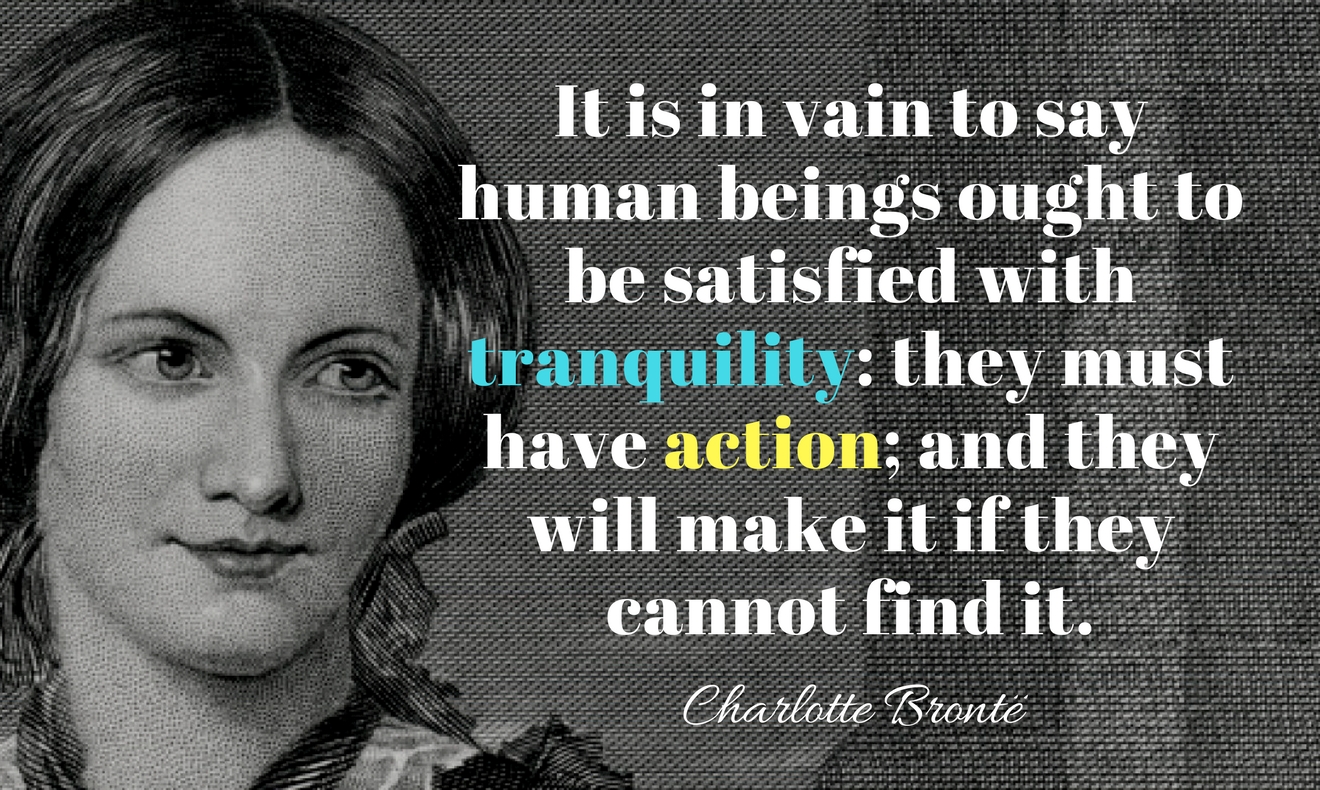
It is in vain to say human beings ought to be satisfied with tranquility: they must have action; and they will make it if they cannot find it.
Charlotte Brontë (1816-1855) British novelist [pseud. Currer Bell]
Jane Eyre, ch. 12 [Jane] (1847)
(Source)

A man who is happy at home doesn’t lie awake nights worrying about the hereafter.
Robert A. Heinlein (1907-1988) American writer
Job: A Comedy of Justice (1984)
The staircase that leads to God. What does it matter if it is make-believe, if we really climb it? What difference does it make who builds it, or if it is made of marble or word, of brick, stone, or mud? The essential thing is that it be solid and that in climbing it we feel the peace that is inaccessible to those who do not climb it.
Joseph Joubert (1754-1824) French moralist, philosopher, essayist, poet
Pensées [Thoughts], 1797 entry [tr. Auster (1983)]
(Source)
I could not find an analog in other translations of the Pensées.
And the peace of God, which passeth all understanding …
[καὶ ἡ εἰρήνη τοῦ θεοῦ ἡ ὑπερέχουσα …]
The Bible (The New Testament) (AD 1st - 2nd C) Christian sacred scripture
Philippians 4: 7 [KJV (1611)]
(Source)
(Source (Greek)). Alternate translations:And that peace of God, which is so much greater than we can understand ...
[JB (1966)]And the peace of God which is beyond our understanding ...
[NJB (1985)]And God's peace, which is far beyond human understanding ...
[GNT (1992 ed.)]Then the peace of God that exceeds all understanding ...
[CEB (2011)]And the peace of God, which surpasses all understanding ...
[NRSV (2021 ed.)]

It is neither wealth nor splendor, but tranquility and occupation, which give happiness.
Thomas Jefferson (1743-1826) American political philosopher, polymath, statesman, US President (1801-09)
Letter (1788-07-12) to Anna Jefferson Marks
(Source)
The salutation is "My dear Sister," and is a congratulations for her marrying Hastings Marks. Some copies, and filings of the letter, make it out to "Anna Scott Marks," her birth name was Anna Scott Jefferson.
Peace indeed is both sweet in name and wholesome in reality; but there is all the difference in the world between peace and slavery. Peace is the calmness of freedom, slavery the worst of all evils, to be kept off at the cost not only of war, but even of life itself.
[Et nomen pacis dulce est et ipsa res salutaris; sed inter pacem et servitutem plurimum interest. Pax est tranquilla libertas, servitus postremum malorum omnium, non modo bello sed morte etiam repellendum.]
Marcus Tullius Cicero (106-43 BC) Roman orator, statesman, philosopher
Philippics [Philippicae; Antonian Orations], No. 2, ch. 44 / sec. 113 (2,44/2.113) (44-10-24 BC) [tr. King (1877)]
(Source)
(Source (Latin)). Alternate translations:And the name of peace is sweet, and the thing itself wholesome, but between peace and servitude the difference is great. Peace is tranquil liberty, servitude the last of all evils, one to be repelled, not only by war but even by death.
[tr. Ker (1926)]The name of peace is sweet, the thing itself is most salutary. But between peace and slavery there is a wide difference. Peace is liberty in tranquility; slavery is the worst of all evils, -- to be repelled, if need be, not only by war, but even by death.
[tr. Yonge (1903)]Peace indeed is both sweet in name and wholesome in reality; but there is all the difference between peace and slavery. Peace is the calmness of freedom, slavery the worst of all evils, to be kept off at the cost not only of war, but even of life itself.
[ed. Harbottle (1906)]Even the name of peace is sweet, and peace itself a blessing; but there is all the difference in the world between peace and servitude. Peace is the quiet enjoyment of freedom, whereas servitude is the greatest of all evils, something to be resisted not just with war, but even with death.
[tr. Berry (2006)]There is sweetness in the name of peace, and living in peace is beneficial, but there is a great difference between peace and slavery. Slavery is the worst of all evils and must be driven off by war -- or even by death.
[tr. McElduff (2011)]
The first rule is, to keep an untroubled spirit; for all things must bow to Nature’s law, and soon enough you must vanish into nothingness, like Hadrian and Augustus. The second is to look things in the face and know them for what they are, remembering that it is your duty to be a good man. Do without flinching what man’s nature demands; say what seems to you most just — though with courtesy, modesty, and sincerity.
[Τὸ πρῶτον μὴ ταράσσου: πάντα γὰρ κατὰ τὴν τοῦ ὅλου φύσιν καὶ ὀλίγου χρόνου οὐδεὶς οὐδαμοῦ ἔσῃ, ὥσπερ οὐδὲ Ἁδριανὸς οὐδὲ Αὔγουστος. ἔπειτα ἀτενίσας εἰς τὸ πρᾶγμα ἴδε αὐτὸ καὶ συμμνημονεύσας ὅτι ἀγαθόν σε ἄνθρωπον εἶναι δεῖ καὶ τί τοῦ ἀνθρώπου ἡ φύσις ἀπαιτεῖ, πρᾶξον τοῦτο ἀμεταστρεπτὶ καὶ εἰπέ, ὡς δικαιότατον φαίνεταί σοι: μόνον εὐμενῶς καὶ αἰδημόνως καὶ ἀνυποκρίτως.]
Marcus Aurelius (AD 121-180) Roman emperor (161-180), Stoic philosopher
Meditations [To Himself; Τὰ εἰς ἑαυτόν], Book 8, ch. 5 (8.5) (AD 161-180) [tr. Staniforth (1964)]
(Source)
This translation was adapted (and significantly shortened) by Norman Vincent Peale in You Can If You Think You Can (1974): "The first rule is to keep an untroubled spirit. The second is to look things in the face and know them for what they are."
Peale's paraphrase significantly changes the meaning (by removing the fatalism and the sense of duty in the face of the actions of great men from the past, and turning it into a general call for calm and clarity). Nonetheless, Peale's version of this translation shows up all over the place, and generally without reference to him.
Original Greek. Alternate translations:First; let it not trouble thee. For all things both good and evil come to pass according to the nature and general condition of the universe, and within a very little while, all things will be at an end; no man will be remembered: as now of Africanus (for example) and Augustus it is already come to pass. Then secondly; fix thy mind upon the thing itself; look into it, and remembering thyself, that thou art bound nevertheless to be a good man, and what it is that thy nature requireth of thee as thou art a man, be not diverted from what thou art about, and speak that which seemeth unto thee most just: only speak it kindly, modestly, and without hypocrisy.
[tr. Casaubon (1634), 8.4]In the first place , keep your self easie, for all things are govern'd by the Laws, and Order of Providence: Besides, you'l quickly go the way of all Flesh, as Augustus, Adrian, and the rest of the Emperours have done before you. Farther, Examine the matter to the bottom , and remember, that the top of your business is to be a Good Man : Therefore whatever the Dignity of Humane Nature requires of you, set about it presently , without Ifs, or Ands : And speak always according to your Conscience , but let it be done in the Terms of Good Nature and Civility.
[tr. Collier (1701)]In the first place, be not disturbed or put into confusion. All things happen according to the nature of the whole. In a little time you shall be gone, as Hadrian, and Augustus. And, then, attentively consider the nature of what occurs to you: Remember you must persist in the purpose of being a good man. Act, then, inflexibly what suits the nature of a man, and speak always what appears to you just, and yet with calm good-nature and modesty; and without Hypocrisy.
[tr. Hutcheson/Moor (1742)]Let it be a principal part of your philosophy to preserve your tranquility: for all things come to pass by the direction of Providence. And, in a few years, you yourself must leave this world, as Hadrian and Augustus have done before you.
In the next place, consider the affair in its proper light, and you will find, that your whole business here is to be a good man. Whatever teh nature of man therefore requires of you, perform it strenuously and with assiduity; and whatever justice dictates on every occasion, speak it boldly, but with good-nature, modesty, and sincerity.
[tr. Graves (1792)]This is the chief thing: Be not perturbed, for all things are according to the nature of the universal; and in a little time thou wilt be nobody and nowhere, like Hadrianus and Augustus. In the next place, having fixed thy eyes steadily on thy business, look at it, and at the same time remembering that it is thy duty to be a good man, and what man's nature demands, do that without turning aside; and speak as it seems to thee most just, only let it be with a good disposition and with modesty and without hypocrisy.
[tr. Long (1862)]In the first place, keep yourself easy, for all things are governed by the universal nature. Besides, you'll quickly go the way of all flesh, as Augustus and Hadrian have done before you. Farther, examine the matter from top to bottom, and remember that your business is to be a good man. Therefore, whatever the dignity of human nature requires of you, set about it at once, without "ifs" or "ands"; and speak always according to your conscience, but let it be done in the terms of good nature and modesty and sincerity.
[tr. Collier/Zimmern (1887)]First and foremost, keep unperturbed. For all things follow the law of Nature: and in a little while you will vanish and be nought, even as are Hadrian and Augustus. Secondly, face facts open-eyed, bearing in mind that it is your duty to be a man and to do good; what man's nature demands, that you do without swerving; so speak, as seems to you most just; only be it considerately, modestly, and with sincerity.
[tr. Rendall (1898)]Before all things, be not perturbed. Everything comes to pass as directed by universal Nature, and in a little time you will be departed and gone, like Hadrianus and Augustus. Then, scan closely the nature of what has befallen, remembering that it is your duty to be a good man. Do unflinchingly whatever man’s nature requires, and speak as seems most just, yet in kindliness, modesty, and sincerity.
[tr. Hutcheson/Chrystal (1902)]Firstly, fret not thyself, for all things are as the Nature of the Universe would have them, and within a little thou shalt be non-existent, and nowhere, like Hadrianus and Augustus. Secondly, look steadfastly at the thing, and see it as it is and, remembering withal that thou must be a good man, and what the Nature of man calls for, do this without swerving, and speak as seemeth to thee most just, only be it graciously, modestly, and without feigning.
[tr. Haines (Loeb) (1916)]In the first place, be not troubled; for all things are according to Universal Nature, and in a little while you will be no one and nowhere, even as Hadrian and Augustus are no more. Next, looking earnestly at the question, perceive its essence, and reminding yourself that your duty is to be a good man, and what it is that man's nature demands, do that without swerving, and speak the thing that appears to you to be most just, provided only that it is with kindness and modesty, and without hypocrisy
. [tr. Farquharson (1944)]First of all, be untroubled in your mind; for all things come about as universal nature would have them, and in a short while you will be no one and nowhere, as are Hadrian and Augustus. And next, keep your eyes fixed on the matter in hand and observe it well, remembering that it is your duty to be a good person, and that whatever human nature demands, you must fulfil without the slightest deviation and in the manner that seems most just to you; only do so with kindness and modesty, and without false pretences.
[tr. Hard (1997 ed.), Hard (2011 ed.)]The first step: Don't be anxious. Nature controls it all. And before long you'll be no one, nowhere -- like Hadrian, like Augustus. The second step: Concentrate on what you have to do. Fix your eyes on it. Remind yourself that your task is to be a good human being; remind yourself what nature demands of people. Then do it, without hesitation, and speak the truth as you see it. But with kindness. With humility. Without hypocrisy.
[tr. Hays (2003)]First, do not be upset: all things follow the nature of the Whole, and in a little while you will be no one and nowhere, as is true now even of Hadrian and Augustus. Next, concentrate on the matter in hand and see it for what it is. Remind yourself of your duty to be a good man and rehearse what man’s nature demands: then do it straight and unswerving, or say what you best think right. Always, though, in kindness, integrity, and sincerity.
[tr. Hammond (2006)]