Boy, these conservatives are really something, aren’t they? They’re all in favor of the Unborn. They will do anything for the Unborn. But once you’re born, you’re on your own. Pro-life conservatives are obsessed with the fetus from conception to nine months. After that, they don’t want to know about you. They don’t want to hear from you. No nothing. No neo-natal care. No daycare. No Head Start. No school lunch. No food stamps. No welfare. No nothing. If you’re pre-born you’re fine. If you’re pre-school, you’re fucked.
George Carlin (1937-2008) American comedian
Show (1996-03-29), Back in Town, “Abortion,” Beacon Theatre, New York City (HBO)
(Source)
(Source (Video), dialogue confirmed)
Quotations about:
welfare
Note not all quotations have been tagged, so Search may find additional quotes on this topic.
In a land of great wealth, families must not live in hopeless poverty. In a land rich in harvest, children just must not go hungry. In a land of healing miracles, neighbors must not suffer and die untended. In a great land of learning and scholars, young people must be taught to read and write.
Lyndon B. Johnson (1908-1973) American politician, educator, US President (1963-69)
Speech (1965-01-20), Inaugural Address, Washington, D. C.
(Source)

It may not therefore be unseasonable to recommend to this present Generation the Practice of that Virtue, for which their Ancestors were particularly famous, and which is called The Love of one’s Country. This Love to our Country, as a moral Virtue, is a fixed Disposition of Mind to promote the Safety; Welfare, and Reputation of the Community in which we are born, and of the Constitution under which we are protected.
Joseph Addison (1672-1719) English essayist, poet, statesman
Essay (1716-01-06), The Freeholder, No. 5
(Source)

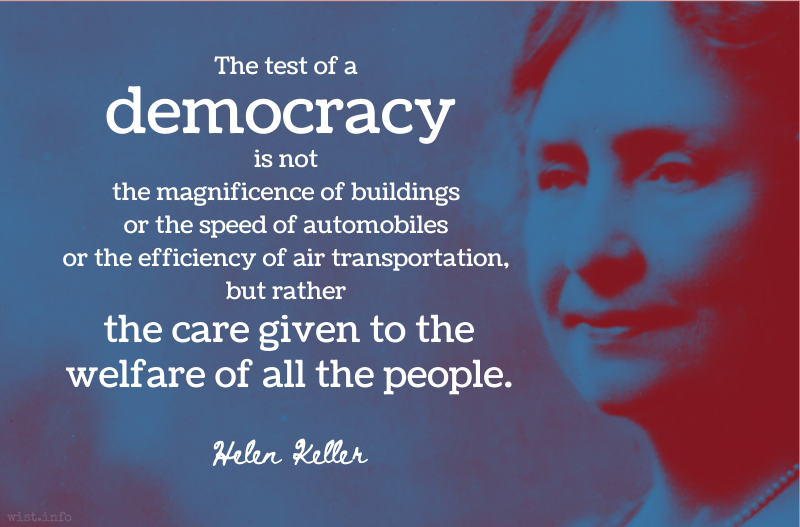
The test of a democracy is not the magnificence of buildings or the speed of automobiles or the efficiency of air transportation, but rather the care given to the welfare of all the people.
Helen Keller (1880-1968) American author and lecturer
“Try Democracy,” The Home Magazine, Vol. 11, # 4 (Apr 1935)
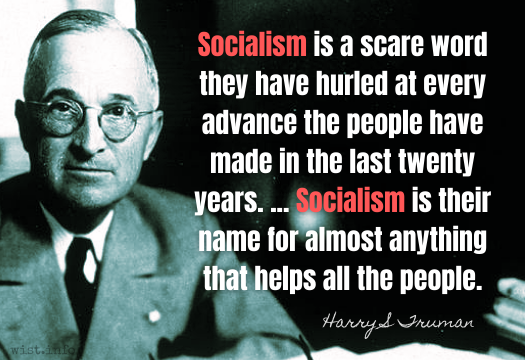
Taft explained that the great issue in this campaign is “creeping socialism.” Now that is the patented trademark of the special interest lobbies. Socialism is a scare word they have hurled at every advance the people have made in the last twenty years. Socialism is what they called public power. Socialism is what they called Social Security. Socialism is what they called farm prices supports. Socialism is what they called bank deposit insurance. Socialism is what they called the growth of free and independent labor organizations. Socialism is their name for almost anything that helps all the people.
Harry S Truman (1884-1972) US President (1945-1953)
Speech (1952-10-10), Syracuse, New York
(Source)
Referring to Sen. Robert A. Taft (R-Ohio).
Audio recording (the quotation is at 6:35 into the speech).
Being a mother is a noble status, right? So why does it change when you put “unwed” or “welfare” in front of it?
Florynce "Flo" Kennedy (1916-2000) American lawyer, feminist, civil rights activist
(Attributed)
(Source)
Quoted in Gloria Steinem, "The Verbal Karate of Florynce R. Kennedy, Esq.," Ms. (Mar 1973).

Convinced that character is all and circumstances nothing, [the Puritan] sees in the poverty of those who fall by the way, not a misfortune to be pitied and relieved, but a moral failing to be condemned, and in riches, not an object of suspicion but the blessing which rewards the triumph of energy and will.
R. H. Tawney (1880-1962) English writer, economist, historian, social critic [Richard Henry Tawney]
Religion and the Rise of Capitalism, ch. 4 (1926)
(Source)
It’s okay if you don’t want to feed the hungry, or heal the sick, or house the homeless. Just don’t say you’re doing it for their own good. Don’t say you’d like to help people, but your hands are tied, because if you did it would cause a “culture of dependency,” or “go against the Bible,” or, worst of all, “rob them of their freedom” to be sick and hungry. Just admit you’re selfish, and based on how little your beliefs mirror the actual teachings of Jesus you might as well be worshiping Despicable Me.
William "Bill" Maher (b. 1956) American comedian, political commentator, critic, television host.
Real Time with Bill Maher (8 Nov 2013)

To blame the poor for subsisting on welfare has no justice unless we are also willing to judge every rich member of society by how productive he or she is. Taken individual by individual, it is likely that there’s more idleness and abuse of government favors among the economically privileged than among the ranks of the disadvantaged.
Norman Mailer (1923-2007) American novelist, journalist, playwright, activist
Esquire (1996)
An American Government cannot permit Americans to starve.
Franklin Delano Roosevelt (1882-1945) American lawyer, politician, statesman, US President (1933-1945)
Speech, San Diego Exposition (2 Oct 1935)
(Source)
It is all right to tell a man to lift himself up by his own bootstraps, but it is a cruel jest to say to a bootless man that he ought to lift himself up by his own bootstraps.
Martin Luther King, Jr. (1929-1968) American clergyman, civil rights leader, social activist, preacher
Sermon, Passion Sunday, National Cathedral (31 Mar 1968)
This Administration has declared unconditional war on poverty and I have come here this morning to ask all of you to enlist as volunteers. Members of all parties are welcome to our tent. Members of all races ought to be there. Members of all religions should come and help us now to strike the hammer of truth against the anvil of public opinion again and again until the ears of this Nation are open, until the hearts of this Nation are touched, and until the conscience of America is awakened.
Lyndon B. Johnson (1908-1973) American politician, educator, US President (1963-69)
Speech (1964-05-09), Convention of Amalgamated Clothing Workers, New York
(Source)
But I do not believe that just because you’re opposed to abortion, that makes you “pro-life.” In fact, I think in many cases, your morality is deeply lacking. If all you want is a child born but not a child fed, not a child educated, not a child housed — and why would I think that you don’t? Because you don’t want any tax money to go there. That’s not “pro-life”. That’s pro-birth. We need a much broader conversation on what the morality of pro-life is.
Joan D. Chittister (b. 1936) American Benedictine nun, author and lecturer
Interview with Bill Moyer, “NOW” (PBS) (12 Nov 2004)
(Source)

I believe in shaping the ends of government to protect property as well as human welfare. Normally, and in the long run, the ends are the same; but whenever the alternative must be faced, I am for men and not for property, as you were in the Civil War. I am far from underestimating the importance of dividends; but I rank dividends below human character.
Theodore Roosevelt (1858-1919) American politician, statesman, conservationist, writer, US President (1901-1909)
Speech (1910-08-31), “The New Nationalism,” John Brown Memorial Park dedication, Osawatomie, Kansas
(Source)
But now Nixon has come along and everything I’ve worked for is ruined. There’s a story in the paper every day about him slashing another one of my Great Society programs. I can just see him waking up in the morning, making that victory sign of his and deciding which program to kill. It’s a terrible thing for me to sit by and watch someone else starve my Great Society to death. She’s getting thinner and thinner and uglier and uglier all the time; now her bones are beginning to stick out and her wrinkles are beginning to show. Soon she’ll be so ugly that the American people will refuse to look at her; they’ll stick her in a closet to hide her away and there she’ll die. And when she dies, I, too, will die.
Lyndon B. Johnson (1908-1973) American politician, educator, US President (1963-69)
Comment (1971) to Doris Kearns Goodwin
(Source)
Quoted in Doris Kearns Goodwin, Lyndon Johnson and the American Dream, ch. 10 "Things Go Wrong" (1976). Kearns was an intern and staff member in the Johnson White House, and worked with him on his memoirs.
The fundamental thing to do for every man is to give him a chance to reach a place in which he will make the greatest possible contribution to the public welfare. Understand what I say there. Give him a chance, not push him up if he will not be pushed. Help any man who stumbles; if he lies down, it is a poor job to try to carry him; but if he is a worthy man, try your best to see that he gets a chance to show the worth that is in him.
Theodore Roosevelt (1858-1919) American politician, statesman, conservationist, writer, US President (1901-1909)
Speech (1910-08-31), “The New Nationalism,” John Brown Memorial Park dedication, Osawatomie, Kansas
(Source)
That the greatest of evils is idleness, that the poor are the victims, not of circumstances, but of their own “idle, irregular, and wicked courses,” that the truest charity is not to enervate them by relief, but so to reform their characters that relief may be unnecessary — such doctrines turned severity from a sin into a duty, and froze the impulse of natural pity with an assurance that, if indulged, it would perpetuate the suffering which it sought to allay.
R. H. Tawney (1880-1962) English writer, economist, historian, social critic [Richard Henry Tawney]
Religion and the Rise of Capitalism, ch. 4, sec. 4 (1926)
(Source)
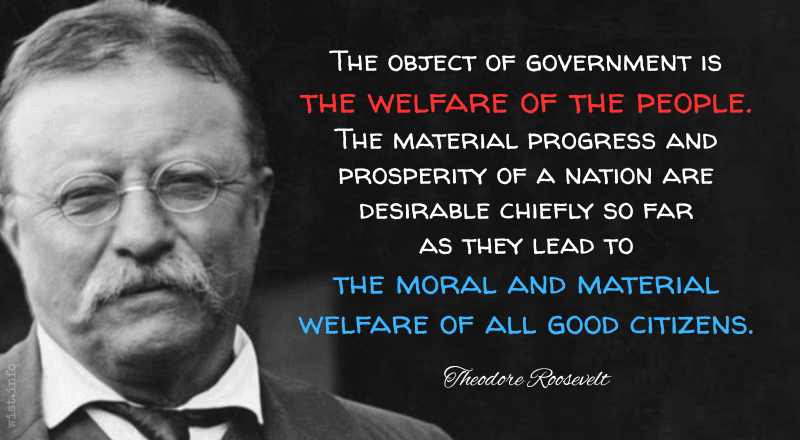
The object of government is the welfare of the people. The material progress and prosperity of a nation are desirable chiefly so far as they lead to the moral and material welfare of all good citizens.
Theodore Roosevelt (1858-1919) American politician, statesman, conservationist, writer, US President (1901-1909)
Speech (1910-08-31), “The New Nationalism,” John Brown Memorial Park dedication, Osawatomie, Kansas
(Source)
A decent provision for the poor is the true test of civilization.
Samuel Johnson (1709-1784) English writer, lexicographer, critic
Comment (1770)
(Source)
Quoted by Rev. Dr. Maxwell. In James Boswell, The Life of Samuel Johnson (1791).
See Dostoyevsky, Buck.

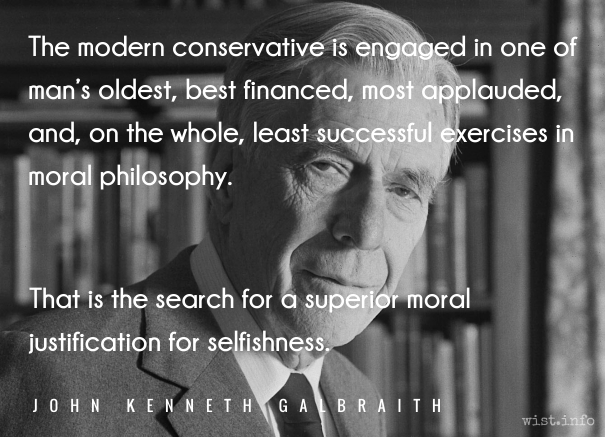
The modern conservative is not even especially modern. He is engaged, on the contrary, in one of man’s oldest, best financed, most applauded, and, on the whole, least successful exercises in moral philosophy. That is the search for a superior moral justification for selfishness. It is an exercise which always involves a certain number of internal contradictions and even a few absurdities. The conspicuously wealthy turn up urging the character-building value of privation for the poor. The man who has struck it rich in minerals, oil, or other bounties of nature is found explaining the debilitating effect of unearned income from the state. The corporate executive who is a superlative success as an organization man weighs in on the evils of bureaucracy. Federal aid to education is feared by those who live in suburbs that could easily forgo this danger, and by people whose children are in public schools. Socialized medicine is condemned by men emerging from Walter Reed Hospital. Social Security is viewed with alarm by those who have the comfortable cushion of an inherited income. Those who are immediately threatened by public efforts to meet their needs — whether widows, small farmers, hospitalized veterans, or the unemployed — are almost always oblivious to the danger.
John Kenneth Galbraith (1908-2006) Canadian-American economist, diplomat, author
Speech (1963-12-13), “Wealth and Poverty,” National Policy Committee on Pockets of Poverty
(Source)
Galbraith used variations on this quote over the years.
- The above quotation was from a speech given, that was then entered into the Congressional Record, Vol. 109, Senate (1963-12-18).
- This material was reworked into an article "Let us begin: An invitation to action on poverty," in Harper's (1964-03), which was in turn again entered into the Congressional Record, Vol. 110 (1964).
- One of the last is most often cited: "The modern conservative is engaged in one of man’s oldest exercises in moral philosophy, that is the search for a superior moral justification for selfishness. It is an exercise which always involves a certain number of internal contradictions and even a few absurdities. The conspicuously wealthy turn up urging the character-building value of privation for the poor." ["Stop the Madness," Interview with Rupert Cornwell, Toronto Globe and Mail (2002-07-06)]

Money is always to be found when men are to be sent to the frontiers to be destroyed: when the object is to preserve them, it is no longer so.
[On en trouve [l’argent] toujours quand il s’agit d’aller faire tuer des hommes sur la frontière: il n’y en a plus quand il faut les sauver.]
Voltaire (1694-1778) French writer [pseud. of Francois-Marie Arouet]
Questions on the Encyclopedia [Questions sur l’Encyclopédie], “Charity [Charité]” (1770) [tr. Fleming]
(Source)
Referring to the scandalous conditions at the Hôtel Dieu charity hospital in Paris.
(Source (French)). Subsequently folded into later editions of the Philosophical Dictionary [Dictionnaire Philosophique].

It is not only in war, however, that we fight for freedom. One fights for freedom in personal contacts and in many phases of civilian life. When the war is over, the four freedoms will not have been won, we shall simply have dominated their more aggressive enemies. At all times, day by day, we have to continue fighting for freedom of religion, freedom of speech, freedom from fear, and freedom from want — for these are things that must be gained in peace as well as in war. At all times, day by day, we have to continue fighting for freedom of religion, freedom of speech, and freedom from want — for these are things that must be gained in peace as well as in war.
Eleanor Roosevelt (1884-1962) First Lady of the US (1933-45), politician, diplomat, activist
Column (1943-04-15), “My Day”
(Source)

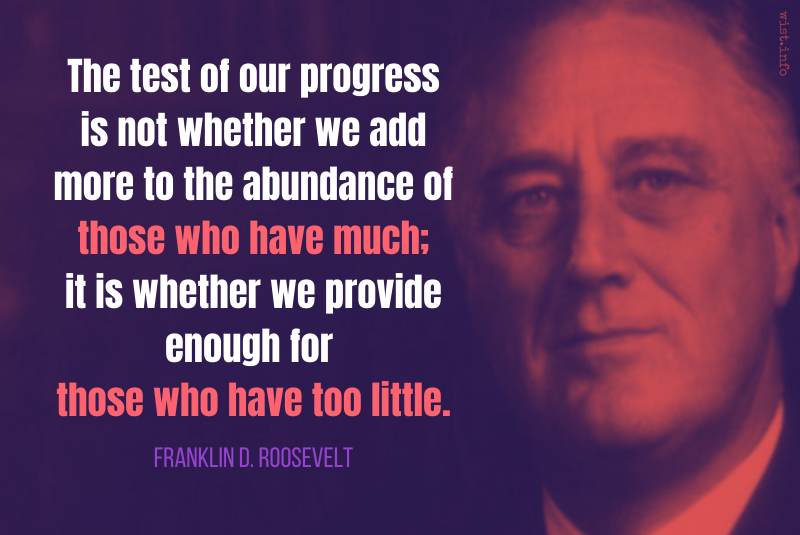
The test of our progress is not whether we add more to the abundance of those who have much; it is whether we provide enough for those who have too little.
“But you were always a good man of business, Jacob,” faltered Scrooge, who now began to apply this to himself.
“Business!” cried the Ghost, wringing its hands again. “Mankind was my business. The common welfare was my business; charity, mercy, forbearance, and benevolence were, all, my business. The dealings of my trade were but a drop of water in the comprehensive ocean of my business!”
Charles Dickens (1812-1870) English writer and social critic
A Christmas Carol (1843)
We are face to face with new conceptions of the relations of property to human welfare, chiefly because certain advocates of the rights of property as against the rights of men have been pushing their claims too far. The man who wrongly holds that every human right is secondary to his profit must now give way to the advocate of human welfare, who rightly maintains that every man holds his property subject to the general right of the community to regulate its use to whatever degree the public welfare may require it.
Theodore Roosevelt (1858-1919) American politician, statesman, conservationist, writer, US President (1901-1909)
Speech (1910-08-31), “The New Nationalism,” Osawatomie, Kansas
(Source)
The national budget must be balanced. The public debt must be reduced; the arrogance of the authorities must be moderated and controlled. Payments to foreign governments must be reduced, if the nation doesn’t want to go bankrupt. People must again learn to work, instead of living on public assistance.
Marcus Tullius Cicero (106-43 BC) Roman orator, statesman, philosopher
(Spurious)
(Source)
One of several related paraphrases of this "quote" from Taylor Caldwell's novel about Cicero, A Pillar of Iron, ch. 51 (1965):Antonius heartily agreed with him [sc. Cicero] that the budget should be balanced, that the Treasury should be refilled, that public debt should be reduced, that the arrogance of the generals should be tempered and controlled, that assistance to foreign lands should be curtailed lest Rome become bankrupt, that the mobs should be forced to work and not depend on government for subsistence, and that prudence and frugality should be put into practice as soon as possible.
See here and here for more discussion.