

If you would be loved, love and be lovable.
Benjamin Franklin (1706–1790) American statesman, scientist, philosopher, aphorist
Poor Richard’s Almanack (Feb 1755)
Earlier given, "If you'd be beloved, make yourself amiable." (Nov 1744). See Ovid.
Quotations by:
Franklin, Benjamin
A Man without a Wife is but half a Man.
Benjamin Franklin (1706–1790) American statesman, scientist, philosopher, aphorist
Poor Richard’s Almanack (Jan 1755)
Sloth and Silence are a Fool’s Virtues.
Benjamin Franklin (1706–1790) American statesman, scientist, philosopher, aphorist
Poor Richard’s Almanack (Jul 1735)
Anger is never without a Reason,
But seldom with a good One.Benjamin Franklin (1706–1790) American statesman, scientist, philosopher, aphorist
Poor Richard’s Almanack (Jul 1753)
Tomorrow, every Fault is to be amended;
but that Tomorrow never comes.Benjamin Franklin (1706–1790) American statesman, scientist, philosopher, aphorist
Poor Richard’s Almanack (Jul 1756)
Nothing but Money
Is sweeter than Honey.Benjamin Franklin (1706–1790) American statesman, scientist, philosopher, aphorist
Poor Richard’s Almanack (Jun 1735)
Mankind are very odd Creatures: One Half censure what they practice, the other half practice what they censure; the rest always say and do as they ought.
Benjamin Franklin (1706–1790) American statesman, scientist, philosopher, aphorist
Poor Richard’s Almanack (Jun 1752)
Calamity and Prosperity are the Touchstones of Integrity.
Benjamin Franklin (1706–1790) American statesman, scientist, philosopher, aphorist
Poor Richard’s Almanack (Mar 1752)
When Reason preaches, if you won’t hear her, she’ll box your Ears.
Benjamin Franklin (1706–1790) American statesman, scientist, philosopher, aphorist
Poor Richard’s Almanack (Mar 1753)
Love your Enemies, for they tell you your Faults.
Benjamin Franklin (1706–1790) American statesman, scientist, philosopher, aphorist
Poor Richard’s Almanack (Mar 1756)
The honest Man takes Pains, and then enjoys Pleasures;
the Knave takes Pleasure, and then suffers Pains.Benjamin Franklin (1706–1790) American statesman, scientist, philosopher, aphorist
Poor Richard’s Almanack (May 1755)
Work as if you were to live 100 years; pray as if you were to die tomorrow.
Benjamin Franklin (1706–1790) American statesman, scientist, philosopher, aphorist
Poor Richard’s Almanack (May 1757)
(Source)
Not to oversee Workmen, is to leave them your Purse open.
Benjamin Franklin (1706–1790) American statesman, scientist, philosopher, aphorist
Poor Richard’s Almanack (Nov 1751)
(Source)
Diligence overcomes Difficulties; Sloth makes them.
Benjamin Franklin (1706–1790) American statesman, scientist, philosopher, aphorist
Poor Richard’s Almanack (Nov 1755)
Happiness depends more on the inward Disposition of Mind than on the outward Circumstances.
Benjamin Franklin (1706–1790) American statesman, scientist, philosopher, aphorist
Poor Richard’s Almanack (Nov 1757)
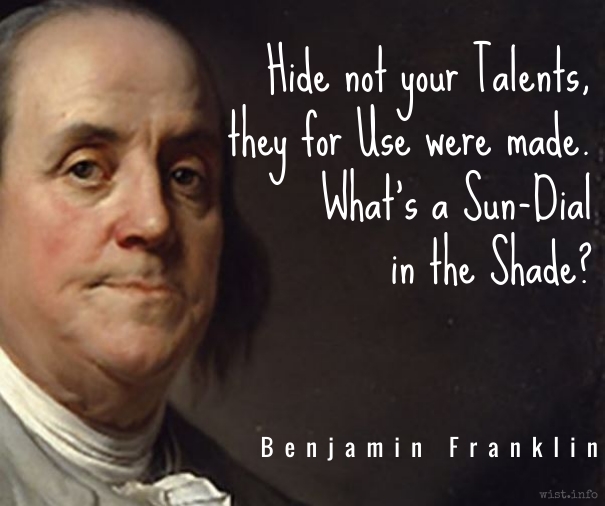
Hide not your Talents, they for Use were made.
What’s a Sun-Dial in the Shade?
Benjamin Franklin (1706–1790) American statesman, scientist, philosopher, aphorist
Poor Richard’s Almanack (Oct 1750)
To serve the Public faithfully, and at the same time please it entirely, is impracticable.
Benjamin Franklin (1706–1790) American statesman, scientist, philosopher, aphorist
Poor Richard’s Almanack (Oct 1758)
Who is wise? He that learns from every One. Who is powerful? He that governs his Passions. Who is rich? He that is content. Who is that? Nobody.
Benjamin Franklin (1706–1790) American statesman, scientist, philosopher, aphorist
Poor Richard’s Almanack (Jul 1755)
Human Felicity is produc’d not so much by great Pieces of good Fortune that seldom happen, as by little Advantages that occur every day.
Benjamin Franklin (1706–1790) American statesman, scientist, philosopher, aphorist
The Autobiography of Ben Franklin (1771-1790)
Full text.
How convenient does it prove to be a rational animal, that knows how to find or invent a plausible pretext for whatever it has an inclination so to do.
Benjamin Franklin (1706–1790) American statesman, scientist, philosopher, aphorist
The Life of Benjamin Franklin (1791)
(Source)
Often paraphrased: "Man is a rational animal. He can think up a reason for anything he wants to believe." Sometimes attributed to Anatole France.
Those who would give up essential Liberty, to purchase a little temporary Safety, deserve neither Liberty nor Safety.
Benjamin Franklin (1706–1790) American statesman, scientist, philosopher, aphorist
Letter (1755-11-11) to Royal Governor Robert Hunter Morris, from the Pennsylvania Assembly
(Source)
Also given as, "They that can give up essential liberty to obtain a little temporary safety deserve neither liberty nor safety" (cited in the Historical Review of Pennsylvania (1759)).
The actual "Reply to the Governor" letter, a response to Morris' rejection of the Assembly's proposals for frontier defense, was written by a committee of which Franklin was a member. He is usually credited as largely being the author, and he used this phrase subsequent to this.

Without Freedom of Thought, there can be no such Thing as Wisdom; and no such Thing as publick Liberty, without Freedom of Speech.
Benjamin Franklin (1706–1790) American statesman, scientist, philosopher, aphorist
Letter #8 from “Silence Dogood” (pseud.), in The New-England Courant, Boston (9 Jul 1722)
Inscribed on Cox Corridor II, first floor House corridor, U.S. Capitol.
If we look back into history for the character of the present sects in Christianity, we shall find few that have not in their turns been persecutors, and complainers of persecution. The primitive Christians thought persecution extremely wrong in the Pagans, but practised it on one another. The first Protestants of the Church of England blamed persecution in the Romish Church, but practised it against the Puritans. These found it wrong in the bishops, but fell into the same practice themselves, both here and in New England.
Benjamin Franklin (1706–1790) American statesman, scientist, philosopher, aphorist
Letter in The London Packet (3 Jun 1772)
(Source)
We hear of the conversion of water into wine at the marriage in Cana, as of a miracle. But this conversion is, through the goodness of God, made every day before our eyes. Behold the rain which descends from heaven upon our vineyards, and which incorporates itself with the grapes to be changed into wine; a constant proof that God loves us, and loves to see us happy!
Benjamin Franklin (1706–1790) American statesman, scientist, philosopher, aphorist
Letter to Abbé Morallet (1779)
(Source)
Apparent origin of the misquote: "Beer is proof that God loves us and wants us to be happy."
When the natural Weakness and Imperfection of Human Understanding is considered, with the unavoidable Influences of Education, Custom, Books and Company, upon our Ways of thinking, I imagine a Man must have a good deal of Vanity who believes, and a good deal of Boldness who affirms, that all the Doctrines he holds, are true; and all he rejects, are false. And perhaps the same may be justly said of every Sect, Church and Society of men when they assume to themselves that Infallibility which they deny to the Popes and Councils.
Benjamin Franklin (1706–1790) American statesman, scientist, philosopher, aphorist
Letter to Abiah Franklin (father) (13 Apr 1738)
Full text.
That it is better 100 guilty Persons should escape than that one innocent Person should suffer, is a Maxim that has been long and generally approved.
Benjamin Franklin (1706–1790) American statesman, scientist, philosopher, aphorist
Letter to Benjamin Vaughan (14 Mar 1785)
Here is my Creed: I believe in one God, Creator of the Universe. That He governs it by his Providence. That he ought to be worshipped. That the most acceptable Service we can render to him, is doing Good to his other Children. That the Soul of Man is immortal, and will be treated with Justice in another Life respecting its Conduct in this. These I take to be the fundamental Principles of all sound Religion, and I regard them as you do, in whatever Sect I meet with them.
Benjamin Franklin (1706–1790) American statesman, scientist, philosopher, aphorist
Letter to Ezra Stiles (9 Mar 1790)
(Source)
As to Jesus of Nazareth, my Opinion of whom you particularly desire, I think the System of Morals and his Religion as he left them to us, the best the World ever saw, or is likely to see; but I apprehend it has received various corrupting Changes, and I have with most of the present Dissenters in England, some Doubts as to his Divinity: tho’ it is a Question I do not dogmatise upon, having never studied it, and think it needless to busy myself with it now, when I expect soon an Opportunity of knowing the Truth with less Trouble. I see no harm however in its being believed, if that Belief has the good Consequence as probably it has, of making his Doctrines more respected and better observed, especially as I do not perceive that the Supreme takes it amiss, by distinguishing the Believers, in his Government of the World, with any particular Marks of his Displeasure.
Benjamin Franklin (1706–1790) American statesman, scientist, philosopher, aphorist
Letter to Ezra Stiles (9 Mar 1790)
(Source)
I have ever let others enjoy their religious Sentiments, without reflecting on them for those that appeared to me insupportable and even absurd. All Sects here, and we have a great Variety, have experienced my Good will in assisting them with Subscriptions for building their new Places of Worship, and as I have never opposed any of their Doctrines I hope to go out of the World in Peace with them all.
Benjamin Franklin (1706–1790) American statesman, scientist, philosopher, aphorist
Letter to Ezra Stiles (9 Mar 1790)
(Source)
Each party abuses the other; the profane and the infidel believe both sides, and enjoy the fray; the reputation of religion in general suffers, and its enemies are ready to say, not what was said in the primitive times, Behold how these Christians love one another, — but, Mark how these Christians HATE one another! Indeed, when religious people quarrel about religion, or hungry people about their victuals, it looks as if they had not much of either among them.
Benjamin Franklin (1706–1790) American statesman, scientist, philosopher, aphorist
Letter to Jane Mecom (23 Feb 1769)
(Source)
On the vociferous denominational debate in America over whether a new bishop should be sent from the Church of England to the Colonies.
Our new Constitution is now established, and has an appearance that promises permanency, but in this world nothing can be said to be certain, except death and taxes.
The Faith you mention has doubtless its use in the World. I do not desire to see it diminished, nor would I endeavour to lessen it in any Man. But I wish it were more productive of good Works, than I have generally seen it: I mean real good Works, Works of Kindness, Charity, Mercy, and Publick Spirit; not Holiday-keeping, Sermon-Reading or Hearing; performing Church Ceremonies, or making long Prayers, filled with Flatteries and Compliments, despis’d even by wise Men, and much less capable of pleasing the Deity.
Benjamin Franklin (1706–1790) American statesman, scientist, philosopher, aphorist
Letter to Joseph Huey (6 Jun 1753)
(Source)
The worship of God is a Duty; the hearing and reading of Sermons may be useful; but, if Men rest in Hearing and Praying, as too many do, it is as if a Tree should Value itself on being water’d and putting forth Leaves, tho’ it never produc’d any Fruit.
Benjamin Franklin (1706–1790) American statesman, scientist, philosopher, aphorist
Letter to Joseph Huey (6 Jun 1753)
(Source)
You both seem concern’d lest I have imbib’d some erroneous Opinions. Doubtless I have my Share, and when the natural Weakness and Imperfection of Human Understanding is considered, with the unavoidable Influences of Education, Custom, Books and Company, upon our Ways of thinking, I imagine a Man must have a good deal of Vanity who believes, and a good deal of Boldness who affirms, that all the Doctrines he holds, are true; and all he rejects, are false. And perhaps the same may be justly said of every Sect, Church and Society of men when they assume to themselves that Infallibility which they deny to the Popes and Councils. I think Opinions should be judg’d of by their Influences and Effects; and if a Man holds none that tend to make him less Virtuous or more vicious, it may be concluded he holds none that are dangerous; which I hope is the Case with me.
Benjamin Franklin (1706–1790) American statesman, scientist, philosopher, aphorist
Letter to Josiah and Abiah Franklin (13 Apr 1738)
(Source)
His parents.
But since it is no more in a Man’s Power to think than to look like another, methinks all that should be expected from me is to keep my Mind open to Conviction, to hear patiently and examine attentively whatever is offered me for that end; and if after all I continue in the same Errors, I believe your usual Charity will induce you rather to pity and excuse than blame me.
Benjamin Franklin (1706–1790) American statesman, scientist, philosopher, aphorist
Letter to Josiah and Abiah Franklin (13 Apr 1738)
(Source)
His parents.
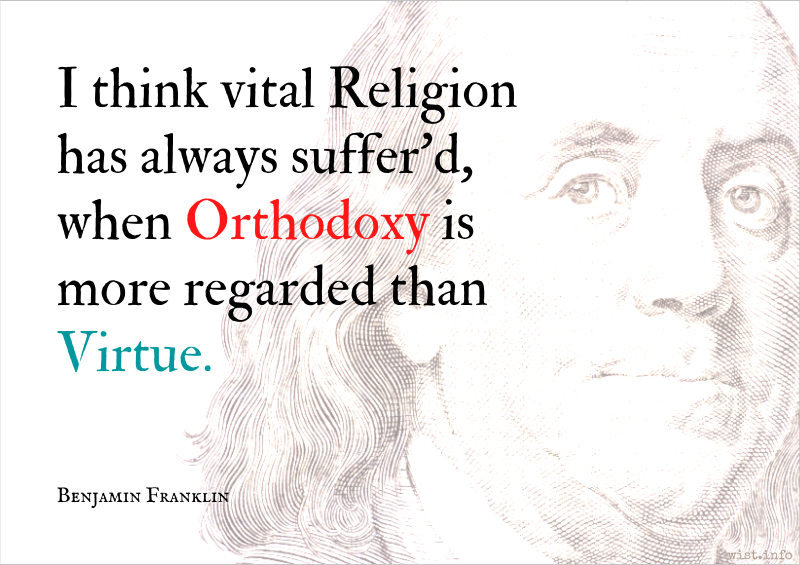
I think vital Religion has always suffer’d, when Orthodoxy is more regarded than Virtue. And the Scripture assures me, that at the last Day, we shall not be examin’d what we thought, but what we did; and our Recommendation will not be that we said Lord, Lord, but that we did GOOD to our Fellow Creatures.
Benjamin Franklin (1706–1790) American statesman, scientist, philosopher, aphorist
Letter to Josiah and Abiah Franklin (13 Apr 1738)
(Source)
His parents. Franklin cites Matt. 26 in the letter, but it should be Matt. 25:31-46.
From such Considerations as these it follows, that I ought never to be angry with any one for differing in Judgment from me. For how know I but the Point in dispute between us, is one of those Errors that I have embrac’d as Truth. If I am in the Wrong, I should not be displeas’d that another is in the Right. If I am in the Right, ’tis my Happiness; and I should rather pity than blame him who is unfortunately in the Wrong.
Benjamin Franklin (1706–1790) American statesman, scientist, philosopher, aphorist
Letter to Josiah Franklin (Apr 1738) [draft]
(Source)
His father.
People who live long, who will drink of the cup of life to the very bottom, must expect to meet with some of the usual dregs.
Benjamin Franklin (1706–1790) American statesman, scientist, philosopher, aphorist
Letter to M. Le Veillard (15 Apr 1787)
(Source)
I have indeed now and then a little compunction in reflecting that I spend time so idly; but another reflection comes to relieve me, whispering, “You know that the soul is immortal; why then should you be such a niggard of a little time, when you have a whole eternity before you?” So, being easily convinced, and, like other reasonable creatures, satisfied with a small reason, when it is in favor of doing what I have a mind to do, I shuffle the cards again, and begin another game.
Benjamin Franklin (1706–1790) American statesman, scientist, philosopher, aphorist
Letter to Mary Hewson (6 May 1786)
(Source)
One’s true happiness depends more upon one’s own judgment of one’s self, or a consciousness of rectitude in action and intention, and the approbation of those few, who judge impartially, than upon the applause of the unthinking, undiscerning multitude, who are apt to cry Hosanna today, and tomorrow, Crucify him.
Benjamin Franklin (1706–1790) American statesman, scientist, philosopher, aphorist
Letter to Mrs. Jane Mecom (1 Mar 1766)
When a religion is good, I conceive it will support itself; and when it does not support itself, and God does not take care to support it so that its professors are obligated to call for help of the civil power, it’s a sign, I apprehend, of its being a bad one.
Benjamin Franklin (1706–1790) American statesman, scientist, philosopher, aphorist
Letter to Richard Price (9 Oct 1780)
All the property that is necessary to a Man, for the Conservation of the Individual and the Propagation of the Species, is his natural Right, which none can justly deprive him of: But all Property superfluous to such purposes is the Property of the Publick, who, by their Laws, have created it, and who may therefore by other laws dispose of it, whenever the Welfare of the Publick shall demand such Disposition. He that does not like civil Society on these Terms, let him retire and live among Savages. He can have no right to the benefits of Society, who will not pay his Club towards the Support of it.
Benjamin Franklin (1706–1790) American statesman, scientist, philosopher, aphorist
Letter to Robert Morris (25 Dec 1783)
(Source)
‘Tis an old Saying, That an Ounce of Prevention is worth a Pound of Cure.
Benjamin Franklin (1706–1790) American statesman, scientist, philosopher, aphorist
Letter to Samuel Johnson (13 Sep 1750)
For my own part I wish the Bald Eagle had not been chosen the Representative of our Country. He is a Bird of bad moral Character. He does not get his Living honestly. You may have seen him perched on some dead Tree near the River, where, too lazy to fish for himself, he watches the Labour of the Fishing Hawk; and when that diligent Bird has at length taken a Fish, and is bearing it to his Nest for the Support of his Mate and young Ones, the Bald Eagle pursues him and takes it from him. With all this Injustice, he is never in good Case but like those among Men who live by Sharping & Robbing he is generally poor and often very lousy. Besides he is a rank Coward: The little King Bird not bigger than a Sparrow attacks him boldly and drives him out of the District. [… T]he Turkey is in Comparison a much more respectable Bird, and withal a true original Native of America […] He is besides, though a little vain & silly, a Bird of Courage, and would not hesitate to attack a Grenadier of the British Guards who should presume to invade his Farm Yard with a red Coat on.
Benjamin Franklin (1706–1790) American statesman, scientist, philosopher, aphorist
Letter to Sarah Franklin Bache (26 Jan 1784)
(Source)
To confirm still more your piety and gratitude to Divine Providence, reflect upon the situation which it has given to the elbow. You see in animals, who are intended to drink the waters that flow upon the earth, that if they have long legs, they have also a long neck, so that they can get at their drink without kneeling down. But man, who was destined to drink wine, is framed in a manner that he may rise the glass to his mouth. If the elbow had been placed nearer the hand, the part in advance would have been too short to bring the glass up to the mouth; and if it had been nearer the shoulder, that part would have been so long that when it attempted to carry the wine to the mouth it would have overshot the mark, and gone beyond the head; thus, either way, we should have been in the case of Tantalus. But from the actual situation of the elbow, we are enabled to drink at our ease, the glass going directly to the mouth. Let us, then, with glass in hand, adore this benevolent wisdom; — let us adore and drink!
Benjamin Franklin (1706–1790) American statesman, scientist, philosopher, aphorist
Letter to the Abbé Morallet, Postscript (1779)
(Source)
Everything one has a right to do is not best to be done.
Benjamin Franklin (1706–1790) American statesman, scientist, philosopher, aphorist
Memorandum on Colonial Taxation
(Source)