

Leisure is Time for doing something useful; this Leisure the diligent Man will obtain but the lazy Man never.
Benjamin Franklin (1706-1790) American statesman, scientist, philosopher, aphorist
“The Way to Wealth” (7 Jul 1757)
Quotations by:
Franklin, Benjamin
In short, we can judge by nothing but Appearances, and they are very apt to deceive us. Some put on a gay chearful Outside, and appear to the World perfectly at Ease, tho’ even then, some inward Sting, some secret Pain imbitters all their Joys, and makes the Balance even: Others appear continually dejected and full of Sorrow; but even Grief itself is sometimes pleasant, and Tears are not always without their Sweetness: Besides, Some take a Satisfaction in being thought unhappy, (as others take a Pride in being thought humble,) these will paint their Misfortunes to others in the strongest Colours, and leave no Means unus’d to make you think them thoroughly miserable; so great a Pleasure it is to them to be pitied; Others retain the Form and outside Shew of Sorrow, long after the Thing itself, with its Cause, is remov’d from the Mind; it is a Habit they have acquir’d and cannot leave.
Benjamin Franklin (1706-1790) American statesman, scientist, philosopher, aphorist
“A Dissertation on Liberty and Necessity” (1725)
(Source)
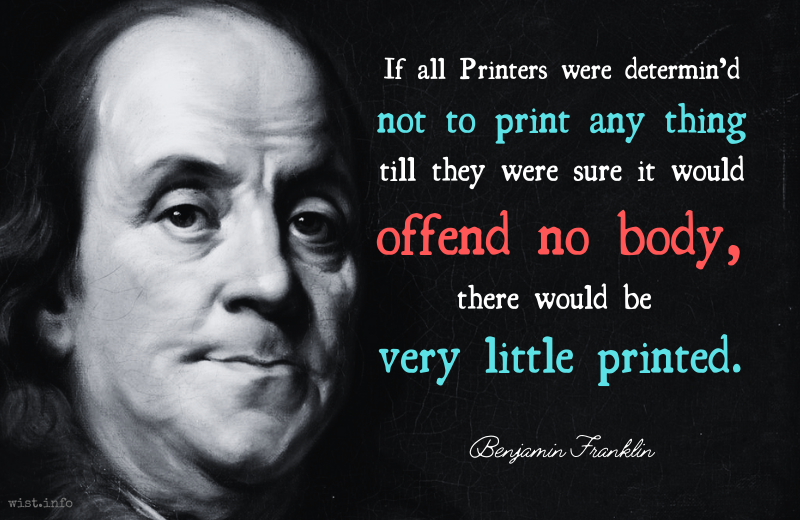
If all Printers were determin’d not to print any thing till they were sure it would offend no body, there would be very little printed.
Benjamin Franklin (1706-1790) American statesman, scientist, philosopher, aphorist
“Apology for Printers,” Philadelphia Gazette (1731-06-10)
(Source)
It is as unreasonable in any one Man or Set of Men to expect to be pleas’d with every thing that is printed, as to think that nobody ought to be pleas’d but themselves.
Benjamin Franklin (1706-1790) American statesman, scientist, philosopher, aphorist
“Apology for Printers,” Philadelphia Gazette (1731-06-10)
(Source)
Printers are educated in the Belief, that when Men differ in Opinion, both Sides ought equally to have the Advantage of being heard by the Publick; and that when Truth and Error have fair Play, the former is always an overmatch for the latter: Hence they chearfully serve all contending Writers that pay them well, without regarding on which side they are of the Question in Dispute.
Benjamin Franklin (1706-1790) American statesman, scientist, philosopher, aphorist
“Apology for Printers,” Philadelphia Gazette (1731-06-10)
(Source)
That hence arises the peculiar Unhappiness of that Business, which other Callings are no way liable to; they who follow Printing being scarce able to do any thing in their way of getting a Living, which shall not probably give Offence to some, and perhaps to many; whereas the Smith, the Shoemaker, the Carpenter, or the Man of any other Trade, may work indifferently for People of all Persuasions, without offending any of them: and the Merchant may buy and sell with Jews, Turks, Hereticks, and Infidels of all sorts, and get Money by every one of them, without giving Offence to the most orthodox, of any sort; or suffering the least Censure or Ill-will on the Account from any Man whatever.
Benjamin Franklin (1706-1790) American statesman, scientist, philosopher, aphorist
“Apology for Printers,” Philadelphia Gazette (1731-06-10)
(Source)
Being thus continually employ’d in serving all Parties, Printers naturally acquire a vast Unconcernedness as to the right or wrong Opinions contain’d in what they print; regarding it only as the Matter of their daily labour: They print things full of Spleen and Animosity, with the utmost Calmness and Indifference, and without the least Ill-will to the Persons reflected on; who nevertheless unjustly think the Printer as much their Enemy as the Author, and join both together in their Resentment.
Benjamin Franklin (1706-1790) American statesman, scientist, philosopher, aphorist
“Apology for Printers,” Philadelphia Gazette (1731-06-10)
(Source)
It is unreasonable to imagine Printers approve of every thing they print, and to censure them on any particular thing accordingly; since in the way of their Business they print such great variety of things opposite and contradictory. It is likewise as unreasonable what some assert, That Printers ought not to print any Thing but what they approve; since if all of that Business should make such a Resolution, and abide by it, an End would thereby be put to Free Writing, and the World would afterwards have nothing to read but what happen’d to be the Opinions of Printers.
Benjamin Franklin (1706-1790) American statesman, scientist, philosopher, aphorist
“Apology for Printers,” Philadelphia Gazette (1731-06-10)
(Source)
If all the People of different Opinions in this Province would engage to give me as much for not printing things they don’t like, as I can get by printing them, I should probably live a very easy Life; and if all Printers were every where so dealt by, there would be very little printed.
Benjamin Franklin (1706-1790) American statesman, scientist, philosopher, aphorist
“Apology for Printers,” Philadelphia Gazette (1731-06-10)
(Source)
I believe long habits of virtue have a sensible effect on the countenance.
Benjamin Franklin (1706-1790) American statesman, scientist, philosopher, aphorist
“Busy-Body Papers,” American Weekly Mercury (18 Feb 1729)
You philosophers are sages in your maxims, and fools in your conduct.
Benjamin Franklin (1706-1790) American statesman, scientist, philosopher, aphorist
“Dialogue Between Franklin and the Gout” (22 Oct 1780)
Morality or Virtue is the end, faith only a Means to obtain that end: And if the end be obtained, it is no matter by what means.
Benjamin Franklin (1706-1790) American statesman, scientist, philosopher, aphorist
“Dialogue Between Two Presbyterians” (1735)
The body of Benjamin Franklin, Printer (like the cover of an old book, its contents torn out and stripped of its lettering and gilding), lies here, food for worms; but the work shall not be lost, for it will (as he believed) appear once more in a new and more elegant edition, revised and corrected by the author.
Benjamin Franklin (1706-1790) American statesman, scientist, philosopher, aphorist
“Epitaph on Himself” (1778)
Variant words (and format):The body of
B. Franklin
Printer
Like the cover of an old book,
its contents torn out,
and stripped of its lettering and gilding,
lies here, food for worms.
But the work shall not be wholly lost;
for it will, as he believed, appear once more,
in a new and more perfect edition
corrected and amended
by the Author.
Ambition has its disappointments to sour us, but never the good fortune to satisfy us. Its appetite grows keener by indulgence and all we can gratify it with at present serves but the more to inflame its insatiable desires.
Benjamin Franklin (1706-1790) American statesman, scientist, philosopher, aphorist
“On True Happiness,” The Pennsylvania Gazette (20 Nov 1735)
(Source)
Those who would give up essential Liberty, to purchase a little temporary Safety, deserve neither Liberty nor Safety
Benjamin Franklin (1706-1790) American statesman, scientist, philosopher, aphorist
“Reply to the Governor,” Pennsylvania Assembly (11 Nov 1755)
Also given as, "They that can give up essential liberty to obtain a little temporary safety deserve neither liberty nor safety." (cited Historical Review of Pennsylvania (1759))
Never leave that till tomorrow which you can do today.
Benjamin Franklin (1706-1790) American statesman, scientist, philosopher, aphorist
“The Way to Wealth” (1758)
(Source)
Today, this is more commonly given as "Never put off till tomorrow what you can do today."
Franklin had used a different phrasing in Poor Richard (1742 ed.): "Have you somewhat to do To-morrow, do it To-day." That was reprinted in Poor Richard Improved (1758 ed.), but when that latter work was condensed into "The Way to Wealth" that same year, the wording above was used.
As with so many of Franklin's "Poor Richard" aphorisms, this was not original to him. Thomas Fuller uses a similar phrase in 1725.
The sentiment itself has been mocked or modified by others such as Mark Twain, Josh Bilings, Aldous Huxley, Pablo Picasso, and Mignon McLaughlin.
Hear reason, or she’ll make you feel her.
Benjamin Franklin (1706-1790) American statesman, scientist, philosopher, aphorist
(Attributed)
He who multiplies riches multiplies cares.
Benjamin Franklin (1706-1790) American statesman, scientist, philosopher, aphorist
(Attributed)
Many a man thinks he is buying pleasure, when he is really selling himself to it.
Benjamin Franklin (1706-1790) American statesman, scientist, philosopher, aphorist
(Attributed)
If we take care of the minutes, the years will take care of themselves.
Benjamin Franklin (1706-1790) American statesman, scientist, philosopher, aphorist
(Attributed)
There is no kind of dishonesty into which otherwise good people more easily and frequently fall than that of defrauding the government.
Benjamin Franklin (1706-1790) American statesman, scientist, philosopher, aphorist
(Attributed)
I haven’t failed, I’ve found ten thousand ways that don’t work.
Benjamin Franklin (1706-1790) American statesman, scientist, philosopher, aphorist
(Attributed)
(also attrib. Thomas Edison)
The learned fool writes his nonsense in better language than the unlearned, but still ’tis nonsense.
Benjamin Franklin (1706-1790) American statesman, scientist, philosopher, aphorist
(Attributed)
You may delay, but Time will not.
Benjamin Franklin (1706-1790) American statesman, scientist, philosopher, aphorist
(Attributed)
We must all hang together, or most assuredly, we shall all hang separately.
Benjamin Franklin (1706-1790) American statesman, scientist, philosopher, aphorist
(Attributed)
Attributed remark at the signing of the Declaration of Independence (4 Jul 1776)
Carelessness does more harm than a want of knowledge.
Benjamin Franklin (1706-1790) American statesman, scientist, philosopher, aphorist
(Attributed)
Fake quotes will ruin the Internet.
Benjamin Franklin (1706-1790) American statesman, scientist, philosopher, aphorist
(Attributed)
Democracy is two wolves and a lamb voting on what to have for lunch.
Benjamin Franklin (1706-1790) American statesman, scientist, philosopher, aphorist
(Spurious)
Frequently attributed to Franklin, but not found in his writing (and the word "lunch" dates only back to the 1820s). The phrase is only found in sources dating back to the early 1990s, e.g.,
- "Democracy is like two wolves and a lamb deciding on what they want for dinner." [Shelby Foote in Ken Burns, Civil War (1990)]
- "Democracy has been described as four wolves and a lamb voting on what to have for lunch." [Los Angeles Times (25 Nov 1990)]
- "Democracy is not freedom. Democracy is two wolves and a lamb voting on what to eat for lunch. Freedom comes from the recognition of certain rights which may not be taken, not even by a 99% vote." [Marvin Simkin, Los Angeles Times (1992)]
- "Democracy must be something more than two wolves and a sheep voting on what to have for dinner." [James Bovard, Lost Rights, "Conclusion" (1994)]
So convenient a thing it is to be a reasonable creature, since it enables one to find or make a reason for everything one has a mind to do.
Benjamin Franklin (1706-1790) American statesman, scientist, philosopher, aphorist
Autobiography, 1771 (1798)
A perfect character might be attended with the inconveniences of being envied and hated; … a benevolent man should allow a few faults in himself, to keep his friends in contenance.
Benjamin Franklin (1706-1790) American statesman, scientist, philosopher, aphorist
Autobiography, 1784 (1798)
Were it offered to my choice, I should have no objection to a repetition of the same life from its beginning, only asking the advantages authors have in a second edition to correct some faults in the first.
Benjamin Franklin (1706-1790) American statesman, scientist, philosopher, aphorist
Autobiography, ch. 1
I had been religiously educated as a Presbyterian; and tho’ some of the Dogmas of that Persuasion, such as the Eternal Decrees of God, Election, Reprobation, &c. appear’d to me unintelligible, others doubtful, & I early absented myself from the Public Assemblies of the Sect, Sunday being my Studying-Day, I never was without some religious Principles; I never doubted, for instance, the Existence of the Deity, that he made the World, & govern’d it by his Providence; that the most acceptable Service of God was the doing Good to Man; that our Souls are immortal; and that all Crime will be punished & Virtue rewarded either here or hereafter; these I esteem’d the Essentials of every Religion, and being to be found in all the Religions we had in our Country I respected them all, tho’ with different degrees of Respect as I found them more or less mix’d with other Articles which without any Tendency to inspire, promote or confirm Morality, serv’d principally to divide us & make us unfriendly to one another.
Benjamin Franklin (1706-1790) American statesman, scientist, philosopher, aphorist
Autobiography, Part 2 (1785)
(Source)
Use no hurtful deceit; think innocently and justly and, if you speak, speak accordingly.
Benjamin Franklin (1706-1790) American statesman, scientist, philosopher, aphorist
Autobiography, Virtue #7 “Sincerity,” 1784 (1798)
Old Boys have their Playthings as well as young Ones; the Difference is only in the Price.
Silence is not always a Sign of Wisdom, but Babbling is ever a Mark of Folly.
Benjamin Franklin (1706-1790) American statesman, scientist, philosopher, aphorist
Poor Richard’s Alamanack (Apr 1758)
‘Tis easier to prevent bad habits than to break them.
Benjamin Franklin (1706-1790) American statesman, scientist, philosopher, aphorist
Poor Richard’s Alamanack (Oct 1745)
A good example is the best sermon.
Benjamin Franklin (1706-1790) American statesman, scientist, philosopher, aphorist
Poor Richard’s Almanack
It is Ill-manners to silence a fool, and Cruelty to let him go on.
Benjamin Franklin (1706-1790) American statesman, scientist, philosopher, aphorist
Poor Richard’s Almanack
Many a little makes a mickle. Beware of small expenses; a small leak will sink a great ship.
Benjamin Franklin (1706-1790) American statesman, scientist, philosopher, aphorist
Poor Richard’s Almanack
Contentment makes poor men rich; discontent makes rich men poor.
Benjamin Franklin (1706-1790) American statesman, scientist, philosopher, aphorist
Poor Richard’s Almanack
Children and Princes will quarrel for Trifles.
Benjamin Franklin (1706-1790) American statesman, scientist, philosopher, aphorist
Poor Richard’s Almanack
He that can have patience can have what he will.
Benjamin Franklin (1706-1790) American statesman, scientist, philosopher, aphorist
Poor Richard’s Almanack (1736)
Full text.
Many a long dispute among Divines may be thus abridg’d, It is so; It is not so. It is so; It is not so.
Benjamin Franklin (1706-1790) American statesman, scientist, philosopher, aphorist
Poor Richard’s Almanack (1743)
(Source)
How many observe Christ’s Birth-day! How few, his Precepts! O! ’tis easier to keep Holidays than Commandments.
Benjamin Franklin (1706-1790) American statesman, scientist, philosopher, aphorist
Poor Richard’s Almanack (1743)
(Source)
Why then should I give my Readers bad Lines of my own, when good Ones of other People’s are so plenty? ‘Tis methinks a poor Excuse for the bad Entertainment of Guests, that the Food we set before them, tho’ coarse and ordinary, is of one’s own Raising, off one’s own Plantation, &c. when there is Plenty of what is ten times better, to be had in the Market. — On the contrary, I assure ye, my Friends, that I have procur’d the best I could for ye, and much Good may’t do ye.
Benjamin Franklin (1706-1790) American statesman, scientist, philosopher, aphorist
Poor Richard’s Almanack (1747)
(Source)
On his borrowing of maxims and aphorisms of others for his almanac.
He is not well-bred, that cannot bear Ill-Breeding in others.
Benjamin Franklin (1706-1790) American statesman, scientist, philosopher, aphorist
Poor Richard’s Almanack (1748)
Having been poor is no shame, but being ashamed of it, is.
Benjamin Franklin (1706-1790) American statesman, scientist, philosopher, aphorist
Poor Richard’s Almanack (1749)
It is easier to suppress the first Desire than to satisfy all that follow it.
Benjamin Franklin (1706-1790) American statesman, scientist, philosopher, aphorist
Poor Richard’s Almanack (1751)
(Source)
Included in his summary piece, "The Way to Wealth" (1757).
He that is of Opinion Money will do every Thing, may well be suspected of doing every Thing for Money.
Benjamin Franklin (1706-1790) American statesman, scientist, philosopher, aphorist
Poor Richard’s Almanack (1753)
See also Halifax.
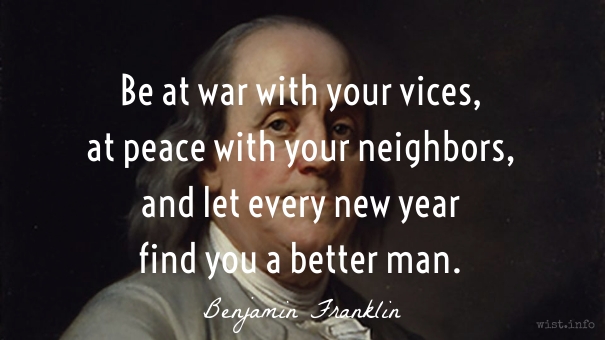
Be at War with your Vices, at Peace with your Neighbours, and let every New-Year find you a better Man.
Benjamin Franklin (1706-1790) American statesman, scientist, philosopher, aphorist
Poor Richard’s Almanack (1755)
More information on this quotation here.
Be civil to all; sociable to many; familiar with few; friend to one; enemy to none.
Benjamin Franklin (1706-1790) American statesman, scientist, philosopher, aphorist
Poor Richard’s Almanack (1756)
Dost thou love life? Then do not squander time, for that’s the stuff life is made of.
Benjamin Franklin (1706-1790) American statesman, scientist, philosopher, aphorist
Poor Richard’s Almanack (1757)
Act uprightly, and despise Calumny; Dirt may stick to a Mud Wall, but not to polish’d Marble.
Benjamin Franklin (1706-1790) American statesman, scientist, philosopher, aphorist
Poor Richard’s Almanack (1757)
The way to see by faith is to shut the eye of reason.
Benjamin Franklin (1706-1790) American statesman, scientist, philosopher, aphorist
Poor Richard’s Almanack (1758)
Most People return small Favors, acknowledge middling ones, and repay great ones with Ingratitude.
Benjamin Franklin (1706-1790) American statesman, scientist, philosopher, aphorist
Poor Richard’s Almanack (Apr 1751)
You may delay, but Time will not.
Benjamin Franklin (1706-1790) American statesman, scientist, philosopher, aphorist
Poor Richard’s Almanack (Apr 1758)
Genius without education is like silver in the mine.
Benjamin Franklin (1706-1790) American statesman, scientist, philosopher, aphorist
Poor Richard’s Almanack (Aug 1750)
‘Tis a great Confidence in a Friend to tell him your Faults, greater to tell him his.
Benjamin Franklin (1706-1790) American statesman, scientist, philosopher, aphorist
Poor Richard’s Almanack (Aug 1751)
Experience keeps a dear school, yet Fools will learn in no other.
Benjamin Franklin (1706-1790) American statesman, scientist, philosopher, aphorist
Poor Richard’s Almanack (Dec 1743)
(Source)
Franklin quotes Poor Richard as well in The Way to Wealth (1758).
More discussion of this quotation, and an image of the original page: Experience Keeps a Dear School; Yet Fools Will Learn In No Other – Quote Investigator.
Success has ruined many a man.
Benjamin Franklin (1706-1790) American statesman, scientist, philosopher, aphorist
Poor Richard’s Almanack (Dec 1752)
Tell me my Faults, and mend your own.
Benjamin Franklin (1706-1790) American statesman, scientist, philosopher, aphorist
Poor Richard’s Almanack (Dec 1756)
Setting too good an Example is a Kind of Slander seldom forgiven.
Benjamin Franklin (1706-1790) American statesman, scientist, philosopher, aphorist
Poor Richard’s Almanack (Feb 1753)
If you would be loved, love and be lovable.
Benjamin Franklin (1706-1790) American statesman, scientist, philosopher, aphorist
Poor Richard’s Almanack (Feb 1755)
Earlier given, "If you'd be beloved, make yourself amiable." (Nov 1744). See Ovid.
A Man without a Wife is but half a Man.
Benjamin Franklin (1706-1790) American statesman, scientist, philosopher, aphorist
Poor Richard’s Almanack (Jan 1755)
Sloth and Silence are a Fool’s Virtues.
Benjamin Franklin (1706-1790) American statesman, scientist, philosopher, aphorist
Poor Richard’s Almanack (Jul 1735)
Anger is never without a Reason,
But seldom with a good One.Benjamin Franklin (1706-1790) American statesman, scientist, philosopher, aphorist
Poor Richard’s Almanack (Jul 1753)
Tomorrow, every Fault is to be amended;
but that Tomorrow never comes.Benjamin Franklin (1706-1790) American statesman, scientist, philosopher, aphorist
Poor Richard’s Almanack (Jul 1756)
Nothing but Money
Is sweeter than Honey.Benjamin Franklin (1706-1790) American statesman, scientist, philosopher, aphorist
Poor Richard’s Almanack (Jun 1735)
Good Sense is Thing all need, few have,
and none think they lack.Benjamin Franklin (1706-1790) American statesman, scientist, philosopher, aphorist
Poor Richard’s Almanack (Jun 1746)
Mankind are very odd Creatures: One Half censure what they practice, the other half practice what they censure; the rest always say and do as they ought.
Benjamin Franklin (1706-1790) American statesman, scientist, philosopher, aphorist
Poor Richard’s Almanack (Jun 1752)
Calamity and Prosperity are the Touchstones of Integrity.
Benjamin Franklin (1706-1790) American statesman, scientist, philosopher, aphorist
Poor Richard’s Almanack (Mar 1752)
When Reason preaches, if you won’t hear her, she’ll box your Ears.
Benjamin Franklin (1706-1790) American statesman, scientist, philosopher, aphorist
Poor Richard’s Almanack (Mar 1753)
Love your Enemies, for they tell you your Faults.
Benjamin Franklin (1706-1790) American statesman, scientist, philosopher, aphorist
Poor Richard’s Almanack (Mar 1756)
If Passion drives, let Reason hold the Reins.
Benjamin Franklin (1706-1790) American statesman, scientist, philosopher, aphorist
Poor Richard’s Almanack (May 1749)
The honest Man takes Pains, and then enjoys Pleasures;
the Knave takes Pleasure, and then suffers Pains.Benjamin Franklin (1706-1790) American statesman, scientist, philosopher, aphorist
Poor Richard’s Almanack (May 1755)
Work as if you were to live 100 years; pray as if you were to die tomorrow.
Benjamin Franklin (1706-1790) American statesman, scientist, philosopher, aphorist
Poor Richard’s Almanack (May 1757)
(Source)
A Mob’s a Monster; Heads enough, but no Brains.
Benjamin Franklin (1706-1790) American statesman, scientist, philosopher, aphorist
Poor Richard’s Almanack (Nov 1747)
Not to oversee Workmen, is to leave them your Purse open.
Benjamin Franklin (1706-1790) American statesman, scientist, philosopher, aphorist
Poor Richard’s Almanack (Nov 1751)
(Source)
Diligence overcomes Difficulties; Sloth makes them.
Benjamin Franklin (1706-1790) American statesman, scientist, philosopher, aphorist
Poor Richard’s Almanack (Nov 1755)
Happiness depends more on the inward Disposition of Mind than on the outward Circumstances.
Benjamin Franklin (1706-1790) American statesman, scientist, philosopher, aphorist
Poor Richard’s Almanack (Nov 1757)
A soft Tongue may strike hard.
Benjamin Franklin (1706-1790) American statesman, scientist, philosopher, aphorist
Poor Richard’s Almanack (Oct 1744)
Most fools think they are only ignorant.
Benjamin Franklin (1706-1790) American statesman, scientist, philosopher, aphorist
Poor Richard’s Almanack (Oct 1748)
Nine men in ten are suicides.
Benjamin Franklin (1706-1790) American statesman, scientist, philosopher, aphorist
Poor Richard’s Almanack (Oct 1749)
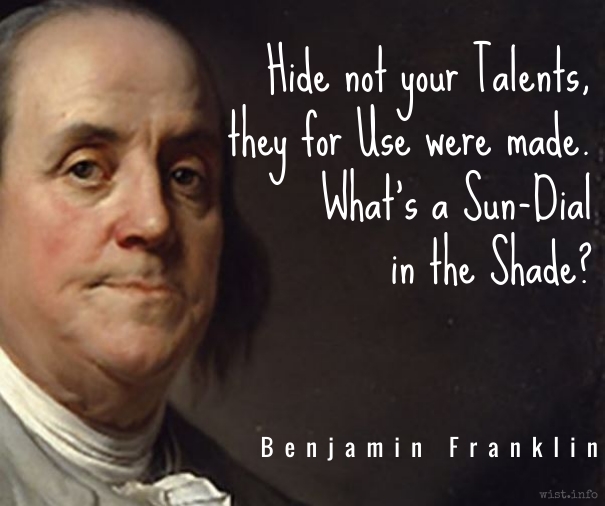
Hide not your Talents, they for Use were made.
What’s a Sun-Dial in the Shade?
Benjamin Franklin (1706-1790) American statesman, scientist, philosopher, aphorist
Poor Richard’s Almanack (Oct 1750)
Being ignorant is not so much a Shame, as being unwilling to learn.
Benjamin Franklin (1706-1790) American statesman, scientist, philosopher, aphorist
Poor Richard’s Almanack (Oct 1755)
To serve the Public faithfully, and at the same time please it entirely, is impracticable.
Benjamin Franklin (1706-1790) American statesman, scientist, philosopher, aphorist
Poor Richard’s Almanack (Oct 1758)
Write Injuries in Dust, Benefits in Marble.
Benjamin Franklin (1706-1790) American statesman, scientist, philosopher, aphorist
Poor Richard’s Almanack, “August” (1747)
(Source)
As with so much else of Franklin's, this phrase is not without earlier forms, e.g.: Thomas More, History of King Richard III (1513):For men use, if they have an evil turn, to write it in marble; and whosoever does us a good turn, we write it in dust.
Or see Shakespeare, Henry VIII 4.2.45-46 (1613):Men's evil manners live in brass, their virtues
We write in water.
Variants include "but kindnesses in marble" or "but kindness in marble."
This also shows up as a French saying in various forms:
- "Ecrivez les injures sur le sable, mais les bienfaits sur le marbre."
- "Écrivez les injures sur le sable, gravez les bienfaits sur le marbre."
In Christmas feasting pray take care;
Let not your table be a Snare;
But with the Poor God’s Bounty share.
Benjamin Franklin (1706-1790) American statesman, scientist, philosopher, aphorist
Poor Richard’s Almanack, December (1748)
(Source)
Strive to be the greatest Man in your Country, and you may be disappointed; Strive to be the best, and you may succeed: He may well win the race that runs by himself.
Benjamin Franklin (1706-1790) American statesman, scientist, philosopher, aphorist
Poor Richard’s Almanack (Jan 1747)
(Source)
Who is wise? He that learns from every One. Who is powerful? He that governs his Passions. Who is rich? He that is content. Who is that? Nobody.
Benjamin Franklin (1706-1790) American statesman, scientist, philosopher, aphorist
Poor Richard’s Almanack (Jul 1755)
Distrust and caution are the parents of security.
Benjamin Franklin (1706-1790) American statesman, scientist, philosopher, aphorist
Poor Richard (1733)
(Source)
Hunger never saw bad bread.
Benjamin Franklin (1706-1790) American statesman, scientist, philosopher, aphorist
Poor Richard (1733)
(Source)
The proof of gold is fire, the proof of woman, gold; the proof of man, a woman.
Benjamin Franklin (1706-1790) American statesman, scientist, philosopher, aphorist
Poor Richard (1733)
(Source)
Mirth pleaseth some, to others ’tis offence,
Some commend plain conceit, some profound sense;
Some wish a witty Jest, some dislike that,
And most would have themselves they know not what.
Then he that would please all, and himself too,
Takes more in hand than he is like to do.Benjamin Franklin (1706-1790) American statesman, scientist, philosopher, aphorist
Poor Richard (1733)
(Source)
Take counsel in wine, but resolve afterwards in water.
Benjamin Franklin (1706-1790) American statesman, scientist, philosopher, aphorist
Poor Richard (1733)
(Source)
Where bread is wanting, all’s to be sold.
Benjamin Franklin (1706-1790) American statesman, scientist, philosopher, aphorist
Poor Richard (1733)
(Source)
Blame-all and Praise-all are two blockheads.
Benjamin Franklin (1706-1790) American statesman, scientist, philosopher, aphorist
Poor Richard (1734 ed.)
(Source)
Where there’s Marriage without Love, there will be Love without Marriage.
Benjamin Franklin (1706-1790) American statesman, scientist, philosopher, aphorist
Poor Richard (1734 ed.)
(Source)
Take this remark from Richard poor and lame,
Whate’er’s begun in anger ends in shame.Benjamin Franklin (1706-1790) American statesman, scientist, philosopher, aphorist
Poor Richard (1734 ed.)
(Source)
A learned blockhead is a greater blockhead than an ignorant one.
Benjamin Franklin (1706-1790) American statesman, scientist, philosopher, aphorist
Poor Richard (1734 ed.)
(Source)
Would you persuade, speak of Interest, not of Reason.
Benjamin Franklin (1706-1790) American statesman, scientist, philosopher, aphorist
Poor Richard (1734 ed.)
(Source)
There have been as great Souls unknown to fame as any of the most famous.
Benjamin Franklin (1706-1790) American statesman, scientist, philosopher, aphorist
Poor Richard (1734 ed.)
(Source)
He that cannot obey, cannot command.
Benjamin Franklin (1706-1790) American statesman, scientist, philosopher, aphorist
Poor Richard (1734 ed.)
(Source)
He that is rich need not live sparingly, and he that can live sparingly need not be rich.
Benjamin Franklin (1706-1790) American statesman, scientist, philosopher, aphorist
Poor Richard (1734 ed.)
(Source)
Altho’ thy Teacher act not as he preaches,
Yet ne’ertheless, if good, do what he teaches;
Good Counsel, failing Men may give; for why,
He that’s aground knows where the Shoal doth lie.
My old Friend Berryman, oft, when alive,
Taught others Thrift; himself could never thrive:
Thus like the Whetstone, many Men are wont
To sharpen others while themselves are blunt.Benjamin Franklin (1706-1790) American statesman, scientist, philosopher, aphorist
Poor Richard (1734 ed.)
(Source)
From a cross Neighbour, and a sullen Wife,
A pointless Needle, and a broken Knife;
From Suretyship, and from an empty Purse,
A Smoaky Chimney and a jolting Horse;
From a dull Razor, and an aking Head,
From a bad Conscience and a buggy Bed;
A Blow upon the Elbow and the Knee,
From each of these, Good L—d deliver me.Benjamin Franklin (1706-1790) American statesman, scientist, philosopher, aphorist
Poor Richard (1734 ed.)
(Source)
Better slip with foot than tongue.
Benjamin Franklin (1706-1790) American statesman, scientist, philosopher, aphorist
Poor Richard (1734 ed.)
(Source)
Wedlock, as old Men note, hath likened been,
Unto a publick Crowd or common Rout;
Where those that are without would fain get in,
And those that are within would fain get out.
He does not possess Wealth, it possesses him.
Benjamin Franklin (1706-1790) American statesman, scientist, philosopher, aphorist
Poor Richard (1734 ed.)
(Source)
He that waits upon Fortune, is never sure of a Dinner.
Benjamin Franklin (1706-1790) American statesman, scientist, philosopher, aphorist
Poor Richard (1734 ed.)
(Source)
Be temperate in wine, in eating, girls, and sloth;
Or the Gout will seize you and plague you both.Benjamin Franklin (1706-1790) American statesman, scientist, philosopher, aphorist
Poor Richard (1734 ed.)
(Source)
Do good to thy friend to keep him, to thy enemy to gain him.
Benjamin Franklin (1706-1790) American statesman, scientist, philosopher, aphorist
Poor Richard (1734)
(Source)
Necessity never made a good bargain.
Benjamin Franklin (1706-1790) American statesman, scientist, philosopher, aphorist
Poor Richard (1735 ed.)
(Source)
Three may keep a Secret, if two of them are dead.
Benjamin Franklin (1706-1790) American statesman, scientist, philosopher, aphorist
Poor Richard (1735 ed.)
(Source)
Be slow in chusing a Friend, slower in changing.
Benjamin Franklin (1706-1790) American statesman, scientist, philosopher, aphorist
Poor Richard (1735 ed.)
(Source)
By diligence and patience, the mouse bit in two the cable.
Benjamin Franklin (1706-1790) American statesman, scientist, philosopher, aphorist
Poor Richard (1735 ed.)
(Source)
A little House well fill’d, a little Field well till’d, and a little Wife well will’d, are great Riches.
Benjamin Franklin (1706-1790) American statesman, scientist, philosopher, aphorist
Poor Richard (1735 ed.)
(Source)
As with so many other proverbs, Franklin did not originate it, just presented it as Poor Richard's own.
The oldest version of this is handwritten (at the same time period) in a copy of the Grete Herball (1526), found by William Hazlitt in the late 19th C:A little house well filled,
A little land well tilled,
And a little wife well willed,
Are great riches.
It was likely known before then. Subsequent to that, a version was included by John Ray in his Compleat English Proverbs [Ray's Proverbs] (1670):A little house well fill'd,
a little land well till'd,
and a little wife well will'd.
It was later adapted by James Hook as "A little Farm well till'd," in the comic opera, The Soldier's Return (1805), the first lines of which read:A little Farm well tilled,
A little Cot well filled,
A little Wife well will'd,
Give me, give me.
When will the Miser’s Chest be full enough?
When will he cease his Bags to cram and stuff?
All Day he labours and all Night contrives,
Providing as if he’d an hundred Lives.
While endless Care cuts short the common Span:
So have I seen with Dropsy swoln, a Man,
Drink and drink more, and still unsatisfi’d,
Drink till Drink drown’d him, yet he thirsty dy’d.Benjamin Franklin (1706-1790) American statesman, scientist, philosopher, aphorist
Poor Richard (1735 ed.)
(Source)
The King’s cheese is half wasted in parings: But no matter, ’tis made of the peoples milk.
Benjamin Franklin (1706-1790) American statesman, scientist, philosopher, aphorist
Poor Richard (1735 ed.)
(Source)
Poverty wants some things, Luxury many things, Avarice all things.
Benjamin Franklin (1706-1790) American statesman, scientist, philosopher, aphorist
Poor Richard (1735 ed.)
(Source)
Early to bed and early to rise, makes a man healthy wealthy and wise.
Benjamin Franklin (1706-1790) American statesman, scientist, philosopher, aphorist
Poor Richard (1735 ed.)
(Source)
There are a variety of predecessors to Franklin focused on early rising. Aristotle mentions it in his Economics using very similar language to "healthy, wealthy, and wise". (He also suggests, though, staying up late for similar reasons.) An old English proverb (mentioned in 1496) notes “Whoever will rise early shall be holy, healthy, and happy.”
Eventually this morphs (and begins including advice to go to bed early, too) into what John Clarke records in Paroemiologia Anglo-Latina in usum scholarum concinnata [Proverbs English and Latine adopted for use in schools] (1639), the same wording as Franklin uses.
As with many popular Poor Richard adages, this one has been riffed against by many others, e.g., Thurber, Animaniacs.
More discussion about this quote's origins: About the Old Proverb “Early to Bed, Early to Rise…”.
Admiration is the Daughter of Ignorance.
Benjamin Franklin (1706-1790) American statesman, scientist, philosopher, aphorist
Poor Richard (1736 ed.)
(Source)
Some have learnt many Tricks of sly Evasion,
Instead of Truth they use Equivocation,
And eke it out with mental Reservation,
Which to good Men is an Abomination.Benjamin Franklin (1706-1790) American statesman, scientist, philosopher, aphorist
Poor Richard (1736 ed.)
(Source)
Fish and Visitors stink in 3 days.
Benjamin Franklin (1706-1790) American statesman, scientist, philosopher, aphorist
Poor Richard (1736 ed.)
(Source)
Another saying Franklin repurposed from other sources. Proverbs comparing things to fish not aging well, or how guests outstay their welcome, or both, are not uncommon over the centuries.
Plautus is often mentioned as the originator of the combined sentiments, but instead he wrote of each individually. In the Asinaria [The Comedy of Asses], Act 1, sc. 3, l. 26 (c. 212-205 BC), he mentions a Roman proverb:CLEARITA: Quasi piscis itidem est amator lenae: nequam est nisi recens.
[Just like a fish, so is a lover to a procuress; he's good for nothing if he isn't fresh.] [tr. Riley (1912)]
[For a brothel-keeper a lover is like a fish: he's no good unless he's fresh. [Source]
[For a madam a lover is just like a fish: if he’s not fresh, he’s worthless. [Loeb]]
Plautus also wrote in Miles Gloriosus [The Swaggering Soldier], Act 3, sc. 1, l. 146 (206 BC):Hospes nullus tam in amici hospitium divorti potest, quin, ubi triduum continuum fuerit, jam odiosis siet.
[Whene’er a man is quartered at a friend’s, if he but stay three days, his company they will grow weary of.] [tr. Thomas]
[No guest is so welcome in a friend's house that he will not become a nuisance after three days.] [Source]
Medieval Italy sees the development of the proverb "L'ospite è come il pesce: dopo tre giorni puzza [The guest is like fish: after three days it stinks]." This is said to derive from the Latin "Post tres saepe dies vilescit piscis et hospes," which is sometimes credited (incorrectly) to Plautus. Wegeler includes that Latin in Philosophia Patrum [Philosophy of the Fathers] (1869) as a proverb (No. 931).
Erasmus in his Adagia [Proverbs] (1523), mentioning Plautus and the Asinaria line above, indicates a shortened version of this is still in circulation as a saying to (indirectly) refer to friends who stay three days or more:Piscis nequam est, nisi recens.
[Fish is bad, unless it's fresh.]
John Lyly wrote in Euphues and His England (1580), "Fish and Guests in three days are stale."
Matthew Henry, in his Bible commentary (1706) on Proverbs 25:17, mentions that Latin proverb "Post tres saepe dies vilescit piscis et hospes" (translating it "After the third day fish and company become distasteful").
Diligence is the Mother of Good-Luck.
Benjamin Franklin (1706-1790) American statesman, scientist, philosopher, aphorist
Poor Richard (1736 ed.)
(Source)
Do not do that which you would not have known.
Benjamin Franklin (1706-1790) American statesman, scientist, philosopher, aphorist
Poor Richard (1736 ed.)
(Source)
Wealth is not his that has it, but his that enjoys it.
Benjamin Franklin (1706-1790) American statesman, scientist, philosopher, aphorist
Poor Richard (1736 ed.)
(Source)
God helps them that help themselves.
Benjamin Franklin (1706-1790) American statesman, scientist, philosopher, aphorist
Poor Richard (1736 ed.)
(Source)
Sometimes misattributed as a Biblical proverb. A modern variant is "God helps those that help themselves."
Force shites upon Reason’s Back.
Benjamin Franklin (1706-1790) American statesman, scientist, philosopher, aphorist
Poor Richard (1736 ed.)
(Source)
If you desire many things, many things will seem but a few.
Benjamin Franklin (1706-1790) American statesman, scientist, philosopher, aphorist
Poor Richard (1736 ed.)
(Source)
Well done is better than well said.
Benjamin Franklin (1706-1790) American statesman, scientist, philosopher, aphorist
Poor Richard (1737 ed.)
(Source)
The noblest question in the world is, What Good may I do in it?
Benjamin Franklin (1706-1790) American statesman, scientist, philosopher, aphorist
Poor Richard (1737 ed.)
(Source)
As to the Weather, if I were to fall into the Method my Brother J****n sometimes uses, and tell you, Snow here or in New England, — Rain here or in South-Carolina, — Cold to the Northward, — Warm to the Southward, and the like, whatever Errors I might commit, I should be something more secure of not being detected in them: But I consider, it will be of no Service to any body to know what Weather it is 1000 miles off, and therefore I always set down positively what Weather my Reader will have, be he where he will at the time. We modestly desire only the favourable Allowance of a day or two before and a day or two after the precise Day against which the Weather is set; and if it does not come to pass accordingly, let the Fault be laid upon the Printer, who, ’tis very like, may have transpos’d or misplac’d it, perhaps for the Conveniency of putting in his Holidays: And since, in spight of all I can say, People will give him great part of the Credit of making my Almanacks, ’tis but reasonable he should take some share of the Blame.
Benjamin Franklin (1706-1790) American statesman, scientist, philosopher, aphorist
Poor Richard (1737 ed.)
(Source)
"Brother J****n" is John Jerman, whose almanac Franklin had printed for several years, but who in 1737 moved to a different printer. Weather, forecast, prediction, blame
The Use of Money is all the Advantage there is in having Money.
Benjamin Franklin (1706-1790) American statesman, scientist, philosopher, aphorist
Poor Richard (1737 ed.)
(Source)
A Penny sav’d is Twopence clear,
A Pin a day is a Groat a Year.
Save and have.
Every little makes a mickle.Benjamin Franklin (1706-1790) American statesman, scientist, philosopher, aphorist
Poor Richard (1737 ed.)
(Source)
The greatest monarch on the proudest throne, is oblig’d to sit upon his own arse.
Benjamin Franklin (1706-1790) American statesman, scientist, philosopher, aphorist
Poor Richard (1737 ed.)
(Source)
He that can take rest is greater than he that can take cities.
Benjamin Franklin (1706-1790) American statesman, scientist, philosopher, aphorist
Poor Richard (1737 ed.)
(Source)
He that can compose himself, is wiser than he that composes books.
Benjamin Franklin (1706-1790) American statesman, scientist, philosopher, aphorist
Poor Richard (1737 ed.)
(Source)
There are no ugly Loves, nor handsome Prisons.
Benjamin Franklin (1706-1790) American statesman, scientist, philosopher, aphorist
Poor Richard (1737 ed.)
(Source)
The worst wheel of the cart makes the most noise.
Benjamin Franklin (1706-1790) American statesman, scientist, philosopher, aphorist
Poor Richard (1737 ed.)
(Source)
Certainlie these things agree,
The Priest, the Lawyer, and Death all three:
Death takes both the weak and the strong.
The lawyer takes from both right and wrong,
And the priest from living and dead has his Fee.Benjamin Franklin (1706-1790) American statesman, scientist, philosopher, aphorist
Poor Richard (1737 ed.)
(Source)
Don’t misinform your Doctor nor your Lawyer.
Benjamin Franklin (1706-1790) American statesman, scientist, philosopher, aphorist
Poor Richard (1737 ed.)
(Source)
He that pursues two Hares at once, does not catch one and lets t’other go.
Benjamin Franklin (1706-1790) American statesman, scientist, philosopher, aphorist
Poor Richard (1737 ed.)
(Source)
Who has deceiv’d thee so oft as thy self?
Benjamin Franklin (1706-1790) American statesman, scientist, philosopher, aphorist
Poor Richard (1738 ed.)
(Source)
If you wou’d not be forgotten
As soon as you are dead and rotten,
Either write things worth reading,
Or do things worth the writing.Benjamin Franklin (1706-1790) American statesman, scientist, philosopher, aphorist
Poor Richard (1738 ed.)
(Source)
None but the well-bred man knows how to confess a fault, or acknowledge himself in error.
Benjamin Franklin (1706-1790) American statesman, scientist, philosopher, aphorist
Poor Richard (1738 ed.)
(Source)
Wish a miser long life, and you wish him no good.
Benjamin Franklin (1706-1790) American statesman, scientist, philosopher, aphorist
Poor Richard (1738 ed.)
(Source)
He that would have a short Lent, let him borrow Money to be repaid at Easter.
Benjamin Franklin (1706-1790) American statesman, scientist, philosopher, aphorist
Poor Richard (1738 ed.)
(Source)
Search others for their virtues, thy self for thy vices.
Benjamin Franklin (1706-1790) American statesman, scientist, philosopher, aphorist
Poor Richard (1738 ed.)
(Source)
There are three faithful friends, an old wife, an old dog, and ready money.
Benjamin Franklin (1706-1790) American statesman, scientist, philosopher, aphorist
Poor Richard (1738 ed.)
(Source)
Thou canst not joke an Enemy into a Friend; but thou may’st a Friend into an Enemy.
Benjamin Franklin (1706-1790) American statesman, scientist, philosopher, aphorist
Poor Richard (1739 ed.)
(Source)
Kings and Bears often worry their Keepers.
Benjamin Franklin (1706-1790) American statesman, scientist, philosopher, aphorist
Poor Richard (1739 ed.)
(Source)
Historians relate, not so much what is done, as what they would have believed.
Benjamin Franklin (1706-1790) American statesman, scientist, philosopher, aphorist
Poor Richard (1739 ed.)
(Source)
He that falls in love with himself, will have no Rivals.
Benjamin Franklin (1706-1790) American statesman, scientist, philosopher, aphorist
Poor Richard (1739 ed.)
(Source)
Blessed is he that expects nothing, for he shall never be disappointed.
Benjamin Franklin (1706-1790) American statesman, scientist, philosopher, aphorist
Poor Richard (1739 ed.)
(Source)
The earliest recorded usage of this phrase is actually Alexander Pope (1727), though Pope says he had devised it many years earlier. Modeled after the Beatitudes in the New Testament.
A Man of Knowledge like a rich Soil, feeds
If not a world of Corn, a world of Weeds.Benjamin Franklin (1706-1790) American statesman, scientist, philosopher, aphorist
Poor Richard (1739 ed.)
(Source)
Proclaim not all thou knowest, all thou owest, all thou hast, nor all thou canst.
Benjamin Franklin (1706-1790) American statesman, scientist, philosopher, aphorist
Poor Richard (1739 ed.)
(Source)
Sin is not hurtful because it is forbidden but it is forbidden because it’s hurtful.
Benjamin Franklin (1706-1790) American statesman, scientist, philosopher, aphorist
Poor Richard (1739 ed.)
(Source)
Observe all men, thy self most.
Benjamin Franklin (1706-1790) American statesman, scientist, philosopher, aphorist
Poor Richard (1740 ed.)
(Source)
To bear other Peoples afflictions, every one has Courage enough, and to spare.
Benjamin Franklin (1706-1790) American statesman, scientist, philosopher, aphorist
Poor Richard (1740 ed.)
(Source)
Happy that nation, fortunate that age, whose history is not diverting.
Benjamin Franklin (1706-1790) American statesman, scientist, philosopher, aphorist
Poor Richard (1740 ed.)
(Source)
Tricks and Treachery are the Practice of Fools, that have not Wit enough to be honest.
Benjamin Franklin (1706-1790) American statesman, scientist, philosopher, aphorist
Poor Richard (1740 ed.)
(Source)
Borrowed without attribution from La Rochefoucauld (1665).
Thou hadst better eat salt with the Philosophers of Greece, than sugar with the Courtiers of Italy.
Benjamin Franklin (1706-1790) American statesman, scientist, philosopher, aphorist
Poor Richard (1740 ed.)
(Source)
Fear to do ill, and you need fear nought else.
Benjamin Franklin (1706-1790) American statesman, scientist, philosopher, aphorist
Poor Richard (1740 ed.)
(Source)
A Flatterer never seems absurd:
The Flatter’d always take his Word.Benjamin Franklin (1706-1790) American statesman, scientist, philosopher, aphorist
Poor Richard (1740 ed.)
(Source)
Lend Money to an Enemy, and thou’lt gain him, to a Friend and thou’lt lose him.
Benjamin Franklin (1706-1790) American statesman, scientist, philosopher, aphorist
Poor Richard (1740 ed.)
(Source)
Up, Sluggard, and waste not life; in the grave will be sleeping enough.
Benjamin Franklin (1706-1790) American statesman, scientist, philosopher, aphorist
Poor Richard (1741 ed.)
(Source)
If you would keep your Secret from an enemy, tell it not to a friend.
Benjamin Franklin (1706-1790) American statesman, scientist, philosopher, aphorist
Poor Richard (1741 ed.)
(Source)
If evils come not, then our fears are vain:
And if they do, Fear but augments the pain.Benjamin Franklin (1706-1790) American statesman, scientist, philosopher, aphorist
Poor Richard (1741 ed.)
(Source)
The cringing Train of Pow’r, survey;
What Creatures are so low as they!
With what obsequiousness they bend!
To what vile actions condescend!
Their Rise is on their Meanness built,
And Flatt’ry is their smallest Guilt.Benjamin Franklin (1706-1790) American statesman, scientist, philosopher, aphorist
Poor Richard (1741 ed.)
(Source)
Don’t overload Gratitude; if you do, she’ll kick.
Benjamin Franklin (1706-1790) American statesman, scientist, philosopher, aphorist
Poor Richard (1741 ed.)
(Source)
Honest Men often go to Law for their Right; when Wise Men would sit down with the Wrong, supposing the first Loss least. In some Countries the Course of the Courts is so tedious, and the Expence so high, that the Remedy, Justice, is worse than, Injustice, the Disease. In my Travels I once saw a Sign call’d The Two Men at Law; One of them was painted on one Side, in a melancholy Posture, all in Rags, with this Scroll, I have lost my Cause. The other was drawn capering for Joy, on the other Side, with these Words, I have gain’d my Suit; but he was stark naked.
Benjamin Franklin (1706-1790) American statesman, scientist, philosopher, aphorist
Poor Richard (1742 ed.)
(Source)
What knowing Judgment, or what piercing Eye,
Can Man’s mysterious Maze of Falshood try?
Intriguing Man, of a suspicious Mind,
Man only knows the Cunning of his Kind;
With equal Wit can counter-work his Foes,
And Art with Art, and Fraud with Fraud oppose.
Then heed ye Fair, e’er you their Cunning prove,
And think of Treach’ry, while they talk of Love.Benjamin Franklin (1706-1790) American statesman, scientist, philosopher, aphorist
Poor Richard (1742 ed.)
(Source)
One good Husband is worth two good Wives; for the scarcer things are the more they’re valued.
Benjamin Franklin (1706-1790) American statesman, scientist, philosopher, aphorist
Poor Richard (1742 ed.)
(Source)
You will be careful, if you are wise;
How you touch Men’s Religion, or Credit, or Eyes.Benjamin Franklin (1706-1790) American statesman, scientist, philosopher, aphorist
Poor Richard (1742 ed.)
(Source)
Money and Man a mutual Friendship show:
Man makes false Money, Money makes Man so.Benjamin Franklin (1706-1790) American statesman, scientist, philosopher, aphorist
Poor Richard (1742 ed.)
(Source)
A little well-gotten will do us more good,
Than lordships and scepters by Rapine and Blood.Benjamin Franklin (1706-1790) American statesman, scientist, philosopher, aphorist
Poor Richard (1743 ed.)
(Source)
The World is full of fools and faint hearts; and yet every one has courage enough to bear the misfortunes, and wisdom enough to manage the Affairs of his neighbour.
Benjamin Franklin (1706-1790) American statesman, scientist, philosopher, aphorist
Poor Richard (1743 ed.)
(Source)
Men differ daily, about things which are subject to Sense, is it likely then they should agree about things invisible.
Benjamin Franklin (1706-1790) American statesman, scientist, philosopher, aphorist
Poor Richard (1743 ed.)
(Source)
A little well-gotten will do us more good,
Than lordships and scepters by Rapine and Blood.Benjamin Franklin (1706-1790) American statesman, scientist, philosopher, aphorist
Poor Richard (1743 ed.)
(Source)
’Tis easy to frame a good bold resolution;
But hard is the Task that concerns execution.Benjamin Franklin (1706-1790) American statesman, scientist, philosopher, aphorist
Poor Richard (1743 ed.)
(Source)
Sloth (like Rust) consumes faster than Labour wears: the used Key is always bright.
Benjamin Franklin (1706-1790) American statesman, scientist, philosopher, aphorist
Poor Richard (1744 ed.)
(Source)
Tart Words make no Friends: a spoonful of honey will catch more flies than Gallon of Vinegar.
Benjamin Franklin (1706-1790) American statesman, scientist, philosopher, aphorist
Poor Richard (1744 ed.)
(Source)
Not original with Franklin. See Giovanni Torriano, A Common Place of Italian Proverbs [Piazza universale di proverbi Italiani] (1666):Il mele catta più mosche, che non fà l'aceto.
Honey gets more flyes to it, than doth viniger.
No gains without pains.
Benjamin Franklin (1706-1790) American statesman, scientist, philosopher, aphorist
Poor Richard (1745 ed.)
(Source)
Franklin recapped this in his final Poor Richard Improved (1758 ed.): "There are no Gains, without Pains." This was in turn reprinted in abridged Way to Wealth (1773).
Sometimes erroneously cited to Poor Richard (1734 ed.); that has something different in structure and meaning: "Hope of gain / Lessens pain."
See also Breton (1577) and Herrick (1648).
Human Felicity is produc’d not so much by great Pieces of good Fortune that seldom happen, as by little Advantages that occur every day.
Benjamin Franklin (1706-1790) American statesman, scientist, philosopher, aphorist
The Autobiography of Ben Franklin (1771-1790)
Full text.
How convenient does it prove to be a rational animal, that knows how to find or invent a plausible pretext for whatever it has an inclination so to do.
Benjamin Franklin (1706-1790) American statesman, scientist, philosopher, aphorist
The Life of Benjamin Franklin (1791)
(Source)
Often paraphrased: "Man is a rational animal. He can think up a reason for anything he wants to believe." Sometimes attributed to Anatole France.
Without Freedom of Thought, there can be no such Thing as Wisdom; and no such Thing as publick Liberty, without Freedom of Speech.
Benjamin Franklin (1706-1790) American statesman, scientist, philosopher, aphorist
Letter #8 from “Silence Dogood” (pseud.), in The New-England Courant, Boston (9 Jul 1722)
Inscribed on Cox Corridor II, first floor House corridor, U.S. Capitol.