Order is indeed the dream of man, but chaos, which is only another word for dumb, blind, witless chance, is still the law of nature.
Quotations about:
dream
Note not all quotations have been tagged, so Search may find additional quotes on this topic.
REALITY, n. The dream of a mad philosopher.
Ambrose Bierce (1842–1914?) American writer and journalist
“Reality,” The Devil’s Dictionary (1911)
(Source)
Originally published in the "Cynic's Dictionary" column in the San Francisco Examiner.

With rapturous face he produces his pipes, and the Never birds and the fairies gather closer till the roof of the little house is so thick with his admirers that some of them fall down the chimney. He plays on and on till we wake up.
J. M. Barrie (1860–1937) Scottish novelist and dramatist [James Matthew Barrie]
Peter Pan, Act 5, closing lines (1904, pub. 1928)
(Source)
RICHARD: But shall I live in hope?
LADY ANNE: All men, I hope, live so.William Shakespeare (1564–1616) English dramatist and poet
Richard III, Act 1, sc. 2, l. 218ff (1.2.218-219) (1592)
(Source)

In fact, were it given to our human eye to see into the consciences of others, we would judge a man much more surely from what he dreams than from what he thinks.
[En effet, s’il était donné à nos yeux de chair de voir dans la conscience d’autrui, on jugerait bien plus sûrement un homme d’après ce qu’il rêve que d’après ce qu’il pense.]
Victor Hugo (1802–1885) French writer, journalist, human rights activist, politician
Les Misérables, Part 3 “Marius,” Book 5 “The Excellence of Misfortune,” ch. 5 (3.5.5) (1862) [tr. Wilbour/Fahnestock/MacAfee (1987)]
(Source)
(Source (French)). Other translations:In fact, were it given to our eye of flesh to see into the consciences of others, we should judge a man much more surely from what he dreams than from what he thinks.
[tr. Wilbour (1862)]In fact, if our eyes of the flesh were allowed to peer into the consciences of our neighbor, a man could be judged far more surely from what he dreams than from what he thinks.
[tr. Wraxall (1862)]In fact, had it been given to our eyes of the flesh to gaze into the consciences of others, we should be able to judge a man much more surely according to what he dreams, than according to what he thinks.
[tr. Hapgood (1887)]Indeed, if our earthly eyes possessed this power of seeing into the hearts of others, we would judge men far more surely by their dreams than by their thoughts.
[tr. Denny (1976)]For had it been given to our eyes of flesh to see into the conscience of others, our judgment of a man would be much sounder were it based on what he dreams rather than on what he thinks.
[tr. Donougher (2013)]
I dreamed once that I was going to be hanged; but I was not at all surprised about it. Nobody was. My relations came to see me off, I thought, and to wish me “Good-by!” They all came, and were all very pleasant; but they were not in the least astonished — not one of them. Everybody appeared to regard the coming tragedy as one of the most-naturally-to-be-expected things in the world.
Jerome K. Jerome (1859–1927) English writer, humorist [Jerome Klapka Jerome]
“Dreams” (1886)
(Source)

Designing a dream city is easy; rebuilding a living one takes imagination.
Jane Jacobs (1916–2006) American-Canadian journalist, author, urban theorist, activist
“Downtown Is for People,” Fortune (1958-04)
(Source)
Closing words of the essay.
Originally reprinted in the magazine's topical collection, The Exploding Metropolis (1958). Later collected in Samuel Zipp and Nathan Storring, eds., Vital Little Plans: The Short Works of Jane Jacobs (2016).

If it came true, it wasn’t much of a dream.
Mignon McLaughlin (1913–1983) American journalist and author
The Neurotic’s Notebook, ch. 5 (1963)
(Source)

Yes, I am personally the victim of deferred dreams, of blasted hopes, but in spite of that I close today by saying I still have a dream, because, you know, you can’t give up in life. If you lose hope, somehow you lose the vitality that keeps life moving, you lose that courage to be, that quality that helps you go on in spite of it all. And so today I still have a dream.
Martin Luther King, Jr. (1929–1968) American clergyman, civil rights leader, social activist, preacher
Sermon (1967-12-24), “A Christmas Sermon on Peace,” Ebenezer Baptist Church, Atlanta
(Source)
Broadcast by CBC Radio as the final of King's Massey Lectures, "Conscience for Change." Collected in Conscience for Change, republished after his assassination as The Trumpet of Conscience (1968).
All who strive to live for something beyond mere selfish aims find their capacities for doing good very inadequate to their aspirations. They do so much less than they want to do, and so much less than they, at the outset, expected to do, that their lives, viewed retrospectively, inevitably look like failure.
Lydia Maria Child (1802–1880) American abolitionist, activist, journalist, suffragist
Letter to John Fraser (1868)
(Source)
My theory has always been that if we are to dream, the flatteries of hope are as cheap, and pleasanter than the gloom of despair.
Thomas Jefferson (1743–1826) American political philosopher, polymath, statesman, US President (1801–09)
Letter (1817-06-14) to François de Marbois
(Source)

A single dream is more powerful than a thousand realities.
J.R.R. Tolkien (1892–1973) English writer, fabulist, philologist, academic [John Ronald Reuel Tolkien]
(Misattributed)
Frequently misattributed to J. R. R. Tolkien, most likely because it was used as copy on the Tom Jung's classic movie poster for Ralph Bakshi's The Lord of the Rings film (1978). The origin of the phrase seems to be from Nathaniel Hawthorne, Fanshawe (1828): "If his inmost heart could have been laid open, there would have been discovered that dream of undying fame, which, dream as it is, is more powerful than a thousand realities."
More discussion on this quotation here: Not a Tolkien quote: "A single dream is more powerful than a thousand realities." TThnsdwohatdw, Part 3. - thetolkienist.com.
If his inmost heart could have been laid open, there would have been discovered that dream of undying fame, which, dream as it is, is more powerful than a thousand realities.
In dreams and in love there are no impossibilities.
[Álomban és szerelemben nincs lehetetlenség.]
János Arany (1817–1882) Hungarian poet, writer, translator, journalist [John Arany]
(Attributed)
(Source)
Quoted in James Wood, Dictionary of Quotations from Ancient and Modern, English and Foreign Sources (1893).
On another occasion the question was put to him, what hope is? and his answer was, “The dream of a waking man.”
[ἐρωτηθεὶς τί ἐστιν ἐλπίς, “ἐγρηγορότος,” εἶπεν, “ἐνύπνιον.”]
Aristotle (384–322 BC) Greek philosopher
Attributed in Diogenes Laërtius, Lives and Opinions of Eminent Philosophers [Vitae Philosophorum], Book 5, sec. 11 [tr. Yonge (1853)]
(Source)
(Source (Greek)). Other translations:He was asked to define hope, and he replied, "It is a waking dream."
[tr. Hicks (1925), sec. 18]When asked what hope is, he said “It is dreaming while awake.”
[tr. @sentantiq (2016), 5.21]When asked to define hope, he said, "It is a waking dream."
[tr. Mensch (2018)]
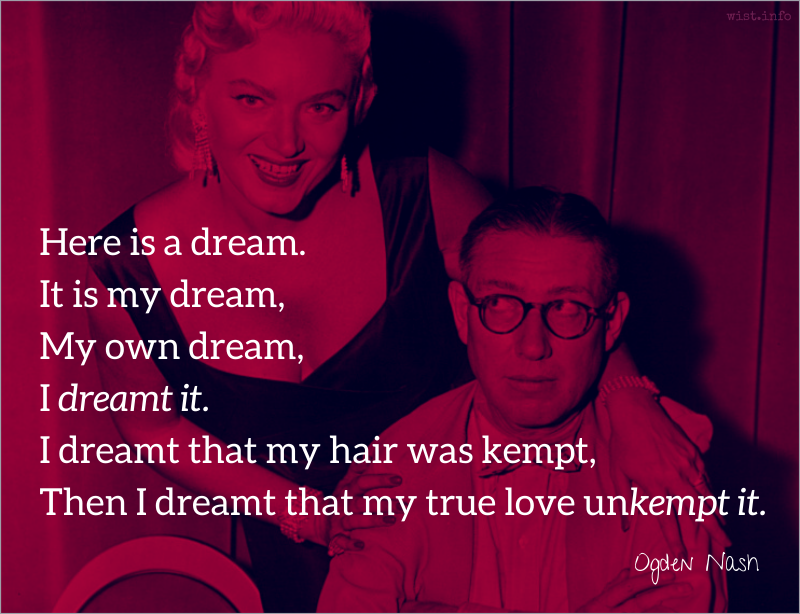
Here is a dream.
It is my dream,
My own dream,
I dreamt it.
I dreamt that my hair was kempt,
Then I dreamt that my true love unkempt it.
Ogden Nash (1902–1971) American poet
“My Dream” (1954), You Can’t Get There from Here (1957)
(Source)

Too many of us are not living our dreams because we are living our fears.
Leslie Calvin "Les" Brown (b. 1945) American motivational speaker, author, politician
(Attributed)

It’s the possibility of having a dream come true that makes life interesting.

If your dreams don’t scare you, they aren’t big enough.
Muhammad Ali (1942–2016) American boxer, activist [b. Cassius Clay]
(Attributed)
Ah Love! could you and I with Him conspire
To grasp this sorry Scheme of Things entire,
Would not we shatter it to bits — and then
Re-mould it nearer to the Heart’s Desire!Omar Khayyám (1048–1123) Persian poet, mathematician, philosopher, astronomer [عمر خیام]
Rubáiyát [رباعیات] [tr. FitzGerald, 3rd ed. (1872), # 99]
(Source)
Also used in FitzGerald, 4th ed. (1879); 5th ed. (1889).
Other translations:Ah, Love! could thou and I with Fate conspire
To grasp this sorry Scheme of Things entire,
Would not we shatter it to bits -- and then
Re-mould it nearer to the Heart's Desire!
[tr. FitzGerald, 1st ed. (1859), # 73]Ah Love! could you and I with Fate conspire
To grasp this sorry Scheme of Things entire,
Would not we shatter it to bits -- and then
Re-mould it nearer to the Heart's Desire!
[tr. FitzGerald, 2nd ed. (1868), # 108]If I, like God, were master of the heavens, I would blot them from the world, and fashion new skies beneath which free man might gain his heart's desire.
[tr. McCarthy (1879), # 378] (1888)]Had I the right great Allah to advise,
I would bid him sweep away this earth and skies,
And build a better, where, unclogged and free,
The clear soul might essay her high emprise.
[tr. Whinfield (1882), # 200]Had I the power great Allah to advise,
I'd bid him sweep away this earth and skies,
And build a better, where, unclogged and free,
The clear soul might achieve her high emprise.
[tr. Whinfield (1883), # 379]Oh that to Heaven's Control I might aspire,
And sweep away this Universe Entire,
Then from the Ruins build another World,
Where Man might sometimes reach his Heart's Desire.
[tr. Garner (1887), 2.8]If I like God o'er Heaven's high fate could reign,
I'd sweep away the present Heaven's domain,
And from its ruins such a new one build
That an honest heart its wish could aye attain!
[tr. M. K. (1888)]If only I controlled God's Universe,
Would I not wipe away these faulty Heavens
And build from nothing a true Paradise
Where all souls could achieve their hearts' desire.
[tr. Graves & Ali-Shah (1967), # 105]If the firmament were in my hand as in God's,
I would have razed it from the midst:
I would have made another firmament such that
The free of heart might easily attain their desire.
[tr. Avery/Heath-Stubbs (1979), # 25]Like God, if this world I could control
Eliminating the world would be my role
I would create the world anew, whole
Such that the free soul would attain desired goal.
[tr. Shahriari (1998), literal]

To understand the heart and mind of a person, look not at what he has already achieved, but at what he aspires to.
Kahlil Gibran (1883–1931) Lebanese-American poet, writer, painter [Gibran Khalil Gibran]
(Attributed)
(Source)
To accomplish great things we must not only act, but also dream, not only plan, but also believe.
Anatole France (1844–1924) French poet, journalist, novelist, Nobel Laureate [pseud. of Jaques-Anatole-François Thibault]
Speech, Académie Française (24 Dec 1896)
If this is a dream, then perhaps our dreaming
Can touch life’s height to a finer fire:
Who knows but the heavens and all their seeming
Were made by the heart’s desire?Edwin Markham (1852–1940) American poet
“The Crowning Hour” (2), The Shoes of Happiness, and Other Poems (1913)
The future will be determined by the young, and there is no more essential task today, it seems to me, than to bring before them once more, in all its brightness, in all its splendor and beauty, the American dream, lest we let it fade, too concerned with the ways of earning a living or impressing our neighbors or getting ahead or finding bigger and more potent ways of destroying the world and all that is in it.
Eleanor Roosevelt (1884–1962) American politician, diplomat, activist; First Lady of the US (1933–45)
Essay (1961-04), “What Has Happened to the American Dream?” Atlantic Monthly
(Source)

Marriage is a step so grave and decisive that it attracts light-headed, variable men by its very awfulness. They have been so tried among the inconstant squalls and currents, so often sailed for islands in the air or lain becalmed with burning heart, that they will risk all for solid ground below their feet. Desperate pilots, they run their sea-sick, weary bark upon the dashing rocks. It seems as if marriage were the royal road through life, and realised, on the instant, what we have all dreamed on summer Sundays when the bells ring, or at night when we cannot sleep for the desire of living. They think it will sober and change them. Like those who join a brotherhood, they fancy it needs but an act to be out of the coil and clamour for ever. But this is a wile of the devil’s. To the end, spring winds will sow disquietude, passing faces leave a regret behind them, and the whole world keep calling and calling in their ears. For marriage is like life in this — that it is a field of battle, and not a bed of roses.
Robert Louis Stevenson (1850–1894) Scottish essayist, novelist, poet
Essay (1876-08), “Virginibus Puerisque, Part 1,” Cornhill Magazine, Vol. 34
(Source)
Collected in Virginibus Puerisque and Other Papers, ch. 1, part 1 (1881).
Life as a "bed of roses" is an old phrase, originating in 13th Century French literature, and popularized in English in Christopher Marlowe's poem (pub. 1599)), "The Passionate Shepherd to His Love."
SARA: Roland thinks L.A. is a place for the brain-dead. He says, if you turned off the sprinklers, it would turn into a desert. But I think — I don’t know, it’s not what I expected. It’s a place where they’ve taken a desert and turned it into their dreams. I’ve seen a lot of L.A. and I think it’s also a place of secrets: secret houses, secret lives, secret pleasures. And no one is looking to the outside for verification that what they’re doing is all right. So what do you say, Roland?
ROLAND: I still say it’s a place for the brain-dead.
Steve Martin (b. 1945) American comedian, actor, writer, producer, musician
L. A. Story (1991)
(Source)

PROSPERO: Our revels now are ended. These our actors,
As I foretold you, were all spirits and
Are melted into air, into thin air;
And like the baseless fabric of this vision,
The cloud-capped towers, the gorgeous palaces,
The solemn temples, the great globe itself,
Yea, all which it inherit, shall dissolve,
And, like this insubstantial pageant faded,
Leave not a rack behind. We are such stuff
As dreams are made on, and our little life
Is rounded with a sleep.William Shakespeare (1564–1616) English dramatist and poet
Tempest, Act 4, sc. 1, l. 165ff (4.1.165-175) (1611)
(Source)
But either in his dreams or out of them, he could not tell which, Frodo heard a sweet singing running in his mind: a song that seemed to come like a pale light behind a grey rain-curtain, and growing stronger to turn the veil all to silver and glass, until at last it was rolled back, and a far green country opened before him under a swift sunrise.
J.R.R. Tolkien (1892–1973) English writer, fabulist, philologist, academic [John Ronald Reuel Tolkien]
The Lord of the Rings, Vol. 1: The Fellowship of the Ring, Book 1, ch. 8 “Fog on the Barrow-Downs” (1954)
(Source)
All men dream: but not equally. Those who dream by night in the dusty recesses of their minds wake in the day to find that it was vanity: but the dreamers of the day are dangerous men, for they may act their dream with open eyes, to make it possible. This I did.
T. E. Lawrence (1888–1935) British officer, diplomat, linguist, memoirist, writer [Thomas Edward Lawrence, a/k/a T. E. Shaw, "Lawrence of Arabia"]
The Seven Pillars of Wisdom, “Introductory Chapter” (1935)
(Source)
Oxford Edition (1922):This, therefore, is a faded dream of the time when I went down into the dust and noise of the Eastern market-place, and with my brain and muscles, with sweat and constant thinking, made others see my visions coming true. Those who dream by night in the dusty recesses of their minds wake in the day to find that all was vanity; but the dreamers of the day are dangerous men, for they may act their dream with open eyes, and make it possible. This I did.
This introductory chapter varies between different editions, and is even missing in some. The history of different versions and editions of The Seven Pillars of Wisdom is complex.
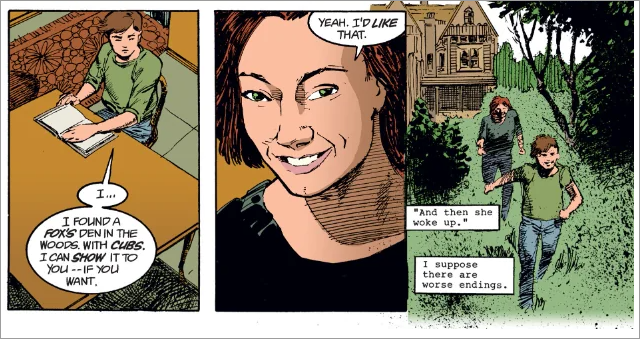
ROSE: “And then she woke up.” I suppose there are worse endings.
Neil Gaiman (b. 1960) British author, screenwriter, fabulist
Sandman, Book 2. The Doll’s House, # 16 “Lost Hearts” (1990)
(Source)
I profoundly believe that there is on this horizon, as yet only dimly perceived, a new dawn of conscience. In that purer light, people will come to see themselves in each other, which is to say they will make themselves known to one another by their similarities rather than by their differences. Man’s knowledge of things will begin to be matched by man’s knowledge of self. The significance of a smaller world will be measured not in terms of military advantage, but in terms of advantage for the human community. It will be the triumph of the heartbeat over the drumbeat.
Adlai Stevenson II (1900–1965) American politician, diplomat, statesman
Speech (1952-10-24), “The United Nations: Our Hope and Commitment,” United Nations Day Radio Broadcast, Springfield, Illinois
(Source)
CALVIN: I wish I could just take a pill to be perfect and I wish I could just push a button and have anything I want.
HOBBES: The American Dream lives on.
CALVIN: Why should I have to work for everything?! It’s like saying I don’t deserve it!