

You read something which you thought only happened to you, and you discover that it happened 100 years ago to Dostoyevsky. This is a very great liberation for the suffering, struggling person, who always thinks that he is alone. This is why art is important. Art would not be important if life were not important, and life is important.
James Baldwin (1924-1987) American novelist, playwright, activist
“An interview with James Baldwin” by Studs Terkel (1961), in Conversations With James Baldwin (1989)
(Source)
Baldwin revisited this theme multiple times.
You think your pain and your heartbreak are unprecedented in the history of the world, but then you read. It was Dostoevsky and Dickens who taught me that the things that tormented me most were the very things that connected me with all the people who were alive, or who had ever been alive. Only if we face these open wounds in ourselves can we understand them in other people. An artist is a sort of emotional or spiritual historian.
[Interview with Jane Howard, Life Magazine (24 May 1963)]
You think your pain and your heartbreak are unprecedented in the history of the world, but then you read. It was books that taught me that the things that tormented me most were the very things that connected me with all the people who were alive, or who had ever been alive.
["James Baldwin Recalls His Childhood," quoting from a television program, New York Times (31 May 1964)]
Quotations by:
Baldwin, James
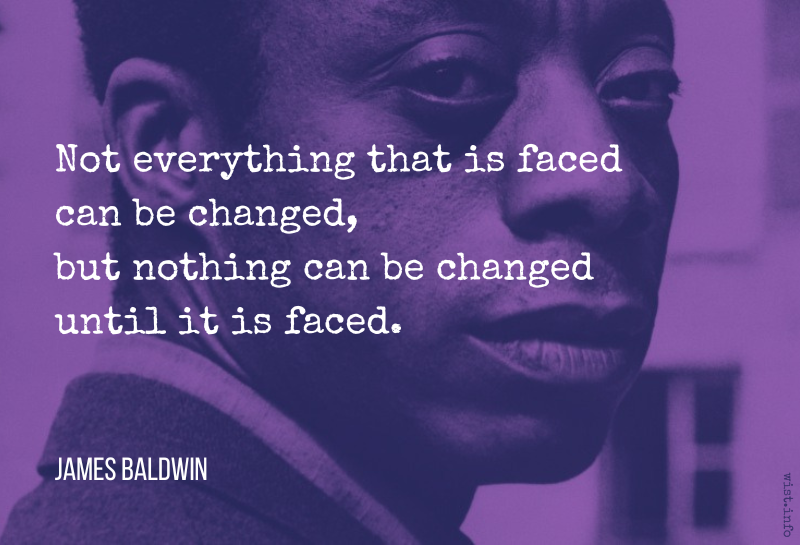
Not everything that is faced can be changed, but nothing can be changed until it is faced.
James Baldwin (1924-1987) American novelist, playwright, activist
“As Much Truth as One Can Bear,” New York Times Book Review (14 Jan 1962)
(Source)
Most of us are about as eager to be changed as we were to be born, and go through our changes in a similar state of shock.
James Baldwin (1924-1987) American novelist, playwright, activist
“Every Good-Bye Ain’t Gone,” New York Times (19 Dec 1977)
(Source)
Reprinted in The Price of the Ticket (1985).
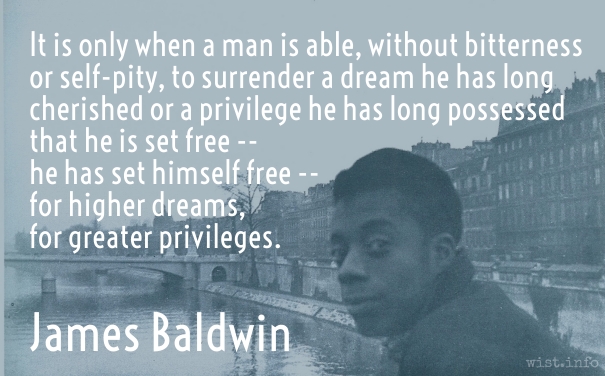
Any real change implies the breakup of the world as one has always known it, the loss of all that gave one an identity, the end of safety. And at such a moment, unable to see and not daring to imagine what the future will now bring forth, one clings to what one knew, or dreamed that one possessed. Yet, it is only when a man is able, without bitterness or self-pity, to surrender a dream he has long cherished or a privilege he has long possessed that he is set free — he has set himself free — for higher dreams, for greater privileges.
James Baldwin (1924-1987) American novelist, playwright, activist
“Faulkner and Desegregation,” Partisan Review (Fall 1956)
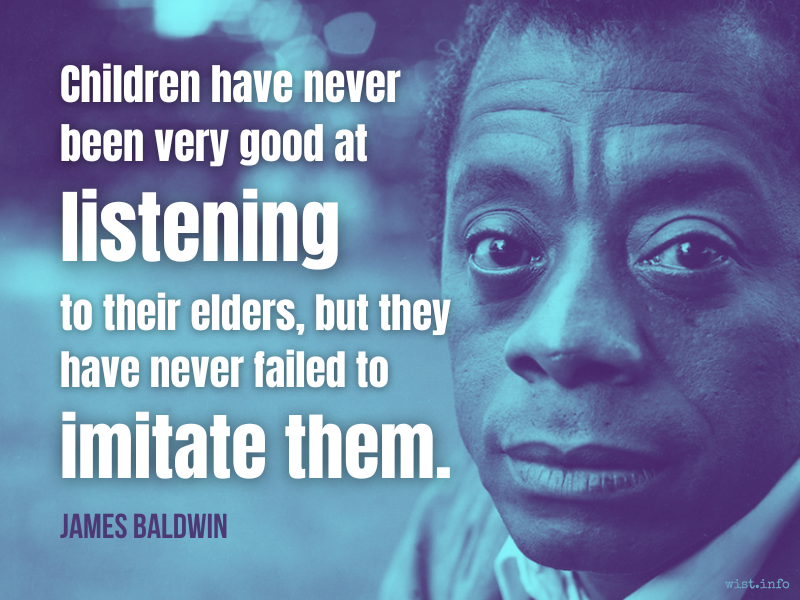
Children have never been very good at listening to their elders, but they have never failed to imitate them.
It is a terrible, an inexorable law, that one cannot deny the humanity of another without diminishing one’s own: in the face of one’s victim, one sees oneself.
James Baldwin (1924-1987) American novelist, playwright, activist
“Fifth Avenue, Uptown,” Esquire (Jul 1960)
Full text.
Anyone who has ever struggled with poverty knows how extremely expensive it is to be poor.
James Baldwin (1924-1987) American novelist, playwright, activist
“Fifth Avenue, Uptown: a Letter from Harlem,” Esquire (Jul 1960)
(Source)
I conceive of God, in fact, as a means of liberation and not a means to control others.
James Baldwin (1924-1987) American novelist, playwright, activist
“In Search of a Majority,” Speech, Kalamazoo College (Feb 1960)
If the concept of God has any validity or any use, it can only be to make us larger, freer, and more loving. If God cannot do this, then it is time we got rid of Him.
James Baldwin (1924-1987) American novelist, playwright, activist
“Letter from a Region of My Mind,” The New Yorker (17 Nov 1962)
Republished as "Down at the Cross: Letter from a Region in My Mind" in The Fire Next Time (1963)
Perhaps the whole root of our trouble, the human trouble, is that we will sacrifice all the beauty of our lives, will imprison ourselves in totems, taboos, crosses, blood sacrifices, steeples, mosques, races, armies, flags, nations, in order to deny the fact of death, which is the only fact we have.
James Baldwin (1924-1987) American novelist, playwright, activist
“Letter from a Region of My Mind,” The New Yorker (17 Nov 1962)
Republished as "Down at the Cross: Letter from a Region in My Mind" in The Fire Next Time (1963).
I do not know many Negroes who are eager to be “accepted” by white people, still less to be loved by them; they, the blacks, simply don’t wish to be beaten over the head by the whites every instant of our brief passage on this planet. White people will have quite enough to do in learning how to accept and love themselves and each other, and when they have achieved this — which will not be tomorrow and may very well be never — the Negro problem will no longer exist, for it will no longer be needed.
James Baldwin (1924-1987) American novelist, playwright, activist
“Letter from a Region of My Mind,” The New Yorker (17 Nov 1962)
Republished as "Down at the Cross: Letter from a Region in My Mind" in The Fire Next Time (1963)
The hope of the world lies in what one demands, not of others, but of oneself.
James Baldwin (1924-1987) American novelist, playwright, activist
“Malcolm and Martin,” Esquire (Apr 1972)
I imagine that the reason that people cling to their hate so stubbornly is because they are afraid that if they let go of the hate, they will have to deal with pain.
James Baldwin (1924-1987) American novelist, playwright, activist
“Me and My House,” Harper’s (1955)
Reprinted in Notes of a Native Son (1955)
To act is to be committed, and to be committed is to be in danger.
James Baldwin (1924-1987) American novelist, playwright, activist
“My Dungeon Shook,” The Fire Next Time (1963)
(Source)
Let me point out to you that freedom is not something that anybody can be given; freedom is something people take and people are as free as they want to be. One hasn’t got to have an enormous military in order to be unfree when it’s simpler to be asleep, when it’s simpler to be apathetic, when it’s simpler, in fact, not to want to be free, to think that something else is more important.
James Baldwin (1924-1987) American novelist, playwright, activist
“Notes for a Hypothetical Novel,” speech, San Francisco College (22 Oct 1960)
(Source)
Later published in Nobody Knows My Name (1961).
At the root of the American Negro problem is the necessity of the American White man to find a way of living with the Negro in order to be able to live with himself.
James Baldwin (1924-1987) American novelist, playwright, activist
“Stranger in a Village,” Harper’s Magazine (Oct 1953)
(Source)
Reprinted in Notes of a Native Son (1955).
It comes as a great shock around the age of 5, or 6, or 7, to discover that the flag to which you have pledged allegiance, along with everybody else, has not pledged allegiance to you.
James Baldwin (1924-1987) American novelist, playwright, activist
“The American Dream is at the Expense of the American Negro,” opening comments, Cambridge Union, Cambridge, England (1965-02-17)
(Source)
Debate with William F. Buckley, Jr.

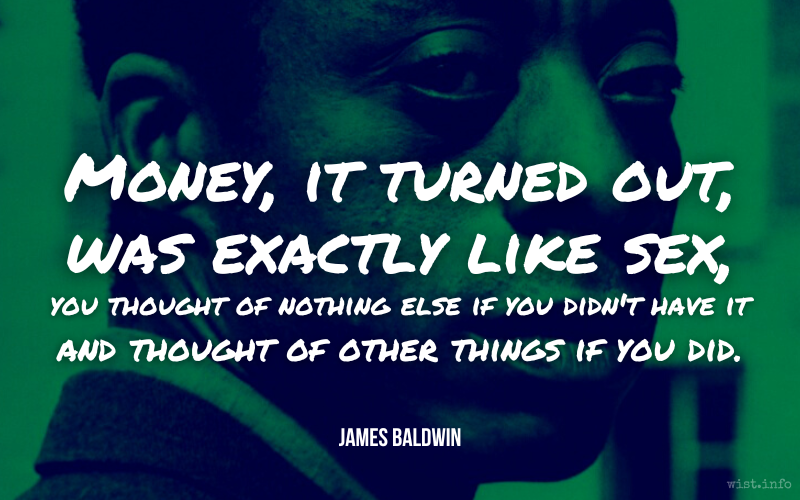
Money, it turned out, was exactly like sex, you thought of nothing else if you didn’t have it and thought of other things if you did.
The price one pays for pursuing any profession, or calling, is an intimate knowledge of its ugly side.
James Baldwin (1924-1987) American novelist, playwright, activist
“The Black Boy Looks at the White Boy,” Esquire (May 1961)
Republished in Nobody Knows My Name (1961)
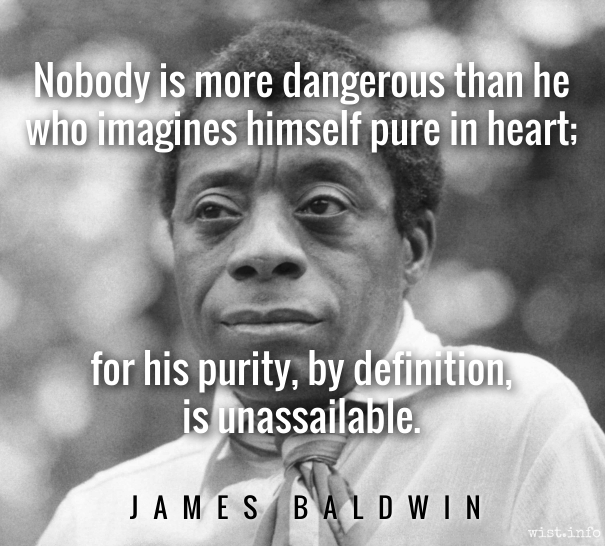
Nobody is more dangerous than he who imagines himself pure in heart; for his purity, by definition, is unassailable.
James Baldwin (1924-1987) American novelist, playwright, activist
“The Black Boy Looks at the White Boy,” Esquire (May 1961)
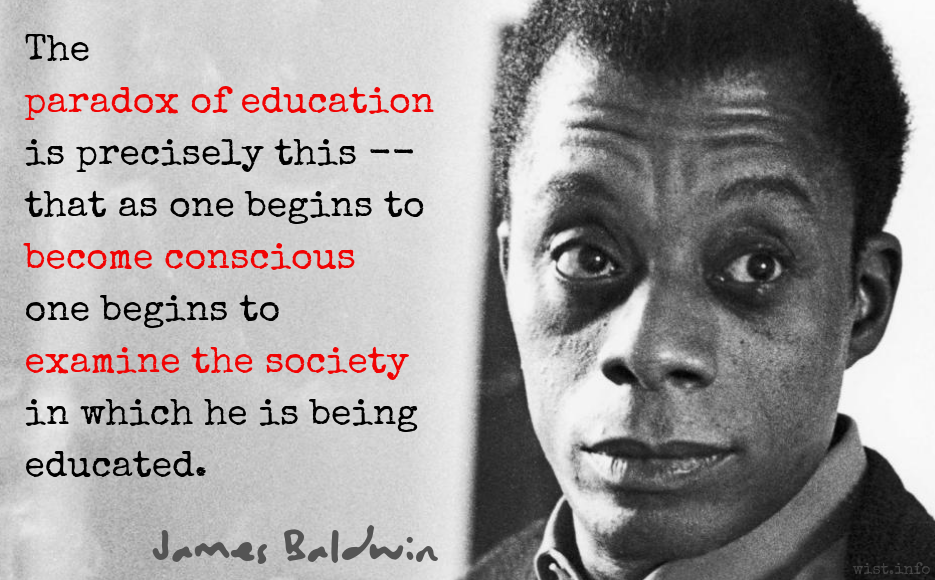
The paradox of education is precisely this — that as one begins to become conscious one begins to examine the society in which he is being educated. The purpose of education, finally, is to create in a person the ability to look at the world for himself, to make his own decisions, to say to himself this is black or this is white, to decide for himself whether there is a God in heaven or not. To ask questions of the universe, and then learn to live with those questions, is the way he achieves his own identity. But no society is really anxious to have that kind of person around. What societies really, ideally, want is a citizenry which will simply obey the rules of society. If a society succeeds in this, that society is about to perish. The obligation of anyone who thinks of himself as responsible is to examine society and try to change it and to fight it -– at no matter what risk. This is the only hope society has. This is the only way societies change.
James Baldwin (1924-1987) American novelist, playwright, activist
“The Negro Child — His Self-Image,” speech (16 Oct 1963)
(Source)
Speech to educators, first published as "A Talk to Teachers," The Saturday Review (21 Dec 1963). The thesis above is restatated at the end in these words, more frequently quoted: "I began by saying that one of the paradoxes of education was that precisely at the point when you begin to develop a conscience, you must find yourself at war with your society. It is your responsibility to change society if you think of yourself as an educated person."
All art is a kind of confession, more or less oblique. All artists, if they are to survive, are forced, at last, to tell the whole story, to vomit the anguish up.
James Baldwin (1924-1987) American novelist, playwright, activist
“The Precarious Vogue of Ingmar Bergman,” Esquire (Apr 1960)
Republished as "The Northern Protestant" in Nobody Knows My Name: More Notes of a Native Son (1961).
It is said that his time was easier than ours, but I doubt it — no time can be easy if one is living through it.
James Baldwin (1924-1987) American novelist, playwright, activist
“Why I Stopped Hating Shakespeare”
(Source)
You cannot fix what you cannot face.
James Baldwin (1924-1987) American novelist, playwright, activist
(Attributed)
Ignorance, allied with power, is the most ferocious enemy justice can have.
James Baldwin (1924-1987) American novelist, playwright, activist
No Name in the Street (1972)
People pay for what they do, and still more for what they have allowed themselves to become, and they pay for it, very simply, by the lives they lead.
James Baldwin (1924-1987) American novelist, playwright, activist
No Name in the Street (1972)
If one really wishes to know how justice is administered in a country, one does not question the policemen, the lawyers, the judges, or the protected members of the middle class. One goes to the unprotected — those, precisely, who need the law’s protection most! — and listens to their testimony.
James Baldwin (1924-1987) American novelist, playwright, activist
No Name in the Street (1972)
Nothing is more desirable than to be released from an affliction, but nothing is more frightening than to be divested of a crutch.
James Baldwin (1924-1987) American novelist, playwright, activist
Nobody Knows My Name, Introduction (1961)
I love America more than any other country in the world and, exactly for this reason, I insist on the right to criticize her perpetually.
James Baldwin (1924-1987) American novelist, playwright, activist
Notes of a Native Son (1955)
People who treat other people as less than human must not be surprised when the bread they have cast on the waters comes floating back to them, poisoned.
James Baldwin (1924-1987) American novelist, playwright, activist
The Price of the Ticket, “No Name in the Street” (1972)
From my point of view, no label, no slogan, no party, no skin color, and indeed no religion is more important than the human being.
James Baldwin (1924-1987) American novelist, playwright, activist
Comment (1963)
(Source)
Included in Karen Thorsen, et al., James Baldwin: The Price of the Ticket, film (1989), a film biography of Baldwin using extensive archival film of the author (the project was started before Baldwin's death, and Baldwin intended to direct it).
I have found, without good citation, two broader contexts for the quotation. First:
The very dangerous effort one has got to make, according to me, is to deal with other people as though they were simply human beings. To remember that no matter what the details of their lives may be like, or how different they may seem to you superficially, or what the social pressures outside of what the psychological pressures are within, to deal with this other human being precisely as though he or she was here for the first and only time. To deal with them in some way that you’d like them to deal with you, no matter the price. From my point of view, no label, no slogan, no party, no skin color, and indeed no religion, is more important than the human being. The human core in everybody, which liberates you and me, because when the chips are down this is all there is -- there isn’t anything else.
The second looks to be a paraphrase of the above:
We must all make the effort to deal with all people simply as human beings. From my point of view, no label, no slogan, no party, no skin color, and indeed no religion is more important than the human being. When the chips are down, this is all that matters.
Without better documentation, I cannot confirm either version.
To be a Negro in this country and to be relatively conscious is to be in a rage almost all the time.
James Baldwin (1924-1987) American novelist, playwright, activist
In “The Negro After Watts,” Time (27 Aug 1965)
(Source)
Article placed in the Congressional Record by Robert Byrd (24 Aug 1965).
Art has to be a kind of confession. I don’t mean a true confession in the sense of that dreary magazine. The effort it seems to me, is: if you can examine and face your life, you can discover the terms with which you are connected to other lives, and they can discover them, too — the terms with which they are connected to other people.
James Baldwin (1924-1987) American novelist, playwright, activist
In Studs Terkel, “An interview with James Baldwin” (1961)
Published in Conversations with James Baldwin (1989)
It is not the world that was my oppressor, because what the world does to you, if the world does it to you long enough and effectively enough, you begin to do to yourself.
James Baldwin (1924-1987) American novelist, playwright, activist
Interview with Nikki Giovanni (4 Nov 1971), A Dialogue (1973)