HECUBA: The clear actions of a man,
Agamemnon, should speak louder than any words.
good words should get their goodness from our lives
and nowhere else; the evil we do should show,
a rottenness that festers in our speech
and what we say, in capable of being glozed
with a film of pretty words.
There are men, I know,
sophists who make a science of persuasion,
glozing evil with the slick of loveliness;
but in the end a speciousness will show.
The imposters are punished; not one escapes
his death.[ἙΚΆΒΗ: Ἀγάμεμνον, ἀνθρώποισιν οὐκ ἐχρῆν ποτε
τῶν πραγμάτων τὴν γλῶσσαν ἰσχύειν πλέον:
ἀλλ᾽, εἴτε χρήστ᾽ ἔδρασε, χρήστ᾽ ἔδει λέγειν,
εἴτ᾽ αὖ πονηρά, τοὺς λόγους εἶναι σαθρούς,
καὶ μὴ δύνασθαι τἄδικ᾽ εὖ λέγειν ποτέ.
σοφοὶ μὲν οὖν εἰσ᾽ οἱ τάδ᾽ ἠκριβωκότες,
ἀλλ᾽ οὐ δύνανται διὰ τέλους εἶναι σοφοί,
κακῶς δ᾽ ἀπώλοντ᾽: οὔτις ἐξήλυξέ πω.]Euripides (485?-406? BC) Greek tragic dramatist
Hecuba [Hekabe; Ἑκάβη], l. 1186ff (c. 424 BC) [tr. Arrowsmith (1958)]
(Source)
Hecuba to Agamemnon, after Polymestor tried to defend his actions in murdering her son and stealing the Trojan treasure.
(Source (Greek)). Alternate translations:O Agamemnon, never ought the tongue
To have a greater influence o'er mankind
Than actions; but whoever hath done well
Ought to speak well; and he whose deeds are base,
To use unseemly language, nor find means
By specious words to colour o'er injustice.
Full wise indeed are they to whom such art
Is most familiar: but to stand the test
Of time not wise enough; for they all perish,
Not one of them e'er scapes.
[tr. Wodhull (1809)]Agamemnon, it never were fitting among men that the tongue should have greater force than actions. But if a man has acted well, well should he speak; if on the other hand basely, his words likewise should be unsound, and never ought he to be capable of speaking unjust things well. Perhaps indeed they who have brought these things to a pitch of accuracy are accounted wise, but they can not endure wise unto the end, but perish vilely, nor has any one yet escaped this.
[tr. Edwards (1826)]Agamemnon, never should this thing have been,
That words with men should more avail than deeds,
But good deeds should with reasonings good be paired,
And caitiff deed be ranged by baseless plea,
And none avail to gloze injustice o'er.
There be whose craft such art hath perfected;
Yet cannot they be cunning to the end:
Foully they perish: never one hath 'scaped.
[tr. Way (Loeb) (1894)]Agamemnon, never ought the tongues of men
To plead more eloquently than the truth.
Good men should prove good speakers, and the bad,
Their very argument grown rank, should find
No specious words to colour evil deeds.
Oh, they are strict professors of the art,
And they are wise; yet in the end of all,
Not wise enough. They perish. None escapes.
[tr. Sheppard (1924)]Never ought words to have outweighed deeds in this world, Agamemnon. No! if a man's deeds were good, so should his words have been; if, on the other hand, evil, his words should have been unsound, instead of its being possible at times to speak injustice well. There are, it is true, clever persons, who have made a science of this, but their cleverness cannot last for ever; a miserable end awaits them; no one ever yet escaped.
[tr. Coleridge (1938)]Agamemnon,
A man should talk as he acts.
Good speaks for itself --
The best make bad liars.
The opposite is also true,
Though it ought not to be.
Men with brains can conceal
Whatever they want concealed.
But the brain grows weary.
A bad end's in.
[tr. McGuinness (2004)]Agamemnon, men shouldn't believe a speech counts for far more than actions ever did. If a man is good in deed, he's good in word. But bad deeds make a man's word rotten, too, and he can't give his injustice a fair gloss. They're clever with their tongues so finely tuned but you couldn't call them clever in the end. Their punishment will come. No one escapes.
[tr. Harrison (2005)]Never, Agamemnon, should words have greater sway for men than do their deeds. When a man does good, his words ought to be good; when he does evil then his words should be unsound. No one should speak well of injustice. About this last thing, there are those clever fellows who have performed it to perfection but they will all, in the end, be destroyed. None of them have escaped so far.
[tr. Theodoridis (2007)]Agamemnon, never in the affairs of men
Should the tongue have more power than facts,
Rather, when someone acts well, he should speak well,
And if the opposite, his words should be rotten.
Glib rhetoric may win us over for a while,
but in the end the smooth talkers die foully.
[tr. Karden/Street (2011)]
Quotations about:
rationale
Note not all quotations have been tagged, so Search may find additional quotes on this topic.
Often an opinion, a custom, seems absurd when we are young, and advancing in life, we find the reason. Mustn’t we conclude that certain habits aren’t so ridiculous? One is lead to think sometimes that they were established by people who had read the entire book of life, and that they are judged by people who, despite their esprit, have only read a few pages.
[Souvent une opinion, une coutume commence à paraître absurde dans la première jeunesse, et en avançant dans la vie, on en trouve la raison; elle paraît moins absurde. En faudrait-il conclure que de certaines coutumes sont moins ridicules? On serait porté à penser quelquefois qu’elles ont été établies par des gens qui avaient lu le livre entier de la vie, et qu’elles sont jugées par des gens qui, malgré leur esprit, n’en ont lu que quelques pages.]
Nicolas Chamfort (1741-1794) French writer, epigrammist (b. Nicolas-Sébastien Roch)
Products of Perfected Civilization [Produits de la Civilisation Perfectionée], Part 1 “Maxims and Thoughts [Maximes et Pensées],” ch. 1, ¶ 21 (1795) [tr. Siniscalchi (1994)]
(Source)
Compare to also Chamfort.(Source (French)). Alternate translations:Often in early youth an opinion or custom seems absurd to us, which, with advancing years, we discover has some justification and so appears less absurd. Ought we to conclude from this that certain customs are not so ridiculous as others? One might sometimes be tempted to think that they were established by people who had read the book of life through, and that they are judged by those who, despite their intelligence, have only glanced at a few pages.
[tr. Hutchinson (1902)]Often an opinion or custom seems absurd to us in early youth; but as we advance in life we see the reason for it, and it appears less fatuous. Must we conclude from this that certain customs actually are less absurd? One is sometimes led to suppose that they have been established by folk who have read the whole of the book of life, and that they are criticized by those who, in spite of their intelligence, have only read a page or two at best.
[tr. Mathers (1926)]Often an opinion, a custom, seems absurd to begin with, when one is very young, and as one advances in life one learns the reason for it, and it seems less so. Must one conclude, then, that certain customs have become less ridiculous? At times one is drawn to the conclusion that they were established by persons who had read the book of life entire, and are judged by others who have read only a few pages.
[tr. Merwin (1969)]Often an opinion, or a custom, begins to seem absurd in one's early youth, and, as life advances, one finds the reason for it; it seems less absurd. Is one ot conclude that certain customs are less ridiculous? One would sometimes be inclined to think that they had been laid down by people who had read the entire book of life, and that they are judged by people who, in spite of their intellect, have only read a few pages of it.
[tr. Pearson (1973)]To the very young some opinions or customs seem absurd, but as you grow older you realize the reason behind them and they seem less absurd. Are we to conclude that certain customs aren't as ridiculous as they seem? There are times when you feel that they've been created by people who've read the book of life from cover to cover and that they're being judged by those who, however intelligent, have read only a few pages.
[tr. Parmée (2003), ¶ 20]

The arguments of tyranny are as contemptible as its force is dreadful.
Edmund Burke (1729-1797) Anglo-Irish statesman, orator, philosopher
Reflections on the Revolution in France (1790)
(Source)
I now return the Sermon you were so kind as to enclose me, having perused it with attention. The reprinting it by me, as you have proposed, would very readily be ascribed to hypocritical affectation, by those who, when they cannot blame our acts, have recourse to the expedient of imputing them to bad motives. This is a resource which can never fail them, because there is no act, however virtuous, for which ingenuity may not find some bad motive.
Thomas Jefferson (1743-1826) American political philosopher, polymath, statesman, US President (1801-09)
Letter (1903-04-19) to Edward Dowse
(Source)
People at the top do not want to share their power. They’ve always got some marvellous reason: I’m following my religion; I’m following the laws of economics. Even Stalin: I’m representing the vanguard of the working class, so please don’t cause trouble. That is the battle that every generation has, and yet we mustn’t be pessimistic about it.
Tony Benn (1925-2014) British politician, writer, diarist
“Hope Is the Key,” Interview, Share International (Jan 2003)
(Source)
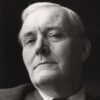
However rationalized it may be, censorship is always an attack on human intelligence and imagination and is always a sign of weakness, not strength, in those who enforce it.
Northrop Frye (1912-1991) Canadian literary critic and literary theorist
“Introduction to Canadian Literature,” #14 (1988)
(Source)
Tut, man, decide promptly, but never give any reasons for your decisions. Your decisions may be right, but your reasons are sure to be wrong.
William Murray, 1st Earl of Mansfield (1705-1793) British barrister, politician, judge, legal reformer
Quoted in John Cordy Jeaffreson, A Book About Lawyers, Vol. 1, ch. 12 (1867)
(Source)
When asked by the new governor of a West Indies island how to apply the law.

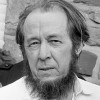
Every man always has handy a dozen glib little reasons why he is right not to sacrifice himself.
Alexander Solzhenitsen (1918-2008) Russian novelist, emigre [Aleksandr Isayevich Solzhenitsyn]
The Gulag Archipelago, Vol. 1, Part 1, ch. 1 (1973) [tr. Whitney]
(Source)
Several excuses are always less convincing than one.
Aldous Huxley (1894-1963) English novelist, essayist and critic
Point CounterPoint, ch. 1 (1928)
(Source)


All men have a reason, but not all men can give a reason.
William Ralph Inge (1860-1954) English prelate [Dean Inge]
“Implicit Reason and Explicit Reason,” St. Peter’s Day sermon, sec. 9, Oxford University (29 Jun 1840)
(Source)
Policies are judged by their consequences but crusades are judged by how good they make the crusaders feel.
Thomas Sowell (b. 1930) American economist and political commentator
Compassion vs. Guilt, and Other Essays (1987)
(Source)

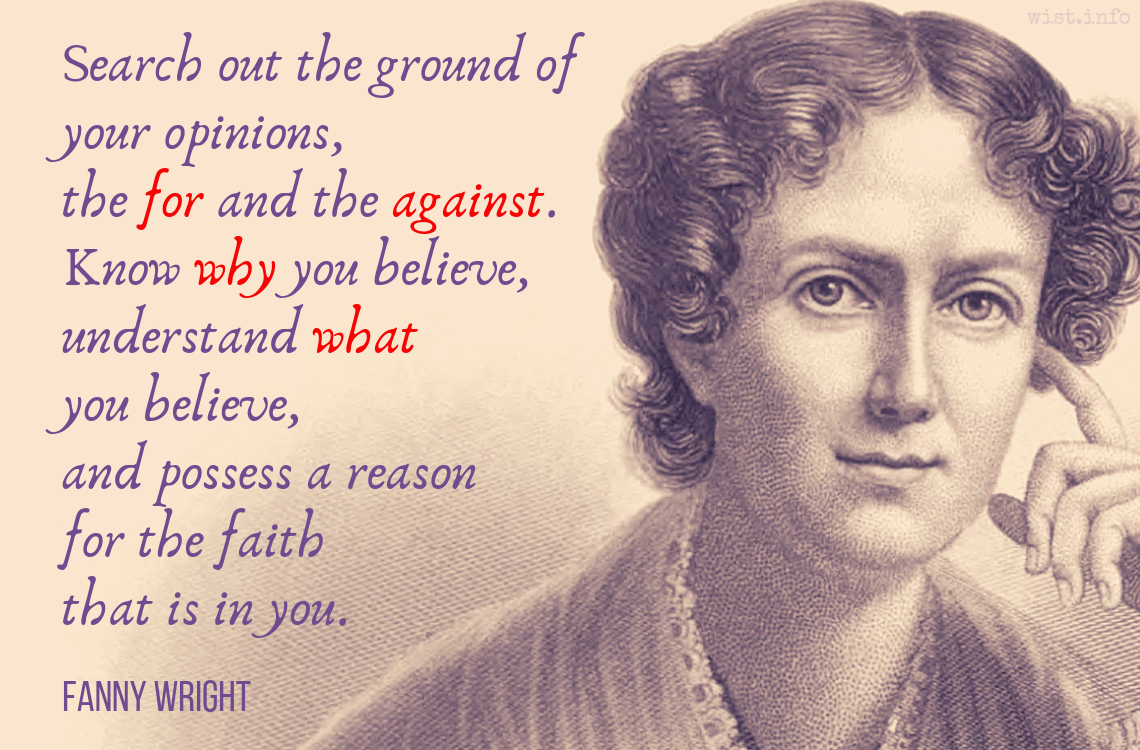
I must intreat your patience — your gentle hearing. I am not going to question your opinions. I am not going to meddle with your belief. I am not going to dictate to you mine. All that I say is, examine; enquire. Look into the nature of things. Search out the ground of your opinions, the for and the against. Know why you believe, understand what you believe, and possess a reason for the faith that is in you.
Frances "Fanny" Wright (1795-1852) Scottish-American writer, lecturer, social reformer
A Course of Popular Lectures, Lecture 3 “Of the more Important Divisions and Essential Parts of Knowledge” (1829)
(Source)
“They thought they were doing it for the best,” said Windle. “People often do. It’s amazing, the things that seem a good idea at the time.”

Historians have a word for Germans who joined the Nazi party, not because they hated Jews, but out of a hope for restored patriotism, or a sense of economic anxiety, or a hope to preserve their religious values, or dislike of their opponents, or raw political opportunism, or convenience, or ignorance, or greed.
That word is “Nazi.” Nobody cares about their motives any more.
They joined what they joined. They lent their support and their moral approval. And, in so doing, they bound themselves to everything that came after. Who cares any more what particular knot they used in the binding?Andrew R. Moxon (contemp.) American writer, critic [a.k.a. Julius Goat]
Essay (2017-01-16), “Sky,” Blogspot
(Source)
Frequently mis-attributed to Twitter, where Moxxon also posted under his @JuliusGoat handle. The original Julius Goat Blogspot site is no longer online.

So spake the Fiend, and with necessity,
The Tyrant’s plea, excus’d his devilish deeds.John Milton (1608-1674) English poet
Paradise Lost, 4.383 (1667)
All error, not merely verbal, is a strong way of stating that the current truth is incomplete. The follies of youth have a basis in sound reason, just as much as the embarrassing questions put by babes and sucklings. Their most antisocial acts indicate the defects of our society. When the torrent sweeps the man against a boulder, you must expect him to scream, and you need not be surprised if the scream is sometimes a theory.
Anger is never without an Argument, but seldom with a good one.
George Savile, Marquis of Halifax (1633-1695) English politician and essayist
“Of Anger,” Political, Moral, and Miscellaneous Thoughts and Reflections (1750)
(Source)

Ignorance of the law excuses no man; not that all men know the law, but because ’tis an excuse every man will plead, and no man can tell how to confute him.
John Selden (1584-1654) English jurist, legal scholar, antiquarian, polymath
Table Talk, § 76.2 “Law” (1689)
(Source)

PREJUDICE, n. A vagrant opinion without visible means of support.
Ambrose Bierce (1842-1914?) American writer and journalist
“Prejudice,” The Devil’s Dictionary (1911)
(Source)
Originally published in the "Cynic's Word Book" column in the New York American (1906-05-30) and the "Cynic's Dictionary" column in the San Francisco Examiner (1906-06-20).

The function of the expert is not to be more right than other people, but to be wrong for more sophisticated reasons.
David Butler (b. 1924) British social scientist, psephologist
The Observer (1969)
There is no kind of idleness by which we are so easily seduced as that which dignifies itself by the appearance of business.
Samuel Johnson (1709-1784) English writer, lexicographer, critic
The Idler, #48 (17 Mar 1759)
(Source)
FLUELLEN: There is occasions and causes why and wherefore in all things.
William Shakespeare (1564-1616) English dramatist and poet
Henry V, Act 5, sc. 1, l. 3ff (5.1.3) (1599)
(Source)

A man always has two reasons for what he does — a good one, and the real one.
John Pierpont "J. P." Morgan (1837-1913) American banker and financier
(Attributed)
Quoted in Owen Wister, Roosevelt: The Story of a Friendship, p. 280 (1930). There's no record in Morgan's writings, and versions of the quote from others can be found in the early 1800s. See here for more details.
Sometimes given as "A man generally has two reasons for doing a thing: one that sounds good, and a real one."