He that will not apply new remedies must expect new evils; for time is the greatest innovator.
Francis Bacon (1561–1626) English philosopher, scientist, author, statesman
“Of Innovations,” Essays, No. 24 (1625)
(Source)
Quotations about:
change
Note not all quotations have been tagged, so Search may find additional quotes on this topic.

Constantly observe everything coming into being through change, and accustom yourself to the thought that universal nature loves nothing so much as to change the things that are and to create new things in their likeness. For everything that exists is, in a sense, the seed of what will arise from it.
[Θεώρει διηνεκῶς πάντα κατὰ μεταβολὴν γινόμενα καὶ ἐθίζου ἐννοεῖν, ὅτι οὐδὲν οὕτως φιλεῖ ἡ τῶν ὅλων φύσις ὡς τὸ τὰ ὄντα μεταβάλλειν καὶ ποιεῖν νέα ὅμοια. σπέρμα γὰρ τρόπον τινὰ πᾶν τὸ ὃν τοῦ ἐξ αὐτοῦ ἐσομένου.]
Marcus Aurelius (AD 121–180) Roman emperor (161–180), Stoic philosopher
Meditations [To Himself; Τὰ εἰς ἑαυτόν], Book 4, ch. 36 (4.36) (AD 161-180) [tr. Hard (2011 ed.)]
(Source)
(Source (Greek)). Other translations:Incessantly consider, all things that are, have their being by change and alteration. Use thyself therefore often to meditate upon this, that the nature of the universe delights in nothing more, than in altering those things that are, and in making others like unto them. So that we may say, that whatsoever is, is but as it were the seed of that which shall be.
[tr. Casaubon (1634), 4.39]Accustom your self to consider, that whatever is produc'd, is produc'd by Alteration: That Nature Loves nothing so much as shifting the Scene, and bringing new Persons upon the Stage. To speak closely; The Destruction of one Thing, is the Making of another : And that which Subsists at present, is as it were the Seed of Succession, which springs from it.
[tr. Collier (1701)]Enure yourself to consider that the nature of the universe delights in nothing more than in changing the things now existing, and in producing others like them. The things now existing are a sort of seed to those which shall arise out of them.
[tr. Hutcheson/Moor (1742)]Observe constantly that all things take place by change, and accustom thyself to consider that the nature of the universe loves nothing so much as to change the things which are and to make new things like them. For everything that exists is in a manner the seed of that which will be.
[tr. Long (1862)]Accustom yourself to consider that whatever is produced, is produced by alteration; that nature loves nothing so much as changing existing things and producing new ones like them. For that which exists at present is, as it were, the seed of what shall spring from it.
[tr. Collier/Zimmern (1887)]Watch how all things continually change, and accustom yourself to realise that Nature's prime delight is in changing things that are, and making new things in their likeness. All that is, is as it were the seed of that which shall issue from it.
[tr. Rendall (1898)]Observe continually that all things exist in change; and keep this thought ever with you, that Nature loves nothing more than changing what things now are, and making others like them. For what now is, is in a manner the seed of what shall be.
[tr. Hutcheson/Chrystal (1902)]Unceasingly contemplate the generation of all things through change, and accustom thyself to the thought that the Nature of the Universe delights above all in changing the things that exist and making new ones of the same pattern. For in a manner everything that exists is the seed of that which shall come out of it.
[tr. Haines (Loeb) (1916)]Contemplate continually all things coming to pass by change, and accustom yourself to think that Universal Nature loves nothing so much as to change what is and to create new things in their likeness. For everything that is, is in a way the seed of what will come out of it.
[tr. Farquharson (1944)]Observe how all things are continually being born of change; teach yourself to see that Nature’s highest happiness lies in changing the things that are, and forming new things after their kind. Whatever is, is in some sense the seed of what is to emerge from it.
[tr. Staniforth (1964)]Observe constantly that all things come into being through change, and accustom yourself to the thought that universal nature loves nothing so much as to change the things that are and create new ones in their place. For everything that exists is, in a sense, the seed of what will arise from it.
[tr. Hard (1997 ed.)]Constant awareness that everything is born from change. The knowledge that there is nothing nature loves more than to alter what exists and make new things like it. All that exists is the seed of what will emerge from it.
[tr. Hays (2003)]Constantly observe all that comes about through change, and habituate yourself to the thought that the nature of the Whole loves nothing so much as to change one form of existence into another, similar but new. All that exists is in a sense the seed of its successor.
[tr. Hammond (2006)]Constantly observe everything coming into being by change and train yourself to realize that the nature of the whole loves nothing so much as to change the things that exist and create new things that are like them. Everything that exists is in a sense the seed of what will come into existence from it.
[tr. Gill (2013)]
THE SERPENT: When you and Adam talk, I hear you say “Why?” Always “Why?” You see things; and you say, “Why?” But I dream things that never were; and I say, “Why not?”
George Bernard Shaw (1856–1950) Irish playwright and critic
Back to Methuselah: A Metabiological Pentateuch, Part 1 “In the Beginning,” Act 1, sec. 1 (1921)
(Source)
The Serpent speaking to Eve.
US President John Kennedy quoted this addressing the Irish Parliament, Dublin (1963-06-28). US Senator Robert Kennedy modified it for his campaign, as quoted by his brother, Senator Edward Kennedy in his eulogy for Robert (1968-06-08): "Some men see things as they are and say, why; I dream things that never were and say, why not?”
I have learned throughout my life as a composer chiefly through my mistakes and pursuits of false assumptions, not by my exposure to founts of wisdom and knowledge.

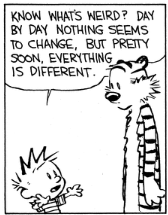
CALVIN: Know what’s weird? Day by day nothing seems to change. But pretty soon, everything is different.

LADY MACBETH: Things without all remedy
Should be without regard: what’s done is done.William Shakespeare (1564–1616) English dramatist and poet
Macbeth, Act 3, sc. 2, l. 13ff [Lady Macbeth] (1606)
(Source)

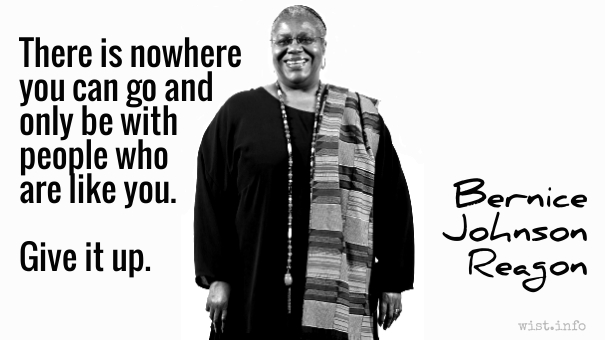
There is nowhere you can go and only be with people who are like you. Give it up.
Bernice Johnson Reagon (b. 1942) American song leader, composer, scholar, social activist
“Coalition Politics: Turning the Century,” presentation, West Coast Women’s Music Festival, Yosemite (1981)
(Source)
There is only one corner of the universe you can be certain of improving, and that’s your own self.
Aldous Huxley (1894–1963) English novelist, essayist and critic
Time Must Have a Stop (1944)

Never doubt that a small group of thoughtful, committed citizens can change the world. Indeed, it is the only thing that ever has.
Margaret Mead (1901–1978) American anthropologist
(Attributed)
Phrase frequently attributed to Mead, but not found in her writings. The first sentence, however, is trademarked.
Mead founded the Institute for Intercultural Studies in 1944 (it dissolved in 2009). Regarding this quote, the IIS noted on its still extant website:We have been unable to locate when and where it was first cited, becoming a motto for many organizations and movements. We believe it probably came into circulation through a newspaper report of something said spontaneously and informally. We know, however, that it was firmly rooted in her professional work and that it reflected a conviction that she expressed often, in different contexts and phrasings.
Additional discussion about this quotation's origins: Never Doubt That a Small Group of Thoughtful, Committed Citizens Can Change the World; Indeed, It’s the Only Thing That Ever Has – Quote Investigator.

Prayer does not change God, but changes him who prays.
Søren Kierkegaard (1813–1855) Danish philosopher, theologian
Works of Love (1847)

And yet in our world everybody thinks of changing humanity, and nobody thinks of changing himself.
Leo Tolstoy (1828–1910) Russian novelist and moral philosopher
Pamphlets, “Some Social Remedies,” “Three Methods of Reform” [tr. Free Age Press (1900)]
(Source)
More common variant: "Everyone thinks of changing the world, but no one thinks of changing himself."
Change means movement. Movement means friction. Only in the frictionless vacuum of a nonexistent abstract world can movement or change occur without that abrasive friction of conflict.
Saul Alinsky (1909–1972) American community organizer, writer.
Rules for Radicals, “The Purpose” (1971)
(Source)
I wanted to change the world. But I have found that the only thing one can be sure of changing is oneself.
Aldous Huxley (1894–1963) English novelist, essayist and critic
Quoted in “Sayings of the Week,” The Observer (2 Jul 1961)
Not actually found in any of Huxley's published works, and this reference does not provide a source or situation where it was said.
For more discussion: I Wanted To Change the World. But I Have Found That the Only Thing One Can Be Sure of Changing Is Oneself – Quote Investigator®
To be interested in the changing seasons is, in this middling zone, a happier state of mind than to be hopelessly in love with spring.
George Santayana (1863–1952) Spanish-American poet and philosopher [Jorge Agustín Nicolás Ruíz de Santayana y Borrás]
The Life of Reason or The Phases of Human Progress, Vol. 4 “Reason in Art,” ch. 9 “Justification of Art” (1905-06)
Full text.
Without deviation from the norm, progress is not possible.
Frank Zappa (1940–1993) American singer-songwriter
A Day with Frank Zappa, Part 5, documentary, dir. Roelof Kiers, VPRO-TV (1971-02-11)
Widely attributed to Zappa in various forms, but with very few actual citations.
The Kiers documentary gave the quotation twice. First (Source, Video):Well I think that progress is not possible without deviation. And I think that it's important that people be aware of some of the creative ways in which some of their fellow men are deviating from the norm, because in some instances they might find these deviations inspiring and might suggest further deviations which might cause progress, you never know.
Second (Source, Video):KIERS: What kind of influence did the Mothers [of Invention] have, you think?
ZAPPA: Well, we had some, but not very much, because of the size of our audience was so small.
KIERS: But, what kind of influence?
ZAPPA: Well, I think we perhaps inspired some of the people who liked what we do to get a little bit looser and a little bit more devious, and as I said before about progress not being possible without some sort of deviation. We need a few deviants.
A variant of this quote shows up in a photo essay titled "A Quarter Century of Gay Life in New York," New York Magazine (1994-06-20). It is attributed to Zappa (who had died the previous December), and is dated (without citation) to 1966:My attitude toward anybody's sexual persuasion is this: without deviation from the norm, progress is not possible.
The quotation also shows up in Leigh Rutledge, The Gay Book of Lists (1987) and his Unnatural Quotations (1988).
Rosemary Silva's Lesbian Quotations (1993) mentions this latter Rudtledge book as a citation, but gives a date on the quote as 1980.
I have not been able to find an earlier source of this variant.
Another use by Zappa can be found in his autobiography, The Real Frank Zappa Book, ch. 8 "All About Music" [with Peter Occhiogrosso] (1989):One of the things I've said before in interviews is: "Without deviation (from the norm), 'progress' is not possible."
In order for one to deviate successfully, one has to have at least a passing acquaintance with whatever norm one expects to deviate from.
The section this text begins is titled "Deviation from the Norm" -- Zappa is speaking here about music, "radio music norms," and enjoying "nuking those norms" when prepping touring arrangements. (He also gives a lengthy critique of the classical / symphonic music realm and their rigid adherence to their norms).
See also Shaw (1903).


No individual or group will be judged by whether they come up to or fall short of some fixed result, but by the direction in which they are moving. The band mans is the man who no matter how good he has been is beginning to deteriorate, to grow less good. The good man in the man who no matter how morally unworthy he has been is moving to become better. Such a conception makes one severe in judging himself and humane in judging others.
John Dewey (1859–1952) American teacher and philosopher
Reconstruction in Philosophy, ch. 7 “Moral Reconstruction” (1919)
(Source)
A state without the means of some change is without the means of its conservation.
Edmund Burke (1729–1797) Anglo-Irish statesman, orator, philosopher
Reflections on the Revolution in France (1790)
(Source)
It is only the very wisest and the very stupidest who never change.
[唯上知與下愚不移]
Confucius (c. 551- c. 479 BC) Chinese philosopher, sage, politician [孔夫子 (Kǒng Fūzǐ, K'ung Fu-tzu, K'ung Fu Tse), 孔子 (Kǒngzǐ, Chungni), 孔丘 (Kǒng Qiū, K'ung Ch'iu)]
The Analects [論語, 论语, Lúnyǔ], Book 17, verse 3 (17.3) (6th C. BC – 3rd C. AD) [tr. Soothill (1910)]
(Source)
Some scholars recommend reading 17.2-3 together (I don't get it), and some actually merge them into a single verse; that is noted below. (Source (Chinese)). Other translations:There are only the wise of the highest class, and the stupid of the lowest class, who cannot be changed.
[tr. Legge (1861)]Only the supremely wise and the most deeply ignorant do not alter.
[tr. Jennings (1895)]It is only men of the highest understanding and men of the grossest dullness, who do not change.
[tr. Ku Hung-Ming (1898)]There are two classes that never change: the supremely wise and the profoundly stupid.
[Source (1906)]Only the wisest and the dullest never change.
[tr. Soothill (1910), Alternate 1]Only the uppermost wise and the lowermost stupid do not change.
[tr. Soothill (1910), Alternate 2]Only those of highest intelligence, and lowest simplicity do not shift.
[tr. Pound (1933)]It is only the very wisest and the very stupidest who cannot change.
[tr. Waley (1938)]Only the highest and the lowest characters don’t change.
[tr. Lin Yutang (1938)]The only ones who do not change are sages and idiots.
[tr. Ware (1950), 17.2]It is only the most intelligent and the most stupid who are not susceptible to change.
[tr. Lau (1979)]Only the most intelligent and the most stupid do not change.
[tr. Dawson (1993), 17.2]Only the wisest and the stupidest never change.
[tr. Leys (1997)]Only the highest of the wise and the lowest of the stupid do not change.
[tr. Huang (1997), 17.2]Only the super wisdom and the infer stupidness cannot be changed.
[tr. Cai/Yu (1998), #443]Only the most wise (zhi) and the most stupid do not move.
[tr. Ames/Rosemont (1998)]It is the highest wisdom and the lowest stupidity that do not change.
[tr. Brooks/Brooks (1998), 17.2b]Those of the loftiest wisdom and those of the basest ignorance: they alone never change.
[tr. Hinton (1998)]Only the highest among the wise and the lowest among the stupid never change.
[tr. Watson (2007)]Only the most intelligent and the most stupid are not inclined to change.
[tr. Annping Chin (2014)]Only superior wisdom and extreme stupidity cannot be changed.
[tr. Li (2020)]Only the supremely wise and the most deeply ignorant do not alter.
[Source]Only the supremely wise and the abysmally ignorant do not change.

The Framers knew, better perhaps than we do today, the risks they were taking. They knew that free speech might be the friend of change and revolution. But they also knew that it is always the deadliest enemy of tyranny. With this knowledge they still believed that the ultimate happiness and security of a nation lies in its ability to explore, to change, to grow and ceaselessly to adapt itself to new knowledge born of inquiry free from any kind of governmental control over the mind and spirit of man. Loyalty comes from love of good government, not fear of a bad one.
Hugo Black (1886–1971) American politician and jurist; US Supreme Court Justice (1937–71)
James Madison Lecture, NYU School of Law (1960-02-17)
(Source)
The inaugural Madison lecture. Reprinted as "The Bill of Rights," NYU Law Review, Vol. 35 (Apr 1960).
Faced with the choice between changing one’s mind and proving there is no need to do so, almost everyone gets busy on the proof.
John Kenneth Galbraith (1908–2006) Canadian-American economist, diplomat, author
Economics, Peace and Laughter (1971)
(Source)
(also called "Galbraith's Law")
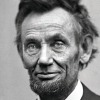
The dogmas of the quiet past are inadequate to the stormy present. The occasion is piled high with difficulty, and we must rise with the occasion. As our case is new, so we must think anew and act anew. We must disenthrall ourselves, and then we shall save our country.
Abraham Lincoln (1809–1865) American lawyer, politician, US President (1861–65)
Message (1862-12-01) to Congress, Annual Message (State of the Union)
(Source)
A clay pot sitting in the sun will always be a clay pot. It has to go through the white heat of the furnace to become porcelain.
Mildred W. Struven (1892–1983) American Christian Scientist, housewife
(Attributed)
Quoted by her daughter Jean Harris, Stranger in Two Worlds (1986)
All great truths begin as blasphemies.
The country needs and, unless I mistake its temper, the country demands bold, persistent experimentation. It is common sense to take a method and try it: If it fails, admit it frankly and try another. But above all, try something.
Franklin Delano Roosevelt (1882–1945) American lawyer, politician, statesman; US President (1933–45)
Speech (1932-05-22), Commencement, Oglethorpe University, Atlanta, Georgia
(Source)