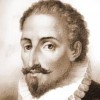
Everyone’s shit smells good to himself.
[Stercus cuique suum bene olet.]
Michel de Montaigne (1533-1592) French essayist
Essays, Book 3, ch. 8 (3.8), “Of the Art of Discussion [De l’art de conferer]” (1587) [tr. Screech (1987)]
(Source)
Montaigne is recollecting an adage collected by Desiderius Erasmus in his Adagia (3.4.2, No. 2302). It's actually rendered there as Suus cuique crepitus bene olet. Erasmus maintains that the proverb is not meant literally, but metaphorically (that people value most things that are their own), though he does concede that people are more repulsed by others' excrement than their own.
Montaigne only presents the Latin, not a French translation (as is true with most of his Classical quotations). In context, he uses the phrase regarding how people criticize others for flaws that they, themselves, possess (and even consider virtuous, in their own cases).
I have also seen a version of this cited as an Icelandic proverb.
This essay (and passage) first appeared in the 2nd (1588) edition.
(Source (Latin)). Alternate translations:Ev’ry mans ordure well,
To his owne sense doth smell.
[tr. Florio (1603)]To each one their own manure smells good.
[tr. Cotton/Hazlitt (1877)]Every man's filth smells sweet to himself.
[tr. Ives (1925)]Each man likes best the smell of his own dung.
[tr. Zeitlin (1934)]Every man likes the smell of his own dung.
[tr. Frame (1943)]Every man's filth smells sweet to him.
[tr. Cohen (1958)]Everyone thinks his own fart smells sweet.
[tr. Drysdall (2001); of Erasmus]
Quotations about:
ownership
Note not all quotations have been tagged, so Search may find additional quotes on this topic.
The faithful all lived together and owned everything in common; they sold their goods and possessions and shared out the proceeds among themselves according to what each one needed.
[πάντες δὲ οἱ πιστεύοντες ἦσαν ἐπὶ τὸ αὐτὸ καὶ εἶχον ἅπαντα κοινὰ καὶ τὰ κτήματα καὶ τὰς ὑπάρξεις ἐπίπρασκον καὶ διεμέριζον αὐτὰ πᾶσιν καθότι ἄν τις χρείαν εἶχεν·]
The Bible (The New Testament) (AD 1st - 2nd C) Christian sacred scripture
Acts 2:44-45 [JB (1966)]
(Source)
(Source (Greek)). Alternate translations:And all that believed were together, and had all things common; and sold their possessions and goods, and parted them to all men, as every man had need.
[KJV (1611)]And all who shared the faith owned everything in common; they sold their goods and possessions and distributed the proceeds among themselves according to what each one needed.
[NJB (1985)]All the believers continued together in close fellowship and shared their belongings with one another. They would sell their property and possessions, and distribute the money among all, according to what each one needed.
[GNT (1992 ed.)]All the believers were united and shared everything. They would sell pieces of property and possessions and distribute the proceeds to everyone who needed them.
[CEB (2011)]All who believed were together and had all things in common; they would sell their possessions and goods and distribute the proceeds to all, as any had need.
[NRSV (2021 ed.)]
For Nature nere appointed him or me,
Or any else, proprietors to be
Of our own lands, though now the time is his
To turn me out, yet his unthriftiness
Or ignorance of tricks in law, or else
Who e’re survives him, him at last expells,
This Farm which now by Umbrenas name is known
Was mine, but none can say, It is his own;
‘Tis thine, and mine, and his.[Nam propriae telluris erum natura nec illum
nec me nec quemquam statuit: nos expulit ille,
illum aut nequities aut vafri inscitia iuris,
postremum expellet certe vivacior heres.
nunc ager Umbreni sub nomine, nuper Ofelli
dictus, erit nulli proprius, sed cedet in usum
nunc mihi, nunc alii.]Horace (65-8 BC) Roman poet, satirist, soldier, politician [Quintus Horatius Flaccus]
Satires [Saturae, Sermones], Book 2, # 2, “Quae virtus et quanta,” l. 129ff (2.2.129-135) (30 BC) [tr. A. B.; ed. Brome (1666)]
(Source)
On accepting the transitory nature of property and possessions.
(Source (Latin)). Alternate translations:For Nature doth not Me or Him Create,
The proper Lord of such and such Estate:
He forc't us out, and doth possess my Plain;
Another cheat shall force him out again,
Or quircks in Law, or when those fears are past,
His long-liv'd Heir shall force him out at last:
That which was once Ofellus Farm is gone,
Now call'd Umbrena's, but 'tis no Mans own:
None hath the Property, it comes and goes,
As merry Chance, or stubborn Fates dispose,
As God thinks fit, and his firm Nods Decree,
Now to be us'd by Others, now by Me.
[tr. Creech (1684)]Nature will no perpetual heir assign,
Or make the farm his property or mine.
He turn'd us out: but follies all his own,
Or law-suits, and their knaveries unknown,
Or, all his follies and his law-suits past,
Some long-lived heir shall turn him out at last.
The farm, once mine, now bears Umbrenus' name,
The use alone, not property we claim.
[tr. Francis (1747)]For view'd as property, the land, my sons,
Is neither his, nor mine, nor any one's.
He turn'd me out; and him his own excess
Or the law's quirks shall shortly dispossess:
At best, stern Death's ejectment, soon or late,
Shall prove these acres but a life-estate.
Umbrenus' name the farm at present bears;
'Twas lately mine, and shall be soon his heir's:
Now this, now that may sow the ground and till;
But all like are tenants but at will.
[tr. Howes (1845)]For nature has appointed to be lord of this earthly property, neither him, nor me, nor any one. He drove us out: either iniquity or ignorance in the quirks of the law shall [do the same by] him: certainly in the end his long-lived heir shall expel him. Now this field under the denomination of Umbrenus', lately it was Ofellus', the perpetual property of no man; for it turns to my use one while, and by and by to that of another.
[tr. Smart/Buckley (1853)]And I say "resident," because nor him nor me nor any one has nature fixed to be the owner of the land in perpetuity. He turned me out, and him profuse expenditure, or ignorance of legal quirk, or certainly at last, his heir, who's longer lived, will oust. The farm now bears Umbrenus' name, and lately bore Ofella's ; 'twill belong in perpetuity to none, but pass into the tenancy now of myself, now of some other man.
[tr. Millington (1870)]Holder, I say, for tenancy's the most
That he, or I, or any man can boast:
Now he has driven us out: but him no less
His own extravagance may dispossess
Or slippery lawsuit: in the last resort
A livelier heir will cut his tenure short.
Ofellus' name it bore, the field we plough,
A few years back: it bears Umbrenus' now:
None has it as a fixture, fast and firm,
But he or I may hold it for a term.
[tr. Conington (1874)]Nature, in truth, makes neither him nor me nor anyone else lord of the soil as his own. He drove us out, and he will be driven out by villainy, or by ignorance of the quirks of the law, or in the last resort by an heir of longer life. To-day the land bears the name of Umbrenus; of late it had that of Ofellus; to no one will it belong for good, but for use it will pass, now to me and now to another.
[tr. Fairclough (Loeb) (1926)]Nature indeed has appointed not him, not me,
Nor anyone else as lord and master of the earth.
He drove us off; some force will in turn drive him out:
Inefficiency, ignorance of some subtle clause of law,
Or at least and at last, no doubt, an heir that outlives him.
The land now known as Umbrenus' was recently called
Ofellus'; it will never belong to anyone, really:
It is loaned to use for our use, now mine, now others'.
[tr. Palmer Bovie (1959)]The land has no owners: nature never granted him a title,
she gave no rights to me or anyone. He pushed us out;
his sloth, or his ignorance of our complicated law,
a surviving heir, if nothing else, will push him out.
Now this field is named after Umbrenus; Ofellus was
the old name. It belongs to no one, but lets itself be used
now by me, now by others.
[tr. Fuchs (1977)]I call him so because nature has not
made him absolute master of
this land; neither he nor I nor anyone else.
He drove us out. His incapacity
or ignorance or quirks of the law will push
him out in turn, or ultimately
without fail, the heir who succeeds him.
Now the farm is under the name of
Umbrenus; once it was owned by
Ofellus. It will never be the absolute
property of anyone but will pass
in use now by me now by another.
[tr. Alexander (1999)]Nobody can own the land.
Nature signs no deeds. He harried us out,
and in his turn, his sloth or ignorance
of legal trickery, or at the last, an heir
will supplant him. Now the land bears the name
of Umbrenus. Once the name was Ofellus.
Still it belongs to none, and uses us
to till it, one by one.
[tr. Matthews (2002)]I say "occupant," for by nature's decree possession of the land
isn't his or mine or anyone else's. He turned us out,
and he'll be turned out by his own improvidence, his inability
to cope with the law's cunning, or at last by the heir who outlives him.
The farm is now in Umbrenus' name; not long ago
it was called Ofellus'; no one will own it, but its use will still
be enjoyed -- now by me, in time by another.
[tr. Rudd (2005 ed.)]Nature makes no-one, not he nor I, the true owner
Of the land: he replaced us, and he’ll be replaced
Through incompetence, not grasping legal subtlety,
Or, failing all that, by the heir that outlives him.
Today it’s Umbrenus’ farm, it was Ofellus’ lately,
No one will truly own it, but it will be worked
Now by me, now another.
[tr. Kline (2015)]
For a possession which is not diminished by being shared with others, if it is possessed and not shared, is not yet possessed as it ought to be possessed.
[Omnis enim res quae dando non deficit, dum habetur et non datur, nondum habetur quomodo habenda est.]
Augustine of Hippo (354-430) Christian church father, philosopher, saint [b. Aurelius Augustinus]
On Christian Doctrine [De Doctrina Christiana], Book 1, ch. 1 / § 1 (1.1.1) (AD 397) [tr. Shaw (1858)]
(Source)
(Source (Latin)). Alternate translations:Everything which does not decrease on being given away is not properly owned when it is owned and not given.
[tr. Robertson (1958)]For everything which does not give out when given away is not yet possessed in the way in which it should be possessed, while it is possessed and not given away.
[tr. Green (1995)]For if a thing is not diminished by being shared with others, it is not rightly owned if it is only owned and not shared.
[Example]

The man who consciously owns a tree and knows how to use it and gives you thanks for it may not know its exact height or how widely the branches spread; but he is better off than the man who, while he has measured the tree and counted all its branches, neither owns it nor knows and loves its creator.
[Sicut enim melior est qui novit possidere arborem et de usu eius tibi gratias agit, quamvis nesciat vel quot cubitis alta sit vel quanta latitudine diffusa, quam ille qui eam metitur et omnes ramos eius numerat et neque possidet eam neque creatorem eius novit aut diligit.]
Augustine of Hippo (354-430) Christian church father, philosopher, saint [b. Aurelius Augustinus]
Confessions, Book 5, ch. 4 / ¶ 7 (5.4.7) (c. AD 398) [tr. Warner (1963)]
(Source)
(Source (Latin)). Alternate translations:For as he is better off who knows how to possess a tree, and return thanks to Thee for the use thereof, although he know not how many cubits high it is, or how wide it spreads, than he that can measure it, and count all its boughs, and neither owns it, nor knows or loves its Creator.
[tr. Pusey (1838)]But as he is happier who knows how to possess a tree, and for the use thereof renders thanks to Thee, although he may not know how many cubits high it is, or how wide it spreads, than he that measures it and counts all its branches, and neither owns it nor knows or loves its Creator.
[tr. Pilkington (1876)]For as he is better off who knows how to possess a tree, and gives thanks for its use, though he knows not its height or breadth, than he who has accurate knowledge of its dimensions , and the number of its boughs, and yet does not own it, and neither knows nor loves its Creator.
[tr. Hutchings (1890)]For as he who knows that he owns a tree, and gives thanks to thee for its use, although he knows not how many feet high it is, or how wide it spreads, is better than he who measures it and counts all its branches, yet neither owns it nor knows nor loves its Creator.
[tr. Bigg (1897), 5.4.2]For just as he is better who knows he possesses a tree and gives thanks to You for the use it is to him, although he does not know how many cubits high it is or the width of its spread, than another man who can measure it and number its branches but neither possesses it nor knows and loves Him who created it.
[tr. Sheed (1943)]For just as that man who knows how to possess a tree, and give thanks to thee for the use of it -- although he may not know how many feet high it is or how wide it spreads -- is better than the man who can measure it and count all its branches, but neither owns it nor knows or loves its Creator.
[tr. Outler (1955)]A man who knows that he owns a tree, and gives thanks to you for its fruit, even though he may not know how many cubits high it is or how wide it spreads, is better than one who measures it and counts all its branches, but does not own it and does not know or love its creator.
[tr. Ryan (1960)]A man who knows that he owns a tree and thanks you for the use he has of it, even though he does not know its exact height or the width of its spread, is better than another who measures it and counts all its branches, but neither owns it nor knows and loves its Creator.
[tr. Pine-Coffin (1961)]For example, he is the better man who knows how to own a tree and thanks you for its usefulness, though he does not know how many cubits high it is, or how broad its spread, than the man who measures it, counts its branches, but never calls it his own or esteems the one who made it.
[tr. Blaiklock (1983)]Someone who knows enough to become the owner of a tree, and gives thanks to you for the benefits it brings him, is in a better state, even if ignorant of its height in feet and the extent of its spread, than another who measures and counts all its branches but neither owns it nor knows its creator nor loves him.
[tr. Boulding (1997)]
A man who owns a dog is, in every sense of the word, its master; the term expresses accurately their mutual relations. But it is ridiculous when applied to the limited possession of a cat. I am certainly not Agrippina’s mistress, and the assumption of authority on my part would be a mere empty dignity, like those swelling titles which afford such innocent delight to the Freemasons of our severe republic. If I call Agrippina, she does not come; if I tell her to go away, she remains where she is; if I try to persuade her to show off her one or two little accomplishments, she refuses, with courteous but unswerving decision.
Many pleasant things are better when they belong to someone else. You can enjoy them more that way. The first day, pleasure belongs to the owner; after that, to others. When things belong to others, we enjoy them twice as much, without the risk of losing them, and with the pleasure of novelty. Everything tastes better when we are deprived of it.
[Muchas cosas de gusto no se han de poseer en propiedad. Más se goza de ellas ajenas que propias. El primer día es lo bueno para su dueño, los demás para los extraños. Gózanse las cosas ajenas con doblada fruición, esto es, sin el riesgo del daño y con el gusto de la novedad. Sabe todo mejor a privación.]
Baltasar Gracián y Morales (1601-1658) Spanish Jesuit priest, writer, philosopher
The Art of Worldly Wisdom [Oráculo Manual y Arte de Prudencia], § 264 (1647) [tr. Maurer (1992)]
(Source)
(Source (Spanish)). Alternate translations:Many things that serve for pleasure, ought not to be peculiar. One enjoys more of what is another's, than of what belongs to himself. The first day is for the Master, and all the rest for Strangers. One doubly enjoys what belongs to others, that's to say, not only without fear of loss, but also with the pleasure of Novelty. Privation makes every thing better.
[Flesher ed. (1685), §263]Many things of Taste one should not possess oneself. One enjoys them better if another's than if one's own. The owner has the good of them the first day, for all the rest of the time they are for others. You take a double enjoyment in other men's property, being without fear of spoiling it and with the pleasure of novelty. Everything tastes better for having been without it.
[tr. Jacobs (1892)]Many of the things that bring delight should not be owned. They are more enjoyed if another's, than if yours; the first day they give pleasure to the owner, but in all the rest to the others: what belongs to another rejoices doubly, because without the risk of going stale, and with the satisfaction of freshness; everything tastes better after fasting.
[tr. Fischer (1937)]
The hair she swears is hers Fabulla bought.
So, Paulus, is that perjury or not?[Iurat capillos esse, quos emit, suos
Fabulla: numquid, Paule, peierat?]Martial (AD c.39-c.103) Spanish Roman poet, satirist, epigrammatist [Marcus Valerius Martialis]
Epigrams [Epigrammata], Book 6, epigram 12 (6.12) (AD 91) [tr. McLean (2014)]
(Source)
Perhaps a reference back to Paulus doing something similar with poetry (ep. 2.10). (Source (Latin)). Alternate translations:You see the goodly hayre that Galla weares,
'Tis certain her own hair, who would have thought it?
She sweares it is her owne: and true she sweares:
For hard by Temple-barre last day she bought it.
[tr. Harington (fl. c. 1600), Ep. 162 - Epigrams Book 2 #66 "Of Galla's goodly Periwigge"]The golden hair that Galla wears
Is hers: who would have thought it?
She swears 'tis hers, and true she swears,
For I know where she bought it.
[tr. Harington (fl. c. 1600), as paraphrased in Bohn, possibly from Anon. below.]Fabulla sweares her haire (which at a rate
She bought) is hers. Is she forsworne in that?
[tr. May (1629)]Shee sweares tis her owne hayre. Who would have thought it?
Shee's nott forsworne though: I know where shee bought it.
[tr. Anon. - British Library MS Add. 27343 (17th C)]Locks Fabby purchas'd, and her own she swore.
Who would not, Paul, the perjury deplore?
[tr. Elphinston (1782), Book 12, ep. 163]Fabulla swears that the hair which she has bought is her own. Does she perjure herself, Paulus?
[tr. Bohn's Classical (1859)]Fabulla swears that the hair she buys is hers.
Does she therefore swear falsely, Paulus?
[tr. Ker (1919)]Those purchased tresses which her head adorn
Fabulla swears are hers -- is she forsworn?
[tr. Pott & Wright (1921), "By Right of Purchase"]That plush hair Fabulla wears?
It's hers, Fabulla swears.
I've no reason to deny it:
I saw Fabulla buy it.
[tr. Matthews (1992)]Fabulla swears that the hair she buys is her own. Is that perjury, Paulus?
[tr. Shackleton Bailey (1993)]Swears Fabby of her hair so fine,
"I purchased it, so, yes, it's mine."
[tr. Ericsson (1995)]The coif she wears she claims she grew.
Does that seem splitting hairs to you?
[tr. Wills (2007)]She swears the hair she bought is her own.
Is she lying? No.
[tr. Kennelly (2008), "No Lie"]Fabulla swears that hair is hers -- the hair she bought; tell me, Paulus, is she lying?
[tr. Nisbet (2015)]
Remember that we can own only what we can assimilate and appreciate, no more. Many wealthy people are little more than janitors of their possessions.
Frank Lloyd Wright (1867-1959) American architect, interior designer, writer, educator [b. Frank Lincoln Wright]
On Architecture: Selected Writings (1894-1940) (1941)
(Source)
Earthly possessions dazzle our eyes and delude us into thinking that they can provide security and freedom from anxiety. Yet all the time they are the very source of anxiety. If our hearts are set on them, our reward is an anxiety whose burden is intolerable. Anxiety creates its own treasures, and they in turn beget further care. When we seek for security in possessions, we are trying to drive out care with care, and the net result is the precise opposite of our anticipations. The fetters that bind us to our possessions prove to be the cares themselves.
Dietrich Bonhoeffer (1906-1945) German Lutheran pastor, theologian, martyr
The Cost of Discipleship, Part 2, ch. 16 (1959)
(Source)
Paul reads as his own all the poems he buys.
Well, all that he pays for is his, I surmise.[Carmina Paulus emit, recitat sua carmina Paulus.
Nam quod emas, possis iure vocare tuum.]Martial (AD c.39-c.103) Spanish Roman poet, satirist, epigrammatist [Marcus Valerius Martialis]
Epigrams [Epigrammata], Book 2, epigram 20 (2.20) (AD 86) [tr. Pott & Wright (1921)]
(Source)
Martial returns to this theme (and Paulus) in epigram 6.12. Original Latin. Alternate translations:Paulus buys verse, recites, and owns them all,
For what thou buy'st, thou may'st thine truly call.
[tr. Fletcher (1656)]Bought verses for his own Paul doth recite,
For what you buy you may call yours by right.
[tr. Wright (1663)]Paul verses buys; and what he buys, recites.
Alike his own are what he buys and writes.
[tr. Elphinson (1782)]Sly Paul buys verse as he buys merchandise,
Then for his own he'll pompously recite it --
Paul scorns a lie -- the poetry is his --
By law his own, although he could not write it.
[tr. New Monthly Magazine (1825)]Paulus buys verses; Paulus recites his own verses. And they are his own, for that which you buy, you have a right to call yours.
[tr. Amos (1858), 2.32]Paullus buys poems, and aloud,
As his, recites them to the crowd.
For what you buy it is well known
You have a right to call your own.
[tr. Webb (1879)]Paulus buys verses: Paulus recites his own verses; and what you buy you may legally call your own.
[tr. Bohn's Classical (1897)]Paullus buys poems; his own poems he'll recite,
For what he buys is surely his by right.
[ed. Harbottle (1897)]Paulus buys a book of verse
And reads us then his own.
One's right, of course, to what one buys
Can legally be shown.
[tr. Nixon (1911)]Paul buys up poems, and to your surprise,
Paul then recites them as his own:
And Paul is right; for what a person buys
Is his, as can by law be shown!
[tr. Duff (1929)]Paulus buys poems, Paulus recites
his own poems. What you can buy
you are entitled to call your own.
[tr. Bovie (1970)]He buys up poems for recital
And then as "author" reads.
Why not? The purchase proves the title.
our words become his "deeds."
[tr. Michie (1972)]Paulus buys poems, Paulus recites his poems. For what you buy, you may rightly call your own.
[tr. Shackleton Bailey (1993)]Paulus buys poems; Paulus gives readings from his poems.
After all, what you buy you can rightfully call your own.
[tr. Williams (2004)]A poet's name is what you sought.
The name, you found, is all you bought.
[tr. Wills (2007)]Paulus buys verse, which he recites as his,
for if the things you buy aren't yours, what is?
[tr. McLean (2014)]Paul is reciting poems he buys.
At least he doesn’t plagiarize.
[tr. Juster (2016)]
We are all more blind to what we have than to what we have not.
Audre Lorde (1934-1992) American writer, feminist, civil rights activist
“Notes from a Trip to Russia,” Sister Outsider (1984)
(Source)
Men may be divided almost any way we please, but I have found the most useful distinction to be made between those who devote their lives to conjugating the verb “to be” and those who spend their lives conjugating the verb “to have.”
Sydney J. Harris (1917-1986) Anglo-American columnist, journalist, author
For the Time Being, ch. 6, epigram (1972)
(Source)
The methods by which the “Empire of Business” maintains its control over journalism are four: First, ownership of the papers; second, ownership of the owners; third, advertising subsidies; and fourth, direct bribery. By these methods there exists in America a control of news and of current comment more absolute than any monopoly in any other industry.
Upton Sinclair (1878-1968) American writer, journalist, activist, politician
The Brass Check, ch. 38 “Owning the Press” (1919)
(Source)
The animals of the world exist for their own reasons. They were not made for humans any more than black people were made for whites or women for men.
Alice Walker (b. 1944) American writer, activist
Foreword to Marjorie Spiegel, The Dreaded Comparison: Human and Animal Slavery (1988; rev. ed. 1997)

As long as our civilization is essentially one of property, of fences, of exclusiveness, it will be mocked by delusions. Our riches will leave us sick; there will be bitterness in our laughter; and our wine will burn our mouth. Only that good profits which we can taste with all doors open, and which serves all men.
Ralph Waldo Emerson (1803-1882) American essayist, lecturer, poet
“Napoleon; or, The Man of the World,” Representative Men, Lecture 6 (1850)
(Source)
It is not private ownership, but private ownership divorced from work, which is corrupting to the principle of industry; and the idea of some socialists that private property in land or capital is necessarily mischievous is a piece of scholastic pedantry as absurd as that of those conservatives who would invest all property with some kind of mysterious sanctity.
R. H. Tawney (1880-1962) English writer, economist, historian, social critic [Richard Henry Tawney]
The Acquisitive Century, ch. 5 “The Functional Society” (1920)
(Source)
That conception is written large over the history of the nineteenth century, both in England and in America. The doctrine which it inherited was that property was held by an absolute right on an individual basis, and to this fundamental it added another, which can be traced in principle far back into history, but which grew to its full stature only after the rise of capitalist industry, that societies act both unfairly and unwisely when they limit opportunities of economic enterprise. Hence every attempt to impose obligations as a condition of the tenure of property or of the exercise of economic activity has been met by uncompromising resistance. The story of the struggle between humanitarian sentiment and the theory of property transmitted from the eighteenth century is familiar. No one has forgotten the opposition offered in the name of the rights of property to factory legislation, to housing reform, to interference with the adulteration of goods, even to the compulsory sanitation of private houses. “May I not do what I like with my own?” was the answer to the proposal to require a minimum standard of safety and sanitation from the owners of mills and houses.
R. H. Tawney (1880-1962) English writer, economist, historian, social critic [Richard Henry Tawney]
The Acquisitive Century, ch. 3 “The Acquisitive Society” (1920)
(Source)
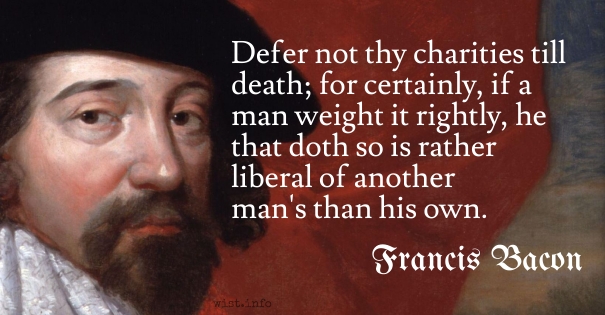
Defer not thy charities till death; for certainly, if a man weight it rightly, he that doth so is rather liberal of another man’s than his own.
Francis Bacon (1561-1626) English philosopher, scientist, author, statesman
“Of Riches,” Essays, No. 34 (1625)
(Source)
I know a great many rich men and I have read about a great many others, and I do not envy them. They are no happier than I am. You see, after all, few rich men own their property. The property owns them. It gets them up early in the morning. It will not let them sleep; it makes them suspect their friends. Sometimes they think their children would like to attend a first-class funeral. Why should we envy the rich?
Robert Green Ingersoll (1833-1899) American lawyer, agnostic, orator
Speech (1896-10-29), “The Chicago and New York Gold Speech,” McKinley League, Carnegie Hall, New York City
Our life on earth is, and ought to be, material and carnal. But we have not yet learned to manage our materialism and carnality properly; they are still entangled with the desire for ownership.
E. M. Forster (1879-1970) English novelist, essayist, critic, librettist [Edward Morgan Forster]
Abinger Harvest: A Miscellany, “My Wood” (1927)
Those two fatal words, Mine and Thine.
Miguel de Cervantes (1547-1616) Spanish novelist
Don Quixote, Part 1, Book 2, ch. 11 (1605) [tr. Motteux & Ozell (1743)]
(Source)
Alt trans.:
- "Oh happy age, which our first parents called the age of gold! not because gold, so much adored in this iron-age, was then easily purchased, but because those two fatal words, mine and thine, were distinctions unknown to the people of those fortunate times." [Full version of the above]
- "Happy the age, happy the time, to which the ancients gave the name of golden, not because in that fortunate age the gold so coveted in this our iron one was gained without toil, but because they that lived in it knew not the two words 'mine' and 'thine'!" [tr. Ormsby (1885)]
- "Happy age, and happy days were those, to which the ancients gave the name of golden; not, that gold, which in these our iron-times, is so much esteemed, was to be acquired without trouble, in that fortunate period; but, because people then, were ignorant of those two words MINE and THINE." [tr. Smollett (1976), as Part 1, Book 1, ch. 3]