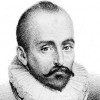
My business, my art, is to live my life. If anyone forbids me to talk about it according to my own sense, experience and practice, let him also command an architect to talk about buildings not according to his own standard but his next-door neighbour’s, according to somebody else’s knowledge not his own.
[Mon mestier & mon art, c’est vivre. Qui me defend d’en parler selon mon sens, experience & usage : qu’il ordonne à l’architecte de parler des bastimens non selon soy, mais selon son voisin, selon la science d’un autre, non selon la sienne.]
Michel de Montaigne (1533-1592) French essayist
Essays, Book 2, ch. 6 (2.6), “Of Practice [De l’exercitation]” (1574?) [tr. Screech (1987)]
(Source)
(Source (French)). Alternate translations:My arte and profession, is to live. Who forbids mee to speake of it, according to my sense, experience, and custome? Let him appoint the Architect to speake of buildings, not according to himselfe, but his neighbours, according to anothers skill, and not his owne.
[tr. Florio (1603)]My art and business is to live. He that forbids me to speak according to my own sense, experience, and practice, may as well enjoin an architect to speak of buildings not in his own style, but in his neighbour's; not according to his own science, but according to another man's.
[tr. Cotton (1686)]My trade and art is to live; he that forbids me to speak according to my own sense, experience, and practice, may as well enjoin an architect not to speak of building according to his own knowledge, but according to that of his neighbor; according to the knowledge of another, and not according to his own.
[tr. Cotton/Hazlitt (1877)]My profession and my art is living. Whoever forbids me to speak of this according to my perceptions, experience, and habit, let him bid the architect talk about buildings, not according to his own ideas, but according to those of his neighbour; according to another's knowledge, not according to his own.
[tr. Ives (1925)]My trade and my art is to live. He that forbids me to speak of it according to my own sense, experience, and practice, let him command an architect to speak of buildings not in his own style but his neighbour's, according to another man's knowledge, not according to his own.
[tr. Zeitlin (1934)]My trade and my art is living. He who forbids me to speak about it according to my sense, experience, and practice, let him order the architect to speak of buildings not according to himself but according to his neighbor; according to another man’s knowledge, not according to his own.
[tr. Frame (1943)]Living is my job and my art.
[ed. Rat (1958)]Living is my work, and my art. Let anyone who forbids me to speak of it according to my understanding, experience, and practice order an architect to speak of his buildings according, not to himself, but to his neighbor; according to his knowledge, not his own.
[tr. Atkinson/Sices (2012)]
Quotations about:
speak out
Note not all quotations have been tagged, so Search may find additional quotes on this topic.
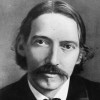
The cruellest lies are often told in silence. A man may have sat in a room for hours and not opened his teeth, and yet come out of that room a disloyal friend or a vile calumniator.
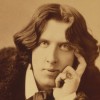
GWENDOLEN: On an occasion of this kind it becomes more than a moral duty to speak one’s mind. It becomes a pleasure.
Oscar Wilde (1854-1900) Irish poet, wit, dramatist
The Importance of Being Earnest, Act 2 (1895)
(Source)
There is no wilderness where I can hide from these things, there is no haven where I can escape them; though I travel to the ends of the earth, I find the same accursed system — I find that all the fair and noble impulses of humanity, the dreams of poets and the agonies of martyrs, are shackled and bound in the service of organized and predatory Greed! And therefore I cannot rest, I cannot be silent; therefore I cast aside comfort and happiness, health and good repute — and go out into the world and cry out the pain of my spirit!
Upton Sinclair (1878-1968) American writer, journalist, activist, politician
The Jungle, ch. 28 (1906)
(Source)
Speak out on behalf of the voiceless,
and for the rights of all who are vulnerable.
Speak out in order to judge with righteousness
and to defend the needy and the poor.The Bible (The Old Testament) (14th - 2nd C BC) Judeo-Christian sacred scripture [Tanakh, Hebrew Bible], incl. the Apocrypha (Deuterocanonicals)
Proverbs 31: 8-9 [CEB (2011)]
(Source)
From the sayings of King Lemuel of Massa, given by his mother. Alternate translations:Open thy mouth for the dumb in the cause of all such as are appointed to destruction. Open thy mouth, judge righteously, and plead the cause of the poor and needy.
[KJV (1611)]Speak, yourself, on behalf of the dumb, on behalf of all the unwanted; speak, yourself, pronounce a just verdict, uphold the rights of the poor, of the needy.
[JB (1966)]Speak up for people who cannot speak for themselves. Protect the rights of all who are helpless. Speak for them and be a righteous judge. Protect the rights of the poor and needy.
[GNT (1976)]Make your views heard, on behalf of the dumb, on behalf of all the unwanted; make your views heard, pronounce an upright verdict, defend the cause of the poor and the wretched.
[NJB (1985)]Speak out for those who cannot speak,
for the rights of all the destitute.
Speak out; judge righteously;
defend the rights of the poor and needy.
[NRSV (2021 ed.)]Speak up for the dumb,
For the rights of all the unfortunate.
Speak up, judge righteously,
Champion the poor and the needy.
[RJPS (2023 ed.)]
Being a lover of freedom, when the revolution came in Germany, I looked to the universities to defend it, knowing that they had always boasted of their devotion to the cause of truth; but, no, the universities immediately were silenced. Then I looked to the great editors of the newspapers whose flaming editorials in days gone by had proclaimed their love of freedom; but they, like the universities, were silenced in a few short weeks. Then I looked to individual writers who, as literary guides of Germany, had written much and often concerning the place of freedom in modern life; but they, too, were mute.
Only the church stood squarely across the path of Hitler’s campaign for suppressing truth. I never had any special interest in the church before, but now I feel a great affection and admiration because the church alone has had the courage and persistence to stand for intellectual truth and moral freedom. I am forced thus to confess that what I once despised I now praise unreservedly.
Albert Einstein (1879-1955) German-American physicist
(Disputed)
Regarding the rise of the Nazi party in Germany. Originally attributed in S. Parkes Cadman, "The Conflict Between Church And State In The Third Reich," La Crosse Tribune and Leader-Press (28 Oct 1934), noted as a "free translation" made by a colleague of the writer. Made famous in being quoted in Time (23 Dec 1940). Einstein himself said that he'd said something like this to a journalist, noting that the only German intellectuals supporting individual rights and intellectual freedom in the early Nazi regime were a few churchmen. He later suggested that his words on the matter had been significantly exaggerated, and issued much more critical statements about how the Catholic Church, in particular, had been silent or collaborated with the Nazi regime.More discussion here and here.
Our loyalty is due entirely to the United States. It is due to the President only and exactly to the degree in which he efficiently serves the United States. It is our duty to support him when he serves the United States well. It is our duty to oppose him when he serves it badly.
Theodore Roosevelt (1858–1919) American politician, statesman, conservationist, writer, US President (1901–1909)
Essay (1918-04-06), “Citizens or Subjects?” Kansas City Star
(Source)
Regarding a bill which had just passed the Senate Judiciary Committee which would fine and imprison any one who used "contemptuous or slurring language about the President."
This passage was added to later editions of his essay, "Lincoln and Free Speech,", as printed in The Works of Theodore Roosevelt, vol. 21, The Great Adventure, ch. 7 (1925). It does not appear in the original version of the essay or book. See Roosevelt and Roosevelt.

The more profound the thought, the more burdensome. What is in will out.
Ralph Waldo Emerson (1803-1882) American essayist, lecturer, poet
Journal (1836)
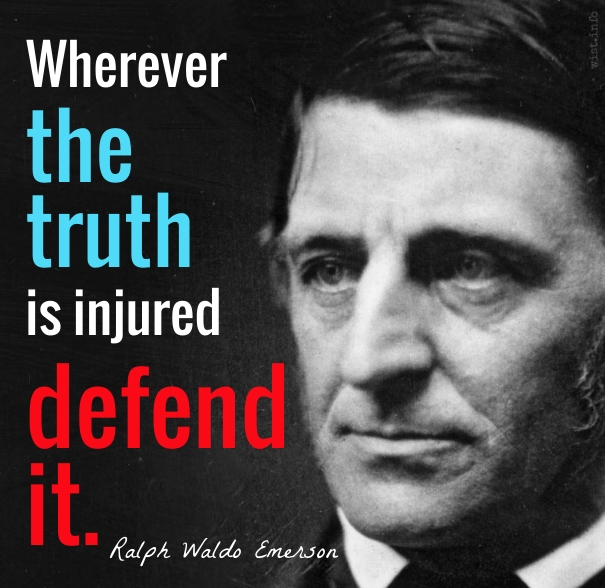
Wherever the truth is injured, defend it.
Ralph Waldo Emerson (1803-1882) American essayist, lecturer, poet
Journal (1834)
Courage is what it takes to stand up and speak; courage is also what it takes to sit down and listen.
Winston Churchill (1874-1965) British statesman and author
(Spurious)
(Source)
Not found in Churchill's works.
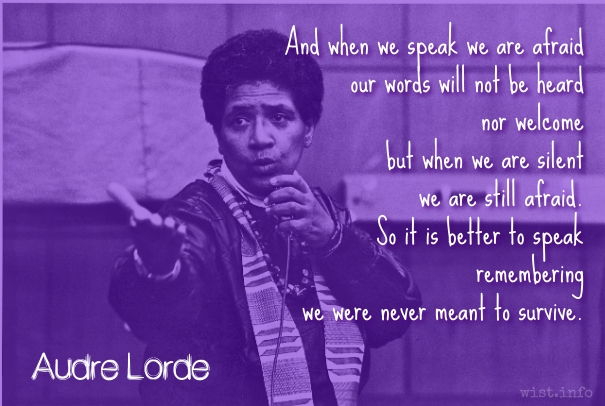
And when we speak we are afraid
our words will not be heard
nor welcome
but when we are silent
we are still afraid.
So it is better to speak
remembering
we were never meant to survive.
Audre Lorde (1934-1992) American writer, feminist, civil rights activist
“A Litany for Survival,” The Black Unicorn (1978)
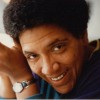
What the world expects of Christians is that Christians should speak out, loud and clear, and that they should voice their condemnation in such a way that never a doubt, never the slightest doubt, could rise in the heart of the simplest man. […] Perhaps we cannot prevent this world from being a world in which children are tortured. But we can reduce the number of tortured children. And if you don’t help us, who else in the world can help us do this?
Albert Camus (1913-1960) Algerian-French novelist, essayist, playwright
Speech, Dominican Monastery of Latour-Maubourg (1948)
Speaking on the Holocaust. In Camus, Resistance, Rebellion and Death [tr. O'Brien (1961)]
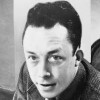
He who does not bellow the truth when he knows the truth makes himself the accomplice of liars and forgers.
Charles Péguy (1873-1914) French poet, essayist, editor
“Basic Verities: The Honest People,” Basic Verities: Prose and Poetry [tr. A and J. Green (1943)]
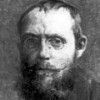
Silence is the first thing within the power of the enslaved to shatter. From that shattering, everything else spills forth.
Robin Morgan (b. 1941) American poet, author, activist, journalist
The Demon Lover, ch. 10 (1989)

It is almost impossible to remain silent in the face of tyranny without, by this very act of silence, becoming an agent of that tyranny.
Jeffrey Moussaieff Masson (b. 1941) American author
Against Therapy, Conclusion (1988)
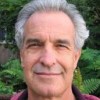
The true crime, the collective, general crime of almost all Germans of that time was that of lacking the courage to speak.
Primo Levi (1919-1987) Italian Jewish chemist and writer
The Drowned and the Saved, ch. 8 “Letters from Germans” (1986) [tr. Rosenthal (1888)]
(Source)
Regarding the Third Reich and the Holocaust.
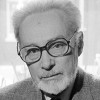
Let us speak, though we show all our faults and weaknesses — for it is a sign of strength to be weak, to know it, and out with it — not in a set way and ostentatiously, but incidentally and without premeditation.
Herman Melville (1819-1891) American writer
Letter to Nathaniel Hawthorne (29 Jun 1851)
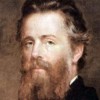
Each of you, for himself, by himself and on his own responsibility, must speak. And it is a solemn and weighty responsibility, and not lightly to be flung aside at the bullying of pulpit, press, government, or the empty catch-phrases of politicians. Each must for himself alone decide what is right and what is wrong, and which course is patriotic and which isn’t. You cannot shirk this and be a man. To decide against your convictions is to be an unqualified and inexcusable traitor, both to yourself and to your country, let men label you as they may. If you alone of all the nation shall decide one way, and that way be the right way according to your convictions of the right, you have done your duty by yourself and by your country — hold up your head! You have nothing to be ashamed of.
Mark Twain (1835-1910) American writer [pseud. of Samuel Clemens]
Essay (1909 ca.), Papers of the Adams Family, ch. 6 “Two Fragments from a Suppressed Book Called ‘Glances at History’ or ‘Outlines of History'”
(Source)
Collected in Letters from the Earth (c. 1909; pub. 1962) [ed. DeVoto (1939)]
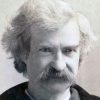
Gentlemen, you can never make me believe — no statute can ever convince me, that there is any infinite Being in this universe who hates an honest man. It is impossible to satisfy me that there is any God, or can be any God, who holds in abhorrence a soul that has the courage to express his thought. Neither can the whole world convince me that any man should be punished, either in this world or in the next, for being candid with his fellow-men. If you send men to the penitentiary for speaking their thoughts, for endeavoring to enlighten their fellows, then the penitentiary will become a place of honor, and the victim will step from it — not stained, not disgraced, but clad in robes of glory.
Robert Green Ingersoll (1833-1899) American lawyer, freethinker, orator
Trial of C.B. Reynolds for blasphemy (May 1887)
(Source)
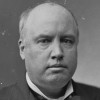
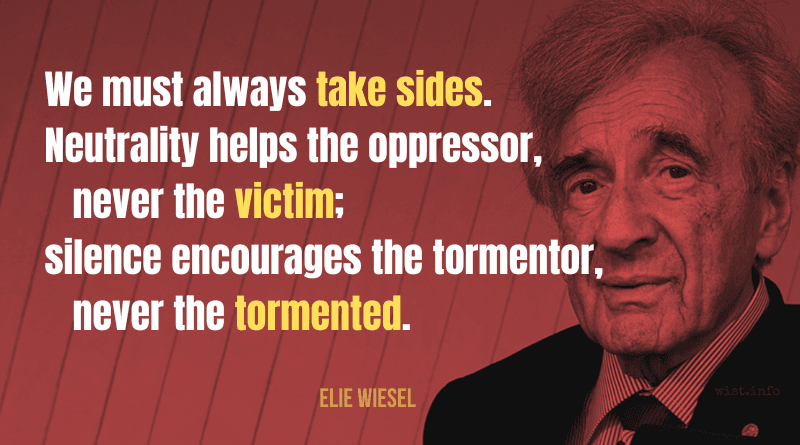
I swore to never be silent whenever and wherever human beings endure suffering and humiliation. We must always take sides. Neutrality helps the oppressor, never the victim; silence encourages the tormentor, never the tormented.
Elie Wiesel (1928-2016) Romanian-American novelist, professor, political activist, Nobel Laureate.
Speech (1986-12-10), Accepting the Nobel Peace Prize
(Source)
To sin by silence, when we should protest,
Makes cowards out of men.
Patriotism means to stand by the country. It does not mean to stand by the President or any other public official save exactly to the degree in which he himself stands by the country. It is patriotic to support him in so far as he efficiently serves the country. It is unpatriotic not to oppose him to the exact extent that by inefficiency or otherwise he fails in his duty to stand by the country. In either event, it is unpatriotic not to tell the truth — whether about the President or about any one else.
Theodore Roosevelt (1858–1919) American politician, statesman, conservationist, writer, US President (1901–1909)
Essay (1918-05), “Lincoln and Free Speech,” Metropolitan Magazine, Vol. 47, No. 6
(Source)
On war-time censorship by the Wilson Administration taken against critics of its handling of war efforts.
Reprinted in Appendix C of his The Great Adventure (1918), and as ch. 7 of that book in Vol. 21 of The Works of Theodore Roosevelt (1925), The Great Adventure.
See also Roosevelt and Roosevelt.
A man dies when he refuses to stand up for that which is right. A man dies when he refuses to stand up for justice. A man dies when he refuses to take a stand for that which is true.
Martin Luther King, Jr. (1929-1968) American clergyman, civil rights leader, social activist, preacher
Sermon, Selma, Alabama (8 Mar 1965)
Possibly the source of the uncited attributions (or variants) "Our lives begin to end the day we become silent about things that matter" and "The day we see the truth and cease to speak is the day we begin to die."