

Man has three friends on whose company he relies. First, wealth — which goes with him only while good fortune lasts. Second, his relatives — they go only as far as the grave and leave him there. The third friend, his good deeds, go with him beyond the grave.
The Talmud (AD 200-500) Collection of Jewish rabbinical writings
(Attributed)
I could not find an actual citation for this quotation, but the story (the explanation of a parable, in which a man is summoned before a king, and while his dearest friend will not go with him, and his second best friend will only go to the palace gates, his least-loved friend goes with him before the throne) shows up with different translation in multiple sources:
- The Talmud: Selections, Part 5 "Civil and Criminal Laws -- the Holy Days" - "The Day of Atonement" [tr. Polano (1876)].
- Isaac Aboav, Lamp of Light [Menorat Hamoar] [14th C], Fifth Lamp "Teshuvah," Sec. 2 [ch. 3] in Leonard Kravitz and Kerry Olitzky, <i>Journey of the Soul: Traditional Sources on the</i> Teshuvah (1995).
- Talmudic and Other Legends [tr., comp. Weiss (1888 ed.), "Man's Three Friends" (Pirke R. Eliezer).
Quotations by:
Talmud
Why was man created on the last day? So that he can be told, when pride possesses him, God created the gnat before thee.
The Talmud (AD 200-500) Collection of Jewish rabbinical writings
(Unreferenced)
Who can protest and does not, is an accomplice in the act.
The Talmud (AD 200-500) Collection of Jewish rabbinical writings
(Unreferenced)
Teach your tongue to say, “I do not know,” lest you err and stumble through your error.
The Talmud (AD 200-500) Collection of Jewish rabbinical writings
(Unreferenced)
The Divine Spirit does not reside in any except the joyful heart.
The Talmud (AD 200-500) Collection of Jewish rabbinical writings
(Unreferenced)
When the Egyptians were drowning in the Red Sea, the angels in heaven began to break forth in songs of jubilation, but the Holy One, blessed be He, silenced them: “My creatures are perishing — and ye are ready to sing!”
The Talmud (AD 200-500) Collection of Jewish rabbinical writings
(Unreferenced)
In Louis I. Newman, comp. The Talmudic Anthology, 103 (1945): "When the Egyptians were drowning, the angels wished to sing. But God said, 'My children are dying, and you would sing?'"
A quotation at the right moment is like bread to the famished.
The Talmud (AD 200-500) Collection of Jewish rabbinical writings
(Unreferenced)
Examine the contents, not the bottle.
The Talmud (AD 200-500) Collection of Jewish rabbinical writings
(Unreferenced)
He who carries out one good deed acquires one advocate in his own behalf, and he who commits one transgression acquires one accuser against himself. Repentance and good works are like a shield against calamity.
The Talmud (AD 200-500) Collection of Jewish rabbinical writings
(Unreferenced)
When man appears before the Throne of Judgment, the first question he is asked is not: “Have you believed in God?” or “Have you prayed and observed the ritual?” He is asked: “Have you dealt honorably and faithfully in all your dealings with your fellow man?”
The Talmud (AD 200-500) Collection of Jewish rabbinical writings
(Unreferenced)
Charity and loving-kindness are powerful defenses on the Day of Judgment.
The Talmud (AD 200-500) Collection of Jewish rabbinical writings
(Unreferenced)
If two men claim thy help, and one is thy enemy, help him first.
The Talmud (AD 200-500) Collection of Jewish rabbinical writings
(Unreferenced)
In Louis I. Newman (comp.), The Talmudic Anthology, #136 (1945)
Pray for the welfare of the government, for were it not for the fear of the government, a man would swallow up his neighbor alive.
The Talmud (AD 200-500) Collection of Jewish rabbinical writings
(Unreferenced)
Deeds of kindness are equal in weight to all the commandments.
The Talmud (AD 200-500) Collection of Jewish rabbinical writings
(Unreferenced)
In Louis I. Newman, comp., The Talmudic Anthology, #177 (1945)
Prohibit not something to others which you permit to yourself.
The Talmud (AD 200-500) Collection of Jewish rabbinical writings
(Unreferenced)
No sackcloth and fasting avail, but repentance and good deeds.
The Talmud (AD 200-500) Collection of Jewish rabbinical writings
(Unreferenced)
A man may not be responsible for his actions in an hour of tribulation and pain.
The Talmud (AD 200-500) Collection of Jewish rabbinical writings
(Unreferenced)
Silence is equivalent to confession.
The Talmud (AD 200-500) Collection of Jewish rabbinical writings
(Unreferenced)
In Louis I. Newman, The Talmudic Anthology, ch. 189 (1945)
We will be held accountable for all the permitted pleasures we failed to enjoy.
The Talmud (AD 200-500) Collection of Jewish rabbinical writings
(Unreferenced)
He that feeds the hungry feeds God also.
The Talmud (AD 200-500) Collection of Jewish rabbinical writings
(Unreferenced)
He that gives should never remember. He that receives should never forget.
The Talmud (AD 200-500) Collection of Jewish rabbinical writings
(Unreferenced)
Loving-kindness is greater than laws; and the charities of life are more than all ceremonies.
The Talmud (AD 200-500) Collection of Jewish rabbinical writings
(Unreferenced)
He who publicly shames his neighbor is as though he shed blood.
The Talmud (AD 200-500) Collection of Jewish rabbinical writings
Baba Mezia 58b
Thy friend has a friend, and thy friend’s friend has a friend; be discreet.
The Talmud (AD 200-500) Collection of Jewish rabbinical writings
Babylonian Talmud, Baba Bathra 28b
(Source)
Noted as a common saying. The summary "be discreet" does not appear in the actual Talmud translations I found, but seems to be an explanation from early Christian reviews of the Talmud for when the verse is given as a stand-alone proverb.
These things are good in little measure and evil in large; yeast, salt, and hesitation.
The Talmud (AD 200-500) Collection of Jewish rabbinical writings
Babylonian Talmud, Berakoth 34a
Alt. trans.: "Our Rabbis taught: If one is asked to pass before the Ark, he ought to refuse, and if he does not refuse he resembles a dish without salt; but if he persists too much in refusing he resembles a dish which is over-salted. How should he act? The first time he should refuse; the second time he should hesitate; the third time he should stretch out his legs and go down. Our Rabbis taught: There are three things of which one may easily have too much while a little is good, namely, yeast, salt, and refusal."
Alt. trans.: "There are three things that are harmful in excess but are beneficial when used sparingly. They are: Leavening in dough, salt in a cooked dish and refusal for the sake of propriety." [William Davidson Talmud]
Alt. trans.: "There are three things of which you may easily have too much, while a little is good: yeast, salt, and hesitation." [Joshua of the South, Berakot 5.3]
Alt trans.: "Three things are disagreeable when used in excess, and pleasant when moderately indulged in: yeast, salt, and hesitancy in accepting proffered honours." [Paul Isaac Hershon, The Pentateuch According to the Talmud: Genesis, Part 1, Genesis 19:26, Synoptical Notes: "Salt"]
No labor, however humble, is dishonoring.
The Talmud (AD 200-500) Collection of Jewish rabbinical writings
Babylonian Talmud, Nedarim 49b
Alt. trans.: "Great is labor, for it honors the worker." [tr. Freedman] Alt. trans.: "Labor is great, as it brings honor to the laborer who performs it."
What is hateful to you, do not to your neighbor. That is the whole Torah; the rest is commentary. Go and study it.
[d’`alakh sani l’khaverkha la ta`avid. Zo hi kol hatora kulahh, v’idakh peirusha hu: zil g’mor]
The Talmud (AD 200-500) Collection of Jewish rabbinical writings
Babylonian Talmud, Shabbat 31a (Rabbi Hillel)
(Noted elsewhere as tractate Shabbat 30a.) See also the Bible, Matthew 7:12. Alt. Trans.: "What is hateful to thee, do not unto thy fellow; this is the whole law. All the rest is a commentary to this law; go and learn it."
If a man repents of his evil deeds, and then returns to the same deeds, he has not truly repented.
The Talmud (AD 200-500) Collection of Jewish rabbinical writings
In Louis J. Newman, comp., The Talmudic Anthology, ch. 282 (1945)
The gates of repentance are always open.
The Talmud (AD 200-500) Collection of Jewish rabbinical writings
Midrash
In Louis J. Newman, comp., The Talmudic Anthology, ch. 282 (1945)
He who hates a man is as if he hated God.
The Talmud (AD 200-500) Collection of Jewish rabbinical writings
Midrash
in Louis Mewman, The Talmudic Anthology, 136 (1945)
Every blade of grass has its angel that bends over it and whispers, “Grow, grow.”
The Talmud (AD 200-500) Collection of Jewish rabbinical writings
Midrash Rabba, Bereshit 10:6
Usually attributed to the Talmud, but actually from a Midrash. Alt. trans.:
- "R. Shimon said: There is not a single herb but has a mazal [constellation] in the heavens which strikes it and says, 'Grow!'" [tr. Rabbi Ruth Adar]
- "Said Rabbi Simon: 'Every single blade of grass has a corresponding 'mazal' in the sky which hits it and tells it to grow." [Source]
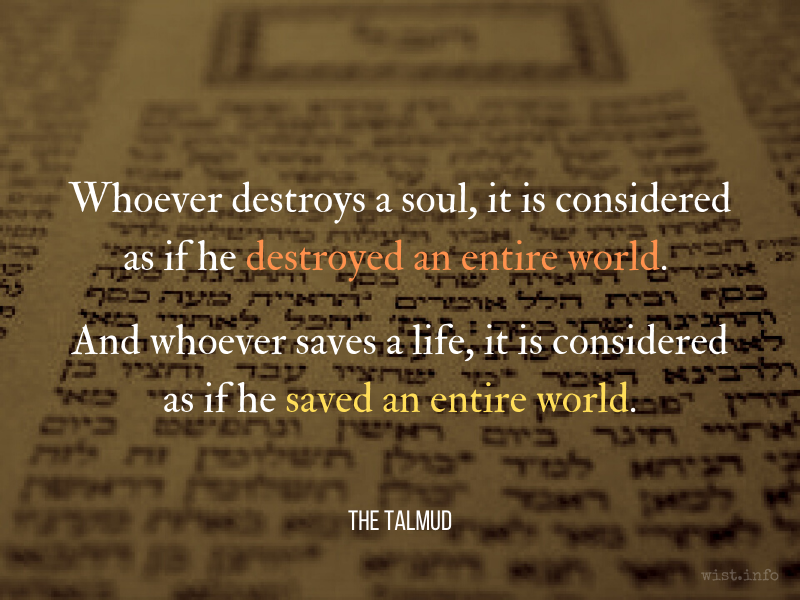
Whoever destroys a soul, it is considered as if he destroyed an entire world. And whoever saves a life, it is considered as if he saved an entire world.
The Talmud (AD 200-500) Collection of Jewish rabbinical writings
Mishnah Sanhedrin 4:9; Yerushalmi Talmud, Tractate Sanhedrin 37a
(Source)
Alt. trans.: "Whoever destroys a single life is as guilty as though he had destroyed the entire world; and whoever rescues a single life earns as much merit as though he had rescued the entire world."
Deeds of kindness are equal in weight to all the commandments.
The Talmud (AD 200-500) Collection of Jewish rabbinical writings
Mishnah, Zeraim, Pe’ah 4:19
(Source)
Don’t threaten a child; either punish or forgive him.
The Talmud (AD 200-500) Collection of Jewish rabbinical writings
Passage
When you teach your son, you teach your son’s son.
The Talmud (AD 200-500) Collection of Jewish rabbinical writings
Seder Nashim, Kiddushin 30a
Paraphrase of "This serves to say to you that whoever teaches his son Torah, the verse ascribes him credit as though he taught him, and his son, and his son’s son, until the end of all generations" (alt. trans. "to him who teaches his son Torah, the Writ ascribes merit as though he had taught him, his son and his son's son until the end of all time!"). This is in turn referenced to Deut. 4:9.
Rabbi Jannai said: “It is beyond our power to explain either the prosperity of the wicked or the afflictions of the righteous.”
The Talmud (AD 200-500) Collection of Jewish rabbinical writings
The Mishnah (c. AD 200)