So we’re just in this maze for now, trying to figure out if that glint in the distance is daylight, or a Minotaur with an Uzi.
J. Michael (Joe) Straczynski (b. 1954) American screenwriter, producer, author [a/k/a "JMS"]
rec.arts.sf.tv.babylon5.moderated, “ATTN JMS: Warner Bros” (8 Dec 1996)
(Source)
Quotations about:
danger
Note not all quotations have been tagged, so Search may find additional quotes on this topic.

The saying that a little knowledge is a dangerous thing is, to my mind, a very dangerous adage. If knowledge is real and genuine, I do not believe that it is other than a very valuable possession, however infinitesimal its quantity may be. Indeed, if a little knowledge is dangerous, where is the man who has so much as to be out of danger?
Act nothing in furious Passion; it’s putting to Sea in a Storm.
Thomas Fuller (1654–1734) English physician, preacher, aphorist, writer
Introductio ad Prudentiam, Vol. 1, # 365 (1725)
(Source)

A little learning is a dangerous thing;
Drink deep, or taste not the Pierian Spring:
There shallow draughts intoxicate the brain,
And drinking largely sobers us again.Alexander Pope (1688–1744) English poet
“An Essay on Criticism,” Part 2, ll. 15-18 (1711)
(Source)
In Greek mythology, the Pierian Spring was sacred to the Muses, representing the metaphorical source of knowledge.
The first line is more commonly paraphrased as "A little knowledge is a dangerous thing."

When you want to test the depths of a stream, don’t use both feet.
Proverbs, Sayings, and Adages
Chinese proverb

Bringing about Armageddon can be dangerous. Do not attempt it in your own home.


He that will not sail till all Dangers are over, must never put out to Sea.
Thomas Fuller (1654–1734) English physician, preacher, aphorist, writer
Gnomologia: Adages and Proverbs (compiler), # 2353 (1732)
(Source)
An actuary is someone who brings a fake bomb on a plane because that decreases the chances that there will be another bomb on the plane.
Lawrence J. Peter (1919–1990) American educator, management theorist
(Attributed)
NORFOLK: Heat not a furnace for your foe so hot
That it do singe yourself.William Shakespeare (1564–1616) English dramatist and poet
Henry VIII, Act 1, sc. 1, l. 168ff (1.1.168-169) (1613)
(Source)

Every crisis has both its dangers and its opportunities. Each can spell either salvation or doom.
Martin Luther King, Jr. (1929–1968) American clergyman, civil rights leader, social activist, preacher
Stride Toward Freedom, ch. 11 “Where Do We Go from Here?” (1958)
(Source)
A timid person is frightened before a danger, a coward during the time, and a courageous person afterward.
Jean Paul Richter (1763–1825) German writer, art historian, philosopher, littérateur [Johann Paul Friedrich Richter; pseud. Jean Paul]
(Attributed)
(Source)
Quoted in Edward Parsons Day, Day's Collacon: an Encyclopaedia of Prose Quotations, "Danger" (1884), without citation.

When thy next neighbours house is all on fire,
’Tis thy concern to make his flames expire;
For fire will gather strength if let alone,
And with thy neighbours house burn down thine owne.[Nam tua res agitur, paries cum proximus ardet.
Et neglecta solent incendia sumere vires.]Horace (65–8 BC) Roman poet, satirist, soldier, politician [Quintus Horatius Flaccus]
Epistles [Epistularum, Letters], Book 1, ep. 18 “To Lollius,” l. 84ff (1.18.84-85) (20 BC) [tr. A. B.; ed. Brome (1666)]
(Source)
On the need to defend friends who are being slandered by others.
(Source (Latin)). Other translations:The case is thyne, thy neighboures house when it doth flame up bright,
And burninges thowght but smal, or now have grown to dreedful might.
[tr. Drant (1567)]For you're in danger when the Next's on fire,
And Flames neglected often blaze the higher.
[tr. Creech (1684)]When flames your neighbour's dwelling seize,
Your own with instant rage shall blaze;
Then haste to stop the spreading fire,
Which, if neglected, rises higher.
[tr. Francis (1747)]He that espies a neighbour's roof on fire
And calmly sees the flames to heaven aspire,
Will find them gather strength, till let alone
They with his neigbour's house burn down his own.
[tr. Howes (1845)]For it is your own concern, when the adjoining wall is on fire: and flames neglected are wont to gain strength.
[tr. Smart/Buckley (1853)]No time for sleeping with a fire next door;
Neglect such things, they only blaze the more.
[tr. Conington (1874)]With the next house in flames, best look ahead —
A fire neglected's pretty sure to spread.
[tr. Martin (1881)]For your own business is affected when your neighbor's wall is on fire, and flames neglected gather strength.
[tr. Dana/Dana (1911)]'Tis your own safety that's at stake, when your neighbour's wall is in flames, and fires neglected are wont to gather strength.
[tr. Fairclough (Loeb) (1926)]When flames your neighbor’s dwelling seize,
Your own with instant rage shall blaze;
Then haste to stop the spreading fire,
Which, if neglected, rises higher.
[tr. A. F. Murison (1931); ed. Kraemer (1936)]When your neighbor's house catches fire, your place is threatened,
And flames that are disregarded usually burn brighter.
[tr. Palmer Bovie (1959)]If your neighbor's house is burning, your own is next;
for fires, if they're not put out, are apt to spread.
[tr. Fuchs (1977)]Your own house is in danger when your neighbor's
House is on fire; a fire not watched can spread.
[tr. Ferry (2001)]It's very much your affair when the house next door is ablaze.
Ignore a fire, and soon you're faced with a conflagration.
[tr. Rudd (2005 ed.)]If your neighbour’s roof’s in flames, it’s your business too,
And neglected fires have a habit of gaining strength.
[tr. Kline (2015)]
To let a sudden fit of anger make you forget the dangers you risk for yourself and for those who are nearest and dearest to you — is this not clouded judgment?
[A. 一朝之忿、忘其身以及其親、非惑與。]
[B. 一朝之忿忘其身以及其亲非惑与]
Confucius (c. 551- c. 479 BC) Chinese philosopher, sage, politician [孔夫子 (Kǒng Fūzǐ, K'ung Fu-tzu, K'ung Fu Tse), 孔子 (Kǒngzǐ, Chungni), 孔丘 (Kǒng Qiū, K'ung Ch'iu)]
The Analects [論語, 论语, Lúnyǔ], Book 12, verse 21 (12.21) (6th C. BC – AD 3rd C.) [tr. Chin (2014)]
(Source)
Waley suggests the internal rhymes in both the questions in 12.21 and this particular answer mean they are quotations from an outside source, a "didactic poem," and thus carry additional meaning now lost.
(Source (Chinese) A, B). Other translations:For a morning's anger to disregard one's own life, and involve that of his parents; -- is not this a case of delusion?
[tr. Legge (1861)]And as to illusions, is not one morning's fit of anger, causing a man to forget himself, and even involving the consequences those who are near and dear to him -- is not that an illusion?
[tr. Jennings (1895)]If a man allows himself to lose his temper and forget himself of a morning, in such a way as to become careless for the safety of is own person and for the safety of his parents and friends: -- is that not a case of a great delusion in life?
[tr. Ku Hung-Ming (1898)]For a morning's anger to forget his own safety and involve that of his relatives, is not this irrational?
[tr. Soothill (1910)]For one morning’s temper to jeopard one's life and even that of one's relatives, isn’t that hallucination?
[tr. Pound (1933)]Because of a morning's blind rage to forget one's own safety and even endanger one's kith and kin, is that not a case of divided mind?
[tr. Waley (1938)]In a moment’s burst of anger to forget oneself and one’s family. Wouldn’t this be utter confusion?
[tr. Ware (1950)]To let a sudden fit of anger make you forget the safety of your own person or even that of your parents, is that not misguided judgment?
[tr. Lau (1979)]To be oblivious of one's own person and even of one's own parents all because of a morning's anger -- is this not a confusion?
[tr. Dawson (1993)]To endanger oneself and one's kin in a sudden fit of anger: is this not an instance of incoherence?
[tr. Leys (1997)]In a fit of rage, you forget yourself and even your parents -- is that not delusion?
[tr. Huang (1997)]If one has any anger so that one forgets one's pro0per behavior to take the anger upon the relatives, is not one confused?
[tr. Cai/Yu (1998), #307]In a moment of rage to forget not only one's own person but even one's parents -- is this not being in a quandary?
[tr. Ames/Rosemont (1998)]For the anger of a morning, to forget one's self and even one's kin, is that not a contradiction?
[tr. Brooks/Brooks (1998)]To endanger yourself and your family, all in a morning's blind rage -- is that not delusion?
[tr. Hinton (1998)]To forget yourself in a moment of anger and thereby bring ruin upon both you and your family -- is this not an example of confusion?
[tr. Slingerland (2003)]Because of one morning's anger, to forget your own safety and even endanger those close to you -- this is faulty thinking, isn't it?
[tr. Watson (2007)]If you act out of animus with the consequence of hurting yourelf and yoru loved ones, is that an example of delusion?
[tr. Li (2020)]
A common paraphrase of this is "When anger rises, think of the consequences." This is attributed to Confucius in Kang-Hi (K'ang-hsi, Kangxi) The Sacred Edict, Maxim #16 (1670, 1724) [tr. Milne (1817)]. An alternate translation is "In anger, think of the trouble" [tr. Baller (1892), ch. 16, sec. 15]

SHYLOCK: Thou call’dst me dog before thou hadst a cause,
But since I am a dog, beware my fangs.William Shakespeare (1564–1616) English dramatist and poet
Merchant of Venice, Act 3, sc. 3, l. 7ff (3.3.7-8) (1597)
(Source)
Security is mostly a superstition. It does not exist in nature, nor do the children of men as a whole experience it. God Himself is not secure, having given man dominion over His works! Avoiding danger is no safer in the long run than outright exposure. The fearful are caught as often as the bold. Faith alone defends. Life is either a daring adventure or nothing. To keep our faces toward change and behave like free spirits in the presence of fate is strength undefeatable.
Helen Keller (1880–1968) American author and lecturer
Let Us Have Faith, “Faith Fears Not” (1940)
(Source)
Reprinted in her compilation book, The Open Door (1957). This quotation is often given in excerpted form, leaving out certain sentences, or even rearranging some of the sentences and sometimes making it seem that the two sources are actually different.
GONZALO: Beseech you, sir, be merry. You have cause —
So have we all — of joy, for our escape
Is much beyond our loss. Our hint of woe
Is common; every day some sailor’s wife,
The masters of some merchant, and the merchant
Have just our theme of woe. But for the miracle —
I mean our preservation — few in millions
Can speak like us. Then wisely, good sir, weigh
Our sorrow with our comfort.William Shakespeare (1564–1616) English dramatist and poet
Tempest, Act 2, sc. 1, l. 1ff (2.1.1-9) (1611)
(Source)
People who used magic without knowing what they were doing usually came to a sticky end.
All over the entire room, sometimes.
But if he does really think that there is no distinction between virtue and vice, why, Sir, when he leaves our houses let us count our spoons.
Samuel Johnson (1709–1784) English writer, lexicographer, critic
Comment (1763-07-14)
(Source)
In James Boswell, The Life of Samuel Johnson, Vol. 1: 1709-1765 (1791). Regarding an unnamed "impudent fellow from Scotland" Boswell told him of.
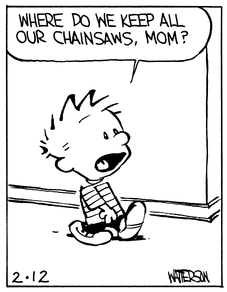
CALVIN: Where do we keep all our chainsaws, Mom?

The dogmas of the quiet past are inadequate to the stormy present. The occasion is piled high with difficulty, and we must rise with the occasion. As our case is new, so we must think anew and act anew. We must disenthrall ourselves, and then we shall save our country.
Abraham Lincoln (1809–1865) American lawyer, politician, US President (1861–65)
Message (1862-12-01) to Congress, Annual Message (State of the Union)
(Source)

Government is not reason, it is not eloquence, it is force; like fire, a troublesome servant and a fearful master. Never for a moment should it be left to irresponsible action.
George Washington (1732–1799) American military leader, Founding Father, US President (1789–1797)
(Attributed)
Unsourced. First attributed to "The First President of the United States" in "Liberty and Government" by W. M., in The Christian Science Journal (Nov 1902) [ed. Mary Baker Eddy].
Variant: "Government is not reason, it is not eloquence — it is force! Like fire, it is a dangerous servant and a fearful master. Never for a moment should it be left to irresponsible action."
More information on this quotation's origins and inspiration: Quote Origin: Government Is Like Fire, a Dangerous Servant and a Fearful Master – Quote Investigator®.
Every evil in the bud is easily crushed: as it grows older, it becomes stronger.
[Omne malum nascens facile opprimitur; inveteratum fit pleurumque robustius.]
Marcus Tullius Cicero (106–43 BC) Roman orator, statesman, philosopher
Philippics [Philippicae; Antonian Orations], No. 5, ch. 11 / sec. 31 (5.11/5.31) (43-01-01 BC) [ed. Hoyt (1896)]
(Source)
(Source (Latin)). Other translations:Every evil is easily crushed at its birth; when it has become of long standing, it usually gets stronger.
[tr. Yonge (1903)]Every evil at its birth is easily suppressed; but if it be of long standing, it will offer a stouter resistance.
[ed. Harbottle (1906)]Every evil is easily crushed at its birth; become inveterate it as a rule gathers strength.
[tr. Ker (Loeb) (1926)]Every evil is easily nipped in the bud; with age it usually gets stronger.
[tr. Manuwald (2007)]