You can do very little with faith, but you can do nothing without it.
Samuel Butler (1835–1902) English novelist, satirist, scholar
The Note-Books of Samuel Butler, ch. 21 “Faith” (1912)
Full text.
Quotations about:
faith
Note not all quotations have been tagged, so Search may find additional quotes on this topic.
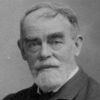
It is natural for the mind to believe, and for the will to love; so that, for want of true objects, they must attach themselves to false.
Blaise Pascal (1623–1662) French scientist and philosopher
Pensées, # 81 (1670) [tr. W. Totter (1931)]
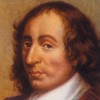
Religious persecution may shield itself under the guise of a mistaken and over-zealous piety.
Edmund Burke (1729–1797) Anglo-Irish statesman, orator, philosopher
Speech (18 Feb 1788)
Quoted in E. A. Bond (ed.), Speeches ... in the Trial of Warren Hastings, vol. 1 (1859)
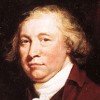
In our era, the road to holiness necessarily passes through the world of action.
Dag Hammarskjöld (1905–1961) Swedish diplomat, author, UN Secretary-General (1953–61)
Markings (1955) [tr. Sjoberg, Auden (1964)]
(Source)
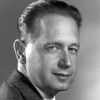
There is nothing anti-intellectual in the leap of faith, for faith is not believing without proof but trusting without reservation.
William Sloane Coffin, Jr. (1924–2006) American minister, social activist
Credo, “Faith, Hope, Love” (2004)
(Source)
Even if we think religion insoluble, we cannot think it irrelevant. Even if we ourselves have no view of the ultimate verities, we must feel that wherever such a view exists in a man it must be more important than anything else in him.
Gilbert Keith Chesterton (1874–1936) English journalist and writer
Heretics, ch. 20 “Concluding Remarks on the Importance of Orthodoxy” (1905)
(Source)
Man is a credulous animal, and must believe something; in the absence of good grounds for belief, he will be satisfied with bad ones.
Bertrand Russell (1872–1970) English mathematician and philosopher
“An Outline of Intellectual Rubbish,” Unpopular Essays (1950)
Also in "Atheism and Agnosticism," Essays in Skepticism (1962).
What good is it, my brothers and sisters, if someone claims to have faith but does not have works? Surely that faith cannot save, can it? If a brother or sister is naked and lacks daily food and one of you says to them, “Go in peace; keep warm and eat your fill,” and yet you do not supply their bodily needs, what is the good of that? So faith by itself, if it has no works, is dead.
But someone will say, “You have faith, and I have works.” Show me your faith apart from works, and I by my works will show you faith.[Τί τὸ ὄφελος ἀδελφοί μου ἐὰν πίστιν λέγῃ τις ἔχειν ἔργα δὲ μὴ ἔχῃ μὴ δύναται ἡ πίστις σῶσαι αὐτόν. ἐὰν ἀδελφὸς ἢ ἀδελφὴ γυμνοὶ ὑπάρχωσιν καὶ λειπόμενοι τῆς ἐφημέρου τροφῆς. εἴπῃ δέ τις αὐτοῖς ἐξ ὑμῶν Ὑπάγετε ἐν εἰρήνῃ θερμαίνεσθε καὶ χορτάζεσθε μὴ δῶτε δὲ αὐτοῖς τὰ ἐπιτήδεια τοῦ σώματος τί τὸ ὄφελος. οὕτως καὶ ἡ πίστις ἐὰν μὴ ἔχῃ ἔργα νεκρά ἐστιν καθ’ ἑαυτήν.
Ἀλλ’ ἐρεῖ τις Σὺ πίστιν ἔχεις κἀγὼ ἔργα ἔχω δεῖξόν μοι τὴν πίστιν σου χωρὶς τῶν ἔργων κἀγώ σοι δείξω ἐκ τῶν ἔργων μου τὴν πίστιν.]The Bible (The New Testament) (AD 1st - 2nd C) Christian sacred scripture
Book 20. Letter of James 2:14ff (Jas 2:14–18) [NRSV (2021 ed.)]
(Source)
(Source (Greek)). Other translations:What doth it profit, my brethren, though a man say he hath faith, and have not works? Can faith save him? If a brother or sister be naked, and destitute of daily food, and one of you say unto them, Depart in peace, be ye warmed and filled; notwithstanding ye give them not those things which are needful to the body; what doth it profit? Even so faith, if it hath not works, is dead, being alone. Yea, a man may say, Thou hast faith, and I have works: shew me thy faith without thy works, and I will shew thee my faith by my works.
[KJV (1611)]Take the case, my brothers, of someone who has never done a single good act but claims that he has faith. Will that faith save him? If one of the brothers or one of the sisters is in need of clothes and has not enough food to live on, and one of you says to them, 'I wish you well; keep yourself warm and eat plenty', without giving them these bare necessities of life, then what good is that? Faith is like that: if good works do not go with it, it is quite dead. This is the way to talk to people of that kind: 'You say you have faith and I have good deeds; I will prove to you that I have faith by showing you my good deeds -- now you prove to me that you have faith without any good deeds to show.'
[JB (1966)]My friends, what good is it for one of you to say that you have faith if your actions do not prove it? Can that faith save you? Suppose there are brothers or sisters who need clothes and don't have enough to eat. What good is there in your saying to them, “God bless you! Keep warm and eat well!”—if you don't give them the necessities of life? So it is with faith: if it is alone and includes no actions, then it is dead.
But someone will say, “One person has faith, another has actions.” My answer is, “Show me how anyone can have faith without actions. I will show you my faith by my actions.”
[GNT (1976)]How does it help, my brothers, when someone who has never done a single good act claims to have faith? Will that faith bring salvation? If one of the brothers or one of the sisters is in need of clothes and has not enough food to live on, and one of you says to them, 'I wish you well; keep yourself warm and eat plenty,' without giving them these bare necessities of life, then what good is that? In the same way faith, if good deeds do not go with it, is quite dead. But someone may say: So you have faith and I have good deeds? Show me this faith of yours without deeds, then! It is by my deeds that I will show you my faith.
[NJB (1985)]My brothers and sisters, what good is it if people say they have faith but do nothing to show it? Claiming to have faith can’t save anyone, can it? Imagine a brother or sister who is naked and never has enough food to eat. What if one of you said, “Go in peace! Stay warm! Have a nice meal!”? What good is it if you don’t actually give them what their body needs? In the same way, faith is dead when it doesn’t result in faithful activity. Someone might claim, “You have faith and I have action.” But how can I see your faith apart from your actions? Instead, I’ll show you my faith by putting it into practice in faithful action.
[CEB (2011)]
When I, a thoughtful and unblessed Presbyterian, examine the Koran, I know that beyond any question every Mohammedan is insane; not in all things, but in religious matters. When a thoughtful and unblessed Mohammedan examines the Westminster Catechism, he knows that beyond any question I am spiritually insane. I cannot prove to him that he is insane, because you never can prove anything to a lunatic — for that is a part of his insanity and the evidence of it. He cannot prove to me that I am insane, for my mind has the same defect that afflicts his. All Democrats are insane, but not one of them knows it; none but the Republicans and Mugwumps know it. All the Republicans are insane, but only the Democrats and Mugwumps can perceive it. The rule is perfect: in all matters of opinion our adversaries are insane.
Mark Twain (1835–1910) American writer [pseud. of Samuel Clemens]
Christian Science, ch. 5 (1907)
(Source)
Often misattributed to Oscar Wilde.
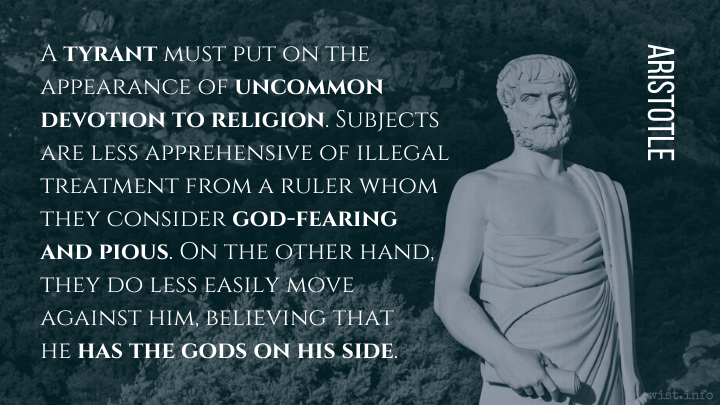
A tyrant must put on the appearance of uncommon devotion to religion. Subjects are less apprehensive of illegal treatment from a ruler whom they consider god-fearing and pious. On the other hand, they do less easily move against him, believing that he has the gods on his side.
Aristotle (384–322 BC) Greek philosopher
Politics [Πολιτικά], Book 5, ch. 11 / 1314b.39
Other translations:
- "Also he should appear to be particularly earnest in the service of the Gods; for if men think that a ruler is religious and has a reverence for the Gods, they are less afraid of suffering injustice at his hands, and they are less disposed to conspire against him, because they believe him to have the very Gods fighting on his side. At the same time his religion must not be thought foolish." [tr. Jowett (1885)]
- "And, moreover, always to seem particularly attentive to the worship of the gods; for from persons of such a character men entertain less fears of suffering anything illegal while they suppose that he who governs them is religious and reverences the gods; and they will be less inclined to raise insinuations against such a one, as being peculiarly under their protection: but this must be so done as to give no occasion for any suspicion of hypocrisy." [tr. Ellis (1912)]
- "And further he must be seen always to be exceptionally zealous as regards religious observances (for people are less afraid of suffering any illegal treatment from men of this sort, if they think that their ruler has religious scruples and pays regard to the gods, and also they plot against him less, thinking that he has even the gods as allies), though he should not display a foolish religiosity." [tr. Rackham (1932)]
- "Further, he must always show himself to be seriously attentive to the things pertaining to the gods. For men are less afraid fo being treated in some respect contrary to the law by such persons, if they consider the ruler a god-fearing sort who takes thought for the gods, and they are less ready to conspire against him as one who has the gods too as allies. In showing himself of this sort, however, he must avoid silliness." [tr. Lord (1984)]
All Faith is false, all Faith is true: truth is the shattered mirror strown
In myriad bits; while each believes his little bit the whole to own.Richard Francis Burton (1821–1890) British explorer and orientalist
The Kasîdah of Hâjî Abdû Al-Yazdi (1900)
(Source)
SCRIPTURES, n. The sacred books of our holy religion, as distinguished from the false and profane writings on which all other faiths are based.
Ambrose Bierce (1842–1914?) American writer and journalist
“Scriptures,” The Devil’s Dictionary (1911)
(Source)
Originally published in The Devil's Dictionary [A-Z] as Vol. 7 of his Collected Works.

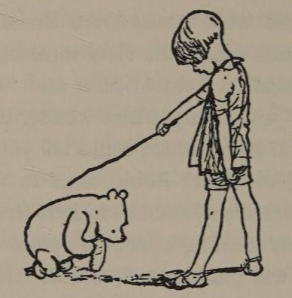
Pooh wondered if being a faithful Knight meant that you just went on being faithful without being told things.
A. A. Milne (1882–1956) English poet and playwright [Alan Alexander Milne]
House at Pooh Corner, ch. 10 “An Enchanted Place” (1928)
(Source)
All tragedies are finish’d by a death,
All comedies are ended by a marriage;
The future states of both are left to faith.
Kindness is the mark of faith; and whoever has not kindness has not faith.
Muhammad (AD c. 570–632) Arab religious, military, and political leader; founder of Islam [Mohammed, مُحَمَّد]
The Sayings of Mohammed, #254 [tr. Abdullah Al-Suhrawardy (1941)]
I find that doing the will of God leaves me with no time for disputing about His plans — I do not say for thinking about them.
Who never doubted never half believed
Where doubt there truth is — ’tis her shadowPhilip James Bailey (1816–1902) English poet, lawyer
Festus, Sc. “A Country Town – Market-place – Noon” [Lucifer] (1839)
(Source)

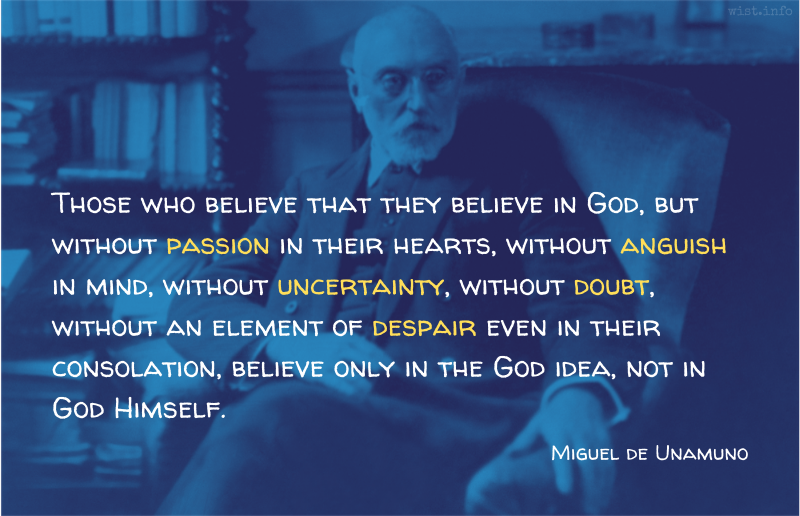
Those who believe that they believe in God, but without passion in their hearts, without anguish in mind, without uncertainty, without doubt, without an element of despair even in their consolation, believe only in the God idea, not in God Himself.
[Los que sin pasión de ánimo, sin congoja, sin incertidumbre, sin duda, sin la desesperación en el consuelo, creen creer en Dios, no creen sino en la idea de Dios, más no en Dios mismo.]
Miguel de Unamuno (1864–1936) Spanish philosopher and writer [Miguel de Unamuno y Jugo]
The Tragic Sense of Life [Del sentimiento trágico de la vida], ch. 9 “Faith, Hope, and Charity” (1912) [tr. Flitch (1921)]
(Source)
Alt. trans. [tr. Kerrigan (1972)]: "Whoever believes he believes in God, but believes without passion, without anguish, without uncertainty, without doubt, without despair-in-consolation, believes only in the God-Idea, not in God Himself."
Original Spanish.
In Unamuno's earlier, unpublished work Treatise on the Love of God [Tratado del amor de Dios], ch. 3 "What is Faith?" (1905-08) [tr. Orringer], he used this same phrase and surrounding text: "Those without passion in their soul, without anguish, without uncertainty, without doubt, without despair in consolation, think they believe in God; they believe only in the idea of God, but not in God Himself."
Tolerance implies no lack of commitment to one’s beliefs. Rather it condemns the oppression or persecution of others.
John F. Kennedy (1917–1963) American politician, author, journalist, US President (1961–63)
Letter (1960-10-26) to the National Conference of Christians and Jews Conference)
(Source)
With most people, disbelief in one thing is founded on blind belief in another.
Georg C. Lichtenberg (1742–1799) German physicist, writer
Aphorisms, Notebook L, #81 [p. 674] (1796-99) [tr. Tester (2012)]
(Source)
Other translations:
- "With most people, unbelief in one thing is founded upon blind belief in another."
- "With most people disbelief in a thing is founded on a blind belief in some other thing." [tr. Hollingdale (1990)]
Human knowledge is very short, and don’t reach but a little ways, and even that little ways iz twilite; but faith lengthens out the road, and makes it light, so that we kan see tew read the letterings on the mile stuns.
[Human knowledge is very short, and doesn’t reach but a little way, and even that little way is twilight; but faith lengthens out the road, and makes it light, so that we can see to read the lettering on the milestones.]
Josh Billings (1818–1885) American humorist, aphorist [pseud. of Henry Wheeler Shaw]
Everybody’s Friend, Or; Josh Billing’s Encyclopedia and Proverbial Philosophy of Wit and Humor, ch. 9 “Essays: Faith” (1874)
(Source)
This may be the source of an attributed Billings quote I cannot find in his writings: "Faith was given to man to lengthen out his reason."
His religion at best is an anxious wish, — like that of Rabelais, a great Perhaps.
Thomas Carlyle (1795–1881) Scottish essayist and historian
“Burns,” Edinburgh Review No. 96, Art. 1 (1828-12)
(Source)
A review of Lockhart, The Life of Robert Burns (1828).
Doubt is not a pleasant condition, but certainty is an absurd one.
[Le doute n’est pas une état bien agréable, mais l’assurance est un état ridicule.]
Voltaire (1694–1778) French writer [pseud. of Francois-Marie Arouet]
Letter (1770-11-28) to Frederick William, Prince of Prussia [tr. Tallentyre (1919)]
(Source)
The French is sometimes given (e.g.) as "Le doute n'est pas une condition agréable, mais la certitude est absurde."
(Source (French)). Other translations:Doubt is not a very agreeable state, but certainty is a ridiculous one.
[tr. Robertson (1922)]Doubt is not a pleasant condition, but certainty is absurd.
[E.g. (1994)]Doubt is not an agreeable condition, but certainty is an absurd one.
[E.g.]
In my opinion, any faith that cannot withstand a little shaking isn’t constructed too well to begin with. Jesus built his church on a rock, not on swampland.
John Russell (contemp.) ("jr")
Belief-L

Trust in another’s goodness is no light testimony to one’s own.
[La fiance de la bonté d’autruy, est un non leger tesmoignage de la bonté propre]
Michel de Montaigne (1533–1592) French essayist
Essays, Book 1, ch. 14 (1.14), “The Taste of Good and Bad Things Depends Mostly on the Opinion We Have of Them [Que le goust des biens et des maux despend en bonne partie de l’opinion que nous en avons]” (1572) [tr. Screech (1987)]
(Source)
Writing admirably of an elderly prelate who had turned over management of his household and wealth to a succession of trusted servants.
This essay was in the 1st ed. (1580), but was expanded substantially for subsequent editions. This passage first appeared in the 3rd edition (1595). It is in Book 1, number 40 in most older translations; some more recent ones (as noted) number it as 14.
(Source (French)). Other translations:The confidence in others honestie, is no light testimonie of ones owne integritie [Confidence in others’ honesty is no light testimony of one’s own integrity].
[tr. Florio (1603)]The confidence of another Mans vertue, is no light evidence of a Mans own.
[tr. Cotton (1686)]The confidence in another man's virtue is no light evidence of a man's own.
[tr. Cotton/Hazlitt (1877)]Confidence in another's goodness is no slight testimony of one's own goodness.
[tr. Ives (1925), 1.14]Confidence in the goodness of others is no slight testimony to one's own goodness.
[tr. Frame (1943), 1.14]Trust in the goodness of others truly testifies to the goodness in ourselves.
[tr. HyperEssays (2025)]
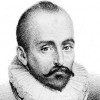
Say nothing of my religion. It is known to God and myself alone. Its evidence before the world is to be sought in my life: if it has been honest and dutiful to society the religion which has regulated it cannot be a bad one.
Thomas Jefferson (1743–1826) American political philosopher, polymath, statesman, US President (1801–09)
Letter (1817-01-11) to John Adams
(Source)
Instructions he gave to a biographer.
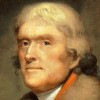
‘Twas an unhappy division that has been made betwixt faith and works; though in my intellect I may divide them just as in the candle, I know there is both heat and light; but yet put out the candle, and they are both gone: one remains not without the other. So ’tis between faith and works.
John Selden (1584–1654) English jurist, legal scholar, antiquarian, polymath
Table Talk, § 42 “Faith and Works” (1689)
(Source)
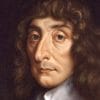
If a man will begin with certainties, he shall end in doubts; but if he will be content to begin in doubts, he shall end in certainties.
Francis Bacon (1561–1626) English philosopher, scientist, author, statesman
De Augmentis Scientiarum [Advancement of Learning], Book 1, ch. 5, sec. 8 (1605)
Alt trans. (Willey Book ed., (1944)): "If we begin with certainties, we shall end in doubts; but if we begin with doubts, and are patient with them, we shall end in certainties."
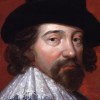
When men have realized that time has upset many fighting faiths, they may come to believe even more than they believe the very foundations of their own conduct that the ultimate good desired is better reached by free trade in ideas — that the best test of truth is the power of the thought to get itself accepted in the competition of the market.
Oliver Wendell Holmes, Jr. (1841–1935) American jurist, Supreme Court Justice
Abrams v. United States, 250 U.S. 616, 630 (1919) [Dissent]
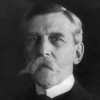
Nothing is so firmly believed as what is least known.
[N’est rien creu si fermement, que ce qu’on sçait le moins.]
Michel de Montaigne (1533–1592) French essayist
Essays, Book 1, ch. 31 (1.31), “That a Man Is Soberly to Judge of the Divine Ordinance [Qu’il faut sobrement se mesler de juger des ordonnances divines] (1572) [tr. Frame (1943), ch. 32]
(Source)
Both the essay and the quote appeared in the 1st (1580) edition.
(Source (French)). Other translations:Nothing is so firmely beleeved, as that which a man knoweth least.
[tr. Florio (1603)]Nothing is so firmly believed as what we least know.
[tr. Cotton (1686)]What we know is the least of what we do not know.
[tr. Friswell (1868)]Nothing is so firmly believed, as what we least know.
[tr. Cotton/Hazlitt (1877)]Nothing is so firmly believed as that which we know least.
[tr. Ives (1925), ch. 32]Nothing is so firmly believed as whatever we know least about.
[tr. Screech (1987), ch. 32]

Security is mostly a superstition. It does not exist in nature, nor do the children of men as a whole experience it. God Himself is not secure, having given man dominion over His works! Avoiding danger is no safer in the long run than outright exposure. The fearful are caught as often as the bold. Faith alone defends. Life is either a daring adventure or nothing. To keep our faces toward change and behave like free spirits in the presence of fate is strength undefeatable.
Helen Keller (1880–1968) American author and lecturer
Let Us Have Faith, “Faith Fears Not” (1940)
(Source)
Reprinted in her compilation book, The Open Door (1957). This quotation is often given in excerpted form, leaving out certain sentences, or even rearranging some of the sentences and sometimes making it seem that the two sources are actually different.
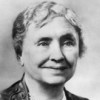
If a man, holding a belief which he was taught in childhood or persuaded of afterwards, keeps down and pushes away any doubts which arise about it in his mind, purposely avoids the reading of books and the company of men that call in question and discuss it, and regards as impious those questions which cannot easily be asked without disturbing it — the life of that man is one long sin against mankind.
William Kingdon Clifford (1845–1879) English mathematician and philosopher
“The Ethics of Belief,” Part 1 “The Duty of Inquiry,” Contemporary Review (Jan 1877)
(Source)