No orthodox church ever had power that it did not endeavor to make people think its way by force and flame.
Robert Green Ingersoll (1833–1899) American lawyer, freethinker, orator
Trial of C.B. Reynolds for blasphemy (May 1887)
(Source)
Quotations about:
tyranny
Note not all quotations have been tagged, so Search may find additional quotes on this topic.
How has the church in every age, when in authority, defended itself? Always by a statute against blasphemy, against argument, against free speech. And there never was such a statute that did not stain the book that it was in and that did not certify to the savagery of the men who passed it.
Robert Green Ingersoll (1833–1899) American lawyer, freethinker, orator
Trial of C.B. Reynolds for blasphemy (May 1887)
(Source)
Nothing is so galling to a people, not broken in from the birth, as a paternal or, in other words, a meddling government, a government which tells them what to read and say and eat and drink and wear.
Thomas Babington Macaulay (1800–1859) English writer and politician
Southey’s Colloquies on Society (1830)
Of the best rulers
The people (only) know that they exist;
The next best they love and praise;
The next they fear;
And the next they revile.
When they do not command the people’s faith,
Some will lose faith in them,
And then they resort to oaths!
But (of the best) when their task is accomplished, their work done,
The people all remark, “We have done it ourselves.”Lao-tzu (604?-531? BC) Chinese philosopher, poet [also Lao-tse, Laozi]
The Wisdom of Laotse, ch 17 (1948) [tr. Lin Yutang]
Alt. trans. [Tao-te Ching tr. Wing-Tsit Chan]:
"The best are those whose existence is merely known by the people.
The next best are those who are loved and praised.
The next are those who are feared.And the next are those who are reviled.
The great rulers accomplish their task; they complete their work.
Nevertheless their people say that they simply follow Nature."
Tyranny, like hell, is not easily conquered; yet we have this consolation with us, that the harder the conflict, the more glorious the triumph. What we obtain too cheap, we esteem too lightly: it is dearness only that gives every thing its value.
Thomas Paine (1737–1809) American political philosopher and writer
“The American Crisis” #1 (19 Dec 1776)
And what is this liberty which must lie in the hearts of men and women? It is not the ruthless, the unbridled will; it is not freedom to do as one likes. That is the denial of liberty, and leads straight to its overthrow. A society in which men recognize no check upon their freedom soon becomes a society where freedom is the possession of only a savage few; as we have learned to our sorrow.
Learned Hand (1872–1961) American jurist
“The Spirit of Liberty,” speech, “I Am an American Day,” New York (1941-05-21)
(Source)
It is important, likewise, that the habits of thinking in a free country should inspire caution in those intrusted with its administration to confine themselves within their respective constitutional spheres, avoiding in the exercise of the powers of one department to encroach upon another. The spirit of encroachment tends to consolidate the powers of all the departments in one, and thus to create, whatever the form of government, a real despotism. A just estimate of that love of power and proneness to abuse it which predominates in the human heart is sufficient to satisfy us of the truth of this position.
George Washington (1732–1799) American military leader, Founding Father, US President (1789–1797)
Essay (1796-09-18), “Farewell Address,” Claypoole’s American Daily Advertiser, Philadelphia
(Source)
The original draft of "The Address of Gen. Washington to the People of America on His Declining the Presidency of the United States" was by James Madison in June 1792. At the end of his second term, Washington, with the help of Alexander Hamilton, revised it for release and publication.
By the frame of the Government under which we live this same people have wisely given their public servants but little power for mischief, and have with equal wisdom provided for the return of that little to their own hands at very short intervals. While the people retain their virtue and vigilance no Administration by any extreme of wickedness or folly can very seriously injure the Government in the short space of four years.
Abraham Lincoln (1809–1865) American lawyer, politician, US President (1861–65)
Speech (1861-03-04), Inaugural Address, Washington, D. C.
(Source)

ALL ANIMALS ARE EQUAL
BUT SOME ANIMALS ARE MORE
EQUAL THAN OTHERSGeorge Orwell (1903–1950) English journalist, essayist, writer [pseud. of Eric Arthur Blair]
Animal Farm, ch. 10 (1945)
(Source)
Sacrifice, patience, understanding, and implacable purpose may be our lot of years to come. Let’s face it. Let’s talk sense to the American people. Let’s tell them the truth, that there are no gains without pains, that there — that we are now on the eve of great decisions, not easy decisions, like resistance when you’re attacked, but a long, patient, costly struggle which alone can assure triumph over the great enemies of man — war, poverty, and tyranny — and the assaults upon human dignity which are the most grievous consequences of each.
Adlai Stevenson II (1900–1965) American politician, diplomat, statesman
Speech (1952-07-26), Democratic National Convention, Chicago
(Source)
The difference between a Democracy and a Dictatorship is that in a Democracy you vote first and take orders later; in a Dictatorship you don’t have to waste your time voting.
Charles Bukowski (1920–1994) German-American author, poet
Erections, Ejaculations, Exhibitions and Tales of Ordinary Madness (1972)
(Source)
ISABELLA:O, it is excellent
To have a giant’s strength, but it is tyrannous
To use it like a giant.William Shakespeare (1564–1616) English dramatist and poet
Measure for Measure, Act 2, sc. 2, l. 135ff (2.2.135-137) (1604)
(Source)
Few men desire liberty; most men wish only for a just master.
[Namque pauci libertatem, pars magna iustos dominos volunt.]
Sallust (c. 86–35 BC) Roman historian and politician [Gaius Sallustius Crispus]
Histories, 4.69.18Alt. trans.:
- "Few men desire freedom, the greater part desire just masters."
- "Only a few prefer liberty, the majority seek nothing more than fair masters."
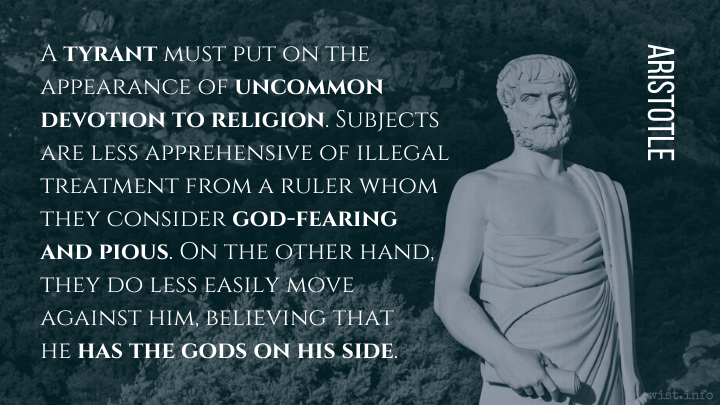
A tyrant must put on the appearance of uncommon devotion to religion. Subjects are less apprehensive of illegal treatment from a ruler whom they consider god-fearing and pious. On the other hand, they do less easily move against him, believing that he has the gods on his side.
Aristotle (384–322 BC) Greek philosopher
Politics [Πολιτικά], Book 5, ch. 11 / 1314b.39
Other translations:
- "Also he should appear to be particularly earnest in the service of the Gods; for if men think that a ruler is religious and has a reverence for the Gods, they are less afraid of suffering injustice at his hands, and they are less disposed to conspire against him, because they believe him to have the very Gods fighting on his side. At the same time his religion must not be thought foolish." [tr. Jowett (1885)]
- "And, moreover, always to seem particularly attentive to the worship of the gods; for from persons of such a character men entertain less fears of suffering anything illegal while they suppose that he who governs them is religious and reverences the gods; and they will be less inclined to raise insinuations against such a one, as being peculiarly under their protection: but this must be so done as to give no occasion for any suspicion of hypocrisy." [tr. Ellis (1912)]
- "And further he must be seen always to be exceptionally zealous as regards religious observances (for people are less afraid of suffering any illegal treatment from men of this sort, if they think that their ruler has religious scruples and pays regard to the gods, and also they plot against him less, thinking that he has even the gods as allies), though he should not display a foolish religiosity." [tr. Rackham (1932)]
- "Further, he must always show himself to be seriously attentive to the things pertaining to the gods. For men are less afraid fo being treated in some respect contrary to the law by such persons, if they consider the ruler a god-fearing sort who takes thought for the gods, and they are less ready to conspire against him as one who has the gods too as allies. In showing himself of this sort, however, he must avoid silliness." [tr. Lord (1984)]
Under a government which imprisons any unjustly, the true place for a just man is also a prison.
Henry David Thoreau (1817–1862) American philosopher and writer
Essay (1849-05), “Resistance to Civil Government [On the Duty of Civil Disobedience],” Æsthetic Papers, No. 1, Article 10
(Source)
Based on an 1848 lecture at the Concord Lyceum.
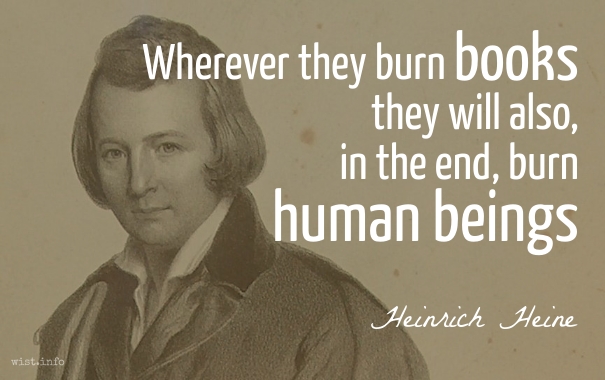
Wherever they burn books they will also, in the end, burn human beings.
[Dort, wo man Bücher verbrennt, verbrennt man auch am Ende Menschen.]
Heinrich Heine (1797–1856) German poet and critic
Almansor: A Tragedy, l. 245 (1823)
Alt trans:
- "Where they burn books, at the end they also burn people."
- "Where they burn books, they will also burn people."
- "It is there, where they burn books, that eventually they burn people."
- "Where they burn books, so too will they in the end burn human beings."
- "Where they burn books, they also burn people."
- "Them that begin by burning books, end by burning men."
- "Wherever books are burned, sooner or later men are also burned."
He, who will not reason, is a bigot; he, who cannot, is a fool; and he, who dares not, is a slave.
William Drummond of Logie-Almond (1770–1828) Scottish classical scholar, philosopher, diplomat, politician
Academical Questions, Preface (1805)
(Source)
Sometimes misattributed to Byron.


Of all tyrannies a tyranny sincerely exercised for the good of its victims may be the most oppressive. It may be better to live under robber barons than under omnipotent moral busybodies, The robber baron’s cruelty may sometimes sleep, his cupidity may at some point be satiated; but those who torment us for own good will torment us without end, for they do so with the approval of their own conscience. They may be more likely to go to Heaven yet at the same time likelier to make a Hell of earth.
C. S. Lewis (1898–1963) English writer, literary scholar, lay theologian [Clive Staples Lewis]
God in the Dock, “The Humanitarian Theory of Punishment” (1970)
The fundamental Article of my political Creed is, that Despotism, or unlimited Sovereignty, or absolute Power is the Same in a Majority of a popular Assembly, an Aristocratical Counsel, an Oligarchical Junto and a Single Emperor. Equally arbitrary cruel bloody and in every respect, diabolical.
John Adams (1735–1826) American lawyer, Founder, statesman; US President (1797–1801)
Letter (1815-11-13) to Thomas Jefferson
(Source)
The most certain test by which we judge whether a country is really free is the amount of security enjoyed by minorities.
John Dalberg, Lord Acton (1834–1902) British historian, politician, writer
Speech (1877-02-28), “The History of Freedom in Antiquity,” Bridgenorth Institute
It is true, the bill is said to be founded on necessity; but what is this? Is it not necessity, which has always been the plea of every illegal exertion of power, or exercise of oppression? Is not necessity the pretence of every usurpation? Necessity is the plea for every infringement of human freedom. It is the argument of tyrants; it is the creed of slaves.
Any excuse will serve a tyrant.
Aesop (620?-560? BC) Legendary Greek storyteller
Fables [Aesopica], “The Wolf and the Lamb” (6th C BC) [tr. Jacobs (1894)]
(Source)
Other translations:
- "'Tis an Easie Matter to find a Staff to Beat a Dog." [tr. L'Estrange (1692)]
- "A tyrant never wants a plea." [tr. James (1848)]
- "The tyrant will always find a pretext for his tyranny." [tr. Townsend (1887)]
I would rather be exposed to the inconveniencies attending too much liberty than those attending too small a degree of it.
Thomas Jefferson (1743–1826) American political philosopher, polymath, statesman, US President (1801–09)
Letter (1791-12-23) to Archibald Stuart
(Source)
Jefferson originally wrote "dangers" instead of "inconveniencies."
A majority held in restraint by constitutional checks and limitations, and always changing easily with deliberate changes of popular opinions and sentiments, is the only true sovereign of a free people. Whoever rejects it does of necessity fly to anarchy or to despotism.
Abraham Lincoln (1809–1865) American lawyer, politician, US President (1861–65)
Speech (1861-03-04), Inaugural Address, Washington, D. C.
(Source)
Some will object, that a comparison cannot fairly be made between the government of the male sex and the forms of unjust power which I have adduced in illustration of it, since these are arbitrary, and the effect of mere usurpation, while it on the contrary is natural. But was there ever any domination which did not appear natural to those who possessed it?
John Stuart Mill (1806–1873) English philosopher and economist
The Subjection of Women, ch. 1 (1869)
(Source)
An avidity to punish is always dangerous to liberty. It leads men to stretch, to misinterpret, and to misapply even the best of laws. He that would make his own liberty secure must guard even his enemy from oppression; for if he violates this duty he establishes a precedent that will reach to himself.
Thomas Paine (1737–1809) American political philosopher and writer
“Dissertation on the First Principles of Government” (Jul 1795)
Source essay
If you don’t understand that you work for your mislabeled “subordinates,” then you know nothing of leadership. You know only tyranny.
Dee W. Hock (1929–2022) American businessman
“Unit of One Anniversary Handbook,” Fast Company (1997-02-28)
(Source)
Our progress in degeneracy appears to me to be pretty rapid. As a nation we began by declaring that “all men are created equal.” We now practically read it “all men are created equal, except negroes.” When the Know-Nothings get control, it will read “all men are created equal, except negroes, and foreigners, and catholics.” When it comes to this, I shall prefer emigrating to some country where they make no pretence of loving liberty — to Russia, for instance, where despotism can be taken pure, and without the base alloy of hypocrisy.
Abraham Lincoln (1809–1865) American lawyer, politician, US President (1861–65)
Letter (1854-08-24) to Joshua Speed
(Source)
Liberty without learning is always in peril; learning without liberty is always in vain.
John F. Kennedy (1917–1963) American politician, author, journalist, US President (1961–63)
Speech (1963-05-18), Convocation, Vanderbilt University, Nashville
(Source)
Many politicians are in the habit of laying down as self-evident the proposition that no people ought to be free till they are fit to use their freedom. This maxim is worthy of the fool in the old story who resolved not to go into the water till he had learned to swim! If men are to wait for liberty till they become wise and good in slavery, they may indeed wait forever.
Thomas Babington Macaulay (1800–1859) English writer and politician
“John Milton,” Edinburgh Review (Aug 1825)
(Source)
I shall ask no more than that you agree with Dean Inge that even though counting heads is not an ideal way to govern, at least it beats breaking them.
Learned Hand (1872–1961) American jurist
“Democracy: Its Presumptions and Realities,” speech, Federal Bar Association, Washington, DC (1932-03-08)
(Source)
First printed in the Federal Bar Association Journal (Mar 1932).
And I will war, at least in words (and — should
My chance so happen — deeds), with all who war
With Thought; — and of Thought’s foes by far most rude,
Tyrants and sycophants have been and are.
I know not who may conquer: if I could
Have such a prescience, it should be no bar
To this my plain, sworn, downright detestation
Of every despotism in every nation.