Hoover would like to live in the White House. Smith is not adverse to living in the White House. In order to get in there either one will promise the voters anything from perpetual motion to eternal salvation.
Will Rogers (1879-1935) American humorist
Column (1928-11-04), “Daily Telegram”
(Source)
Referring to the 1928 Republican and Democratic presidential nominees Herbert Hoover and Al Smith. Also included in The Autobiography of Will Rogers (1949) [ed. Donald Day].
Variant:Fellows would like to live in the White House, and in order to get there they will promise the voters anything from perpetual motion to eternal salvation.
Quotations about:
election
Note not all quotations have been tagged, so Search may find additional quotes on this topic.
You know, it don’t take near as good a man to be a Candidate as it does to hold the office. That’s why we wisely defeat more than we elect.
You may seek comfort at the feet of false leaders, who like medicine doctors beat drums to ward off evil spirits. You may listen to false leaders who tell you that there is an easy way — that all you have to do is to elect them and thereafter relax in a tax-free paradise, the political equivalent of sending 10¢ to cover the cost of postage. You may, fearing to face the facts squarely, be distracted by phony issues that have no bearing upon the life-or-death controversy of our time. But deluded you run the risk of being beguiled to destruction, for there is no easy way.
A campaign addressed not to men’s minds and to their best instincts, but to their passions, emotions and prejudices, is unworthy at best — now, with the fate of the nation at stake, it is unbearable.
If you have a radio, the next three months is a good time to have it get out of fix. All you will hear from now until the 4th of November will be: “We must get our government out of the hands of predatory wealth.” “The good people of this great country are burdened to death with taxes; now what I intend to do is ….”
What he intends to do is try and get elected. That’s all any of them intend to do.Will Rogers (1879-1935) American humorist
Column (1924-08-03), “Weekly Article: Random Shots at the News of a Week” [No. 86]
(Source)
With the election coming on, you are going to be fed a lot of hooey about a lot of things. Naturally both sides are going to put their best side forward.
They are now trying to figure out which side is their best.
And, when the votes are counted, let everybody, including the candidates, get into a good humor as quick as they got into a bad one.
Will Rogers (1879-1935) American humorist
Column (1932-11-07), “Daily Telegram”
(Source)
On the elections to be held the following day, which included the presidential race between Herbert Hoover and Franklin Roosevelt.
Rulers are no more than attorneys, agents and trustees for the people; and if the cause, the interest and trust is insidiously betray’d, or wantonly trifled away, the people have a right to revoke the authority, that they themselves have deputed, and to constitute abler and better agents, attorneys and trustees.
John Adams (1735–1826) American lawyer, Founding Father, statesman, US President (1797–1801)
Essay (1765-09-30), “A Dissertation on the Canon and the Feudal Law,” No. 3, Boston Gazette
(Source)
If a public man tries to get your vote by saying that he will do something wrong in your interest, you can be absolutely certain that if ever it becomes worth his while he will do something wrong against your interest.
Theodore Roosevelt (1858–1919) American politician, statesman, conservationist, writer, US President (1901–1909)
Speech (1910-04-23), “Citizenship in a Republic [The Man in the Arena],” Sorbonne, Paris
(Source)
You take a Democrat and a Republican and you keep them both out of office and I bet you they will turn out to be good friends and maybe make useful citizens, and devote their time to some work instead of lectioneering all the time.
Will Rogers (1879-1935) American humorist
Column (1923-11-11), “Weekly Article: Come On, Boys, Let’s Rescue the Politicians” [No. 48]
(Source)
Well, you know how Congress is. They’ll vote for anything if the thing they vote for will turn around and vote for them.
In this country, people don’t vote for, they vote against.
A statesman is a man that can do what the politician would like to do but can’t, because he is afraid of not being elected.
That’s the problem with a Politician’s life, somebody is always interrupting it with an election.
One of the evils of democracy is you have to put up with the man you elect whether you want him or not.
The right of voting for representatives is the primary right by which other rights are protected. To take away this right is to reduce a man to slavery, for slavery consists in being subject to the will of another, and he that has not a vote in the election of representatives is in this case.
Thomas Paine (1737-1809) American political philosopher and writer
“Dissertation on First-Principles of Government” (1795)
(Source)
If you are bored and disgusted by politics and don’t bother to vote, you are in effect voting for the entrenched Establishments of the two major parties, who please rest assured are not dumb, and who are keenly aware that it is in their interests to keep you disgusted and bored and cynical and to give you every possible psychological reason to stay at home doing one-hitters and watching MTV on primary day. By all means stay home if you want, but don’t bullshit yourself that you’re not voting. In reality, there is no such thing as not voting: you either vote by voting, or you vote by staying home and tacitly doubling the value of some Diehard’s vote.

If pressed to pick a political system, I think that some country or other ought to try jury duty as a way of picking its politicians: if your name gets picked, and you can’t come up with a good enough excuse, you’ll have to give up four or five years of your life to helping run the country, which avoids the main problem of politics as I see it, which is that the kind of people you have to choose between and vote for are the kind of people who actually think that they ought to be running things. If you have a country and want to try this as a political system, let me know how it works out.
Neil Gaiman (b. 1960) British author, screenwriter, fabulist
Blog entry (2004-11-17), “Politics, Portugal and No Gumbo-Limbo Trees”
(Source)
“It comes from a very ancient democracy, you see ….”
“You mean, it comes from a world of lizards?”
“No,” said Ford, who by this time was a little more rational and coherent than he had been, having finally had the coffee forced down him, “nothing so simple. Nothing anything like so straightforward. On its world, the people are people. The leaders are lizards. The people hate the lizards and the lizards rule the people.”
“Odd,” said Arthur, “I thought you said it was a democracy.”
“I did,” said Ford. “It is.”
“So,” said Arthur, hoping he wasn’t sounding ridiculously obtuse, “why don’t the people get rid of the lizards?”
“It honestly doesn’t occur to them,” said Ford. “They’ve all got the vote, so they all pretty much assume that the government they’ve voted in more or less approximates to the government they want.”
“You mean they actually vote for the lizards?”
“Oh yes,” said Ford with a shrug, “of course.”
“But,” said Arthur, going for the big one again, “why?”
“Because if they didn’t vote for a lizard,” said Ford, “the wrong lizard might get in.”
Douglas Adams (1952-2001) English author, humorist, screenwriter
So Long, And Thanks For All The Fish, ch. 36 (1984)
(Source)

Allegiance to the group identity forged by political party affiliation renders Americans blind to the essential similarities between the agendas of the two parties, similarities that can be expected to be exactly the ones that run counter to public interest, in other words, those interests of the deep-pocketed backers of elections to which any politician must be subservient in order to raise the kind of money necessary to run for national office.
Jason Stanley (b. 1969) American philosopher, epistemologist, academic
How Propaganda Works, Introduction (2015)
(Source)

Hell, I never vote for anybody. I always vote against.
W. C. Fields (1880-1946) American entertainer [b. William Claude Dukenfield]
Comment to Gene Fowler
(Source)
Quoted in Robert Lewis Taylor, W. C. Fields, ch. 25 (1949). See also Adams.
More discussion about the origins of this quotation: I Never Vote For Anybody. I Always Vote Against – Quote Investigator.
Choose your leaders
with wisdom and forethought.
To be led by a coward
is to be controlled
by all that the coward fears.
To be led by a fool
is to be led
by the opportunists
who control the fool.
To be led by a thief
is to offer up
your most precious treasures
to be stolen.
To be led by a liar
is to ask
to be lied to.
To be led by a tyrant
is to sell yourself
and those you love
into slavery.
Our political system has been thoroughly corrupted, and by the usual suspect — money, what else? The corruption is open, obscene, and unmistakable. The way campaigns are financed is a system of legalized bribery. We have a government of special interests, by special interests, and for special interests. And that will not change until we change the way campaigns are financed.
Molly Ivins (1944-2007) American writer, political columnist [Mary Tyler Ivins]
Essay (1998-01), “Introduction,” You Got to Dance with Them What Brung You (1998)
(Source)

I would rather be defeated than make capital out of my religion.
James A. Garfield (1831-1881) US President (1881), lawyer, lay preacher, educator
Speech, Chatauqua (1 Apr 1880)
(Source)
Another point of disagreement [over Lesser Evil Voting] is not factual but involves the ethical/moral principle […] sometimes referred to as the “politics of moral witness.” Generally associated with the religious left, secular leftists implicitly invoke it when they reject LEV on the grounds that “a lesser of two evils is still evil.” Leaving aside the obvious rejoinder that this is exactly the point of lesser evil voting — i.e. to do less evil, what needs to be challenged is the assumption that voting should be seen a form of individual self-expression rather than as an act to be judged on its likely consequences. […] The basic moral principle at stake is simple: not only must we take responsibility for our actions, but the consequences of our actions for others are a far more important consideration than feeling good about ourselves.
Noam Chomsky (b. 1928) American linguist and activist
“An Eight Point Brief for LEV (Lesser Evil Voting)” (2016-06-15) [with John Halle]
(Source)
Of course I vote! If you’re a woman, or a person of color, or a person who doesn’t own property, or even a white male who doesn’t belong to the nobility, centuries of struggle and many deaths have bought you the right to vote. I vote to keep faith with peasant rebels and suffragist hunger strikers and civil rights workers braving the lynch mobs of the South, if for no other reason. But there is another reason — because who we vote for has an enormous impact on real peoples’ lives.
Starhawk (b. 1951) American writer, activist, feminist theologian [b. Miriam Simos]
Blog post (2016-11-07), “Pre-Election Day Thoughts”
(Source)

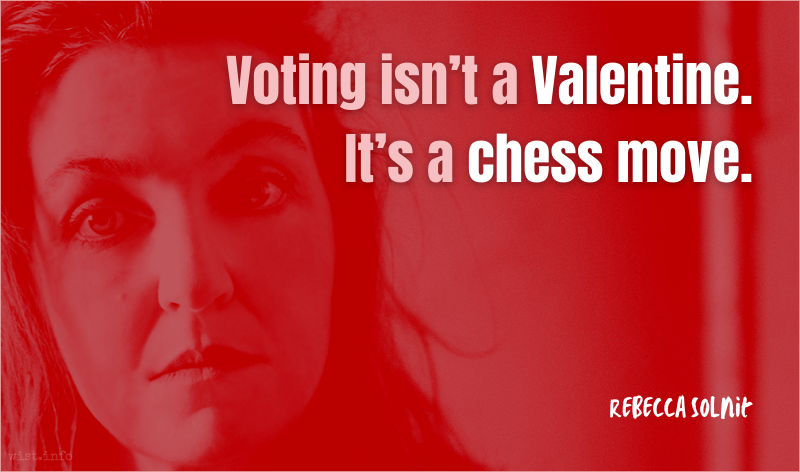
Build movements. Vote with your values, but vote strategically. Voting isn’t a Valentine. It’s a chess move.
Rebecca Solnit (b. 1961) American writer, historian, activist
Facebook (17 Oct 2016)
(Source)
Solnit is credited with the core message of the last two sentences. She indicates (including from that Facebook post) that it was something she had said that was extracted and perhaps tweaked by May Boeve. E.g., "That 2016 aphorism that I sort of said and May Boeve made into this stand-alone slogan." (1 Nov 2018) "I said that off the cuff in 2016 and May Boeve caught it and it went on to have a nice life. It's also not the only chess move you get." (11 Aug 2020).
Variants:
- "Voting is a chess move, not a valentine. And here's the joy of being politically engaged all year round every year; you get to work with a whole lot of chess pieces and players and strategies and long-term visions, so you don't agonize over whether this little hop with a pawn we call voting defines you. You get to define yourself by what you're passionately committed to, by who you align with, by your dreams and your visions, you get to move a lot of pieces a lot of times, you get heroic allies, and you play to win above, beyond, around elections. But you vote, because you know it matters too." (7 Nov 2016)
- "I think of voting as a chess move, not a valentine. It’s just a little part of the picture of how we make the world." ("The 2000 Election Unleashed Disaster on the World. We Can’t Let that Happen Again in 2016," The Nation (3 Nov 2016))
- "A vote is not a valentine. You are not confessing your love for the candidate. It's a chess move for the world you want to live in."
- "Voting isn't a valentine, it's a chess move. Just one of many with one of your many pieces, if you're using what you've been given."

The American People will take Socialism, but they won’t take the label. I certainly proved it in the case of EPIC. Running on the Socialist ticket I got 60,000 votes, and running on the slogan to “End Poverty in California” I got 879,000. I think we simply have to recognize the fact that our enemies have succeeded in spreading the Big Lie. There is no use attacking it by a front attack, it is much better to out-flank them.
Upton Sinclair (1878-1968) American writer, journalist, activist, politician
Letter to Norman Thomas (25 Sep 1951)
(Source)
There is some hope of elections, but doubtful; some suspicion of a Dictatorship, but that too not definite; peace reigns in the Forum, but it’s the peace of a senile community rather than a contented one.
[Erat non nulla spes comitiorum sed incerta, erat aliqua suspicio dictaturae, ne ea quidem certa, summum otium forense sed senescentis magis civitatis quam acquiescentis]
Marcus Tullius Cicero (106-43 BC) Roman orator, statesman, philosopher
Epistulae ad Quintum fratrem [Letters to brother Quintus], Book 2, Letter 15, sec. 5 (2.15.5) (54 BC) [tr. Shackleton Bailey (1978), # 18, 2.14]
(Source)
Describing the situation in Rome. This letter is identified by various editors and translators (besides their own ordinal numbers) as 2.13, 2.14, 2.15, and 2.15A.
(Source (Latin)). Alternate translations:There was some expectation of the comitia, but a doubtful one: there was some suspicion of a dictatorship, but not even that was certain. There is a perfect cessation of all business in the courts of law, but more as if the state was growing indolent from age than from real tranquility.
[tr. Watson (1855), 2.15A.4]There is some hope of the elections taking place, but it is an uncertain one. There is some latent idea of a dictatorship, but neither is that confirmed. There is profound calm in the forum, but it is rather the calm of decrepitude than content.
[tr. Shuckburgh (1900), # 140, 2.13]Tis some hope of the elections being held, but it is a vague one; there is also some suspicion of a dictatorship, but even that has no certain foundation; the forum is profoundly tranquil, but that indicates senile decay, rather than acquiescence, on the part of the State.
[tr. Williams (Loeb) (1928), 2.15A]We have no small hope in our elections, but it is still uncertain. There is some suspicion of a dictatorship. We have peace in public but it is the calm of an old and tired state, not one giving consent.
[tr. @sentantiq (2020), # 19]
The one pervading evil of democracy is the tyranny of the majority, or rather of that party, not always the majority, that succeeds, by force or fraud, in carrying elections.
John Dalberg, Lord Acton (1834-1902) British historian, politician, writer
“Review of Sir Erskine May’s Democracy in Europe,” The Quarterly Review (1878-01)
(Source)
The salvation of America and of the human race depends on the next election, if we believe the newspapers. But so it was last year, and so it was the year before, and our fathers believed the same thing forty years ago.
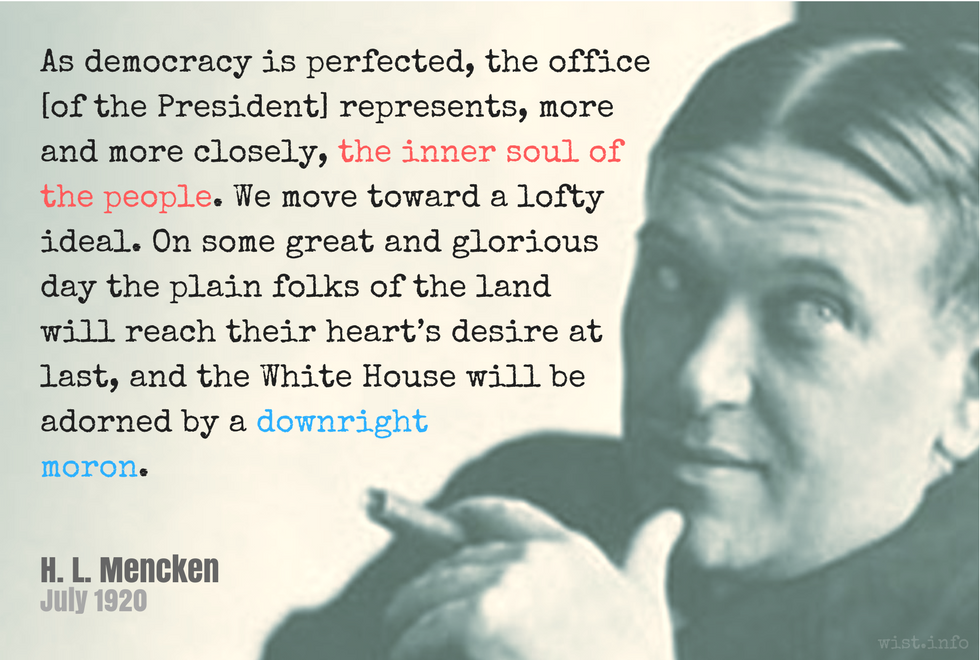
As democracy is perfected, the office [of the President] represents, more and more closely, the inner soul of the people. We move toward a lofty ideal. On some great and glorious day the plain folks of the land will reach their heart’s desire at last, and the White House will be adorned by a downright moron.
H. L. Mencken (1880-1956) American writer and journalist [Henry Lewis Mencken]
“Bayard vs. Lionheart,” The Baltimore Evening Sun (26 Jul 1920)
Variant: "As democracy is perfected, the office of the President represents, more and more closely, the inner soul of the people. On some great and glorious day, the plain folks of the land will reach their heart's desire at last, and the White House will be occupied by a downright fool and a complete narcissistic moron."
Verification and discussion of this quotation here, here, and here.
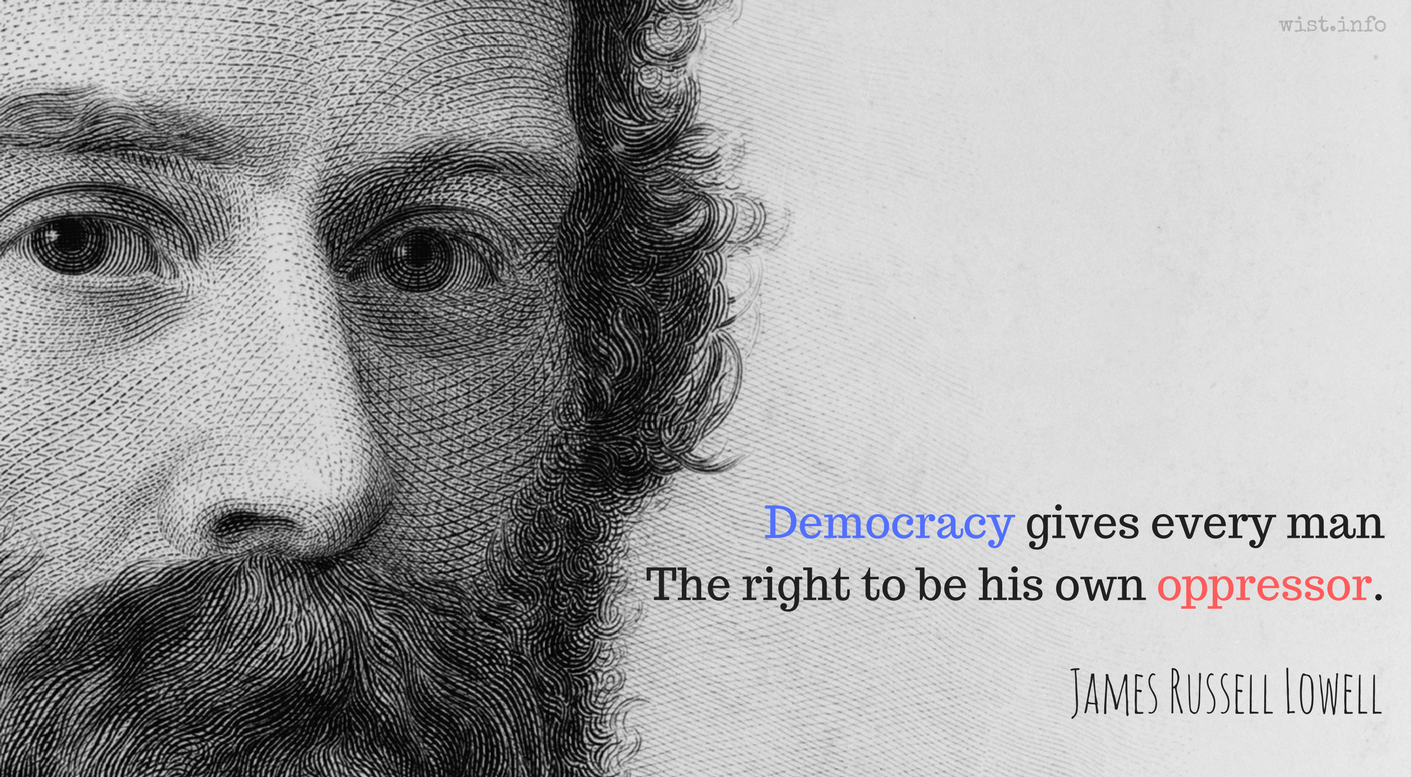
Democ’acy gives every man
The right to be his own oppressor.
James Russell Lowell (1819-1891) American diplomat, essayist, poet
The Bigalow Papers, Second Series, “Ef I a song or two could make,” l. 97 (1867)
Elections are won by men and women chiefly because most people vote against somebody rather than for somebody.
Franklin Pierce Adams (1881-1960) American journalist and humorist ["F. P. A."]
Nods and Becks (1944)
Adams earlier used a similar phrase (not claiming attribution) in his "Conning Tower" column (13 Nov 1916): "Voters went to the polls, as had been observed frequently, with the intention to vote against Somebody rather than for Somebody." See also Fields.
More discussion about the origins of this quotation: I Never Vote For Anybody. I Always Vote Against – Quote Investigator.
PRESIDENT, n. The leading figure in a small group of men of whom — and of whom only — it is positively known that immense numbers of their countrymen did not want any of them for President.
Ambrose Bierce (1842-1914?) American writer and journalist
“President,” The Devil’s Dictionary (1911)
(Source)
Originally published in the "Cynic's Word Book" column in the New York American (1906-06-14).

For a candidate to spend millions of dollars during the primaries to win a job that pays only $100,000 a year, doesn’t bode well for the citizens’ hopes of electing a man to this high office whose knowledge of economics will balance our national budget.
Goodman Ace (1899-1982) American humorist [b. Goodman Aiskowitz]
(Attributed)
If a baseball player slides into home plate and, right before the umpire rules if he is safe or out, the player says to the umpire, “Here is $1,000,” what would we call that? We would call that a bribe. If a lawyer was arguing a case before a judge and said, “Your honor before you decide on the guilt or innocence of my client, here is $1,000,” what would we call that? We would call that a bribe. But if an industry lobbyist walks into the office of a key legislator and hands her or him a check for $1,000, we call that a campaign contribution. We should call it a bribe.
Janice Fine (contemp.) American political scientist, academic
Interview with Laura Orlando, “The Clean-Elections Movement,” Dollars and Sense (Jul/Aug 2000)

The trouble with this country is that there are too many politicians who believe, with a conviction based on experience, that you can fool all of the people all of the time.
Franklin Pierce Adams (1881-1960) American journalist and humorist ["F. P. A."]
Nods and Becks (1944)
See Lincoln.
The difficulty about a politician, no matter how honest and well-intentioned he may be, is always this: that the matter of absolute importance in his mind, to which everything else must yield, is to carry the next election for his party.
James Freeman Clarke (1810-1888) American theologian and author
“Wanted, a Statesman!”, Old and New Magazine (Dec 1870)
(Source)
The system isn’t about ideals. The country doesn’t elect great leaders. It elects fucked-up people who for reasons of ego want to run the world. Then the citizenry makes them become great.
Tony Kushner (b. 1956) American playwright and screenwriter
Interview with Ben Greenman, “Tony Kushner, Radical Pragmatist,” Mother Jones (Nov/Dec 2003)
(Source)
The voters selected us, in short, because they had confidence in our judgement and our ability to exercise that judgement from a position where we could determine what were their own best interest, as a part of the nation’s interest.
John F. Kennedy (1917-1963) American politician, author, journalist, US President (1961–63)
Profiles in Courage (1956)
I believe that the public temper is such that the voters of the land are prepared to support the party which gives the best promise of administering the government in the honest, simple, and plain manner which is consistent with its character and purposes. They have learned that mystery and concealment in the management of their affairs cover tricks and betrayal. The statesmanship they require consists in honesty and frugality, a prompt response to the needs of the people as they arise, and a vigilant protection of all their varied interests.
Grover Cleveland (1837–1908) American President (1885–1889, 1893–1897)
Letter accepting Democratic nomination for President (8 Aug 1884)
(Source)
We are not a cynical people. The will to believe lingers on. We like to think that heroes can emerge from obscurity, as they sometimes do; that elections do matter, even though the process is at least part hokum; that through politics we can change our society and maybe even find a cause to believe in.
Ronald Steel (b. 1931) American writer, historian, and professor
“The Vanishing Campaign Biography,” New York Times (5 Aug 1984)
There are worse things than losing an election; the worst thing is to lose one’s convictions and not tell the people the truth.
Adlai Stevenson (1900-1965) American diplomat, statesman
(Attributed)
In Edward Doyle, As We Knew Adlai: The Stevenson Story by Twenty-two Friends (1966). In response to the suggestion his support for a nuclear test ban would cost him votes.
The salvation of America and of the human race depends on the next Election, if we believe the newspapers.
Ralph Waldo Emerson (1803-1882) American essayist, lecturer, poet
Journal (1848-10)
If I was to really get at the burr in my saddle, it’s not politics — and this is, I think, probably a horrible analogy — but I look at politicians as, they are doing what inherently they need to do to retain power. Their job is to consolidate power. When you go to the zoo and you see a monkey throwing poop, you go, “that’s what monkeys do, what are you gonna do?” But what I wish the media would do more frequently is say “bad monkey.”
Jon Stewart (b. 1962) American satirist, comedian, and television host. [b. Jonathan Stuart Leibowitz]
Interview by Charlie Rose (2004-09-29)Full text.

I pledge you, I pledge myself, to a new deal for the American people. Let us all here assembled constitute ourselves prophets of a new order of competence and of courage. This is more than a political campaign; it is a call to arms. Give me your help, not to win votes alone, but to win in this crusade to restore America to its own people.
Franklin Delano Roosevelt (1882-1945) American lawyer, politician, statesman, US President (1933-1945)
Speech (1932-07-02), Acceptance, Nomination for President, Democratic National Convention, Chicago
(Source)
(Source (Audio)). Concluding words of the speech.,
To give the victory to the right, not bloody bullets, but peaceful ballots only, are necessary.
But I go on this great republican principle, that the people will have virtue and intelligence to select men of virtue and wisdom. Is there no virtue among us? If there be not, we are in a wicked situation. No theoretical checks, no form of government, can render us secure. To suppose that any for of government will secure liberty or happiness without any virtue in the people, is a chimerical idea. If there be sufficient virtue and intelligence in the community, it will be exercised in the selection of these men; so that we do not depend on their virtue, or put confidence in our rulers, but in the people who are to choose them.
James Madison (1751-1836) American statesman, political theorist, US President (1809-17)
Speech at the Virginia Convention (20 Jun 1788)
(Source)
ARTHUR: I am your king.
WOMAN: Well, I didn’t vote for you.
ARTHUR: You don’t vote for kings.
WOMAN: Well how’d you become king then?
ARTHUR: (angelic music plays) The Lady of the Lake, her arm clad in the purest shimmering samite, held aloft Excalibur from the bosom of the water, signifying by divine providence that I, Arthur, was to carry Excalibur. (angelic music stops) That is why I am your king.
DENNIS: (interrupting) Listen, strange women lying in ponds distributing swords is no basis for a system of government. Supreme executive power derives from a mandate from the masses, not from some farcical aquatic ceremony.
ARTHUR: Be quiet!
DENNIS: You can’t expect to wield supreme executive power just ’cause some watery tart threw a sword at you!
ARTHUR: Shut up!
DENNIS: I mean, if I went around saying I was an emperor just because some moistened bint had lobbed a scimitar at me, they’d put me away!
ARTHUR: (grabbing him by the collar) Shut up! Will you shut up!
Monty Python (b. 1969) British comedy troupe [Graham Chapman, John Cleese, Terry Gilliam, Eric Idle, Terry Jones, Michael Palin]
Monty Python and the Holy Grail, sc. 3 (1975)
(Source)
(Source (Video); dialog verified)
It is enough that the people know there was an election. The people who cast the votes decide nothing. The people who count the votes decide everything.
[Я считаю, что совершенно неважно, кто и как будет в партии голосовать; но вот что чрезвычайно важно, это – кто и как будет считать голоса.]
Josef Stalin (1879-1953) Georgian revolutionary and Soviet dictator
Comment (1923)
Alternate translation: "Those who cast the votes decide nothing. Those who count the votes decide everything."
Alternate translation: "I consider it completely unimportant who in the party will vote, or how; but what is extraordinarily important is this -- who will count the votes, and how." Quoted in B. Bazhanov, The Memoirs of Stalin's Former Secretary (1992) [Борис Бажанов. Воспоминания бывшего секретаря Сталина], regarding elections to the Central Committee of the Communist Party.
The quotation is considered dubious by a number of sources.
The phrase was used by Tom Stoppard in Jumpers (1972): "It's not the voting that's democracy, it's the counting."
Bad officials are elected by good people who do not vote.
George Jean Nathan (1892-1958) American editor and critic
(Attributed)
Quoted in Clifton Fadiman, ed., The American Treasury, 1455—1955 (1955), but not found in any of Nathan's writings.
True merit, like a river, the deeper it is, the less noise it makes.
George Savile, Marquis of Halifax (1633-1695) English politician and essayist
“Some Cautions Offered to the Consideration of Those Who Are to Choose Members to Serve in the Ensuing Parliament,” sec. 16 (1695)
(Source)