States function as smoothly as they do, because the greater part of the population is not very intelligent, dreads responsibility, and desires nothing better than to be told what to do. Provided the rulers do not interfere with its material comforts and its cherished beliefs, it is perfectly happy to let itself be ruled.
Aldous Huxley (1894-1963) English novelist, essayist and critic
Essay (1927-10), “A Note on Eugenics,” Proper Studies (1927)
(Source)
Huxley was somewhat sympathetic to eugenicist arguments, though pessimistic about addressing them. He used this observation as an argument against eugenic attempts to "improve" humanity, because increasing the "superior" part of the population would disrupt states and society through their increased ambition. The passage continues:The socially efficient and the intellectually gifted are precisely those who are not content to be ruled, but are ambitious either to rule or to live in an anti-social solitude. A state with a population consisting of nothing but these superior people could not hope to last for a year.
An abridged version of the essay appeared in Vanity Fair (1927-10), but did not include this passage.
Quotations about:
passivity
Note not all quotations have been tagged, so Search may find additional quotes on this topic.
He won over the ignorant masses with shows, building projects, largesses, and banquets. His followers he bound to him by rewards, his opponents by an apparent clemency. In short, he succeeded in bringing a free country, partly because of its fear, partly because of its passivity, to an acceptance of servitude.
[Muneribus, monumentis, congiariis, epulis multitudinem imperitam delenierat; suos praemiis, adversarios clementiae specie devinxerat. Quid multa? Attulerat iam liberae civitati partim metu partim patientia consuetudinem serviendi.]
Marcus Tullius Cicero (106-43 BC) Roman orator, statesman, philosopher
Philippics [Philippicae; Antonian Orations], No. 2, ch. 45 / sec. 116 (2.45/2.116) (44-10-24 BC) [tr. Berry (2006)]
(Source)
Talking of Julius Caesar and his ambitions of becoming a king.
(Source (Latin)). Other translations:He had conciliated the ignorant multitude with gladiatorial shows, with the erection of public buildings, with largesses, with feasts; he had bound his own followers to him with rewards, his opponents with a show of clemency; he had already rendered slavery familiar to a free state, partly by fear, partly by patience.
[tr. King (1877)]He had conciliated the ignorant multitude by presents, by monuments, by largesses of food, and by banquets; he had bound his own party to him by rewards, his adversaries by the appearances of clemency. Why need I say much on such a subject? He had already brought a free city, partly by fear, partly by patience, into a habit of slavery.
[tr. Yonge (1903)]He had won the affections of the ignorant populace by means of entertainments, banquets, largesses, and other public benefactions, while he had bound his immediate followers to him by his liberality, his opponents by an appearance of clemency. In a word, he had so revolutionised public feeling, that partly from fear, and partly from acquiescence, a state which prided itself upon its freedom had become accustomed to subjection.
[ed. Harbottle (1906)]By shows, buildings, largesses, banquets he had conciliated the ignorant crowd; his own followers he had bound to him by rewards, his adversaries by a show of clemency: in brief, he had already brought to a free community -- partly by fear, partly by endurance -- a habit of servitude.
[tr. Ker (Loeb) (1926)]He softened up the ignorant masses with games, buildings, gifts and feasts. He bound his followers to himself with rewards, his opponents with the appearance of clemency. Why go on? He brought to a free state acceptance of slavery, partly through fear, partly through familiarity.
[tr. McElduff (2011)]
However, as we have just pointed out, brains which are absorbed in some bit of wisdom, or folly, or, as it often happens, in both at once, are but slowly accessible to the things of actual life. Their own destiny is a far-off thing to them. There results from such concentration a passivity, which, if it were the outcome of reasoning, would resemble philosophy. One declines, descends, trickles away, even crumbles away, and yet is hardly conscious of it one’s self. It always ends, it is true, in an awakening, but the awakening is tardy. In the meantime, it seems as though we held ourselves neutral in the game which is going on between our happiness and our unhappiness. We are the stake, and we look on at the game with indifference.
[Du reste, comme nous venons de l’indiquer, les cerveaux absorbés dans une sagesse, ou dans une folie, ou, ce qui arrive souvent, dans les deux à la fois, ne sont que très lentement perméables aux choses de la vie. Leur propre destin leur est lointain. Il résulte de ces concentrations-là une passivité qui, si elle était raisonnée, ressemblerait à la philosophie. On décline, on descend, on s’écoule, on s’écroule même, sans trop s’en apercevoir. Cela finit toujours, il est vrai, par un réveil, mais tardif. En attendant, il semble qu’on soit neutre dans le jeu qui se joue entre notre bonheur et notre malheur. On est l’enjeu, et l’on regarde la partie avec indifférence.]
Victor Hugo (1802-1885) French writer
Les Misérables, Part 3 “Marius,” Book 5 “The Excellence of Misfortune,” ch. 4 (3.5.4) (1862) [tr. Hapgood (1887)]
(Source)
(Source (French)). Alternate translations:However, as we have just indicated, brains absorbed in wisdom, or in folly, or, as often happens, in both at once, are but very slowly permeable by the affairs of life. Their own destiny is far from them. There results from such concentrations of mind a passivity which, if it were due to reason, would resemble philosophy . We decline, we descend, we fall, we are even overthrown, and we hardly perceive it. This always ends, it is true, by an awakening, but a tardy one. In the meantime, it seems as though we were neutral in the game which is being played between our good and our ill fortune. We are the stake, yet we look upon the contest with indifference.
[tr. Wilbour (1862)]As we have remarked, things of this world permeate very slowly brains absorbed in wisdom, or mania, or, as often happens, in both at once. Their own destiny is remote from them. The result of such concentrations is a passiveness which, were it of a reasoning nature, would resemble philosophy. Men sink, pass away, drift away, even crumble away without exactly noticing, though this always ends with a re-awakening, but a tardy one. In the meanwhile, it appears as if they are neutral in the game which is being played between their happiness and misery; they are the stakes, and look on at the game with indifference.
[tr. Wraxall (1862)]In general, as we have already suggested, minds absorbed in wisdom or in folly, or in both at once as often happens, are little affected by the vicissitudes of daily life. Their personal destiny is a thing remote from them. Such detachment creates a state of acquiescence which, if it were the outcome of reflection, might be termed philosophical. But they submit to losses and reverses, even to physical decay, without being much aware of them. It is true that in the end there is an awakening, but it is late in coming. In the meantime they stand as it were aloof from the play of personal fortune and misfortune, pawns in a game of which they are detached spectators.
[tr. Denny (1976)]However, as we have just indicated, brains absorbed in wisdom, in folly, or, as often happens, in both at once, are permeated only slowly by the affairs of life. Their own destiny is far from them. From such concentrations of mind comes a passivity which, if due to reason, would resemble philosophy. We decline, we descend, we fall, we are even overthrown, and we hardly notice it. This always ends, it is true, in an awakening, but a tardy one. In the meantime, we seem neutrals in the game being played between our good and our ill fortune. We are the stake, yet we look on the contest with indifference.
[tr. Wilbour/Fahnestock/MacAfee (1987)]However, as we have just suggested, minds engrossed in wisdom or folly , or, as is often the case, in both at the same time, are only very slowly pervious to matters of everyday life. Their own destiny is far removed from them. resulting from this kind of concentration is a passivity, which, if there were any reasoning behind it, would seem philosophical. Such minds go into a decline, they sink, they languish, they even come to grief without really being aware of it. True, this always ends with an awakening, but a belated one. In the meantime it is as if they had no interest in the game that plays out between their happiness and their unhappiness. They who are themselves as stake watch the game with indifference.
[tr. Donougher (2013)]
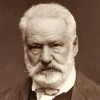
There is nothing to be done with that type of citizen of whom all that can be said is that he is harmless. Virtue which is dependent upon a sluggish circulation is not impressive. There is little place in active life for the timid good man.
Theodore Roosevelt (1858-1919) American politician, statesman, conservationist, writer, US President (1901-1909)
Speech (1910-04-23), “Citizenship in a Republic [The Man in the Arena],” Sorbonne, Paris
(Source)
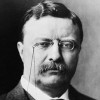
MACBETH: If chance will have me king, why, chance may crown me
Without my stir.William Shakespeare (1564-1616) English dramatist and poet
Macbeth, Act 1, sc. 3, l. 158ff (1.3.158-159) (1606)
(Source)

He that waits upon Fortune, is never sure of a Dinner.
Benjamin Franklin (1706-1790) American statesman, scientist, philosopher, aphorist
Poor Richard (1734 ed.)
(Source)
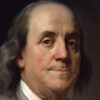
There are really only two ways to approach life — as victim or as gallant fighter — and you must decide if you want to act or react, deal your own cards or play with a stacked deck. And if you don’t decide which way to play with life, it always plays with you.
Merle Shain (1935-1989) Canadian journalist and author
(Attributed)

I was waiting for
something extraordinary to
happenbut as the years wasted on
nothing ever did unless I
caused itCharles Bukowski (1920-1994) German-American author, poet
“two kinds of hell” (c. 1990)
(Source)
While this sounds motivational, in the context of the poem, the "extraordinary" things (bar fights, dalliances) always end up poorly.
First published in Third Lung Review, #8 (1992); collected in an edited version in The People Look Like Flowers at Last (2007).
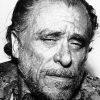
In the face of evil, detachment is a dubious virtue.
Barbara Grizzuti Harrison (1934-2002) American journalist, essayist, memoirist
“Budapest, Winter 1989,” The Astonishing World (1992)
(Source)

There are two kinds of injustice — the one, on the part of those who inflict wrong, the other on the part of those who, when they can, do not shield from wrong those upon whom it is being inflicted. For he who, under the influence of anger or some other passion, wrongfully assaults another seems, as it were, to be laying violent hands upon a comrade; but he who does not prevent or oppose wrong, if he can, is just as guilty of wrong as if he deserted his parents or his friends or his country.
[Sed iniustitiae genera duo sunt, unum eorum, qui inferunt, alterum eorum, qui ab iis, quibus infertur, si possunt, non propulsant iniuriam. Nam qui iniuste impetum in quempiam facit aut ira aut aliqua perturbatione incitatus, is quasi manus afferre videtur socio; qui autem non defendit nec obsistit, si potest, iniuriae, tam est in vitio, quam si parentes aut amicos aut patriam deserat.]
Marcus Tullius Cicero (106-43 BC) Roman orator, statesman, philosopher
De Officiis [On Duties; On Moral Duty; The Offices], Book 1, ch. 7 (1.7) / sec. 23 (44 BC) [tr. Miller (1913)]
(Source)
Original Latin. Alternate translations:The vice that is opposite to justice is injustice, of which there are two sorts: the first consists in the actual doing an injury to another; the second, in tamely looking on while he is injured, and not helping and defending him though we are able: for he that injuriously falls on another, whether prompted by rage or other violent passion, does as it were leap at the throat of his companion; and he that refuses to help him when injured, and to ward off the wrong if it lies in his power, is as plainly guilty of baseness and and injustice as though he had deserted his father, his friends, or his native country.
[tr. Cockman (1699)]There are two kinds of injustice: Of the one, they are guilty who do an injury; of the other, they who, if they are able, do not defend those from injury to whom it is offered. For he who urged on by anger, or some violent passion, attempts to injure any man, lifts his hand against his brother' and he who interferes not to resist or repel the attempt, is as guilty as if he had deserted his parents, his friends, or his country.
[tr. McCartney (1798)]But there are two kinds of injustice; the first of those who offer an injury, the second of those who have in their power to avert an injury from those to whom it is offered, and yet do it not. For if a man, prompted either by anger or any sudden perturbation, unjustly assaults another man, such a one seems as it were to lay violent hands on one's ally; and the man who does not repel or withstand the injury, if he can, is as much to blame as if he deserted the cause of his parents, his friends, or his country.
[tr. Edmonds (1865)]Of injustice there are two kinds, -- one, that of those who inflict injury; the other, that of those who do not, if they can, repel injury from those on whom it is inflicted. Moreover, he who, moved by anger or by some disturbance of mind, makes an unjust assault on any person, is as one who lays violent hands on a casual companion; while he who does not, if he can, ward off or resist the injury offered to another, is as much in fault as if he were to desert his parents, or his friends, or his country.
[tr. Peabody (1883)]There are two kinds of injustice: the positive injustice of the aggressor, and the negative injustice of neglecting to defend those who are wronged. To attack a man unjustly under the influence of anger or some other passion is to lay hands upon a comrade; not to defend the oppressed and shield them from injustice, is as great a crime as to desert our parents, friends, or country.
[tr. Gardiner (1899)]There are two classifications of injustice. One part includes those who act unjustly. The other part includes men who, even if they have the power to do so, fail to protect from abuse those people against whom other men commit violence. The man who unjustly does harm to someone else, either in anger or because some other passion arounds him, acts as if he were striking a companion. But the man who does not avert an act of violence, or offer resistance if he has the power, is just as much at fault as if he betrayed his parents, or friends, or his fatherland.
[tr. Edinger (1974)]
A man may hear a thousand lectures, and read a thousand volumes, and be at the end of the process very much where he was, as regards knowledge. Something more than merely admitting it in a negative way into the mind is necessary, if it is to remain there. It must not be passively received, but actually and actively entered into, embraced, mastered. The mind must go half-way to meet what comes to it from without.
John Henry Newman (1801-1890) English prelate, Catholic Cardinal, theologian
The Idea of a University, Lecture 9 “Discipline of Mind,” sec. 4 (1852)
(Source)
I don’t think.
I don’t know.
I don’t care.
I am too busy.
I leave well enough alone.
I have no time to read and find out.
I am not interested.William J. H. Boetcker (1873-1962) German-American religious leader, author, public speaker [William John Henry Boetcker]
“Seven National Crimes”
Reading after a certain age diverts the mind too much from its creative pursuits. Any man who reads too much and uses his own brain too little falls into lazy habits of thinking, just as the man who spends too much time in the theater is tempted to be content with living vicariously instead of living his own life.
Keep on going, and chances are you will stumble on something, perhaps when you are least expecting it. I never heard of anyone stumbling on something sitting down.
Charles F. Kettering (1876-1958) American inventor, engineer, researcher, businessman
(Attributed)
Variant:"Keep on going and the chances are you will stumble on something, perhaps when you are least expecting it. I have never heard of anyone stumbling on something sitting down."
I am unable to find this precise phrase in Kettering's writings or primary writings about him. However, this appears to have been part of a common set of phrases he used, which indicates either it is accurate or a paraphrase of one of them:Accomplishment has been an accident as a rule. Nobody ever stumbled while he was standing still. You only stumble when you are moving. So we always had it a rule in our organization when we lacked intelligence we speeded up motion, because the chances of stumbling infinitely increased.
"250 at Luncheon Honor Kettering," New York Times (1936-11-11)Nobody ever found anything while sitting down. So, Q.E.D., don't be afraid to stumble.
“Don’t Be Afraid to Stumble,” The Rotarian (1952-01)
I know that we will be the sufferers if we let great wrongs occur without exerting ourselves to correct them.
Eleanor Roosevelt (1884-1962) First Lady of the US (1933-45), politician, diplomat, activist
Column (1943-08-13), “My Day”
(Source)
On the persecution of Jews in Europe.
Anyone, then, who knows the right thing to do and fails to do it, commits sin.
[εἰδότι οὖν καλὸν ποιεῖν καὶ μὴ ποιοῦντι ἁμαρτία αὐτῷ ἐστιν.]
The Bible (The New Testament) (AD 1st - 2nd C) Christian sacred scripture
James 4:17 [NRSV (2021 ed.)]
(Source)
(Source (Greek)). Alternate translations:Therefore to him that knoweth to do good, and doeth it not, to him it is sin.
[KJV (1611)]Everyone who knows what is the right thing to do and doesn't do it commits a sin.
[JB (1966)]So then, if we do not do the good we know we should do, we are guilty of sin.
[GNT (1976)]Everyone who knows what is the right thing to do and does not do it commits a sin.
[NJB (1985)]It is a sin when someone knows the right thing to do and doesn’t do it.
[CEB (2011)]If anyone, then, knows the good they ought to do and doesn't do it, it is sin for them.
[NIV (2011 ed.)]

He who does not punish evil commends it to be done.
Leonardo da Vinci (1452-1519) Italian artist, engineer, scientist, polymath
Note-books (1508-1518)
(Source)
In some versions, this is translated as "commands it to be done."

It is always easier to hear an insult and not retaliate than have the courage to fight back against someone stronger than yourself; we can always say we’re not hurt by the stones others throw at us, and it’s only at night — when we’re alone and our wife or our husband or our school friend is asleep — that we can silently grieve over our own cowardice.
Paulo Coelho (b. 1947) Brazilian spiritual writer
The Devil and Miss Prym (2000)

To accept passively an unjust system is to cooperate with that system; thereby the oppressed become as evil as the oppressor. Non-cooperation with evil is as much a moral obligation as is cooperation with good. The oppressed must never allow the conscience of the oppressor to slumber. Religion reminds every man that he is his brother’s keeper. To accept injustice or segregation passively is to say to the oppressor that his actions are morally right. It is a way of allowing his conscience to fall asleep. At this moment the oppressed fails to be his brother’s keeper. So acquiescence — while often the easier way — is not the moral way. It is the way of the coward.
Martin Luther King, Jr. (1929-1968) American clergyman, civil rights leader, social activist, preacher
Stride Toward Freedom, ch. 11 “Where Do We Go from Here?” (1958)
(Source)
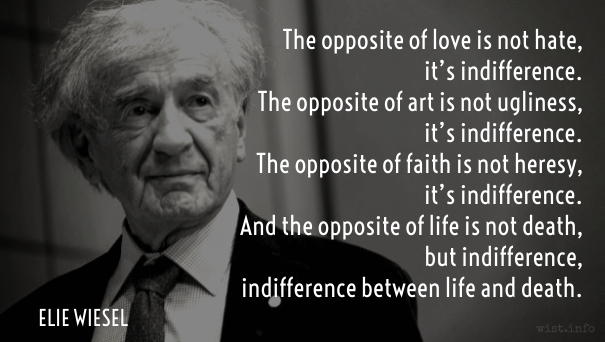
Indifference, to me, is the epitome of evil.
The opposite of love is not hate, it’s indifference.
The opposite of art is not ugliness, it’s indifference.
The opposite of faith is not heresy, it’s indifference.
And the opposite of life is not death, but indifference,
indifference between life and death.
Elie Wiesel (1928-2016) Romanian-American novelist, professor, political activist, Nobel Laureate.
“One Must Not Forget,” interview by Alvin P. Sanoff, US News & World Report (27 Oct 1986)
See also Nietzsche.
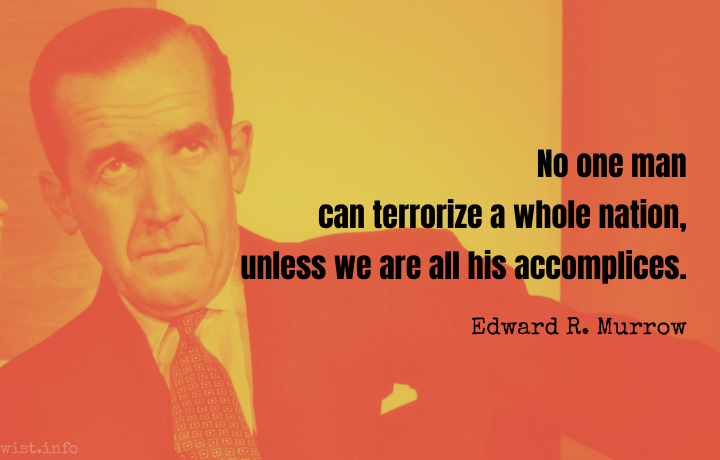
No one man can terrorize a whole nation, unless we are all his accomplices.
Edward R. Murrow (1908-1965) American journalist
See It Now (7 Mar 1954)
(Source)
Comment to the production team before the episode on Senator Joseph R McCarthy’s Communist witch hunt.
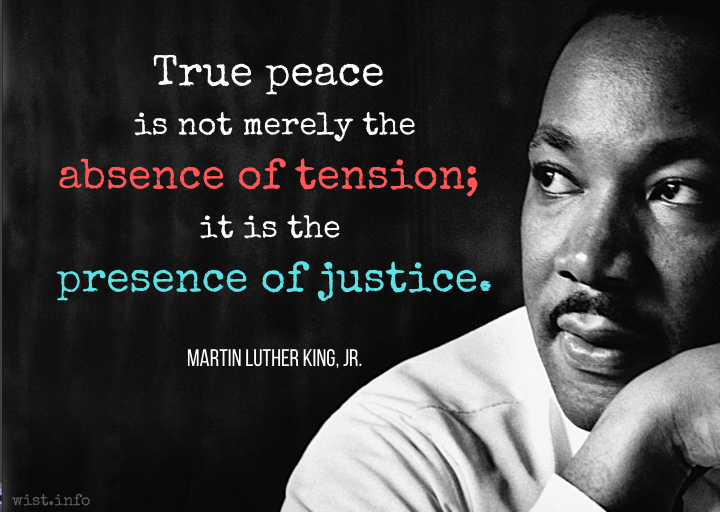
True peace is not merely the absence of tension; it is the presence of justice.
Martin Luther King, Jr. (1929-1968) American clergyman, civil rights leader, social activist, preacher
Stride Toward Freedom, ch. 2 “Montgomery Before the Protest” (1958)
(Source)
Response to a Montgomery resident who complained that race relations had been so "peaceful and harmonious" before King and other protesters arrived.
For there is no comparison between that which we may lose by not trying and by not succeeding; since by not trying we throw away the chance of an immense good; by not succeeding we only incur the loss of a little human labour. But as it is, it appears to me from what has been said, and also from what has been left unsaid, that there is hope enough and to spare, not only to make a bold man try, but also to make a sober-minded and wise man believe.
[Non enim res pari periculo non tentatur, et no succedit; cum in illo ingentis boni, in hoc exiguae humanae operae, jactura vertatur. Verum ex dictis, atque etiam ex non dictis, visum est nobis spei abunde subesse, non tantum homini strenuo ad experiendum, sed etiam prudenti et sobrio ad credendum.]
Francis Bacon (1561-1626) English philosopher, scientist, author, statesman
Instauratio Magna, Part 2 “Novum Organum” [The New Organon],” Book 1, Aphorism # 114 (1620) [tr. Spedding (1858)]
(Source)
(Source (Latin)). Alternate translations:For the risk attending want of success is not to be compared with that of neglecting the attempt; the former is attended with the loss of a little human labour, the latter with that of an immense benefit. For these and other reasons, it appears to us that there is abundant ground to hope, and to induce not only those who are sanguine to make experiment, but even those who are cautious and sober to give their assent.
[tr. Wood (1831)]For it is not a case where there is an equal risk in not trying and not succeeding; since in the former instance we risk a huge advantage; in the latter a little human labour is thrown away. But from what has been said, and also from what has not been said, it seems to us that there is abundant ground of hope, not only to justify a stout-hearted man in trying, but even a prodent and sober man in believing.
[tr. Johnson (1859)]For the danger of not trying and the danger of not succeeding are not equal, since the former risks the loss of great good, the latter of a little human effort. But from what we have said and from other things which we have not said, it has seemed to us that we have abundance of hope, whether we are men who press forward to meet new experiences, or whether we are careful and slow to believe.
[tr. Silverthorne (2000) "The Great Renewal"]The loss that may come from not trying is much greater than what may come from trying and not succeeding: by not trying we throw away the chance of an immense good; by not succeeding we only incur the loss of a little human labour. But from what I have said (and from some things that I haven’t said) it seems to me that there is more than enough hope not only to get a vigorous man to try but also to make a sober-minded and wise man believe that he will succeed.
[tr. Bennett (2017)]
CALVIN: Oh, Great Altar of Passive Entertainment … Bestow upon me thy discordant images at such speed as to render linear thought impossible!