Note not all quotations have been tagged, so Search may find additional quotes on this topic.
Philosophy is odious and obscure;
Both law and physic are for petty wits;
Divinity is basest of the three,
Unpleasant, harsh, contemptible, and vile:
‘Tis magic, magic, that hath ravish’d me.
Christopher "Kit" Marlowe (1564-1593) English dramatist and poet The Tragicall History of the Life and Death of Doctor Faustus, Act 1, sc. 1 (sc. 1), l. 138ff (1594; 1604 “A” text)
(Source)
Declaring to the magicians Valdes and Cornelius his decision to pursue magical studies.
What knowing Judgment, or what piercing Eye,
Can Man’s mysterious Maze of Falshood try?
Intriguing Man, of a suspicious Mind, Man only knows the Cunning of his Kind;
With equal Wit can counter-work his Foes,
And Art with Art, and Fraud with Fraud oppose.
Then heed ye Fair, e’er you their Cunning prove,
And think of Treach’ry, while they talk of Love.
Benjamin Franklin (1706-1790) American statesman, scientist, philosopher, aphorist Poor Richard (1742 ed.)
(Source)
“Will you walk into my parlour?” said a spider to a fly:
“‘Tis the prettiest little parlour that ever you did spy.”
Mary Howitt (1799-1888) English poet
Poem (1828), “The Spider and the Fly,” st. 1, The New Year’s Gift and Juvenile Souvenir [ed. Mrs. Alaric Watts]
(Source)
Variant: “Step into my parlor, said the spider to the fly …”
The poem has been parodied frequently, including by Lewis Carroll's "Mock Turtle's Song." More information about this poem here.
Then let no woman hence in man believe, Or think a lover speaks but to deceive.
He, while ungratified desire is high, Shrinks from no oath, no promise will deny;
Soon as his lust is satiate with its prize, He spurns his vows and perjury’s curse defies.
[Nunc iam nulla viro iuranti femina credat,
nulla viri speret sermones esse fideles;
quis dum aliquid cupiens animus praegestit apisci,
nil metuunt iurare, nihil promittere parcunt:
sed simul ac cupidae mentis satiata libido est,
dicta nihil metuere, nihil periuria curant.]
Catullus (c. 84 BC – c. 54 BC) Latin poet [Gaius Valerius Catullus]
Carmina # 64 “The Nuptuals of Peleus and Thetis,” ll. 144-149 [tr. Lamb (1821)]
(Source)
Hear this, and wisdom learn, ye witless fair!
Ne'er let false man with empty oaths deceive, No protestations of the sex believe!
Is there a wish their ardent souls would gain; they swear, they promise, and at length obtain;
The wish obtain'd, they fearless break their word, Nor plighted faith, nor solemn vows regard.
[tr. Nott (1795), # 61; ll. 173ff.]
Henceforth let woman; never trust the oaths that man shall make, Nor ever more his honeyed speech within her bosom take!
While yet the fire of his desire is hot within his breast, What will he not to woman swear, to heav'n what not protest?
But let her in an evil hour resign her maiden trust, And yield the blossom of her youth to sate his selfish lust,
Then what recks he of lavish oath, or vow, or whisper'd pray'r? He triumphs in his perjuries, and spurns at her despair.
[tr. T. Martin (1861)]
Henceforth let never woman trust an oath than man shall swear, Nor count the tender speeches true his lying lips declare:
For when with lusting soul he yearns some object to enjoy, No oath, no promise then he deems too sacred to employ;
But when his soul is sated, and his burning passion dies, He fears to break no plighted vows, cares nought for perjuries.
[tr. Cranstoun (1867)]
Let not a woman trust, since that first treason, a lover's
Desperate oath, none hope true lover's promise is earnest.
They, while fondly to win their amorous humour essayeth,
Fear no covetous oath, all false free promises heed not;
They if once lewd pleasure attain unruly possession,
Lo they fear not promise, of oath or perjury reck not.
[tr. Ellis (1871)]
Now, let woman no more trust her to man when he sweareth,
Ne'er let her hope to find or truth or faith in his pleadings,
Who when lustful thought forelooks to somewhat attaining,
Never an oath they fear, shall spare no promise to promise.
Yet no sooner they sate all lewdness and lecherous fancy,
Nothing remember of words and reck they naught of fore-swearing.
[tr. Burton (1893)]
Now, now, let no woman give credence to man's oath, let none hope for faithful vows from mankind; for while their eager desire strives for its end, nothing fear they to swear, nothing of promises forbear they: but instantly their lusting thoughts are satiate with lewdness, nothing of speech they remember, nothing of perjuries care.
[tr. Smithers (1894)]
Henceforth let no woman believe a man's oath, let none believe that a man's speeches can be trustworthy. They, while their mind desires something and longs eagerly to gain it, nothing fear to swear, nothing spare to promise; but as soon as the lust of their greedy mind is satisfied, they fear not then their words, they heed not their perjuries.
[tr. Warre Cornish (1904)]
Hereafter let; no woman trust man's promises, or hope for faithful words; for when they wish to attain their desires, there is nothing they will not swear, no promise do they scruple to make: but once their desires have been satisfied, they fear no broken words and care nothing for their perjuries.
[tr. Stuttaford (1912)]
Never let maid believe a lover's oath; Nor hope a man be faithful to his troth;
Long as men's hearts are spurred by keen desire,
No oath they shrink from and no promise spare; Soon as their sated lust begins to tire No oath they heed and nought for falsehood care.
[tr. Symons-Jeune (1923)]
Henceforth, no woman trust the oath of man,
No woman dream the word of man is true:
They, whensoe'er they lust for anything,
Swear every oath and every promise make,
But, when their eager lust is satisfied,
Nor reck of oaths nor promises regard.
[tr. MacNaghten (1925)]
Henceforth let never listening maid believe Protesting man! When their false hearts conceive
The selfish wish, to all but pleasure blind, No words they spare, no oaths unuttered leave.
But when possession cloys their pampered mind, No care have they for oaths, no words their honour bind.
[tr. Wright (1926)]
From this hour may no woman believe what men say, for men (minds set upon a single end) will promise everything, but once the shrewd mind satisfies its passion, it plunges forward (the broken promise merely words that trail behind tall bravery).
[tr. Gregory (1931)]
Let no woman ever believe any oath that a man swears,
or ever expect him to keep faith with his fine speeches!
When they want something, when they are anxious to get it,
they take oaths without fear, and pour out promises freely;
but just as soon as their hot desire is sated,
none of their lies & deceptions ever disturb them.
[tr. C. Martin (1979)]
From now on let no woman believe a man's sworn promises.
From now on let no woman hope a man's talk is true.
So long as their desiring minds are eager to get something,
they swear to anything. No promise do they spare.
But as soon as the lust in their desirous intent is gratified,
they remember nothing they said, they care nothing for their lies.
[tr. Banks (1997)]
Now, no woman should believe a man’s pledges,
or believe there’s any truth in a man’s words:
when their minds are intent on their desire,
they have no fear of oaths, don’t spare their promises:
but as soon as the lust of their eager mind is slaked
they fear no words, they care nothing for perjury.
[tr. Kline (2001)]
Henceforth let no woman trust a man's sworn promise,
or hope that he'll ever be true to his given word,
for as long as his lustful heart is bent on possession
he'll shrink from no oath, stop short at no promises,
but the moment hte urge of his ardent mind is sated
he forgets all he's said, breaks oaths without a tremor.
[tr. Green (2005)]
Now already let no woman trust a man swearing,
let none hope that the speeches of man are faithful,
for whom while the desiring mind is eager to grasp something,
They fear to swear nothing, they spare to promise nothing.
But as soon as the lust of the desiring mind has been satisfied,
They feared the words as nothing, they care for the false oaths not at all.
[tr. Wikisource (2018)]
BANQUO: And oftentimes, to win us to our harm,
The instruments of darkness tell us truths,
Win us with honest trifles, to betray ’s
In deepest consequence.
William Shakespeare (1564-1616) English dramatist and poet Macbeth, Act 1, sc. 3, l. 135ff (1.3.135-138) (1606)
(Source)
Speaking to Macbeth of the Weïrd Sisters (witches).
LUCY: When young at the Bar you first taught me to score,
And bid me be free of my Lips, and no more;
I was kiss’d by the Parson, the Squire, and the Sot,
When the Guest was departed, the Kiss was forgot.
But his Kiss was so sweet, and so closely he prest,
That I languish’d and pin’d till I granted the rest.
John Gay (1685-1732) English poet and playwright The Beggar’s Opera, Act 3, sc. 1, Air 40 (1728)
(Source)
TARTUFFE: Some joys, it’s true, are wrong in Heaven’s eyes;
Yet Heaven is not averse to compromise;
There is a science, lately formulated.
Whereby one’s conscience may be liberated,
And any wrongful act you care to mention
May be redeemed by purity of intention.
I’ll teach you. Madam, the secrets of that science;
Meanwhile, just place on me your full reliance.
Assuage my keen desires, and feel no dread:
The sin, if any, shall be on my head.
[Le ciel défend, de vrai, certains contentements;
Mais on trouve avec lui des accommodements.
Selon divers besoins, il est une science
D’étendre les liens de notre conscience,
Et de rectifier le mal de l’action
Avec la pureté de notre intention.
De ces secrets, madame, on saura vous instruire ;
Vous n’avez seulement qu’à vous laisser conduire.
Contentez mon désir, et n’ayez point d’effroi ;
Je vous réponds de tout, et prends le mal sur moi.]
Molière (1622-1673) French playwright, actor [stage name for Jean-Baptiste Poquelin] Tartuffe, or the Hypocrite [Le Tartuffe, ou L’Imposteur], Act 4, sc. 5 (1669) [tr. Wilbur (1963)]
(Source)
The pious fraud, Tartuffe, attempting to seduce Orgon's wife, Elmire. Moliere does a certain amount of CYA by inserts a note at this line, "A scoundrel is speaking [C’est un scélérat qui parle.]"
The passage mirrors Pascal's assertion in the seventh Provinciale that "When we cannot prevent the action, we at least purify the intention' and thus we correct vice by means of the purity of the end."
Heav'n 'tis true, forbids certain Gratifications. But then there are ways of compounding those Matters. It is a Science to stretch the Strings of Conscience according to the different Exigences of the Cawe, and to rectify the Immorality of the Action by the Purity of our Intention. These are Secrets, Madam, I can instruct you in; you have nothing to do, but passively to be conducted. Satisfy my Desire, and fear nothing, I'll answer for you, and will take the Sin upon myself.
[tr. Clitandre (1672)]
Heaven, it is true, forbids certain gratifications, but there are ways and means of compounding such matters. According to our different wants, there is a science which loosens that which binds our conscience, and which rectifies the evil of the act with the purity of our intentions. We shall be able to initiate you into these secrets, Madam; you have only to be led by me. Satisfy my desires, and have no fear; I shall be answerable for everything, and shall take the sin upon myself.
[tr. Van Laun (c. 1870), 4.5]
It is true that Heaven forbids certain gratifications, but there are means of compounding with it upon such matters., and of rectifying the evil fo the act by the purity of the intention. We shall be able to initiate you into all those secrets, madam; all you have to do is to suffer yourself to be led by me. Satisfy my wishes, and be without fear. I will be answerable for everything and take the sin upon myself.
[tr. Wall (1879), 4.5]
Heaven, it is true, forbids certain gratifications; but there are ways of compounding these matters. There is a science of stretching the strings of our conscience, according to different exigencies, and of rectifying the wrongness of the action by the purity of our intention. In these secrets, madame, I know how to instruct you, and all you have to do is to let me guide you. Satisfy my wishes, madame, and have no fear. I will answer for you, and take any wrong on myself.
[tr. Mathew (1890), 4.4]
Heaven, it is true, forbids certain gratifications; but there are ways of compounding with it. It is a science to stretch the string of our conscience according to divers needs and to rectify the immorality of the act with the purity of our intention. I can initiate you into these secrets, Madam; you have only to allow yourself to be led. Satisfy my desire, and do not be afraid: I will be answerable for you in everything, and I will take the sin upon myself.
[tr. Waller (1903), 4.5]
Heaven forbids, 't is true, some satisfactions;
But we find means to make things right with Heaven.
There is a science, madam, that instructs us
How to enlarge the limits of our conscience
According to our various occasions,
And rectify the evil of the deed
According to our purity of motive.
I'll duly teach you all these secrets, madam;
You only need to let yourself be guided.
Content my wishes, have no fear at all;
I answer for't, and take the sin upon me.
[tr. Page (1909), 4.5]
It's true that heaven forbids some satisfactions,
But there are possible ways to understandings.
To suit our various needs, there is a science
Of loosening the bonds of human conscience,
And rectifying the evil of an action
By means of the purity of our intention.
Madame, I shall instruct you in these secrets,
If you will put your confidence in me.
Content my longings, do not be afraid;
All the responsibility is mine ...
[tr. Bishop (1957)]
It's true, there are some pleasures Heaven denies;
But there are ways to reach a compromise.
Yes, now there is a science that succeeds
In stretching consciences to meet our needs,
And can correct, by a sublime invention,
An evil deed just by a pure intention.
To all this there are keys I can provide you;
All you need do, Madame, is let me guide you.
Content my longings, free yourself of dread:
If there is sin, I’ll take it on my head.
[tr. Frame (1967), 4.5]
It's true that Heaven forbids certain pleasures,
but it's possible to make bargains.
Depending on what's needed,
there are ways to accommodate our consciences
and to justify bad acts
by the purity of our intentions.
I can be your teacher, Madame;
you have only to let me be your guide.
Satisfy my desire; never fear,
I'll answer for it all and take you sin on.
[tr. Steiner (2008), 4.5]
Heaven forbids certain pleasures, in theory;
But one can always get round that;
According to requirement, it is a science
To stretch the limits of our conscience
And to balance out the evil of the deed
With the purity of the intention.
Nothing simpler, My Lady, than to instruct you in these mysteries;
You need only let yourself be led.
Give me what I want and have no fear:
I'll take the sin upon myself.
[tr. Campbell (2013)]
Heaven forbids, in truth, certain contentments;
But we find with him accomodations;
According to various needs, it is a science
To extend the bonds of our consciousness
And to rectify the evil of action
With the purity of our intention.
Of these secrets, Madam, we will know how to instruct you;
You just have to let yourself be driven.
Satisfy my desire, and have no fear:
I answer you for everything, and take evil on me.
[Source]
It's true Heaven forbids some pleasures, but a compromise can usually be found.
[E.g.]
PENTHEUS: Do you hold your rites during the day or night?
DIONYSUS: Mostly by night. The darkness is well suited to devotion.
PENTHEUS: Better suited to lechery and seducing women.
DIONYSUS: You can find debauchery by daylight too.
PENTHEUS: By night or day these sacred rites perform'st thou ?
BACCHUS: Mostly by nighty for venerable is darkness.
PENTHEUS: To women this is treacherous and unsafe.
BACCHUS: E'en in the broadest day may shame be found.
[tr. Wodhull (1809)]
PENTHEUS: Do you perform the rites by night or by day?
DIONYSUS: Mostly by night; darkness conveys awe.
PENTHEUS: This is treacherous towards women, and unsound.
DIONYSUS: Even during the day someone may devise what is shameful.
[tr. Buckley (1850)]
PENTHEUS: Performest thou these rites by night or day?
DIONYSUS: Most part by night -- night hath more solemn awe.
PENTHEUS: A crafty rotten plot to catch our women.
DIONYSUS: Even in the day bad men can do bad deeds.
[tr. Milman (1865)]
PENTHEUS: Dost thou perform thy rites by day; or night?
DIONYSUS: Chiefly by night; darkness gives dignity.
PENTHEUS: Craft rather and seduction it denotes.
DIONYSUS: Base acts are oft made manifest by day.
[tr. Rogers (1872), l. 462ff]
PENTHEUS: Is it by night or day thou performest these devotions?
DIONYSUS: By night mostly; darkness lends solemnity.
PENTHEUS: Calculated to entrap and corrupt women.
DIONYSUS: Day too for that matter may discover shame.
[tr. Coleridge (1891)]
PENTHEUS: By night or day dost thou perform his rites?
DIONYSUS: Chiefly by night: gloom lends solemnity.
PENTHEUS: Ay -- and for women snares of lewdness too.
DIONYSUS: In the day too may lewdness be devised.
[tr. Way (1898)]
PENTHEUS: How is thy worship held, by night or day?
DIONYSUS: Most oft by night; 'tis a majestic thing, The darkness.
PENTHEUS: Ha! with women worshipping? 'Tis craft and rottenness!
DIONYSUS: By day no less, Whoso will seek may find unholiness.
[tr. Murray (1902)]
PENTHEUS: Do you celebrate your sacred acts at night or by day?
DIONYSUS: At night for the most party. Darkness possesses solemnity.
PENTHEUS: Darkness for women is deceitful and corrupt!
DIONYSUS: Even in daytime one could discover disgraceful behavior.
[tr. Kirk (1970)]
PENTHEUS: Do you celebrate your mysteries by night or by day?
DIONYSUS: Chiefly by night. Darkness induces religious awe.
PENTHEUS: For women darkness is treacherous and impure.
DIONYSUS: Impurity can be practiced by daylight too.
[tr. Vellacott (1973)]
PENTHEUS: These sacred practices of your god, the worship, The rites of great devotion, do they Hold at night, or in the day.
DIONYSUS: [...] We hold our rites mostly at night Because it is cooler. And the lamps Lend atmosphere and feeling to the heart in worship.
[...]
PENTHEUS: And I say night hours are dangerous Lascivious hours, lechery ....
DIONYSUS: You'll find debauchery in daylight, too.
[tr. Soyinka (1973)]
PENTHEUS: The rites -- at night or by day you perform them?
DIONYSUS: At night, mostly; there’s majesty in darkness.
PENTHEUS: And for women there’s trickery and smut.
DIONYSUS: Even by day one may discover shame.
[tr. Neuburg (1988)]
PENTHEUS: Do you perform your mysteries during the day or by night?
DIONYSUS: Mostly at night. The dark is more conducive to worship.
PENTHEUS: You mean to lechery and bringing out the filth in women.
DIONYSUS: Those who look for filth, can find it at the height of noon.
[tr. Cacoyannis (1982)]
PENTHEUS: Do you worship in daylight or at night?
DIONYSUS: Mostly at night. Darkness is most sacred.
PENTHEUS: That is treacherous and unwholesome for women.
DIONYSUS: Some find shame even in daylight.
[tr. Blessington (1993)]
PENTHEUS: Do you celebrate these sacred rites at night or in the day?
THE STRANGER: At night mostly, since darkness induces devotion.
PENTHEUS: No, darkness is devious and corrupts women.
THE STRANGER: Even in the day someone could devise shameful deeds.
[tr. Esposito (1998)]
PENTHEUS: You practice this cult by night or by day?
DIONYSUS: Mostly at night. Darkness lends solemnity.
PENTHEUS: Darkness is just a filthy trap for women.
DIONYSUS: Some people can dig up dirt in daytime, too.
[tr. Woodruff (1999)]
PENTHEUS: Do you perform the rites by day? -- or night?
DIONYSUS: Mostly at night -- because the darkness has its holiness.
PENTHEUS: It's treacherous, for women, and corrupts them.
DIONYSUS: What's shameful can be found even by light of day.
[tr. Gibbons/Segal (2000), l. 571ff]
PENTHEUS: Do you practice your rites at night or by day?
DIONYSUS: Mostly at night: darkness lends solemnity.
PENTHEUS: This is an immoral trick aimed at women.
DIONYSUS: Someone could engage in shameful deeds even by day.
[tr. Kovacs (2002)]
PENTHEUS: And you perform these practices at night?
DIONYSUS: Man's true nature's seen in darkness not in light.
PENTHEUS: While darkness shrouds a woman's true duplicity.
DIONYSUS: Duplicity's not found in night exclusively.
[tr. Teevan (2002)]
PENTHEUS: Tell me, when do you hold your worship? By clear day, or dark night?
DIONYSUS: Mostly by night -- it is a majestic time.
PENTHEUS: Indeed! A majestic time to take advantage of women. Shameful!
DIONYSUS: There are enough shameful things done by day. And enough shameful thoughts in your head, I am sure!
[tr. Rao/Wolf (2004)]
PENTHEUS: These ... holy orgies of yours… do you perform them during the day or in the night?
DIONYSUS: Most of them during the night. Darkness adds a certain modesty.
PENTHEUS: That’s quite a dubious thing for the women… and rather lecherous, I’d say.
DIONYSUS: Shame, of course can be seen during the day, too, if it exists and if one were to look for it.
[tr. Theodoridis (2005)]
PENTHEUS: Do you conduct the mysteries in the night or by day?
DIONYSUS: Us'ally by night, for darkness holds reverence.
PENTHEUS: Is this thing deceitful or unwholesome towards women?
DIONYSUS: One might also uncover shameful things i' the day.
[tr. Valerie (2005)]
PENTHEUS: When you dance these rites, is it at night or during daylight hours?
DIONYSUS: Mainly at night. Shadows confer solemnity.
PENTHEUS: And deceive the women. It's all corrupt!
DIONYSUS: One can do shameful things in daylight, too.
[tr. Johnston (2008), l. 604ff]
PENTHEUS: These mysteries. Do you practise them by day, or night?
DIONYSUS: Mostly by night. Dark is better for devotion.
PENTHEUS: Better for lechery and the taking of women.
DIONYSUS: That happens in daylight too.
[tr. Robertson (2014)]
PENTHEUS: And are these rites conducted by day or by night?
DIONYSUS: Night, for the most part. It’s so much more ... spiritual. Good for devotion.
PENTHEUS: The night’s a trap for women’s virtue.
DIONYSUS: And the day isn’t? You don’t get out much, do you?
[tr. Pauly (2019)]
PENTHEUS: Do you perform your rituals by day or night?
DIONYSUS: By night. We believe that darkness is holy.
PENTHEUS: It's a cunning time to force filth upon women.
DIONYSUS: Vice thrives in daylight, too.
[tr. Behr/Foster (2019)]
PENTHEUS: Do you perform the sacred rites [hiera] by night or by day?
DIONYSUS: Mostly by night; darkness conveys awe.
PENTHEUS: This is treacherous towards women, and unsound.
DIONYSUS: Even during the day you can find what is shameful.
[tr. Buckley/Sens/Nagy (2020)]
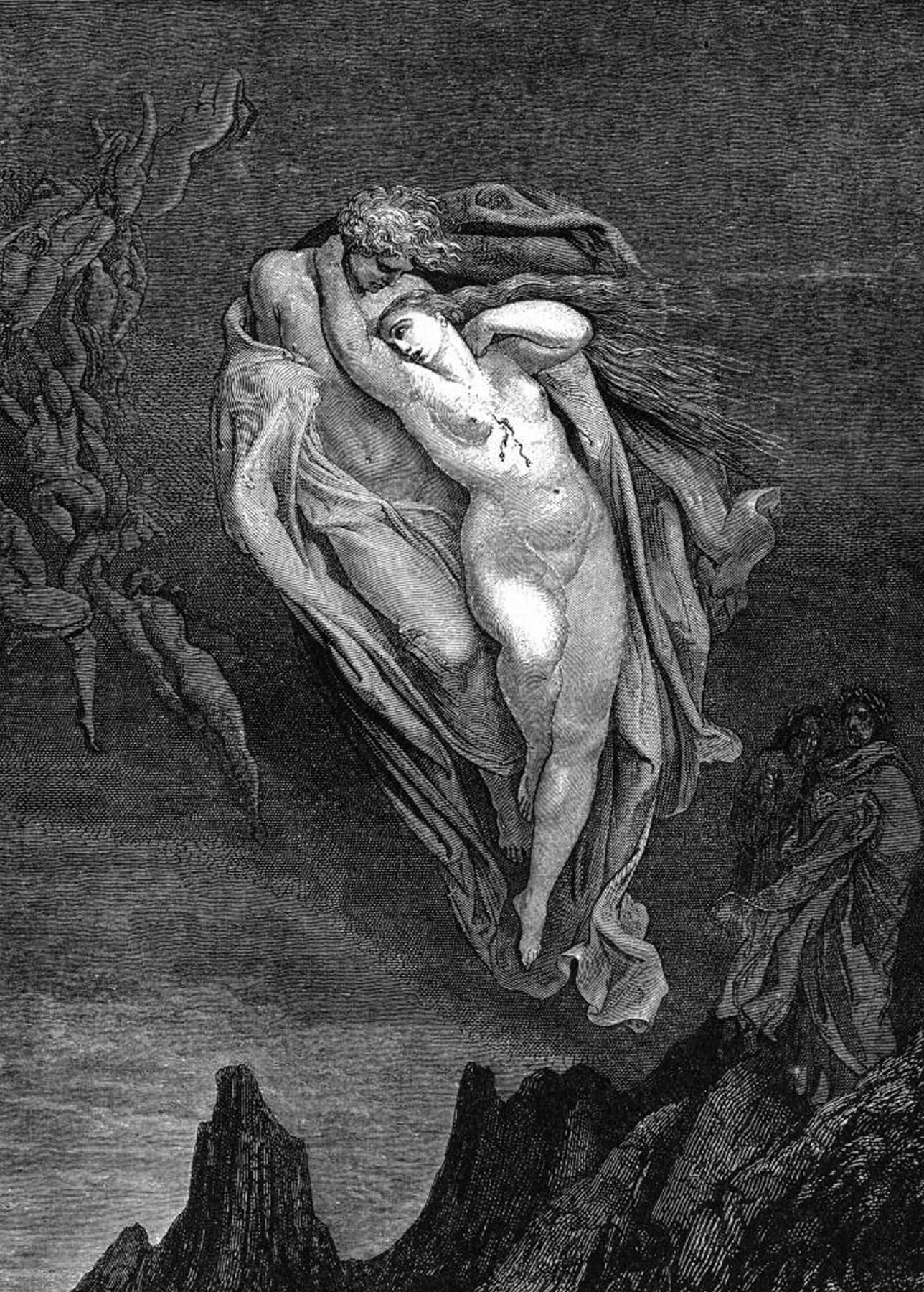
One day together, for pastime, we read Of Lancelot, and how Love held him in thrall. We were alone, and without any dread.
Sometimes our eyes, at the word’s secret call, Met, and our cheeks a changing color wore. But it was one page only that did all.
When we read how that smile, so thirsted for, Was kissed by such a lover, he that may Never from me be separated more
All trembling kissed my mouth. The book I say Was a Galahalt to us, and he beside that wrote that book. We read no more that day.
Gustave Dore – Divine Comedy, Inferno, Canto 5 “The Souls of Paolo and Francesca” (1857)
[Noi leggiavamo un giorno per diletto di Lancialotto come amor lo strinse; soli eravamo e sanza alcun sospetto.
Per più fïate li occhi ci sospinse quella lettura, e scolorocci il viso; ma solo un punto fu quel che ci vinse.
Quando leggemmo il disïato riso esser basciato da cotanto amante, questi, che mai da me non fia diviso,
la bocca mi basciò tutto tremante. Galeotto fu ‘l libro e chi lo scrisse: quel giorno più non vi leggemmo avante.]
Dante Alighieri (1265-1321) Italian poet The Divine Comedy [Divina Commedia], Book 1 “Inferno,” Canto 5, l. 127ff (5.127-138) [Francesca] (1309) [tr. Binyon (1943)]
(Source)
In the Old French romance of Lancelot du Lac they were reading, Sir Gallehault (spelled variously) serves as go-between for Lancelot and Guinevere (a couple not able to express their love because of her marriage to King Arthur), and ultimately persuades the Queen to give Lancelot a first, dooming kiss. Similarly, Paolo was the intermediary to arrange the marriage of his brother, Gianciotto, and Francesca. After the marriage, reading together that racy tale of Lancelot seduced Paolo and Francesca into pursuing their carnal affair.
The Italian form of Gallehault -- "Galeotto" or "Galleot" -- became Middle Ages Italian slang for a panderer or pimp, and Francesca draws on this meaning in her chat with the Pilgrim, blaming the book and its writer for her damning sins with Paolo. See also, earlier, here.
Together we, for pleasure, one day read
How strictly Lancelot was bound by love;
We, then alone, without suspicion were:
T'admire each other, often from the book
Our eyes were ta'en, and oft our colour chang'd;
That was the point of time which conqurer'd us,
When, reading that her captivating smile
Was by the Lover the adored kiss'd;
This, my Companion, always with me seen,
Fearful, and trembling, also kiss'd my mouth.
The Writer, Galeotto, nam;d the Book.
But from that day we never read in't more.
[tr. Rogers (1782), l. 113ff]
One day (a day I ever must deplore!)
The gentle youth, to spend a vacant hour,
To me the soft seducing story read,
Of Launcelot and fair Geneura's love,
While fascinating all the quiet grove
Fallacious Peace her snares around us spread.
Too much I found th' insidious volume charm,
And Paulo's mantling blushes rising warm;
Still as he read the guilty secret told:
Soon from the line his eyes began to stray;
Soon did my yielding looks my heart betray,
Nor needed words our wishes to unfold.
Eager to realize the story'd bless,
Trembling he snatch'd the half resented kiss,
To ill soon lesson'd by the pandar-page!
Vile pandar-page! it smooth'd the paths of shame.
[tr. Boyd (1802), st. 24-26]
One day
For our delight we read of Lancelot, How him love thrall’d. Alone we were, and no Suspicion near us. Ofttimes by that reading
Our eyes were drawn together, and the hue Fled from our alter’d cheek. But at one point Alone we fell. When of that smile we read,
The wished smile, rapturously kiss’d By one so deep in love, then he, who ne’er From me shall separate, at once my lips
All trembling kiss’d. The book and writer both Were love’s purveyors. In its leaves that day We read no more.
[tr. Cary (1814)]
'Twas on a day when we for pastime read Of Lancelot, whom love ensnared to ruin: We were alone, nor knew suspicious dread.
That lesson oft, the conscious look renewing, Held us suspense, and turned our cheeks to white; But one sole moment wrought for our undoing:
When of the kiss we read, from smile so bright. So coveted, that such true-lover bore. He, from my side who ne'er may disunite,
Kissed me upon the mouth, trembling all o'er. The broker of our Vows, it was the lay, And he who wrote -- that day we read no more.
[tr. Dayman (1843)]
One day, for pastime, wwe read of Lancelot, how love restrained him; we were alone, and without all suspicion. Several times that reading urged our eyes to meet, and changed the color of our faces; but one moment alone it was that overcame us. When we read how the fond smile was kissed by such a lover, he, who shall never be divided from me, kissed my mouth all trembling: the book, and he who wrote it, was a Galeotto; that day we read in it no farther.
[tr. Carlyle (1849)]
We were reading one day, for our delight,
In Lancilotto, bound in love so strict.
We were alone, and neither could suspect
Suspended were our eyes, and more than once,
In reading, and the visage colorless;
One point it was lone that conquered us.
When we read first of that -- the longed-for smile
At being kissed by one who loved so well;
Galeotti was the book -- he wrote it:
That Day we read not there any farther.
[tr. Bannerman (1850)]
One day we read, to pass a pleasant time, How Lancelot was bound in chains of love; Alone we were and no suspicion knew.
often we sigh'd; and as we read our eyes Each other sought, the color fled our cheeks; But we were vanquish'd by one point alone.
When we had read how the smile long desir'd Was kiss'd by him who lov'd with such deep love, This one, from me no more to be apart,
Trembling all over, kiss'd me on the mouth. Galeotto was the writer and the book; In it we read no further on that day.
[tr. Johnston (1867)]
One day we reading were for our delight Of Launcelot, how Love did him enthrall. Alone we were and without any fear.
Full many a time our eyes together drew That reading, and drove the color from our faces; But one point only was it that o'ercame us.
Whenas we read of the much longed-for smile Being by such a noble lover kissed, This one, who ne'er from me shall be divided,
Kissed me upon the mouth all palpitating. Galeotto was the book and he who wrote it. That day no farther did we read therein.
[tr. Longfellow (1867)]
We were reading one day, for delight, of Lancelot, how Love constrained him; alone were we, and without any suspicion. Many times did that reading impel our eyes, and change the hue of our visages; but one point only was it that overcame us. When we read that the wished-for smile was kissed by such a lover, this one who never from me shall be parted kissed me on the mouth all trembling. A Gallehault was the book, and he who wrote it. That day we read no further in it.
[tr. Butler (1885)]
We read one day for pleasure, in the song Of Launcelot, how Love him captive made; We were alone without one thought of wrong.
Many and many a time our eyes delayed The reading, and our faces paled apart; One point alone it was that us betrayed.
In reading of that worshipt smile o' the heart, Kissed by such lover on her lips' red core. This one, who never more from me must part,
Kissed me upon the mouth, trembling all o'er: For us our Galeotto was that book; That day we did not read it any more.
[tr. Minchin (1885)]
We were reading one day, for delight, of Lancelot, how love constrained him. We were alone and without any suspicion. Many times that reading made us lift our eyes, and took the color from our faces, but only one point was that which overcame us. When we read of the longed-for smile being kissed by such a lover, this one, who never from me shall be divided, kissed my mouth all trembling. Galahaut was the book, and he who wrote it. That day we read in it no farther.
[tr. Norton (1892)]
We read one day, to while the hour, of Lancelot, how love enthralled him: we were alone, with never a thought of harm. And oft and oft that reading brought our eyes together and drave the colour to our cheeks ; but one point, only one, it was that overcame us. When that we came to read of how the smiling lips he loved were kissed by lover such as he, he that no more shall e'er be parted from me, kissed my mouth trembling through. Our Galahad was the book and he that penned it: that day we read in it no more.
[tr. Sullivan (1893)]
One day, by way of pastime, we were reading Of Lancelot, how love in fetters held him: We were alone, and without thought of danger.
Full often did that reading bring together Our glances, and made colourless our visage; But just one point was that which overcame us:
When as we read how that the smile much longed for Was kissed by one so passionately loving, He who from me shall never be divided
Kissed me upon the mouth, all, all a-quiver: -- A Galehalt was the book and he who wrote it: -- Upon that day we read therein no further.
[tr. Griffith (1908)]
We read one day for pastime of Lancelot, how love constrained him. We were alone and had no misgiving. Many times that reading drew our eyes together and changed the color in our faces, but one point alone it was that mastered us; when we read that the longed-fro smile was kissed by so great a lover, he who never shall be parted from me, all trembling, kissed my mouth. A Galeotto was the book and he that wrote it; that day we read in it no farther.
[tr. Sinclair (1939)]
One day we read for pastime how in thrall Lord Lancelot lay to love, who loved the Queen; We were alone -- we thought no harm at all.
As we read on, our eyes met now and then, And to our cheeks the changing color started, But just one moment overcame us -- when
We read of the smile, desired of lips long-thwarted, Such smile, by such a lover kissed away, He that may never more from me be parted
Trembling all over, kissed my mouth. I say The book was Galleot, Galleot the complying Ribald who wrote; we read no more that day.
[tr. Sayers (1949)]
One day for dalliance we read the rhyme of Lancelot, how love had mastered him. We were alone with innocence and dim time.
Pause after pause that high old story drew our eyes together while we blushed and paled; but it was one soft passage overthrew
our caution and our hearts. For when we read how her fond smile was kissed by such a lover, he who is one with me alive and dead
breathed on my lips the tremor of his kiss. That book, and he who wrote it, was a pander. That day we read no further.
[tr. Ciardi (1954), l. 124ff]
One day, for pastime, we reqd of Lancelot, how love constrained him; we were alone, suspecting nothing. Several times that reading urged our eyes to meet and too the color from our faces, but one moment alone it was that overcame us. When we read how the longed-for smile was kissed by so great a lover, this one, who never shll be parted from me, kissed my mouth all trembling. A Gallehault was the book and he who wrote it; that day we read no farther in it.
[tr. Singleton (1970)]
One day we read, to pass the time away, of Lancelot, how he had fallen in love; we were alone, innocent of suspicion.
Time and again our eyes were brought together by the book we read; our faces flushed and paled. To the moment of one line alone we yielded:
it was when we read about those longed-for lips now being kissed by such a famous lover, that this one (who shall never leave my side)
then kissed my mouth, and trembled as he did. The book and its author was our galehot! That day we read no further.
[tr. Musa (1971)]
One day, to pass the time away, we read of Lancelot -- how love had overcome him. We were alone, and we suspected nothing.
And time and time again that reading led our eyes to meet, and made our faces pale, and yet one point alone defeated us.
When we had read how the desired smile was kissed by one who was so true a lover, this one, who never shall be parted from me,
while all his body trembled, kissed my mouth. A Gallehault indeed, that book and he who wrote it, too; that day we read no more.
[tr. Mandelbaum (1980)]
One day, when we were reading, for distraction, How Lancelot was overcome by love -- We were alone, without any suspicion;
Several times, what we were reading forced Our eyes to meet, and then we changed color: But one page only was more than we could bear.
When we read how that smile, so much desired, Was kissed by such a lover, in the book, He, who will never be divided from me,
Kissed my mouth, he was trembling as he did so; The book, the writer played the part of Galahalt: That day we got no further with our reading.
[tr. Sisson (1981)]
One day, for pleasure,
We read of Lancelot, by love constrained:
Alone, suspecting nothing, at our leisure.
Sometimes at what we read our glances joined,
Looking from the book each to the other's eyes,
And then the color in our faces drained.
But one particular moment alone it was
Defeated us: the longed-for smile, it said, Was kissed by that most noble lover: at this,
This one, who now will never leave my side,
Kissed my mouth, trembling. A Galeotto, that book!
And so was he who wrote it; that day we read
No further.
[tr. Pinsky (1994), l. 112ff]
We were reading one day, for pleasure, of Lancelot, how Love beset him; we were alone and without any suspicion. Many times that reading drove our eyes together and turned our faces pale; but one point alone was the one that overpowered us. When we read that the yearned-for smile was kissed by so great a lover, he, who will never be separated from me, kissed my mouth all trembling. Galeotto was the book and he who wrote it: that day we read there no further.
[tr. Durling (1996)]
We read, one day, to our delight, of Lancelot and how love constrained him: we were alone and without suspicion. Often those words urged our eyes to meet, and coloured our cheeks, but it was a single moment that undid us. When we read how that lover kissed the beloved smile, he who will never be separated from me, kissed my mouth all trembling. That book was a Galeotto, a pandar, and he who wrote it: that day we read no more.
[tr. Kline (2002)]
One day, to pass the time, we read of Lancelot, who loved illicitly. Just the two of us; we had not thought of what, as yet, was not.
From time to time that reading urged our eyes to meet. and made our faces flush and pale, but one point in the story changed our lives;
for when we read of how the longed-for smile was kissed by such a noble knight, the one who for eternity is by my side all trembling
kissed my trembling mouth. The man who wrote this was a Galeotto; so was the book. That day the rest of it remained unscanned.
[tr. Carson (2002)]
One day we read together for pure joy how Lancelot was taken in Love's palm. We were alone. We knew no suspicion.
Time after time, the words we read would lift our eyes and drawn all color from our faces. A single point, however, vanquished us.
For when at last we read the longed-for smile of Guinevere -- at last her lover kissed -- he, who from me will never now depart,
touched his kiss, trembling to my open mouth. This book was Galehault -- pander-penned, the pimp! That day we read no further down those lines.
[tr. Kirkpatrick (2006)]
One day, to pass the time in pleasure, we read of Lancelot, how love enthralled him. We were alone, without the least misgiving.
More than once that reading made our eyes meet and drained the color from our faces. Still, it was a single instant overcame us:
When we read how the longed-for smile was kissed by so renowned a lover, this man, who never shall be parted from me,
all trembling, kissed me on my mouth. A Galeotto was the book and he that wrote it. That day we read in it no further.
[tr. Hollander/Hollander (2007)]
One day we read the story of Lancelot And how his love attacked and held him tight. We were alone and unaware of our thoughts.
More than once the story forced our eyes To meet, and as we looked our faces turned pale, But just one single moment hung and decided
Us. We read how a smile we longed for stayed On her lips until the greatest of lovers kissed them, And then this man, who cannot be taken away
From me, kissed my mouth, his body trembling. A famous go-between had written that tale. That day, our time for reading suddenly ended.
[tr. Raffel (2010)]
One day, to amuse ourselves, we were reading The tales of love-struck Lancelot; we were all alone, And naively unaware of what could happen.
More than once, while reading, we looked up And saw the other looking back. We'd blush, then pale, Then look down again. Until a moment did us in.
We were reading about the longed-for kiss The great lover gives his Guinevere, when that one From whom I'll now never be parted,
Trembling, kissed my lips. That author and his book played the part Of Gallehault. We read no more that day.
[tr. Bang (2012)]
Reading together one day for delight
Or Lancelot, caught up in Love's sweet snare,
We were alone, with no thought of what might
Occur to us, although we stopped to stare
Sometimes at what we read, and even paled.
But then the moment came we turned a page
And all our powers of resistance failed:
When we read of that great knight in a rage
To kiss the smile he so desired. Paolo,
This one so quiet now, made my mouth still --
Which, loosened by those words, had trembled so --
With his mouth. And right then we lost the will --
For Love can will will's loss, as well you know --
To read on. But let that man take a bow
Who wrote the book we called our Galahad,
The reason nothing can divide us now.
[tr. James (2013), l. 149ff]
If I may be his guide, you’ll lose him yet;
I’ll subtly lead him my way, if you’ll let
Me do so; shall we have a bet?
[Was wettet Ihr? den sollt Ihr noch verlieren!
Wenn Ihr mir die Erlaubnis gebt,
Ihn meine Straße sacht zu führen.]
Johann Wolfgang von Goethe (1749-1832) German poet, statesman, scientist Faust: a Tragedy [eine Tragödie], Part 1, sc. 3 “Prologue in Heaven,” l. 320ff [Mephistopheles] (1808-1829) [tr. Luke (1987)]
(Source)
Mephisto to the Lord, on tempting His servant, Faust.
Some translations (and this site) include the Declaration, Prelude on the Stage, and Prologue in Heaven as individual scenes; others do not, leading to their Part 1 scenes being numbered three lower.
What will you wager? Him you yet shall lose,
If you will give me your permission
To lead him gently on the path I choose.
[tr. Priest (1808)]
What will you bet? -- now I am sure of winning --
Only, observe you give me full permission
To lead him softly on my path.
[tr. Shelley (1815)]
What will you wager? you shall lose him yet, if you give me leave to guide him quietly my own way.
[tr. Hayward (1831)]
What wilt thou wager? Him thou yet shall lose,
If leave to me thou wilt but give,
Gently to lead him as I choose!
[tr. Swanwick (1850)]
What will you bet? You'll surely lose your wager!
If you will give me leave henceforth,
To lead him softly on, like an old stager.
[tr. Brooks (1868)]
What will you bet? There's still a chance to gain him,
If unto me full leave you give,
Gently upon my road to train him!
[tr. Taylor (1870)]
What wager you? you yet shall lose that soul!
Only give me full license, and you’ll see
How I shall lead him softly to my goal.
[tr. Blackie (1880)]
What will you wager? Give me but permission
To lead him gently on my way,
I'll win him from you to perdition.
[tr. Latham (1908)]
What will you bet? You'll lose him yet to me,
If you will graciously connive
That I may lead him carefully.
[tr. Kaufmann (1961)]
What will you bet? You'll lose him in the end, if you'll just give me your permission to lead him gently down my street.
[tr. Salm (1962)]
You'll lose him yet! I offer bet and tally,
Provided that your Honor gives
Me leave to lead him gently up my alley!
[tr. Arndt (1976)]
Would you care to bet on that? You'll lose, I tell you,
If you'll give me leave to lead the fellow
Gently down my broad, my primrose path.
[tr. Greenberg (1992)]
What would you wager? Will you challenge me
To win him from you? Give me your permission
To lead him down my path to his perdition?
[tr. Williams (1999)]
What do you wager? I might win him yet!
If you give me your permission first,
I’ll lead him gently on the road I set.
[tr. Kline (2003)]
I felt it myself. The glitter of nuclear weapons. It is irresistible if you come to them as a scientist. To feel it’s there in your hands, to release this energy that fuels the stars, to let it do your bidding. To perform these miracles, to lift a million tons of rock into the sky. It is something that gives people an illusion of illimitable power, and it is, in some ways, responsible for all our troubles — this, what you might call technical arrogance, that overcomes people when they see what they can do with their minds.
Freeman Dyson (1923-2020) English-American theoretical physicist, mathematician, futurist
In Jon Else, dir., The Day After Trinity: J. Robert Oppenheimer and the Atomic Bomb, Part 2 (1981)
(Source)
(Source (Video)). Film written by David Peoples, Janet Peoples, and Jon Else.
“You are wise and powerful. Will you not take the Ring?” “No!” cried Gandalf, springing to his feet. “With that power I should have power too great and terrible. And over me the Ring would gain a power still greater and more deadly.” His eyes flashed and his face was lit as by a fire within. “Do not tempt me! For I do not wish to become like the Dark Lord himself. Yet the way of the Ring to my heart is by pity, pity for weakness and the desire of strength to do good. Do not tempt me! I dare not take it, not even to keep it safe, unused. The wish to wield it would be too great for my strength. I shall have such need of it. Great perils lie before me.”
J.R.R. Tolkien (1892-1973) English writer, fabulist, philologist, academic [John Ronald Reuel Tolkien] The Lord of the Rings, Vol. 1: The Fellowship of the Ring, Book 1, ch. 2 “The Shadow of the Past” [Frodo and Gandalf] (1954)
(Source)
Frodo drew the Ring out of his pocket again and looked at it. It now appeared plain and smooth, without mark or device that he could see. The gold looked very fair and pure, and Frodo thought how rich and beautiful was its colour, how perfect was its roundness. It was an admirable thing and altogether precious.
J.R.R. Tolkien (1892-1973) English writer, fabulist, philologist, academic [John Ronald Reuel Tolkien] The Lord of the Rings, Vol. 1: The Fellowship of the Ring, Book 1, ch. 2 “The Shadow of the Past” (1954)
(Source)
We are all at a wonderful ball where the champagne sparkles in every glass and soft laughter falls upon the summer air. We know, by the rules, that at some moment the Black Horsemen will come shattering through the great terrace doors, wreaking vengeance and scattering the survivors. Those who leave early are saved, but the ball is so splendid no one wants to leave while there is still time, so that everyone keeps asking, “What time is it? What time is it?” but none of the clocks have any hands.
George Goodman (1930-2014) American author, economics broadcast commentator [pseud. Adam Smith] Supermoney, Part 3, ch. 2 (1972)
(Source)
An explanation he gave to a "mass-circulation magazine" about the stock bubble in 1968. He later incorporated a variation of the story in a republication of his 1968 The Money Game:
We are all at a wonderful party, and by the rules of the game we know that at some point in time the Black Horsemen will burst through the great terrace doors to cut down the revelers; those who leave early may be saved, but the music and wines are so seductive that we do not want to leave, but we do ask, "What time is it? What time is it?" Only none of the clocks have any hands.
"But backed by hope, lucre has ruined many." [tr. Donaldson (1848)]
"Yet hope of gain hath lured men to their ruin oftentimes." [tr. Storr (1859)]
"But hope of gain full oft ere now hath been the ruin of men." [tr. Campbell (1873)]
"Yet by just the hope of it, money has many times corrupted men." [tr. Jebb (1891)]
"Yet lucre hath oft ruined men through their hopes." [tr. Jebb (1917)]
"Yet money talks, and the wisest have sometimes been known to count a few coins too many." [tr. Fitts/Fitzgerald (1939)]
"But often we have known men to be ruined by the hope of profit." [tr. Wyckoff (1954)]
"But love of gain has often lured a man to his destruction." [tr. Kitto (1962)]
"But all too often the mere hope of money has ruined many men." [tr. Fagles (1982)]
"But hope -- and bribery -- often have led men to destruction." [tr. Woodruff (2001)]
"But profit with its hopes often destroys men." [tr. Tyrell/Bennett (2002)]
https://diotima-doctafemina.org/translations/greek/sophocles-antigone/#post-1273:~:text=But%20profit,with%20its%20hopes%20often%20destroys%20men.
"Yet there are men who the mere hope of winning has killed them." [tr. Theodoridis (2004)]
"And yet men have often been destroyed because they hoped to profit in some way." [tr. Johnston (2005)]
"But often profit has destroyed men through their hopes." [tr. Thomas (2005)]
"But the profit-motive has destroyed many people in their hope for gain." [tr. @sentantiq (2018)]
But oh! ye gracious Powers above,
Wrath and revenge from men and gods remove,
Far, far too dear to every mortal breast,
Sweet to the soul, as honey to the taste;
Gathering like vapours of a noxious kind
From fiery blood, and darkening all the mind.
How then too soon can hastiest death supplant
My fate-curst life? Her instrument to my indignity
Being that black fiend Contention; whom would to God might die
To Gods and men; and Anger too, that kindles tyranny
In men most wise, being much more sweet than liquid honey is
To men of pow’r to satiate their watchful enmities;
[tr. Chapman (1611), l. 98ff]
May fierce contention from among the Gods
Perish, and from among the human race,
With wrath, which sets the wisest hearts on fire;
Sweeter than dropping honey to the taste,
But in the bosom of mankind, a smoke!
[tr. Cowper (1791), l. 134ff]
Would that therefore contention might be extinguished from gods and men; and anger, which is wont to impel even the very wisest to be harsh; and which, much sweeter than distilling honey, like smoke, rises in the breasts of men.
[tr. Buckley (1860)]
Accurs’d of Gods and men be hateful strife
And anger, which to violence provokes
E’en temp’rate souls: though sweeter be its taste
Than dropping honey, in the heart of man
Swelling, like smoke.
[tr. Derby (1864)]
May strife perish utterly among gods and men, and wrath that stirreth even a wise man to be vexed, wrath that far sweeter than trickling honey waxeth like smoke in the breasts of men.
[tr. Leaf/Lang/Myers (1891)]
Therefore, perish strife both from among gods and men, and anger, wherein even a righteous man will harden his heart -- which rises up in the soul of a man like smoke, and the taste thereof is sweeter than drops of honey.
[tr. Butler (1898)]
So may strife perish from among gods and men, and anger that setteth a man on to grow wroth, how wise soever he be, and that sweeter far than trickling honey waxeth like smoke in the breasts of men.
[tr. Murray (1924)]
Why, I wish that strife would vanish away from among gods and mortals, and gall, which makes a man grow angry for all his great mind, that gall of anger that swarms like smoke inside of a man's heart and becomes a thing sweeter to him by far than the dripping of honey.
[tr. Lattimore (1951)]
Ah, let strife and rancor perish from the lives of gods and men, with anger that envenoms even the wise and is far sweeter than slow-dripping honey, clouding the hearts of men like smoke.
[tr. Fitzgerald (1974)]
If only strife could die from the lives of gods and men
and anger that drives the sanest man to flare in outrage --
bitter gall, sweeter than dripping streams of honey,
that swarms in people's chests and blinds like smoke.
[tr. Fagles (1990), l. 126ff]
Homer (fl. 7th-8th C. BC) Greek author The Iliad [Ἰλιάς], Book 14, l. 216ff (14.216) (c. 750 BC) [tr. Fagles (1990), l. 259ff]
(Source)
Referring to Venus' girdle (cestus). Original Greek. Alternate translations:
In whose sphere
Were all enticements to delight, all loves, all longings were,
Kind conference, fair speech, whose pow’r the wisest doth inflame.
[tr. Chapman (1611), l. 181ff]
In this was every art, and every charm,
To win the wisest, and the coldest warm:
Fond love, the gentle vow, the gay desire,
The kind deceit, the still reviving fire,
Persuasive speech, and more persuasive sighs,
Silence that spoke, and eloquence of eyes.
[tr. Pope (1715-20)]
It was an ambush of sweet snares, replete
With love, desire, soft intercourse of hearts,
And music of resistless whisper’d sounds
That from the wisest steal their best resolves
[tr. Cowper (1791), l. 256ff]
In it were love, and desire, converse, seductive speech, which steals away the mind even of the very prudent.
[tr. Buckley (1860)]
There Love, there young Desire,
There fond Discourse, and there Persuasion dwelt,
Which oft enthralls the mind of wisest men.
[tr. Derby (1864)]
Therein are love, and desire, and loving converse, that steals the wits even of the wise.
[tr. Leaf/Lang/Myers (1891)]
Love, desire, and that sweet flattery which steals the judgement even of the most prudent.
[tr. Butler (1898)]
Therein is love, therein desire, therein dalliance -- beguilement that steals the wits even of the wise.
[tr. Murray (1924)]
Allurement of the eyes, hunger of longing, and the touch of lips that steals all wisdom from the coolest men.
[tr. Fitzgerald (1974)]
There upon it is affection, upon it desire and seductive dalliance with robs even a sensible person of wisdom.
[tr. Merrill (2007)]
No one has ever been known to decline to serve on a committee to investigate radicals on the ground that so much exposure to their doctrines would weaken his patriotism, nor on a vice commission on the ground that it would impair his morals. Anything may happen inside the censor, but what counts is that in his outward appearances after his ordeal by temptation he is more than ever a paragon of the conforming virtues. Perhaps his appetites are satisfied by an inverted indulgence, but to a clear-sighted conservative that does not really matter. The conservative is not interested in innocent thoughts. He is interested in loyal behavior.
Walter Lippmann (1889-1974) American journalist and author Men of Destiny, ch. 8 “The Nature of the Battle Over Censorship,” sec. 2 (1927)
(Source)
KING : Am I the strongest or am I not?
BECKET: You are, today. But one must never drive one’s enemy to despair. It makes him strong. Gentleness is better politics. It saps virility. A good occupational force must never crush, it must corrupt.
Jean Anouilh (1910-1987) French dramatist Becket, Act 2 (1959) [tr. Hill (1961)
(Source)
The lines remain intact in Edward Anhalt's 1964 screenplay.
The trail of the serpent reaches into all the lucrative professions and practices of man, Each has its own wrongs. Each finds a tender and very intelligent conscience a disqualification for success. Each requires of the practitioner a certain shutting of the eyes, a certain dapperness and compliance, an acceptance of customs, a sequestration from the sentiments of generosity and love, a compromise of private opinion and lofty integrity.
Ralph Waldo Emerson (1803-1882) American essayist, lecturer, poet
“Man the Reformer,” lecture, Boston (1841-01-25)
(Source)
The young man appeared disconcerted at the vehemence of Phryne’s discourse, and she changed the subject. One did not wantonly disconcert young men on whom one might be having designs in future.
Kerry Greenwood (b. 1954) Australian author and lawyer Murder on the Ballarat Train (1991)
Man cannot live without hope. If it is not engendered by his own convictions and desires, it can easily be fired from without, and by the most meretricious and empty of promises.
Eleanor Roosevelt (1884-1962) First Lady of the US (1933-45), politician, diplomat, activist
“What Has Happened to the American Dream?” Atlantic Monthly (Apr 1961)
(Source)
Most of the bad guys in the real world don’t know that they are bad guys. You don’t get a flashing warning sign that you’re about to damn yourself. It sneaks up on you when you aren’t looking.
Jim Butcher (b. 1971) American author Proven Guilty, ch. 41 (2006)
(Source)
Alas! Where is human nature so weak as in a book-store! Speak of the appetite for drink; or of a bon-vivant’s relish for dinner! What are these mere animal throes and ragings compared with those fantasies of taste, of those yearning of the imagination, of those insatiable appetites of intellect, which bewilder a student in a great bookseller’s temptation-hall?
Henry Ward Beecher (1813-1887) American clergyman and orator
Essay (1855), “Book-Stores, Books,” Star Papers, “Experiences of Nature,” ch. 21
(Source)
Originally published in his "STAR" column in the New York Independent," and is dated May 25 without a year given. This essay, separate from the original book, is usually titled "Subtleties of Book Buyers."
To provide the best experiences, we use technologies like cookies to store and/or access device information. Consenting to these technologies will allow us to process data such as browsing behavior or unique IDs on this site. Not consenting or withdrawing consent, may adversely affect certain features and functions.
Functional
Always active
The technical storage or access is strictly necessary for the legitimate purpose of enabling the use of a specific service explicitly requested by the subscriber or user, or for the sole purpose of carrying out the transmission of a communication over an electronic communications network.
Preferences
The technical storage or access is necessary for the legitimate purpose of storing preferences that are not requested by the subscriber or user.
Statistics
The technical storage or access that is used exclusively for statistical purposes.The technical storage or access that is used exclusively for anonymous statistical purposes. Without a subpoena, voluntary compliance on the part of your Internet Service Provider, or additional records from a third party, information stored or retrieved for this purpose alone cannot usually be used to identify you.
Marketing
The technical storage or access is required to create user profiles to send advertising, or to track the user on a website or across several websites for similar marketing purposes.
To provide the best experiences, we use technologies like cookies to store and/or access device information. Consenting to these technologies will allow us to process data such as browsing behavior or unique IDs on this site. Not consenting or withdrawing consent, may adversely affect certain features and functions.
Functional
Always active
The technical storage or access is strictly necessary for the legitimate purpose of enabling the use of a specific service explicitly requested by the subscriber or user, or for the sole purpose of carrying out the transmission of a communication over an electronic communications network.
Preferences
The technical storage or access is necessary for the legitimate purpose of storing preferences that are not requested by the subscriber or user.
Statistics
The technical storage or access that is used exclusively for statistical purposes.The technical storage or access that is used exclusively for anonymous statistical purposes. Without a subpoena, voluntary compliance on the part of your Internet Service Provider, or additional records from a third party, information stored or retrieved for this purpose alone cannot usually be used to identify you.
Marketing
The technical storage or access is required to create user profiles to send advertising, or to track the user on a website or across several websites for similar marketing purposes.