If I solve my dispute with my neighbor by killing him, I have certainly solved the immediate dispute. If my neighbor was a scoundrel, then the world is no doubt better for his absence. But in killing my neighbor, though he may have been a terrible man who did not deserve to live, I have made myself a killer — and the life of my next neighbor is in greater peril than the life of the last.
Wendell Berry (b. 1934) American farmer, educator, poet, conservationist
Speech (1968-02-10), “A Statement Against the War in Vietnam,” Kentucky Conference on the War and the Draft, University of Kentucky
(Source)
Collected in The Long-Legged House, Part 2 (1971).
Quotations about:
foreign policy
Note not all quotations have been tagged, so Search may find additional quotes on this topic.

I know some politicians who tell us that we don’t need allies. Life would certainly be much simpler if that were so, for our friends can be highly irritating. But it is not so.
Adlai Stevenson (1900-1965) American diplomat, statesman
Speech (1955-04-11), “New China Policy” (radio address)
(Source)
So we started in to pay some attention to our neighbors to the south. Up to now our calling card to Mexico or Central America had been a gunboat or a bunch of Violets shaped like Marines. We could never understand why Mexico wasent just crazy about us; for we always had their good-will, and Oil and coffee and minerals, at heart.
Will Rogers (1879-1935) American humorist
Essay (1928-05-12), “More Letters from a Self-Made Diplomat to His President,” Saturday Evening Post, Vol. 200, No. 46
(Source)
Excerpted in Donald Day (ed.), The Autobiography of Will Rogers, ch. 14 (1949), which indicates Rogers' trip to Mexico was in December 1927. The text there is the same except at the very beginning, where it reads "We've started in to pay ..."
Shortened variant:I see where we are starting to pay some attention to our neighbors to the south. We could never understand why Mexico wasn't just crazy about us, for we have always had their good will, and oil and minerals, at heart.
We will not be intimidated by the threats of dictators that they will regard as a breach of international law or as an act of war our aid to the democracies which dare to resist their aggression. Such aid is not an act of war, even if a dictator should unilaterally proclaim it so to be.
Franklin Delano Roosevelt (1882-1945) American lawyer, politician, statesman, US President (1933-1945)
Speech (1941-01-06) to Congress, Annual Message (State of the Union), “Four Freedoms,” Washington, D. C.
(Source)
The moral case for intervention is only as strong as the practicality of the mission itself. There is no moral case for doing something you’re not capable of doing.
Dexter Filkins (b. 1961) American journalist
“The Moral Logic of Humanitarian Intervention,” New Yorker (16 Sep 2019)
(Source)

Diplomacy mostly consists of managing crazies who are making unreasonable demands in impossible situations with no solutions. And those are just our allies.
Nicholas Kristof (b. 1959) American journalist and political commentator
“The Foreign Relations Fumbler,” New York Times (16 Sep 2012)
(Source)

We will lead not merely by the example of our power but by the power of our example.
Joe Biden (b. 1942) American politician, US President (2021- ) [Joseph Robinette Biden Jr.]
Inaugural Address (20 Jan 2021)
(Source)
Regarding American foreign relations.
They know of no solutions to the paradoxes of the Middle East and Europe, the Far East and Africa except the landing of Marines. Being baffled, and also being very tired of being baffled, they have come to believe that there is no way out — except war — which would remove all the bewildering paradoxes of their tedious and now misguided attempts to construct peace. In place of these paradoxes they prefer the bright, clear problems of war — as they used to be. For they still believe that “winning” means something, although they never tell us what.
C. Wright Mills (1916-1962) American sociologist, academic, author [Charles Wright Mills]
The Causes of World War Three (1958)
(Source)
The dread of being duped by other nations — the notion that foreign heads are more able, though at the same time foreign hearts are less honest than our own, has always been one of our prevailing weaknesses.
Jeremy Bentham (1748-1832) English jurist and philosopher
Principles of International Law, Essay 4 “A Plan for Universal and Perpetual Peace” (1796-89)
(Source)

One odd thing about foreign-policy professionals is that for all their sophistication, they tend to think the way to communicate with allies and potential allies is to compliment and sooth, compliment and soothe. But that isn’t polite, it’s patronizing, and to patronize is to insult. Candor is a compliment; it implies equality. It’s how true friends talk.

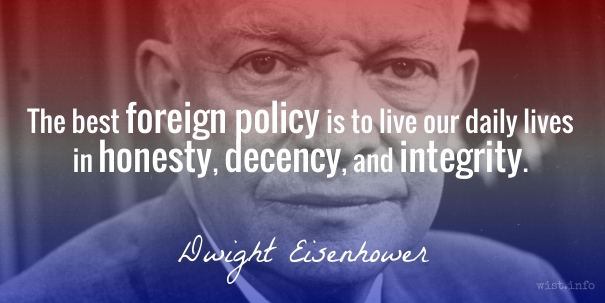
The best foreign policy is to live our daily lives in honesty, decency, and integrity; at home, making our own land a more fitting habitation for free men; and abroad, joining with those of like mind and heart, to make of the world a place where all men can dwell in peace.
Dwight David Eisenhower (1890-1969) American general, US President (1953-61)
Lecture (1950-03-23), Inaugural Gabriel Silver Lecture, Columbia University
When I think about all the money we spent on bombs and munitions, and our failures in Viet Nam, Iraq, Afghanistan and other places around the world … Instead of advancing our agenda using force, we should have instead built schools and hospitals in these countries, improving the lives of their children. By now, those children would have grown into positions of influence, and they would be grateful to us instead of hating us.
George Shultz (b. 1920) American economist, statesman, and businessman
(Attributed)
(Source)
Quoted in In Daniel Levitin, The Organized Mind (2014).
Better perish than hate and fear, and twice rather perish than make oneself hated and feared — this must someday become the highest maxim for every single commonwealth.
Friedrich Nietzsche (1844-1900) German philosopher and poet
The Wanderer and His Shadow (1880)
Physicists and astronomers see their own implications in the world being round, but to me it means that only one-third of the world is asleep at any given time and the other two-thirds is up to something.
Dean Rusk (1909-1994) American politician and diplomat
Speech, American Bar Assoc., Atlanta (22 Oct 1964)

We have no eternal allies, and we have no perpetual enemies. Our interests are eternal and perpetual, and these interests it is our duty to follow.
Henry Temple, 3rd Viscount Palmerston (1784-1865) British statesman, Prime Minister (1855-58, 1859-65) [Lord Palmerston]
Speech, House of Commons (1 Mar 1848)

There can be no greater error than to expect or calculate upon real favors from nation to nation. It is an illusion which experience must cure, which a just pride ought to discard.
George Washington (1732–1799) American military leader, Founding Father, US President (1789–1797)
Farewell Address (17 Sep 1796) [with A. Hamilton]
If crisis management requires cold and even brutal measures to show determination, it also imposes the need to show the opponent a way out. Grandstanding is good for the ego but bad for foreign policy. […] Many wars have started because no line of retreat was left open.
Law and Justice play no role in the relations of peoples of unequal strength.
Gustave LeBon (1841-1931) German psychologist
Aphorisms of Present Times, 2.6 (1913)
War is not violence and killing, pure and simple; war is controlled violence, for a purpose. The purpose of war is to support your government’s decisions by force. The purpose is never to kill the enemy just to be killing him — but to make him do what you want him to do. Not killing — but controlled and purposeful violence.
In foreign policy one must make do with what one has.
Henry Kissinger (1923-2024) German-American diplomat
Years of Upheaval, ch. 12 (1982)
International relations are governed by interests, and not by moral principles.
B. H. Liddell Hart (1895-1970) English soldier, military historian (Basil Henry Liddell Hart)
“The Illusion of Treaties,” Why Don’t We Learn from History? (1944)
The question [is] asked, “Is it common for a nation to obtain a redress of wrongs by war?” The answer to this question you will of course draw from history. In the meantime, reason will answer it on grounds of probability, that where the wrong has been done by a weaker nation, the stronger one has generally been able to enforce redress; but where by a stronger nation, redress by war has been neither obtained nor expected by the weaker. On the contrary, the loss has been increased by the expenses of the war in blood and treasure. Yet it may have obtained another object equally securing itself from future wrong. It may have retaliated on the aggressor losses of blood and treasure far beyond the value to him of the wrong he had committed, and thus have made the advantage of that too dear a purchase to leave him in a disposition to renew the wrong in future. In this way the loss by the war may have secured the weaker nation from loss by future wrong.
Thomas Jefferson (1743-1826) American political philosopher, polymath, statesman, US President (1801-09)
Letter (1816-01-29) to Noah Worcester
(Source)
But to those who expect us to calculate whether a compliance with unjust demands will not cost us less than a war we must leave as a question of calculation for them also whether to retire from unjust demands will not cost them less than a war. We can do to each other very sensible injuries by war, but mutual advantages of peace make that the best interest of both.
Thomas Jefferson (1743-1826) American political philosopher, polymath, statesman, US President (1801-09)
Message (1804-11-08) to Congress, Annual Message (State of the Union)
(Source)
The crisis in which [our country] is placed cannot but be unwelcome to those who love peace, yet spurn at a tame submission to wrong.
Thomas Jefferson (1743-1826) American political philosopher, polymath, statesman, US President (1801-09)
Letter (1808-02-29) to the New York Tammany Society
(Source)
Sent to Jacob Van Dervoort, and addressed to "the Society of Tammany or Columbian order No. 1 of the city of New York."
A respect for the rights of other people to determine their forms of government and their economy will not weaken our democracy. It will inevitably strengthen it. One of the first things we must get rid of is the idea that democracy is tantamount to capitalism.
Eleanor Roosevelt (1884-1962) First Lady of the US (1933-45), politician, diplomat, activist
Tomorrow Is Now (1963)

My hope of preserving peace for our country is not founded in the quaker principle of non resistance under every wrong, but in the belief that a just and friendly conduct on our part will procure justice and friendship from others, and that, in the existing contest, each of the combatants will find an interest in our friendship.
Thomas Jefferson (1743-1826) American political philosopher, polymath, statesman, US President (1801-09)
Letter (1803-07-10) to the Earl of Buchan
(Source)
The way chosen by the United States was plainly marked by a few clear precepts, which govern its conduct in world affairs.
First: No people on earth can be held, as a people, to be enemy, for all humanity shares the common hunger for peace and fellowship and justice.
Second: No nation’s security and well-being can be lastingly achieved in isolation but only in effective cooperation with fellow-nations.
Third: Any nation’s right to form of government and an economic system of its own choosing is inalienable.
Fourth: Any nation’s attempt to dictate to other nations their form of government is indefensible.
And fifth: A nation’s hope of lasting peace cannot be firmly based upon any race in armaments but rather upon just relations and honest understanding with all other nations.
Dwight David Eisenhower (1890-1969) American general, US President (1953-61)
“The Chance for Peace,” speech to American Society of Newspaper Editors, Washington (16 Apr 1953)
Also known as the "Cross of Iron" speech.
Always a friend to peace, & believing it to promote eminently the happiness & prosperity of mankind, I am ever unwilling that it should be disturbed, as long as the rights & interests of the nation can be preserved. but whensoever hostile aggressions on these require a resort to war, we must meet our duty, & convince the world that we are just friends & brave enemies.
Thomas Jefferson (1743-1826) American political philosopher, polymath, statesman, US President (1801-09)
Letter (1806-12-03) to Andrew Jackson
(Source)
I have ever deemed it fundamental for the United States never to take an active part in the quarrels of Europe. Their political interests are entirely distinct from ours. Their mutual jealousies, their balance of power, their complicated alliances, their forms and principles of government, are all foreign to us. They are nations of eternal war.
Thomas Jefferson (1743-1826) American political philosopher, polymath, statesman, US President (1801-09)
Letter (1823-06-11) to James Monroe
(Source)
I believe in national friendships and heartiest good-will to all nations; but national friendships, like those between men, must be founded on respect as well as on liking, on forbearance as well as upon trust. I should be heartily ashamed of any American who did not try to make the American Government act as Justly toward the other nations in international relations as he himself would act toward any individual in private relations. I should be heartily ashamed to see us wrong a weaker power, and I should hang my head forever if we tamely suffered wrong from a stronger power.
Theodore Roosevelt (1858–1919) American politician, statesman, conservationist, writer, US President (1901–1909)
Speech (1910-08-31), “The New Nationalism,” John Brown Memorial Park dedication, Osawatomie, Kansas
(Source)
What could be more absurd, to begin with, than our attitude of high moral outrage against other nations for manufacturing the selfsame weapons that we manufacture? The difference, as our leaders say, is that we will use these weapons virtuously, whereas our enemies will use them maliciously — a proposition that too readily conforms to a proposition of much less dignity: we will use them in our interest, whereas our enemies will use them in theirs.
Wendell Berry (b. 1934) American farmer, educator, poet, conservationist
Essay (1999), “The Failure of War,” Citizenship Papers (2003)
(Source)
Freedom is not an ideal, it is not even a protection, if it means nothing more than freedom to stagnate, to live without dreams, to have no greater aim than a second car and another television set — and this in a world where half our fellow men have less than enough to eat.
Adlai Stevenson (1900-1965) American diplomat, statesman
“Putting First Things First”, Foreign Affairs (1960-01)
(Source)
A decline in courage may be the most striking feature that an outside observer notices in the West today. The Western world has lost its civic courage, both as a whole and separately, in each country, in each government, in each political party, and, of course, in the United Nations. Such a decline in courage is particularly noticeable among the ruling and intellectual elites, causing an impression of a loss of courage by the entire society. There are many courageous individuals, but they have no determining influence on public life.
Political and intellectual functionaries exhibit this depression, passivity, and perplexity in their actions and in their statements, and even more so in their self-serving rationales as to how realistic, reasonable, and intellectually and even morally justified it is to base state policies on weakness and cowardice. And the decline in courage, at times attaining what could be termed a lack of manhood, is ironically emphasized by occasional outbursts and inflexibility on the part of those same functionaries when dealing with weak governments and with countries that lack support, or with doomed currents which clearly cannot offer resistance. But they get tongue-tied and paralyzed when they deal with powerful governments and threatening forces, with aggressors and international terrorists.
Should one point out that from ancient times decline in courage has been considered the beginning of the end?
Alexander Solzhenitsen (1918-2008) Russian novelist, emigre [Aleksandr Isayevich Solzhenitsyn]
“A World Split Apart,” Commencement Address, Harvard (8 Jun 1978)
(Source)
In the field of world policy I would dedicate this Nation to the policy of the good neighbor — the neighbor who resolutely respects himself and, because he does so, respects the rights of others — the neighbor who respects his obligations and respects the sanctity of his agreements in and with a world of neighbors.
Franklin Delano Roosevelt (1882-1945) American lawyer, politician, statesman, US President (1933-1945)
Speech (1933-03-04), Inaugural Address, Washington, D.C.
(Source)
(Source (video); text confirmed)
Just as our national policy in internal affairs has been based upon a decent respect for the rights and the dignity of all our fellow men within our gates, so our national policy in foreign affairs has been based on a decent respect for the rights and dignity of all nations, large and small. And the justice of morality must and will win in the end.
Franklin Delano Roosevelt (1882-1945) American lawyer, politician, statesman, US President (1933-1945)
Speech (1941-01-06), “State of the Union [Four Freedoms],” Washington, D. C.
(Source)
War is not merely a political act but a real political instrument, a continuation of political intercourse, a carrying out of the same by other means.
[Der Krieg nicht bloss ein politischer Akt, sondern ein wahres politisches Instrument ist, eine Fortsetzung des politischen Verkhers, ein Durchführen desselben mit andern Mitteln.]
Karl von Clausewitz (1780-1831) Prussian soldier, historian, military theorist
On War [Vom Kriege], Book 1, ch. 1 “What is War? [Was ist der Krieg?],” § 24 (1.1.24) (1832) [tr. Jolles (1943)]
(Source)
(Source (German)). Alternate translations:War is not merely a political act, but also a real political instrument, a continuation of political commerce, a carrying out of the same by other means.
[tr. Graham (1874)]War is not merely an act of policy but a true political instrument, a continuation of political intercourse, carried on with other means.
[tr. Howard & Paret (1976)]
There is often confusion between this full sentence and the shorter section heading, which is also quoted:War is a mere continuation of policy by other means.
[tr. Graham (1874) and Jolles (1943)]War is merely the continuation of policy by other means.
[tr. Howard & Paret (1976)]Der Krieg ist eine blosse Fortsetzung der Politik mit andern Mitteln.
[German source]

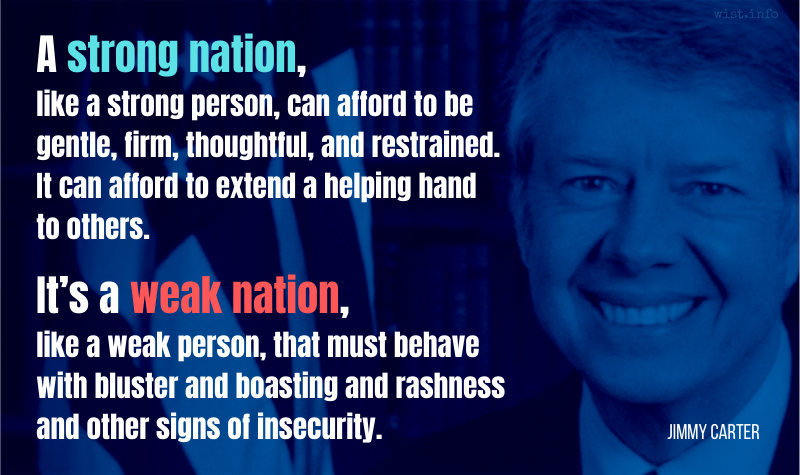
A strong nation, like a strong person, can afford to be gentle, firm, thoughtful, and restrained. It can afford to extend a helping hand to others. It’s a weak nation, like a weak person, that must behave with bluster and boasting and rashness and other signs of insecurity.
Jimmy Carter (b. 1924) American politician, US President (1977-1981), Nobel laureate [James Earl Carter, Jr.]
Speech (1976-10-14), “Warm Hearts and Cool Heads,” Liberal Party of New York Dinner, New York City
(Source)
The title of the speech was from a phrase coined by Adlai Stevenson.

So let us begin anew — remembering on both sides that civility is not a sign of weakness, and sincerity is always subject to proof. Let us never negotiate out of fear. But let us never fear to negotiate.
John F. Kennedy (1917-1963) American politician, author, journalist, US President (1961–63)
Inaugural Address (20 Jan 1961)
(Source)