Much has been said in this country about not wanting to participate in foreign wars and people who have said it, must now face the fact that foreign wars come very close to our own shores. We will always have not only the religious groups, but many groups who feel that war is wrong. I cannot imagine how anyone could feel otherwise with the picture before them today. But when force not only rules in certain countries, but is as menacing to all the world, as it is today, one cannot live in a Utopia which prays for different conditions and ignores those which exist.
Eleanor Roosevelt (1884-1962) First Lady of the US (1933-45), politician, diplomat, activist
Column (1940-05-17), “My Day”
(Source)
Quotations about:
idealism
Note not all quotations have been tagged, so Search may find additional quotes on this topic.

Hope is the boy, a blind, headlong, pleasant fellow, good to chase swallows with the salt; Faith is the grave, experienced, yet smiling man. Hope lives on ignorance; open-eyed Faith is built upon a knowledge of our life, of the tyranny of circumstance and the frailty of human resolution. Hope looks for unqualified success; but Faith counts certainly on failure, and takes honourable defeat to be a form of victory. Hope is a kind old pagan; but Faith grew up in Christian days, and early learnt humility.
In the one temper, a man is indignant that he cannot spring up in a clap to heights of elegance and virtue; in the other, out of a sense of his infirmities, he is filled with confidence because a year has come and gone, and he has still preserved some rags of honour. In the first, he expects an angel for a wife; in the last, he knows that she is like himself — erring, thoughtless, and untrue; but like himself also, filled with a struggling radiancy of better things, and adorned with ineffective qualities.Robert Louis Stevenson (1850-1894) Scottish essayist, novelist, poet
Essay (1881), “Virginibus Puerisque, Part 2”
(Source)
First published in Virginibus Puerisque and Other Papers, ch. 1, part 2 (1881).
CALVIN: Some people are pragmatists, taking things as they come and making the best of the choices available. Some people are idealists, standing for principle and refusing to compromise. And some people just act on any whim that enters their head.
HOBBES: I wonder which you are.
CALVIN: I pragmatically turn my whims into principles!


The essence of being human is that one does not seek perfection, that one is sometimes willing to commit sins for the sake of loyalty, that one does not push asceticism to the point where it makes friendly intercourse impossible, and that one is prepared in the end to be defeated and broken up by life, which is the inevitable price of fastening one’s love upon other human individuals. No doubt alcohol, tobacco and so forth are things that a saint must avoid, but sainthood is also a thing that human beings must avoid.
George Orwell (1903-1950) English writer [pseud. of Eric Arthur Blair]
Essay (1949-01), “Reflections on Gandhi,” Partisan Review
(Source)
If you keep your eyes so fixed on Heaven that you never look at the Earth, you will stumble into Hell.
Austin O'Malley (1858-1932) American ophthalmologist, professor of literature, aphorist
Keystones of Thought (1914)
(Source)
Art is born and takes hold wherever there is a timeless and insatiable longing for the spiritual, for the ideal: that longing which draws people to art. Modern art has taken the wrong turn in abandoning the search for the meaning of existence in order to affirm the value of the individual for his own sake.
Andrei Tarkovsky (1932-1986) Russian film director, screenwriter, film theorist [Андрей Арсеньевич Тарковский]
Sculpting in Time (1986) [tr. Hunter-Blair]
(Source)

I questioned the desire to attribute the worst aspects of human behaviour to characters whose only useful function, as I see it, aside from simply entertaining young people and anyone else who fancies an uplifting holiday in a storybook world far from the grinding monotony of pessimism and disillusion, is to provide a primary-coloured cartoon taste of how we all might be if we had the wit and the will and the self-sacrifice it takes to privilege our best selves and loftiest aspirations over our base instincts. While that great day is unlikely to happen any time soon in any halfway-familiar real world, why not let comic book universes be playgrounds for the kind of utopian impulses that have in the past brought out the best in us?
Grant Morrison (b. 1960) Scottish comic book writer and playwright
“SUPERMAN and THE AUTHORITY annotations Pt 2,” blog entry (16 Feb 2022)
(Source)

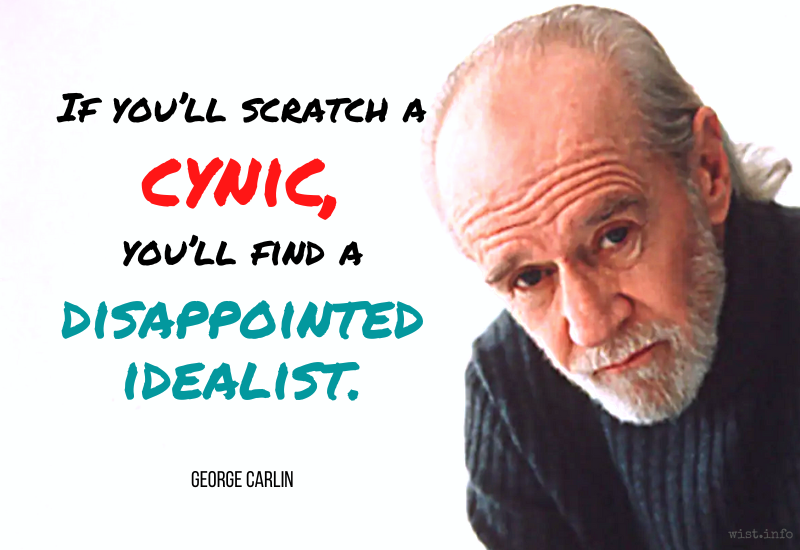
If you’ll scratch a cynic, you’ll find a disappointed idealist.
George Carlin (1937-2008) American comedian
Interview (2001-07) by Marc Cooper, The Progressive
(Source)
A documented case of a trademark phrase Carlin frequently used, though not necessarily original with him.
Often quoted as "Inside every cynical person, there is a disappointed idealist."
Scratch the surface of most cynics and you find a frustrated idealist — someone who made the mistake of converting his ideals into expectations.
Peter Senge (b. 1947) American systems scientist, lecturer, academic
The Fifth Discipline, Part 3, ch. 8 (1990)
(Source)

The uncommitted life is not worth living. We either believe in something or we don’t. Commitment is willingness to stand up and be counted. It is a human must — for young and old, for black and white, for Christian, Moslem and Buddhist. It is skill plus good will. It is a thoughtful decision on the part of an individual to participate passionately in the events of his time. It is the dogged staying-power coupled with the sensible idealism that makes the word go ’round.
The young know how old age should be; the old how youth should have been.
Paul Eldridge (1888-1982) American educator, novelist, poet
Maxims for a Modern Man, #139 (1965)
(Source)

Monsieur, my son is twenty-two years old. If he had not become a Communist at twenty-two, I would have disowned him. If he is still a Communist at thirty, I will do it then.
Georges Clemenceau (1841–1929) French statesman, physician, journalist
(Attributed)
Response to someone who was alarmed about his son being a Communist, as attributed in Bennett Cerf, Try and Stop Me (1944).
This may be the source of the quote also attributed to Clemenceau, “Any man who is not a socialist at age twenty has no heart. Any man who is still a socialist at age forty has no head.” Later, George Seldes attributed to David Lloyd George: "A young man who isn’t a socialist hasn’t got a heart; an old man who is a socialist hasn’t got a head.” François Guizot in the mid-19th Century was said to have said, “Not to be a republican at twenty is proof of want of heart; to be one at thirty is proof of want of head.”
The earliest version of this comes from a public letter by Anselme Polycarpe Batbie (1828-1887), who attributed this to Edmund Burke: "Anyone who is not a republican at twenty casts doubt on the generosity of his soul; but he who, after thirty years, perseveres, casts doubt on the soundness of his mind. [Celui qui n’est pas républicain à vingt ans fait douter de la générosité de son âme; mais celui qui, après trente ans, persévère, fait douter de la rectitude de son esprit.]" This has not been found in Burke's writings.
Variants have also been attributed to Benjamin Disraeli, Dean Inge, George Bernard Shaw, Winston Churchill, Otto von Bismarck, and Bertrand Russell.
Further discussion of this quotation:
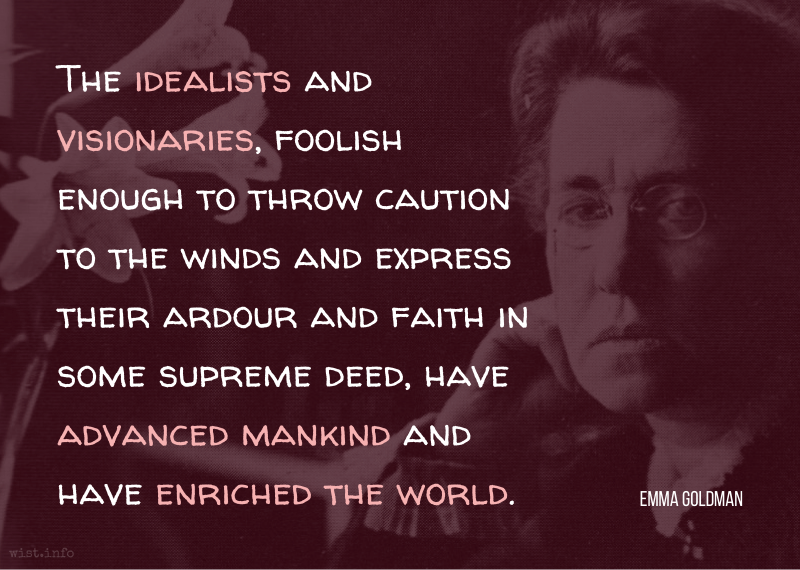
From time immemorial the wise and practical have denounced every heroic spirit. Yet it has not been they who have influenced our lives. The idealists and visionaries, foolish enough to throw caution to the winds and express their ardour and faith in some supreme deed, have advanced mankind and have enriched the world.
Emma Goldman (1869-1940) Lithuanian-American anarchist, activist
Living My Life, Part 2, ch. 39 (1931)
(Source)

The greatest bloodshed? The most murders? I would say two things: sincere love and a sincere devotion to liberty. … If you kill out of love or for the perfect utopia, you never stop killing because human nature is always imperfect.
Peter Viereck (1916-2006) American poet, historian, academic
“Clio is No Cleo: The Messiness of History,” lecture, Mt. Holyoke College (1997)
(Source)
Reprinted in Society (Mar 2004) and collected in Strict Wildness (2008).

“People aren’t either wicked or noble,” the hook-handed man said. “They’re like chef salads, with good things and bad things chopped and mixed together in a vinaigrette of confusion and conflict.”
Lemony Snicket (b. 1970) American author, screenwriter, musician (pseud. for Daniel Handler)
The Grim Grotto (2004)

I have no more faith in positive militant ideals; they can so seldom be carried out without thousands of human beings getting maimed or imprisoned. Phrases like “I will purge this nation,” “I will clean up this city,” terrify and disgust me. They might not have mattered so much when the world was emptier: they are horrifying now, when one nation is mixed up with another, when one city cannot be organically separated from its neighbours.
E. M. Forster (1879-1970) English novelist, essayist, critic, librettist [Edward Morgan Forster]
“The Unsung Virtue of Tolerance,” radio broadcast (Jul 1941)
(Source)
Published as "Tolerance," Two Cheers for Democracy (1951).
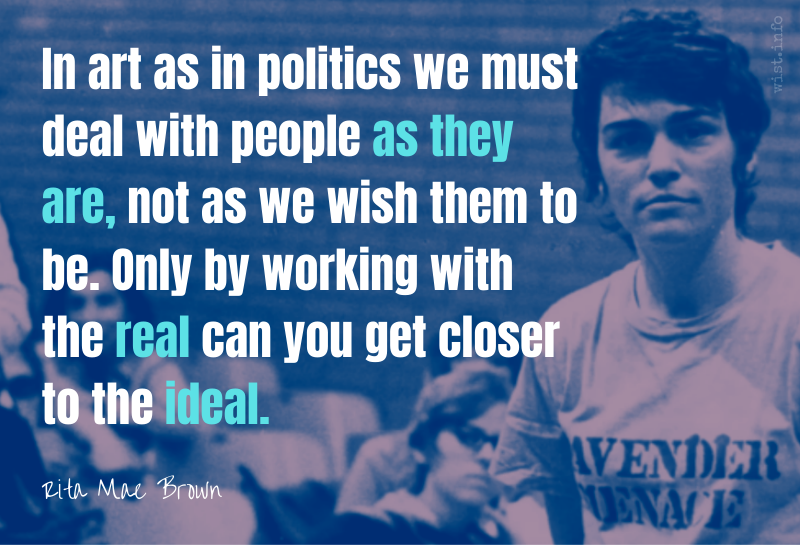
In art as in politics we must deal with people as they are, not as we wish them to be. Only by working with the real can you get closer to the ideal.
Rita Mae Brown (b. 1944) American author, playwright
In Her Day, Preface, “A Note to the Feminist Reader” (1976)
(Source)

SIR HUMPHREY: A cynic is what an idealist calls a realist.
Jonathan Lynn (b. 1943) English actor, comedy writer, director
Yes Minister, S3E4 “The Moral Dimension” (1982) [with Antony Jay]

The people I respect most behave as if they were immortal and as if society was eternal. Both assumptions are false: both of them must be accepted as true if we are to go on eating and working and loving, and are to keep open a few breathing-holes for the human spirit. No millennium seems likely to descend upon humanity; no better and stronger League of Nations will be instituted; no form of Christianity and no alternative to Christianity will bring peace to the world or integrity to the individual; no “change of heart” will occur. And yet we need not despair, indeed, we cannot despair; the evidence of history shows us that men have always insisted on behaving creatively under the shadow of the sword; that they have done their artistic and scientific and domestic stuff for the sake of doing it, and that we had better follow their example under the shadow of the aeroplanes.
E. M. Forster (1879-1970) English novelist, essayist, critic, librettist [Edward Morgan Forster]
“What I Believe,” The Nation (16 Jul 1938)
(Source)
Come heed me, my brothers, come heed, one and all
Don’t brag about standing or you’ll surely fall
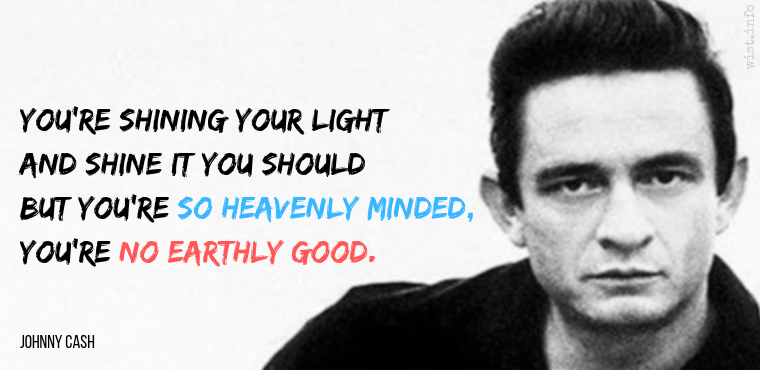
You’re shining your light and shine it you should
But you’re so heavenly minded, you’re no earthly goodIf you’re holding heaven, then spread it around
There’s hungry hands reaching up here from the ground
Move over and share the high ground where you stood
So heavenly minded, you’re no earthly good
John R. "Johnny" Cash (1932-2003) American singer-songwriter, guitarist, actor, author
“So Heavenly Minded, You’re No Earthly Good”
(Source)

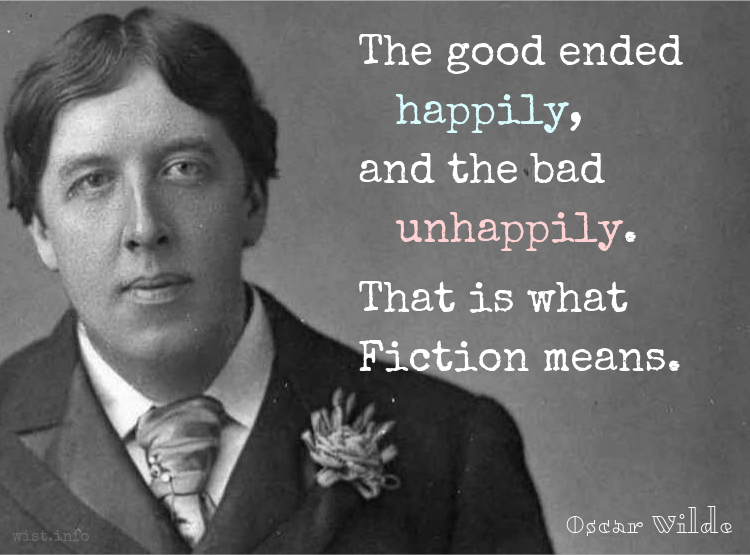
The good ended happily, and the bad unhappily. That is what Fiction means.
Oscar Wilde (1854-1900) Irish poet, wit, dramatist
The Importance of Being Earnest, act 2 (Miss Prism) [1895]
(Source)

Cynics are, in the end, only idealists with awkwardly high standards.

Back in the nineteen-hundreds it was a wonderful experience for a boy to discover H. G. Wells. There you were, in a world of pedants, clergymen and golfers, with your future employers exhorting you to “get on or get out”, your parents systematically warping your sexual life, and your dull-witted schoolmasters sniggering over their Latin tags; and here was this wonderful man who could tell you about the inhabitants of the planets and the bottom of the sea, and who knew that the future was not going to be what respectable people imagined.
George Orwell (1903-1950) English writer [pseud. of Eric Arthur Blair]
Essay (1941-08), “Wells, Hitler, and the World State,” Horizon
(Source)
The process which, if not checked, will abolish Man goes on apace among Communists and Democrats no less than among Fascists. The methods may (at first) differ in brutality. But many a mild-eyed scientist in pince-nez, many a popular dramatist, many an amateur philosopher in our midst, means in the long run just the same as the Nazi rulers of Germany: ‘Traditional values are to be debunked’ and mankind to be cut out into some fresh shape at the will (which must, by hypothesis, be an arbitrary will) of some few lucky people in one lucky generation which has learned how to do it.
C. S. Lewis (1898-1963) English writer, literary scholar, lay theologian [Clive Staples Lewis]
The Abolition of Man (1943)

[Capitalism is] the astonishing belief that the nastiest motives of the nastiest men somehow or other work for the best results in the best of all possible worlds.
John Maynard Keynes (1883-1946) English economist
(Attributed)
Attributed by Sir George Schuster, Christianity and Human Relations in Industry (1951). Frequently quoted, but no direct citation found.
A common variant, also not found in Keynes' work (and also attributed, without citation, to John Kenneth Galbraith):Capitalism is the astounding belief that the most wickedest of men will do the most wickedest of things for the greatest good of everyone.
E. A. G. Robinson was a close colleague of Galbraith, and in his book Monopoly (1941), he wrote:The great merit of the capitalist system, it has been said, is that it succeeds in using the nastiest motives of nasty people for the ultimate benefit of society.
Another variant:Capitalism is the extraordinary belief that the nastiest of men for the nastiest of motives will somehow work for the benefit of all.
More discussion and research into this quote:
- Quote Origin: Capitalism: The Nastiest of Men for the Nastiest of Motives Will Somehow Work for the Benefit of All – Quote Investigator®
- "Capitalism is the belief that the wickedest of men…
- John Maynard Keynes: Capitalism and the "Nastiest/Wickedest of Men" | Steve Cotler | One man's squint at the metaphorical signposts, songbirds, soapboxes, street musicians, and hot dog stands of life. Criticism, lyricism, polemics, performance, and making change...all with mustard.

DRUMLIN: I know you must think this is all very unfair. Maybe that’s an understatement. What you don’t know is I agree. I wish the world was a place where fair was the bottom line, where the kind of idealism you showed at the hearing was rewarded, not taken advantage of. Unfortunately, we don’t live in that world.
ARROWAY: Funny, I’ve always believed that the world is what we make of it.
Carl Sagan (1934-1996) American scientist and writer
Contact, novel (1997) [film screenplay by J. Hart and M. Goldenberg]
(Source)
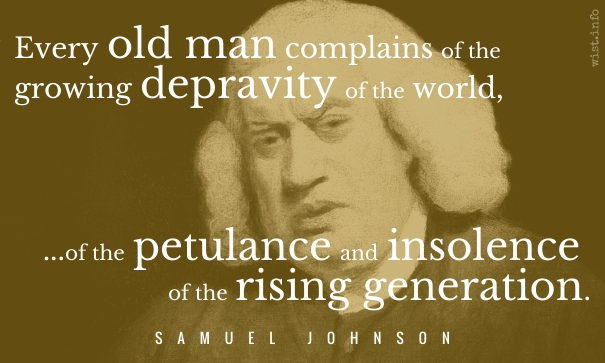
Every old man complains of the growing depravity of the world, of the petulance and insolence of the rising generation. He recounts the decency and regularity of former times, and celebrates the discipline and sobriety of the age in which his youth was passed; a happy age which is now no more to be expected, since confusion has broken in upon the world, and thrown down all the boundaries of civility and reverence.
Samuel Johnson (1709-1784) English writer, lexicographer, critic
The Rambler, #50 (8 Sep 1750)
(Source)

By concentrating on what is good in people, by appealing to their idealism and their sense of justice, and by asking them to put their faith in the future, socialists put themselves at a severe disadvantage.
Ian McEwan (b. 1948) English novelist and screenwriter
City Limits (London, May 27, 1983)
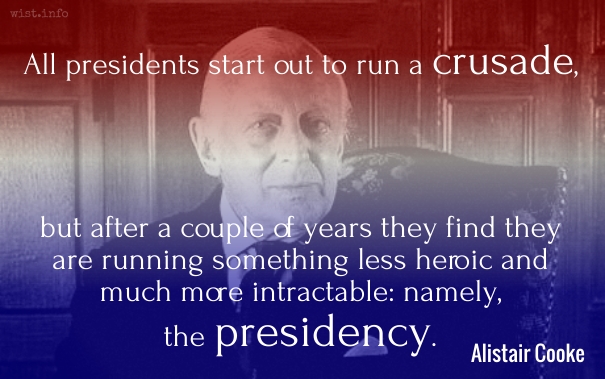
All presidents start out to run a crusade, but after a couple of years they find they are running something less heroic and much more intractable: namely, the presidency.
Alistair Cooke (1908-2004) Anglo-American essayist and journalist
Talk About America, ch. 6 (1981)
He that studies books alone, will know how things ought to be; and he that studies men will know how things are.
Charles Caleb "C. C." Colton (1780-1832) English cleric, writer, aphorist
Lacon: or, Many Things in Few Words, Vol. 1, Preface (1820)
No member of our generation who wasn’t a Communist or a dropout in the thirties is worth a damn.
Lyndon B. Johnson (1908-1973) American politician, educator, US President (1963-69)
Comment (1960)
(Source)
Comment regarding wealthy campaign donors, made to friends and reporters while flying back from a campaign event in Binghamton, New York. Quoted in David Halberstam, The Best and the Brightest, ch. 20 (1972)

All men in whose character there is not an element of hardened baseness must admit the need in our public life of those qualities which we somewhat vaguely group together when we speak of “reform,” and all men of sound mind must also admit the need of efficiency.
There are, of course, men of such low moral type, or of such ingrained cynicism, that they do not believe in the possibility of making anything better, or do not care to see things better. There are also men who are slightly disordered mentally, or who are cursed with a moral twist which makes them champion reforms less from a desire to do good to others than as a kind of tribute to their own righteousness, for the sake of emphasizing their own superiority. From neither of these classes can we get any real help in the unending struggle for righteousness.
There remains the great body of the people, including the entire body of those through whom the salvation of the people must ultimately be worked out. All these men combine or seek to combine in varying degrees the quality of striving after the ideal, that is, the quality which makes men reformers, and the quality of so striving through practical methods — the quality which makes men efficient. Both qualities are absolutely essential. The absence of either makes the presence of the other worthless or worse.
It is this belief in absolutes, I would hazard, that is the great enemy today of the life of the mind. This may seem a rash proposition. The fashion of the time is to denounce relativism as the root of all evil. But history suggests that the damage done to humanity by the relativist is far less than the damage done by the absolutist — by the fellow who, as Mr. Dooley once put it, “does what he thinks th’ Lord wud do if He only knew th’ facts in th’ case.”
Arthur M. Schlesinger, Jr. (1917-2007) American historian, author, social critic
“The Opening of the American Mind,” New York Times (23 Jul 1989)

Courage charms us becaue it indicates that a man loves an idea better than all the things in the world, that he is thinking neither of his bed, nor his dinner, nor hismoney, but will venture all to put in act the invisible thought of his mind.
Ralph Waldo Emerson (1803-1882) American essayist, lecturer, poet
Journal (1859, Fall)
The extremes of vice and virtue are alike detestable; absolute virtue is as sure to kill a man as absolute vice is, let alone the dullnesses of it and the pomposities of it.
Samuel Butler (1835-1902) English novelist, satirist, scholar
The Note-Books of Samuel Butler, “Vice and Virtue,” ii (1912)Full text.
Aim at perfection in everything, though in most things it is unattainable; however, they who aim at it, and persevere, will come much nearer it than those whose laziness and despondency make them give it up as unattainable.
Lord Chesterfield (1694-1773) English statesman, wit [Philip Dormer Stanhope]
Letter to his son, #226 (24 May 1750)
(Source)