Quotations about:
self-aggrandizement
Note not all quotations have been tagged, so Search may find additional quotes on this topic.
As a horse when he has run, a dog when he has tackled the game, a bee when it has made the honey, so a man when he has done a good act does not call out for others to come and see, but he goes on to another act, as a vine goes on to produce again the grapes in season.
[ἵππος δραμών, κύων ἰχνεύσας, μέλισσα μέλι ποιήσασα, ἄνθρωπος δ̓ εὖ ποιήσας οὐκ ἐπιβοᾶται, ἀλλὰ μεταβαίνει ἐφ̓ ἕτερον, ὡς ἄμπελος ἐπὶ τὸ πάλιν ἐν τῇ ὥρᾳ τὸν βότρυν ἐνεγκεῖν.]
Marcus Aurelius (AD 121-180) Roman emperor (161-180), Stoic philosopher
Meditations [To Himself; Τὰ εἰς ἑαυτόν], Book 5, ch. 6 (5.6) (AD 161-180) [tr. Long (1862)]
(Source)
(Source (Greek)). Alternate translations:As a horse after a race, and a hunting dog when he hath hunted, and a bee when she hath made her honey, look not for applause and commendation; so neither doth that man that rightly doth understand his own nature when he hath done a good turn: but from one doth proceed to do another, even as the vine after she hath once borne fruit in her own proper season, is ready for another time.
[tr. Casaubon (1634)]A Fleet Horse or Greyhound, don't use to make a Noise when they have perform'd handsomly, nor a Bee neither when she has made a little Hony: And thus a Man that's rightly Kind, never proclaims a Good Turn, but does another as soon as he can; just like a Vine that bears again the next Season.
[tr. Collier (1701)]The horse, when he hath run his course, the hound, when he has followed the track, the bee, when it has made its honey, and the Man, when he hath done good to others, don’t make a noisy boast of it, but go on to repeat the like actions, as the vine in its season produces its new clusters again.
[tr. Hutcheson/Moor (1742)]This same is applicable to the horse that has finished his course, to the hound that has ended his chase, and to the bee that has produced its honey. Let the man, then, who has done a beneficent action, not look for applause; but repeat it the first opportunity; as the vine again yields its fruit at the proper season.
[tr. Graves (1792), 5.5]A fleet horse or greyhound do not make a noise when they have done well, nor a bee neither when she has made a little honey. And thus a man that has done a kindness never proclaims it, but does another as soon as he can, just like a vine that bears again the next season.
[tr. Collier/Zimmern (1887)]As the horse that runs, the hound that hunts, the bee that hives its honey, so the man who does the kindness does not raise a shout, but passes on to the next act, as a vine to the bearing of clusters for next season.
[tr. Rendall (1898)]The horse when he has run his course, the hound when he has followed the track, the bee when it has made its honey, and the man when he has done good to others, make no noisy boast of it, but set out to do the same once more, as the vine in its season produces its new clusters again.
[tr. Hutcheson/Chrystal (1902)][...] a steed when it has run its course, a hound when it has singled out the trail, a bee when she hath made her comb. And so a man when he hath done one thing well, does not cry it abroad, but betakes himself to a second, as a vine to bear afresh her clusters in due season.
[tr. Haines (Loeb) (1916)]A horse runs, a hound tracks, bees make honey, and a man does good, but doesn't know that he has done it and passes on to a second act, like a vine to bear once more its grapes in due season.
[tr. Farquharson (1944)][...] a horse that has run its race, a hound that has tracked his quarry, or a bee that has hived her honey. Like them, the man who has done one good action does not cry it aloud, but passes straight on to a second, as the vine passes on to the bearing of another summer's grapes.
[tr. Staniforth (1964)][...] a horse when it has run its race, or a dog when it has followed a trail, or a bee when it has mades its honey. And so such a person, when he has done a good deed, does not cry it abroad, but passes straight on to the next, as the vine yields new clusters of grapes when the season comes around.
[tr. Hard (1997 ed.)]A horse at the end of the race ...
A dog when the hunt is over ...
A bee with its honey stored ...
And a human being after helping others.
They don't make a fuss about it. They just go on to something else, as the vine looks forward to bearing fruit again in season.
[tr. Hays (2003)]A horse that has raced, a dog that has tracked, a bee that has made honey, and a man that has done good -- none of these knows what they have done, but they pass on to the next action, just as the vine passes on to bear grapes again in due season.
[tr. Hammond (2006)][...] a horse when it has run its race, or a dog when it has followed its trail, or a bee when it has made its honey. And so such a person, when he has done a good deed, does not shout about it, but passes straight on to the next one, as the vine yields new clusters of grapes when the season comes around.
[tr. Hard (2011 ed.)][...] a horse which has run a race, a dog which has followed the scent, or a bee which has made its honey. A person who has done something good does not make a big fuss about it, but goes on to the next action, as a vine goes on to produce grapes again in season.
[tr. Gill (2013), sec. 3-4]A man does not proclaim a good deed, but proceeds to another, as a vine bears grapes again in season.
[ed. Taplin (2016)]

Courage, intellect, all the masterful qualities, serve but to make a man more evil if they are used merely for that man’s own advancement, with brutal indifference to the rights of others. It speaks ill for the community if the community worships these qualities and treats their possessors as heroes regardless of whether the qualities are used rightly or wrongly.
Theodore Roosevelt (1858-1919) American politician, statesman, conservationist, writer, US President (1901-1909)
Speech (1910-04-23), “Citizenship in a Republic [The Man in the Arena],” Sorbonne, Paris
(Source)
Can I forget your many favours? Nay.
Why don’t I mention them? Because you do.
If I begin, some one is sure to say
“Your patron told me all he did for you”;
Friend there are tasks cannot be done by two;
Shall this be yours or mine? for I submit
However great a gift, there nothing due
To any giver who shall boast of it.[Quae mihi praestiteris memini semperque tenebo.
Cur igitur taceo, Postume? Tu loqueris.
Incipio quotiens alicui tua dona referre,
Protinus exclamat ‘Dixerat ipse mihi.’
Non belle quaedam faciunt duo: sufficit unus
Huic operi: si vis, ut loquar, ipse tace.
Crede mihi, quamvis ingentia, Postume, dona
Auctoris pereunt garrulitate sui.]Martial (AD c.39-c.103) Spanish Roman poet, satirist, epigrammatist [Marcus Valerius Martialis]
Epigrams [Epigrammata], Book 5, epigram 52 (5.52) (AD 90) [tr. Pott & Wright (1921), “Self-Praise”]
(Source)
"To Postumus." (Source (Latin)). Alternate translations:Thy gifts to me I thinke of, and still shall.
Why then do I not speake of them at all?
Thou dost. Where ere I tell thy charitie,
Tis answer'd straight, himselfe has told it me.
This work befits not both; one is enough;
If thou wouldst have me speake, be silent thou.
For (trust me) wert thou nere so liberall,
The givers talking would destroy it all.
[tr. May (1629), ep. 53]What thou conferr'st on me I do
Remember, and shall think on, too.
Why therefore do I hold my tongue?
Cause, Posthumus, thou ne'er hast done.
As often as I go to treat
of these thy gifts to them I meet,
'T is presently replied, "Forbear,
He whisper'd it into my ear."
Two men some things cannot do well:
One person may suffice to tell,
and do this work: if it may please
That I shall speak, then hold thy peace.
For prithee, Postumus, believe,
Though that thy gifts are great to give
All thanks must perish, and are lost,
When authors their own actions boast.
[tr. Fletcher (1656)]Your favors to me I remember well;
But do not mention them; because you tell.
Whenever I begin, I'm answer'd strait,
"I heard from his own mouth, what you relate."
Two ill become the business of but one;
Be you but silent, I will speak alone.
Great are your gifts; but when proclaim'd around,
The obligation dies upon the sound.
[tr. Hay (1755), ep. 53]The services you have rendered me I do not forget, and will always keep them in my mind. How happens it, Posthumus, that I am silent? It is because you talk. Do I begin to expatiate on your favours, I am told, "I heard all about it from himself." Some things are not handsomely performed by two; one person is enough to relate kindness; if you wish me to speak, you must remain silent. The merit of gifts, however great they be, is lost by the garrulity of the giver.
[tr. Amos (1858), ch. 3, ep. 78; ep. 53]Your services to me I remember, and shall never forget Why then am I silent about them, Postumus? Because you yourself talk of them. Whenever I begin to speak to any one of your favours, he immediately exclaims, "He has told me of them himself." There are certain things which cannot be well done by two people; one is enough in this case. If you wish me to speak, keep silence yourself. Believe me, Postumus, gifts, however great, are deprived of their value by garrulity on the part of the donor.
[tr. Bohn's Classical (1859)]I'm grateful for your favors;
They'll never be forgot.
You wonder why I'm dumb about 'em?
Just because you're not.
Whenever I start telling
Of kindnesses you'd done,
The tale, I find, you'd quite concluded
Long ere I'd begun.
Now two men spoil the business
That one does well alone.
If I 'm desired to open my mouth,
Kindly shut your own.
[tr. Nixon (1911)]Your bounty to me I remember and shall always keep in mind. Why, then, and I silent about it, Postumus? You speak of it. As often as I begin to report to someone your presents, he at once exclaims, "He himself had told me." These are things which two persons do not do nicely: one suffices for this work' if you want me to speak, be you yourself silent. Trust me; gifts, however great, Postumus, lose their value by the chattering of the giver.
[tr. Ker (1919)]Grateful for all your gifts I still shall be;
"Why then be silent?" Well, you speak for me.
If to a friend your kindness I report,
With, "Yes, he told me so" he cuts me short.
Some tasks are not so suitable for two,
So thank you, Postumus, I'll wait for you.
Believe me, gifts, however rich they be,
Lose all their value by loquacity.
[tr. Francis & Tatum (1924), #251]I remember all you have done for me and shall ever keep it in mind. Why then do I say nothing about it, Postumus? You talk. Whenever I start to tell somebody of your generosity, he exclaims at once: "He tole me that himself." Some things are not nicely done by two. One is enough for this work. If you want me to talk, you must hold your tongue. Believe me, Postumus, the most magnificent of gifts are nullified by the garrulity of the giver.
[tr. Shackleton Bailey (1993)]You are my patron, I would give you praise,
But when talk of your virtues I would raise,
I'm told you have already laid them out.
Where I would whisper, you your merits shout.
We must more prudently divide our labor
To have efficient impact on our neighbor.
If I'm to praise you, you must hold your peace,
Or give me from my gratitude release.
Your gifts do not give me the power to do
Promotion constantly undone by you.
You undermine my prized veracity
With puffings of your own loquacity.
[tr. Wills (2007)]I'll always cherish what you’ve done for me.
Why don’t I speak of it? Because you do.
Whenever I tell someone of your bounty,
he cries at once: “He told me of it, too!”
Some things two can’t do well; just one suffices.
You must keep mum, if you want me to gush.
Believe me, Postumus, the greatest gifts
are canceled when the giver just won't hush.
[tr. McLean (2014)]About your gifts I'd love to gush,
Instead, I feel I have to hush.
When I tell people, they don't doubt it:
You've already bragged about it.
Maybe we should coordinate
Who praises your largesse of late.
But gifts do lose their gleam and such
When givers praise themselves too much.
[tr. Hill (2023)]
Whoseover interrupts the conversation of others to make a display of his own wisdom, certainly betrays his ignorance.
Sa'adi (1184-1283/1291?) Persian poet [a.k.a. Sa'di, Moslih Eddin Sa'adi, Mushrif-ud-Din Abdullah, Muslih-ud-Din Mushrif ibn Abdullah, Mosleh al-Din Saadi Shirazi, Shaikh Mosslehedin Saadi Shirazi]
Gulistān [Rose Garden, گُلِستان], ch. 8 “Rules for Conduct in Life,” Maxim 82 (1258) [tr. Gladwin (1806)]
(Source)
Alternate translations:Whoever interrupts the conversation of others to display the extent of his wisdom, will assuredly discover the depth of his folly.
[tr. Eastwick (1852), #82]Who interrupts the conversation of others that they may know his excellence, they will become acquainted only with the degree of his folly.
[tr. Burton (1888), #58]Whoever interrupts the conversation of others to make a display of his own fund of knowledge, makes notorious his own stock of ignorance.
[tr. Ross (1900), #96]If any one interrupts the speech of others in order that people may know his stock of learning, they will discover the extent of his ignorance.
[tr. Platts (1904), #86]Those whose conversation has been interrupted by a man trying to show off his intelligence will know him instead by the depth of his ignorance.
[tr. Rehatsek/Newman (2004), #84]

The very essence of politeness seems to be to take care that by our words and actions we make other people pleased with us as well as with themselves.
[Il me semble que l’esprit de politesse est une certaine attention à faire que par nos paroles et par nos manières les autres soient contents de nous et d’eux-mêmes.]
Jean de La Bruyère (1645-1696) French essayist, moralist
The Characters [Les Caractères], ch. 5 “Of Society and Conversation [De la Société et de la Conversation],” § 32 (5.32) (1688) [tr. Van Laun (1885)]
(Source)
(Source (French)). Alternate translations:The Politeness of the Mind is a certain care to make us pleasing by our discourses and manners to our selves and others.
[Bullord ed. (1696)]Politeness seems to be a certain Care, by the manner of our Words and Actions, to make others pleas'd with us and themselves.
[Curll ed. (1713)]Politeness seems to be a Care to model our Discourses and Manners so as to please ourselves and others.
[Browne ed. (1752)]It seems to me that the spirit of politeness lies in taking care to speak and act in such a way as to make others pleased with us and with themselves.
[tr. Stewart (1970)]

You have to be very careful when you give to others that you don’t tell them how great you are rather than how much you value them.
Merle Shain (1935-1989) Canadian journalist and author
When Lovers Are Friends, ch. 9 (1980)
(Source)

It is better to be praised by another than by oneself.
[βέλτερον ὑφ’ ἑτέρου ἢ ὑφ’ ἑαυτοῦ ἐπαινέεσθαι.]
Democritus (c. 460 BC - c. 370 BC) Greek philosopher
Frag. 114 (Diels) [tr. Freeman (1948)]
(Source)
Original Greek. Diels citation "114. (117 N.) DEMOKRATES. 82." Freeman notes this as one of the Gnômae, from a collection called "Maxims of Democratês," but because Stobaeus quotes many of these as "Maxims of Democritus," they are generally attributed to the latter. The same translation is made by @sentantiq (2016).
Alternate translation: "It is better to be praised by others than by oneself." [tr. Barnes (1987)]
Be your character what it will, it will be known; and nobody will take it up on your own word. Never imagine that anything you can say yourself will varnish your defects or add lustre to your perfections! but, on the contrary, it may, and nine times in ten will, make the former more glaring, and the latter obscure.
Lord Chesterfield (1694-1773) English statesman, wit [Philip Dormer Stanhope]
Letter to his son, #166 (19 Oct 1748)
(Source)
There is another sort of lies, inoffensive enough in themselves, but wonderfully ridiculous; I mean those lies which a mistaken vanity suggests, that defeat the very end for which they are calculated, and terminate in the humiliation and confusion of their author, who is sure to be detected. These are chiefly narrative and historical lies, all intended to do infinite honor to their author. He is always the hero of his own romances; he has been in dangers from which nobody but himself ever escaped; he as seen with his own eyes, whatever other people have heard or read of; he has had more bonnes fortunes than ever he knew women; and has ridden more miles post in one day, than ever courier went in two. He is soon ridiculed, and as soon becomes the object of universal contempt and ridicule.
Lord Chesterfield (1694-1773) English statesman, wit [Philip Dormer Stanhope]
Letter to his son, #126 (21 Sep 1747)
(Source)
All ambitions are lawful except those which climb upward on the miseries or credulities of mankind.
Joseph Conrad (1857-1924) Polish-English novelist [b. Teodor Josef Konrad Korzeniowski]
A Personal Record (1912)

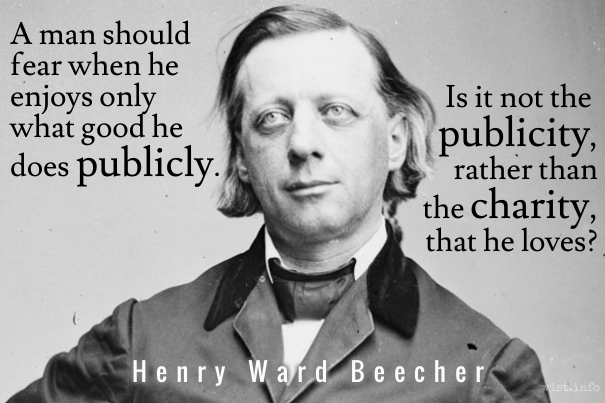
A man should fear when he enjoys only what good he does publicly. Is it not the publicity, rather than the charity, that he loves?
Henry Ward Beecher (1813-1887) American clergyman and orator
In Henry Ward Beecher and Edna Dean Proctor, Life Thoughts: Gathered From the Extemporaneous Discourses of Henry Ward Beecher (1858)
See Matthew.
It is far more impressive when others discover your good qualities without your help.
Judith Martin (b. 1938) American author, journalist, etiquette expert [a.k.a. Miss Manners]
(Attributed)
Widely attributed to Martin, but no citeable source found. Some sources point to Reader's Digest which, on research, was not helpful.

Be careful that you don’t practice your religion in front of people to draw their attention. If you do, you will have no reward from your Father who is in heaven.
Whenever you give to the poor, don’t blow your trumpet as the hypocrites do in the synagogues and in the streets so that they may get praise from people. I assure you, that’s the only reward they’ll get. But when you give to the poor, don’t let your left hand know what your right hand is doing so that you may give to the poor in secret. Your Father who sees what you do in secret will reward you.
When you pray, don’t be like hypocrites. They love to pray standing in the synagogues and on the street corners so that people will see them. I assure you, that’s the only reward they’ll get. But when you pray, go to your room, shut the door, and pray to your Father who is present in that secret place. Your Father who sees what you do in secret will reward you.[Προσέχετε [δὲ] τὴν δικαιοσύνην ὑμῶν μὴ ποιεῖν ἔμπροσθεν τῶν ἀνθρώπων πρὸς τὸ θεαθῆναι αὐτοῖς· εἰ δὲ μή γε, μισθὸν οὐκ ἔχετε παρὰ τῷ πατρὶ ὑμῶν τῷ ἐν τοῖς οὐρανοῖς.
Ὅταν οὖν ποιῇς ἐλεημοσύνην, μὴ σαλπίσῃς ἔμπροσθέν σου, ὥσπερ οἱ ὑποκριταὶ ποιοῦσιν ἐν ταῖς συναγωγαῖς καὶ ἐν ταῖς ῥύμαις, ὅπως δοξασθῶσιν ὑπὸ τῶν ἀνθρώπων· ἀμὴν λέγω ὑμῖν, ἀπέχουσιν τὸν μισθὸν αὐτῶν. σοῦ δὲ ποιοῦντος ἐλεημοσύνην μὴ γνώτω ἡ ἀριστερά σου τί ποιεῖ ἡ δεξιά σου, ὅπως ᾖ σου ἡ ἐλεημοσύνη ἐν τῷ κρυπτῷ· καὶ ὁ πατήρ σου ὁ βλέπων ἐν τῷ κρυπτῷ ἀποδώσει σοι.
Καὶ ὅταν προσεύχησθε, οὐκ ἔσεσθε ὡς οἱ ὑποκριταί, ὅτι φιλοῦσιν ἐν ταῖς συναγωγαῖς καὶ ἐν ταῖς γωνίαις τῶν πλατειῶν ἑστῶτες προσεύχεσθαι, ὅπως φανῶσιν τοῖς ἀνθρώποις· ἀμὴν λέγω ὑμῖν, ἀπέχουσιν τὸν μισθὸν αὐτῶν. σὺ δὲ ὅταν προσεύχῃ, εἴσελθε εἰς τὸ ταμεῖόν σου καὶ κλείσας τὴν θύραν σου πρόσευξαι τῷ πατρί σου τῷ ἐν τῷ κρυπτῷ· καὶ ὁ πατήρ σου ὁ βλέπων ἐν τῷ κρυπτῷ ἀποδώσει σοι.]The Bible (The New Testament) (AD 1st - 2nd C) Christian sacred scripture
Matthew 6: 1-6 (Jesus) [CEB (2011)]
(Source)
No Synoptic parallels.
(Source (Greek)). Alternate translations:Take heed that ye do not your alms before men, to be seen of them: otherwise ye have no reward of your Father which is in heaven. Therefore when thou doest thine alms, do not sound a trumpet before thee, as the hypocrites do in the synagogues and in the streets, that they may have glory of men. Verily I say unto you, They have their reward. But when thou doest alms, let not thy left hand know what thy right hand doeth: that thine alms may be in secret: and thy Father which seeth in secret himself shall reward thee openly.
And when thou prayest, thou shalt not be as the hypocrites are: for they love to pray standing in the synagogues and in the corners of the streets, that they may be seen of men. Verily I say unto you, They have their reward. But thou, when thou prayest, enter into thy closet, and when thou hast shut thy door, pray to thy Father which is in secret; and thy Father which seeth in secret shall reward thee openly.
[KJV (1611)]Be careful not to parade your good deeds before men to attract their notice; by doing this you will lose all reward from your Father in heaven.
So when you give alms, do not have it trumpeted before you; this is what the hypocrites do in the synagogues and in the streets to win men's admiration. I tell you solemnly, they have had their reward. But when you give alms, your left hand must not know what your right is doing; your almsgiving must be secret, and your Father who sees all that is done in secret will reward you.
And when you pray, do not imitate the hypocrites: they love to say their prayers standing up in the synagogues and at the street corners for people to see them; I tell you solemnly, they have had their reward. But when you pray, go to your private room and, when you have shut your door, pray to your Father who is in that secret place, and your Father who sees all that is done in secret will reward you.
[JB (1966)]Make certain you do not perform your religious duties in public so that people will see what you do. If you do these things publicly, you will not have any reward from your Father in heaven.
So when you give something to a needy person, do not make a big show of it, as the hypocrites do in the houses of worship and on the streets. They do it so that people will praise them. I assure you, they have already been paid in full. But when you help a needy person, do it in such a way that even your closest friend will not know about it. Then it will be a private matter. And your Father, who sees what you do in private, will reward you.
When you pray, do not be like the hypocrites! They love to stand up and pray in the houses of worship and on the street corners, so that everyone will see them. I assure you, they have already been paid in full. But when you pray, go to your room, close the door, and pray to your Father, who is unseen. And your Father, who sees what you do in private, will reward you.
[GNT (1976)]Be careful not to parade your uprightness in public to attract attention; otherwise you will lose all reward from your Father in heaven.
When you pray, don’t be like hypocrites. They love to pray standing in the synagogues and on the street corners so that people will see them. I assure you, that’s the only reward they’ll get. But when you pray, go to your room, shut the door, and pray to your Father who is present in that secret place. Your Father who sees what you do in secret will reward you.
So when you give alms, do not have it trumpeted before you; this is what the hypocrites do in the synagogues and in the streets to win human admiration. In truth I tell you, they have had their reward. But when you give alms, your left hand must not know what your right is doing; your almsgiving must be secret, and your Father who sees all that is done in secret will reward you.
[NJB (1985)]Be careful not to practice your righteousness in front of others to be seen by them. If you do, you will have no reward from your Father in heaven.
So when you give to the needy, do not announce it with trumpets, as the hypocrites do in the synagogues and on the streets, to be honored by others. Truly I tell you, they have received their reward in full. But when you give to the needy, do not let your left hand know what your right hand is doing, so that your giving may be in secret. Then your Father, who sees what is done in secret, will reward you.
And when you pray, do not be like the hypocrites, for they love to pray standing in the synagogues and on the street corners to be seen by others. Truly I tell you, they have received their reward in full. But when you pray, go into your room, close the door and pray to your Father, who is unseen. Then your Father, who sees what is done in secret, will reward you.
[NIV (2011 ed.)]Beware of practicing your righteousness before others in order to be seen by them, for then you have no reward from your Father in heaven.
So whenever you give alms, do not sound a trumpet before you, as the hypocrites do in the synagogues and in the streets, so that they may be praised by others. Truly I tell you, they have received their reward. But when you give alms, do not let your left hand know what your right hand is doing, so that your alms may be done in secret, and your Father who sees in secret will reward you.
And whenever you pray, do not be like the hypocrites, for they love to stand and pray in the synagogues and at the street corners, so that they may be seen by others. Truly I tell you, they have received their reward. But whenever you pray, go into your room and shut the door and pray to your Father who is in secret, and your Father who sees in secret will reward you.
[NRSV (2021 ed.)]

SELFISH, adj. Devoid of consideration for the selfishness of others.
Ambrose Bierce (1842-1914?) American writer and journalist
“Selfish,” The Devil’s Dictionary (1911)
(Source)
Originally published in The Devil's Dictionary [A-Z] as Vol. 7 of his Collected Works.