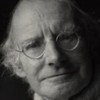
It is my belief that Peter Pan is a great and refining and uplifting benefaction to this sordid and money-mad age; and that the next best play on the boards is a long way behind it as long as you play Peter.
Mark Twain (1835-1910) American writer [pseud. of Samuel Clemens]
Letter (1906-10-09) to Maude Adams, advertisement in the Boston Globe
(Source)
(Source (Image)). Adams played Peter Pan during its New York debut in 1905, and had the role when Twain saw it in November of that year; Twain submitted the advertisement to the Globe prior to the show's opening in Boston.
Quoted in Maria Tatar, The Annotated Peter Pan (2011) and in Phyllis Robbins, Maude Adams: An Intimate Portrait (1956) (also referenced contemporaneously here).
Quotations about:
theater
Note not all quotations have been tagged, so Search may find additional quotes on this topic.

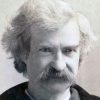
Tragedy in the theater has the great moral inconvenience of putting too much importance in life and death.
[Le Théâtre tragique a le grand inconvénient moral de mettre trop d’importance à la vie et à la mort.]
Nicolas Chamfort (1741-1794) French writer, epigrammist (b. Nicolas-Sébastien Roch)
Products of Perfected Civilization [Produits de la Civilisation Perfectionée], Part 1 “Maxims and Thoughts [Maximes et Pensées],” ch. 1, ¶ 79 (1795) [tr. Siniscalchi (1994)]
(Source)
(Source (French)). Alternate translations:The tragic drama has the great moral drawback of attaching too high an importance to life and death.
[tr. Hutchinson (1902), "The Cynic's Breviary"]There is one great objection to the tragic Drama, it attaches too importance to life and death.
[tr. Mathers (1926)]Tragic drama has the great moral disadvantage of attaching too much importance to life and death.
[tr. Merwin (1969)]The tragic theatre suffers from the great moral disadvantage of attaching too much importance to life and death.
[tr. Pearson (1973)]Tragic drama has the great ethical flaw of attaching too much importance to life and death.
[tr. Dusinberre (1992)]Tragedies suffer from the moral defect of attaching too great an importance to life and death.
[tr. Parmée (2003), ¶66]

The fourth and most important difference between a novel and a film (or play) is that when the reader tires of a novel he can mark his place, put it down, and return to it later. But the attention of an audience must be held continuously. There must be an unbroken progression. It may be progression of the emotion or the thought or the action, but emotion and thought must issue in action or threaten to. In a dramatic medium such as film the characters cannot pause to propound ideas and emotions not directly relevant to their own dramatic situation. In the middle of War and Peace Tolstoy can plant a substantial essay on the nature of military power. In a film script one unnecessary page, one page not furthering the progression, will lose the attention of the audience for the next ten.
Robert Bolt (1924-1995) English dramatist
Doctor Zhivago: The Screenplay, “Author’s Note” (1965)
(Source)
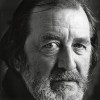
A dramatist is one who believes that the pure event, an action involving human beings, is more arresting than any comment that can be made upon it. On the stage it is always now; the personages are standing on that razor edge, between the past and the future, which is the essential character of conscious being; the words are rising to their lips in immediate spontaneity. […] The theater is supremely fitted to say: “Behold! These things are.”
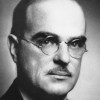
No play is rubbish if it pleases and if it takes money at the door.
A play is fiction — and fiction is fact distilled into truth.
Edward Albee (1928-2016) American playwright
In Elenore Lester, “Albee: I’m Still in Process,” New York Times (1966-09-18)
(Source)
When asked whether his plays were autobiographical.
What is the reason that we laugh so freely in a theatre but are ashamed to weep? Is it less natural to be melted by what excites pity than to burst into laughter at what is comical? […] It is not thought odd to hear a whole theatre ring with laughter at some passage of a comedy, but, on the contrary, it implies that it was funny, and very naturally performed; therefore the extreme restraint every one puts on himself not to shed tears and the affected laughter with which one tries to disguise them, clearly prove that the natural result of lofty tragedy should be to make us all weep without concealment and publicly, and without any other hindrance than wiping our eyes.
[D’où vient que l’on rit si librement au théâtre, et que l’on a honte d’y pleurer? Est-il moins dans la nature de s’attendrir sur le pitoyable que d’éclater sur le ridicule? […] Comme donc ce n’est point une chose bizarre d’entendre s’élever de tout un amphithéâtre un ris universel sur quelque endroit d’une comédie, et que cela suppose au contraire qu’il est plaisant et très naïvement exécuté, aussi l’extrême violence que chacun se fait à contraindre ses larmes, et le mauvais ris dont on veut les couvrir prouvent clairement que l’effet naturel du grand tragique serait de pleurer tous franchement et de concert à la vue l’un de l’autre, et sans autre embarras que d’essuyer ses larmes, outre qu’après être convenu de s’y abandonner.]
Jean de La Bruyère (1645-1696) French essayist, moralist
The Characters [Les Caractères], ch. 1 “Of Works of the Mind [Des Ouvrages de l’Esprit],” § 50 (1.50) (1688) [tr. Van Laun (1885)]
(Source)
(Source (French)). Alternate translations:What's the reason that we laugh so freely, and are asham'd to weep at the Theatre? Is Nature less subjects to be soften'd by pity, than to burst forth at what is Comical? [...] We must suppose 'tis the natural effect of a good Tragedy, to make us Weep freely in sight of the whole Audience, without any other trouble than drying our Eyes, and wiping our Faces. It being no more ridiculous to be seen Weeping, than to be heard to Laugh by the whole Theatre: On the contrary, we then conclude there was something acted very pleasantly, and to the life; and the restraint a man puts on him∣self to hide his tears, by an affected Grimace, plainly demonstrates that he ought not to resist the main design of a Tragedy, but give way to his Passions, and discover em as openly, and with as much confidence, as at a Comedy.
[Bullord ed. (1696)]What is the reason we laugh so freely, but are asham'd to weep at the Theatre? Is Nature less subject to be soften'd by Pity, than to burst out into Laughter at what is Comical? [...] As therefore 'tis thought no odd thing to hear the whole Amphitheatre ring with an Universal Laughter, at some passage of a Comedy; butr on the contrary, implies something was pleasantly said, and naturally perform';d; so the extreme violence which every one offers to himself in constraining his Tears, and disguising ;em with affected Grimaces, clealry prove that the Natural Effect of good Tragedy is to make us weep with all freedom, and in concert, in another's sight, and wihtout any other disturbance than wiping our Eyes.
[Curll ed. (1713)]Why is it that we laugh so freely at the theatre and yet are ashamed to weep there? Is it less natural to be moved by what is pitiful than to be amused by what is ridiculous? [...] Since then it is no unusual thing to hear a whole theatre break into unanimous laughter at some passage in a comedy, since this implies, on the contrary, that it is amusing and extremely life-like, so the extreme violence we do to our feelings by restraining our tears, and the false laughter with which we try to conceal them, clearly proves that the natural effect of great tragedy should be to make us all weep quite openly, with one accord, in one another’s presence, with no further concern than to wipe our eyes.
[tr. Stewart (1970), "Of Books"]
We pursued an empty fame and popularity even down to the applause of the playhouse, poetical competitions, and contests for garlands of grass, foolish plays on the stage, and unbridled lusts.
[Hac popularis gloriae sectantes inanitatem, usque ad theatricos plausus et contentiosa carmina et agonem coronarum faenearum et spectaculorum nugas et intemperantiam libidinum]
Augustine of Hippo (354-430) Christian church father, philosopher, saint [b. Aurelius Augustinus]
Confessions, Book 4, ch. 1 / ¶ 1 (4.1.1) (c. AD 398) [tr. Ryan (1960)]
(Source)
(Source (Latin)). Alternate translations:Hunting after the emptiness of popular praise, down even to theatrical applauses, and poetic prizes, and strifes for grassy garlands, and the follies of shows, and the intemperance of desires.
[tr. Pusey (1838)]Striving after the emptiness of popular fame, even to theatrical applauses, and poetic contests, and strifes for grassy garlands, and the follies of shows and the intemperance of desire.
[tr. Pilkington (1876)]Vain seeking the emptiness of popular praise, even the applause of the theatres , and the prizes for verses, and the struggle for withering garlands, and the follies of shows, and the gratification of ungoverned desires.
[tr. Hutchings (1890)]Education drew me to follow the toys that men call fame, applause in the theatre, prize poems, contests for crowns of hay, the follies of the stage, all the riot of passion.
[tr. Bigg (1897)]I pursued the emptiness of popular glory and the applause of spectators, with competition for prize poems and strife for garlands of straw and the vanity of stage shows and untempered lusts.
[tr. Sheed (1943)]In my public life I was striving after the emptiness of popular fame, going so far as to seek theatrical applause, entering poetic contests, striving for the straw garlands and the vanity of theatricals and intemperate desires.
[tr. Outler (1955)]We would hunt for worthless popular distinctions, the applause of an audience, prizes for poetry, or quickly fading wreaths won in competition. We loved the idle pastimes of the stage and in self-indulgence we were unrestrained.
[tr. Pine-Coffin (1961)]I and my friends would be hunting after the empty show of popularity -- theatrical applause from the audience, verse competitions, contests for crowns of straw, the vanity of the stage, immoderate lusts.
[tr. Warner (1963)]I would be seeking empty popularity, cheers in the theatre, poetic competitions, strife for straw crowns, trifles of stage shows, and undisciplined desires.
[tr. Blaiklock (1983)]We pursued trumpery, popular acclaim, theatrical plaudits, song-competitions and the contest for ephemeral wreaths, we watched trashy shows and indulged our interperate lusts.
[tr. Boulding (1997)]

I have always thought that all the theories of what a good play is, or how a good play should be written, are futile. A good play is a play which, when acted upon the boards, makes an audience interested and pleased. A play that fails in this is a bad play.
Maurice Baring (1874-1945) English man of letters, writer, essayist, translator
Have You Anything to Declare? (1936)
(Source)
Many of us go through life feeling as an actor might feel who does not like his part, and does not believe in the play.
Mignon McLaughlin (1913-1983) American journalist and author
The Neurotic’s Notebook, ch. 5 (1963)
(Source)

Our life gets as complicated as a comedy as it goes on, but the complications get gradually resolved: see that the curtain comes down on a good denouement.
[Vase empeñando nuestra vida como en comedia, al fin viene a desenredarse. Atención, pues, al acabar bien.]
Baltasar Gracián y Morales (1601-1658) Spanish Jesuit priest, writer, philosopher
The Art of Worldly Wisdom [Oráculo Manual y Arte de Prudencia], § 211 (1647) [tr. Jacobs (1892)]
(Source)
(Source (Spanish)). Alternate translations:Our life is acted like a Play. The Catastrophy is in the last Act. The chief part then is, to end it well.
[Flesher ed. (1685)]Our life becomes more complicated as we go along, like a comedy, but toward the end it becomes simpler; keep in mind, therefore, the happy ending.
[tr. Fischer (1937)]Our lives fold and unfold like theater, so be careful to end well.
[tr. Maurer (1992)]

The very women who object to the morals of a notoriously beautiful actress, grow big with pride when an admirer suggests their marked resemblance to this stage beauty in physique.
Minna Antrim (1861-1950) American epigrammatist, writer
Naked Truth and Veiled Allusions (1901)
One does not go to the theater to see life and nature; one goes to see the particular way in which life and nature happen to look to a cultivated, imaginative and entertaining man who happens, in turn, to be a playwright.
George Jean Nathan (1892-1958) American editor and critic
The Critic and the Drama, ch. 2 (1922)
(Source)
Detective inspector John “Call me Jack, everyone does” Robinson did not like theatres. Bit of a night out at the variety or even the Tiv was fair enough, but ever since a high-minded relative had forced him to sit through an Ibsen festival at an impressionable age, theatres had always been synonymous with what he called ‘high art’, a portmanteau term for everything self-indulgent, terminally tedious and incomprehensible in the world of culture.

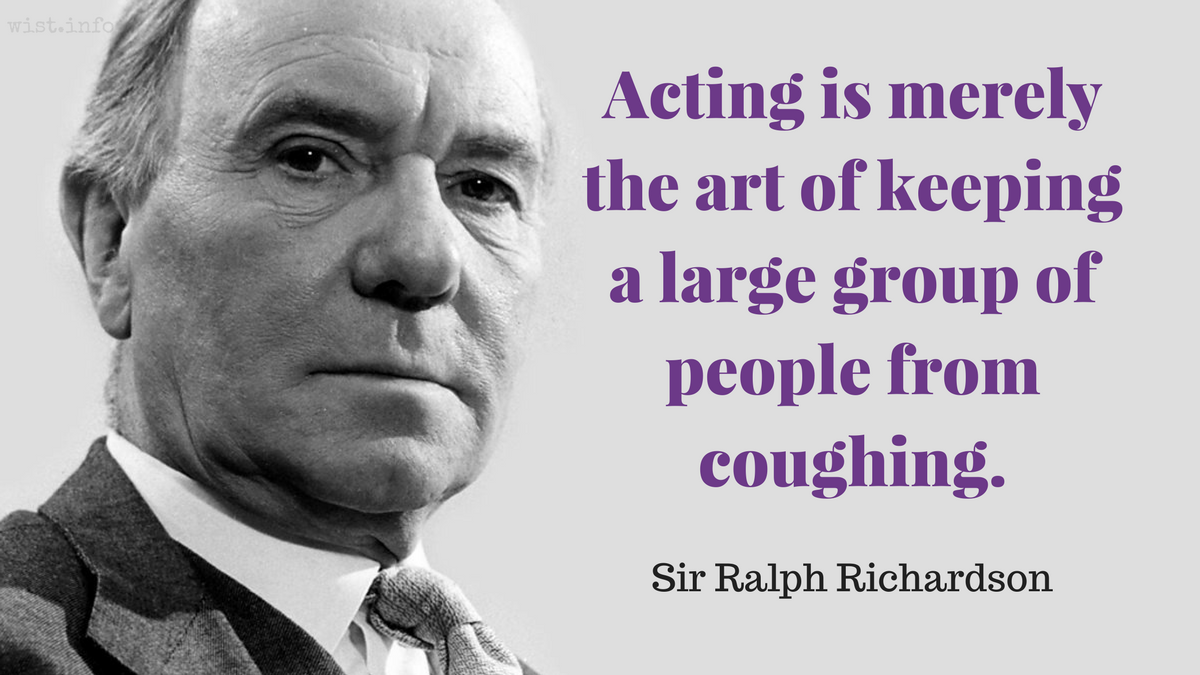
Acting is merely the art of keeping a large group of people from coughing.
“What’s the play about?”
“Nobody seems to know.”
“What do the actors say it’s about?”
“They don’t know,” Susan said. She was as close to embarrassed as she gets.
“The actors don’t know what it’s about?”
“No.”
“How about the Director?”
“Lou says that a play is not required to be about anything.”
“And it runs how long?”
“Four and a half hours with an intermission.” Susan smiled encouragingly. “It’s very controversial,” she said.
“Excellent,” I said. “Maybe a fight will break out.”Robert B. Parker (1932-2010) American writer
Walking Shadow (1994)

I have observed that in comedies the best actor plays the droll, while some scrub rogue is made the fine gentleman or hero. Thus it is in the farce of life. Wise men spend their time in mirth, ’tis only fools who are serious.
Henry St John, 1st Viscount Bolingbroke (1678-1751) English politician, government official, political philosopher [Lord Bolingbroke]
(Attributed)
Quoted in Gleason's Pictorial (Boston) (3 Dec 1853).
Reading after a certain age diverts the mind too much from its creative pursuits. Any man who reads too much and uses his own brain too little falls into lazy habits of thinking, just as the man who spends too much time in the theater is tempted to be content with living vicariously instead of living his own life.
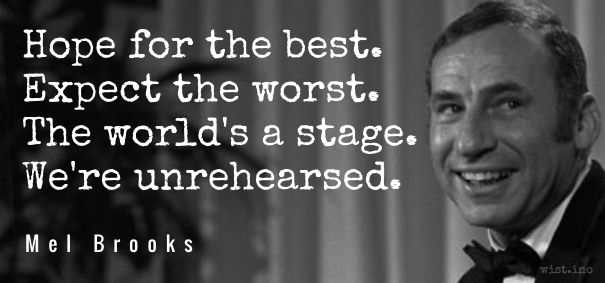
Hope for the best.
Expect the worst.
The world’s a stage.
We’re unrehearsed.
Mel Brooks (b. 1926) American comedic actor, writer, producer [b. Melvyn Kaminsky]
The Twelve Chairs, “Hope for the Best, Expect the Worst” (1970)
(Source)
(Source (Audio)). More information on composition of the song here and here.
See also Shakespeare and O'Casey.
Any man who undertakes to write a play is either a damn fool or a hero, I don’t know which. When you write a book, you pull it out of the typewriter and that’s that. When you write a play you’ve got to go on with the producer and the director and the actors and the rehearsals and the …
Rex Stout (1886-1975) American writer
In “Author Rex Stout vs. the FBI,” Interview with Sandra Schmidt, Life (10 Dec 1965)
The theater needs continual reminders that there is nothing more debasing than the work of those who do well what is not worth doing at all.
Gore Vidal (1925-2012) American novelist, dramatist, critic
“Love Love Love,” Partisan Review (Spring 1959)
PROSPERO: Our revels now are ended. These our actors,
As I foretold you, were all spirits and
Are melted into air, into thin air;
And like the baseless fabric of this vision,
The cloud-capped towers, the gorgeous palaces,
The solemn temples, the great globe itself,
Yea, all which it inherit, shall dissolve,
And, like this insubstantial pageant faded,
Leave not a rack behind. We are such stuff
As dreams are made on, and our little life
Is rounded with a sleep.William Shakespeare (1564-1616) English dramatist and poet
Tempest, Act 4, sc. 1, l. 165ff (4.1.165-175) (1611)
(Source)

Glory is largely a theatrical concept. There is no striving for glory without a vivid awareness of an audience — the knowledge that our mighty deeds will come to the ears of our contemporaries or “of those who are to be.” We are ready to sacrifice our true, transitory self for the imaginary eternal self we are building up, by our heroic deeds, in the opinion and imagination of others.
Eric Hoffer (1902-1983) American writer, philosopher, longshoreman
True Believer: Thoughts on the Nature of Mass Movements, Part 3, ch. 13, § 47 (1951)
(Source)
The empty pageant; a stage play; flocks of sheep, herds of cattle; a tussle of spearmen; a bone flung among a pack of curs; a crumb tossed into a pond of fish; ants, loaded and laboring; mice, scared and capering; puppets, jerking on their strings — that is life.
In the midst of it all you must take your stand, good-temperedly and without disdain, yet always aware that a man’s worth is no greater than the worth of his ambitions.[Πομπῆς κενοσπουδία, ἐπὶ σκηνῆς δράματα, ποίμνια, ἀγέλαι, διαδορατισμοί, κυνιδίοις ὀστάριον ἐρριμμένον, ψωμίον εἰς τὰς τῶν ἰχθύων δεξαμενάς, μυρμήκων ταλαιπωρίαι καὶ ἀχθοφορίαι, μυιδίων ἐπτοημένων διαδρομαί, σιγιλλάρια νευροσπαστούμενα.
χρὴ οὖν ἐν τούτοις εὐμενῶς μὲν καὶ μὴ καταφρυαττόμενον ἑστάναι, παρακολουθεῖν μέντοι, ὅτι τοσούτου ἄξιος ἕκαστός ἐστιν, ὅσου ἄξιά ἐστι ταῦτα περὶ ἃ ἐσπούδακεν.]Marcus Aurelius (AD 121-180) Roman emperor (161-180), Stoic philosopher
Meditations [To Himself; Τὰ εἰς ἑαυτόν], Book 7, ch. 3 (7.3) (AD 161-180) [tr. Staniforth (1964)]
(Source)
(Source (Greek)). Alternate translations:Public shows and solemnities with much pomp and vanity, stage plays, flocks and herds; conflicts and contentions: a bone thrown to a company of hungry curs; a bait for greedy fishes; the painfulness, and continual burden-bearing of wretched ants, the running to and fro of terrified mice: little puppets drawn up and down with wires and nerves: these be the objects of the world.
Among all these thou must stand steadfast, meekly affected, and free from all manner of indignation; with this right ratiocination and apprehension; that as the worth is of those things which a man doth affect, so is in very deed every man's worth more or less.
[tr. Casaubon (1634)]Gazing after Triumphs, and Cavalcades; the Diversions of the Stage-Farms well stock'd with Flocks and Herds; contests for Victory in the Field; These are the little Pleasures, and concerns of Mortals. Would you have a farther Illustration, and see an Image of them elsewhere? Fancy then that you saw two or three Whelps quarrelling about a Bone; Fishes scrambling for a Bait, Pismires in a peck of troubles about the Carriage of a Grain of Wheat; Mice frighted out of their Wits, and scouring cross the Room; Poppets danced upon a Wire, &c.
And after all, tho' Humane Life is but ordinary, and trifling, a Wise Man must be easie and Good-humour'd, and not grow Splenetick, or Haughty upon the Contemplation. Remembring notwithftanding, that the true Bulk and Bigness of a Man, is to be measur'd by the size of his Business, and the Quality of his Inclinations.
[tr. Collier (1701)]The vain solicitude about shows, scenical representations, flocks and herds, skirmishing, little bones cast in for contention among little dogs, baits cast into a fish-pond, the toiling of Ants, and their carrying of burdens, the fluttering of affrighted flies, the involuntary agitations of puppets by wires!
We ought to persist amidst such things with good-nature, without storming at them; and be persuaded that such is the worth of each person, as is the value of the things he pursues.
[tr. Hutcheson/Moor (1742)]A fondness for pompous processions, grand exhibitions on the stage, or skirmishes in the amphitheatre; the care of flocks and herds; these are some of the solemn amusements of mankind; and are of much the same importance as the quarrelling of dogs for a bone, of fishes catching at a bait, an hillock of ants in an uproar about carrying a grain of corn, of mince scampering across a room in a fright, or puppets danced on wires. Such is the bustle of human life!
Let us, however, amidst this ludicrous scene of things not be out of humour, but contemplate it with complacency and benevolence; remembering always to estimate the value of men by the utility of those employments on which they bestow their attention.
[tr. Graves (1792)]The idle business of show, plays on the stage, flocks of sheep, herds, exercises with spears, a bone cast to little dogs, a bit of bread into fishponds, laborings of ants and burden-carrying, runnings about of frightened little mice, puppets pulled by strings -- [all alike].
It is thy duty then in the midst of such things to show good humor and not a proud air; to understand however that every man is worth just so much as the things are worth about which he busies himself.
[tr. Long (1862)]Gazing after shows, the diversions of the stage, farms well stocked with flocks and herds, contests for victory in the field are all much the same. So, too, a bone thrown to puppies, fishes scrambling for a bait, ants laboriously carrying a grain of wheat, mice frighted out of their wits and running away, puppets danced upon a wire.
And in the midst of them a wise man must be good-humored, and not grow haughty in the contemplation. Remembering, notwithstanding, that the true worth of a man is to be measured by the objects he pursues.
[tr. Collier/Zimmern (1887)]A mimic pageant, a stage spectacle, flocking sheep and herding cows, an armed brawl, a bone flung to curs, a crumb dropped in the fish-tanks, toiling of burdened ants, the scamper of scurrying mice, puppets pulled with strings -- such is life.
In such surroundings you must take your stand, considerate and undisdainful; yet understand the while, that the measure of the man's worth is the worth of his aims.
[tr. Rendall (1898)]Your vain concern for shows, for stage plays, for flocks and herds, your little combats, are as bones cast for the contention of puppies, as baits dropped into a fishpond, as the toil of ants and the burdens that they bear, as the scampering of frightened mice, or the antics of puppets jerked by wires.
It is then your duty amid all this to stand firm, kindly and not proud, yet to understand that a man’s worth is just the worth of that which he pursues.
[tr. Hutcheson/Chrystal (1902)]Empty love of pageantry, stage-plays, flocks and herds, sham-fights, a bone thrown to lap-dogs, crumbs cast in a fish-pond, painful travail of ants and their bearing of burdens, scurryings of scared little mice, puppets moved by strings.
Amid such environment therefore thou must take thy place graciously and not "snorting defiance," nay thou must keep abreast of the fact that everyone is worth just so much as those things are worth in which he is interested.
[tr. Haines (Loeb) (1916)]A procession's vain pomp, plays on a stage, flocks, herds, sham fights, a bone thrown to puppies, a crumb into fishponds, toiling and moiling of ants carrying their loads, scurrying of startled mice, marionettes dancing to strings.
Well, then, you must stand up in all this, kindly and not carrying your head proudly; yet understand that every man is worth just so much as the worth of what he has set his heart upon.
[tr. Farquharson (1944)]The idle pageantry of a procession, plays on the stage, flocks and herds, the clahsing of spears, a bone tossed to puppies, a scrap of bread cast into a fishpond, the wretched labours of overladen ants, the scurryings of stargled mice, puppets pulled about on their strings.
You must take your place, then, in the midst of all this, with a good grace and without assuming a scornful air; and yet, at the same time, keep in mind that a person's worth is measured by the worth of what he has set his heart on.
[tr. Hard (1997 ed.)]Pointless bustling of processions, opera arias, herds of sheep and cattle, military exercises. A bone flung to pet poodles, a little food in the fish tank. The miserable servitude of ants, scampering of frightened mice, puppets jerked on strings.
Surrounded as we are by all of this, we need to practice acceptance. Without disdain. But remembering that our own worth is measured by what we devote our energy to.
[tr. Hays (2003)]The empty pomp of a procession, plays on the stage, flocks and herds, jousting shows, a bone thrown to puppies, tit-bits into the fishponds, ants toiling and carrying, the scurries of frightened mice, puppets dancing on their strings.
Well, amid all this you must keep yourself tolerant -- do not snort at them. But bear in mind that a person’s worth is measured by the worth of what he values.
[tr. Hammond (2006)]The idle pageantry of a procession, plays on a stage, flocks and herds, the clashing of spears, a bone tossed to puppies, a scrap of bread cast into a fishpond, the wretched labours of overladen ants, the scurryings of startled mice, puppets pulled about on their strings.
You must take your place, then in, the midst of all this, with a good grace and without assuming a scornful air; and yet, at the same time, keep in mind that a person's worth is measured by the worth of what he has set his heart on.
[tr. Hard (2011 ed.)]Each man is as worthy as his endeavours are worthy.
[ed. Taplin (2016)]
All the world’s a stage and most of us are desperately unrehearsed.
Sean O'Casey (1880-1964) Irish playwright [b. John Casey, a.k.a. Seán O'Cathaseaigh]
(Attributed)
Widely attributed to O'Casey, but I am unable to find a primary source or verifiable citation.