

A man must not always tell all, for that were folly: but what a man says should be what he thinks, otherwise ’tis knavery.
[Il ne faut pas tousjours dire tout, car ce seroit sottise : Mais ce qu’on dit, il faut qu’il soit tel qu’on le pense : autrement, c’est meschanceté.]
Michel de Montaigne (1533-1592) French essayist
Essays, Book 2, ch. 17 (2.17), “Of Presumption [De la Presomption]” (1578) [tr. Cotton/Hazlitt (1877)]
(Source)
Both this essay and this passage were in the 1st (1580) edition.
(Source (French)). Alternate translations:A man must not alwayes say al he knows, for that were folie: But what a man speaks ought to be agreeing to his thoughts, otherwise it is impietie.
[tr. Florio (1603)]A man must not always tell all, for that were folly; but what a man says should be what he thinks, otherwise it is knavery.
[tr. Cotton (1686)]Every thing must not always be said, for that would be folly; but what one says should be what one thinks; otherwise it is knavery.
[tr. Ives (1925)]A man must not always say everything, for that were folly; but what a man does say should be what he thinks; otherwise it is knavery.
[tr. Zeitlin (1934)]We must not always say everything, for that would be folly; but what we say must be what we think; otherwise it is wickedness.
[tr. Frame (1943)]It is not necessary always to say everything, for that would be foolish; but what we say should be what we think, the contrary is wicked.
[tr. Cohen (1958)]We should not always say everything: that would be stupid; but what we do say must be what we think: to do otherwise is wicked.
[tr. Screech (1987)]
Quotations about:
foolishness
Note not all quotations have been tagged, so Search may find additional quotes on this topic.

Intelekt without judgement iz what ails about one halff the smart people in this world.
[Intellect without judgment is what ails about one half the smart people in this world.]
Josh Billings (1818-1885) American humorist, aphorist [pseud. of Henry Wheeler Shaw]
Josh Billings’ Farmer’s Allminax, 1975-02 “Heliotropes” (1875 ed.)
(Source)

Where the environment is stupid or prejudiced or cruel, it is a sign of merit to be out of harmony with it.
Bertrand Russell (1872-1970) English mathematician and philosopher
Conquest of Happiness, Part 1, ch. 9 “Fear of Public Opinion” (1930)
(Source)


There is some wisdom, and some foolishness in every people’s way.
Walter M. Miller Jr. (1923-1996) American writer
“The Soul-Empty Ones,” Astounding Science Fiction (1951-08)
(Source)
Now listen while I show you, how the rest
Who call you madman, are themselves possessed.
Just as in woods, when travellers step aside
From the true path for want of some good guide,
This to the right, that to the left hand strays,
And all are wrong, but wrong in different ways,
So, though you’re mad, yet he who banters you
Is not more wise, but wears his pigtail too.[Nunc accipe, quare
desipiant omnes aeque ac tu, qui tibi nomen
insano posuere. Velut silvis, ubi passim
palantis error certo de tramite pellit,
ille sinistrorsum, hic dextrorsum abit, unus utrique
error, sed variis inludit partibus: hoc te
crede modo insanum, nihilo ut sapientior ille
qui te deridet caudam trahat.]Horace (65–8 BC) Roman poet, satirist, soldier, politician [Quintus Horatius Flaccus]
Satires [Saturae, Sermones], Book 2, # 3 “Si raro scribes,” l. 46ff (2.3.46-53) (30 BC) [tr. Conington (1874)]
(Source)
Horace may be quoting or paraphrasing Stertinus here.
The odd "tail" metaphor was a proverbial expression for unknowingly being a fool. Apparently Roman children would tie sheep or other animal tails to the backs of innocent passers-by, then laugh at them.
(Source (Latin)). Alternate translations:Now leane thyne eares, and listen well, perceave howe all be mad,
Yea those who earste to make the woorse, such mockeries have had.
Admit there be through darkesum wood a speedie footepathe way,
On ryghte syde sum, on lefte syde sum, and all do go a stray
Through wilsumnes of wildernes: the error is all one,
Though through miswandringe diverslye, they diverslye have gone.
Thou maist be mad, frend Damasipp, thou maiste be muche unwyse,
Thy mockers staringe mad also, though in an other guyse.
[tr. Drant (1567)]Nay give me leave, and I'le demonstrate how
He who calls thee fool's as much fool as thou.
Like Trav'lers passing through a Wood, when they
Range up and down missing their ready way,
This to the right that to the left hand strayes,
One error fools them both, though several wayes.
And tho thou think'st thou'rt mad, yet even he
Is not a jot less mad that laughs at thee,
Both to Fool-coats have like propriety.
[tr. "A. B."; ed. Brome (1666)]Some call Thee mad, but those that call Thee so,
Observe, I'll prove them quite as mad as You:
As Men that lose their ways in Woods, divide;
Some go on this, and some on t'other side,
The Error is the same, all miss the Road,
Altho in different Quarters of the Wood.
Thus as they call thee, think that thou art mad;
But those that call thee so are quite as bad.
[tr. Creech (1684)]And they who call you fool, with equal claim
May plead an ample title to the name.
When in a wood we leave the certain way
One error fools us, though we various stray:
Some to the left, some turn to t'other side:
So he, who dares thy madness to deride,
Though you may frankly own yourself a fool,
Behind him trails his mark of ridicule.
[tr. Francis (1747)]Hear now why those who proudly call you mad,
In reason's view are every whit as bad.
As, when bewilder'd in a wood by night
This trav'ller takes the left and that the right,
Each strays, though in a different path he strays,
Mock'd by the self-same error various ways, --
So is it here; and he that laughs at you
May wear the cap; for he is crack-brain'd too.
[tr. Howes (1845)]Now learn, why all those, who have fixed the name of madman upon you, are as senseless as yourself. As in the woods, where a mistake makes people wander about from the proper path; one goes out of the way to the right, another to the left; there is the same blunder on both sides, only the illusion is in different directions: in this manner imagine yourself mad; so that he, who derides you, hangs his tail not one jot wiser than yourself.
[tr. Smart/Buckley (1853)]Now listen to the reason why all those who've called you "madman" are as mad as you. As in the woods, when some mistake drives from the beaten track men vaguely wandering, one goes off to the right, another to the left, -- they make the same mistake, but in quite opposite directions; -- so think that you're mad, and that the man who mocks you is no saner than yourself, and a fit laughingstock for boys.
[tr. Millington (1870)]Now let me show you why all who have dubbed you "madman" are quite as crazy as you. When men miss the path in a forest and go astray in every direction, all miss it equally, though one is led wrong on the right side of the road and one on the left. So for yourself, believe that if you are mad it is only in such a sense that the man who is laughing at you drags his tail also.
[tr. Wickham (1903)]Now learn why all, who have given you the name of madman, are quite as crazy as yourself. Just as in a forest, where some error drives men to wander to and fro from the proper path, and this one goes off to the left and that one to the right: both are under the same error, but are led astray in different ways: so believe yourself to be insane only so far that he who laughs at you drags a tail behind him, no whit the wiser man.
[tr. Fairclough (Loeb) (1926)]Now learn
Why it is that all who have fastened the name on you
Are quite as crazy as you. Just as men in a forest,
Whom confusion forces to wander away from the right path,
Will veer off, one to the left, the other to the right,
Misled by the same mistake but misled in different
Directions, so you may consider yourself deluded
To the exact degree of the man who makes fun of you,
Who is dragging a tail behind himself all unawares.
[tr. Palmer Bovie (1959)]Now, hear why you're no madder
than all those others, who bestowed on you the name
‘insane.’ Think of travelers in a forest who get lost
and leave the proper path: one might wander over
to the left, the other to the right. They're deceived
in different ways, but it's the same mistake. Similarly,
you think you're insane, but who is any wiser
among those tail-draggers who make fun of you?
[tr. Fuchs (1977)]Listen: here is why everyone
Who calls you mad is just as senseless himself.
It's like a forest, where people wander this way and that,
Hunting the path and never finding it, not right, or left,
Or center, all confused, all equally lost, but all
Lost in different directions. Believe yourself mad,
If you like, but as sane as the man who laughs at you
And never sees the tail tied behind him.
[tr. Raffel (1983)]Now hear me: why all those who have
called you crazy are brainless like yourself.
As in the woods folk wander off
the true path in error and scatter
here and there, this one to the left,
this one to the right, both of them in
different directions; in the same way
you may consider yourself insane.
Yet you know full well that he who
derides you is no wiser than you
but drags a tail behind him.
[tr. Alexander (1999)]Now, here’s how
those who call you mad are mad. In a wood,
error diverts men from the strict path, some
left, some right. They’re all wrong, each in his
way. Who says he’s right is of course wrong —
is he the one you’ll let pronounce you wrong?
[tr. Matthews (2002)]Now this is the reason
why those who call you mad are every bit as crazy
as you are: You know how people lose their way in the woods --
one goes wandering off to the left, another to the right;
both are equally wrong, though each has strayed in a different
direction. So you may rest assured that if you're to be counted
mad the fellow who laughs at you is no saner himself.
He too has straw in his hair.
[tr. Rudd (2005 ed.)]Now learn why all those who call
You insane, are every bit as foolish themselves.
It’s like a wood, where error leads men to wander
Here and there, from the true path, one off to the left,
Another off to the right, the same error both times,
But leading them in different directions: so know
You’re only as mad as the man no wiser than you
Who laughs at you, but still has a tail pinned behind.
[tr. Kline (2015)]
“He is mad as a hare, poor fellow,
And should be in chains” you say,
I haven’t a doubt of your statement,
But who isn’t mad, I pray?
Why, the world is a great asylum,
And the people are all insane,
Gone daft with pleasure or folly,
Or crazed with passion and pain.Ella Wheeler Wilcox (1850-1919) American author, poet, temperance advocate, spiritualist
Poem (1882), “All Mad,” st. 1, Maurine and Other Poems (1882 ed.)
(Source)
Also collected in Poems of Cheer (1910) and Poems of Life (1919).

There are more fools than wise men, and even in the wise there is more folly than wisdom.
[Il y a plus de fous que de sages, et dans le sage même, il y a plus de folie que de sagesse.]
Nicolas Chamfort (1741-1794) French writer, epigrammist (b. Nicolas-Sébastien Roch)
Products of Perfected Civilization [Produits de la Civilisation Perfectionée], Part 1 “Maxims and Thoughts [Maximes et Pensées],” ch. 2, ¶ 149 (1795) [tr. Merwin (1969)]
(Source)
(Source (French)). Alternate translations:There are more fools than wise men, and even in the wise man himself there is more folly than wisdom.
[tr. Hutchinson (1902)]There are more fools than wise men, and even in a wise man there is more folly than wisdom.
[tr. Mathers (1926)]There are more fools than wise people, and in wise people themselves there is more folly than wisdom.
[tr. Siniscalchi (1994)]

Of lingering and gain-seeking make an end;
Think, while there’s time, how soon Death’s pyre may blaze;
And some brief folly mix with prudent ways:
At the fit hour ’tis sweet to unbend.[Verum pone moras et studium lucri
nigrorumque memor, dum licet, ignium
misce stultitiam consiliis brevem:
dulce est desipere in loco.]Horace (65–8 BC) Roman poet, satirist, soldier, politician [Quintus Horatius Flaccus]
Odes [Carmina], Book 4, # 12, l. 25ff (4.12.25-28) (13 BC) [tr. Marshall (1908)]
(Source)
Usually subtitled by translators "To Virgil" or "Invitation to Virgil." There has been great controversy amongst scholars whether the Virgil mentioned in the ode refers to the famous poet who composed the Aeneid, among other works. The two knew each other, but that Virgil died in 19 BC. Some suggest this was an older poem of Horace's, finished and inserted into this later, final volume by him.
(Source (Latin)). Alternate translations:Think Life is short, forget thy fears,
And eager thoughts of Gain,
Short Folly mix with graver Cares,
'Tis decent sometimes to be vain.
[tr. Creech (1684)]Come, quit those covetous thoughts, those knitted brows,
Think on the last black embers, while you may,
And be for once unwise. When time allows,
'Tis sweet the fool to play.
[tr. Conington (1872)]But lay aside delay, and the desire of gain; and, mindful of the gloomy [funeral] flames, intermix, while you may, your grave studies with a little light gayety: it is delightful to give a loose on a proper occasion.
[tr. Smart/Buckley (1853)]To the winds with base lucre and pale melancholy ! --
In the flames of the pyre these, alas! will be vain,
Mix your sage ruminations with glimpses of folly, --
'T is delightful at times to be somewhat insane!
[tr. Martin (1864)]But put aside delays and care of gain,
Warned, while yet time, by the dark death-fires; mix
With thought brief thoughtlessness; to be unwise
In time and place is sweet.
[tr. Bulwer-Lytton (1870)]Then lay aside delays, pursuit of gain, and, mindful fo the funeral pyre, intermix, while it is permitted, a temporary foolishness with thy worldly plans. There is pleasure in indulging in folly on special occasions.
[tr. Elgood (1893)]Quick! ere the lurid death-fire's day,
Drive thou the lust of gain away!
Thy wisdom with unwisdom grace:
'Tis well to rave, in time and place.
[tr. Gladstone (1894)]Come! a truce to delay, and the desire of gain!
And, all mindful, in time, of the dark fun'ral fires.
Mingle with your grave plans some little folly's fling,
Sweet is folly at fitting times.
[tr. Phelps (1897)]Mingle a little folly with your wisdom; a little nonsense now and then is pleasant.
[Source (1908)]But put aside delay and thirst for gain, and, mindful of Death’s dark fires, mingle, while thou mayst, brief folly with thy wisdom. ’Tis sweet at the fitting time to cast serious thoughts aside.
[tr. Bennett (Loeb) (1912), "The Delights of Spring"]Quick, quit your usury. Time is fleet.
Think, while you may, of funeral flames,
And blend brief folly with your aims;
Folly, in folly's hour, is sweet.
[tr. Mills (1924)]Then come at once and pause for breath
In chasing wealth. Remembering death
And death's dark fires, mix, while you may,
Method and madness, work and play.
Folly is sweet, well-timed.
[tr. Michie (1963)]Don’t linger, don’t stop to be sensible,
Let a little folly mix with your wisdom,
Be aware of death’s dark fires:
Frivolity is sweet, in season.
[tr. Raffel (1983)]And, heedful of death's black fire, consent for a while
To mix a little pleasure in with your prudence.
It's right to be foolish when the time is right.
[tr. Ferry (1997)]Be mindful, while you may,
of black-smoked funeral pyres
and blend a bit of folly with your wisdom.
O it is sweet at the proper time
to play the fool!
[tr. Alexander (1999)]But abolish delay, and desire for profit,
and, remembering death’s sombre flames, while you can,
mix a little brief foolishness with your wisdom:
it’s sweet sometimes to play the fool.
[tr. Kline (2015), "Spring"]
Roald Dahl had Willy Wonka use the thematically similar line "A little nonsense now and then / Is relished by the wisest men" in both his screenplay for the movie Willy Wonka and the Chocolate Factory (1971) and in the book Charlie and the Great Glass Elevator. For more information in this variant and its possible origins, see Quote Origin: A Little Nonsense Now and Then is Relished by the Wisest Men – Quote Investigator®.
There are well-dressed foolish ideas just as there are well-dressed fools.
[Il y a des sottises bien habillées, comme il y a des sots très bien vêtus.]Nicolas Chamfort (1741-1794) French writer, epigrammist (b. Nicolas-Sébastien Roch)
Products of Perfected Civilization [Produits de la Civilisation Perfectionée], Part 1 “Maxims and Thoughts [Maximes et Pensées],” ch. 1, ¶ 40 (1795) [tr. Hutchinson (1902), “The Cynic’s Breviary”]
(Source)
(Source (French)). Alternate translations:There is such a thing as well-clothed foolishness, just as there are certain very well-dressed fools.
[tr. Mathers (1926)]There are presentably dressed follies just as there are well dressed fools.
[tr. Merwin (1969)]There are some well-turned inanities, just as there are very well turned-out fools.
[tr. Pearson (1973)]There is nonsense that is well said, just as there are fools who are very well dressed.
[tr. Siniscalchi (1994)]Foolishness can seem very smart and there are some very smartly dressed fools.
[tr. Parmée (2003), ¶34]
Folly growes without watering.
George Herbert (1593-1633) Welsh priest, orator, poet.
Jacula Prudentum, or Outlandish Proverbs, Sentences, &c. (compiler), # 581 (1640 ed.)
(Source)
I still should not want you to smile on all occasions:
for nothing is more silly than a silly smile.[Tamen renidere usque quaque te nollem;
Nam risu inepto res ineptior nulla est.]Catullus (c. 84 BC – c. 54 BC) Latin poet [Gaius Valerius Catullus]
Carmina # 39 “To Egnatius,” ll. 15-16 [tr. McDonnell (1998)]
(Source)
(Source (Latin)). Alternate translations:E'en then that ceaseless ill-tim'd grin forego:
A silly laugh's the silliest thing I know.
[tr. Nott (1795), # 37]I'd say renounce thy ceaseless idiot grin,
A silly laugh is folly, if not sin.
[tr. Cranstoun (1867)]Yet sweetly smiling ever I would have you not,
For silly laughter, it's a silly thing indeed.
[tr. Ellis (1871)]Yet thy incessant grin I would not see,
For naught than laughter silly sillier be.
[tr. Burton (1893)]Still I wish you wouldn't grin forever everywhere; for nothing is more senseless than senseless giggling.
[tr. Smithers (1894)]Still I should not like you to be smiling everlastingly; for there is nothing more silly than a silly laugh.
[tr. Warre Cornish (1904)]I would have you drop your endless grin: for nothing is more inane than inane laughter.
[tr. Stuttaford (1912)]Still not to smile for aye is wisdom's rule:
For folly's laugh proclaims the peerless fool.
[tr. MacNaghten (1925)]I still should still disapprove that constant smile;
It shows a silly, poor, affected style.
[tr. Wright (1926)]Your smile would still offend me; nothing is worse
than senseless laughter from a foolish face.
[tr. Gregory (1931)]I still wouldn't want to see you always grinning,
for nothing is more inept than inept laughter.
[tr. C. Martin (1979)]I’d still not want you to smile all the time:
there’s nothing more foolish than foolishly smiling.
[tr. Kline (2001)]I'd still not want you flashing yours all round since
nothing's more fatuous than a fatuous grin.
[tr. Green (2005)]I still should not want you to smile on all occasions:
for nothing is more silly than a silly smile.
[tr. Wikisource (2018)]

As favour and riches forsake a man, we discover in him the foolishness they concealed, and which no one perceived before.
[À mesure que la faveur et les grands biens se retirent d’un homme, ils laissent voir en lui le ridicule qu’ils couvraient, et qui y était sans que personne s’en aperçût.]Jean de La Bruyère (1645-1696) French essayist, moralist
The Characters [Les Caractères], ch. 6 “Of Gifts of Fortune [Des Biens de Fortune],” § 4 (6.4) (1688) [tr. Van Laun (1885)]
(Source)
(Source (French)). Alternate translations:When Riches and Favour forsake a Man, we see presently he was a Fool, but no body could find it out in his Prosperity.
[Bullord ed. (1696)]In proportion as Riches and Favour forsake a Man, we discover he was a Fool, which no body cou'd find out in his Prosperity.
[Curll ed. (1713)]As Riches and Favour forsake a Man, we discover him to be a Fool, but no body could find it out in his Prosperity.
[Browne ed. (1752)]As a man falls out of favour and his wealth declines, we discover for the first time the ridiculous aspects of his character, which were always there but which wealth and favour had concealed.
[tr. Stewart (1970)]

People say that age creeps up on them quicker than they expected. First of all, who forced them to think that way? Does age creep up on adults more quickly than maturity creeps up on children? And again, would their age lie less heavily upon them if they were in their eight hundredth year rather than their eightieth? It doesn’t matter how much time has passed; a foolish old man can never be consoled or comforted.
[Obrepere aiunt eam citius, quam putassent. Primum quis coegit eos falsum putare? Qui enim citius adulescentiae senectus quam pueritiae adulescentia obrepit? Deinde qui minus gravis esset eis senectus, si octingentesimum annum agerent quam si octogesimum? Praeterita enim aetas quamvis longa cum effluxisset, nulla consolatio permulcere posset stultam senectutem.]Marcus Tullius Cicero (106-43 BC) Roman orator, statesman, philosopher
De Senectute [Cato Maior; On Old Age], ch. 2 / sec. 4 (2.4) [Cato] (44 BC) [tr. Cobbold (2012)]
(Source)
(Source (Latin)). Alternate translations:All the folis seyn that olde age comyth in them sonner thenne they wend, but I demaunde a question of such men what maner foly constreyned them forto trowe or suppose the thyng the which is fals, for they can sey no reason how olde age entrith sonner in the man aftir adolescence no more than doeth adolescence aftir puerice callid chidlhode which is the seconde age, how be it that it is so ordeyned by nature that that one of the ages entrith aftir the ende of the othir. More ovir I demaunde such foolys how olde age shuld be lesse chargyng & lesse grevous to men if they myght lyve viii C yere, for how be it that the age past had be longer yit it may neithir comforte ne allege ne satisfye the foole olde man.
[tr. Worcester/Worcester/Scrope (1481)]They say [old age] creepeth and stealeth upon them faster and sooner than they thought it would. First, who causeth them to imagine and think such a false and peevish untruth? for why should they think that after their youth and adolescency, old age creepeth faster upon them, rather than their adolescency and youth doth after childhood? Seeing therefore they do not repine nor complain any whit after that they have been children to grow up to be tall striplings and lusty young men, why should they be aggrieved or think themselves discontented, after they have been striplings and young men, to be old and aged? Again, if they might reach ot the age of eight hundreth years, what greater pleasure and commodity is therein, or wherein should they think it to be less troublesome and tedious than it is when they be of the age of four-score years? for the age that is once passed and gone, be it never so long, can with no manner of pleasure or delectation comfort, recreate nor mitigate the old age that is in such fond persons.
[tr. Newton (1569)]They say that [age] creepeth upon them ere they are aware. First let me aske, who bade them over reckon themselves? for how much sooner doth age creep on youth, then youth on child-hood? then, how much more grievous would their age be to them, if they should as well live to the eight hundred year, as to the eighty year? for the former age (though long,) when it is past, can asswage a foolish old age, with no comfort.
[tr. Austin (1648)][They are] always complaining that [Old Age] stole upon them unawares. But pray whose fault is it, that they were so surprized by a wrong computation? Why may they not with equal reason exclaim, that their Youth came too quick upon their Childhood, as that Old Age stole upon their Youth? Or what reason have they to expect Old Age to be less burthensome at eight hundred, than at eighty? For the time they have passed, of what length soever it be, will administer no comfort to Old Age, if foolishly squandered away.
[tr. Hemming (1716)]They charge Old Age with stealing on them faster than it was expected. Who constrain'd them to think wrongfully? Does not Age gain sooner on Youth, than Youth does on Childhood? Besides, How much easier would Old Age fit upon them, where they in their eight-hundredth Year, than in their eightieth? Because the Effluction of Time thro' several Æras,, can give no Comfort to us in these Years of Dotage.
[tr. J. D. (1744)]But, oh! they say, [Old Age] has crept on us too fast, and overtaken us sooner than we thought or expected. In the first Place, pray who put them on thinking wrong? How can they say, Old Age creeps faster on Manhood, than Manhood succeeded Youth and Childhood? Or how would it sit lighter at the Age of Eight Hundred Years, if that were the Term of it, than at Eighty? For the longer Duration of the preceding Age, when once 'tis past, abates Nothing from the Effects of Old Age, when come; nor affords any Relief against the Follies and Weakness of such as sink under it.
[tr. Logan (1744)]It is usual with men at this season of life to complain that old age has stolen upon them by surprise, and much sooner than they expected. But if they were deceived by their own false calculations, must not the blame rest wholly on themselves? For, in the first place, old age surely does not gain by swifter and more imperceptible steps on manhood, than manhood advances on youth ; and in the next, in what respect would age have sitten less heavily upon them, had its progress been much slower, and, instead of making his visit at fourscore years, it had not reached them till four hundred? For the years that are elapsed, how numerous soever they may have been, can by no means console a weak and frivolous mind under the usual consequences of long life.
[tr. Melmoth (1773)]They say that [old age] steals upon them sooner than they had supposed. First, who compelled them to make a truthless supposition? For, what? Does old age steal upon adolescence sooner than adolescence upon boyhood? Then, how would old age be less onerous to them, if they were passing their eight-hundredth year than their eightieth? For the past life, however long, when it had run out, could sooth a foolish old age with no consolation.
[Cornish Bros. ed. (1847)]They say that [old age] steals over them more quickly than they had supposed. Now, first of all, who compelled them to form a false estimate of its progress? for how does old age more quickly steal upon youth, than youth upon boyhood? Then, again, how would old age be less burdensome to them, if they were in their 800th year than in their 80th? for the past time, however long, when it had flowed away, would not be able to soothe with any consolation an old age of folly.
[tr. Edmonds (1874)]They say that age creeps upon them faster than they had thought possible. In the first place, who forced them to make this false estimate? In the next place, how could old age be less burdensome to them if it came on their eight-hundredth year than it is in their eightieth? For the time past, however long, when it had elapsed, could furnish no comfort to soothe a foolish old age.
[tr. Peabody (1884)]They say that [old age] is stealing upon them faster than they expected. In the first place, who compelled them to hug an illusion? For in what respect did old age steal upon manhood faster than manhood upon childhood? In the next place, in what way would old age have been less disagreeable to them if they were in their eight-hundredth year than in their eightieth? For their past, however long, when once it was past, would have no consolation for a stupid old age.
[tr. Shuckburgh (1895)]They say that it has come with quicker step
Than they expected: pray, who was it then
Forced them to this illusion?
Did old age Come quicker upon youth, than youth itself
On childhood? Had it seemed a lighter load
If they had reached not to their eightieth year
But e'en to ten times that? For sure past years
Howe'er prolonged could ne'er endow with charm
A stupid old age.
[tr. Allison (1916)]They say that [old age] stole upon them faster than they had expected. In the first place, who has forced them to form a mistaken judgement? For how much more rapidly does old age steal upon youth than youth upon childhood? And again, how much less burdensome would old age be to them if they were in their eight hundredth rather than in their eightieth year? In fact, no lapse of time, however long, once it had slipped away, could solace or soothe a foolish old age.
[tr. Falconer (1923)]Old age, they protest, crept up on them more rapidly than they had expected. But, to begin with, who was to blame for their mistaken forecast? For age does not steal upon adults any faster than adulthood steals upon children. Besides, if they were approaching eight hundred instead of eight, they would complain of the burden just as loudly! If old people are stupid enough, then nothing can console them for the time that has gone by, however great its length.
[tr. Grant (1960, 1971 ed.)]They complain that [old age] crept up on them faster than they had thought it would. To begin with, who compelled them to accept something that is patently untrue? How does old age “creep up on” adulthood any faster than adulthood does on childhood? In the second place, how would old age be less burdensome to these people if it were to come at age eight hundred instead of at age eighty? No matter how many years of life might have gone by, there could be no effective word of comfort for the old, if they were foolish and thoughtless.
[tr. Copley (1967)]They also say old age creeps up on us more quickly than we thought it would. But tell me, just how does old age creep up on middle age any more quickly than middle age creeps up on youth? The length of time before the onset of old age is not the issue here. To those who think it is, a life in their 800th year would be just as bothersome as one in their 80th. No matter how long the past lasts, once it has gone, it is gone, and a past that has no other virtue than its length will offer no consolation for old age.
[tr. Gerberding (2014)]Faster than they thought, they say,
Senility worms its way
Into them but who obliged them to
Hold such an imaginary view?
But how much faster in truth
Does old age encroach on youth
Than youth itself upon infancy?
And again how overbearing would old age be
Were one eight hundred years old rather than eighty?
Indeed no past life could, as a rule,
Soothe and cheer the old age of a fool.
[tr. Bozzi (2015)]They say that old age crept up on them much faster than they expected. But, first of all, who is to blame for such poor judgment? Does old age steal upon youth any faster than youth does on childhood? Would growing old really be less of a burden to them if they were approaching eight hundred rather than eighty? If old people are foolish, nothing can console them for time slipping away, no matter how long they live.
[tr. Freeman (2016)]They say that [old age] came upon them faster than they had expected. Who forced them to this false belief? For, who would claim that old age succeeded adolescence any faster than adolescence succeeded childhood? Would old age seem any less a burden to them if they were living their eight-hundredth year instead of their eightieth? Once an age has passed and flown away, no consolation is able to soften the blow of a feeble-minded senescence.
[tr. Robinson / @sentantiq (2017)]
A foolish man speaks foolishness.
[Μῶρα γὰρ μῶρος λέγει.]
Euripides (485?-406? BC) Greek tragic dramatist
Bacchæ [Βάκχαι], l. 369 [Tiresias/Τειρεσίας] (405 BC) [tr. Wodhull (1809)]
(Source)
To Cadmus, about his grandson, Pentheus. (Source (Greek)). Alternate translations:Folly issues from the mouth of fools.
[tr. Buckley (1850)]Fools still speak folly.
[tr. Milman (1865)]Fools blurt their folly out.
[tr. Rogers (1872), l. 357]The words of a fool are folly.
[tr. Coleridge (1891)]Fools alone speak folly.
[tr. Way (1898)]Blind words and a blind heart.
[tr. Murray (1902)]The words of fools finish in folly.
[tr. Arrowsmith (1960)]He who speaks folly is himself a fool.
[tr. Kirk (1970)]The things he has said reveal the depth of his folly.
[tr. Vellacott (1973)]It is a fool who folly speaks.
[tr. Neuburg (1988)]You can tell a dangerous fool by his own words.
[tr. Cacoyannis (1982)]For a fool speaks folly.
[tr. Blessington (1993)]For Pentheus is a fool and says foolish things.
[tr. Esposito (1998)]He who speaks foolishness is a fool.
[tr. Woodruff (1999)]The fool speaks foolish things.
[tr. Gibbons/Segal (2000), l. 435]His talk is folly and he's a fool.
[tr. Kovacs (2002)]Often a fool speaks foolishly.
[tr. Valerie (2005)]A man who's mad tends to utter madness.
[tr. Johnston (2008)]His foolish words will end in folly.
[tr. Robertson (2014)]A fool says foolish things.
[tr. @sentantiq (2016)]The speech of the fool is foolish.
[tr. @sentantiq (2018)]The tongue of a fool makes a foolish noise.
[tr. Behr/Foster (2019)]For a foolish man says foolish things.
[tr. Buckley/Sens/Nagy (2020)]
I don’t care how smart you are, if you say something you are liable to say something foolish, and the smarter you are, and the longer you talk, the more foolish things you will say.
Will Rogers (1879-1935) American humorist
Column (1924-08-24), “Weekly Article: About Peggy, the Prince, Candidates, and Coolidge” [No. 89]
(Source)
But many do not know that they do not know, and many think they know when they know nothing. Failings of the intelligence are incorrigible since those who do not know do not know themselves and cannot therefore seek what they lack.
[Pero hay muchos que ignoran que no saben y otros que piensan que saben, no sabiendo. Achaques de necedad son irremediables, que como los ignorantes no se conocen, tampoco buscan lo que les falta.]
Baltasar Gracián y Morales (1601-1658) Spanish Jesuit priest, writer, philosopher
The Art of Worldly Wisdom [Oráculo Manual y Arte de Prudencia], § 176 (1647) [tr. Jacobs (1892)]
(Source)
(Source (Spanish)). Alternate translations:Yet there are some, who are ignorant that they know nothing; and others, who think they know, though they know nothing at all. The faults that proceed from the want of wit, are incurable. For as ignorants know not themselves, so they take no care to search for that they want.
[Flesher ed. (1685)]But there be many who do not know that they know nothing, and others who think that they know, but know nothing; these deformities of the mind are incurable, whence it is that the ignorant neither know themselves nor yet how to gain what they lack.
[tr. Fischer (1937)]But many people are unaware that they do not know, and others think they know when they do not. Attacks of foolishness have no remedy. Because the ignorant do not know themselves, they never look for what they're lacking.
[tr. Maurer (1992)]

What inconceivable madness! For it is not enough to call an opinion “foolishness” when it is utterly devoid of reason.
[O delirationem incredibilem! non enim omnis error stultitia dicenda est.]
Marcus Tullius Cicero (106-43 BC) Roman orator, statesman, philosopher
De Divinatione [On Divination], Book 2, ch. 43 (2.43) / sec. 90 (44 BC) [tr. Falconer (1923)]
(Source)
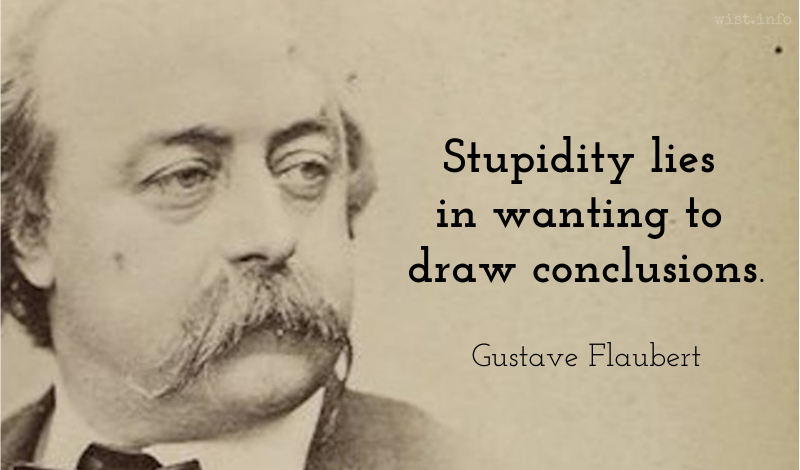
Stupidity lies in wanting to draw conclusions.
[L’ineptie consiste à vouloir conclure. […] Oui, la bêtise consiste à vouloir conclure.]
Gustave Flaubert (1821-1880) French writer, novelist
Letter to Louis Bouilhet (4 Sep 1850)
(Source)
The phrase is used twice in the letter. The initial phrase is usually translated to "foolishness" or "folly," the second to "stupidity."
‘Tis hard bewildering riddles to compose
And labour lost to work at nonsense prose.[Turpe est difficiles habere nugas,
Et stultus labor est ineptiarum.]Martial (AD c.39-c.103) Spanish Roman poet, satirist, epigrammatist [Marcus Valerius Martialis]
Epigrams [Epigrammata], Book 2, epigram 86 (2.86.9-10) (AD 86) [tr. Francis & Tatum (1924), #105]
(Source)
Discussing writing elaborate or highly stylized poetry forms. (Source (Latin)). Alternate translations:Disgraceful 't is unto a poet's name
Difficult toys to make his highest am:
The labour's foolish that doth rack the brains
For things have nothing in them, but much pains.
[tr. Killigrew (1695)]How foolish is the toil of trifling cares.
[tr. Johnson (1750); he credits the translation Elphinston]How pitifull the boast of petty feats!
How idle is the toil of mean conceits!
[tr. Elphinston (1782), 2.76]It is disgraceful to be engaged in difficult trifles; and the labour spent on frivolities is foolish.
[tr. Amos (1858), 2.19]It is absurd to make one's amusements difficult; and labor expended on follies is childish.
[tr. Bohn's Classical (1859)]'Tis mean and foolish to assign
Long care and pains to trifles light.
[tr. Webb (1879)]Disgraceful ’tis to treat small things as difficult;
‘Tis silly to waste time on foolish trifles.
[ed. Harbottle (1897)]'Tis degrading to undertake difficult trifles; and foolish is the labour spent on puerilities.
[tr. Ker (1919)]'Tis hard bewildering riddles to compose
And labor lost to work at nonsense prose.
[tr. Francis & Tatum (1924)]It's demeaning to make difficulties out of trifles, and labor over frivolities is foolish.
[tr. Shackleton Bailey (1993)]It is absurd to make trifling poetry difficult, and hard work on frivolities is foolish.
[tr. Williams (2004)]
The Latin phrase was used by Addison as the epigram of The Spectator #470 (29 Aug 1712).

It is safe to wager that every public idea and every accepted convention is sheer foolishness, because it has suited the majority.
[Il y a à parier que toute idée publique, toute convention reçue, est une sottise, car elle a convenu au plus grand nombre.]
Nicolas Chamfort (1741-1794) French writer, epigrammist (b. Nicolas-Sébastien Roch)
Products of Perfected Civilization [Produits de la Civilisation Perfectionée], Part 1 “Maxims and Thoughts [Maximes et Pensées],” ch. 2, ¶ 130 (1795) [tr. Mathers (1926)]
(Source)
(Source (French)). Alternate translations:It may be argued that every public idea, every accepted convention, is a piece of stupidity, for has it not commended itself to the greatest number?
[tr. Hutchinson (1902), "The Cynic's Breviary"]One can be certain that every generally held idea, every received notion, will be an idiocy, because it has been able to appeal to a majority.
[In Botton, Status Anxiety (2004)]It is likely that every public idea, every received convention, is folly, because the majority of men consented to it.
[Siniscalchi (1994)]
The only wa tu pleze evra boddy, is tu make evry boddy think yu ar a bigger fule than tha ar.
[The only way to please everybody is to make everybody think you are a bigger fool than they are.]
Josh Billings (1818-1885) American humorist, aphorist [pseud. of Henry Wheeler Shaw]
His Sayings, ch. 45 (1867)
Virtue begins by shunning vice; wisdom
By shunning folly.[Virtus est vitium fugere et sapientia prima
stultitia caruisse.]Horace (65–8 BC) Roman poet, satirist, soldier, politician [Quintus Horatius Flaccus]
Epistles [Epistularum, Letters], Book 1, ep. 1 “To Maecenas,” l. 41ff (1.1.41-42) (20 BC) [tr. Ferry (2001)]
(Source)
(Source (Latin)). Other translations:It is virtue, vice t'avoyde and wysedome chéefe of all
Follie to wante: these two ills lo do vex the at thy gall.
[tr. Drant (1567)]'Tis Vertue, to flie Vice: and the first Stair
Of Wisdome, to want Folly.
[tr. Fanshawe; ed. Brome (1666)]'Tis Vertue, Sir, to be but free from Vice,
And the first step tow'rds being truly Wise
Is to want folly.
[tr. Creech (1684)]Even in our flight from vice some virtue lies;
And free from folly, we to wisdom rise.
[tr. Francis (1747)]Vice to renounce is virtue's earliest rule,
Wisdom's first step is to lay aside the fool.
[tr. Howes (1845)]It is virtue, to fly vice; and the highest wisdom, to have lived free from folly.
[tr. Smart/Buckley (1853)]To fly from vice is virtue: to be free
From foolishness is wisdom's first degree.
[tr. Conington (1874)]To fly from vice is virtue, says the sage,
Not to be foolish, wisdom's earliest stage.
[tr. Martin (1881)]It is virtue to fly from vice, and the beginning of wisdom to be free from folly.
[tr. Elgood (1893)]To flee vice is the beginning of virtue, and to have got rid of folly is the beginning of wisdom.
[tr. Fairclough (Loeb) (1926)]Virtue means keeping from vice, and wisdom begins
When you stop being stupid.
[tr. Palmer Bovie (1959)]Virtue begins with fleeing vice and wisdom starts
in being a fool no longer.
[tr. Fuchs (1977)]Running when vice runs after you
Is the beginning of virtue; shaking
Foolishness off is the beginning
Of sense.
[tr. Raffel (1983)]Virtue's first rule is "avoid vice," and wisdom's
"get rid of folly."
[tr. Rudd (2005 ed.)]Virtue is to flee vice, and wisdoms’ beginning is
Freedom from foolishness.
[tr. Kline (2015)]
TOUCHSTONE: I do now remember a saying, “The fool doth think he is wise, but the wise man knows himself to be a fool.”
William Shakespeare (1564-1616) English dramatist and poet
As You Like It, Act 5, sc. 1, l. 30ff (5.1.30-32) (1599)
(Source)

No man is exempt from saying silly things; the mischief is to say them deliberately.
[Personne n’est exempt de dire des fadaises: le malheur est, de les dire curieusement]
Michel de Montaigne (1533-1592) French essayist
Essays, Book 3, ch. 1 (3.1), “Of the Useful and the Honorable [De l’utile et de l’honnête]” (1586)
(Source)
First appeared in the 2nd (1588) edition. (Source (French)). Alternate translations:No man living is free from speaking foolish things; the ill lucke is, to speake them curiouslie.
[tr. Florio (1603)]No Man is free from speaking foolish things; but the worst on't is when a Man studies to play the Fool.
[tr. Cotton (1686)]No man is free from speaking foolish things; but the worst on it is, when a man labors to play the fool.
[tr. Cotton/Hazlitt (1877)]No one is exempt from saying foolish things; the misfortune is to say them intentionally.
[tr. Ives (1925)]No one is exempt from saying silly things. The misfortune is to say them with earnest effort.
[tr. Frame (1943)]No one is free from uttering stupidities. The harm lies in doing it meticulously.
[tr. Screech (1987)]
The first principle is that you must not fool yourself — and you are the easiest person to fool.
Richard Feynman (1918-1988) American physicist
“Cargo Cult Science,” commencement address, California Institute of Technology (1974)
(Source)
All men make mistakes; but it is fools who persist in them.
[Cuiusvis hominis est errare, nullius nisi insipientis in errore perseverare.]
Marcus Tullius Cicero (106-43 BC) Roman orator, statesman, philosopher
Philippics [Philippicae; Antonian Orations], No. 12, ch. 2 / sec. 5 (12.2/12.5) (43-03 BC) [tr. @sentantiq (2012)]
(Source)
(Source (Latin)). Other translations:Every man may err, but no man who is not a fool may persist in error.
[ed. Harbottle (1897)]Any man is liable to a mistake; but no one but a downright fool will persist in error.
[tr. Yonge (1903)]Every man is liable to err; it is the part only of a fool to persevere in error.
[tr. Ker (Loeb) (1926)]Any man is liable to err, only a fool persists in error.
[ed. Guterman (1966)]Of any man at all it is to err, to persist in error is of none except unthinking.
[tr. Wiseman]
