

Most people are not even aware of their need to conform. They live under the illusion that they follow their own ideas and inclinations, that they are individualists, that they have arrived at their opinions as the result of their own thinking — and that it just happens that their ideas are the same as those of the majority. The consensus of all serves as a proof for the correctness of “their” ideas.
Erich Fromm (1900-1980) American psychoanalyst and social philosopher
The Art of Loving, ch. 2 (1956)
(Source)
Quotations about:
orthodoxy
Note not all quotations have been tagged, so Search may find additional quotes on this topic.

Strange! that no one has ever been persecuted by the church for believing God bad, while hundreds of millions have been destroyed for thinking him good. The orthodox church never will forgive the Universalist for saying “God is love.” It has always been considered as one of the very highest evidences of true and undefiled religion to insist that all men, women and children deserve eternal damnation. It has always been heresy to say, “God will at last save all.”
Heaven alone can produce devout people; Princes produce hypocrites.
[Le Ciel seul peut faire les dévots; les Princes font les hypocrites.]
Charles-Lewis de Secondat, Baron de Montesquieu (1689-1755) French political philosopher
Pensées Diverses [Assorted Thoughts], # 630 / 1007 “General Maxims of Politics,” No. 10 (1720-1755) [tr. Clark (2012)]
(Source)
In the French, "seul [alone, solely]" is an amendment above the line in manuscript.(Source (French)).
Don’t be seduc’d by a Multitude. Thou wilt stand alone when thou diest; and shalt be call’d to give thy Account by thyself.
Thomas Fuller (1654-1734) English physician, preacher, aphorist, writer
Introductio ad Prudentiam, Vol. 2, # 2087 (1727)
(Source)

The boldest thinker may have his moments of languor and discouragement, when he feels as if he could willingly exchange faiths with the old beldame crossing herself at the cathedral-door, — nay, that, if he could drop all coherent thought, and lie in the flowery meadow with the brown-eyed solemnly unthinking cattle, looking up to the sky, and all their simple consciousness staining itself blue, then down to the grass, and life turning to a mere greenness, blended with confused scents of herbs, — no individual mind-movement such as men are teased with, but the great calm cattle-sense of all time and all places that know the milky smell of herds, — if he could be like these, he would be content to be driven home by the cow-boy, and share the grassy banquet of the king of ancient Babylon. Let us be very generous, then, in our judgment of those who leave the front ranks of thought for the company of the meek non-combatants who follow with the baggage and provisions. Age, illness, too much wear and tear, a half-formed paralysis, may bring any of us to this pass.
Liberty is often a heavy burden on a man. It involves that necessity for perpetual choice which is the kind of labor men have always dreaded. In common life we shirk it by forming habits, which take the place of self-determination. In politics party-organization saves us the pains of much thinking before deciding how to cast our vote. In religious matters there are great multitudes watching us perpetually, each propagandist ready with his bundle of finalities, which having accepted we may be at peace. The more absolute the submission demanded, the stronger the temptation becomes to those who have been long tossed among doubts and conflicts.
Oliver Wendell Holmes, Sr. (1809-1894) American poet, essayist, scholar
Article (1860-09), “The Professor’s Story [Elsie Venner],” ch. 18, Atlantic Monthly, Vol. 6, No. 35
(Source)
Originally serialized as “The Professor’s Story,” but collected as the novel Elsie Venner, ch. 18 (1861).
There are people who are convinced of the wickedness both of armies and of police forces, but who are nevertheless much more intolerant and inquisitorial in outlook than the normal person who believes that it is necessary to use violence in certain circumstances. They will not say to somebody else, “Do this, that and the other or you will go to prison”, but they will, if they can, get inside his brain and dictate his thoughts for him in the minutest particulars.
George Orwell (1903-1950) English journalist, essayist, writer [pseud. of Eric Arthur Blair]
Essay (1947-03), “Lear, Tolstoy and the Fool,” Polemic Magazine, No. 7
(Source)
Collected in Inside the Whale, and Other Essays (1962).
Is it desirable that all should be exactly alike in their religious convictions? Is any such thing possible? Do we not know that there are no two persons alike in the whole world? No two, trees, no two leaves, no two anythings that are alike? Infinite diversity is the law. Religion tries to force all minds into one mould. Knowing that all cannot believe, the church endeavors to make all say they believe. She longs for the unity of hypocrisy, and detests the splendid diversity of individuality and freedom.
Robert Green Ingersoll (1833-1899) American lawyer, freethinker, orator
Lecture (1873-12) “Individuality,” Chicago Free Religious Society
(Source)
Full title "Arraignment of the Church and a Plea for Individuality." Collected in The Gods and Other Lectures (1876).
CLÉANTE: These are the arguments of all your kind:
Since they can’t see, they think that no one ought;
Whoever does, is tainted with free thought;
Whoever balks at pious affectation
Fails to hold piety in veneration.
Come now, for all your talk, I’m not afraid;
Heaven sees my heart, and I know what I’ve said.[Voilà de vos pareils le discours ordinaire:
Ils veulent que chacun soit aveugle comme eux;
C’est être libertin que d’avoir de bons yeux;
Et qui n’adore pas de vaines simagrées
N’a ni respect ni foi pour les choses sacrées.
Allez, tous vos discours ne me font point de peur;
Je sais comme je parle, et le ciel voit mon cœur.]Molière (1622-1673) French playwright, actor [stage name for Jean-Baptiste Poquelin]
Tartuffe, or the Hypocrite [Le Tartuffe, ou L’Imposteur], Act 1, sc. 6 (1669) [tr. Frame (1967), 1.5]
(Source)
On being warned by Orgon that his impiety and free-thinking will get him in trouble some day.
(Source (French)). Alternate translations:This is the usual Strain of such as you. They would have every body as blind as themselves: To be clear-sighted is Libertinism, and such as don't dote on empty Grimaces, have neither Faith nor Respect to sacred things. Come, come, all this Discourse of yours frights not me; I know what I say, and Heaven sees my Heart.
[tr. Clitandre (1672)]The usual clap-trap of your set; they wish everyone to be blind like themselves. To keep one's eyes open is to be a free-thinker; and whosoever does not worship pretentious affection has neither respect for, nor faith in holy things. Go along; all your speeches do not frighten me; I know what I am saying, and Heaven sees my heart.
[tr. Van Laun (1876)]Tut! This is the usual way of talking with such as you. They want everybody to be as blind as they are: to see clearly is to be a freethinking; and not to worship empty show is to act from a want of faith and of respect for holy things. Believe me, all your denunciations do not frighten me: I know what I say, and God sees my heart.
[tr. Wall (1879)]This is the usual style of such as you. They would have every one as blind as themselves; to be clear-sighted is libertinism, and those who do not like foolish grimaces, have neither faith nor respect for holy things. All your talk does not frighten me, I know how I speak, and heaven sees my heart.
[tr. Mathew (1890)]That is the usual style of talking among your set; they want everyone to be as blind as themselves. To be clear-sighted is to be a free-thinker, and he who does not bow down to idle affectations has neither respect for nor faith in sacred things. I tell you none of your sermons frighten me: I know what I say, and Heaven sees my heart.
[tr. Waller (1903)]That is the usual strain of all your kind;
They must have every one as blind as they.
They call you atheist if you have good eyes;
And if you don't adore their vain grimaces,
You've neither faith nor care for sacred things.
No, no; such talk can't frighten me; I know
What I am saying; heaven sees my heart.
[tr. Page (1909)]I've heard that kind of talk from others like you.
They want to make the whole world blind like them.
It's irreligion just to have open eyes!
If you're not taken in by mummery,
They say you've no respect for sacred things.
You cannot scare me with that sort of language.
I know what I say, and heaven can see my heart.
[tr. Bishop (1957)]So I've been told before by dupes like you:
Being blind, you'd have all others blind as well;
The clear-eyed man you call an infidel,
And he who sees through humbug and pretense
Is charged, by you, with want of reverence.
Spare me your warnings, Brother; I have no fear
Of speaking out, for you and Heaven to hear.
[tr. Wilbur (1963), 1.5]Your kind
All talk like that -- because you're blind
You'd rather others didn't see,
You deem perceptiveness to be
A kind of sin! Let us adore
The idols that you kneel before
Or else be damned! Well listen here;
Your sermons don't fill me with fear:
I know my subject, for a start
And Heaven sees into my heart.
[tr. Bolt (2002)]People like you always say things like that. They want everyone to be as blind as they are. They think that seeing clearly is impiety, that those who refuse to worship false idols have no respect for true faith and true religion. Such talk doesn’t frighten me; I know what I’m saying, and Heaven itself knows what I think.
[tr. Steiner (2008), 1.5]That's how people like you always talk:
You want everyone else to be as blind as you are.
It's disrespectful to have a pair of functioning eyes, is it?
And anyone who doesn't love empty pretence and show and mindless drivel
Has no respect for faith or sacred things.
Come on, all your nonsense doesn't scare me at all:
Heaven sees my heart.
[tr. Campbell (2013)]
On every hand are the enemies of individuality and mental freedom. Custom meets us at the cradle and leaves us only at the tomb. Our first questions are answered by ignorance, and our last by superstition. We are pushed and dragged by countless hands along the beaten track, and our entire training can be summed up in the word –suppression. Our desire to have a thing or to do a thing is considered as conclusive evidence that we ought not to have it, and ought not to do it. At every turn we run against cherubim and a flaming sword guarding some entrance to the Eden of our desire. We are allowed to investigate all subjects in which we feel no particular interest, and to express the opinions of the majority with the utmost freedom. We are taught that liberty of speech should never be carried to the extent of contradicting the dead witnesses of a popular superstition. Society offers continual rewards for self-betrayal, and they are nearly all earned and claimed, and some are paid.
Robert Green Ingersoll (1833-1899) American lawyer, freethinker, orator
Lecture (1873-12) “Individuality,” Chicago Free Religious Society
(Source)
Full title "Arraignment of the Church and a Plea for Individuality." Collected in The Gods and Other Lectures (1876).
The greatest crimes in the world are not committed by people breaking the rules but by people following the rules. It’s people who follow orders that drop bombs and massacre villages. As a precaution to never committing major acts of evil it is our solemn duty never to do what we’re told, this is the only way we can be sure.
Banksy (b. 1974?) England-based pseudonymous street artist, political activist, film director
Wall and Piece, “Cops” (2005)
(Source)

’T were a dull old world, methinks, my friend,
If we all just went one way;
Yet our paths will meet no doubt at the end,
Though they lead apart today.Ella Wheeler Wilcox (1850-1919) American author, poet, temperance advocate, spiritualist
Poem (1879), “Advice,” st. 4, Maurine and Other Poems (1882 ed.)
(Source)

Whoso belongs only to his own age, and reverences only its gilt Popinjays or smoot-smeared Mumbojumbos, must needs die with it.
Thomas Carlyle (1795-1881) Scottish essayist and historian
Essay (1832-05) “Boswell’s Life of Johnson,” Fraser’s Magazine, Vol. 5, No. 28
(Source)
Reviewing James Boswell The Life of Samuel Johnson, LL.D.; including a Tour to the Hebrides (1831 ed.). Collected in Critical and Miscellaneous Essays (1827-1855)
Men’s ideas are like card-playing or any other game. Ideas which in the past I’ve seen considered reckless have since become commonplace, almost trivial, and adopted by men unworthy of sharing them. Ideas which now seem extraordinary will be regarded feeble and perfectly ordinary by our descendants.
[Les idées des hommes sont comme les cartes et autres jeux. Des idées que j’ai vu autrefois regarder comme dangereuses et trop hardies, sont depuis devenues communes, et presque triviales, et ont descendu jusqu’à des hommes peu dignes d’elles. Quelques-unes de celles à qui nous donnons le nom d’audacieuses seront vues comme faibles et communes par nos descendans.]Nicolas Chamfort (1741-1794) French writer, epigrammist (b. Nicolas-Sébastien Roch)
Products of Perfected Civilization [Produits de la Civilisation Perfectionée], Part 1 “Maxims and Thoughts [Maximes et Pensées],” ch. 2, ¶ 145 (1795) [tr. Parmée (2003), ¶ 115]
(Source)
(Source (French)). Alternate translations:Men’s ideas are like cards and other games. Ideas which I remember to have seen regarded as dangerous and over-bold have since become commonplace and almost trite, and have descended to men little worthy of them. So it is that some of the ideas which to-day we call audacious will be considered feeble and conventional by our descendants.
[tr. Hutchinson (1902), "The Cynic's Breviary"]Man's ideas are like card & other games. Ideas which I once heard stigmatised as dangerous and over-daring have since become common and even trivial, and have sunk to be the tenets of quite unworthy persons. Some ideas which we call audacious nowadays will seem feeble and ordinary to our descendants.
[tr. Mathers (1926)]The ideas of men are like cards and other games. ideas that at one time, to my own knowledge, were considered dangerous and rash, have since become general, almost commonplace, and have descended to men who are little worthy of them. Some of those that we call daring will seem feeble and ordinary to our descendants.
[tr. Merwin (1969)]The ideas of men are like cards and other games. Some ideas, which formerly I observed to be considered dangerous and intemperate, have since become universal, even trivial, and have been adopted by men scarcely worthy of them. Some notions which we call bold will be regarded as feeble and commonplace by our descendants.
[tr. Pearson (1973)]

Cruel and savage as orthodoxies have always proved to be, the faithful seem able to convince themselves that the heretics, as they continue to crop up, get nothing worse than their due, and to rest with an easy conscience.
Learned Hand (1872-1961) American jurist
Speech (1955-01-29), “A Fanfare for Prometheus,” American Jewish Committee annual dinner, New York City
(Source)
For, does the reader inquire into the subject-matter of controversy in this case; what the difference between Orthodoxy or My-doxy and Heterodoxy or Thy-doxy might here be?
Thomas Carlyle (1795-1881) Scottish essayist and historian
The French Revolution: A History, Part 2, Book 4, ch. 2 (2.4.2) (1837)
(Source)
However that may be, it is always disastrous when governments set to work to uphold opinions for their utility rather than for their truth. As soon as this is done it becomes necessary to have a censorship to suppress adverse arguments, and it is thought wise to discourage thinking among the young for fear of encouraging “dangerous thoughts.” When such mal-practices are employed against religion as they are in Soviet Russia, the theologians can see that they are bad, but they are still bad when employed in defence of what the theologians think good. Freedom of thought and the habit of giving weight to evidence are matters of far greater moral import than the belief in this or that theological dogma. On all these grounds it cannot be maintained that theological beliefs should be upheld for their usefulness without regard to their truth.
Bertrand Russell (1872-1970) English mathematician and philosopher
“Is There a God?” (1952)
(Source)
Essay commissioned by Illustrated magazine in 1952, but never published there. First publication in Russell, Last Philosophical Testament, 1943-68 (1997) [ed. Slater/Köllner].
A wise man once said, “Convention is like the shell to the chick, a protection till he is strong enough to break it through.”
Learned Hand (1872-1961) American jurist
“The Preservation of Personality,” commencement address, Bryn Mawr College (1927-06-02)
(Source)
Source of the quotation Hand references is unknown. It is often attributed directly to Hand himself.
It is impossible to exaggerate the evil work theology has done in the world. What destruction of the beautiful monuments of past ages, what waste of life, what disturbance of domestic and social happiness, what perverted feelings, what blighted hearts, have always marked its baneful progress.
Lydia Maria Child (1802-1880) American abolitionist, activist, journalist, suffragist
The Progress of Religious Ideas Through Successive Ages, Vol. 3, “Concluding Chapter” (1855)
(Source)
Child is specifically referring to religious thinking and doctrine removed from sentiments of reverence, justice, and benevolence.
I believe that thousands of men would be orthodox enough in certain points, if divines had not been too curious, or too narrow, in reducing orthodoxy within the compass of subtleties, niceties, and distinctions, with little warrant from Scripture, and less from reason or good policy.

My opinion is that there would never have been an infidel, if there had never been a priest. The artificial structures they have built on the purest of all moral systems, for the purpose of deriving from it pence and power, revolts those who think for themselves, and who read in that system only what is really there.
Thomas Jefferson (1743-1826) American political philosopher, polymath, statesman, US President (1801-09)
Letter (1816-08-06) to Margaret Bayard Smith
(Source)
And that this is the Case very often, we may observe from the Behaviour of some of the most zealous for Orthodoxy, who have often great Friendships and Intimacies with vicious immoral Men, provided they do but agree with them in the same Scheme of Belief.
Joseph Addison (1672-1719) English essayist, poet, statesman
Essay (1711-10-02), The Spectator, No. 185
(Source)

A nation which, in the name of loyalty or of patriotism or of a sincere and high-sounding idea, discourages criticism and dissent, and puts a premium on acquiescence and conformity, is headed for disaster.

The greatest danger that threatens us is neither heterodox thought nor orthodox thought, but the absence of thought.
Henry Steele Commager (1902-1998) American historian, writer, activist
Civil Liberties under Attack (1951)
(Source)
By force you can make hypocrites — men who will agree with you from the teeth out, and in their hearts hate you. We want no more hypocrites. We have enough in every community. And how are you going to keep from having more? By having the air free, — by wiping from your statute books such miserable and infamous laws as this.
Robert Green Ingersoll (1833-1899) American lawyer, freethinker, orator
Speech to the Jury, Trial of C. B. Reynolds for Blasphemy, Morristown, New Jersey (May 1887)
(Source)
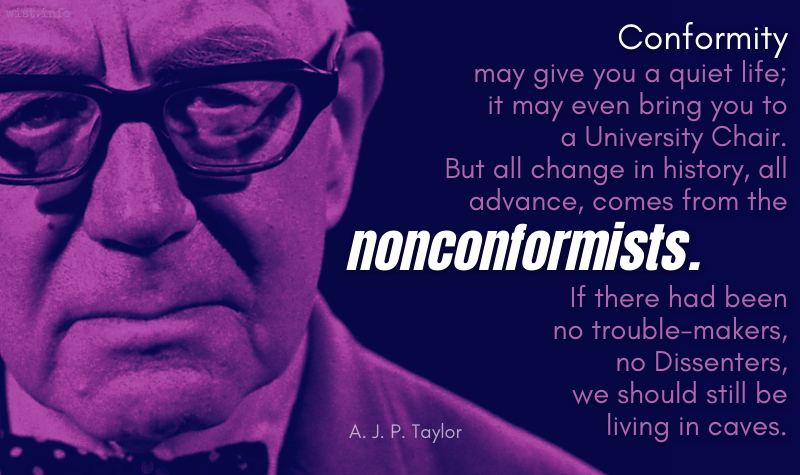
Conformity may give you a quiet life; it may even bring you to a University Chair. But all change in history, all advance, comes from the nonconformists. If there had been no trouble-makers, no Dissenters, we should still be living in caves.
A. J. P. Taylor (1906-1990) British historian, journalist, broadcaster [Alan John Percivale Taylor]
“The Radical Tradition: Fox, Paine, and Cobbett,” The Trouble Makers: Dissent over Foreign Policy, 1792–1939 (1969)

To write in plain, vigorous language one has to think fearlessly, and if one thinks fearlessly one cannot be politically orthodox.
George Orwell (1903-1950) English journalist, essayist, writer [pseud. of Eric Arthur Blair]
Essay (1946-01), “The Prevention of Literature,” Polemic Magazine
(Source)
On why, in authoritarian regimes, literature suffers.
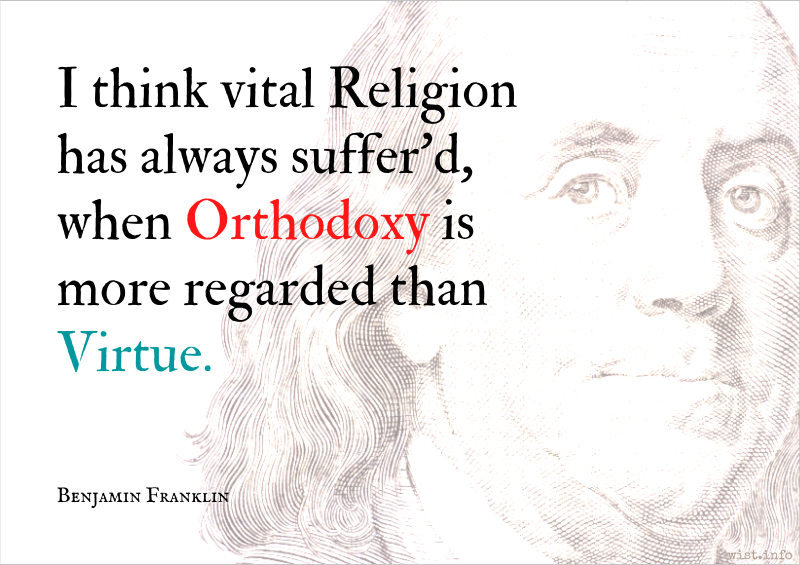
I think vital Religion has always suffer’d, when Orthodoxy is more regarded than Virtue. And the Scripture assures me, that at the last Day, we shall not be examin’d what we thought, but what we did; and our Recommendation will not be that we said Lord, Lord, but that we did GOOD to our Fellow Creatures.
Benjamin Franklin (1706-1790) American statesman, scientist, philosopher, aphorist
Letter to Josiah and Abiah Franklin (13 Apr 1738)
(Source)
His parents. Franklin cites Matt. 26 in the letter, but it should be Matt. 25:31-46.
The truth is always in the minority, and the minority is always stronger than the majority, because as a rule the minority is made up of those who actually have an opinion, while the strength of the majority is illusory, formed of that crowd which has no opinion — and which therefore the next moment (when it becomes clear that the minority is the stronger) adopts the latter’s opinion, which now is in the majority, i.e., becomes rubbish by having the whole retinue and numerousness on its side, while the truth is again in a new minority.

If I know your sect, I anticipate your argument.
Ralph Waldo Emerson (1803-1882) American essayist, lecturer, poet
“Self-Reliance,” Essays: First Series (1841)
(Source)
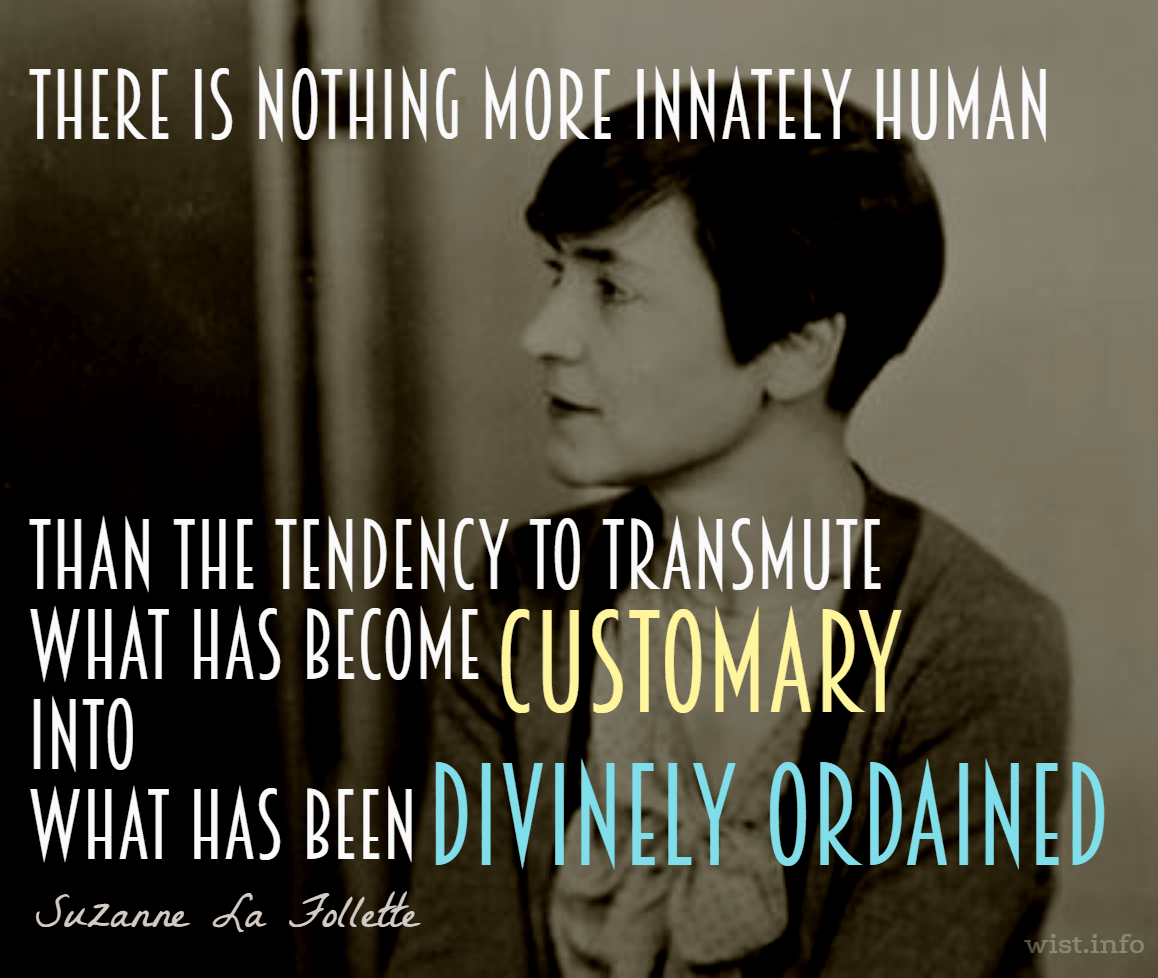
There is nothing more innately human than the tendency to transmute what has become customary into what has been divinely ordained.
Suzanne La Follette (1893-1983) American journalist, author, feminist
Concerning Women, “The Beginnings of Emancipation”(1926)

The surest way to corrupt a youth is to instruct him to hold in higher esteem those who think alike than those who think differently.
Friedrich Nietzsche (1844-1900) German philosopher and poet
The Dawn (1881)
Alternate translation:The surest way of ruining a youth is to teach him to respect those who think as he does more highly than those who think differently from him.
[tr. Hollingdale (1982)]

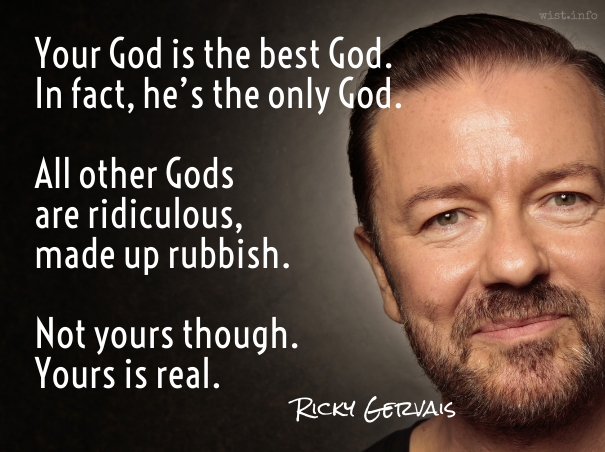
Your God is the best God.
In fact, he’s the only God.
All other Gods are ridiculous, made up rubbish.
Not yours though. Yours is real.

The further a society drifts from the truth, the more it will hate those who speak it.
George Orwell (1903-1950) English journalist, essayist, writer [pseud. of Eric Arthur Blair]
(Attributed)
Admiration for ourselves and our institutions is too often measured by our contempt and dislike for foreigners.
William Ralph Inge (1860-1954) English prelate [Dean Inge]
“Our Present Discontents,” Outspoken Essays: First Series (1919)
But public opinion, because of the tremendous urge to conformity in gregarious animals, is less tolerant than any system of law. When human beings are governed by “thou shalt not,” the individual can practice a certain amount of eccentricity: when they are supposedly governed by “love” or “reason,” he is under continuous pressure to make him behave and think in exactly the same way as everyone else.
George Orwell (1903-1950) English journalist, essayist, writer [pseud. of Eric Arthur Blair]
Essay (1946-09), “Politics vs. Literature: An Examination of Gulliver’s Travels,” Polemic, No. 5
(Source)
It always pains me greatly to discover how some Christian communities, and even consecrated persons, can tolerate different forms of enmity, division, calumny, defamation, vendetta, jealousy and the desire to impose certain ideas at all costs, even to persecutions which appear as veritable witch hunts. Whom are we going to evangelize if this is the way we act?
Francis I (1936-2025) Argentinian Catholic Pope (2013–2025) [b. Jorge Mario Bergoglio]
Evangelii Gaudium, sec. 100 (24 Nov 2013)
(Source)
Every religion consists of moral precepts, & of dogmas. In the first they all agree. All forbid us to murder, steal, plunder, bear false witness Etc. and these are the articles necessary for the preservation of order, justice, & happiness in society. In their particular dogmas all differ; no two professing the same. These respect vestments, ceremonies, physical opinions, & metaphysical speculations, totally unconnected with morality, & unimportant to the legitimate objects of society. Yet these are the questions on which have hung the bitter schisms of Nazarenes, Socinians, Arians, Athanasians in former times, & now of Trinitarians, Unitarians, Catholics, Lutherans, Calvinists, Methodists, Baptists, Quakers Etc. Among the Mahometans we are told that thousands fell victims to the dispute whether the first or second toe of Mahomet was longest; & what blood, how many human lives have the words ‘this do in remembrance of me’ cost the Christian world!
We all agree in the obligation of the moral precepts of Jesus: but we schismatize & lose ourselves in subtleties about his nature, his conception maculate or immaculate, whether he was a god or not a god, whether his votaries are to be initiated by simple aspersion, by immersion, or without water; whether his priests must be robed in white, in black, or not robed at all; whether we are to use our own reason, or the reason of others, in the opinions we form, or as to the evidence we are to believe. It is on questions of this, & still less importance, that such oceans of human blood have been spilt, & whole regions of the earth have been desolated by wars & persecutions, in which human ingenuity has been exhausted in inventing new tortures for their brethren.
It is time then to become sensible how insoluble these questions are by minds like ours, how unimportant, & how mischievous; & to consign them to the sleep of death, never to be awakened from it. The varieties in the structure & action of the human mind, as in those of the body, are the work of our creator, against which it cannot be a religious duty to erect the standard of uniformity.
Thomas Jefferson (1743-1826) American political philosopher, polymath, statesman, US President (1801-09)
Letter (1809-09-27) to James Fishback [draft]
(Source)
Jefferson seriously dialed back his actual response, though he kept both in his files; the final letter read, in this passage:The interests of society require the observation of those moral precepts only in which all religions agree, (for all forbid us to murder, steal, plunder, or bear false witness.) and that we should not intermeddle with the particular dogmas in which all religions differ, and which are totally unconnected with morality. in all of them we see good men, & as many in one as another. The varieties in the structure & action of the human mind as in those of the body, are the work of our creator, against which it cannot be a religious duty to erect the standard of uniformity.
Orthodoxy:
- In religion, that state of mind which congratulates itself on being absolutely right, and a belief that all who think otherwise are wholly wrong.
- A faith in the fixed — a worship of the static.
- The joy that comes from thinking that most everybody is lined up for Limbus with no return ticket.
- A condition brought about by the sprites of Humor, according to the rule that whom the gods would destroy they first make mad.
- The zenith of selfishness and the nadir of egotism.
- Mephisto with a lily in his hand.
- A corpse that does not know it is dead.
- Spiritual constipation.
- That peculiar condition where the patient can neither eliminate an old idea or absorb a new one.
Elbert Hubbard (1856-1915) American writer, businessman, philosopher
The Roycroft Dictionary (1914)
(Source)
Orthodoxy means not thinking — not needing to think. Orthdoxy is unconsciousness.
George Orwell (1903-1950) English journalist, essayist, writer [pseud. of Eric Arthur Blair]
Nineteen Eighty-Four, Part 1, ch. 5 [Symes] (1949)
(Source)
The longer I live, the more I am satisfied of two things: first, that the truest lives are those that are cut rose-diamond-fashion, with many facets answering to the many-planed aspects of the world about them; secondly, that society is always trying in some way or other to grind us down to a single flat surface.
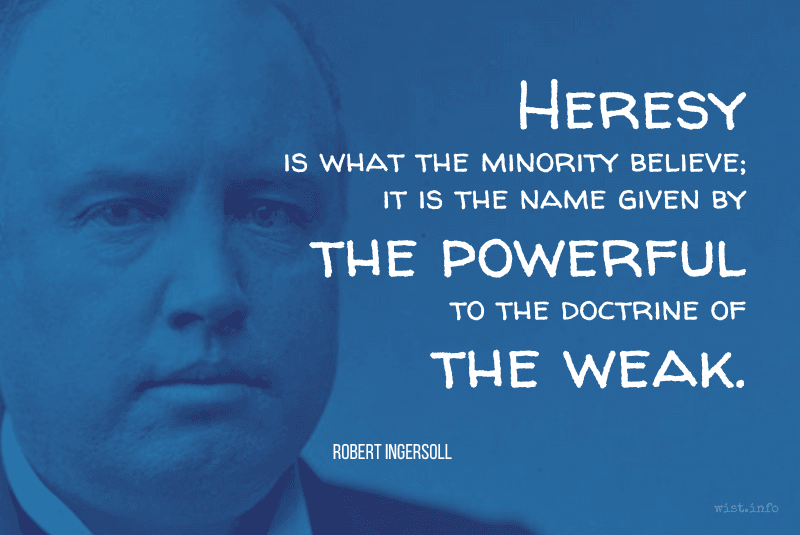
Whoever has an opinion of his own, and honestly expresses it, will be guilty of heresy. Heresy is what the minority believe; it is the name given by the powerful to the doctrine of the weak.
Robert Green Ingersoll (1833-1899) American lawyer, freethinker, orator
Lecture (1874-05-03), “Heretics and Heresies,” Free Religious Society, Kingsbury Hall, Chicago
(Source)
Collected in The Gods and Other Lectures (1876).
If a man has a genuine, sincere, hearty wish to get rid of his liberty, if he is really bent upon becoming a slave, nothing can stop him. And the temptation is to some natures a very great one.
Subject opinion to coercion: whom will you make your inquisitors? Fallible men; men governed by bad passions, by private as well as public reasons.
Thomas Jefferson (1743-1826) American political philosopher, polymath, statesman, US President (1801-09)
Notes on the State of Virginia, Query 17 (1782)
(Source)
But is uniformity of opinion desirable? No more than of face and stature. Introduce the bed of Procrustes then, and as there is danger that the great men may beat the small, make us all of a size, by lopping the former and stretching the latter. Difference of opinion is advantageous in religion. The several sects perform the office of a Censor morum over each other. Is uniformity attainable? Millions of innocent men, women, and children, since the introduction of Christianity, have been burnt, tortured, fined, imprisoned; yet we have not advanced one inch towards uniformity. What has been the effect of coercion? To make one half the world fools, and the other half hypocrites. To support roguery and error all over the earth.
Thomas Jefferson (1743-1826) American political philosopher, polymath, statesman, US President (1801-09)
Notes on the State of Virginia, Query 17 (1782)
(Source)
A cult is a religion with no power.
Thomas Wolfe (1900-1938) American writer
In Our Time, ch. 2 (1980)

I will not attack your doctrines nor your creeds if they accord liberty to me. If they hold thought to be dangerous — if they aver that doubt is a crime, then I attack them one and all, because they enslave the minds of men.
Robert Green Ingersoll (1833-1899) American lawyer, freethinker, orator
“The Ghosts” (1877)
(Source)
A man who never alters his opinion is like standing water, and breeds reptiles of the mind.
William Blake (1757-1827) English poet, mystic, artist
The Marriage of Heaven and Hell, “A Memorable Fancy” (1790)
(Source)
Success, recognition, and conformity are the bywords of the modern world where everyone seems to crave the anesthetizing security of being identified with the majority.
Martin Luther King, Jr. (1929-1968) American clergyman, civil rights leader, social activist, preacher
Strength to Love, ch. 2 “Transformed Non-Conformist” (1963)
(Source)
No iron chain, or outward force of any kind, could ever compel the soul of a man to believe or to disbelieve: it is his own indefeasible light, that judgment of his; he will reign, and believe there, by the grace of God alone!
Thomas Carlyle (1795-1881) Scottish essayist and historian
Lecture (1840-05-15), “The Hero as Priest,” Home House, Portman Square, London
(Source)
The lecture notes were collected by Carlyle into On Heroes, Hero-Worship, & the Heroic in History, Lecture 4 (1841).
Let the human Mind loose. It must be loose; it will be loose. Superstition and Despotism cannot confine it.
John Adams (1735-1826) American lawyer, Founding Father, statesman, US President (1797-1801)
Letter (1816-11-13) to John Quincy Adams
(Source)
No orthodox church ever had power that it did not endeavor to make people think its way by force and flame.
Robert Green Ingersoll (1833-1899) American lawyer, freethinker, orator
Trial of C.B. Reynolds for blasphemy (May 1887)
(Source)
Give any orthodox church the power, and to-day they would punish heresy with whip, and chain, and fire. As long as a church deems a certain belief essential to salvation, just so long it will kill and burn if it has the power. Why should the church pity a man whom her God hates? Why should she show mercy to a kind and noble heretic whom her God will burn in eternal fire? Why should a Christian be better than his God?
Robert Green Ingersoll (1833-1899) American lawyer, freethinker, orator
Lecture (1874-05-03), “Heretics and Heresies,” Free Religious Society, Kingsbury Hall, Chicago
(Source)
Collected in The Gods and Other Lectures (1876).
Men and women have been burned for thinking there is but one God; that there was none; that the Holy Ghost is younger than God; that God was somewhat older than his son; for insisting that good works will save a man without faith; that faith will do without good works; for declaring that a sweet babe will not be burned eternally, because its parents failed to have its head wet by a priest; for speaking of God as though he had a nose; for denying that Christ was his own father; for contending that three persons, rightly added together, make more than one; for believing in purgatory; for denying the reality of hell; for pretending that priests can forgive sins; for preaching that God is an essence; for denying that witches rode through the air on sticks; for doubting the total depravity of the human heart; for laughing at irresistible grace, predestination and particular redemption; for denying that good bread could be made of the body of a dead man; for pretending that the pope was not managing this world for God, and in the place of God; for disputing the efficacy of a vicarious atonement; for thinking the Virgin Mary was born like other people; for thinking that a man’s rib was hardly sufficient to make a good-sized woman; for denying that God used his finger for a pen; for asserting that prayers are not answered, that diseases are not sent to punish unbelief; for denying the authority of the Bible; for having a Bible in their possession; for attending mass, and for refusing to attend; for wearing a surplice; for carrying a cross, and for refusing; for being a Catholic, and for being a Protestant; for being an Episcopalian, a Presbyterian, a Baptist, and for being a Quaker. In short, every virtue has been a crime, and every crime a virtue. The church has burned honesty and rewarded hypocrisy. And all this, because it was commanded by a book.
Robert Green Ingersoll (1833-1899) American lawyer, freethinker, orator
Lecture (1874-05-03), “Heretics and Heresies,” Free Religious Society, Kingsbury Hall, Chicago
(Source)
Collected in The Gods and Other Lectures (1876).
Many orthodox people speak as though it were the business of sceptics to disprove received dogmas rather than of dogmatists to prove them. This is, of course, a mistake. If I were to suggest that between the Earth and Mars there is a china teapot revolving about the sun in an elliptical orbit, nobody would be able to disprove my assertion provided I were careful to add that the teapot is too small to be revealed even by our most powerful telescopes. But if I were to go on to say that, since my assertion cannot be disproved, it is intolerable presumption on the part of human reason to doubt it, I should rightly be thought to be talking nonsense.
Bertrand Russell (1872-1970) English mathematician and philosopher
“Is There a God?” (1952)
(Source)
Essay commissioned by Illustrated magazine in 1952, but never published there. First publication in Russell, Last Philosophical Testament, 1943-68 (1997) [ed. Slater/Köllner].
I believe this is the earliest (chronologically) reference by Russell to his teapot analogy.
Heretics have been hateful from the beginning of recorded time; they have been ostracized, exiled, tortured, maimed, and butchered; but it has generally proved impossible to smother them; and when it has not, the society that has succeeded has always declined.
Learned Hand (1872-1961) American jurist
“A Fanfare for Prometheus,” speech, American Jewish Committee (1955-01-29)
(Source)
On the necessary points, unity. On the questionable points, liberty. In everything, love.
[In necessariis unites, in non necessariis libertas, in omnibus caritas.]
Rupertus Meldenius (1582-1651) German writer [pseud. of Peter Meiderlin]
Paraenesis Votiva pro Pace Ecclesiae ad Theologos Augustanae Confessionis [Votive Counsel for the Peace of the Church, to the Theologians of the Augustan Confession] (1626)
Also translated as "essentials" and "non-essentials."
Paraphrase of final lines of the work:Verbo dicam: Si nos servaremus IN necesariis Unitatem, IN non-necessariis Libertatem, IN UTRISQUE Charitatem, optimo certe loco essent res nostrae.
[In a word, were we to observe unity in essentials, liberty in incidentals, and in all things charity, our affairs would be certainly in a most happy situation.]
Commonly attributed to St Augustine, but also to John Wesley, Richard Baxter, and several others.
One should respect public opinion insofar as is necessary to avoid starvation and keep out of prison, but anything that goes beyond this is voluntary submission to an unnecessary tyranny.
Bertrand Russell (1872-1970) English mathematician and philosopher
Conquest of Happiness, Part 1, ch. 9 “Fear of Public Opinion” (1930)
(Source)
Conventionality is not morality. Self-righteousness is not religion. To attack the first is not to assail the last. To pluck the mask from the face of the Pharisee, is not to lift an impious hand to the Crown of Thorns.
Charlotte Brontë (1816-1855) British novelist [pseud. Currer Bell]
Jane Eyre, Preface, 2nd edition (21 Dec 1847)

If there is any fixed star in our constitutional constellation, it is that no official, high or petty, can prescribe what shall be orthodox in politics, nationalism, religion, or other matters of opinion, or force citizens to confess by word or act their faith therein. If there are any circumstances which permit an exception, they do not now occur to us.
Robert H. Jackson (1892-1954) US Supreme Court Justice (1941-54), lawyer, jurist, politician
West Virginia State Board of Education v. Barnette, 319 U.S. 624 (1943) [majority opinion]
(Source)
Will we continue to march to the drumbeat of conformity and respectability, or will we, listening to the beat of a more distant drum, move to its echoing sounds? Will we march only to the music of time, or will we, risking criticism and abuse, march to the soul-saving music of eternity?
Martin Luther King, Jr. (1929-1968) American clergyman, civil rights leader, social activist, preacher
Strength to Love, ch. 2 “Transformed Nonconformist,” sec. 3 (1963)
(Source)
In necessary things, unity; in disputed things, liberty; in all things, charity.
Every generation laughs at the old fashions, but follows religiously the new.
Henry David Thoreau (1817-1862) American philosopher and writer
Walden; or, Life in the Woods, ch. 1 “Economy” (1854)
(Source)
It is error alone which needs the support of government. Truth can stand by itself.
Thomas Jefferson (1743-1826) American political philosopher, polymath, statesman, US President (1801-09)
Notes on the State of Virginia, Query 17 (1782)
(Source)