When we walk in the Lord’s presence, everything we see, hear, touch, or taste reminds us of Him. This is what is meant by a prayerful life. It is not a life in which we say many prayers but a life in which nothing, absolutely nothing, is done, said, or understood independently of Him who is the origin and purpose of our existence.
Henri Nouwen (1932–1996) Dutch Catholic priest and writer
The Living Reminder: Service and Prayer in Memory of Jesus Christ (1977)
Quotations about:
life
Note not all quotations have been tagged, so Search may find additional quotes on this topic.
Prayer is not a pious decoration of life but the breath of human existence.
Henri Nouwen (1932–1996) Dutch Catholic priest and writer
The Wounded Healer (1972)
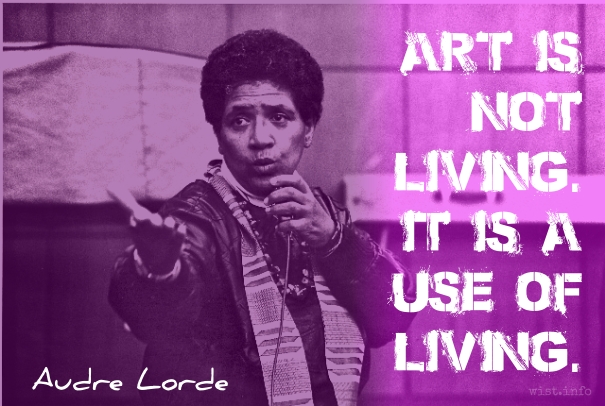
Art is not living. It is a use of living.
Audre Lorde (1934–1992) American writer, feminist, civil rights activist
“My Words Will Be There”
(Source)
O Earth! all bathed with blood and tears, yet never
Hast thou ceased putting forth thy fruit and flowers.Germaine de Staël (1766–1817) Swiss-French writer, woman of letters, critic, salonist [Anne Louise Germaine de Staël-Holstein, Madame de Staël, Madame Necker]
Corinne, Book 13, ch. 4 (1807)

Just to be is a blessing. Just to live is holy.
Abraham Joshua Heschel (1907–1972) Polish-American rabbi, theologian, philosopher
“No Religion Is an Island,” Union Theological Seminary Quarterly Review (Jan 1966)
One must, in one’s life, make a choice between boredom and suffering.
Germaine de Staël (1766–1817) Swiss-French writer, woman of letters, critic, salonist [Anne Louise Germaine de Staël-Holstein, Madame de Staël, Madame Necker]
Letter to Claude Hochet (Summer 1800)
Quoted in J. Christopher Herold, Mistress to an Age: A Life of Madame de Staël (1958). Herold added, "Her decision was emphatically in favor of suffering, which after all was a pleasure compared to boredom."
Life often seems like a long shipwreck, of which the debris are friendship, glory, and love; the shores of existence are strewn with them.
Germaine de Staël (1766–1817) Swiss-French writer, woman of letters, critic, salonist [Anne Louise Germaine de Staël-Holstein, Madame de Staël, Madame Necker]
Reflections on Suicide [Réflexions sur le suicide], Sec. 1 (1813) [tr. De Finod]
When thinking about life, remember this: no amount of guilt can change the past, and no amount of anxiety can change the future.
(Other Authors and Sources)
Anonymous

Remember that you have only one soul; that you have only one death to die; that you have only one life, which is short and has to be lived by you alone; and there is only one Glory, which is eternal. If you do this, there will be many things about which you care nothing.
Teresa of Ávila (1515–1582) Spanish mystic, poet, philosopher, saint
“Maxims for Her Nuns”
In Complete Works St. Teresa of Avila, Vol. 3 (1963) [ed. Peers]

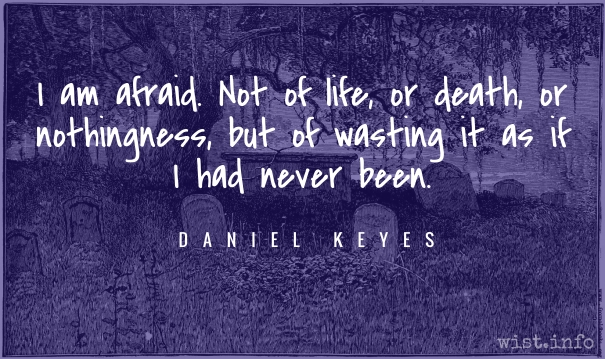
I am afraid. Not of life, or death, or nothingness, but of wasting it as if I had never been.
Daniel F. Keyes (1927–2014) American author
Flowers for Algernon (novel) (1966)
The whole fun of living is trying to make something better.
Charles F. Kettering (1876–1958) American inventor, engineer, researcher, businessman
(Attributed)
PELAGEA VLASOVA: Don’t be afraid of death so much as an inadequate life.
Bertolt Brecht (1898–1956) German poet, playwright, director, dramaturgist
The Mother (1930)
The golden apple of selfhood, thrown among the false gods, became an apple of discord because they scrambled for it. They did not know the first rule of the holy game, which is that every player must by all means touch the ball and then immediately pass it on. To be found with it in your hands is a fault: to cling to it, death. But when it flies to and fro among the players too swift for eye to follow, and the great master Himself leads the revelry, giving Himself eternally to His creatures in the generation, and back to Himself in the sacrifice, of the Word, then indeed the eternal dance ‘makes heaven drowsy with the harmony’. All pains and pleasures we have known on earth are early initiations in the movements of that dance: but the dance itself is strictly incomparable with the sufferings of this present time. As we draw nearer to its uncreated rhythm, pain and pleasure sink almost out of sight. There is joy in the dance, but it does not exist for the sake of joy. It does not even exist for the sake of good, or of love. It is Love Himself, and Good Himself, and therefore happy. It does not exist for us, but we for it.
C. S. Lewis (1898–1963) English writer, literary scholar, lay theologian [Clive Staples Lewis]
The Problem of Pain (1940)
The main idea in golf as in life, I suppose, is to learn to accept what cannot be altered, and to keep on doing one’s own reasoned and resolute best whether the prospect be bleak or rosy.
Robert Tyre "Bobby" Jones, Jr. (1902–1971) American amateur golfer, lawyer
Golf Is My Game (1960)
(Source)

The latter part of a wise man’s life is taken up in curing the follies, prejudices, and false opinions he had contracted in the former.
Jonathan Swift (1667–1745) English writer and churchman
“Thoughts on Various Subjects” (1706)
(Source)

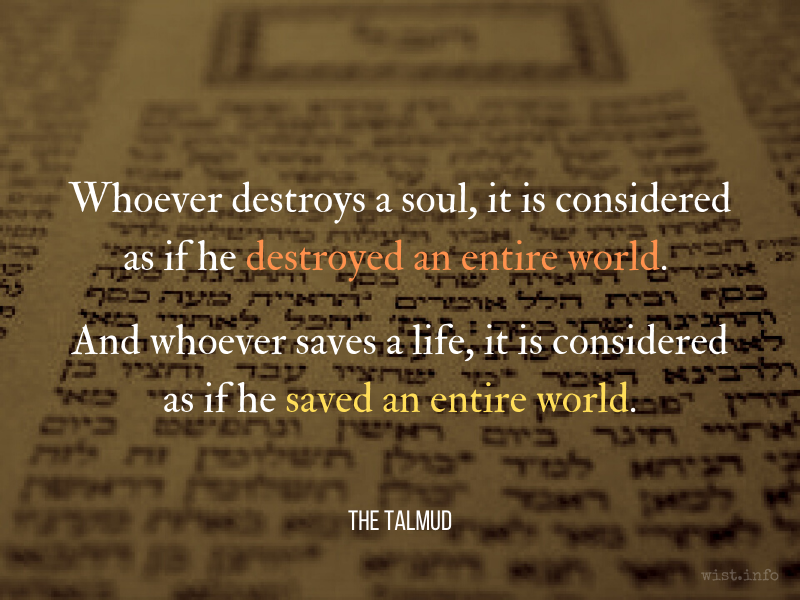
Whoever destroys a soul, it is considered as if he destroyed an entire world. And whoever saves a life, it is considered as if he saved an entire world.
The Talmud (AD 200–500) Collection of Jewish rabbinical writings
Mishnah Sanhedrin 4:9; Yerushalmi Talmud, Tractate Sanhedrin 37a
(Source)
Other translations: "Whoever destroys a single life is as guilty as though he had destroyed the entire world; and whoever rescues a single life earns as much merit as though he had rescued the entire world."

Never give up on a dream just because of the time it will take to accomplish it. The time will pass anyway.
Earl Nightingale (1921–1989) American motivational speaker, writer, radio personality
(Attributed)
Like as the waves make towards the pebbl’d shore,
So do our minutes hasten to their end.

The Stream of Life sometimes glides smoothly on, through flowry meadows and enamell’d planes. At other times it draggs a winding reluctant Course through offensive Boggs and dismal gloomy Swamps. The same road now leads us thro’ a spacious Country fraught with evry delightful object, Then plunges us at once, into miry Sloughs, or stops our passage with craggy and inaccessible mountains. The free roving Songster of the forest, now rambles unconfin’d, and hopps from Spray to Spray but the next hour perhaps he alights to pick the scattered Grain and is entangled in the Snare. The Ship, which, wafted by a favourable gale, sails prosperously upon the peaceful Surface, by a sudden Change of weather may be tossed by the Tempest, and driven by furious, opposite winds, upon rocks or quicksands. In short nothing in this world enjoys a constant Series of Joy and prosperity.
John Adams (1735–1826) American lawyer, Founder, statesman; US President (1797–1801)
Diary (1756-03-27)
(Source)

You must understand the whole of life, not just one little part of it. That is why you must read, that is why you must look at the skies, that is why you must sing and dance, and write poems and suffer and understand, for all that is life.
Jiddu Krishnamurti (1895–1986) Indian philosopher, mystic, orator
Think on These Things, Part 1, ch. 3 (1963)
(Source)

There are more truths in twenty-four hours of a man’s life than in all the philosophies.
Raoul Vaneigem (b. 1934) Belgian writer
The Revolution of Everyday Life, 1.1 (1967)
Because inside every old person is a young person wondering what happened.

A great many people (not you) do now seem to think that the mere state of being worried is in itself meritorious. I don’t think it is. We must, if it so happens, give our lives for others: but even while we’re doing it, I think we’re meant to enjoy Our Lord and, in Him, our friends, our food, our sleep, our jokes, and the birds’ song and the frosty sunrise.
C. S. Lewis (1898–1963) English writer, literary scholar, lay theologian [Clive Staples Lewis]
Letter to Alan Griffiths (20 Dec 1946)
(Source)
Life is much too important a thing ever to talk seriously about it.
Oscar Wilde (1854–1900) Irish poet, wit, dramatist
Vera; or, The Nihilists, Act 2 [Prince Paul] (1881)
(Source)
Almost always paraphrased, "Life is too important to be taken seriously."
In Lady Windermere's Fan, Act 2 (1892), he recycled the line as "Life is far too important a thing ever to talk seriously about it."
Also (mis)attributed to G.K. Chesterton. More discussion of this quotation: Life Is Too Important To Be Taken Seriously – Quote Investigator.
We all die. The goal isn’t to live forever, the goal is to create something that will.
Chuck Palahniuk (b. 1962) American novelist and freelance journalist
Diary [Grace] (2003)

Let us never be betrayed into saying we have finished our education; because that would mean we had stopped growing.
Julia H. Gulliver (1856–1940) American philosopher, educator, academician
(Attributed)

Experience: that most brutal of teachers. But you learn, my God, do you learn.
C. S. Lewis (1898–1963) English writer, literary scholar, lay theologian [Clive Staples Lewis]
(Attributed)
There are several variants, but no citation for this quotation. See Pliny the Younger.
He died doing what he loved most: not being dead.
Joss Whedon (b. 1964) American screenwriter, author, producer [Joseph Hill Whedon]
Tweet (3 Oct 2014)
(Source)

May you live to be a hundred years,
With one extra year to repent.Proverbs, Sayings, and Adages
Irish proverb

He preaches well that lives well, quoth Sancho; that’s all the Divinity I understand.
Miguel de Cervantes (1547–1616) Spanish novelist
Don Quixote, Part 2, Book 3, ch. 29 (1615) [tr. Motteux & Ozell (1743)]

All of life is a foreign country.
Jack Kerouac (1922–1969) Canadian-American novelist and poet
Letter to John Clellon Holmes (24 Jun 1949)

This isn’t life in the fast lane, it’s life in the oncoming traffic.
The real reason for not committing suicide is because you always know how swell life gets again after hell is over.
Ernest Hemingway (1899–1961) American writer
Letter (1926)

Why is it that we rejoice at a birth and grieve at a funeral? It is because we are not the person involved.
Mark Twain (1835–1910) American writer [pseud. of Samuel Clemens]
The Tragedy of Pudd’nhead Wilson, ch. 9 epigraph “Pudd’nhead Wilson’s Calendar” (1894)
(Source)
If you try and take a cat apart to see how it works, the first thing you have on your hands is a nonworking cat. Life is a level of complexity that almost lies outside our vision; it is so far beyond anything we have any means of understanding that we just think of it as a different class of object, a different class of matter; ‘life’, something that had a mysterious essence about it, was God given, and that’s the only explanation we had.
Douglas Adams (1952–2001) English author, humorist, screenwriter
Speech, Digital Biota 2 Conference, Cambridge, UK (Sep 1998)
(Source)
Quoted by Richard Dawkins in his eulogy for Adams (17 Sep 2001)

The last pleasure in life is the sense of discharging our duty.
William Hazlitt (1778–1830) English writer
Table Talk, “On Novelty and Familiarity” (1822)
The great and glorious masterpiece of man is to know how to live to purpose; all other things, to reign, to lay up treasure, to build, are, at most, but little appendices and props.
[Le glorieux chef-d’oeuvre de l’homme, c’est vivre à propos. Toutes autres choses ; regner, thesauriser, bastir, n’en sont qu’appendicules et adminicules, pour le plus.]
Michel de Montaigne (1533–1592) French essayist
Essays, Book 3, ch. 13 (3.13), “Of Experience [De l’Experience] (1587) [tr. Cotton/Hazlitt (1877)]
(Source)
This passage was added to the original version of the essay, published 1588, for the 1595 edition.
(Source (French)). Other translations:The glorious master-piece of man, is, to live to the purpose. All other things, as to raigne, to governe, to hoarde up treasure, to thrive and to build, are for the most part but appendixes and supportes thereunto.
[tr. Florio (1603)]The glorious Master-piece of Man is to know how to live to purpose; all other things, to reign, to lay up Treasure, and to build, are at the most but little Appendixes, and little Props.
[tr. Cotton (1686)]Man's great and glorious master-work is to live befittingly; all other things -- to reign, to lay up treasure, to build -- are at the best mere accessories and aids.
[tr. Ives (1925)]Our great and glorious masterpiece is to live appropriately. All other things, ruling, hoarding, building, are only little appendages and props, at most.
[tr. Frame (1943)]Our most great and glorious achievement is to live our life fittingly. Everything else -- reigning, building, laying up treasure -- are at most tiny props and small accessories.
[tr. Screech (1987)]

Life is one day at a time. And thank God! I couldn’t take much more.
Daniel Patrick Moynihan (1927–2003) American politician, diplomat, sociologist
Meet the Press (19 Jun 1994)
Life’s under no obligation to give us what we expect. We take what we get and are thankful it’s no worse than it is.
Margaret Mitchell (1900–1949) American author and journalist.
Gone with the Wind, ch. 53 [Ashley] (1936)
What a wee little part of a person’s life are his acts and his words! His real life is led in his head, and is known to none but himself. All day long, and every day, the mill of his brain is grinding, and his thoughts (which are but the mute articulation of his feelings,) not those other things, are his history. His acts and his words are merely the visible thin crust of his world, with its scarred snow summits and its vacant wastes of water — and they are so trifling a part of his bulk! a mere skin enveloping it. The mass of him is hidden — it and its volcanic fires that toss and boil, and never rest, night nor day. These are his life, and they are not written, and cannot be written. Every day would make a whole book of eighty thousand words — three hundred and sixty-five books a year. Biographies are but the clothes and buttons of the man — the biography of the man himself cannot be written.
Mark Twain (1835–1910) American writer [pseud. of Samuel Clemens]
The Autobiography of Mark Twain, Vol. 1 (2010)
(Source)
The important thing is neither your nationality nor the religion you professed, but how your faith translated itself in your life.
Eleanor Roosevelt (1884–1962) American politician, diplomat, activist; First Lady of the US (1933–45)
Column (1943-09-23), “My Day”
(Source)
On the war dead in the military cemetery on Guadalcanal, and the messages left by their comrades-in-arms.
He achieved success who has lived well, laughed often, and loved much;
Who has enjoyed the trust of pure women, the respect of intelligent men and the love of little children;
Who has filled his niche and accomplished his task;
Who has never lacked appreciation of Earth’s beauty or failed to express it;
Who has left the world better than he found it,
Whether an improved poppy, a perfect poem, or a rescued soul;
Who has always looked for the best in others and given them the best he had;
Whose life was an inspiration;
Whose memory a benediction.Elisabeth-Anne "Bessie" Anderson Stanley (1879–1952) American poet
“Success” (1905)
The essay was written for a poetry contest to answer the question "What is success?" in 100 words or less. It (especially the first 13 words) is often misattributed to Robert Louis Stevenson, Ralph Waldo Emerson, or Elbert Hubbard (the latter probably because the essay appeared in an advertisment in his series of books Little Journeys to the Homes of Great Lovers (e.g.).
More information: Bessie Anderson Stanley - Wikipedia.
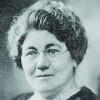
The world is like a ride in an amusement park, and when you choose to go on it you think it’s real because that’s how powerful our minds are. The ride goes up and down, around and around, it has thrills and chills, and it’s very brightly colored, and it’s very loud, and it’s fun for a while. Many people have been on the ride a long time, and they begin to wonder, “Hey, is this real, or is this just a ride?” And other people have remembered, and they come back to us and say, “Hey, don’t worry; don’t be afraid, ever, because this is just a ride.” And we … kill those people. “Shut him up! I’ve got a lot invested in this ride, shut him up! Look at my furrows of worry, look at my big bank account, and my family. This has to be real.” It’s just a ride. But we always kill the good guys who try and tell us that, you ever notice that? And let the demons run amok. … But it doesn’t matter, because it’s just a ride. And we can change it any time we want. It’s only a choice. No effort, no work, no job, no savings of money. Just a simple choice, right now, between fear and love. The eyes of fear want you to put bigger locks on your doors, buy guns, close yourself off. The eyes of love instead see all of us as one.
Bill Hicks (1961–1994) American stand-up comedian, social critic, satirist, musician [William Melvin "Bill" Hicks]
Revelations (1993)
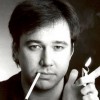
EDDIE: Kid, life’s hard. But it’s a lot harder if you’re stupid.
Paul Monash (1917–2003) American producer and screenwriter
The Friends of Eddie Coyle (movie) (1973)
Screenplay based on the novel by George V. Higgins (though the line is not in the book). Played in the movie by Robert Mitchum, to whom the quote is often attributed.

Lives of great men all remind us
We can make our lives sublime,
And, departing, leave behind us
Footprints on the sands of time.Henry Wadsworth Longfellow (1807–1882) American poet
“A Psalm of Life” (1838)
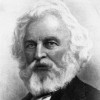
What a day-to-day affair life is.
Jules Laforgue (1860–1887) Franco-Uruguayan Symbolist poet
“Complainte sur certains ennuis,” Les Complaintes (1885)
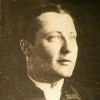
You have no lease of your lives, and death is not bound to give you warning before it gives you that deadly blow that will send you to everlasting misery or everlasting felicity.
Thomas Brooks (1608–1680) English Puritan divine, writer
The Hypocrite Detected, Anatomized (1650)
Time is a jewel more worth than a world. Time is not yours to dispose of as you please; it is a glorious talent that men must be accountable for as well as any other talent.
Thomas Brooks (1608–1680) English Puritan divine, writer
The Hypocrite Detected, Anatomized (1650)
Pain is a byproduct of life. That’s the truth. Life sometimes sucks. That’s true for everyone. But if you don’t face the pain and the suck, you don’t ever get the other things either. Laughter. Joy. Love. Pain passes, but those things are worth fighting for. Worth dying for.
Jim Butcher (b. 1971) American author
(Attributed)
Often cited to the short story "Vignette" (also known as "Publicity and Advertising"), but not found there.

Tonight, we gather to affirm the greatness of our nation — not because of the height of our skyscrapers, or the power of our military, or the size of our economy. Our pride is based on a very simple premise, summed up in a declaration made over two hundred years ago: “We hold these truths to be self-evident, that all men are created equal, that they are endowed by their Creator with certain inalienable rights, that among these are life, liberty and the pursuit of happiness.” That is the true genius of America — a faith in simple dreams, an insistence on small miracles.
Life is a biography, not a series of disconnected moments, more or less pleasurable but increasingly tedious and unsatisfying unless one imposes a purposive pattern upon them.
Theodore Dalrymple (b. 1949) English writer, journalist, psychiatrist [pen name for Anthony (A.M.) Daniels]
Life at the Bottom (2001)
Reason is incompetent to answer any fundamental questions about God, or morality, or the meaning of life.
Carl L. Becker (1873–1945) American historian
The Heavenly City of the Eighteenth-Century Philosophers (1932)
Concision in style, precision in thought, decision in life.
[Concision dans le style, précision dans la pensée, décision dans la vie.]
Victor Hugo (1802–1885) French writer, journalist, human rights activist, politician
Victor Hugo’s Intellectual Autobiography [Postscriptum de ma Vie], “Thoughts,” sec. 3 (1901) [tr. O’Rourke (1907)]
(Source)
I think the authors of that notable instrument intended to include all men, but they did not mean to declare all men equal in all respects. They did not mean to say all men were equal in color, size, intellect, moral development, or social capacity. They defined with tolerable distinctness in what they did consider all men created equal — equal in “certain inalienable rights, among which are life, liberty, and the pursuit of happiness.” This they said, and this they meant. They did not mean to assert the obvious untruth that all were then actually enjoying that equality, or yet that they were about to confer it immediately upon them. In fact, they had no power to confer such a boon. They meant simply to declare the right, so that the enforcement of it might follow as fast as circumstances should permit. They meant to set up a standard maxim for free society which should be familiar to all, constantly looked to, constantly labored for, and even, though never perfectly attained, constantly approximated, and thereby constantly spreading and deepening its influence, and augmenting the happiness and value of life to all people, of all colors, everywhere.

Gentleness is everywhere in daily life, a sign that faith rules through ordinary things: through cooking and small talk, through storytelling, making love, fishing, tending animals and sweet corn and flowers, through sports, music and books, raising kids — all the places where the gravy soaks in and grace shines through.
Garrison Keillor (b. 1942) American entertainer, author
“The Meaning of Life,” We Are Still Married (1989)
One ship drives east and another drives west,
With the self-same winds that blow,
‘Tis the set of the sails
And not the gales
That tell them way to go.
Like the winds of the sea are the winds of fate,
As we journey along through life,
‘Tis the set of the soul,
That determines the goal,
And not the calm or the strife.Ella Wheeler Wilcox (1850–1919) American author, poet, temperance advocate, spiritualist
Poem (1913), “The Winds of Fate,” Poems of Optimism (1915)
(Source)
Sometimes called "'Tis the Set of the Sail."
There is a longer variant of the poem, sometimes called "One Ship Sails East," that includes two stanzas in front, and has slightly different words in the analogous stanzas. I have not found a primary source for this version:But to every mind there openeth,
A way, and way, and away,
A high soul climbs the highway,
And the low soul gropes the low,
And in between on the misty flats,
The rest drift to and fro.
But to every man there openeth,
A high way and a low,
And every mind decideth,
The way his soul shall go.
One ship sails East,
And another West,
By the self-same winds that blow,
'Tis the set of the sails
And not the gales,
That tells the way we go.
Like the winds of the sea
Are the waves of time,
As we journey along through life,
'Tis the set of the soul,
That determines the goal,
And not the calm or the strife.

Never give children a chance of imagining that anything exists in isolation. Make it plain from the very beginning that all living is relationship. Show them relationships in the woods, in the fields, in the ponds and streams, in the village and in the country around it. Rub it in.
Aldous Huxley (1894–1963) English novelist, essayist and critic
Island (1962)
Life has no other discipline to impose, if we would but realize it, than to accept life unquestioningly. Everything we shut our eyes to, everything we run away from, everything we deny, denigrate, or despise, serves to defeat us in the end. What seems nasty, painful, evil, can become a source of beauty, joy, and strength, if faced with an open mind. Every moment is a golden one for him who has the vision to recognize it as such.
Henry Miller (1891–1980) American novelist
The World of Sex (1940)
Eighty percent of success is showing up.
Woody Allen (b. 1935) American comedian, writer, director [b. Allan Steward Konigsberg]
Comment
Originally attributed to Allen by collaborator Marshall Brickman in Susan Brady, "He's Woody Allen's Not-So-Silent Partner," New York Times (21 Aug 1977) as "Showing up is 80 percent of life." On inquiry, Allen confirmed that he'd said the quotation above in a letter to William Safire (1989). More information here.
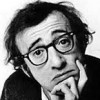
But we live through the fine days without noticing them; only when we fall on evil ones do we wish to have back the former. With sour faces we let a thousand bright and pleasant hours slip by unenjoyed and afterwards vainly sigh for their return when times are trying and depressing. Instead of this, we should cherish every present moment that is bearable, even the most ordinary, which with such indifference we now let slip by, and even with impatience push on.
[Aber wir verleben unsre schönen Tage, ohne sie zu bemerken: erst wann die schlimmen kommen, wünschen wir jene zurück. Tausend heitere, angenehme Stunden lassen wir, mit verdrießlichem Gesicht, ungenossen an uns vorüberziehn, um nachher, zur trüben Zeit, mit vergeblicher Sehnsucht ihnen nachzuseufzen. Statt dessen sollten wir jede erträgliche Gegenwart, auch die alltägliche, welche wir jetzt so gleichgültig vorüberziehn lassen, und wohl gar noch ungeduldig nachschieben.]
Arthur Schopenhauer (1788–1860) German philosopher
Parerga and Paralipomena, Vol. 1, “Aphorisms on the Wisdom of Life [Aphorismen zur Lebensweisheit],” ch. 5 “Counsels and Maxims [Paränesen und Maximen],” § 2.5 (1851) [tr. Payne (1974)]
(Source)
(Source (German)). Another translation:But we live through our days of happiness without noticing them; it is only when evil comes upon us that we wish them back. A thousand gay and pleasant hours are wasted in ill-humor; we let them slip by unenjoyed, and sigh for them in vain when the sky is overcast. Those present moments that are bearable, be they never so trite and common, -- passed by in indifference, or, it may be, impatiently pushed away.
[tr. Saunders (1890)]

We have no reason to harbor any mistrust against our world, for it is not against us. If it has terrors, they are our terrors; if it has abysses, these abysses belong to us; if there are dangers, we must try to love them. And if only we arrange our life in accordance with the principle which tells us that we must always trust in the difficult, then what now appears to us as the most alien will become our most intimate and trusted experience. How could we forget those ancient myths that stand at the beginning of all races, the myths about dragons that at the last moment are transformed into princesses? Perhaps all the dragons in our lives are princesses who are only waiting to see us act, just once, with beauty and courage. Perhaps everything that frightens us is, in its deepest essence, something helpless that wants our love.
Rainer Maria Rilke (1875–1963) German poet
Letters to a Young Poet, Letter 8, 12 Aug 1904 (1929)
(Source)
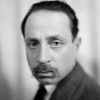
To live is to war with trolls in heart and soul.
Henrik Ibsen (1828–1906) Norwegian poet and playwright
Letter to Ludwig Passarge (16 Jun 1890)
Discussing Peter Gynt, which Passarge was translating. Often paraphrased "To live is to war against the trolls."
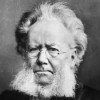
Autumn is really the best of the seasons: and I’m not sure that old age isn’t the best part of life. But of course, like Autumn, it doesn’t last.
C. S. Lewis (1898–1963) English writer, literary scholar, lay theologian [Clive Staples Lewis]
Letter to Miss Jane Douglass (31 Oct 1963)
In W. H. Lewis, ed., The Letters of C. S. Lewis (1966), final letter.
Sometimes I don’t know if my life is complicated, or if it’s that I just think too much about things.
John Scalzi (b. 1969) American writer
Zoe’s Tale, ch. 7 (2008)

Human life must be some kind of mistake. The truth of this will be sufficiently obvious if we only remember that man is a compound of needs and necessities hard to satisfy; and that even when they are satisfied, all he obtains is a state of painlessness, where nothing remains to him but abandonment to boredom. This is direct proof that existence has no real value in itself; for what is boredom but the feeling of the emptiness of life? If life — the craving for which is the very essence of our being — were possessed of any positive intrinsic value, there would be no such thing as boredom at all: mere existence would satisfy us in itself, and we should want for nothing. But as it is, we take no delight in existence except when we are struggling for something; and then distance and difficulties to be overcome make our goal look as though it would satisfy us — an illusion which vanishes when we reach it; or else when we are occupied with some purely intellectual interest — when in reality we have stepped forth from life to look upon it from the outside, much after the manner of spectators at a play. And even sensual pleasure itself means nothing but a struggle and aspiration, ceasing the moment its aim is attained. Whenever we are not occupied in one of these ways, but cast upon existence itself, its vain and worthless nature is brought home to us; and this is what we mean by boredom. The hankering after what is strange and uncommon — an innate and ineradicable tendency of human nature — shows how glad we are at any interruption of that natural course of affairs which is so very tedious.
[Daß das menschliche Daseyn eine Art Verirrung seyn müsse, geht zur Genüge aus der einfachen Bemerkung hervor, daß der Mensch ein Konkrement von Bedürfnissen ist, deren schwer zu erlangende Befriedigung ihm doch nichts gewährt, als einen schmerzlosen Zustand, in welchem er nur noch der Langenweile Preis gegeben ist, welche dann geradezu beweist, daß das Daseyn an sich selbst keinen Werth hat: denn sie ist eben nur die Empfindung der Leerheit desselben. Wenn nämlich das Leben, in dem Verlangen nach welchem unser Wesen und Daseyn besteht, einen positiven Werth und realen Gehalt in sich selbst hätte; so könnte es gar keine Langeweile geben: sondern das bloße Daseyn, an sich selbst, müßte uns erfüllen und befriedigen. Nun aber werden wir unsers Daseyns nicht anders froh, als entweder im Streben, wo die Ferne und die Hindernisse das Ziel als befriedigend uns vorspiegeln, welche Illusion nach der Erreichung verschwindet; oder aber in einer rein intellektuellen Beschäftigung, in welcher wir jedoch eigentlich aus dem Leben heraustreten, um es von außen zu betrachten, gleich Zuschauern in den Logen. Sogar der Sinnengenuß selbst besteht in einem fortwährenden Streben und hört auf, sobald sein Ziel erreicht ist. So oft wir nun nicht in einem jener beiden Fälle begriffen, sondern auf das Daseyn selbst zurückgewiesen sind, werden wir von der Gehaltlosigkeit und Nichtigkeit desselben überführt, und Das ist die Langeweile. Sogar das uns inwohnende und unvertilgbare, begierige Haschen nach dem Wunderbaren zeigt an, wie gern wir die so langweilige, natürliche Ordnung des Verlaufs der Dinge unterbrochen sähen.]
Arthur Schopenhauer (1788–1860) German philosopher
Parerga and Paralipomena, Vol. 2, ch. 11 “The Vanity of Existence [Der Nichtigkeit des Daseins],” § 146 (1851)
(Source)
(Source (German)). Another translation:That human life must be a kind of mistake is sufficiently clear from the fact that man is a compound of needs, which are difficult to satisfy; moreover, if they are satisfied, all he is granted is a state of painlessness, in which he can only give himself up to boredom. This is a precise proof that existence in itself has no value, since boredom is merely the feeling of the emptiness of life. If, for instance, life, the longing for which constitutes our very being, had in itself any positive and real value, boredom could not exist; mere existence in itself would supply us with everything, and therefore satisfy us. But our existence would not be a joyous thing unless we were striving after something; distance and obstacles to be overcome then represent our aim as something that would satisfy us -- an illusion which vanishes when our aim has been attained; or when we are engaged in something that is of a purely intellectual nature, when, in reality, we have retired from the world, so that we may observe it from the outside, like spectators at a theatre. Even sensual pleasure itself is nothing but a continual striving, which ceases directly its aim is attained. As soon as we are not engaged in one of these two ways, but thrown back on existence itself, we are convinced of the emptiness and worthlessness of it; and this it is we call boredom. That innate and ineradicable craving for what is out of the common proves how glad we are to have the natural and tedious course of things interrupted.
[tr. Dircks]That human existence must be some kind of error, is sufficiently clear from the simple observation that man is a concretion of needs and wants. Their satisfaction is hard to attain and yet affords him nothing but a painless state in which he is still abandoned to boredom. This, then, is a positive proof that, in itself, existence has no value; for boredom is just that feeling of its emptiness. Thus if life, in the craving for which our very essence and existence consist, had a positive value and in itself a real intrinsic worth, there could not possibly be any boredom. On the contrary, mere existence in itself would necessarily fill our hearts and satisfy us. Now we take no delight in our existence except in striving for something when the distance and obstacles make us think that the goal will be satisfactory, an illusion that vanishes when it is reached; or else in a purely intellectual occupation where we really step out of life in order to contemplate it from without, like spectators in the boxes. Even sensual pleasure itself consists in a constant striving and ceases as soon as its goal is attained. Now whenever we are not striving for something or are not intellectually occupied, but are thrown back on existence itself, its worthlessness and vanity are brought home to us; and this is what is meant by boredom. Even our inherent and ineradicable tendency to run after what is strange and extraordinary shows how glad we are to see an interruption in the natural course of things which is so tedious.
[tr. Payne (1974)]
Those people you saw — the realborn — are born without a plan. They’re born because biology tells humans to make more humans; but it doesn’t consider what to do with them after that. Realborn go for years without the slightest clue what they’re going to do with themselves. From what I understand, some of them never actually figure it out. They just walk through life in a daze and then fall into their graves at the end of it. Sad. And inefficient.
John Scalzi (b. 1969) American writer
The Ghost Brigades, ch. 5 (2006)
The life, the fortune, and the happiness of every one of us, and, more or less, of those who are connected with us, do depend upon our knowing something of the rules of a game infinitely more difficult and complicated than chess. It is a game which has been played for untold ages, every man and woman of us being one of the two players in a game of his or her own. The chessboard is the world, the pieces are the phenomena of the universe, the rules of the game are what we call the laws of Nature. The player on the other side is hidden from us. We know that his play is always fair, just, and patient. But also we know, to our cost, that he never overlooks a mistake, or makes the smallest allowance for ignorance. To the man who plays well, the highest stakes are paid, with that sort of overflowing generosity with which the strong shows delight in strength. And one who plays ill is checkmated — without haste, but without remorse.
T. H. Huxley (1825–1895) English biologist [Thomas Henry Huxley]
“A Liberal Education and Where to Find It” (1868)
(Source)
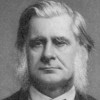
Richard was not dead. He was sitting in the dark, on a ledge, on the side of a storm drain, wondering what to do, wondering how much further out of his league he could possibly get. His life so far, he decided, had prepared him perfectly for a job in Securities, for shopping at the supermarket, for watching soccer on the television on the weekends, for turning up the thermostat if he got cold. It had magnificently failed to prepare him for a life as an un-person on the roofs and in the sewers of London, for a life in the cold and the wet and the dark.
Neil Gaiman (b. 1960) British author, screenwriter, fabulist
Neverwhere, ch. 4 (1996)
(Source)
The above is the original US edition language. The 2006 "Author's Preferred Text" edition restores (even in the US) a few British turns of phrase that were in the original British edition (which I am fortunate enough to own).Richard was not dead. He was sitting in the dark, on a ledge, on the side of a storm drain, wondering what to do, wondering how much further out of his depth he could possibly get. His life so far, he decided, had prepared him perfectly for a job in Securities, for shopping at the supermarket, for watching football on the telly on the weekends, for turning on a heater if he got cold. It had magnificently failed to prepare him for a life as an un-person on the roofs and in the sewers of London, for a life in the cold and the wet and the dark.
July 4, 1776 was a day of history in its high and true significance. Not because the underlying principles set out in the Declaration of Independence were new; they are older than the Christian religion, or Greek philosophy, nor was it because history is made by proclamation of declaration; history is made only by action. But it was an historic day because the representatives of three millions of people vocalized Concord, and Lexington, and Bunker Hill, which gave notice to the world that they proposed to establish an independent nation on the theory that “all men are created equal, that they are endowed by their creator with certain inalienable rights, that among these are life, liberty, and the pursuit of happiness.” The wonder and glory of the American people is not the ringing Declaration of that day, but the action then already begun, and in the process of being carried out, in spite of every obstacle that war could interpose, making the theory of freedom and equality a reality.
When you arise in the morning, think of what a precious privilege it is to be alive — to breathe, to think, to enjoy, to love.
Marcus Aurelius (AD 121–180) Roman emperor (161–180), Stoic philosopher
(Spurious)
(Source)
Attributed to Marcus Aurelius by Elbert Hubbard in "The New Thought," The Fra (March 1914):Epictetus, the Roman slave, and Marcus Aurelius, the Roman Emperor, taught a similar gospel. "When you arise in the morning think on what a precious privilege it is to live -- to breathe -- to think -- to enjoy -- to love! God's spirit is close to use when we love. Therefore it is better not to resent, not to hate, not to fear. Equanimity and moderation are the secrets of power and peace."
Marcus Aurelius thoughts when waking up in the morning (Meditations, 5.1 and 8.12) are far more prosaic and, well, stoic.
Paradox though it may seem — and paradoxes are always dangerous things — it is none the less true that life imitates art far more than art imitates life.
Oscar Wilde (1854–1900) Irish poet, wit, dramatist
“The Decay of Lying: A Dialogue,” Littell’s Living Age (16 Feb 1889)
Human beings can be beautiful. If they are not beautiful it is entirely their own fault. It is what they do to themselves that makes them ugly. The longer I live the more beautiful life becomes. If you foolishly ignore beauty, you will soon find yourself without it. Your life will be impoverished. But if you invest in beauty, it will remain with you all the days of your life.
Frank Lloyd Wright (1867–1959) American architect, interior designer, writer, educator [b. Frank Lincoln Wright]
(Attributed)
Don’t believe the world owes you a living. The world owes you nothing. It was here first.
Robert Jones Burdette (1844–1914) American humorist, lecturer, clergyman
“Advice to Young Men,” lecture (1833)
Quoted in the Duluth Evening Observer (1 Feb 1883). Frequently misattributed to Mark Twain. See here for more information.
What is the meaning of life? That was all — a simple question; one that tended to close in on one with years. The great revelation had never come. The great revelation perhaps never did come. Instead there were little daily miracles, illuminations, matches struck unexpectedly in the dark; here was one. This, that, and the other….
Virginia Woolf (1882–1941) English modernist writer [b. Adeline Virginia Stephen]
To the Lighthouse, Part 3, ch. 3 (1927)
You make a living by what you earn, you make a life by what you give.
Winston Churchill (1874–1965) British statesman and author
(Spurious)
Frequently attributed to Churchill, but not found in any of his writings or records of his spoken words by the Churchill Centre.
One does not learn how to die by killing others.
François-René de Chateaubriand (1768–1848) French writer, politican, diplomat
Memoirs from Beyond the Grave [Mémoires d’Outre-Tombe], Book 8, ch. 4 (1848-1850) [tr. Kline]
What is the use of living, if it be not to strive for noble causes and to make this muddled world a better place for those who will live in it after we are gone?
Winston Churchill (1874–1965) British statesman and author
Speech, Dundee (10 Oct 1908)
TURHAN: The past tempts us, the present confuses us, and the future frightens us. And our lives slip away, moment by moment, lost in that vast, terrible in-between.
J. Michael (Joe) Straczynski (b. 1954) American screenwriter, producer, author [a/k/a "JMS"]
Babylon 5, 2×09 “The Coming of Shadows” (1 Feb 1995)

What shall it profit a man, if he shall gain the whole world, and lose his own soul?
[τί γὰρ ὠφελεῖ ἄνθρωπον κερδῆσαι τὸν κόσμον ὅλον καὶ ζημιωθῆναι τὴν ψυχὴν αὐτοῦ]
The Bible (The New Testament) (AD 1st - 2nd C) Christian sacred scripture
Book 2. Gospel of Mark 8:36 (Mark 8:36) (Jesus) [KJV (1611)]
(Source)
This passage is paralleled in Matthew 16:26 and Luke 9:25.
(Source (Greek)). Other translations:What gain, then, is it for a man to win the whole world and ruin his life?
[JB (1966)]What gain, then, is it for anyone to win the whole world and forfeit his life?
[NJB (1985)]Do you gain anything if you win the whole world but lose your life? Of course not!
[GNT (1992 ed.)]Why would people gain the whole world but lose their lives?
[CEB (2011)]For what will it profit them to gain the whole world and forfeit their life?
[NRSV (2021 ed.)]

Yet many men, being slaves to appetite and sleep, have passed through life untaught and untrained, like mere wayfarers. In these men we see, contrary to Nature’s intent, the body a source of pleasure, the soul a burden.
[Sed multi mortales dediti ventri atque somno, indocti incultique vitam sicuti peregrinantes transegere.]
Sallust (c. 86–35 BC) Roman historian and politician [Gaius Sallustius Crispus]
Bellum Catilinae [The War of Catiline; The Conspiracy of Catiline], ch. 2, sent. 8 [tr. Rolfe (1931)]
(Source)
Original Latin. Other translations:"Yet we see in the mass of life numbers addicted to sloth and the gratifications of appetite; men uneducated and uninformed, who have passed their time like incurious travellers, of whom it may be said, the organs of bodily sensation were their delight, and their minds were no better than a burden." [tr. Murphy (1807)]"Yet many there are in the world who, abandoned to sloth and sensuality, without learning or politeness, pass their lives much like travellers; and who, in opposition to the design of nature, place their whole happiness in animal pleasure, looking on their minds as a heavy burden." [tr. Rose (1831)]"But many men abandoned to their belly and sleep, untaught and uneducated, have spent their days like strangers, whose body in truth, contrary to nature, has been their happiness, their soul a burden." [Source (1841)]"Yet many human beings, resigned to sensuality and indolence, uninstructed and unimproved, have passed through life like travelers in a strange country; to whom, certainly, contrary to the intention of nature, the body was a gratification, and the mind a burden." [tr. Watson (1867)]"Many, however, the slaves of gluttony and sloth, without learning or cultivation, have passed through life as though it were a journey in a foreign land, and thus, in defiance of nature, have actually found their body a pleasure and their real vital powers a burden." [tr. Pollard (1882)]"But many mortals, devoted to their stomachs and to sleep, have passed through life untaught and uncouth, like foreign travellers; and of course, contracy to nature, their bodies were a source of pleasure to them, their minds a burden." [tr. Woodman (2007)]
Here dead lie we because we did not choose
To live and shame the land from which we sprung.
Life, to be sure, is nothing much to lose;
But young men think it is, and we were young.A. E. Housman (1859–1936) English scholar and poet [Alfred Edward Housman]
More Poems, #36 (1936)
(Source)
This is what you shall do: Love the earth and sun and the animals, despise riches, give alms to every one that asks, stand up for the stupid and crazy, devote your income and labor to others, hate tyrants, argue not concerning God, have patience and indulgence toward the people, take off your hat to nothing known or unknown or to any man or number of men, go freely with powerful uneducated persons and with the young and with the mothers of families, read these leaves in the open air every season of every year of your life, re-examine all you have been told at school or church or in any book, dismiss whatever insults your own soul; and your very flesh shall be a great poem and have the richest fluency not only in its words but in the silent lines of its lips and face and between the lashes of your eyes and in every motion and joint of your body.
One grows or dies. There is no third possibility.
Oswald Spengler (1880–1936), German author
Aphorisms, #147 [tr. O’Brien (1967)]
He not busy being born
Is busy dying.Bob Dylan (b. 1941) American singer, songwriter
“It’s Alright, Ma (I’m Only Bleeding)” (1965)

Books are good enough in their own way, but they are a mighty bloodless substitute for life. It seems a pity to sit, like the Lady of Shalott, peering into a mirror, with your back turned on all the bustle and glamour of reality.
The true way is along a rope that is not spanned high in the air, but only just above the ground. It seems intended more to cause stumbling than to be walked upon.
[Der wahre Weg geht über ein Seil, das nicht in der Höhe gespannt ist, sondern knapp über dem Boden. Es scheint mehr bestimmt stolpern zu machen, als begangen zu werden.]
Franz Kafka (1883–1924) Czech-Austrian Jewish writer
Notebook, Aphorism #1 [tr. Kaiser and Wilkins]
(Source)
I tell you all this because it’s worth recognizing that there is no such thing as an overnight success. You will do well to cultivate the resources in yourself that bring you happiness outside of success or failure. The truth is, most of us discover where we are headed when we arrive. At that time, we turn around and say, yes, this is obviously where I was going all along. It’s a good idea to try to enjoy the scenery on the detours, because you’ll probably take a few.
Bill Watterson (b. 1958) American cartoonist
Commencement Address, Kenyon College (20 May 1990)
(Source)

Let us consider that we are all partially insane. It will explain us to each other; it will unriddle many riddles; it will make clear and simple many things which are involved in haunting and harassing difficulties and obscurities now.
Those of us who are not in the asylum, and not demonstrably due there, are nevertheless, no doubt, insane in one or two particulars. I think we must admit this; but I think that we are otherwise healthy-minded. I think that when we all see one thing alike, it is evidence that, as regards that one thing, our minds are perfectly sound. Now there are really several things which we do all see alike; things which we all accept, and about which we do not dispute. For instance, we who are outside of the asylum all agree that water seeks its level; that the sun gives light and heat; that fire consumes; that fog is damp; that six times six are thirty-six, that two from ten leaves eight; that eight and seven are fifteen. These are, perhaps, the only things we are agreed about; but, although they are so few, they are of inestimable value, because they make an infallible standard of sanity. Whosoever accepts them him we know to be substantially sane; sufficiently sane; in the working essentials, sane. Whoever disputes a single one of them him we know to be wholly insane, and qualified for the asylum.
Very well, the man who disputes none of them we concede to be entitled to go at large. But that is concession enough. We cannot go any further than that; for we know that in all matters of mere opinion that same man is insane — just as insane as we are; just as insane as Shakespeare was. We know exactly where to put our finger upon his insanity: it is where his opinion differs from ours.
Mark Twain (1835–1910) American writer [pseud. of Samuel Clemens]
Christian Science, Book 1, ch. 5 (1907)
(Source)
God made life to be lived (the world to be inhabited) and not to be known.
Joseph Joubert (1754–1824) French moralist, philosopher, essayist, poet
Pensées [Thoughts], 1797 [tr. Auster (1983)]
(Source)
Not included in standard collections of the Pensées.
One Month in the School of Affliction will teach thee more than the great Precepts of Aristotle in seven years; for thou canst never judge rightly of human Affairs, unless thou hast first felt the Blows, and found out the Deceits of Fortune.
Thomas Fuller (1654–1734) English physician, preacher, aphorist, writer
Introductio ad Prudentiam, Vol. 2, # 2749 (1727)
(Source)
We may not arrive at our port within a calculable period, but we would preserve the true course.
Henry David Thoreau (1817–1862) American philosopher and writer
Walden; or, Life in the Woods, ch. 1 “Economy”(1854)
(Source)
We hold these truths to be self-evident, that all men are created equal; that they are endowed by their Creator with inherent and inalienable Rights; that among these, are Life, Liberty, and the pursuit of Happiness; that to secure these rights, Governments are instituted among Men, deriving their just powers from the consent of the governed; that whenever any Form of Government becomes destructive of these ends, it is the Right of the people to alter or abolish it, and to institute new Government, laying its foundation on such principles, and organizing its powers in such form, as to them shall seem most likely to effect their Safety and Happiness.
Thomas Jefferson (1743–1826) American political philosopher, polymath, statesman, US President (1801–09)
Document (1776-07-02), “Declaration of Independence”
(Source)
As modified and approved by the Continental Congress. Compare to Jefferson's original draft.

When I was 17, I read a quote that went something like: “If you live each day as if it was your last, someday you’ll most certainly be right.” It made an impression on me, and since then, for the past 33 years, I have looked in the mirror every morning and asked myself: “If today were the last day of my life, would I want to do what I am about to do today?” And whenever the answer has been “No” for too many days in a row, I know I need to change something.
Steve Jobs (1955–2011) American computer inventor, entrepreneur
Commencement Address, Stanford University (2005)
(Source)

The God who gave us life, gave us liberty at the same time; the hand of force may destroy, but cannot disjoin them.
Thomas Jefferson (1743–1826) American political philosopher, polymath, statesman, US President (1801–09)
Essay (1774-06), “A Summary View of the Rights of British America”
(Source)
Originally written as a draft of resolutions for the Virginia Convention (Aug 1774) as instructions for the Virginia delegates to the first Continental Congress. Never delivered, as Jefferson was unable to attend the convention, it was given this title by friends who printed up copies without his knowledge.
Every Man has a rainy corner of his life out of which foul weather proceeds and follows after him.
[Jeder Mensch hat eine Regen-Ecke seines Lebens aus der ihm das schlimme Wetter nachzieht.]Jean Paul Richter (1763–1825) German writer, art historian, philosopher, littérateur [Johann Paul Friedrich Richter; pseud. Jean Paul]
Titan, Jubilee 31, cycle 123 [Gaspard] (1803) [tr. Brooks (1863)]
(Source)
(Source (German)). Other translation:Every man has a rainy corner in his life, from which bad weather besets him.
[E.g.]
The reason we struggle with insecurity is because we compare our behind-the-scenes with everyone else’s highlight reel.
Steven Furtick (b. 1980) American pastor
Speech, Willow Creek Global Leadership Summit (church gathering) (11 Aug 2011)
Live a good life. If there are gods and they are just, then they will not care how devout you have been, but will welcome you based on the virtues you have lived by. If there are gods, but unjust, then you should not want to worship them. If there are no gods, then you will be gone, but will have lived a noble life that will live on in the memories of your loved ones.
Marcus Aurelius (AD 121–180) Roman emperor (161–180), Stoic philosopher
(Spurious)
Widely attributed to Marcus Aurelius, but no actual citation found, and with some discrepancies to his philosophy. The closest match appears to be Meditations 2.11, but it is a very poor match.
More information:
HARRIS: Sitting there at that moment I thought of something else Shakespeare said. He said, “Hey … life is pretty stupid; with lots of hubbub to keep you busy, but really not amounting to much.” Of course I’m paraphrasing: “Life is a tale told by an idiot, full of sound and fury, signifying nothing.”
Steve Martin (b. 1945) American comedian, actor, writer, producer, musician
L. A. Story (1991)
(Source)

O poor mortals, how ye make this Earth bitter for each other; this fearful and wonderful Life fearful and horrible; and Satan has his place in all hearts! Such agonies and ragings and wailings ye have, and have had, in all times: — to be buried all, in so deep silence; and the salt sea is not swoln with your tears.
Thomas Carlyle (1795–1881) Scottish essayist and historian
The French Revolution: A History, Part 1, Book 5, ch. 5 (1.5.5) (1837)
(Source)
As the prospect of violence mounts within Paris on the night of 13 July 1789. The next day was the storming of the Bastille.
The paradox of courage is that a man must be a little careless of his life even in order to keep it.
Gilbert Keith Chesterton (1874–1936) English journalist and writer
All Things Considered, “The Methuselahite” (1908)
MACBETH: To-morrow, and to-morrow, and to-morrow,
Creeps in this petty pace from day to day
To the last syllable of recorded time,
And all our yesterdays have lighted fools
The way to dusty death. Out, out, brief candle!
Life’s but a walking shadow, a poor player
That struts and frets his hour upon the stage
And then is heard no more: it is a tale
Told by an idiot, full of sound and fury,
Signifying nothing.William Shakespeare (1564–1616) English dramatist and poet
Macbeth, Act 5, sc. 5, l. 22ff (5.5.22-31) (1606)
(Source)
Remembering that I’ll be dead soon is the most important tool I’ve ever encountered to help me make the big choices in life. Because almost everything — all external expectations, all pride, all fear of embarrassment or failure — these things just fall away in the face of death, leaving only what is truly important. Remembering that you are going to die is the best way I know to avoid the trap of thinking you have something to lose.
Steve Jobs (1955–2011) American computer inventor, entrepreneur
Commencement Address, Stanford University (2005)
(Source)
We are born crying, live complaining, and die disappointed.
Thomas Fuller (1654–1734) English physician, preacher, aphorist, writer
Gnomologia: Adages and Proverbs (compiler), # 5427 (1732)
(Source)
How long is life to the wretched, how short for the happy!
Publilius Syrus (d. 42 BC) Assyrian slave, writer, philosopher [less correctly Publius Syrus]
Sententiae [Moral Sayings], # 621 [tr. Lyman (1862)]
Govern thy Life and Thoughts, as if the whole World were to see the one, and read the other.
Thomas Fuller (1654–1734) English physician, preacher, aphorist, writer
Introductio ad Prudentiam, Vol. 1, # 417 (1725)
(Source)
Life does not consist mainly — or even largely — of facts and happenings. It consists mainly of the storm of thoughts that is forever blowing through one’s head.
Mark Twain (1835–1910) American writer [pseud. of Samuel Clemens]
Autobiography, Part 1, sec. 28 “New York, January 10, 1906” (2003)
Full text.
Life is like playing a violin solo in public and learning the instrument as one goes on.
Samuel Butler (1835–1902) English novelist, satirist, scholar
The Note-Books of Samuel Butler, “Speech at the Somerville Club” (27 Feb 1895) (1912)
Up, Sluggard, and waste not life; in the grave will be sleeping enough.
Benjamin Franklin (1706–1790) American statesman, scientist, philosopher, aphorist
Poor Richard (1741 ed.)
(Source)
Experience: The name every one gives to his mistakes.
Elbert Hubbard (1856–1915) American writer, businessman, philosopher
The Roycroft Dictionary (1914)
(Source)
The effect of a good government is to make life more valuable, — of a bad one, to make it less valuable. We can afford that railroad, and all merely material stock, should lose some of its value, for that only compels us to live more simply and economically; but suppose that the value of life itself should be diminished!
Henry David Thoreau (1817–1862) American philosopher and writer
Speech (1854-07-04), “Slavery in Massachusetts,” Anti-Slavery Celebration, Framingham, Massachusetts
(Source)
Hence comes it that the man is rarely seen
Who owns that his a happy life has been,
And, thankful for past blessings, with good will
Retires, like one who has enjoyed his fill.
[Inde fit ut raro, qui se vixisse beatum
dicat et exacto contentus tempore vita
cedat uti conviva satur, reperire queamus.]Horace (65–8 BC) Roman poet, satirist, soldier, politician [Quintus Horatius Flaccus]
Satires [Saturae, Sermones], Book 1, # 1 “Qui fit, Mæcenas,” l. 117ff (1.1.117-119) (35 BC) [tr. Conington (1874)]
(Source)
(Source (Latin)). Other translations:This is it why very selde we fynde
A man so cloyed with the worlde as he that new hathe dynde
Is with his meate and that thers none which in their extreame dayes
Will parte from lyfe as full from feast to goe theyr homewarde wayes
[tr. Drant (1567)]And hence it comes, we seldome find a man
That sayes He has liv'd happily, and can
Like a well-feasted-guest depart at last
Contented with that part of 's life that past.
[tr. A. B.; ed. Brome (1666)]Hence 'tis scarce any thinks his state is blest,
Nor when Death calls like a contented Guest
Will rise from Life, and lay him down to rest.
[tr. Creech (1684)]From hence, how few, like sated guests, depart
From life's full banquet with a cheerful heart!
[tr. Francis (1747)]Hence few are found, who dying can declare
That theirs was comfort unalloy'd with care;
Or, rising from life's banquet, quit their seat,
Like cheerful guests, contented with the treat.
[tr. Howes (1845)]Hence it is, that we rarely find a man who can say he has lived happy, and content with his past life, can retire from the world like a satisfied guest.
[tr. Smart/Buckley (1853)]And so it is that seldom can we find a man
to say he has lived happily, and to quit life
as sated guests can quit the feast, well pleased
with all the time he spent in it.
[tr. Millington (1870)]Thus it comes that seldom can we find one who says he has had a happy life, and who, when his time is sped, will quit life in contentment, like a guest who has had his fill.
[tr. Fairclough (Loeb) (1926)]So it is
That you rarely find someone who admits to having been happy
With the time allotted him, who admits that he has lived well
And lived right and is ready to leave, like one who gets up
From a banquet.
[tr. Palmer Bovie (1959)]That's why we rarely find anyone who admits he's led
a happy life and is prepared to leave it, pleased
with the time he spent, like a guest after a good dinner.
[tr. Fuchs (1977)]And therefore it’s hard
To find a man so happy with his life
That he’s ready to leave what he’s thoroughly enjoyed,
Like a guest who’s had all he could want.
[tr. Raffel (1983)]Hence it happens
that rarely can we find anyone who
admits having lived happily and now,
content with how he hasa spent his years,
retires from the banquet like a satiated guest.
[tr. Alexander (1999)]No wonder it’s rare that one of them will claim
a happy life or, when that life’s sped past him,
resign like a thankful guest who’s eaten well.
[tr.. Matthews (2002)]So it is that we can rarely find a man who says
he has lived a happy life and who, when his time is up,
contentedly leaves the world like a guest who has had his fill.
[tr. Rudd (2005 ed.)]So we can rarely find a man who claims to have lived
A happy life, who when his time is done is content
To go, like a guest at the banquet who is well sated.
[tr. Kline (2015)]
All rising to a great place is by a winding stair.
Francis Bacon (1561–1626) English philosopher, scientist, author, statesman
“Of Great Place,” Essays, No. 11 (1625)
(Source)

I think your whole life shows in your face and you should be proud of that.
Lauren Bacall (1924–2014) American actress, model [b. Betty Joan Perske]
London Daily Telegraph (2 Mar 1988)

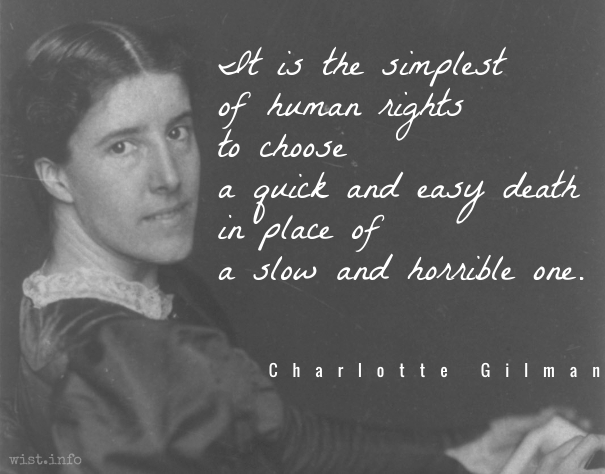
Human life consists in mutual service. No grief, pain, misfortune, or “broken heart,” is excuse for cutting off one’s life while any power of service remains. But when all usefulness is over, when one is assured of an unavoidable and imminent death, it is the simplest of human rights to choose a quick and easy death in place of a slow and horrible one.
Charlotte Perkins Gilman (1860–1935) American sociologist, writer, reformer, feminist
Suicide note (1935-08-17)
(Source)
Gilman, an advocate for euthanasia, took her own life through an overdose of chloroform, after having been diagnosed with incurable breast cancer in January 1932. In both her autobiography and her suicide note, she said she "chose chloroform over cancer."
You read something which you thought only happened to you, and you discover that it happened 100 years ago to Dostoyevsky. This is a very great liberation for the suffering, struggling person, who always thinks that he is alone. This is why art is important. Art would not be important if life were not important, and life is important.
James Baldwin (1924–1987) American novelist, playwright, activist
“An interview with James Baldwin” by Studs Terkel (1961), in Conversations With James Baldwin (1989)
(Source)
Baldwin revisited this theme multiple times.You think your pain and your heartbreak are unprecedented in the history of the world, but then you read. It was Dostoevsky and Dickens who taught me that the things that tormented me most were the very things that connected me with all the people who were alive, or who had ever been alive. Only if we face these open wounds in ourselves can we understand them in other people. An artist is a sort of emotional or spiritual historian.
[Interview with Jane Howard, Life Magazine (24 May 1963)]You think your pain and your heartbreak are unprecedented in the history of the world, but then you read. It was books that taught me that the things that tormented me most were the very things that connected me with all the people who were alive, or who had ever been alive.
["James Baldwin Recalls His Childhood," quoting from a television program, New York Times (31 May 1964)]
Without tradition, art is a flock of sheep without a shepherd. Without innovation, it is a corpse.
Winston Churchill (1874–1965) British statesman and author
Speech, Royal Academy of Art banquet, London (30 Apr 1953)
(Source)
The chessboard is the world; the pieces are the are the phenomena of the universe; the rules of the game are what we call the laws of Nature. The player on the other side is hidden from us. We know that his play is always fair, just, and patient. But also we know, to our cost, that he never overlooks a mistake, or makes the smallest allowance for ignorance. To the man who plays well, the highest stakes are paid, with that sort of overflowing generosity with which the strong shows delight in strength. And one who plays ill is checkmated — without haste, but without remorse.
T. H. Huxley (1825–1895) English biologist [Thomas Henry Huxley]
“A Liberal Education and Where to Find It” (1868)
(Source)
If that’s his humour, trust me, I shall spare
No kind of pains to win admittance there:
I’ll bribe his porter; if denied to-day,
I’ll not desist, but try some other way:
I’ll watch occasions — linger in his suite,
Waylay, salute, huzzah him through the street.
Nothing of consequence beneath the sun
Without great labour ever yet was done.[Haud mihi dero:
muneribus servos corrumpam; non, hodie si
exclusus fuero, desistam; tempora quaeram,
occurram in triviis, deducam. Nil sine magno
vita labore dedit mortalibus]Horace (65–8 BC) Roman poet, satirist, soldier, politician [Quintus Horatius Flaccus]
Satires [Saturae, Sermones], Book 1, # 9 “Ibam forte Via Sacra,” l. 56ff (1.9.56-60) (35 BC) [tr. Howes (1845)]
(Source)
A pesky bore and would-be social climber, describing his determination to wheedle his way into the social circle of Horace's friend, Maecenas.
The last line was an old saying, found at least as early as Hesiod, Works and Days, l. 287 (c. 700 BC).
(Source (Latin)). Other translations:I will not fayle. Brybes shall corrupte his chéefist serving men:
Though once or twice the gates be shut I will not cease yet then:
Ile wayte my opportunitie, to meete him in the ways,
To leade him home, to curtsey him, and cap him when he stayes.
There is no good for to be borne, whilste we are lyuyng here:
Excepte we lye, faune, flatter, face, cap, keele, ducke, crouche, smile, fiere.
[tr. Drant (1567)]Well, to my self I will not wanting be,
I'le watch his hours, his servants I will see;
I will salute his Chariot in the street,
I'le bring him home as often as we meet:
We Courtiers strive for interest in vain,
Unless by long observance it we gain.
[ed. Brome (1666)]Well, when Occasion serves, I'le play my part,
I'le spare no cost and charge, try every Art,
Hang on his Coach, wait on him, all I can,
Bribe, Flatter, Cringe, but I'me resolv'd to gain,
'Tis only Labour, Sir, can raise a Man.
[tr. Creech (1684)]"I sha'n't be wanting there," he cried,
"I'll bribe his servants to my side;
To-day shut out, still onward press,
And watch the seasons of access;
In private haunt, in public meet,
Salute, escort him through the street.
There's nothing gotten in this life,
Without a world of toil and strife."
[tr. Francis (1747)]I will not be wanting to myself; I will corrupt his servants with presents; if I am excluded to-day, I will not desist; I will seek opportunities; I will meet him in the public streets; I will wait upon him home. Life allows nothing to mortals without great labor.
[tr. Smart/Buckley (1853)]Oh, I shall do my duty, I will bribe his slaves, I won't give up. If on the day on which I call, he says he's not at home, I'll choose my times, I'll meet him at the crossings of the streets, nay, I'll escort him home; you know life gives man nought without some toil.
[tr. Millington (1870)]No fear of me, sir: a judicious bribe
Will work a wonder with the menial tribe:
Say, I'm refused admittance for to-day;
I'll watch my time; I'll meet him in the way,
Escort him, dog him. In this world of ours
The path to what we want ne'er runs on flowers.
[tr. Conington (1874)]I'll not fail myself. I'll bribe his slaves. If shut out to-day, I'll not give up. I'll look for the fitting time ; I'll meet him in the streets; I'll escort him home. Life grants no boon to man without much toil.
[tr. Fairclough (Loeb) (1926)]I bet I don't fail.
I'll bribe all his servants. I'll keep coming back, pick my times,
Meet him walking in town, join his escort. Nothing
In life comes without labor.
[tr. Palmer Bovie (1959)]I’m confident.
I'll bribe his servants. And if today, for example, I’m
repulsed, I won't quit. I'll find a chance, bump into him
in public, walk places with him; without great labor
life gives us mortals naught.
[tr. Fuchs (1977)]I'll do it, I'll do it! By god, I'll bribe
His slaves, I'll never give up, I'll get
My foot in his door, somehow. I'll watch,
I'll wait, I'll catch him in the street,
I'll follow him home. Nothing worth doing
Is easy, here on earth!
[tr. Raffel (1983)]O I won't spare myself. I'll bribe his slaves.
Should I be kept out, I won't quit.
I'll keep my eye open for the right moment.
I'll run into him at some street-crossing.
I'll escort him home. Without great toil
life grants nothing to mortals.
[tr. Alexander (1999)]I'm on the case. I'll bribe his slaves. If I'm
repelled today, I won't give up, I'll wait
for the right time and meet him in the streets
and then escort him home.
Life grants no man a prize
who doesn't strive and strive.
[tr. Matthews (2002)]I shan't be found wanting.
I'll bribe his servants; and if today they shut me out,
I'll persevere, bide my time, meet him in the street,
escort him home. "Not without unremitting toil
are mortal prizes won."
[tr. Rudd (2005 ed.)]I’ll not fail:
I’ll bribe his servants with gifts: if I’m excluded
Today, I’ll persist: I’ll search out a suitable time,
Encounter him in the street, escort him home. Life grants
Nothing to mortals without a great effort.
[tr. Kline (2015)]
When a resolute young fellow steps up to the great bully, the World, and takes him boldly by the beard, he is often surprised to find it comes off in his hand, and that it was only tied on to scare away the timid adventurers.
Oliver Wendell Holmes, Sr. (1809–1894) American poet, essayist, scholar
Article (1860-01), “The Professor’s Story [Elsie Venner],” ch. 2, Atlantic Monthly, Vol. 5, No. 27
(Source)
Originally serialized as “The Professor’s Story,” but collected as the novel Elsie Venner, ch. 2 (1861).
Often misattributed to Ralph Waldo Emerson.
We are not human beings having a spiritual experience; we are spiritual beings having a human experience.
Pierre Teilhard de Chardin (1881–1955) French Jesuit priest, paleontologist, philosopher
(Misattributed)
Sometimes paraphrased: "We are not human beings on a spiritual journey. We are spiritual beings on a human journey."
Not actually found in Teilhard's works. Sometimes cited to Le Phénomène Humain [The Phenomenon of Man] (1955) [tr. Wall (1959)], but it is not present there.
The best credit seems to be to Wayne Dyer. Also sometimes cited to Stephen Covey, who used the phrase but credited it to Teilhard (without citation). For more discussion, see You Are Not a Human Being Having a Spiritual Experience. You Are a Spiritual Being Having a Human Experience – Quote Investigator.
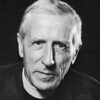
DEATH: When the first living thing existed, I was there, waiting. When the last living thing dies, my job will be finished. I’ll put the chairs on the tables, turn out the lights and lock the universe behind me when I leave.
Neil Gaiman (b. 1960) British author, screenwriter, fabulist
Sandman, Book 3. Dream Country, # 20 “Façade” (1990)
(Source)
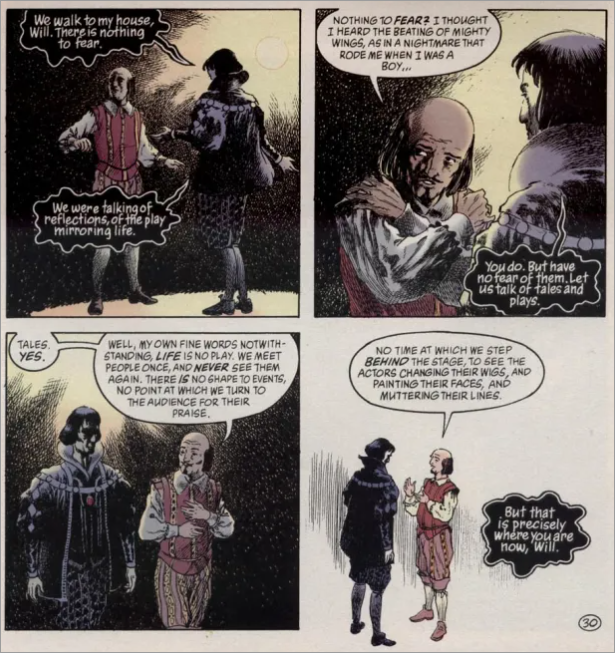
SHAKESPEARE: Well, my own fine words notwithstanding, life is no play. We meet people once, and never see them again. There is no shape to events, no point at which we turn to the audience for their praise. No time at which we step behind the stage, to see the actors changing their wigs, and painting their faces, and muttering their lines.
Neil Gaiman (b. 1960) British author, screenwriter, fabulist
Sandman, Book 10. The Wake, # 75 “The Tempest” (1996-02)
(Source)
Speaking to Morpheus. Final issue of the series.
Choose the best life; for habit will make it pleasant.
Epictetus (c. 55-c. 135 AD) Greek (Phrygian) Stoic philosopher [Ἐπίκτητος, Epíktētos]
Fragment 144
Sometimes attributed to Francis Bacon.
The price for absolute freedom from necessity is, in a sense, life itself, or rather the substitution of vicarious life for real life. […] The human condition is such that pain and effort are not just symptoms which can be removed without changing life itself; they are the modes in which life itself, together with the necessity to which it is bound, makes itself felt. For mortals, the “easy life of the gods” would be a lifeless life.
Hannah Arendt (1906–1975) German-American philosopher, political theorist
The Human Condition, Part 3 “Labor,” ch. 16 (1958)
(Source)
How cunningly nature hides every wrinkle of her inconceivable antiquity under roses and violets and morning dew!
Ralph Waldo Emerson (1803–1882) American essayist, lecturer, poet
“Progress of Culture,” Letters and Social Aims (1876)
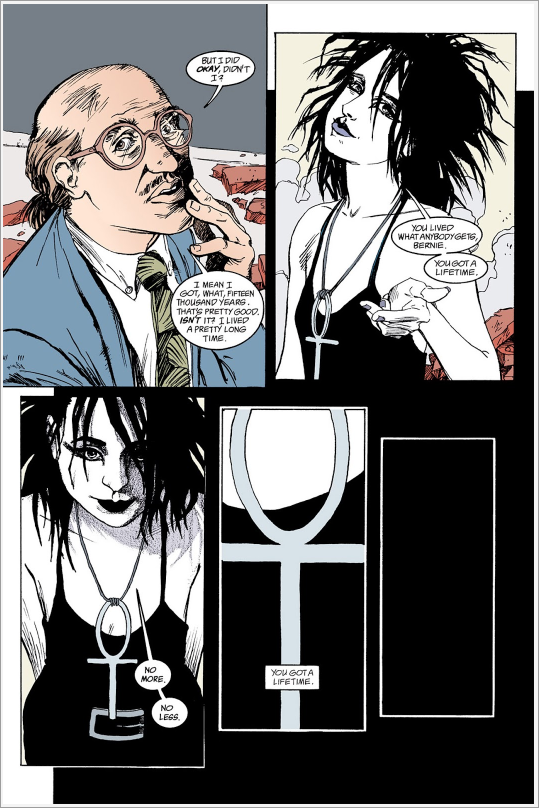
BERNIE: But I did okay, didn’t I? I mean I got, what, fifteen thousand years. That’s pretty good, isn’t it? I lived a pretty long time.
DEATH: You lived what anybody gets, Bernie. You got a lifetime. No more. No less. You got a lifetime.
Neil Gaiman (b. 1960) British author, screenwriter, fabulist
Sandman, Book 7. Brief Lives, # 43 “Part 3” (1992-11)
(Source)
As an atheist, I believe that all life is unspeakably precious, because it’s only here for a brief moment, a flare against the dark, and then it’s gone forever. No afterlives, no second chances, no backsies. So there can be nothing crueler than the abuse, destruction or wanton taking of a life. It is a crime no less than burning the Mona Lisa, for there is always just one of each.
So I cannot forgive. Which makes the notion of writing a character who CAN forgive momentarily attractive … because it allows me to explore in great detail something of which I am utterly incapable.
J. Michael (Joe) Straczynski (b. 1954) American screenwriter, producer, author [a/k/a "JMS"]
Usenet, rec.arts.sf.tv.babylon5, “JMS on Compuserve: Gesthemane Questions” (1995-12-04)
(Source)
Love what you do. Get good at it. Competence is a rare commodity in this day and age. And let the chips fall where they may.
Jon Stewart (b. 1962) American satirist, comedian, and television host. [b. Jonathan Stuart Leibowitz]
Commencement Address, College of William & Mary (2004-05-20)
(Source)

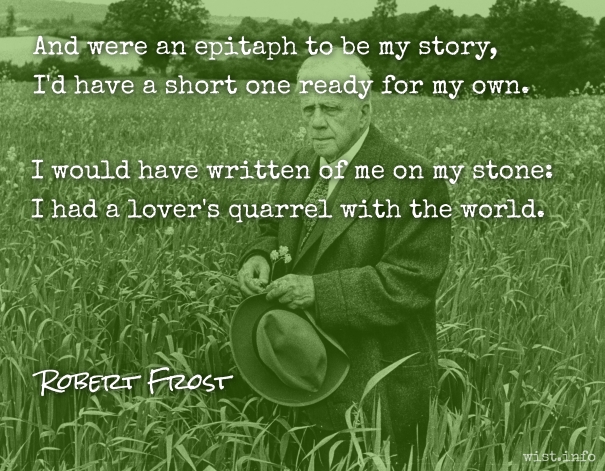
And were an epitaph to be my story,
I’d have a short one ready for my own.
I would have written of me on my stone:
I had a lover’s quarrel with the world.
Robert Frost (1874–1963) American poet
“The Lesson for Today,” A Witness Tree (1942)
Initially read before the Phi Beta Kappa Society, Harvard (20 Jun 1941)
Only actions give life strength; only moderation gives it a charm.
[Nur Taten geben dem Leben Stärke, nur Maß ihm Reiz.]
Jean Paul Richter (1763–1825) German writer, art historian, philosopher, littérateur [Johann Paul Friedrich Richter; pseud. Jean Paul]
Titan, Jubilee 35, cycle 145 (1803) [tr. Brooks (1863)]
(Source)
Often only the first part is given as a quotation (or even just as a "German proverb").
(Source (German)). Other translations:Only deeds give strength to life, and only measure gives it charm.
[Source (1858)]Only deeds give strength to life, only moderation gives it charm.
[Source (1896)]
Only when man’s life comes to its end in prosperity can one call that man happy.
Aeschylus (525–456 BC) Greek dramatist (Æschylus)
Agamemnon, l. 928
Alt trans.:Compare to Sophocles.
- "Call no man happy till he is dead."
- "Hold him alone truly fortunate who has ended his life in happy well-being."
Indifference, to me, is the epitome of evil.
The opposite of love is not hate, it’s indifference.
The opposite of art is not ugliness, it’s indifference.
The opposite of faith is not heresy, it’s indifference.
And the opposite of life is not death, but indifference,
indifference between life and death.
Elie Wiesel (1928–2016) Romanian-American novelist, professor, political activist, Nobel Laureate.
“One Must Not Forget,” interview by Alvin P. Sanoff, US News & World Report (27 Oct 1986)
See also Nietzsche.
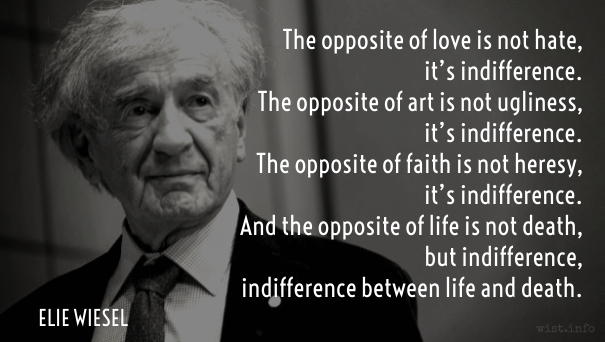
The Christian determination to find the world ugly and bad has made the world ugly and bad.
[Der christliche Entschluss, die Welt hässlich und schlecht zu finden, hat die Welt hässlich und schlecht gemacht.]
Friedrich Nietzsche (1844–1900) German philosopher and poet
The Gay Science [Die fröhliche Wissenschaft], Book 3, § 130 (1882) [tr. Hill (2018)]
(Source)
Also known as La Gaya Scienza, The Joyful Wisdom, or The Joyous Science.
(Source (German)). Other translations:The Christian resolution to find the world ugly and bad, has made the world ugly and bad.
[tr. Common (1911)]The Christian resolve to find the world ugly and bad, has made the world ugly and bad.
[tr. Kaufmann (1974)]The Christian decision to find the world ugly and bad has made the world ugly and bad.
[tr. Nauckhoff (2001)]
HAMLET:Who would fardels bear,
To grunt and sweat under a weary life,
But that the dread of something after death,
The undiscovered country from whose bourn
No traveler returns, puzzles the will
And makes us rather bear those ills we have
Than fly to others that we know not of?William Shakespeare (1564–1616) English dramatist and poet
Hamlet, Act 3, sc. 1, l. 84ff (3.1.84-90) (c. 1600)
(Source)
"Fardels" = "burdens"
Isn’t it the moment of most profound doubt that gives birth to new certainties? Perhaps hopelessness is the very soil that nourished human hope; perhaps one could never find sense in life without first experiencing its absurdity.
Václav Havel (1936–2011) Czech playwright, essayist, dissident, politician
Speech, Salzburg Festival (26 Jul 1990)
(Source)
We play out our days as we play out cards, taking them as they come, not knowing what they will be, hoping for a lucky card and sometimes getting one, often getting just the wrong one.
Samuel Butler (1835–1902) English novelist, satirist, scholar
The Note-Books of Samuel Butler, “The World,” ii (1912)Full text.
It is better to lose health like a spendthrift than to waste it like a miser. It is better to live and be done with it, then to die daily in the sick-room.
Autobiography is only to be trusted when it reveals something disgraceful. A man who gives a good account of himself is probably lying, since any life when viewed from the inside is simply a series of defeats.
George Orwell (1903–1950) English journalist, essayist, writer [pseud. of Eric Arthur Blair]
Essay (1944-06-01), “Benefit of Clergy: Some Notes on Salvador Dali,” Dickens, Dali & Others (1946), opening words
(Source)
The essay was originally printed in Saturday Book magazine, but the publisher decided it had to be "suppressed on grounds of obscenity" and had the essay physically cut out of each printed copy.
The passage is referring to, among others, Dali's The Secret Life of Salvador Dali (1942).
A happy man or woman is a better thing to find than a five-pound note. He or she is a radiating focus of goodwill; and their entrance into a room is as though another candle had been lighted. We need not care whether they could prove the forty-seventh proposition; they do a better thing than that, they practically demonstrate the great Theorem of the Liveableness of Life.
Robert Louis Stevenson (1850–1894) Scottish essayist, novelist, poet
Essay (1877-07), “An Apology for Idlers,” Cornhill Magazine, Vol. 36
(Source)
Euclid's 47th Proposition (in his Elements, Book 1) is the Pythagorean Theorem.Collected in Virginibus Puerisque and Other Papers, ch. 3 (1881).
To live is like to love — all reason is against it, and all healthy instinct for it.
Samuel Butler (1835–1902) English novelist, satirist, scholar
The Note-Books of Samuel Butler, “Life and Love” (1912)
(Source)
Life is not designed to minister to a man’s vanity. He goes upon his long business most of the time with a hanging head, and all the time like a blind child. Full of rewards and pleasures as it is — so that to see the day break or the moon rise, or to meet a friend, or to hear the dinner-call when he is hungry, fills him with surprising joys — this world is yet for him no abiding city. Friendships fall through, health fails, weariness assails him; year after year, he must thumb the hardly varying record of his own weakness and folly. It is a friendly process of detachment. When the time comes that he should go, there need be few illusions left. Here lies one who meant well, tried a little, failed much: — surely that may be his epitaph, of which he need not be ashamed.
Robert Louis Stevenson (1850–1894) Scottish essayist, novelist, poet
Essay (1888-12), “A Christmas Sermon,” sec. 4, Scribner’s Magazine, Vol. 4
(Source)
Originally written in the winter of 1887-88. Collected in Across the Plains, ch. 12 (1892).
There are two types of realist. There is the one who offers a good deal of dirt with his potato to show that it is a real one, and the one who is satisfied with the potato brushed clean. I’m inclined to be the second kind. […] To me, the thing that art does for life is to clean it, to strip it to form.
Robert Frost (1874–1963) American poet
(Attributed)
(Source)
Answering a letter as to whether he would prefer to be classed as a Realist, a Classicist, or a Regionalist. Quoted in Louis Untermeyer (ed.), Modern American Poetry, "Robert Frost" (1921 ed.). Untermeyer, a long-time friend of Frost's, included this quotation in all the biographical sketches he wrote for different poetry anthologies. I cannot find a primary source.
Fate is like a strange, unpopular restaurant, filled with odd waiters who bring you things you never asked for and don’t always like.
Lemony Snicket (b. 1970) American author, screenwriter, musician (pseud. for Daniel Handler)
The Slippery Slope, ch. 1 (2003)

All animals, except man, know that the principal business of life is to enjoy it.
Samuel Butler (1835–1902) English novelist, satirist, scholar
The Way of All Flesh, ch. 19 (1903)
Full text.
I had rather live and love where death is king, than have eternal life where love is not. Another life is nought, unless we know and love again the ones who love us here.
Robert Green Ingersoll (1833–1899) American lawyer, freethinker, orator
Speech (1882-01-08), “At a Child’s Grave,” Congressional Cemetery, Washington, D. C.
(Source)
Eulogy at the burial of Harry Miller.
Alas, after a certain age, every man is responsible for his face.
[Hélas! après un certain âge tout homme est responsable do son visage.]
Life […] is really a constant suffering, or, at any rate, […] a business that does not cover the costs.
[Da das Leben […] eigentlich ein stetes Leiden, oder wenigstens, […] ein Geschäft ist, welches die Kosten nicht deckt.]
Arthur Schopenhauer (1788–1860) German philosopher
Die Welt als Wille und Vorstellung [The World as Will and Representation], Vol. 2, ch. 19 “Vom Primat des Willens im Selbstbewußtseyn [On the primacy of the Will in Self-Consciousness],” § 11 (1844 ed.) [tr. Payne (1958)]
(Source)
(Source (German)). Usually paraphrased: "Life is a business that does not cover the costs."
The world is so exquisite with so much love and moral depth, that there is no reason to deceive ourselves with pretty stories for which there’s little good evidence. Far better it seems to me, in our vulnerability, is to look death in the eye and to be grateful every day for the brief but magnificent opportunity that life provides.
Carl Sagan (1934–1996) American scientist and writer
“In the Valley of the Shadow,” Parade (10 Mar 1996)
In short, in life, as in a foot-ball game, the principle to follow is:
Hit the line hard; don’t foul and don’t shirk, but hit the line hard!Theodore Roosevelt (1858–1919) American politician, statesman, conservationist, writer; US President (1901–09)
“What We Can Expect of the American Boy,” St. Nicholas Magazine (1900-05)
(Source)
Reprinted as "The American Boy" in Roosevelt, The Strenuous Life (1900).
Roosevelt used this general phrasing on multiple occasions, so various forms can be found attributed or associated to him, such as:
- "In life, as in a football game, the principle to follow is: Never flinch. Never foul. Hit the line hard."
[Source]- "Don't flinch. Don't foul. Hit the line hard."
[Puck]- "Don't fowl, don't shirk, and hit the line hard!"
[Autograph]- "Don't flinch, don't fowl, and hit the line hard."
[Speech (1913-07-03)]
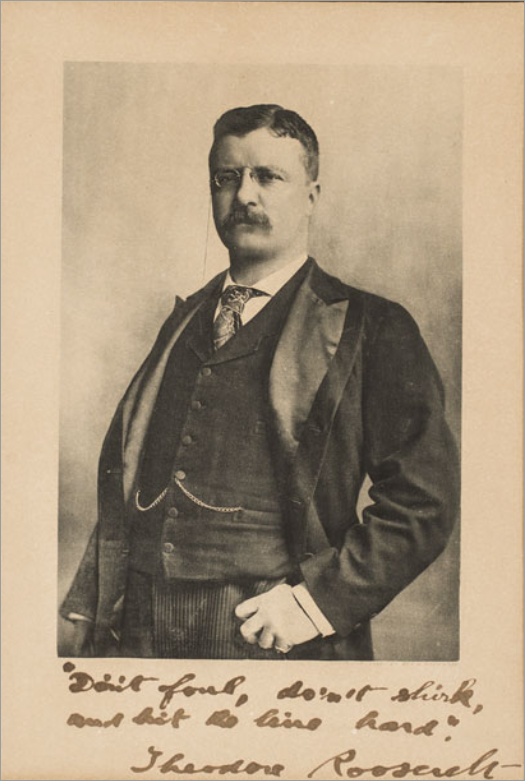
I had wanted to wrap this book up in a neat little package about a girl who is a comedienne from Detroit, becomes famous in New York, with all the world coming her way, gets this horrible disease of cancer, is brave and fights it, learning all the skills she needs to get through it, and then, miraculously, things are neatly tied up and she gets well. I wanted to be able to write on the book jacket: “Her triumph over cancer” or “She wins the cancer war.” I wanted a perfect ending, so I sat down to write the book with the ending in place before there even was an ending.
Now I’ve learned, the hard way. that some poems don’t rhyme, and some stories don’t have a clear beginning, middle and end. Like my life, this book has ambiguity. Like my life, this book is about not knowing, having to change, taking the moment and making the best of it, without knowing what’s going to happen next. Delicious ambiguity, as Joanna said.Gilda Radner (1946–1989) American comedian
It’s Always Something, ch. 16 “Change” (1989)
(Source)
Joanna was Radner's psychotherapist.

The whole of life is just like watching a [film], he thought. Only it’s as though you always get in ten minutes after the big picture has started, and no one will tell you the plot, so you have to work it all out yourself from the clues. And you never, never get a chance to stay in your seat for the second house.
Why should we fear that which will come to all that is? We cannot tell, we do not know, which is the greater blessing — life or death. We do not know whether the grave is the end of this life, or the door of another, or whether the night here is not somewhere else at dawn. Neither can we tell which is the more fortunate — the child dying in its mother’s arms, before its lips have learned to form a word, or he who journeys all the length of life’s uneven road, painfully taking the last slow steps with staff and crutch.
Robert Green Ingersoll (1833–1899) American lawyer, freethinker, orator
Speech (1882-01-08), “At a Child’s Grave,” Congressional Cemetery, Washington, D. C.
(Source)
Eulogy at the burial of Harry Miller.
Most of us lead lives of chaotic improvisation from day to day, bawling for peace while plunging grimly into fresh disorders.
Edward Abbey (1927–1989) American anarchist, writer, environmentalist
A Voice Crying in the Wilderness (1991)
(Source)
“You’re fucked up, Mister. But you’re cool.”
“I believe that’s what they call the human condition,” said Shadow.Neil Gaiman (b. 1960) British author, screenwriter, fabulist
American Gods, Part 1, ch. 7 [Sam and Shadow] (2001)
(Source)
Life is made up of a series of judgments on insufficient data, and if we waited to run down all our doubts, it would flow past us.
Learned Hand (1872–1961) American jurist
“On Receiving an Honorary Degree,” speech, Harvard University (1939-01-22)
(Source)
First printed in the Harvard Alumni Bulletin (7 Jul 1939)
YESTERDAY This Day’s Madness did prepare;
TO-MORROW’S Silence, Triumph, or Despair:
Drink! for you know not whence you came, nor why:
Drink! for you know not why you go, nor where.Omar Khayyám (1048–1123) Persian poet, mathematician, philosopher, astronomer [عمر خیام]
Rubáiyát [رباعیات], Bod. # 26 [tr. FitzGerald, 3rd ed. (1872), # 74]
(Source)
FitzGerald used the same text for subsequent editions.
Other translations:Ah, fill the Cup: -- what boots it to repeat
How Time is slipping underneath our Feet:
Unborn To-morrow and dead Yesterday,
Why fret about them if To-day be sweet!
[tr. FitzGerald, 1st ed. (1859), # 37]Yesterday This Day's Madness did prepare;
To-morrow's Silence, Triumph, or Despair:
Drink! for you know not whence you came, nor why:
Drink! for you know not why you go, nor where.
[tr. FitzGerald, 2nd ed. (1868), # 80]Be on your guard, my friend, for you will be sundered from your soul, you will pass behind the curtain of the secrets of heaven. Drink wine, for you know not whence you come. Be merry, for you know not where you go.
[tr. McCarthy (1879), # 180]O soul, so soon to leave this coil below,
And pass the dread mysterious curtain through,
Be of good cheer, and joy you while you may,
You wot not whence you come, nor whither go.
[tr. Whinfield (1882), # 40]Make haste! soon must you quit this life below,
And pass the veil, and Allah's secrets know;
Make haste to take your pleasure while you may,
You wot not whence you come, nor whither go.
[tr. Whinfield (1883), # 48 or 87]Ah Brother, but a little while, and Thou shalt find
Thy Lasting Home the 'Secret Veil' behind; --
Rejoice Thy Heart and banish Grief, for know, --
Thy source, Thy Goal, has never been defined.
[tr. Garner (1887), 7.8]Ah, brother, but a little while and thou shalt find
Eternal rest, the secret veil behind;
Rejoice thy heart and banish grief, for know --
Thy source, thy goal, has never been divined.
[tr. Garner (1898), # 148]'Tis a strange world we came to, You and I,
Whence no man knows, and surely none knows why,
Why we remain -- a harder question still,
And still another -- whither when we die?
[tr. Le Gallienne (1897)]Bethink thee that soulless and bare thou shalt go;
The veil of God's mysteries to tear thou shalt go:
Drink wine, for thou knowest not whence thou hast come;
Live blithe, for thou knowest not where thou shalt go.
[tr. Payne (1898), # 188]Know this --- that from thy soul thou shalt be separated,
thou shalt pass behind the curtain of the secrets of God.
Be happy -- thou knowest not whence thou hast come:
drink wine - thou knowest not whither thou shalt go.
[tr. Heron-Allen (1898), # 26]Thou shalt be parted from thy soul, and then,
Enter God's veil of mystery again;
Be glad! For whence you came you do not know;
Drink! For you wist as little where you go.
[tr. Cadell (1899), # 26]Soon shall you bid farewell to mortal tie;
Soon shall you read life's deepest mystery.
Drink, for you know not when you go, nor where;
Drink, for you know not whence you came, nor why.
[tr. Roe (1906), # 35]Since from your soul you separate, then know
Behind God's secret veil you will go, too;
Drink wine! for you know not whence you have come;
Be jocund! for you know not where you go!
[tr. Thompson (1906), # 136]Know this, that soon thou diest, and thy soul
The Book of God's Great Secret must unroll;
Be happy! knowing not whence thou hast come,
Nor whither thou shalt go. Drink out the Bowl!
[tr. Talbot (1908), # 26]Know that thou shalt depart, deprived of thy soul; thou
shalt go behind the veil of the mystery of annihilation.
Drink wine: thou knowest not whence thou art come.
Be merry! thou knowest not whither thou shalt go.
[tr. Christensen (1927), # 15]Ye go from soul asunder this ye know,
And that ye creep, behind His curtain low;
Hence sing His Name, ye know not whence ye came,
And live sedate, ye know not where to go.
[tr. Tirtha (1941), 9.99]What, without asking, hither hurried whence?
And, without asking, whither hurried hence!
Another and another cup to drown
The Memory of this impertinence.
[tr. Graves & Ali-Shah (1967)]
We hold these truths to be sacred & undeniable; that all men are created equal & independant, that from that equal creation they derive rights inherent & inalienable, among which are the preservation of life, & liberty, & the pursuit of happiness; that to secure these ends, governments are instituted among men, deriving their just powers from the consent of the governed; that whenever any form of government shall become destructive of these ends, it is the right of the people to alter or to abolish it, & to institute new government, laying it’s foundation on such principles & organising it’s powers in such form, as to them shall seem most likely to effect their safety & happiness.
Thomas Jefferson (1743–1826) American political philosopher, polymath, statesman, US President (1801–09)
Document (1776-06), “Declaration of Independence” (original rough draft)
(Source)
Compare to the final version, as modified and adopted by the Continental Congress.
Everyone is as God has made him, and oftentimes a great deal worse.
Miguel de Cervantes (1547–1616) Spanish novelist
Don Quixote, 11.5
While we have the gift of life, it seems to me the only tragedy is to allow part of us to die — whether it is our spirit, our creativity, or our glorious uniqueness.
Gilda Radner (1946–1989) American comedian
It’s Always Something, ch. 9 “The Wellness Community” (1989)
(Source)
You may autopsy a body all day long, but you’ll never learn what sort of jokes he liked.
Graham Ericsson (b. 1961) American technologist, writer, aphorist
Journal (2005-10-17)

CALVIN: They say the world is a stage. But obviously the play is unrehearsed and everybody is ad-libbing his lines.
HOBBES: Maybe that’s why it’s hard to tell if we’re in a tragedy or a farce.
CALVIN: We need more special effects and dance numbers.
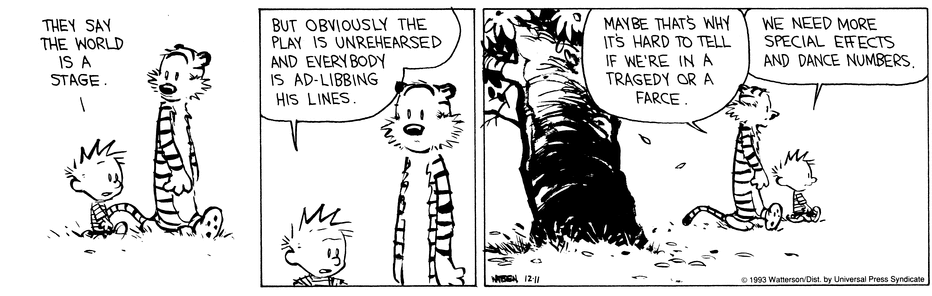
I am here to represent humanity: it is by no means necessary that I should live, but it is by all means necessary that I should act rightly.
Incorporated into “Essential Principles of Religion,” Lecture, Congregational Society, Boston (16 Mar 1862).
We recognize that there are no trivial occurrences in life if we get the right focus on them.
Mark Twain (1835–1910) American writer [pseud. of Samuel Clemens]
The Autobiography of Mark Twain, Vol. 1 (2010)
(Source)
JAQUES:All the world’s a stage,
And all the men and women merely players.
They have their exits and their entrances,
And one man in his time plays many parts ….
Making a film means, first of all, to tell a story. That story can be an improbable one, but it should never be banal. It must be dramatic and human. What is drama, after all, but life with the dull bits cut out.
Alfred Hitchcock (1899–1980) English film director
Interview (1962-08) by François Truffaut
(Source)
Why he avoids making "slice of life" films. Sometimes paraphrased as "Drama is life with the dull bits cut out."
From a series of interviews (with Helen Scott as the translator) of Hitchcock by Truffaut, edited and collected in the Truffaut book Hitchcock: A Definitive Study [Le Cinéma Selon Hitchcock], ch. 4 (1966) [tr. Truffaut (1967)].
We live in deeds, not years:
In thoughts, not breaths;
In feelings, not in figures on a dial.
We should count time by heart-throbs.
He most lives
Who thinks most, feels the noblest, acts the best.Philip James Bailey (1816–1902) English poet, lawyer
Festus, Sc. “A Country Town – Market-place – Noon” [Festus] (1839)
(Source)
Often misattributed to Aristotle.
Live as you will wish to have lived when you are dying.
[Lebe, wie Du, wenn du stirbst, / Wunschen wirst, gelebt zu haben.]
Christian Gellert (1715–1769) German poet, moralist
Geistliche Oden und Lieder, “Vom Tode” (1757)
Life is just one damn thing after another.
Elbert Hubbard (1856–1915) American writer, businessman, philosopher
The Philistine (1909-12)
(Source)
Elbert is likely not the first to express this, though he helped to popularize it. The phrase is presented in The Philistine in a list of aphorisms, uncredited and uncited. Hubbard was the editor of the magazine, and a presumed contributor. Soon collected in Hubbard's A Thousand & One Epigrams (1911).
The earliest documented forms of this phrase show up in 1909 in various periodicals (such as Hubbard's Philistine). Also in 1909, Lilian Bell published The Concentrations of Bee:“Bob has a motto on his wall which says ‘Life is just one damned thing after another!'” said Jimmie. But I refused to smile. I was too distinctly annoyed.
Note that the phrase is showing up (in the book) as second-hand, not necessarily as something Bell wrote.
The phrase is often attributed to Mark Twain. It is not found in Twain's works. The earliest attribution to him found is in H. L. Mencken, The American Language: A Preliminary Inquiry Into the Development of English in the United States, Sec. 9 (1919), where he says that the Twain is "commonly credited" with the phrase.
Variants:More information about this quotation: Life Is Just One Damn Thing After Another – Quote Investigator®
- "Life is just one damned thing after another."
- "Life is just one darn thing after another."
See Zelazny.
Happiness is not the end of life, character is.
Henry Ward Beecher (1813–1887) American clergyman and orator
Life Thoughts: Gathered from the Extemporaneous Discourses of Henry Ward Beecher (1858)
The conviction of the rich that the poor are happier is no more foolish than the conviction of the poor that the rich are.
Mark Twain (1835–1910) American writer [pseud. of Samuel Clemens]
(Misattributed)
I cannot find any reference to this phrase prior to 1921, and no association with Twain until the mid-1970s.
The quotation apparently first appears in various newspaper "filler" columns (e.g., 1921-12-07); in no cases is there an attribution to Twain or to anyone else, except some references of it having been originally seen in the Boston Post (e.g., 1921-12-17, 1921-12-16, 1921-12-07).
One place where a name is associated with the quote is where it appears in the "Facts and Fancies" syndicated column of quips by Robert Quillen (1921-12-07). Quillen (1887-1948) was an American journalist and humorist, whose work was syndicated in hundreds of newspapers. He was know for, among other things, his one-liners. It's unclear whether he adopted material from others, or originated everything in "Facts and Fancies." If the latter, and if the column also appeared in the Boston Post, that would indicate Quillen actually is the source of this quotation.
One place for some doubt is that the one Quillen column shows a date of December 7, but so do some other papers which ran the quote. It is possible, as the actual publication dates of syndicated material can vary between papers or be delayed, that Quillen's column in the paper above ran after its original appearance (in the Boston Globe?), which other papers then stole from as filler material without crediting Quillen.
Twain, who died in 1910, does not seem associated with the quote until the mid-1970s, and it does not show up in more authoritative collections of Twain material. The association to Twain seems to come from Laurence J Peter, Peter's Quotations (1977). Peter included the phrase as a parenthetical comment to a Mark Twain quotation. The proximity may have led to Twain being associated with it (as here, which duplicates the entry from Peter, but with the attribution following the combined two quotes).
In sum, the quotation first appeared in December 1921, a decade after Twain's death, and was possibly created by Robert Quillen. It's association to Mark Twain came from its use by Lawrence Peter as an editorial comment to a different Twain quotation.
Oh, life is a glorious cycle of song,
A medley of extemporanea;
And love is a thing that can never go wrong;
And I am Marie of Roumania.Dorothy Parker (1893–1967) American writer, poet, wit
“Comment,” New York World (16 Aug 1925)
(Source)
Reprinted in Enough Rope (1926)
Work as if you were to live 100 years; pray as if you were to die tomorrow.
Benjamin Franklin (1706–1790) American statesman, scientist, philosopher, aphorist
Poor Richard’s Almanack (May 1757)
(Source)
The baby rises to its feet, takes a step, is overcome with triumph and joy — and falls flat on its face. It is a pattern for all that is to come! But learn from the bewildered baby. Lurch to your feet again. You’ll make the sofa in the end.
Pamela Brown (1924–1989) British writer, actress, television producer
The Swish of the Curtain (1938)
Let us so live that when we come to die even the undertaker will be sorry.
Mark Twain (1835–1910) American writer [pseud. of Samuel Clemens]
The Tragedy of Pudd’n’head Wilson, ch. 6 (1894)
Sometimes given: "Let us endeavor so to live that ..."
Life is not meant to be easy, my child; but take courage — it can be delightful.
George Bernard Shaw (1856–1950) Irish playwright and critic
Back to Methuselah, Part 5 [The He-Ancient] (1921)
(Source)
Dost thou love Life? then do not squander Time; for that’s the Stuff Life is made of.
Benjamin Franklin (1706–1790) American statesman, scientist, philosopher, aphorist
Poor Richard (1746 ed.)
(Source)
Reprinted in Poor Richard Improved (1758 ed.). This edition was Franklin's final Poor Richard, and he had it prefaced (1757-07-07) by a new character, Father Abraham, who combined a hundred aphorisms from previous Poor Richard almanacs. This preface became reprinted and (often abridged) known separately as "The Way to Wealth."
Life is 10 percent what you make it and 90 percent how you take it.
Irving Berlin (1888–1989) American songwriter [b. Isidore Beilin]
(Attributed)
(Source)
Attributed as a comment made by Berlin during a performance of the show This is the Army, Mr. Jones at the Palladium in London in 1943.
Also sometimes attributed to Benjamin Franklin.
Life is made up of constant calls to action, and we seldom have time for more than hastily contrived answers; to follow one’s hunch is usually better than lying doggo, and rough generalizations that have worked well in the past easily easily take on the authority of universals. It does violence to our inner being to be obliged to give a hearing to opinions widely at variance with those we are accustomed to, and to come to a conclusion unweighted by desire.
Learned Hand (1872–1961) American jurist
“At Fourscore,” speech, Harvard Club of New York (1952-01-18)
(Source)
First published in the Harvard Alumni Bulletin (23 Feb 1952).
If we could read the secret history of our enemies, we should find in each man’s life sorrow and suffering enough to disarm all hostility.
Henry Wadsworth Longfellow (1807–1882) American poet
“Table Talk,” Drift-Wood (1857)
(Source)
More discussion of this quotation here: If We Could Read the Secret History of Our Enemies, We Should Find in Each Man’s Life Sorrow and Suffering Enough To Disarm All Hostility – Quote Investigator.
No one imagines that a symphony is supposed to improve in quality as it goes along, or that the whole object of playing it is to reach the finale. The point of music is discovered in every moment of playing and listening to it. It is the same, I feel, with the greater part of our lives, and if we are unduly absorbed in improving them we may forget altogether to live them.
Evils in the journey of life are like the hills which alarm travelers on their road. Both appear great at a distance, but when we approach them we find they are far less insurmountable than we had conceived.
Charles Caleb "C. C." Colton (1780–1832) English cleric, writer, aphorist
Lacon: Or, Many Things in Few Words, Vol. 2, § 241 (1822)
(Source)
A baby is God’s opinion that life should go on.
Carl Sandburg (1878–1967) American poet, biographer
Remembrance Rock, ch. 2 (1948)
(Source)
Orville Brand "Bowbong" Windom speaking to his grandson, Raymond. Sometimes misquoted as "A baby is God’s opinion that the world should go on."
While popular in its own right, the broader context of the quotation is also worth noting. Windom is recounting a story of a man criticized for sleeping through a play he was supposed to be reviewing, who said, "Sleep is an opinion." Windom continues:And a baby is God's opinion that life should go on. A book that does nothing to you is dead. A baby, whether it does anything to you, represents life. If a bad fire should break out in this house and I had my choice of saving the library or the babies, I would save what is alive. Never will a time come when the most marvelous recent invention is as marvelous as a newborn baby. The finest of our precision watches, the most super-colossal of our supercargo planes, don’t compare with a newborn baby in the number and ingenuity of coils and springs, in the flow and change of chemical solutions, in timing devices and interrelated parts that are irreplaceable. A baby is very modern. Yet it is also the oldest of the ancients. A baby doesn’t know he is a hoary and venerable antique -- but he is. Before man learned how to make an alphabet, how to make a wheel, how to make a fire, he knew how to make a baby -- with the great help of woman, and his God and Maker.
This life we have is short, so let us leave a mark for people to remember.
Kip Keino (b. 1940) Kenyan athlete [Kipchoge Keino]
(Attributed)
On why he adopted and educated 69 orphan children.
There is nothing more tragic than to find an individual bogged down in the length of life, devoid of breadth.
Martin Luther King, Jr. (1929–1968) American clergyman, civil rights leader, social activist, preacher
“The Three Dimensions of a Complete Life,” sermon, Dexter Avenue Baptist Church, Montgomery, Alabama (24 Jan 1954)
(Source)
To condemn spontaneous and delightful occupations because they are useless for self-preservation shows an uncritical prizing of life regardless of its contents.
George Santayana (1863–1952) Spanish-American poet and philosopher [Jorge Agustín Nicolás Ruíz de Santayana y Borrás]
The Sense of Beauty, Part 1 “The Nature of Beauty,” sec. 4 “Work and Play” (1896)
(Source)
You should not confuse your career with your life.
Dave Barry (b. 1947) American humorist, author, columnist
“25 Things I Have Learned In 50 Years,” #20 (1997)

Do not be too timid and squeamish about your actions. All life is an experiment. The more experiments you make the better. What if they are a little coarse, and you may get your coat soiled or torn? What if you do fail, and get fairly rolled in the dirt once or twice. Up again, you shall never be so afraid of a tumble.
Life is like music, it must be composed by ear, feeling and instinct, not by rule. Nevertheless one had better know the rules, for they sometimes guide in doubtful cases, though not often.
Samuel Butler (1835–1902) English novelist, satirist, scholar
The Note-Books of Samuel Butler, ch. 1, “Life” (1912)
(Source)
There is no cure for birth and death save to enjoy the interval.
George Santayana (1863–1952) Spanish-American poet and philosopher [Jorge Agustín Nicolás Ruíz de Santayana y Borrás]
Essay (1916 ca.), “War Shrines,” Soliloquies in England, ch. 24 (1922)
(Source)

Life shrinks or expands in proportion to one’s courage.
Anaïs Nin (1903–1977) Catalan-Cuban-French author, diarist
Diary (1941-06)
(Source)
In her Diaries [ed. Stuhlmann (1969)].
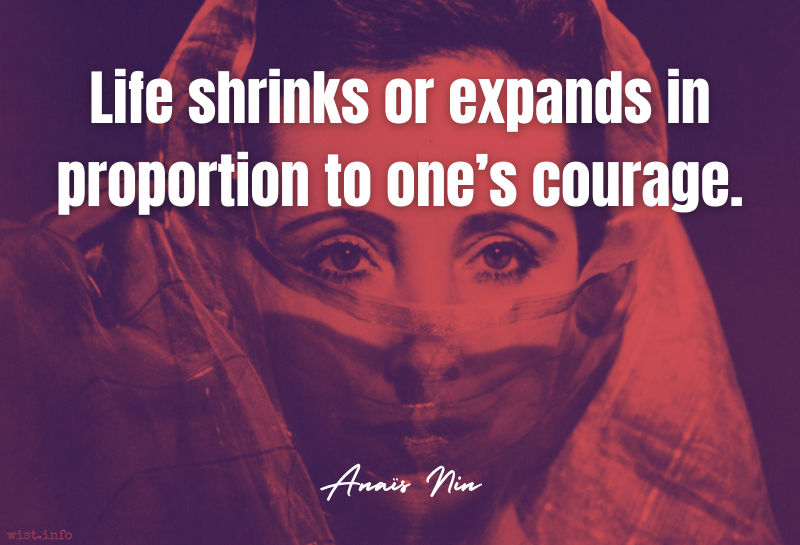

Life cannot be captured in a few axioms. And that is just what I keep trying to do. But it won’t work, for life is full of endless nuances and cannot be captured in just a few formulae.
Esther "Etty" Hillesum (1914–1943) Dutch Jewish law graduate, writer, diarist
Diary (1941-10-22)
(Source)
Collected in An Interrupted Life [Het Verstoorde Leven] (1981) [tr. Pomerans (1983)].

Death, like life, is an affair of being more frightened than hurt.
Samuel Butler (1835–1902) English novelist, satirist, scholar
Erewhon (1872)
That life is worth living is the most necessary of assumptions, and were it not assumed, the most impossible of conclusions.
George Santayana (1863–1952) Spanish-American poet and philosopher [Jorge Agustín Nicolás Ruíz de Santayana y Borrás]
The Life of Reason or The Phases of Human Progress, Vol. 1 “Reason in Common Sense,” ch. 10 (1905-06)
(Source)
KEATING: We don’t read and write poetry because it’s cute. We read and write poetry because we are members of the human race. And the human race is filled with passion. And medicine, law, business, engineering, these are noble pursuits and necessary to sustain life. But poetry, beauty, romance, love, these are what we stay alive for.
Don’t forget until too late that the business of life is not business, but living.
There are two great rules in life, the one general and the other particular. The first is that every one can in the end get what he wants if he only tries. This is the general rule. The particular rule is that every individual is more or less of an exception to the general rule.
Samuel Butler (1835–1902) English novelist, satirist, scholar
The Note-Books of Samuel Butler (1912)
(Source)
The longest-lived and those who will die soonest lose the same thing. The present is all that they give up, since that is all you have, and what you do not have, you cannot lose.
[ἑτέρου δέ, ὅτι καὶ ὁ πολυχρονιώτατος καὶ ὁ τάχιστα τεθνηξόμενος τὸ ἴσον ἀποβάλλει. τὸ γὰρ παρόν ἐστι μόνον, οὗ στερίσκεσθαι μέλλει, εἴπερ γε ἔχει καὶ τοῦτο μόνον καὶ ὃ μὴ ἔχει τις οὐκ ἀποβάλλει.]Marcus Aurelius (AD 121–180) Roman emperor (161–180), Stoic philosopher
Meditations [To Himself; Τὰ εἰς ἑαυτόν], Book 2, ch. 14 (2.14) [tr. Hays (2003)]
(Source)
(Source (Greek)). Other translations:That life which any the longest liver, or the shortest liver parts with, is for length and duration the very same, for that only which is present, is that, which either of them can lose, as being that only which they have; for that which he hath not, no man can truly be said to lose.
[tr. Casaubon (1634), 2.12]When the longest, and shortest Lived Persons come to die, their Loss is equal: For as I observe the Present is their All, and they can Suffer no Farther.
[tr. Collier (1701)]Again that the longest and the shortest lives have an equal loss at Death. The present moment is all which either is deprived of, since that is all he has. A man cannot part with what he has not.
[tr. Hutcheson/Moor (1742)]He who lives the longest, and he who dies the earliest, when they do die, their loss is equal. For they are only deprived of the present moment, which is all they have to lose.
[tr. Graves (1792)]The longest liver and he who will die soonest lose just the same. For the present is the only thing of which a man can be deprived, if it is true that this is the only thing which he has, and that a man cannot lose a thing if he has it not.
[tr. Long (1862)]When the longest and shortest-lived persons come to die, their loss is equal; they can but lose the present as being the only thing they have; for that which he has not, no man can be truly said to lose.
[tr. Collier/Zimmern (1887)]The longest-lived and the shortest-lived man, when they come to die, lose one and the same thing.
[tr. Morgan (1894)]The loss of the longest-lived and the shortest is one and the same. It is the present only of which a man can be deprived, that and that only being his, and what is not his he cannot lose.
[tr. Rendall (1898)]He who lives longest and he who dies soonest have an equal loss in death. The present moment is all of which either is deprived, since that is all he has. No man can be robbed of that which he has not.
[tr. Hutcheson/Chrystal (1902)]The longest liver and he whose time to die comes soonest part with no more the one than the other. For it is but the present that a man can be deprived of, if, as is the fact, it is this alone that he has, and what he has not a man cannot part with.
[tr. Haines (Loeb) (1916)]The longest-lived and the soonest to die have an equal loss; for it is the present alone of which either will be deprived, since (as we saw) this is all he has and a man does not lose what he has not got.
[tr. Farquharson (1944)]When the longest- and shortest-lived of us come to die, their loss is precisely equal. For the sole thing of which any man can be deprived is the present; since this is all he owns, and nobody can lose what is not his.
[tr. Staniforth (1964)]The longest-lived and the earliest to die suffer an equal loss; for it is solely of the present moment that each will be deprived, if it is indeed the case that this is all that he has and a person cannot lose what he does not have.
[tr. Hard (1997 ed.)]Both the longest-lived and the earliest to die suffer the same loss. It is only the present moment of which either stands to be deprived: and if indeed this is all he has, he cannot lose what he does not have.
[tr. Hammond (2006)]The longest to live and the soonest to die lose exactly the same thing, for it is only the present moment which one can be deprived of, if it is true that we possess this alone, and that you cannot lose what you do not have.
[tr. Needleman/Piazza (2008), 2.16]The longest-lived and the earliest to die suffer an equal loss; for it is solely of the present moment that each will be deprived, if it is really the case that this is all he has and a person cannot lose what he does not have.
[tr. Hard (2011 ed.)]Both the one who lives longest and the one who is earliest to die lose an equal amount. The present moment is the only thing of which anyone can be deprived, at least if this is the only thing he has and he cannot lose what he has not got.
[tr. Gill (2013)]The longest and shortest life is therefore the same. We all live in the same present, which is but a moment of time. This moment can be lost in a moment, but that is all that can be lost. The past and future cannot be lost: no one can take from a man what he never had. Time is an infinite eternity and so everything will come around again eventually, it makes no difference how long this might take to happen. The present moment is the only thing any man has.
[tr. McNeill (2019)]
I am always turning, I am perpetually turning, like a demd old horse in a demnition mill. My life is one demd horrid grind!
Charles Dickens (1812–1870) English writer and social critic
The Life And Adventures of Nicholas Nickleby, ch. 64 [Mr Mantalini] (1839)
(Source)