

The neer to the church, the further from God.
John Heywood (1497?-1580?) English playwright and epigrammist
Proverbes, Part 1, ch. 9 (1546)
(Source)
Quotations about:
religion
Note not all quotations have been tagged, so Search may find additional quotes on this topic.

The development from a religion of fear to moral religion is a great step in peoples’ lives. And yet, that primitive religions are based entirely on fear and the religions of civilized peoples purely on morality is a prejudice against which we must be on our guard. The truth is that all religions are a varying blend of both types, with this differentiation: that on the higher levels of social life the religion of morality predominates.
Albert Einstein (1879–1955) German-American physicist
“Religion and Science,” New York Times Magazine (9 Nov 1930)
(Source)
Religion — it’s given people hope in a world torn apart by religion.
Jon Stewart (b. 1962) American satirist, comedian, and television host. [b. Jonathan Stuart Leibowitz]
The Daily Show

When religion becomes organzied, man ceases to be free. It is not God that is worshiped but the group or the authority that claims to speak in his name. Sin becomes disobedience to authority and not violation of integrity.
Sarvepalli Radhakrishnan (1888–1975) Indian philosopher, statesman
East and West: Some Reflections, Preface (1955)
(Source)
Variants:
- "It is not God that is worshiped but the authority that claims to speak in His name."
- An expanded version in Religion, Science and Culture, ch. 3 "The World Communities of Ideals" (1965) includes an inserted second sentence: "If we think that it is a question of life or death -- what concept of God we accept -- then our hearts are filled with fury."
Religions are kept alive by heresies, which are really sudden explosions of faith. Dead religions do not produce them.
Gerald Brenan (1894–1987) British writer and Hispanist [Edward FitzGerald Brenan]
Thoughts in a Dry Season (1978)

We are now again in an epoch of wars of religion, but a religion is now called an “ideology.”
Bertrand Russell (1872–1970) English mathematician and philosopher
“Philosophy and Politics,” lecture, National Book League, London (1946-10-23)
(Source)
Collected in Unpopular Essays (1950).

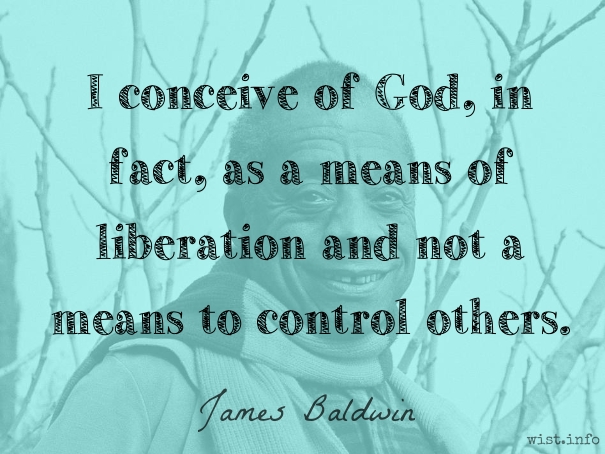
I conceive of God, in fact, as a means of liberation and not a means to control others.
James Baldwin (1924–1987) American novelist, playwright, activist
“In Search of a Majority,” Speech, Kalamazoo College (Feb 1960)
An honest God’s the noblest work of man.
Samuel Butler (1835–1902) English novelist, satirist, scholar
Further Extracts from the Note-Books of Samuel Butler, ch. 1 (1934)
See Pope.
We are all tattooed in our cradles with the beliefs of our tribe; the record may seem superficial, but it is indelible. You cannot educate a man wholly out of the superstitious fears which were early implanted in his imagination; no matter how utterly his reason may reject them, he will still feel as the famous woman did about ghosts, Je ne crois pas, mais je les crains, — “I don’t believe in them, but I am afraid of them, nevertheless.”
The greatest vicissitude of things amongst men is the vicissitude of sects and religions.
Francis Bacon (1561–1626) English philosopher, scientist, author, statesman
“Of Vicissitude of Things,” Essays, No. 58 (1625)
(Source)

The settled opinion here is, that religion is essentially distinct from Civil Govt., and exempt from its cognizance; that a connexion between them is injurious to both; that there are causes in the human breast which ensure the perpetuity of religion without the aid of the law; that rival sects, with equal rights, exercise mutual censorships in favor of good morals; that if new sects arise with absurd opinions or over-heated imaginations, the proper remedies lie in time, forbearance, and example; that a legal establishment of religion without a toleration could not be thought of, and with a toleration, is no security for public quiet & harmony, but rather a source of discord & animosity; and, finally, that these opinions are supported by experience, which has shewn that every relaxation of the alliance between Law & religion, from the partial example of Holland to its consummation in Pennsylvania, Delaware, New Jersey, &c., has been found as safe in practice as it is sound in theory.
James Madison (1751–1836) American statesman, political theorist, US President (1809–17)
Letter to Edward Everett (18 Mar 1823)
But is uniformity of opinion desirable? No more than of face and stature. Introduce the bed of Procrustes then, and as there is danger that the great men may beat the small, make us all of a size, by lopping the former and stretching the latter. Difference of opinion is advantageous in religion. The several sects perform the office of a Censor morum over each other. Is uniformity attainable? Millions of innocent men, women, and children, since the introduction of Christianity, have been burnt, tortured, fined, imprisoned; yet we have not advanced one inch towards uniformity. What has been the effect of coercion? To make one half the world fools, and the other half hypocrites. To support roguery and error all over the earth.
Thomas Jefferson (1743–1826) American political philosopher, polymath, statesman, US President (1801–09)
Notes on the State of Virginia, Query 17 (1782)
(Source)
Reason, devoid of the purifying power of faith, can never free itself from distortions and rationalizations.
Martin Luther King, Jr. (1929–1968) American clergyman, civil rights leader, social activist, preacher
“Pilgrimage to Nonviolence,” Christian Century (13 Apr 1960)
(Source)
Any sufficiently advanced prejudicial piety is indistinguishable from hatred.

“Teacher,” he asked, “which is the greatest commandment in the Law?”
Jesus answered, “‘Love the Lord your God with all your heart, with all your soul, and with all your mind.’ This is the greatest and the most important commandment. The second most important commandment is like it: ‘Love your neighbor as you love yourself.’ The whole Law of Moses and the teachings of the prophets depend on these two commandments.”[Διδάσκαλε ποία ἐντολὴ μεγάλη ἐν τῷ νόμῳ. Ὁ δὲ ἔφη αὐτῷ Ἀγαπήσεις κύριον τὸν Θεόν σου ἐν ὅλῃ τῇ καρδίᾳ σου καὶ ἐν ὅλῃ τῇ ψυχῇ σου καὶ ἐν ὅλῃ τῇ διανοίᾳ σου. αὕτη ἐστὶν ἡ μεγάλη καὶ πρώτη ἐντολή. δευτέρα ‹δὲ› ὁμοία αὐτῇ Ἀγαπήσεις τὸν πλησίον σου ὡς σεαυτόν. ἐν ταύταις ταῖς δυσὶν ἐντολαῖς ὅλος ὁ νόμος κρέμαται καὶ οἱ προφῆται.]
The Bible (The New Testament) (AD 1st - 2nd C) Christian sacred scripture
Book 1. Gospel of Matthew 22:36ff (Matt 22:36–40) [GNT (1976)]
(Source)
The two Old Testament verses quoted by Jesus are from Deuteronomy 6:5 and Leviticus 19:18.
This passage is paralleled in Mark 12:28-31 and Luke 10:25-28; in the latter it serves as an introduction to the Parable of the Good Samaritan as to who counts as a "neighbor."
(Source (Greek)). Other translations:Master, which is the great commandment in the law? Jesus said unto him, Thou shalt love the Lord thy God with all thy heart, and with all thy soul, and with all thy mind. This is the first and great commandment. And the second is like unto it, Thou shalt love thy neighbour as thyself. On these two commandments hang all the law and the prophets.
[KJV (1611)]'Master, which is the greatest commandment of the Law?' Jesus said, 'You must love the Lord your God with all your heart, with all your soul, and with all your mind. This is the greatest and first commandment. The second resembles it: You must love your neighbour as yourself. On these two commandments hang the whole Law, and the Prophets also.'
[JB (1966)]'Master, which is the greatest commandment of the Law?' Jesus said to him, 'You must love the Lord your God with all your heart, with all your soul, and with all your mind. This is the greatest and the first commandment. The second resembles it: You must love your neighbour as yourself. On these two commandments hang the whole Law, and the Prophets too.'
[NJB (1985)]“Teacher, what is the greatest commandment in the Law?”
He replied, “You must love the Lord your God with all your heart, with all your being, and with all your mind. This is the first and greatest commandment. And the second is like it: You must love your neighbor as you love yourself. All the Law and the Prophets depend on these two commands.”
[CEB (2011)]“Teacher, which is the greatest commandment in the Law?”
Jesus replied: ” ‘Love the Lord your God with all your heart and with all your soul and with all your mind.’ This is the first and greatest commandment. And the second is like it: ‘Love your neighbor as yourself.’ All the Law and the Prophets hang on these two commandments.”
[NIV (2011 ed.)]“Teacher, which commandment in the law is the greatest?” He said to him, “ ‘You shall love the Lord your God with all your heart and with all your soul and with all your mind.’ This is the greatest and first commandment. And a second is like it: ‘You shall love your neighbor as yourself.’ On these two commandments hang all the Law and the Prophets.”
[NRSV (2021 ed.)]

A cult is a religion with no power.
Thomas Wolfe (1900–1938) American writer
In Our Time, ch. 2 (1980)

In this country the Episcopalians have done some good, and I want to thank that church. Having on an average less religion than the others — on an average you have done more good to mankind. You preserved some of the humanities. You did not hate music; you did not absolutely despise painting, and you did not altogether abhor architecture, and you finally admitted that it was no worse to keep time with your feet than with your hands. And some went so far as to say that people could play cards, and that God would overlook it, or would look the other way. For all these things accept my thanks.
Robert Green Ingersoll (1833–1899) American lawyer, freethinker, orator
“What Must We Do to Be Saved?” Sec. 7 (1880)
(Source)
Religion that is pure and undefiled before God the Father is this: to care for orphans and widows in their distress and to keep oneself unstained by the world.
[θρησκεία καθαρὰ καὶ ἀμίαντος παρὰ τῷ Θεῷ καὶ Πατρὶ αὕτη ἐστίν ἐπισκέπτεσθαι ὀρφανοὺς καὶ χήρας ἐν τῇ θλίψει αὐτῶν ἄσπιλον ἑαυτὸν τηρεῖν ἀπὸ τοῦ κόσμου.]
The Bible (The New Testament) (AD 1st - 2nd C) Christian sacred scripture
Book 20. Letter of James 1:27 (Jas 1:27) [NRSV (2021 ed.)]
(Source)
(Source (Greek)). Other translations:Pure religion and undefiled before God and the Father is this, To visit the fatherless and widows in their affliction, and to keep himself unspotted from the world.
[KJV (1611)]Pure, unspoilt religion, in the eyes of God our Father is this: coming to the help of orphans and widows when they need it, and keeping oneself uncontaminated by the world.
[JB (1966)]What God the Father considers to be pure and genuine religion is this: to take care of orphans and widows in their suffering and to keep oneself from being corrupted by the world.
[GNT (1976)]Pure, unspoilt religion, in the eyes of God our Father, is this: coming to the help of orphans and widows in their hardships, and keeping oneself uncontaminated by the world.
[NJB (1985)]True devotion, the kind that is pure and faultless before God the Father, is this: to care for orphans and widows in their difficulties and to keep the world from contaminating us.
[CEB (2011)]Religion that God our Father accepts as pure and faultless is this: to look after orphans and widows in their distress and to keep oneself from being polluted by the world.
[NIV (2011 ed.)]
I will not attack your doctrines nor your creeds if they accord liberty to me. If they hold thought to be dangerous — if they aver that doubt is a crime, then I attack them one and all, because they enslave the minds of men.
Robert Green Ingersoll (1833–1899) American lawyer, freethinker, orator
“The Ghosts” (1877)
(Source)
What separates me from most atheists is a feeling of utter humility toward the unattainable secrets of the harmony of the cosmos. The fanatical atheists are like the slaves who are still feeling the weight of their chains which they have thrown off after hard struggle. They are creatures who — in their grudge against traditional religion as the “opium of the masses” — cannot hear the music of the spheres. I prefer the attitude of humility corresponding to the weakness of our intellectual understanding of nature and our own being. Science without religion is lame, religion without science is blind.
Albert Einstein (1879–1955) German-American physicist
(Spurious / Synthetic)
This quotation is actually a synthesis of several Einstein quotes. It is sometimes attributed as a whole to "Science, Philosophy and Religion, A Symposium" (1941), but only a part is found there. Nor is it found at all in the also sometimes cited "Religion and Science," New York Times Magazine (9 Nov 1930)
The "utter humility" portion is attributed as a letter from Einstein to Joseph Lewis (18 Apr 1953). It was quoted in Walter Isaacson, Einstein (2007).The “fanatical” through “spheres” portion is in a letter (7 Aug 1941) discussing responses to his essay “Science and Religion” (1941) per Max Jammer, Einstein and Religion: Physics and Theology (1999)
The “weakness of our intellectual understanding” phrase is attributed to a letter to Guy H. Raner Jr. (28 Sep 1949), quoted in the Isaacson work as well as by Michael R. Gilmore in Skeptic, Vol. 5, No. 2.
The lame/blind phrase is attributed to a letter to Eric Gutkind (3 Jan 1954). It was earlier used by Einstein (1941) at the Symposium cited above.
This synthetic quotation is a good example of the difficulties in quoting Einstein, who is used as a polemical bludgeon by a variety of groups, and is often poorly or incorrectly cited online, compounded by his re-use the same turns of phrase multiple times in his correspondence and papers.
My religiosity consists in a humble admiration of the infinitely superior spirit that reveals itself in the little that we, with our weak and transitory understanding, can comprehend of reality. Morality is of the highest importance — but for us, not for God.
Albert Einstein (1879–1955) German-American physicist
Letter, unsent (1927)
Written (in German) on a letter from a Colorado banker (5 Aug 1927), asking about the question of God. Quoted in H. Dukas, B. Hoffman (eds.), Albert Einstein: The Human Side (1981).
Men are idolaters, and want something to look at and kiss and hug, or throw themselves down before; they always did, they always will; and if you don’t make it of wood, you must make it of words, which are just as much used for idols as promissory notes are used for values.
Man is the religious animal. He is the only religious animal. He is the only animal that has the True Religion — several of them. He is the only animal that loves his neighbor as himself and cuts his throat, if his theology isn’t straight. He has made a graveyard of the globe in trying his honest best to smooth his brother’s path to happiness and heaven.
Mark Twain (1835–1910) American writer [pseud. of Samuel Clemens]
Letters from Earth (1939)
But see how many now cry out “Christ! Christ!”
Who shall be farther from him at the Judgment
Than many who, on earth, did not know Christ.
[Ma vedi: molti gridan “Cristo, Cristo!”,
che saranno in giudicio assai men prope
a lui, che tal che non conosce Cristo.]Dante Alighieri (1265–1321) Italian poet
The Divine Comedy [Divina Commedia], Book 3 “Paradiso,” Canto 19, l. 206ff (19.106-108) [The Eagle] (1320) [tr. Ciardi (1970)]
(Source)
The Eagle, speaking to Dante. See the Bible, Matt. 7:21-23 and Matt. 8:11-12.
Ciardi and Musa note how here, as elsewhere, Dante only rhymes the name of Christ with itself.
(Source (Italian)). Other translations:But many on his Name with boldness call,
Who underneath his righteous doom shall fall,
When virtuous Pagans soar to endless day.
[tr. Boyd (1802), st. 23]But lo! of those
Who call ‘Christ, Christ,’ there shall be many found,
In judgment, further off from him by far,
Than such, to whom his name was never known.
[tr. Cary (1814)]But, mark ! many a one shall call 'Christ, Christ,'
Who, in the judgment, shall be far less near
Than those who never chanced his name to hear.
[tr. Bannerman (1850)]But look thou, many crying are, 'Christ, Christ!'
Who at the judgment shall be far less near
To him than some shall be who knew not Christ.
[tr. Longfellow (1867)]But behold, many cry, Christ, Christ, who in the judgement shall be far less near to Him than such an one that knew not Christ.
[tr. Butler (1885)]But many wilt thou see who cry, Christ, Christ!
Who in the judgment-day will be less near
To Him than some who never heard of Christ.
[tr. Minchin (1885)]But behold, many cry Christ, Christ, who, at the Judgment, shall be far less near to him, than such an one who knew not Christ.
[tr. Norton (1892)]But note, many cry Christ, Christ! who shall be far less near to Him at the Judgement than such as know not Christ.
[tr. Sinclair (1939)]But look! how many are crying: ‘Christ! Christ!’
Who at the day of judgment shall be far
Less near to him than such as knew not Christ.
[tr. Binyon (1943)]But see! full many shall cry aloud: Christ! Christ!
Who in the Last Day shall be sent to lodge
Farther from Him than they who know not Christ.
[tr. Sayers/Reynolds (1962)]But see: many there are who cry “Christ, Christ"
Who at the judgement will be much less near
To him than some who do not know Christ.
[tr. Sisson (1981)]But there are many who now cry ‘Christ! Christ!’
who at the Final Judgment shall be far
less close to Him than one who knows not Christ.
[tr. Mandelbaum (1984)]But then there are all those who cry, ‘Christ, Christ!’
and at the Judgment Day will be less close
to Him than will be those who know not Christ.
[tr. Musa (1984)]But see: many cry Christ, Christ! who at the judgment will be much less prope to him, than someone who does not know Christ.
[tr. Durling (2011)]But see, many call out: “Christ, Christ” who shall be further from Him at the Judgement, than those who do not know of Christ.
[tr. Kline (2002)]But see this: many cry out: “Christ! Christ! Christ!”
Yet many will, come Judgement, be to Him less prope
than are those who don’t know Christ.
[tr. Kirkpatrick (2007)]But observe that many shout out 'Christ, O Christ!'
who shall be farther off from Him,
on Judgment Day, than such as know not Christ.
[tr. Hollander/Hollander (2007)]And yet there are many crying out His name
Who at the Day of Judgment will be farther away
From Him than he who has never heard of Christ.
[tr. Raffel (2010)]

It is natural for the mind to believe, and for the will to love; so that, for want of true objects, they must attach themselves to false.
Blaise Pascal (1623–1662) French scientist and philosopher
Pensées, # 81 (1670) [tr. W. Totter (1931)]
Religion consists in a set of things which the average man thinks he believes and wishes he was certain of.
Mark Twain (1835–1910) American writer [pseud. of Samuel Clemens]
Mark Twain’s Notebook, 1879 [ed. Paine (1935)]
How can cosmic religious feeling be communicated from one person to another, if it can give rise to no definite notion of a God and no theology? In my view, it is the most important function of art and science to awaken this feeling and keep it alive in those who are receptive to it.
Albert Einstein (1879–1955) German-American physicist
“Religion and Science,” New York Times Magazine (9 Nov 1930)
(Source)
Religions, which condemn the pleasures of senses, drive men to seek the pleasures of power. Throughout history, power has been the vice of the ascetic.
Bertrand Russell (1872–1970) English mathematician and philosopher
New York Herald Tribune Magazine (1928-05-06)
(Source)
What a pity it is that we have no amusements in England but vice and religion!
Sydney Smith (1771–1845) English clergyman, essayist, wit
(Attributed)
(Source)
In Hesketh Pearson, The Smith of Smiths, ch. 10 (1934).
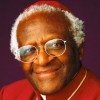
I do not preach a social gospel; I preach the Gospel, period. The gospel of our Lord Jesus Christ is concerned for the whole person. When people were hungry, Jesus didn’t say, “Now, is that political, or social?” He said, “I feed you.” […] I can’t believe that you can compartmentalize life and say this is political and this is religious, because for us religion must permeate the whole of life. If people wish to say, “God’s writ does not run in the political sphere,” I want to ask, “Whose does?”
Desmond Tutu (1931–2021) South African cleric, Anglican Archbishop of Cape Town, Nobel Laureate
“The Bishop and South Africa,” interview by Rafael Suarez, Jr., Worldview (Dec 1984)
(Source)
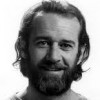
Religion — easily — has the Greatest Bullshit Story Ever Told! Think about it. Religion has actually convinced people that there’s an invisible man — living in the sky — who watches everything you do, every minute of every day. And the invisible man has a special list of ten things He does not want you to do. And if you do any of these ten things, He has a special place, full of fire and smoke and burning and torture and anguish, where he will send you to live and suffer and burn and choke and scream and cry, forever and ever, till the end of time! But He loves you! He loves you. He loves you and He needs money! He always needs money! He’s all-powerful, all-perfect, all-knowing, and all-wise — somehow just can’t handle money! Religion takes in billions of dollars, they pay no taxes, and they always need a little more. Now, you talk about a good bullshit story, holy shit!
George Carlin (1937–2008) American comedian
Show (1999-02-06), You Are All Diseased, Beacon Theater, New York City (HBO)
(Source)
(Source (Video)).Reprinted, slightly edited, in Napalm & Silly Putty, "Bullshit from the Sky" (2001):Religion -- easily -- has the Greatest Bullshit Story Ever Told! Think about it: religion has actually convinced people -- many of them adults -- that there's an invisible man who lives in the sky and watches everything you do, every minute of every day. And who has a special list of ten things he does not want you to do. And if you do any of these ten things, he has a special place, full of fire and smoke and burning and torture and anguish, where he will send you to remain and suffer and burn and choke and scream and cry, forever and ever, till the end of time! But he loves you. He loves you and he needs money! He always needs money. He's all-powerful, all-perfect, all-knowing, and all-wise, but somehow ... he just can't handle money! Religion takes in billions of dollars, pays no taxes, and somehow always need a little more. Now, you talk about a good bullshit story. Holy shit!
Is there any religion whose followers can be pointed to as distinctly more amiable and trustworthy than those of any other? If so, this should be enough. I find the nicest and best people generally profess no religion at all, but are ready to like the best men of all religions.
Samuel Butler (1835–1902) English novelist, satirist, scholar
The Note-Books of Samuel Butler, “Religion” (1912)Full text.
He does not believe, that does not live according to his Belief.
Thomas Fuller (1654–1734) English physician, preacher, aphorist, writer
Gnomologia: Adages and Proverbs (compiler), # 1838 (1732)
(Source)

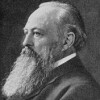
The Stoics could only advise the wise man to hold aloof from politics, keeping the unwritten law in his heart. But when Christ said: “Render unto Caesar the things that are Caesar’s, and unto God the things that are God’s,” those words, spoken on His last visit to the Temple, three days before His death, gave to the civil power, under the protection of conscience, a sacredness it had never enjoyed, and bounds it had never acknowledged; and they were the repudiation of absolutism and the inauguration of freedom.
John Dalberg, Lord Acton (1834–1902) British historian, politician, writer
Speech (1877-02-28), “The History of Freedom in Antiquity,” Bridgenorth Institute
Atheism is the theory that there is no God. Now one kind is a theoretical kind, where someone just sits down and starts thinking about it, and they come to a conclusion that there is no God. The other kind is a practical atheism, and that kind goes out of living as if there is no God. And you know there are a lot of people who affirm the existence of God with their lips, and they deny his existence with their lives. You’ve seen these people who have a high blood pressure of creeds and an anemia of deeds.
A good deed is the best prayer. A loving life is the best religion.
Each nation has created a god, and the god has always resembled his creators. He hated and loved what they hated and loved, and he was invariably found on the side of those in power. Each god was intensely patriotic, and detested all nations but his own. All these gods demanded praise, flattery, and worship. Most of them were pleased with sacrifice, and the smell of innocent blood has ever been considered a divine perfume. All these gods have insisted upon having a vast number of priests, and the priests have always insisted upon being supported by the people, and the principal business of these priests has been to boast about their god, and to insist that he could easily vanquish all the other gods put together.
Robert Green Ingersoll (1833–1899) American lawyer, freethinker, orator
Lecture (1872-01-29), “The Gods,” Fairbury Hall, Fairbury, Illinois
(Source)
An honest God is the noblest work of man.
The most savage controversies are those about matters as to which there is no good evidence either way. Persecution is used in theology, not in arithmetic, because in arithmetic there is knowledge, but in theology there is only opinion.
Bertrand Russell (1872–1970) English mathematician and philosopher
“An Outline of Intellectual Rubbish,” Unpopular Essays (1950)
Standing in the presence of the Unknown, all have the same right to think, and all are equally interested in the great question of origin and destiny. All I claim, all I plead for, is liberty of thought and expression. That is all.
Robert Green Ingersoll (1833–1899) American lawyer, freethinker, orator
“The Liberty of Man, Woman, and Child” (1877)
I’m not an atheist. I don’t think I can call myself a pantheist. The problem involved is too vast for our limited minds. We are in the position of a little child entering a huge library filled with books in many languages. The child knows someone must have written those books. It does not know how. It does not understand the languages in which they are written. The child dimly suspects a mysterious order in the arrangement of the books but doesn’t know what it is. That, it seems to me, is the attitude of even the most intelligent human being toward God. We see the universe marvelously arranged and obeying certain laws but only dimly understand these laws. Our limited minds grasp the mysterious force that moves the constellations.
Albert Einstein (1879–1955) German-American physicist
In G. Viereck, Glimpses of the Great (1930)
(Source)
Note this passage is not present in the Saturday Evening Post interview that was the basis for that chapter of Viereck's book.
Religious persecution may shield itself under the guise of a mistaken and over-zealous piety.
Edmund Burke (1729–1797) Anglo-Irish statesman, orator, philosopher
Speech (18 Feb 1788)
Quoted in E. A. Bond (ed.), Speeches ... in the Trial of Warren Hastings, vol. 1 (1859)
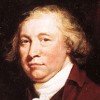
The three most important things a man has are, briefly, his private parts, his money, and his religious opinions.
Samuel Butler (1835–1902) English novelist, satirist, scholar
Further Extracts from Note-books of Samuel Butler (1934)
The Religion that is afraid of science dishonours God and commits suicide.
Ralph Waldo Emerson (1803–1882) American essayist, lecturer, poet
Journal (1831-03-04)
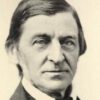
I do not say, and I do not believe, that Christians are as bad as their creeds. In spite of church and dogma, there have been millions and millions of men and women true to the loftiest and most generous promptings of the human heart. They have been true to their convictions, and, with a self-denial and fortitude excelled by none, have labored and suffered for the salvation of men. Imbued with the spirit of self-sacrifice, believing that by personal effort they could rescue at least a few souls from the infinite shadow of hell, they have cheerfully endured every hardship and scorned every danger.
And yet, notwithstanding all this, they believed that honest error was a crime. They knew that the Bible so declared, and they believed that all unbelievers would be eternally lost. They believed that religion was of God, and all heresy of the devil. They killed heretics in defense of their own souls and the souls of their children. They killed them because, according to their idea, they were the enemies of God, and because the Bible teaches that the blood of the unbeliever is a most acceptable sacrifice to heaven.Robert Green Ingersoll (1833–1899) American lawyer, freethinker, orator
Lecture (1874-05-03), “Heretics and Heresies,” Free Religious Society, Kingsbury Hall, Chicago
(Source)
Collected in The Gods and Other Lectures (1876).
Where religion speaks of the heart and soul, and of what happens before we’re born and after we die, and why, then agreeing or disagreeing with it is a matter of personal taste, spirit, and judgment. Where it speaks of the objective, of the real world, of what evidence of our eyes should be accepted or rejected, it is worth no more than anyone else spouting off at a cocktail party.
Graham Ericsson (b. 1961) American technologist, writer, aphorist
Journal (2008-07-27)

I am less concerned about my relationship with God in the afterlife than I am in my relationship with him in this one.
Graham Ericsson (b. 1961) American technologist, writer, aphorist
Journal (2008-06-24)
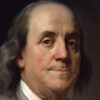
Men differ daily, about things which are subject to Sense, is it likely then they should agree about things invisible.
Benjamin Franklin (1706–1790) American statesman, scientist, philosopher, aphorist
Poor Richard (1743 ed.)
(Source)
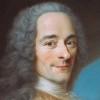
Formerly there were those who said: You believe things that are incomprehensible, inconsistent, impossible because we have commanded you to believe them; go then and do what is unjust because we command it. Such people show admirable reasoning. Truly, whoever is able to make you absurd is able to make you unjust. If the God-given understanding of your mind does not resist a demand to believe what is impossible, then you will not resist a demand to do wrong to that God-given sense of justice in your heart. As soon as one faculty of your soul has been dominated, other faculties will follow as well. And from this derives all those crimes of religion which have overrun the world.
[Il y a eu des gens qui ont dit autrefois: Vous croyez des choses incompréhensibles, contradictoires, impossibles, parce que nous vous l’avons ordonné; faites donc des choses injustes parce que nous vous l’ordonnons. Ces gens-là raisonnaient à merveille. Certainement qui est en droit de vous rendre absurde est en droit de vous rendre injuste. Si vous n’opposez point aux ordres de croire l’impossible l’intelligence que Dieu a mise dans votre esprit, vous ne devez point opposer aux ordres de malfaire la justice que Dieu a mise dans votre coeur. Une faculté de votre âme étant une fois tyrannisée, toutes les autres facultés doivent l’être également. Et c’est là ce qui a produit tous les crimes religieux dont la terre a été inondée.]
Voltaire (1694–1778) French writer [pseud. of Francois-Marie Arouet]
Questions sur les miracles (1765)
(Source)
Commonly translated: "Those who can make you believe absurdities can make you commit atrocities."

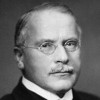
The world is so exquisite with so much love and moral depth, that there is no reason to deceive ourselves with pretty stories for which there’s little good evidence. Far better it seems to me, in our vulnerability, is to look death in the eye and to be grateful every day for the brief but magnificent opportunity that life provides.
Carl Sagan (1934–1996) American scientist and writer
“In the Valley of the Shadow,” Parade (10 Mar 1996)

You can take away a man’s gods, but only to give him others in return.
Why should my freedom be governed by somebody else’s conscience?
[ἱνατί γὰρ ἡ ἐλευθερία μου κρίνεται ὑπὸ ἄλλης συνειδήσεως]
The Bible (The New Testament) (AD 1st - 2nd C) Christian sacred scripture
Book 7. 1st Letter to the Corinthians 10:29 (1 Cor 10:29) [NJB (1985)]
(Source)
Paul on how it's okay to eat food that others think is religiously wrong to eat (but how you shouldn't be a dick about it, either).
(Source (Greek)). Other translations:For why is my liberty judged of another man's conscience?
[KJV (1611)]Why should my freedom depend on somebody else’s conscience?
[JB (1966)]“Well, then,” someone asks, “why should my freedom to act be limited by another person's conscience?"
[GNT (1976)]Why should my freedom be judged by someone else’s conscience?
[CEB (2011)]For why should my liberty be subject to the judgment of someone else’s conscience?
[NRSV (2021 ed.)]
It is bad religion to deify doctrines and creeds. While indispensable to religious life, doctrines and creeds are only so as signposts. Love alone is the hitching post. Doctrines, let’s not forget, supported slavery and apartheid; some still support keeping women in their places and gays and lesbians in limbo. Moreover, doctrines can divide while compassion can only unite. In other words, religious folk, all our lives, have both to recover tradition and to recover from it.
William Sloane Coffin, Jr. (1924–2006) American minister, social activist
Credo, “Faith, Hope, Love” (2004)
(Source)
Even if we think religion insoluble, we cannot think it irrelevant. Even if we ourselves have no view of the ultimate verities, we must feel that wherever such a view exists in a man it must be more important than anything else in him.
Gilbert Keith Chesterton (1874–1936) English journalist and writer
Heretics, ch. 20 “Concluding Remarks on the Importance of Orthodoxy” (1905)
(Source)
KATE: Oh, Harry, you and your sublime religion.
SIR HARRY: My religion? I never was one to talk about religion, but —
KATE. Pooh, Harry, you don’t even know what your religion was and is and will be till the day of your expensive funeral. One’s religion is whatever he is most interested in, and yours is Success.
J. M. Barrie (1860–1937) Scottish novelist and dramatist [James Matthew Barrie]
The Twelve-Pound Look (1910)
(Source)
Men and women have been burned for thinking there is but one God; that there was none; that the Holy Ghost is younger than God; that God was somewhat older than his son; for insisting that good works will save a man without faith; that faith will do without good works; for declaring that a sweet babe will not be burned eternally, because its parents failed to have its head wet by a priest; for speaking of God as though he had a nose; for denying that Christ was his own father; for contending that three persons, rightly added together, make more than one; for believing in purgatory; for denying the reality of hell; for pretending that priests can forgive sins; for preaching that God is an essence; for denying that witches rode through the air on sticks; for doubting the total depravity of the human heart; for laughing at irresistible grace, predestination and particular redemption; for denying that good bread could be made of the body of a dead man; for pretending that the pope was not managing this world for God, and in the place of God; for disputing the efficacy of a vicarious atonement; for thinking the Virgin Mary was born like other people; for thinking that a man’s rib was hardly sufficient to make a good-sized woman; for denying that God used his finger for a pen; for asserting that prayers are not answered, that diseases are not sent to punish unbelief; for denying the authority of the Bible; for having a Bible in their possession; for attending mass, and for refusing to attend; for wearing a surplice; for carrying a cross, and for refusing; for being a Catholic, and for being a Protestant; for being an Episcopalian, a Presbyterian, a Baptist, and for being a Quaker. In short, every virtue has been a crime, and every crime a virtue. The church has burned honesty and rewarded hypocrisy. And all this, because it was commanded by a book.
Robert Green Ingersoll (1833–1899) American lawyer, freethinker, orator
Lecture (1874-05-03), “Heretics and Heresies,” Free Religious Society, Kingsbury Hall, Chicago
(Source)
Collected in The Gods and Other Lectures (1876).
They say the religion of your fathers is good enough. Why should a father object to your inventing a better plow than he had?
Robert Green Ingersoll (1833–1899) American lawyer, freethinker, orator
Speech on Religious Intolerance, Pittsburgh Opera House (14 Oct 1879)
Finally, I believe in an America where religious intolerance will someday end — where all men and all churches are treated as equal — where every man has the same right to attend or not attend the church of his choice — where there is no Catholic vote, no anti-Catholic vote, no bloc voting of any kind — and where Catholics, Protestants and Jews, at both the lay and pastoral level, will refrain from those attitudes of disdain and division which have so often marred their works in the past, and promote instead the American ideal of brotherhood.
John F. Kennedy (1917–1963) American politician, author, journalist, US President (1961–63)
Speech, Greater Houston Ministerial Association (12 Sep 1960)
(Source)
In my religion there would be no exclusive doctrine; all would be love, poetry and doubt.
Cyril Connolly (1903–1974) English intellectual, literary critic and writer.
The Unquiet Grave (1945)

I have ever thought religion a concern purely between our god and our consciences, for which we were accountable to him, and not to the priests. I never told my own religion, nor scrutinised that of another. I never attempted to make a convert, nor wished to change another’s creed. I have ever judged of the religion of others by their lives: and by this test, my dear Madam, I have been satisfied yours must be an excellent one, to have produced a life of such exemplary virtue and correctness. For it is in our lives, and not from our words, that our religion must be read. By the same test the world must judge me.
Thomas Jefferson (1743–1826) American political philosopher, polymath, statesman, US President (1801–09)
Letter (1816-08-06) to Margaret Bayard Smith
(Source)
It doesn’t seem to me that this fantastically marvelous universe, this tremendous range of time and space and different kinds of animals, and all the different planets, and all these atoms with all their motions, and so on, all this complicated thing can merely be a stage so that God can watch human beings struggle for good and evil — which is the view that religion has. The stage is too big for the drama.
Richard Feynman (1918–1988) American physicist
Interview (1959-05-01) by Bill Stout, Viewpoint, KNXT radio
(Source)
Reprinted in Michelle Feynman (ed.), Perfectly Reasonable Deviations from the Beaten Track: The Letters of Richard P Feynman, Appendix I (2006).
That religion, or the duty which we owe to our Creator, and the manner of discharging it, can be directed only by reason and conviction, not by force or violence; and therefore all men are equally entitled to the free exercise of religion, according to the dictates of conscience; and that it is the mutual duty of all to practice Christian forbearance, love, and charity towards each other.
George Mason (1725–1792) American statesman, Founding Father [George Mason IV]
Virginia Declaration of Rights (1776)
I know a number of highly sensitive and intelligent people in my own communion who consider as a heresy my faith that God’s loving concern for his creation will outlast all our willfulness and pride. No matter how many eons it takes, he will not rest until all of creation, including Satan, is reconciled to him, until there is no creature who cannot return his look of love with a joyful response of love […] Some people feel it to be heresy because it appears to deny man his freedom to refuse to love God. But this, it seems to me, denies God his freedom to go on loving us beyond all our willfulness and pride. If the Word of God is the light of the world, and this light cannot be put out, ultimately it will brighten all the dark corners of our hearts and we will be able to see, and seeing, will be given the grace to respond with love — and of our own free will.
Madeleine L'Engle (1918–2007) American writer
The Irrational Season (1977)

The most beautiful thing we can experience is the mysterious. It is the source of all true art and science. He to whom this emotion is a stranger, who can no longer pause to wonder and stand rapt in awe, is as good as dead: his eyes are closed. This insight into the mystery of life, coupled though it may be with fear, has also given rise to religion. To know that what is impenetrable to us really exists, manifesting itself as the highest wisdom and the most radiant beauty which our dull faculties can comprehend only in their most primitive forms — this knowledge, this feeling, is at the center of true religiousness. In this sense, and in this sense only, I belong in the ranks of devoutly religious men.
Albert Einstein (1879–1955) German-American physicist
“What I Believe,” Forum and Century (Oct 1930)
(Source)
Einstein crafted and recrafted his credo multiple times in this period, and specifics are often muddled by differing translations and by his reuse of certain phrases in later writing. The Forum and Century entry appears to be the earliest. Some important variants:The most beautiful experience we can have is the mysterious. It is the fundamental emotion that stands at the cradle of true art and true science. Whoever does not know it and can no longer wonder, no longer marvel, is as good as dead, and his eyes are dimmed. It was the experience of mystery -- even if mixed with fear -- that engendered religion. A knowledge of the existence of something we cannot penetrate, our perceptions of the profoundest reason and the most radiant beauty, which only in their most primitive forms are accessible to our minds: it is this knowledge and this emotion that constitute true religiosity. In this sense, and only this sense, I am a deeply religious man.
— "The World As I See It [Mein Weltbild]" [tr. Bargmann (1954)]The fairest thing we can experience is the mysterious. It is the fundamental emotion which stands at the cradle of true art and true science. He who knows it not and can no longer wonder, no longer feel amazement, is as good as dead, a snuffed-out candle. It was the experience of mystery -- even if mixed with fear -- that engendered religion. A knowledge of the existence of something we cannot penetrate, of the manifestations of the profoundest reason and the most radiant beauty, which are only accessible to our reason in their most elementary forms -- it is this knowledge and this emotion that constitute the truly religious attitude; in this sense, and in this alone, I am a deeply religious man.
— "The World As I See It [Mein Weltbild]" [tr. Harris (1934)]The most beautiful and deepest experience a man can have is the sense of the mysterious. It is the underlying principle of religion as well as all serious endeavor in art and science. He who never had this experience seems to me, if not dead, then at least blind. To sense that behind anything that can be experienced there is a something that our mind cannot grasp and whose beauty and sublimity reaches us only indirectly and as a feeble reflection, this is religiousness. In this sense I am religious.
[Das Schönste und Tiefste, was der Mensch erleben kann, ist das Gefühl des Geheimnisvollen. Es liegt der Religion sowie allem tieferen Streben in Kunst und Wissenschaft zugrunde. Wer dies nicht erlebt hat, erscheint mir, wenn nicht wie ein Toter, so doch wie ein Blinder. Zu empfinden, dass hinter dem Erlebbaren ein für unseren Geist Unerreichbares verborgen sei, dessen Schönheit und Erhabenheit uns nur mittelbar und in schwachem Widerschein erreicht, das ist Religiosität. In diesem Sinne bin ich religiös.]
— Variant in "My Credo [Mein Glaubensbekenntnis]" (Aug 1932)
See parallel sentiments here, here, and here.

Church and state are drawn to each other like moths and flame, and when they are, it’s always about power — power over the population, power over souls. power over votes. But religious and political leaders alike should remember what happens when the moth and flame finally get together.
Graham Ericsson (b. 1961) American technologist, writer, aphorist
Journal (2007-08-13)
Man is a credulous animal, and must believe something; in the absence of good grounds for belief, he will be satisfied with bad ones.
Bertrand Russell (1872–1970) English mathematician and philosopher
“An Outline of Intellectual Rubbish,” Unpopular Essays (1950)
Also in "Atheism and Agnosticism," Essays in Skepticism (1962).
When religion becomes a mere artificial façade to justify a social or economic system — when religion hands over its rites and language completely to the political propagandist, and when prayer becomes the vehicle for a purely secular ideological program, then religion does tend to become an opiate. It deadens the spirit enough to permit the substitution of a superficial fiction and mythology for the truth of life. And this brings about the alienation of the believer, so that his religious zeal becomes political fanaticism. His faith in God, while preserving its traditional formulas, becomes in fact faith in his own nation, class or race. His ethic ceases to be the law of God and love, and becomes the law of might-makes-right: established privilege justifies everything. God is the status quo.
Thomas Merton (1915–1968) French-American religious and writer [a.k.a. Fr. M. Louis]
Contemplative Prayer

You can safely assume that you’ve created God in your own image when it turns out that God hates all the same people you do.
Anne Lamott (b. 1954) American novelist and non-fiction writer
Bird by Bird (1995)
She attributes the quote to "my priest friend Tom"

At Cambridge University I was taught a laudable method of argument: you never personalise, but you have absolutely no respect for people’s opinions. You are never rude to the person, but you can be savagely rude about what the person thinks. That seems to me a crucial distinction: people must be protected from discrimination by virtue of their race, but you cannot ring-fence their ideas. The moment you say that any idea system is sacred, whether it’s a religious belief system or a secular ideology, the moment you declare a set of ideas to be immune from criticism, satire, derision, or contempt, freedom of thought becomes impossible.
Salman Rushdie (b. 1947) Indian novelist
“Do we have to fight the battle for the Enlightenment all over again?” The Independent (22 Jan 2005)
(Source)

Religion, a subject on which I have ever been most scrupulously reserved. I have considered it as a matter between every man and his maker, in which no other, & far less the public, had a right to intermeddle.
Thomas Jefferson (1743–1826) American political philosopher, polymath, statesman, US President (1801–09)
Letter (1813-05-31) to Richard Rush
(Source)
He who carves the Buddha never worships him.
Proverbs, Sayings, and Adages
Chinese proverb

Conventionality is not morality. Self-righteousness is not religion. To attack the first is not to assail the last. To pluck the mask from the face of the Pharisee, is not to lift an impious hand to the Crown of Thorns.
Charlotte Brontë (1816–1855) British novelist [pseud. Currer Bell]
Jane Eyre, Preface, 2nd edition (21 Dec 1847)

Then saith he unto them, Render therefore unto Cæsar the things which are Cæsar’s; and unto God the things that are God’s.
[Τότε λέγει αὐτοῖς Ἀπόδοτε οὖν τὰ Καίσαρος Καίσαρι καὶ τὰ τοῦ Θεοῦ τῷ Θεῷ.]
The Bible (The New Testament) (AD 1st - 2nd C) Christian sacred scripture
Book 1. Gospel of Matthew 22:21 (Matt 22:21) (Jesus) [KJV (1611)]
(Source)
When Jesus' enemies tried to trap him into either supporting paying taxes to the hated Romans, or criminally suggesting that taxes should not be paid. More discussion of the passage here: Render unto Caesar - Wikipedia.
This passage is paralleled in Mark 12:17 and Luke 20:25.
(Source (Greek)). Other translations:He then said to them, "Very well, give back to Caesar what belongs to Caesar -- and to God what belongs to God."
[JB (1966)]So Jesus said to them, “Well, then, pay to the Emperor what belongs to the Emperor, and pay to God what belongs to God.”
[GNT (1976)]Then he said to them, 'Very well, pay Caesar what belongs to Caesar -- and God what belongs to God.'
[NJB (1985)]Then he said, “Give to Caesar what belongs to Caesar and to God what belongs to God.”
[CEB (2011)]Then he said to them, “Give therefore to Caesar the things that are Caesar’s and to God the things that are God’s.”
[NRSV (2021 ed.)]
SCRIPTURES, n. The sacred books of our holy religion, as distinguished from the false and profane writings on which all other faiths are based.
Ambrose Bierce (1842–1914?) American writer and journalist
“Scriptures,” The Devil’s Dictionary (1911)
(Source)
Originally published in The Devil's Dictionary [A-Z] as Vol. 7 of his Collected Works.

All Faith is false, all Faith is true: truth is the shattered mirror strown
In myriad bits; while each believes his little bit the whole to own.Richard Francis Burton (1821–1890) British explorer and orientalist
The Kasîdah of Hâjî Abdû Al-Yazdi (1900)
(Source)
Natives who beat drums to drive off evil spirits are objects of scorn to smart Americans who blow horns to break up traffic jams.
(Other Authors and Sources)
Mary Ellen Kelley

If a man, holding a belief which he was taught in childhood or persuaded of afterwards, keeps down and pushes away any doubts which arise about it in his mind, purposely avoids the reading of books and the company of men that call in question and discuss it, and regards as impious those questions which cannot easily be asked without disturbing it — the life of that man is one long sin against mankind.
William Kingdon Clifford (1845–1879) English mathematician and philosopher
“The Ethics of Belief,” Part 1 “The Duty of Inquiry,” Contemporary Review (Jan 1877)
(Source)

Matters of religion should never be matters of controversy. We neither argue with a lover about his taste, not condemn him, if we are just, for knowing so human a passion.
George Santayana (1863–1952) Spanish-American poet and philosopher [Jorge Agustín Nicolás Ruíz de Santayana y Borrás]
The Life of Reason or The Phases of Human Progress, Vol. 3 “Reason in Religion,” ch. 6 “The Christian Epic” (1905-06)
(Source)
A man’s ethical behavior should be based effectually on sympathy, education, and social ties and needs; no religious basis is necessary. Man would indeed be in a poor way if he had to be restrained by fear of punishment and hopes of reward after death.
Albert Einstein (1879–1955) German-American physicist
“Religion and Science,” New York Times Magazine (9 Nov 1930)
(Source)
We must respect the other fellow’s religion, but only in the sense and to the extent that we respect his theory that his wife is beautiful and his children are smart.
H. L. Mencken (1880–1956) American writer and journalist [Henry Lewis Mencken]
Minority Report: H.L. Mencken’s Notebooks, # 1 (1956)
(Source)
Jews do not presume to judge the honest worshiper of any faith. Our prayer book tells us: “The righteous of all nations are worthy of immortality.” We Jews know that there are many mountain tops — and all of them reach for the stars.
Morris N. Kertzer (1910–1983) American rabbi, writer
“What is a Jew?” Look Magazine (1954)
(Source)
This essay was expanded into a book by the same title; this passage underwent various revisions and expansion across different editions.

The most beautiful experience we can have is the mysterious. It is the fundamental emotion that stands at the cradle of true art and true science. Whoever does not know it and can no longer wonder, no longer marvel, is as good as dead, and his eyes are dimmed. It was the experience of mystery — even if mixed with fear — that engendered religion. A knowledge of the existence of something we cannot penetrate, our perceptions of the profoundest reason and the most radiant beauty, which only in their most primitive forms are accessible to our minds: it is this knowledge and this emotion that constitute true religiosity. In this sense, and only this sense, I am a deeply religious man.
Albert Einstein (1879–1955) German-American physicist
The World As I See It, Title Essay (1931) (1949)
(Source)
The essay is also known as "Mein Weltbild" or "My Worldview." Alternate translation: "The fairest thing we can experience is the mysterious. It is the fundamental emotion which stands at the cradle of true art and true science. He who knows it not and can no longer wonder, no longer feel amazement, is as good as dead, a snuffed-out candle. It was the experience of mystery -- even if mixed with fear -- that engendered religion. A knowledge of the existence of something we cannot penetrate, of the manifestations of the profoundest reason and the most radiant beauty, which are only accessible to our reason in their most elementary forms -- it is this knowledge and this emotion that constitute the truly religious attitude; in this sense, and in this alone, I am a deeply religious man."
Men will wrangle for religion; write for it; fight for it; die for it; anything but — live for it.
Charles Caleb "C. C." Colton (1780–1832) English cleric, writer, aphorist
Lacon: Or, Many Things in Few Words, Vol. 1, § 25 (1820)
(Source)
We despise all reverences and all objects of reverence which are outside the pale of our list of sacred things. And yet, with strange inconsistency, we are shocked when other people despise and defile the things which are holy to us.
Mark Twain (1835–1910) American writer [pseud. of Samuel Clemens]
Following the Equator (1897)
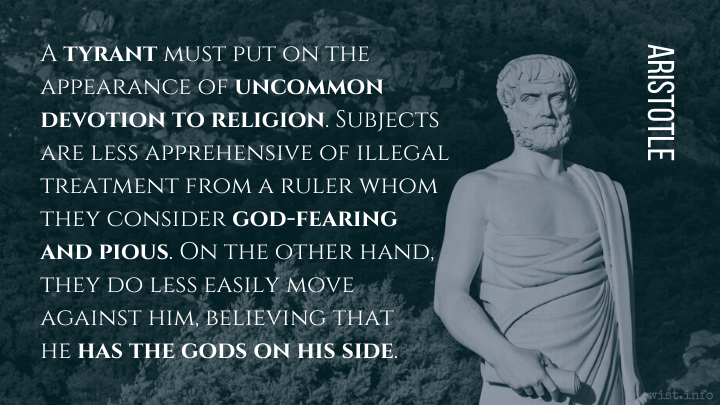
A tyrant must put on the appearance of uncommon devotion to religion. Subjects are less apprehensive of illegal treatment from a ruler whom they consider god-fearing and pious. On the other hand, they do less easily move against him, believing that he has the gods on his side.
Aristotle (384–322 BC) Greek philosopher
Politics [Πολιτικά], Book 5, ch. 11 / 1314b.39
Other translations:
- "Also he should appear to be particularly earnest in the service of the Gods; for if men think that a ruler is religious and has a reverence for the Gods, they are less afraid of suffering injustice at his hands, and they are less disposed to conspire against him, because they believe him to have the very Gods fighting on his side. At the same time his religion must not be thought foolish." [tr. Jowett (1885)]
- "And, moreover, always to seem particularly attentive to the worship of the gods; for from persons of such a character men entertain less fears of suffering anything illegal while they suppose that he who governs them is religious and reverences the gods; and they will be less inclined to raise insinuations against such a one, as being peculiarly under their protection: but this must be so done as to give no occasion for any suspicion of hypocrisy." [tr. Ellis (1912)]
- "And further he must be seen always to be exceptionally zealous as regards religious observances (for people are less afraid of suffering any illegal treatment from men of this sort, if they think that their ruler has religious scruples and pays regard to the gods, and also they plot against him less, thinking that he has even the gods as allies), though he should not display a foolish religiosity." [tr. Rackham (1932)]
- "Further, he must always show himself to be seriously attentive to the things pertaining to the gods. For men are less afraid fo being treated in some respect contrary to the law by such persons, if they consider the ruler a god-fearing sort who takes thought for the gods, and they are less ready to conspire against him as one who has the gods too as allies. In showing himself of this sort, however, he must avoid silliness." [tr. Lord (1984)]
He who begins by loving Christianity better than truth, will proceed by loving his own sect or church better than Christianity, and end in loving himself better than all.
Samuel Taylor Coleridge (1772–1834) English poet and critic
Aids to Reflection (1825)

Men never do evil so completely and cheerfully as when they do it from religious convictions.
[Jamais on ne fait le mal si pleinement et si gaiement, que quand on le fait par un faux principe de conscience.]
Blaise Pascal (1623–1662) French scientist and philosopher
Pensées, ch. 14, Appendix: Polemical Fragments #895 (1669) [tr. Trotter (1910)]
(Source)
Also labeled as Part 2, Article 17, # 53. Sometimes also shown in slightly shorter French as "Jamais on ne fait le mal si pleinement et si gaiement que quand on le fait par conscience."(Source (French)). Other translations:
- "We never do evil so fully and cheerfully as when we do it out of conscience." [#813 (#895), tr. Krailsheimer]
- "We never do evil so completely and cheerfully as when we do it out of conscience." [Miscellaneous Thoughts 7: Sellier #658/Lafuma #813, tr. Ariew]
- "Men never do evil so completely and cheerfully as when they do it conscientiously."
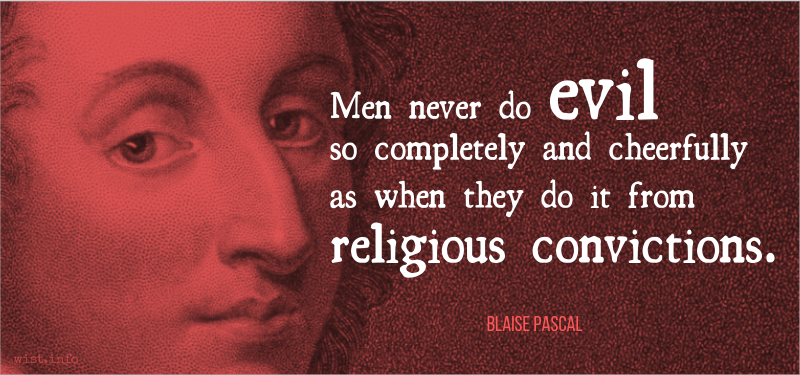
His religion at best is an anxious wish, — like that of Rabelais, a great Perhaps.
Thomas Carlyle (1795–1881) Scottish essayist and historian
“Burns,” Edinburgh Review No. 96, Art. 1 (1828-12)
(Source)
A review of Lockhart, The Life of Robert Burns (1828).
From silly devotions and sad-faced saints, O Lord, deliver me.
Teresa of Ávila (1515–1582) Spanish mystic, poet, philosopher, saint
(Attributed)
Variant: "God, deliver me from sullen saints."

The road to hell is paved with religious conservatives? Nah, probably not. I’ve no doubt, though, that there are a few being used to fill in the potholes.
Graham Ericsson (b. 1961) American technologist, writer, aphorist
Journal (undated)
Each nation knowing it has the only true religion and the only sane system of government, each despising all the others, each an ass and not suspecting it.
I care not for a man’s religion whose dog or cat are not the better for it.
Abraham Lincoln (1809–1865) American lawyer, politician, US President (1861–65)
(Attributed)
Frequently attributed to Lincoln without citation, it's actually a variant of "I would give nothing for that man's religion, whose very dog and cat are not the better for it," by Rowland Hill (1744-1833), an English preacher, attributed in George Seaton Bowes, Illustrative Gatherings, or, Preachers and Teachers (1860). Lincoln may have used the line.

The religious persecution of the ages has been done under what was claimed to be the command of God. I distrust those people who know so well what God wants them to do, because I notice that it always coincides with their own desires.
Susan B. Anthony (1820–1906) American reformer, aboltionist, sufferagist
Address to National American Woman Suffrage Association, Washington (23-28 Jan 1896)
(Source)

Say nothing of my religion. It is known to God and myself alone. Its evidence before the world is to be sought in my life: if it has been honest and dutiful to society the religion which has regulated it cannot be a bad one.
Thomas Jefferson (1743–1826) American political philosopher, polymath, statesman, US President (1801–09)
Letter (1817-01-11) to John Adams
(Source)
Instructions he gave to a biographer.
People who want to share their religious views with you almost never want you to share yours with them.
Dave Barry (b. 1947) American humorist, author, columnist
“25 Things I Have Learned In 50 Years,” #12 (1997)

Such are the evils made acceptable by Religion!
[Tantum religio potuit suadere malorum.]
Lucretius (c. 100-c. 55 BC) Roman poet [Titus Luretius Carus]
De Rerum Natura [On the Nature of Things], I.101
The beginning of wisdom is the most sincere desire for instruction,
and concern for instruction is love of her,
and love of her is the keeping of her laws,
and giving heed to her laws is assurance of immortality,
and immortality brings one near to God,
so the desire for wisdom leads to a kingdom.[ἀρχὴ γὰρ αὐτῆς ἡ ἀληθεστάτη παιδείας ἐπιθυμία,
φροντὶς δὲ παιδείας ἀγάπη,
ἀγάπη δὲ τήρησις νόμων αὐτῆς,
προσοχὴ δὲ νόμων βεβαίωσις ἀφθαρσίας,
ἀφθαρσία δὲ ἐγγὺς εἶναι ποιεῖ θεοῦ·
ἐπιθυμία ἄρα σοφίας ἀνάγει ἐπὶ βασιλείαν.]The Bible (The Old Testament) (14th - 2nd C BC) Judeo-Christian sacred scripture [Tanakh, Hebrew Bible], incl. the Apocrypha (Deuterocanonicals)
Book 22a. Wisdom 6:17ff (Wis 6:17-20) [NRSV (2021 ed.)]
(Source)
(Source (Greek)). Other translations:For the very true beginning of her is the desire of discipline; and the care of discipline is love;
And love is the keeping of her laws; and the giving heed unto her laws is the assurance of incorruption;
And incorruption maketh us near unto God:
Therefore the desire of wisdom bringeth to a kingdom.
[KJV (1611)]For the beginning of her is the most true desire of discipline.
And the care of discipline is love: and love is the keeping of her laws: and the keeping of her laws is the firm foundation of incorruption:
And incorruption bringeth near to God.
Therefore the desire of wisdom bringeth to the everlasting kingdom.
[DRA (1899); 6:18-21]Of her the most sure beginning is the desire for discipline, care for discipline means loving her,
loving her means keeping her laws,
obeying her laws guarantees incorruptibility,
incorruptibility brings near to God;
thus desire for Wisdom leads to sovereignty.
[JB (1966)]Wisdom begins when you sincerely want to learn. To desire Wisdom is to love her; to love her is to keep her laws; to keep her laws is to be certain of immortality; immortality will bring you close to God. This desire for Wisdom can prepare you to rule a kingdom.
[GNT (1976)]For Wisdom begins with the sincere desire for instruction, care for instruction means loving her,
loving her means keeping her laws, attention to her laws guarantees incorruptibility,
and incorruptibility brings us near to God;
the desire for Wisdom thus leads to sovereignty.
[NJB (1985)]The real beginning of wisdom is to desire instruction with all your heart. Love for instruction expresses itself in careful reflection. If you love Wisdom, you will keep her laws. If you are attentive to her laws, you can be assured that you will live forever. If you live forever, you will be near to God. If you desire wisdom with all your heart, you will know what good leadership is.
[CEB (2011)]
There is no religion without love, and people may talk as much as they like about their religion, but if it does not teach them to be good and kind to man and beast, it is all a sham.
Anna Sewell (1820–1878) English novelist
Black Beauty, Part 1, ch. 13 “The Devil’s Trade-Mark” (1877)
(Source)

No loss of flood and lightning, no destruction of cities and temples by hostile forces of nature, has deprived man of so many noble lives and impulses as those which his intolerance has destroyed.

“Huh! Priests!” said Mr. Shoe. “They’re all the same. Always telling you that you’re going to live again after you’re dead, but you just try it and see the look on their faces!”

Toleration is the best religion.
[La tolérance est la meilleure religion.]
Victor Hugo (1802–1885) French writer, journalist, human rights activist, politician
(Attributed) [ed. Ballou (1881)]
(Source)
Widely attributed to Hugo, I am unable to find a citation or primary source in either language. Note this early English language reference was within Hugo's lifetime, which lends the authenticity of the quotation more credible.Variants:
- "Tolerance is the best religion."
- "The best religion is tolerance."
When I, a thoughtful and unblessed Presbyterian, examine the Koran, I know that beyond any question every Mohammedan is insane; not in all things, but in religious matters. When a thoughtful and unblessed Mohammedan examines the Westminster Catechism, he knows that beyond any question I am spiritually insane. I cannot prove to him that he is insane, because you never can prove anything to a lunatic — for that is a part of his insanity and the evidence of it. He cannot prove to me that I am insane, for my mind has the same defect that afflicts his. All Democrats are insane, but not one of them knows it; none but the Republicans and Mugwumps know it. All the Republicans are insane, but only the Democrats and Mugwumps can perceive it. The rule is perfect: in all matters of opinion our adversaries are insane.
Mark Twain (1835–1910) American writer [pseud. of Samuel Clemens]
Christian Science, ch. 5 (1907)
(Source)
Often misattributed to Oscar Wilde.
Christ and The Church: If he were to apply for a divorce on the grounds of cruelty, adultery and desertion, he would probably get one.
Samuel Butler (1835–1902) English novelist, satirist, scholar
The Note-Books of Samuel Butler (1912)