

Freedom is not an ideal, it is not even a protection, if it means nothing more than freedom to stagnate, to live without dreams, to have no greater aim than a second car and another television set — and this in a world where half our fellow men have less than enough to eat.
Adlai Stevenson (1900–1965) American diplomat, statesman
“Putting First Things First”, Foreign Affairs (1960-01)
(Source)
Quotations by:
Stevenson, Adlai
What a man knows at fifty that he did not know at twenty is, for the most part, incommunicable. The laws, the aphorisms, the generalizations, the universal truths, the parables and the old saws — all of the observations about life which can be communicated handily in ready, verbal packages — are as well known to a man at twenty who has been attentive as to a man at fifty. He has been told them all, he has read them all, and he has probably repeated them all before he graduates from college; but he has not lived them all.
Adlai Stevenson (1900–1965) American diplomat, statesman
“The Educated Citizen,” Address, Princeton University (22 Mar 1954)Full text.
All progress has resulted from people who took unpopular positions. All change is the result of a change in the contemporary state of mind. Don’t be afraid of being out of tune with your environment, and above all pray God that you are not afraid to live, to live hard and fast.
Adlai Stevenson (1900–1965) American diplomat, statesman
“The Educated Citizen,” Address, Princeton University (22 Mar 1954)Full text.
Accuracy is to a newspaper what virtue is to a lady, but a newspaper can always print a retraction.
Adlai Stevenson (1900–1965) American diplomat, statesman
(Attributed)
There is nothing more horrifying than stupidity in action.
Adlai Stevenson (1900–1965) American diplomat, statesman
(Attributed)
I have learned that in quiet places reason abounds, that in quiet people there is vision and purpose, that many things are revealed to the humble that are hidden from the great.
Adlai Stevenson (1900–1965) American diplomat, statesman
(Attributed)
Quoted in Elizabeth Stevenson Ives and H. Dolson, My Brother Adlai (1956).
There are worse things than losing an election; the worst thing is to lose one’s convictions and not tell the people the truth.
Adlai Stevenson (1900–1965) American diplomat, statesman
(Attributed)
In Edward Doyle, As We Knew Adlai: The Stevenson Story by Twenty-two Friends (1966). In response to the suggestion his support for a nuclear test ban would cost him votes.
Accuracy is to a newspaper what virtue is to a lady, but a newspaper can always print a retraction.
Adlai Stevenson (1900–1965) American diplomat, statesman
(Attributed)
It’s hard to lead a cavalry charge if you think you look funny on a horse.
Adlai Stevenson (1900–1965) American diplomat, statesman
(Attributed)
Every day, for example, politicians, of which there are plenty, swear eternal devotion to the ends of peace and security. They always remind me of the elder Holmes’ apostrophe to a katydid: “Thou say’st an undisputed thing in such a solemn way.” And every day statesmen, of which there are few, must struggle with limited means to achieve these unlimited ends, both in fact and in understanding. For the nation’s purposes always exceed its means, and it is finding a balance between means and ends that is the heart of foreign policy and that makes it such a speculative, uncertain business.
Adlai Stevenson (1900–1965) American diplomat, statesman
Call to Greatness (1954)
Unreason and anti-intellectualism abominate thought. Thinking implies disagreement; and disagreement implies nonconformity; and nonconformity implies heresy; and heresy implies disloyalty — so, obviously, thinking must be stopped. But shouting is not a substitute for thinking and reason is not the subversion but the salvation of freedom.
Adlai Stevenson (1900–1965) American diplomat, statesman
Call to Greatness, ch. 3 “America’s Burden” (1954)
(Source)
Adapted from his "A Troubled World," Godkin Lectures, Harvard University (1954-03-17 - 1954-03-20)
We have confused the free with the free and easy.
Adlai Stevenson (1900–1965) American diplomat, statesman
Putting First Things (1960)
The idea that you can merchandise candidates for high office like breakfast cereal — that you can gather votes like box tops — is, I think, the ultimate indignity to the democratic process.
Adlai Stevenson (1900–1965) American diplomat, statesman
Comment, after his presidential nomination acceptance speech, Chicago (18 Aug 1956)
What do I believe? As an American I believe in generosity, in liberty, in the rights of man. These are social and political faiths that are part of me, as they are, I suppose, part of all of us. Such beliefs are easy to express. But part of me too is my relation to all life, my religion. And this is not so easy to talk about. Religious experience is highly intimate and, for me, ready words are not at hand. I am profoundly aware of the magnitude of the universe, that all is ruled by law, including my finite person. I believe in the infinite wisdom that envelops and embraces me and from which I take direction, purpose, strength.
Adlai Stevenson (1900–1965) American diplomat, statesman
Essay, This I Believe, Vol. 2 (1952) [ed. E. Murrow]
I am uncomfortably reminded of the abiding truth of those classic words that never occurred to Horace: “Via ovicipitum dura est,” or, for the benefit of the engineers among you: “The way of the egghead is hard.”
Adlai Stevenson (1900–1965) American diplomat, statesman
Lecture (1954-05-17), “A Troubled World,” Godkin Lectures, No. 1, Harvard University
(Source)
Introductory remarks the first session of a four-evening lecture series. Reprinted in the Foreword to Stevenson, Call to Greatness (1954).
The whole notion of loyalty inquisitions is a natural characteristic of the police state, not of democracy. Knowing his rule rests upon compulsion rather than consent, the dictator must always assume the disloyalty, not for a few but of many, and guard against it by continual inquisition and liquidation of the unreliable. The history of Soviet Russia is a modern example of this ancient practice.
The democratic state, on the other hand, is based on the consent of its members. The vast majority of our people are intensely loyal, as they have amply demonstrated. To question, even by implication, the loyalty and devotion of a large group of citizens is to create an atmosphere of suspicion and distrust which is neither justified, healthy, nor consistent with our traditions. […] I must, in good conscience, protest against any unnecessary suppression of our ancient rights of free men. Moreover, we will win the contest of ideas that afflicts the world not by suppressing those rights, but by their triumph. We must not burn down the house to kill the rats.Adlai Stevenson (1900–1965) American diplomat, statesman
Message (1951-06-26), Veto of Illinois State Senate Bill 102
(Source)
The Broyles Bill would have required all public workers, teachers, and officials, as well as candidates for office to sign loyalty oaths. Its veto by Stevenson, as Illinois Governor, was widely used by his political enemies during the Red Scare of the era.
This quote is widely misidentified as a more generic comment condemning the federal McCarran Internal Security Act of 1950. I've been unable to find any primary source connecting this quotation to that event.
This passage is often elided and paraphrased down, e.g.:The whole notion of loyalty inquisitions is a national characteristic of the police state, not of democracy. I must, in good conscience, protest against any unnecessary suppression of our rights as free men. We must not burn down the house to kill the rats.
I am not sure what it means when one says that he is a conservative in fiscal affairs and a liberal in human affairs. I assume what it means is that you will strongly recommend the building of a great many schools to accommodate the needs of our children, but not provide the money.
Adlai Stevenson (1900–1965) American diplomat, statesman
News conference (Fall 1955)
He who slings mud generally loses ground.
Adlai Stevenson (1900–1965) American diplomat, statesman
Quoted in news summaries (11 Jan 1954)
It reminds me of the small boy who jumbled his Biblical quotations and said: “A lie is an abomination unto the Lord, and a very present help in trouble.”
Adlai Stevenson (1900–1965) American diplomat, statesman
Speech (1951-01), Springfield, Illinois
Jumbling together parts of Proverbs 12:22 and Psalms 46:1.
The quotation is attributed to Stevenson in Bessie James and Mary Waterstreet (ed.), Adlai's Almanac (1952) and Bill Adler (ed.), The Stevenson Wit (1965). It is also repeated in an interview (1953-03), "Pageant Visits: Adlai E. Stevenson," Pageant Magazine.
The quote is sometimes given without the preface (making it sound as if Stevenson used the phrase directly).
The anecdote was not original with Stevenson. Historian David McCullough in his history of the building of the Panama Canal, The Path Between the Seas (1977) says the phrase was used on the floor of the US Senate by John T. Morgan, who served there 1877-1907. I have also found versions of it in 1899 and 1902.
See also Elizabeth Knowles, What They Didn't Say (2006).
What counts now is not just what we are against, but what we are for. Who leads us is less important than what leads us — what convictions, what courage, what faith — win or lose. A man doesn’t save a century, or a civilization, but a militant party wedded to a principle can.
Adlai Stevenson (1900–1965) American diplomat, statesman
Speech (1952-07-21), Democratic National Convention, Chicago
(Source)
Self-criticism is the secret weapon of democracy.
Adlai Stevenson (1900–1965) American diplomat, statesman
Speech (1952-07-21), Welcoming Address, Democratic National Convention, International Amphitheatre, Chicago
(Source)
Stevenson, who was not a declared candidate, gave the convention welcoming address as Governor of Illinois. He was later nominated for President.
Sacrifice, patience, understanding, and implacable purpose may be our lot of years to come. Let’s face it. Let’s talk sense to the American people. Let’s tell them the truth, that there are no gains without pains, that there — that we are now on the eve of great decisions, not easy decisions, like resistance when you’re attacked, but a long, patient, costly struggle which alone can assure triumph over the great enemies of man — war, poverty, and tyranny — and the assaults upon human dignity which are the most grievous consequences of each.
Adlai Stevenson (1900–1965) American diplomat, statesman
Speech (1952-07-26), Democratic National Convention, Chicago
(Source)
We talk a great deal about patriotism. What do we mean by patriotism in the context of our times? I venture to suggest that what we mean is a sense of national responsibility which will enable America to remain master of her power — to walk with it in serenity and wisdom, with self-respect and the respect of all mankind; a patriotism that puts country ahead of self; a patriotism which is not short, frenzied outbursts of emotion, but the tranquil and steady dedication of a lifetime. The dedication of a lifetime — these are words that are easy to utter, but this is a mighty assignment. For it is often easier to fight for principles than to live up to them.
Adlai Stevenson (1900–1965) American diplomat, statesman
Speech (1952-08-27), “The Nature of Patriotism,” American Legion Convention, Madison Square Garden, New York City
(Source)
Men who have offered their lives for their country know that patriotism is not the fear of something; it is the love of something. Patriotism with us is not the hatred of Russia; it is the love of this Republic and of the ideal of liberty of man and mind in which it was born, and to which this Republic is dedicated.
Adlai Stevenson (1900–1965) American diplomat, statesman
Speech (1952-08-27), “The Nature of Patriotism,” American Legion Convention, Madison Square Garden, New York City
(Source)
I am not sure that, historically, there has been another powerful nation that has been trusted as the United States is trusted today. It is something new under the sun when the proudest nations on earth have not only accepted American leadership in the common defense effort, but have also welcomed our troops and bases on their territory.
Adlai Stevenson (1900–1965) American diplomat, statesman
Speech (1952-08-27), “The Nature of Patriotism,” American Legion Convention, Madison Square Garden, New York City
(Source)
True patriotism, it seems to me, is based on tolerance and a large measure of humility.
Adlai Stevenson (1900–1965) American diplomat, statesman
Speech (1952-08-27), “The Nature of Patriotism,” American Legion Convention, Madison Square Garden, New York City
(Source)
There are men among us who use “patriotism” as a club for attacking other Americans. What can we say for the self-styled patriot who thinks that a Negro, a Jew, a Catholic, or a Japanese-American is less an American than he? That betrays the deepest article of our faith, the belief in individual liberty and equality which has always been the heart and soul of the American idea.
Adlai Stevenson (1900–1965) American diplomat, statesman
Speech (1952-08-27), “The Nature of Patriotism,” American Legion Convention, Madison Square Garden, New York City
(Source)
The anatomy of patriotism is complex. But surely intolerance and public irresponsibility cannot be cloaked in the shining armor of rectitude and righteousness. Nor can the denial of the right to hold ideas that are different — the freedom of man to think as he pleases. To strike freedom of the mind with the fist of patriotism is an old and ugly subtlety.
Adlai Stevenson (1900–1965) American diplomat, statesman
Speech (1952-08-27), “The Nature of Patriotism,” American Legion Convention, Madison Square Garden, New York City
(Source)
And the freedom of the mind, my friends, has served America well. The vigor of our political life, our capacity for change, our cultural, scientific, and industrial achievements, all derive from free inquiry, from the free mind — from the imagination, resourcefulness, and daring of men who are not afraid of new ideas. Most all of us favor free enterprise for business. Let us also favor free enterprise for the mind. For, in the last analysis, we would fight to the death to protect it.
Adlai Stevenson (1900–1965) American diplomat, statesman
Speech (1952-08-27), “The Nature of Patriotism,” American Legion Convention, Madison Square Garden, New York City
(Source)
We have made great advances in understanding the problem of national security in the modern world. We no longer think in terms of American resources alone. For the most part we now understand the need for a great international system of security, and we have taken the lead in building it.
Adlai Stevenson (1900–1965) American diplomat, statesman
Speech (1952-08-27), “The Nature of Patriotism,” American Legion Convention, Madison Square Garden, New York City
(Source)
The United States has very large power in the world today. And the partner of power — the corollary — is responsibility. It is our high task to use our power with a sure hand and a steady touch — with the self-restraint that goes with confident strength. The purpose of our power must never be lost in the fact of our power — and the purpose, I take it, is the promotion of freedom, justice and peace in the world.
Adlai Stevenson (1900–1965) American diplomat, statesman
Speech (1952-08-27), “The Nature of Patriotism,” American Legion Convention, Madison Square Garden, New York City
(Source)
Laws are never as effective as habits. The fight for equal rights must go on every day in our own souls and consciences, in our schools and our churches and our homes, in our factories and our offices — as well as in our city councils, our state legislatures and our national Congress.
Adlai Stevenson (1900–1965) American diplomat, statesman
Speech (1952-08-28), “Faith in Liberalism,” State Committee of the Liberal Party, New York City
(Source)
The sound of tireless voices is the price we pay for the right to hear the music of our own opinions. But there is also, it seems to me, a moment at which democracy must prove its capacity to act. Every man has a right to be heard; but no man has the right to strangle democracy with a single set of vocal chords.
Adlai Stevenson (1900–1965) American diplomat, statesman
Speech (1952-08-28), “Faith in Liberalism,” State Committee of the Liberal Party, New York City
(Source)
You can tell the size of a man by the size of the thing that makes him mad.
Adlai Stevenson (1900–1965) American diplomat, statesman
Speech (1952-08-28), “Faith in Liberalism,” State Committee of the Liberal Party, New York City
(Source)
Man does not live by words alone, despite the fact that sometimes he has to eat them.
Adlai Stevenson (1900–1965) American diplomat, statesman
Speech (1952-09-05), “Time for a Change –?” Colorado Volunteers for Stevenson Dinner, Denver, Colorado
(Source)
The rock-bottom foundation of a free press is the integrity of the people who run it. Our press may make a million mistakes of judgment without doing itself permanent harm so long as its proprietors are steadfast in their adherence to truth.
Adlai Stevenson (1900–1965) American diplomat, statesman
Speech (1952-09-08), “The One-Party Press,” Portland Journal Luncheon, Portland, Oregon
(Source)
Though progress may be slow, it may be steady and sure. A wise man does not try to hurry history. Many wars have been avoided by patience and many have been precipitated by reckless haste.
Adlai Stevenson (1900–1965) American diplomat, statesman
Speech (1952-09-09), “World Policy,” Veterans Memorial Auditorium, San Francisco, California
(Source)
Public confidence in the integrity of the Government is indispensable to faith in democracy; and when we lose faith in the system, we have lost faith in everything we fight and stand for.
Adlai Stevenson (1900–1965) American diplomat, statesman
Speech (1952-09-11), “On Political Morality,” Town Hall Luncheon, Biltmore Hotel, Los Angeles
(Source)
In the tragic days of Mussolini, the trains in Italy ran on time as never before and I am told in their way, their horrible way, that the Nazi concentration-camp system in Germany was a model of horrible efficiency. The really basic thing in government is policy. Bad administration, to be sure, can destroy good policy, but good administration can never save bad policy.
Adlai Stevenson (1900–1965) American diplomat, statesman
Speech (1952-09-11), “On Political Morality,” Town Hall Luncheon, Biltmore Hotel, Los Angeles
(Source)
Nature is neutral. Man has wrested from nature the power to make the world a desert or to make the desert bloom. There is no evil in the atom; only in men’s souls.
Adlai Stevenson (1900–1965) American diplomat, statesman
Speech (1952-09-18), “The Atomic Future,” Bushnell Memorial Auditorium, Hartford, Connecticut
(Source)
We must never delude ourselves into thinking that physical power is a substitute for moral power, which is the true sign of national greatness.
Adlai Stevenson (1900–1965) American diplomat, statesman
Speech (1952-09-18), “The Atomic Future,” Bushnell Memorial Auditorium, Hartford, Connecticut
(Source)
If the voters of this nation ever stop looking at the record and the character of candidates, and look only at their party label, it will be a sorry day for healthy democracy.
Adlai Stevenson (1900–1965) American diplomat, statesman
Speech (1952-09-18), “The Atomic Future,” Bushnell Memorial Auditorium, Hartford, Connecticut
(Source)
Criticizing a comment from Eisenhower that a presidential candidate should support the party ticket, regardless of who was on it.
Indeed, to keep this campaign on the highest possible level worthy of its significance, I have been tempted to make a proposal to our Republican friends: that if they would stop telling lies about us, we would stop telling the truth about them.
Adlai Stevenson (1900–1965) American diplomat, statesman
Speech (1952-09-19), “The New England Tradition,” City Hall, Springfield, Massachusetts
(Source)
A favorite quip of Stevenson's.
Nature is indifferent to the survival of the human species, including Americans.
You may seek comfort at the feet of false leaders, who like medicine doctors beat drums to ward off evil spirits. You may listen to false leaders who tell you that there is an easy way — that all you have to do is to elect them and thereafter relax in a tax-free paradise, the political equivalent of sending 10¢ to cover the cost of postage. You may, fearing to face the facts squarely, be distracted by phony issues that have no bearing upon the life-or-death controversy of our time. But deluded you run the risk of being beguiled to destruction, for there is no easy way.
A campaign addressed not to men’s minds and to their best instincts, but to their passions, emotions and prejudices, is unworthy at best — now, with the fate of the nation at stake, it is unbearable.
Understanding human needs is half the job of meeting them.
Adlai Stevenson (1900–1965) American diplomat, statesman
Speech (1952-10-03), “Social Gains and the Public Welfare,” Franklin Co. Memorial Auditorium, Columbus, Ohio
(Source)
My definition of a free society is a society where it is safe to be unpopular.
Adlai Stevenson (1900–1965) American diplomat, statesman
Speech (1952-10-07), “Safeguards Against Communism,” Masonic Temple, Detroit, Michigan
(Source)
If we value the pursuit of knowledge, we must be free to follow wherever that search may lead us. The free mind is not a barking dog, to be tethered on a ten-foot chain. It must be unrestricted in the play of its inquiry. If we insist on conclusions before the search is over, we are committed to playing the game of the mind with marked cards.
Adlai Stevenson (1900–1965) American diplomat, statesman
Speech (1952-10-08), “The Area of Freedom,” University of Wisconsin, Madison
(Source)
Nothing so dates a man as to decry the younger generation.
Adlai Stevenson (1900–1965) American diplomat, statesman
Speech (1952-10-08), “The Area of Freedom,” University of Wisconsin, Madison
(Source)
Disturbing things have taken place in our own land. The pillorying of the innocent has caused the wise to stammer and the timid to retreat. I would shudder for this country if I thought that we too must surrender to the sinister figure of the Inquisition, of the great accuser. I hope that the time will never come in America when charges are taken as the equivalent of facts, when suspicions are confused with certainties, and when the voice of the accuser stills every other voice in the land.
Adlai Stevenson (1900–1965) American diplomat, statesman
Speech (1952-10-08), “The Area of Freedom,” University of Wisconsin, Madison
(Source)
I have said what I meant and meant what I said. I have not done as well as I should like to have done, but I have done my best, frankly and forthrightly; no man can do more, and you are entitled to no less.
Adlai Stevenson (1900–1965) American diplomat, statesman
Speech (1952-11-03), “The Good Fight,” Radio and TV Broadcast, Chicago
(Source)
Broadcast the night before the election.
In matters of national security emotion is no substitute for intelligence, nor rigidity for prudence. To act coolly, intelligently and prudently in perilous circumstances is the test of a man — and also a nation.
Adlai Stevenson (1900–1965) American diplomat, statesman
Speech (1955-04-11), “New China Policy” (radio address)
(Source)
I know some politicians who tell us that we don’t need allies. Life would certainly be much simpler if that were so, for our friends can be highly irritating. But it is not so.
Adlai Stevenson (1900–1965) American diplomat, statesman
Speech (1955-04-11), “New China Policy” (radio address)
(Source)
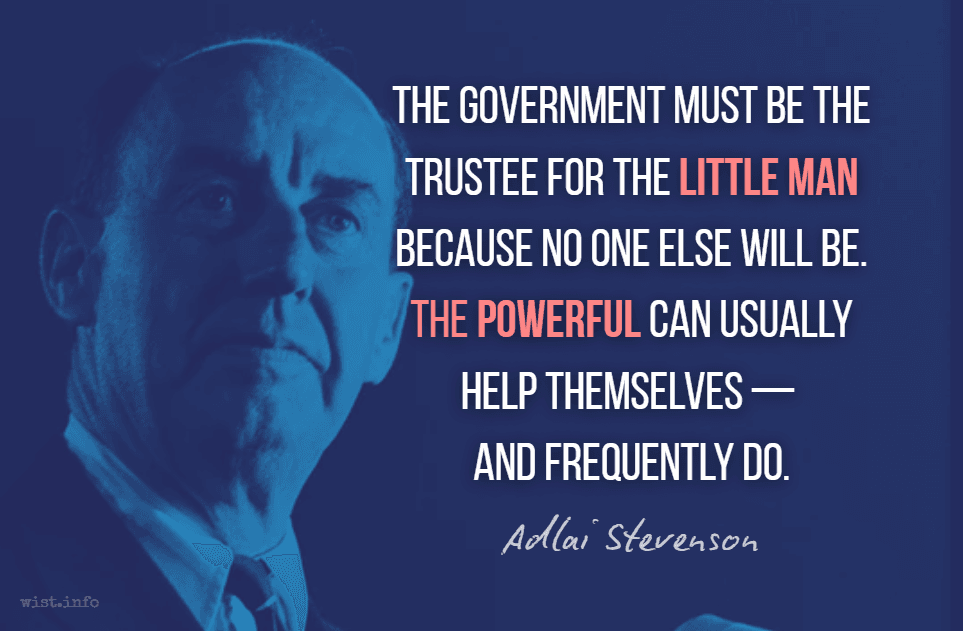
The government must be the trustee for the little man because no one else will be. The powerful can usually help themselves — and frequently do.
Adlai Stevenson (1900–1965) American diplomat, statesman
Speech (1955-10-29), “The Crisis in Agriculture,” Democratic Rally, Duluth, Minnesota
(Source)
Behind the politics of big talk and little action lies the simple fact that most of the big men who run this show want little government.
Adlai Stevenson (1900–1965) American diplomat, statesman
Speech (1955-10-29), “The Crisis in Agriculture,” Democratic Rally, Duluth, Minnesota
(Source)
I’m not an old, experienced hand at politics. But I am now seasoned enough to have learned that the hardest thing about any political campaign is how to win without proving that you are unworthy of winning.
Adlai Stevenson (1900–1965) American diplomat, statesman
Speech (1956-06-02), Fresno, California
(Source)
I cannot find a contemporary, primary report of this quotation. This the text as quoted in Herbert Joseph Muller, Adlai Stevenson : A Study in Values , ch. 8 (epigraph) (1967). It was also so quoted in memorium to Stevenson in Life Magazine (1965-07-23), citing it to 1956-06.
The speech was made in the lead-up to the California presidential primary (1956-06-05), when Stevenson was running against Estes Kefauver. The date for this speech is not confirmed, but extrapolated by the search hit of its text on the 1956-06-03 issue of the Santa Barbara News-Press (contents locked).
Some sources cite the quote as being from 1956-10-11; while it is possible Stevenson repeated the line at a later speech (in Fresno), he infamously disliked using set campaign text.
A variant of the quote is also given in The Atlanta Constitution (1956-06-19), in a Roscoe Drummond syndicated column (which can be found in other contemporary newspapers):Now I'm old and seasoned and the lesson I have learned is that the hardest thing about such a campaign is how to win without proving unworthy of winning.
If I were to attempt to put my political philosophy tonight into a single phrase, it would be this: Trust the people. Trust their good sense, their decency, their fortitude, their faith. Trust them with the facts. Trust them with the great decisions. And fix as our guiding star the passion to create a society where people can fulfill their own best selves — where no American is held down by race or color, by worldly condition or social status, from gaining what his character earns him as an American citizen, as a human being and as a child of God.
Adlai Stevenson (1900–1965) American diplomat, statesman
Speech (1956-09-13), “Democratic and Republican Administrations,” Pennsylvania Farm Show, Harrisburg
(Source)
You will find that the truth is often unpopular and the contest between agreeable fancy and disagreeable fact is unequal. For, in the vernacular, we Americans are suckers for good news.
Adlai Stevenson (1900–1965) American diplomat, statesman
Speech (1958-06-09), Commencement, Michigan State University, East Lansing
(Source)
The first principle of a free society is an untrammeled flow of words in an open forum.
Adlai Stevenson (1900–1965) American diplomat, statesman
Speech (1961-01-18), US Senate Committee on Foreign Relations, Washington, DC
(Source)
Statement given by Stevenson after his nomination by President-elect Kennedy to be ambassador to the United Nation, which office he held until his death in 1965. The speech (or this passage) is often cited to the New York Times coverage of it the following day, though often mistakenly dating it in 1962.
In context, he is addressing criticisms of the UN as a "debating society," noting that the US Congress often serves as such, from which he extends this principle.
The tragedy of our day is the climate of fear in which we live, and fear breeds repression. Too often sinister threats to the Bill of Rights, to freedom of the mind, are concealed under the patriotic cloak of anti-communism.
Adlai Stevenson (1900–1965) American diplomat, statesman
Speech, American Legion convention, New York City (27 Aug 1952)
In America any boy may become President, and I suppose it’s just one of the risks he takes.
Adlai Stevenson (1900–1965) American diplomat, statesman
Speech, Indianapolis, Indiana (26 Sep 1952)
Sometimes quoted as: "In America, anybody can be president. That's one of the risks you take."
A hungry man is not a free man.
Adlai Stevenson (1900–1965) American diplomat, statesman
Speech, Kasson, Minnesota (6 Sep 1952)
The mind is the expression of the soul, which belongs to God and must be let alone by government.
Adlai Stevenson (1900–1965) American diplomat, statesman
Speech, Mormon Tabernacle Temple, Salt Lake City (14 Oct 1952)
Those who corrupt the public mind are just as evil as those who steal from the public purse.
Adlai Stevenson (1900–1965) American diplomat, statesman
Speech, National Guard Armory, Albuquerque (12 Sep 1952)
We can chart our future clearly and wisely only when we know the path which has led to the present.
Adlai Stevenson (1900–1965) American diplomat, statesman
Speech, Richmond, Virginia (20 Sep 1952)
I profoundly believe that there is on this horizon, as yet only dimly perceived, a new dawn of conscience. In that purer light, people will come to see themselves in each other, which is to say they will make themselves known to one another by their similarities rather than by their differences. Man’s knowledge of things will begin to be matched by man’s knowledge of self. The significance of a smaller world will be measured not in terms of military advantage, but in terms of advantage for the human community. It will be the triumph of the heartbeat over the drumbeat.
Adlai Stevenson (1900–1965) American diplomat, statesman
Speech, Springfield Illinois (24 Oct 1952)
We travel together, passengers on a little spaceship, dependent on its vulnerable reserves of air and soil; all committed, for our safety, to its security and peace; preserved from annihilation only by the care, the work and the love we give our fragile craft. We cannot maintain it half fortunate, half miserable, half confident, half despairing, half slave — to the ancient enemies of man — half free in a liberation of resources undreamed of until this day. No craft, no crew can travel safely with such vast contradictions. On their resolution depends the survival of us all.
Adlai Stevenson (1900–1965) American diplomat, statesman
Speech, UN Economic and Social Council, Geneva, Switzerland (9 Jul 1965)
Ignorance is stubborn and prejudice dies hard.
Adlai Stevenson (1900–1965) American diplomat, statesman
Speech, United Nations (1 Oct 1963)
To act coolly, intelligently and prudently in perilous circumstances is the test of a man — and also a nation.
Adlai Stevenson (1900–1965) American diplomat, statesman
Wire services (11 Apr 1955)