

What vitiates nearly all that is written about antisemitism is the assumption in the writer’s mind that he himself is immune to it. “Since I know that antisemitism is irrational,” he argues, “it follows that I do not share it.” He thus fails to start his investigation in the one place where he could get hold of some reliable evidence — that is, in his own mind.
George Orwell (1903-1950) English writer [pseud. of Eric Arthur Blair]
“Antisemitism in Britain,” Contemporary Jewish Record (Apr 1945)
(Source)
Quotations by:
Orwell, George
It is not merely that “power corrupts”; so also do the ways of attaining power.
George Orwell (1903-1950) English writer [pseud. of Eric Arthur Blair]
“Arnold Koestler” (1946)
But the point is that this is a political age. A writer inevitably writes — and less directly this applies to all the arts — about contemporary events, and his impulse is to tell what he believes to be the truth. But no government, no big organization, will pay for the truth. To take a crude example: can you imagine the British Government commissioning E. M. Forster to write A Passage to India? He could only write it because he was not dependent on State aid.
George Orwell (1903-1950) English writer [pseud. of Eric Arthur Blair]
“As I Please” column, Tribune (13 Oct 1944)
(Source)
Politics is mostly non-rational; the world is suffering from some kind of mental disorder which must be diagnosed before it can be cured.
George Orwell (1903-1950) English writer [pseud. of Eric Arthur Blair]
“As I Please” column, Tribune (29 Nov 1946)
Autobiography is only to be trusted when it reveals something disgraceful. A man who gives a good account of himself is probably lying, since any life when viewed from the inside is simply a series of defeats.
George Orwell (1903-1950) English writer [pseud. of Eric Arthur Blair]
“Benefit of Clergy: Some Notes on Salvador Dali,” opening words (1944)
(Source)
Nearly all creators of Utopia have resembled the man who has toothache, and therefore thinks happiness consists in not having toothache. They wanted to produce a perfect society by an endless continuation of something that had only been valuable because it was temporary. The wider course would be to say that there are certain lines along which humanity must move, the grand strategy is mapped out, but detailed prophecy is not our business. Whoever tries to imagine perfection simply reveals his own emptiness.
George Orwell (1903-1950) English writer [pseud. of Eric Arthur Blair]
“Can Socialists Be Happy?” Tribune (20 Dec 1943) [as John Freeman]
(Source)
Men use up their lives in heart-breaking political struggles, or get themselves killed in civil wars, or tortured in the secret prisons of the Gestapo, not in order to establish some central-heated, air-conditioned, strip-lighted Paradise, but because they want a world in which human beings love one another instead of swindling and murdering one another. And they want that world as a first step. Where they go from there is not so certain, and the attempt to foresee it in detail merely confuses the issue.
George Orwell (1903-1950) English writer [pseud. of Eric Arthur Blair]
“Can Socialists Be Happy?” Tribune (20 Dec 1943) [as John Freeman]
(Source)
A thing is funny when — in some way that is not actually offensive or frightening — it upsets the established order. Every joke is a tiny revolution. … Whatever destroys dignity and brings down the mighty from their seats, preferably with a bump, is funny.
George Orwell (1903-1950) English writer [pseud. of Eric Arthur Blair]
“Funny, But Not Vulgar” (Dec 1944)
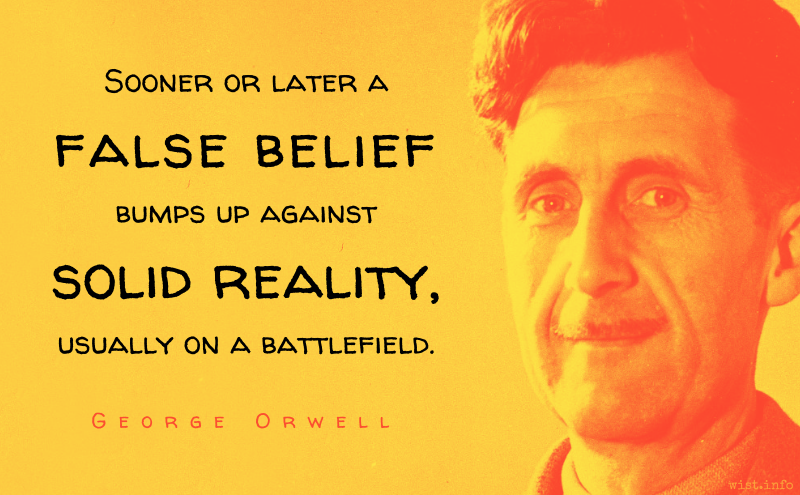
The point is that we are all capable of believing things which we know to be untrue, and then, when we are finally proved wrong, impudently twisting the facts so as to show that we were right. Intellectually, it is possible to carry on this process for an indefinite time: the only check on it is that sooner or later a false belief bumps up against solid reality, usually on a battlefield.
George Orwell (1903-1950) English writer [pseud. of Eric Arthur Blair]
“In Front of Your Nose,” Tribune (22 Mar 1946)
(Source)
To see what is in front of one’s nose needs a constant struggle.
George Orwell (1903-1950) English writer [pseud. of Eric Arthur Blair]
“In Front of Your Nose,” Tribune (22 Mar. 1946)
The point is that we are all capable of believing things which we know to be untrue, and then, when we are finally proved wrong, impudently twisting the facts so as to show that we were right.
George Orwell (1903-1950) English writer [pseud. of Eric Arthur Blair]
“In Front of Your Nose” Tribune (22 Mar 1946)
History consists of a series of swindles, in which the masses are first lured into revolt by the promise of Utopia, and then, when they have done their job, enslaved over again by the new masters.
George Orwell (1903-1950) English writer [pseud. of Eric Arthur Blair]
“James Burnham and the Managerial Revolution” (May 1946)
Summarizing Burnham's view of history.
Power-worship blurs political judgment because it leads almost unavoidably to the belief that present trends will continue. Whoever is winning at the moment will always seem invincible.
George Orwell (1903-1950) English writer [pseud. of Eric Arthur Blair]
“James Burnham and the Managerial Revolution” (May 1946)
There are families in which the father will say to his child, “You’ll get a thick ear if you do that again,” while the mother, her eyes brimming over with tears, will take the child to her arms and murmur lovingly, “Now, darling, is it kind to Mummy to do that?” And who would maintain that the second method is less tyrannous than the first?
George Orwell (1903-1950) English writer [pseud. of Eric Arthur Blair]
“Lear, Tolstoy and the Fool” (1947)
We have become too civilized to grasp the obvious. For the truth is very simple. To survive you often have to fight, and to fight you have to dirty yourself. War is evil, and it is often the lesser evil. Those who take the sword perish by the sword, and those who don’t take the sword perish by smelly diseases.
George Orwell (1903-1950) English writer [pseud. of Eric Arthur Blair]
“Looking Back on the Spanish War” (1943)
Source essay
Although endlessly brooding on power, victory, defeat, revenge, the nationalist is often somewhat uninterested in what happens in the real world. What he wants is to feel that his own unit is getting the better of some other unit, and he can more easily do this by scoring off an adversary than by examining the facts to see whether they support him.
George Orwell (1903-1950) English writer [pseud. of Eric Arthur Blair]
“Notes on Nationalism” (1945)
(Source)
By “nationalism” I mean first of all the habit of assuming that human beings can be classified like insects and that whole blocks of millions or tens of millions of people can be confidently labeled “good” or “bad.” But secondly — and this is much more important — I mean the habit of identifying oneself with a single nation or other unit, placing it beyond good and evil and recognizing no other duty than that of advancing its interests.
George Orwell (1903-1950) English writer [pseud. of Eric Arthur Blair]
“Notes on Nationalism” (May 1945)
(Source)
Nationalism is not to be confused with patriotism. Both words are normally used in so vague a way that any definition is liable to be challenged, but one must draw a distinction between them, since two different and even opposing ideas are involved. By “patriotism” I mean devotion to a particular place and a particular way of life, which one believes to be the best in the world but has no wish to force upon other people. Patriotism is of its nature defensive, both militarily and culturally. Nationalism, on the other hand, is inseparable from the desire for power. The abiding purpose of every nationalist is to secure more power and more prestige, not for himself but for the nation or other unit in which he has chosen to sink his own individuality.
George Orwell (1903-1950) English writer [pseud. of Eric Arthur Blair]
“Notes on Nationalism” (May 1945)
(Source)
All nationalists have the power of not seeing resemblances between similar sets of facts. A British Tory will defend self-determination in Europe and oppose it in India with no feeling of inconsistency. Actions are held to be good or bad, not on their own merits, but according to who does them, and there is almost no kind of outrage — torture, the use of hostages, forced labour, mass deportations, imprisonment without trial, forgery, assassination, the bombing of civilians — which does not change its moral colour when it is committed by ‘our’ side.
George Orwell (1903-1950) English writer [pseud. of Eric Arthur Blair]
“Notes on Nationalism” (May 1945)
(Source)
A nationalist is one who thinks solely, or mainly, in terms of competitive prestige. He may be a positive or a negative nationalist — that is, he may use his mental energy either in boosting or in denigrating — but at any rate his thoughts always turn on victories, defeats, triumphs and humiliations. He sees history, especially contemporary history, as the endless rise and decline of great power units, and every event that happens seems to him a demonstration that his own side is on the upgrade and some hated rival is on the downgrade.
George Orwell (1903-1950) English writer [pseud. of Eric Arthur Blair]
“Notes on Nationalism” (May 1945)
(Source)
it is important not to confuse nationalism with mere worship of success. The nationalist does not go on the principle of simply ganging up with the strongest side. On the contrary, having picked his side, he persuades himself that it is the strongest, and is able to stick to his belief even when the facts are overwhelmingly against him. Nationalism is power-hunger tempered by self-deception. Every nationalist is capable of the most flagrant dishonesty, but he is also — since he is conscious of serving something bigger than himself — unshakably certain of being in the right.
George Orwell (1903-1950) English writer [pseud. of Eric Arthur Blair]
“Notes on Nationalism” (May 1945)
(Source)
Political or military commentators, like astrologers, can survive almost any mistake, because their more devoted followers do not look to them for an appraisal of the facts but for the stimulation of nationalistic loyalties.
George Orwell (1903-1950) English writer [pseud. of Eric Arthur Blair]
“Notes on Nationalism” (May 1945)
(Source)
History is thought of largely in nationalist terms, and such things as the Inquisition, the tortures of the Star Chamber, the exploits of the English buccaneers (Sir Francis Drake, for instance, who was given to sinking Spanish prisoners alive), the Reign of Terror, the heroes of the Mutiny blowing hundreds of Indians from the guns, or Cromwell’s soldiers slashing Irishwomen’s faces with razors, become morally neutral or even meritorious when it is felt that they were done in the “right” cause. If one looks back over the past quarter of a century, one finds that there was hardly a single year when atrocity stories were not being reported from some part of the world; and yet in not one single case were these atrocities — in Spain, Russia, China, Hungary, Mexico, Amritsar, Smyrna — believed in and disapproved of by the English intelligentsia as a whole. Whether such deeds were reprehensible, or even whether they happened, was always decided according to political predilection.
George Orwell (1903-1950) English writer [pseud. of Eric Arthur Blair]
“Notes on Nationalism” (May 1945)
(Source)
The nationalist not only does not disapprove of atrocities committed by his own side, but he has a remarkable capacity for not even hearing about them. […] In nationalist thought there are facts which are both true and untrue, known and unknown. A known fact may be so unbearable that it is habitually pushed aside and not allowed to enter into logical processes, or on the other hand it may enter into every calculation and yet never be admitted as a fact, even in one’s own mind.
George Orwell (1903-1950) English writer [pseud. of Eric Arthur Blair]
“Notes on Nationalism” (May 1945)
(Source)
The primary aim of propaganda is, of course, to influence contemporary opinion, but those who rewrite history do probably believe with part of their minds that they are actually thrusting facts into the past. When one considers the elaborate forgeries that have been committed in order to show that Trotsky did not play a valuable part in the Russian civil war, it is difficult to feel that the people responsible are merely lying. More probably they feel that their own version was what happened in the sight of God, and that one is justified in rearranging the records accordingly.
George Orwell (1903-1950) English writer [pseud. of Eric Arthur Blair]
“Notes on Nationalism” (May 1945)
(Source)
I think one must engage in politics — using the word in a wide sense — and that one must have preferences: that is, one must recognise that some causes are objectively better than others, even if they are advanced by equally bad means. As for the nationalistic loves and hatreds that I have spoken of, they are part of the make-up of most of us, whether we like it or not. Whether it is possible to get rid of them I do not know, but I do believe that it is possible to struggle against them, and that this is essentially a moral effort. It is a question first of all of discovering what one really is, what one’s own feelings really are, and then of making allowance for the inevitable bias.
George Orwell (1903-1950) English writer [pseud. of Eric Arthur Blair]
“Notes on Nationalism” (May 1945)
(Source)
The general uncertainty as to what is really happening makes it easier to cling to lunatic beliefs. Since nothing is ever quite proved or disproved, the most unmistakable fact can be impudently denied.
George Orwell (1903-1950) English writer [pseud. of Eric Arthur Blair]
“Notes on Nationalism” (May 1945)
(Source)
Those who “abjure” violence can only do so because others are committing violence on their behalf.
George Orwell (1903-1950) English writer [pseud. of Eric Arthur Blair]
“Notes on Nationalism” Polemic, (Oct. 1945)
Source essay. Commonly misquoted as "People sleep peaceably in their beds at night only because rough men stand ready to do violence on their behalf." This is not found in Orwell's works, but was a paraphrase of this and other Orwell writings by Richard Grenier, "Perils of Passive Sex," Washington Times (6 Apr 1973). See here for more information.
Political language — and with variations this is true of all political parties, from Conservatives to Anarchists — is designed to make lies sound truthful and murder respectable, and to give an appearance of solidity to pure wind.
George Orwell (1903-1950) English writer [pseud. of Eric Arthur Blair]
“Politics and the English Language,” Horizon, (Apr. 1946)
The great enemy of clear language is insincerity. When there is a gap between one’s real and one’s declared aims, one turns as it were instinctively to long words and exhausted idioms, like a cuttlefish spurting out ink.
George Orwell (1903-1950) English writer [pseud. of Eric Arthur Blair]
“Politics and the English Language,” Horizon, (Apr. 1946)
A man may take to drink because he feels himself to be a failure, and then fail all the more completely because he drinks. It is rather the same thing that is happening to the English language. It becomes ugly and inaccurate because our thoughts are foolish, but the slovenliness of our language makes it easier for us to have foolish thoughts.
George Orwell (1903-1950) English writer [pseud. of Eric Arthur Blair]
“Politics and the English Language,” Horizon (Apr 1946)
(Source)
One can often be in doubt about the effect of a word or a phrase, and one needs rules that one can rely on when instinct fails. I think the following rules will cover most cases:
Never use a metaphor, simile, or other figure of speech which you are used to seeing in print.
Never use a long word where a short one will do.
If it is possible to cut a word out, always cut it out.
Never use the passive where you can use the active.
Never use a foreign phrase, a scientific word, or a jargon word if you can think of an everyday English equivalent.
Break any of these rules sooner than say anything outright barbarous.
George Orwell (1903-1950) English writer [pseud. of Eric Arthur Blair]
“Politics and the English Language,” Horizon (Apr 1946)
(Source)
A scrupulous writer, in every sentence that he writes, will ask himself at least four questions, thus: What am I trying to say? What words will express it? What image or idiom will make it clearer? Is this image fresh enough to have an effect? And he will probably ask himself two more: Could I put it more shortly? Have I said anything that is avoidably ugly?
But you are not obliged to go to all this trouble. You can shirk it by simply throwing your mind open and letting the ready-made phrases come crowding in. The will construct your sentences for you — even think your thoughts for you, to a certain extent — and at need they will perform the important service of partially concealing your meaning even from yourself.
It is at this point that the special connection between politics and the debasement of language becomes clear.
George Orwell (1903-1950) English writer [pseud. of Eric Arthur Blair]
“Politics and the English Language,” Horizon (Apr 1946)
(Source)
In our age there is no such thing as “keeping out of politics.” All issues are political issues, and politics itself is a mass of lies, evasions, folly, hatred, and schizophrenia.
George Orwell (1903-1950) English writer [pseud. of Eric Arthur Blair]
“Politics and the English Language” (Apr 1946)
Public opinion, because of the tremendous urge to conformity in gregarious animals, is less tolerant than any system of law.
George Orwell (1903-1950) English writer [pseud. of Eric Arthur Blair]
“Politics vs. Literature: An Examination of Gulliver’s Travels” (Sep-Oct 1946)
Many people genuinely do not wish to be saints, and it is probable that some who achieve or aspire to sainthood have never felt much temptation to be human beings.
George Orwell (1903-1950) English writer [pseud. of Eric Arthur Blair]
“Reflections on Gandhi” (Jan 1949)
He wears a mask, and his face grows to fit it.
George Orwell (1903-1950) English writer [pseud. of Eric Arthur Blair]
“Shooting an Elephant” (1936)
The weakness of the child is that it starts with a blank sheet. It neither understands nor questions the society in which it lives, and because of its credulity other people can work upon it, infecting it with the sense of inferiority and the dread of offending against mysterious, terrible laws.
George Orwell (1903-1950) English writer [pseud. of Eric Arthur Blair]
“Such, Such Were The Joys…” (1952)
The moral dilemma that is presented to the weak in a world governed by the strong: Break the rules or perish.
George Orwell (1903-1950) English writer [pseud. of Eric Arthur Blair]
“Such, Such Were the Joys” (1947)
The child thinks of growing old as an almost obscene calamity, which for some mysterious reason will never happen to itself. All who have pass the age of thirty five are joyless grotesques, endlessly fussing about things of no importance and staying alive without, so far as the child can see, having anything to live for. Only child life is real life.
George Orwell (1903-1950) English writer [pseud. of Eric Arthur Blair]
“Such, Such Were the Joys” (1948)
(Source)
On the whole, human beings want to be good, but not too good, and not quite all the time.
George Orwell (1903-1950) English writer [pseud. of Eric Arthur Blair]
“The Art of Donald McGill,” Horizon, London (Sep 1941)
The high sentiments always win in the end, the leaders who offer blood, toil, tears, and sweat always get more out of their followers than those who offer safety and a good time. When it comes to the pinch, human beings are heroic.
On the whole human beings want to be good, but not too good and not quite all the time.
George Orwell (1903-1950) English writer [pseud. of Eric Arthur Blair]
“The Art of of Donald McGill” (1941)
http://www.george-orwell.org/The_Art_of_Donald_McGill/0.html
From the totalitarian point of view history is something to be created rather than learned. A totalitarian state is in effect a theocracy, and its ruling caste, in order to keep its position, has to be thought of as infallible. But since, in practice, no one is infallible, it is frequently necessary to rearrange past events in order to show that this or that mistake was not made, or that this or that imaginary triumph actually happened. Then again, every major change in policy demands a corresponding change of doctrine and a revelation of prominent historical figures. This kind of thing happens everywhere, but is clearly likelier to lead to outright falsification in societies where only one opinion is permissible at any given moment. Totalitarianism demands, in fact, the continuous alteration of the past, and in the long run probably demands a disbelief in the very existence of objective truth.
George Orwell (1903-1950) English writer [pseud. of Eric Arthur Blair]
“The Prevention of Literature,” Polemic (Jan 1946)
(Source)
To write in plain, vigorous language one has to think fearlessly, and if one thinks fearlessly one cannot be politically orthodox.
George Orwell (1903-1950) English writer [pseud. of Eric Arthur Blair]
“The Prevention of Literature,” Polemic (Jan 1946)
(Source)
The Catholic and the Communist are alike in assuming that an opponent cannot be both honest and intelligent. Each of them tacitly claims that “the truth” has already been revealed, and that the heretic, if he is not simply a fool, is secretly aware of “the truth” and merely resists it out of selfish motives.
George Orwell (1903-1950) English writer [pseud. of Eric Arthur Blair]
“The Prevention of Literature” (Jan 1946)
If there is a wrong thing to do, it will be done, infallibly.
George Orwell (1903-1950) English writer [pseud. of Eric Arthur Blair]
“War-time Diary” (1941-05-18)
See Murphy's Law.
Back in the nineteen-hundreds it was a wonderful experience for a boy to discover H. G. Wells. There you were, in a world of pedants, clergymen and golfers, with your future employers exhorting you to “get on or get out”, your parents systematically warping your sexual life, and your dull-witted schoolmasters sniggering over their Latin tags; and here was this wonderful man who could tell you about the inhabitants of the planets and the bottom of the sea, and who knew that the future was not going to be what respectable people imagined.
George Orwell (1903-1950) English writer [pseud. of Eric Arthur Blair]
“Wells, Hitler, and the World State,” Horizon (Aug 1941)
(Source)
Power-worship blurs political judgement because it leads, almost unavoidably, to the belief that present trends will continue.
George Orwell (1903-1950) English writer [pseud. of Eric Arthur Blair]
(1946)
If large numbers of people believe in freedom of speech, there will be freedom of speech even if the law forbids it. But if public opinion is sluggish, inconvenient minorities will be persecuted, even if laws exist to protect them.
George Orwell (1903-1950) English writer [pseud. of Eric Arthur Blair]
(Attributed)
The secret of a successful restaurant is sharp knives.
George Orwell (1903-1950) English writer [pseud. of Eric Arthur Blair]
(Attributed)
The further a society drifts from the truth, the more it will hate those who speak it.
George Orwell (1903-1950) English writer [pseud. of Eric Arthur Blair]
(Attributed)
ALL ANIMALS ARE EQUAL
BUT SOME ANIMALS ARE MORE
EQUAL THAN OTHERSGeorge Orwell (1903-1950) English writer [pseud. of Eric Arthur Blair]
Animal Farm, ch. 10 (1946)
Four legs good, two legs bad.
George Orwell (1903-1950) English writer [pseud. of Eric Arthur Blair]
Animal Farm, ch. 3 (1945)
[T]he behaviour of the cat was somewhat peculiar. It was soon noticed that when there was work to be done the cat could never be found. She would vanish for hours on end, and then reappear at meal-times, or in the evening after work was over, as though nothing had happened. But she always made such excellent excuses, and purred so affectionately, that it was impossible not to believe in her good intentions.
George Orwell (1903-1950) English writer [pseud. of Eric Arthur Blair]
Animal Farm, ch. 3 (1945)
(Source)
Since 1930 I had seen little evidence that the USSR was progressing toward anything that one could truly call Socialism. On the contrary, I was struck by clear signs of its transformation into a hierarchical society, in which the rulers have no more reason to give up their power than any other ruling class.
George Orwell (1903-1950) English writer [pseud. of Eric Arthur Blair]
Animal Farm, Preface [Ukrainian ed.] (Mar 1947)
If liberty means anything at all, it means the right to tell people what they do not want to hear.
George Orwell (1903-1950) English writer [pseud. of Eric Arthur Blair]
Animal Farm, Unpublished Preface (1945)
The original essay was written in 1945 as an introduction to the book, but was left unpublished It was finally published as "The Freedom of the Press" in New York Times Magazine (8 Oct 1972).
There’s some devil in us that drives us to and fro on everlasting idiocies. There’s time for everything except the things worth doing. Think of something you really care about. Then add hour to hour and calculate the fraction of your life that you’ve actually spent in doing it. And then calculate the time you’ve spent on things like shaving, riding to and fro on buses, waiting in railway, junctions, swapping dirty stories, and reading the newspapers.
George Orwell (1903-1950) English writer [pseud. of Eric Arthur Blair]
Coming up for Air, ch. 5 (1939)
(Source)
He was an embittered atheist (the sort of atheist who does not so much disbeleive in God as personally dislike Him).
George Orwell (1903-1950) English writer [pseud. of Eric Arthur Blair]
Down and Out in Paris and London, ch. 30 (1933)
One of the most horrible features of war is that all the war-propaganda, all the screaming and lies and hatred, comes invariably from people who are not fighting.
George Orwell (1903-1950) English writer [pseud. of Eric Arthur Blair]
Homage to Catalonia, Appendix 1 (1938)
(Source)
Freedom is the freedom to say that two plus two make four. If that is granted, all else follows.
George Orwell (1903-1950) English writer [pseud. of Eric Arthur Blair]
Nineteen Eighty-Four, I.7 (1949)
WAR IS PEACE
FREEDOM IS SLAVERY
IGNORANCE IS STRENGTHGeorge Orwell (1903-1950) English writer [pseud. of Eric Arthur Blair]
Nineteen Eighty-Four, Part I, ch. 1 (1949)
Being in a minority, even a minority of one, did not make you insane. There was truth and there was untruth, and if you clung to the truth even against the whole world, you were not mad.
George Orwell (1903-1950) English writer [pseud. of Eric Arthur Blair]
Nineteen Eighty-Four (1949)
If the Party could thrust its hand into the past and say of this or that event, it never happened — that, surely, was more terrifying than mere torture and death? The Party said that Oceania had never been in alliance with Eurasia. He, Winston Smith, knew that Oceania had been in alliance with Eurasia as short a time as four years ago. But where did that knowledge exist? Only in his own consciousness, which in any case must soon be annihilated. And if all others accepted the lie which the Party imposed — if all records told the same tale — then the lie passed into history and became truth. “Who controls the past,” ran the Party slogan, “controls the future: who controls the present controls the past.”
George Orwell (1903-1950) English writer [pseud. of Eric Arthur Blair]
Nineteen Eighty-Four (1949)
(Source)
Sometimes paraphrased, "He who controls the past controls the future. He who controls the present controls the past."
“How can I help it?” he blubbered. “How can I help seeing what is in front of my eyes? Two and two are four.”
“Sometimes, Winston. Sometimes they are five. Sometimes they are three. Sometimes they are all of them at once. You must try harder. It is not easy to become sane.”
George Orwell (1903-1950) English writer [pseud. of Eric Arthur Blair]
Nineteen Eighty-Four (1949)
O’Brien knew everything. A thousand times better than Winston, he knew what the world was really like, in what degradation the mass of human beings lived and by what lies and barbarities the Party kept them there. He had understood it all, weighed it all, and it made no difference: all was justified by the ultimate purpose. What can you do, thought Winston, against the lunatic who is more intelligent than yourself, who gives your arguments a fair hearing and then simply persists in his lunacy?
George Orwell (1903-1950) English writer [pseud. of Eric Arthur Blair]
Nineteen Eighty-Four (1949)
(Source)
Big Brother Is Watching You.
George Orwell (1903-1950) English writer [pseud. of Eric Arthur Blair]
Nineteen Eighty-Four, 1.1 (1949)
The secret of rulership is to combine a belief in one’s infallibility with the power to learn from past mistakes.
George Orwell (1903-1950) English writer [pseud. of Eric Arthur Blair]
Nineteen Eighty-Four, 2.9 (1949)
There will be no loyalty, except loyalty toward the Party. There will be no love, except the love of Big Brother. There will be no laughter, except the laugh of triumph over a defeated enemy. … Always, at every moment, there will be the thrill of victory, the sensation of trampling on an enemy who is helpless. If you want a picture of the future, imagine a boot stamping on a human face — forever.
George Orwell (1903-1950) English writer [pseud. of Eric Arthur Blair]
Nineteen Eighty-Four, 3.3 (1949)
Power is power over human beings. Over the body — but, above all, over the mind.
George Orwell (1903-1950) English writer [pseud. of Eric Arthur Blair]
Nineteen Eighty-Four, 3.3 (1949)
At the moment, for example, in 1984 (if it was 1984), Oceania was at war with Eurasia and in alliance with Eastasia. In no public or private utterance was it ever admitted that the three powers had at any time been grouped along different lines. Actually, as Winston well knew, it was only four years since Oceania had been at war with Eastasia and in alliance with Eurasia. But that was merely a piece of furtive knowledge which he happened to possess because his memory was not satisfactorily under control. Officially, the change of partners had never happened. Oceania was at war with Eurasia: therefore Oceania had always been at war with Eurasia. The enemy of the moment always represented absolute evil, and it followed that any past or future agreement with him was impossible.
George Orwell (1903-1950) English writer [pseud. of Eric Arthur Blair]
Nineteen Eighty-Four, ch. 3 (1949)
(Source)
Orthodoxy means not thinking — not needing to think. Orthdoxy is unconsciousness.
George Orwell (1903-1950) English writer [pseud. of Eric Arthur Blair]
Nineteen Eighty-Four, Part 1, ch. 5 [Symes] (1949)
(Source)
Will you understand, Winston, that no one whom we bring to this place ever leaves our hands uncured? We are not interested in those stupid crimes you have committed. The Party is not interested in the overt act: the thought is all we care about. We do not merely destroy our enemies; we change them.
George Orwell (1903-1950) English writer [pseud. of Eric Arthur Blair]
Nineteen Eighty-Four, Part 3, ch. 4 (1949)
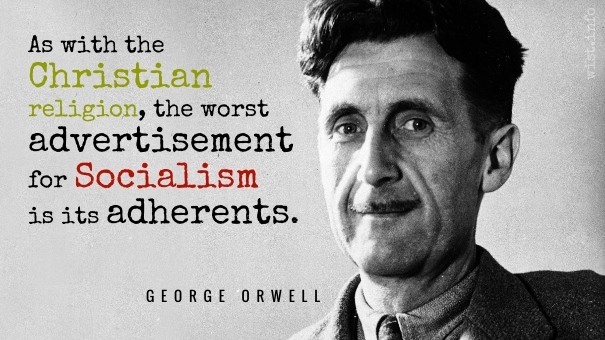
As with the Christian religion, the worst advertisement for Socialism is its adherents.
George Orwell (1903-1950) English writer [pseud. of Eric Arthur Blair]
The Road to Wigan Pier, ch. 11 (1937)
You also ask, if I think the world tendency is towards Fascism, why do I support the war. It is a choice of evils — I fancy nearly every war is that. I know enough of British imperialism not to like it, but I would support it against Nazism or Japanese imperialism, as the lesser evil. Similarly I would support the USSR against Germany because I think the USSR cannot altogether escape its past and retains enough of the original ideas of the Revolution to make it a more hopeful phenomenon than Nazi Germany. I think, and have thought ever since the war began, in 1936 or thereabouts, that our cause is the better, but we have to keep on making it the better, which involves constant criticism.
George Orwell (1903-1950) English writer [pseud. of Eric Arthur Blair]
Letter to Noel Willmett (18 May 1944)
Each generation imagines itself to be more intelligent than the one before it, and wiser than the one that comes after it.
George Orwell (1903-1950) English writer [pseud. of Eric Arthur Blair]
Review of A Coat of Many Colours: Occasional Essays by Herbert Read, Poetry Quarterly (Winter 1945)
Most books are propaganda, direct or indirect.
George Orwell (1903-1950) English writer [pseud. of Eric Arthur Blair]
Review of The Civil War in Spain by F. Jellinek (8 Jul 1938)