This is a world of compensation; and he who would be no slave must consent to have no slave. Those who deny freedom to others deserve it not for themselves, and, under a just God, cannot long retain it.
Abraham Lincoln (1809–1865) American lawyer, politician, US President (1861–65)
Letter (1859-04-06) to Henry L. Pierce, et al.
(Source)
The letter is quoted in Charles Sumner's Eulogy to Lincoln, printed in the City of Boston''s A Memorial of Abraham Lincoln, Late President of the United States (1865).
The letter was in response to an invitation from Boston for the celebration of Thomas Jefferson's birthday. Lincoln praised Jefferson, and warned against those who would "overthrow" the principles of freedom Jefferson wrote of so eloquently. Lincoln apparently saw no irony in this passage, even given Jefferson being a slave-holder.
Quotations about:
justice
Note not all quotations have been tagged, so Search may find additional quotes on this topic.

I have always found that mercy bears richer fruits than strict justice.
Abraham Lincoln (1809–1865) American lawyer, politician, US President (1861–65)
Comment (1864, Summer)
(Source)
Recalled by his long-time friend, Joseph Gillespie, regarding pardons for some army deserters, in O. Oldroyd, The Lincoln Memorial: Album-Immortelles (1882).
Often attributed to a speech in Washington (1865), but I can find nothing in his collected works or in Presidential paper collections.
To punish a man because he has committed a crime, or because he is believed, though unjustly, to have committed a crime, is not persecution. To punish a man, because we infer from the nature of some doctrine which he holds, or from the conduct of other persons who hold the same doctrines with him, that he will commit a crime, is persecution, and is, in every case, foolish and wicked.
Thomas Babington Macaulay (1800–1859) English writer and politician
“Hallam’s Constitutional History,” Edinburgh Review (Sep 1828)
(Source)
Review of Henry Hallam, The Constitutional History of England, from the Accession of Henry VII to George II (1827).

As you press on for justice, be sure to move with dignity and discipline, using only the weapon of love. Let no man pull you so low as to hate him. Always avoid violence. If you succumb to the temptation of using violence in your struggle, unborn generations will be the recipients of a long and desolate night of bitterness, and your chief legacy to the future will be an endless reign of meaningless chaos.
Martin Luther King, Jr. (1929–1968) American clergyman, civil rights leader, social activist, preacher
“The Most Durable Power,” sermon, Dexter Avenue Baptist Church (6 Nov 1956)
It is justice, not charity, that is wanting in the world!
Mary Wollstonecraft (1759–1797) English social philosopher, feminist, writer
A Vindication of the Rights of Women, ch. 4 (1792)
(Source)

In no sense do I advocate evading or defying the law, as would the rabid segregationist. That would lead to anarchy. One who breaks an unjust law must do so openly, lovingly, and with a willingness to accept the penalty. I submit that an individual who breaks a law that conscience tells him is unjust, and who willingly accepts the penalty of imprisonment in order to arouse the conscience of the community over its injustice, is in reality expressing the highest respect for law.
Martin Luther King, Jr. (1929–1968) American clergyman, civil rights leader, social activist, preacher
Letter from Birmingham Jail (16 Apr 1963)
LEAR: Through tattered clothes small vices do appear.
Robes and furred gowns hide all. Plate sin with gold,
And the strong lance of justice hurtless breaks.
Arm it in rags, a pygmy’s straw does pierce it.William Shakespeare (1564–1616) English dramatist and poet
King Lear, Act 4, sc. 6, l. 180ff (4.6.180-183) (1606)
(Source)

To see the right and not do it is cowardice.
[見義不爲、無勇也。]
Confucius (c. 551- c. 479 BC) Chinese philosopher, sage, politician [孔夫子 (Kǒng Fūzǐ, K'ung Fu-tzu, K'ung Fu Tse), 孔子 (Kǒngzǐ, Chungni), 孔丘 (Kǒng Qiū, K'ung Ch'iu)]
The Analects [論語, 论语, Lúnyǔ], Book 2, verse 24 (2.24.2) (6th C. BC – AD 3rd C.) [tr. Soothill (1910)]
(Source)
(Source (Chinese)). Other translations:To see what is right and not to do it is want of courage.
[tr. Legge (1861)]It is (moral) cowardice to leave undone what one perceives to be right to do.
[tr. Jennings (1895)]To see what is right and to act against one's judgment shows a want of courage.
[tr. Ku Hung-Ming (1898)]To see justice and not act upon it is cowardice.
[tr. Pound (1933)]To see what is right and not do it is cowardice.
[tr. Waley (1938)]It is cowardice to fail to do what is right.
[tr. Ware (1950)]Faced with what is right, to leave it undone shows a lack of courage.
[tr. Lau (1979)]To see what is right and not to do it is cowardice.
[tr. Dawson (1993)]To not act when justice commands, that is cowardice.
[tr. Leys (1997)]To see something you ought to do and not to do it is want of courage.
[tr. Huang (1997)]To see something you ought to do and not to do it is want of courage.
[tr. Huang (1997)]One does not do the righteous things when one sees them, it is not brave.
[tr. Cai/Yu (1998), #40]Failing to act on what is seen as appropriate [yi] is a want of courage.
[tr. Ames/Rosemont (1998)]If he sees what is right but does not do it, he lacks courage.
[tr. Brooks/Brooks (1998)]And to recognize a Duty without carrying it out is mere cowardice.
[tr. Hinton (1998)]To see what is right, but to fail to do it, is to be lacking in courage.
[tr. Slingerland (2003)]To see what is right and not do it is cowardly.
[tr. Watson (2007)]Faced with what is right yet doing nothing about it shows a lack of courage.
[tr. Chin (2014)]Being aloof from a righteous obligation is cowardice.
[tr. Li (2020)]

In most men love of justice is only fear of suffering injustice.
[L’amour de la justice n’est en la plupart des hommes que la crainte de souffrir l’injustice.]
François VI, duc de La Rochefoucauld (1613–1680) French epigrammatist, memoirist, noble
Réflexions ou sentences et maximes morales [Reflections; or Sentences and Moral Maxims], ¶78 (1665-1678) [tr. Tancock (1959)]
(Source)
This is thought to be a summary of the two maxims given at the bottom. When first recorded by La Rochefoucauld, it also lacked the qualifier "in most men [en la plupart des hommes]."
(Source (French)). Other translations:In the greatest part of men, [the Love of Justice] is only a fear of suffering injustice.
[tr. Davies (1669), ¶39]What the Generality of People call the Love of Justice, is only the Fear of suffering by Injustice.
[tr. Stanhope (1694), ¶79]The love of justice in most men, is the fear of suffering by injustice.
[pub. Donaldson (1783), ¶264]The love of Justice, in most men, is the fear of suffering by injustice.
[ed. Lepoittevin-Lacroix (1797), ¶75]The love of justice often means no more than the fear of suffering by injustice.
[ed. Carvill (1835), ¶452]Love of justice in the generality of men is only the fear of suffering from injustice.
[ed. Gowens (1851), ¶84]The love of justice is simply in the majority of men the fear of suffering injustice.
[tr. Bund/Friswell (1871), ¶78]In most men love of justice is but the fear of suffering injustice.
[tr. Heard (1917), ¶78]Love of justice is in most cases merely fear of suffering injustice.
[tr. Stevens (1939), ¶78]For most men the love of justice is only the fear of suffering injustice.
[tr. FitzGibbon (1957), ¶78]Love of justice, in most men, is only a fear of encountering injustice.
[tr. Kronenberger (1959), ¶78]Love of justice in most men is merely the fear of suffering injustice.
[tr. Whichello (2016), ¶78]
La Rochefoucauld seems to have distilled the following two maxims down into what became ¶78 in later editions:
¶578 (¶78 in 1665 ed.):Justice is no more than a lively fear that our belongings will be taken away from us. This is at the root of men's consideration and respect for all the interests of others, and their scrupulous care never to do them wrong. This fear keeps a man within the bounds marked out for him by his birth or fortune, and without it he would constantly be encroaching on the rights of others.
[tr. Tancock (1959)]
[La justice n’est qu’une vive appréhension qu’on ne nous ôte ce qui nous appartient ; de là vient cette considération et ce respect pour tous les intérêts du prochain, et cette scrupuleuse application à ne lui faire aucun préjudice. Cette crainte retient l’homme dans les bornes des biens que la naissance ou la fortune lui ont donnés ; et sans cette crainte, il feroit des courses continuelles sur les autres.]
(Source)
¶580 (¶90 in 1665 ed.):People hate injustice not through distaste for it but because of the harm it does them.
[tr. Tancock (1959)]
[On blâme l’injustice, non pas par l’aversion que l’on a pour elle, mais pour le préjudice que l’on en reçoit.]
(Source)

The reward of a thing well done, is to have done it.
Ralph Waldo Emerson (1803–1882) American essayist, lecturer, poet
“New England Reformers,” lecture, Boston (1844-03-03), Essays: Second Series (1844)
(Source)
Reprinted in Essays: Second Series (1844).
I would remind you that extremism in the defense of liberty is no vice. And let me remind you also that moderation in the pursuit of justice is no virtue.
Barry Goldwater (1909–1998) American politician
Speech, accepting the GOP Presidential Nomination, San Francisco (16 Jul 1964)
(Source)
Goldwater believed the phrase originated in Cicero, though the source he used is questionable. Karl Hess was Goldwater's speech writer, and he said he derived the turn of phrase from Lincoln's "House Divided" speech. A closer match is this Thomas Paine passage.
More discussion of this quotation and its origins: On the Saying that "Extremism in Defense of Liberty is No Vice" - Niskanen Center

There is no man so good that if he placed all his actions and thoughts under the scrutiny of the laws, he would not deserve hanging ten times in his life.
[Il n’est si homme de bien, qu’il mette à l’examen des loix toutes ses actions et pensées, qui ne soit pendable dix fois en sa vie.]
Michel de Montaigne (1533–1592) French essayist
Essays, Book 3, ch. 9 (3.9), “Of Vanity [De la vanité]” (1587) [tr. Frame (1943)]
(Source)
First appeared in the 1588 edition.
(Source (French)). Other translations:No man is so exquisitely honest or upright in living, but brings all his actions and thoughts within compasse and danger of the lawes; and that tenne times in his life might not lawfully be hanged.
[tr. Florio (1603)]There is no so good Man, that so squares all his Thoughts and Actions to the Laws, that he is not Faulty enough to deserve Hanging ten Times in his Life.
[tr. Cotton (1686)]There is no so good man, who so squares all his thoughts and actions to the laws, that he is not faulty enough to deserve hanging ten times in his life.
[tr. Cotton/Hazlitt (1877)]There does not exist a man of such worth that, were he to lay open to the scrutiny of the laws all his actions and thoughts, he would not deserve hanging ten times in his life.
[tr. Ives (1925)]No man is so moral but that, if he submitted his deeds and thoughts to cross-examination by the laws, he would be found worthy of hanging on ten occasions in his lifetime.
[tr. Screech (1987)]

An avidity to punish is always dangerous to liberty. It leads men to stretch, to misinterpret, and to misapply even the best of laws. He that would make his own liberty secure must guard even his enemy from oppression; for if he violates this duty he establishes a precedent that will reach to himself.
Thomas Paine (1737–1809) American political philosopher and writer
“Dissertation on the First Principles of Government” (Jul 1795)
Source essay

I cannot ask of Heaven success, even for my Country, in a Cause where she should be in the wrong — Fiat Justitia, pereat Coelum — My toast would be, may our Country be always successful, but whether successful or otherwise, always right.
John Quincy Adams (1767–1848) US President (1825–29)
Letter (1816-08-01) to John Adams
(Source)
In response to Stephen Decatur's toast (1816-04, at a dinner in Norfolk, Virginia): "Our Country! In her intercourse with foreign nations may she always be in the right, but our country, right or wrong." The last part became a common nationalistic slogan.
The Latin translates as "Let justice be done though Heaven should fall."
Under a government which imprisons any unjustly, the true place for a just man is also a prison.
Henry David Thoreau (1817–1862) American philosopher and writer
Essay (1849-05), “Resistance to Civil Government [On the Duty of Civil Disobedience],” Æsthetic Papers, No. 1, Article 10
(Source)
Based on an 1848 lecture at the Concord Lyceum.

You have been told, O mortal, what is good,
And what God requires of you:
Only to do justice
And to love goodness,
And to walk modestly with your God.הִגִּ֥יד לְךָ֛ אָדָ֖ם מַה־טּ֑וֹב וּמָֽה־יְהֹוָ֞ה דּוֹרֵ֣שׁ מִמְּךָ֗ כִּ֣י אִם־עֲשׂ֤וֹת מִשְׁפָּט֙ וְאַ֣הֲבַת חֶ֔סֶד וְהַצְנֵ֥עַ לֶ֖כֶת עִם־אֱלֹהֶֽיךָ׃ {ס}
The Bible (The Old Testament) (14th - 2nd C BC) Judeo-Christian sacred scripture [Tanakh, Hebrew Bible], incl. the Apocrypha (Deuterocanonicals)
Book 33. Micah 6: 8 (Mic 6:8) [tr. RJPS (2023 ed.)]
(Source)
(Source (Hebrew)). Other translations:He hath shewed thee, O man what is good; and what doth the LORD require of thee, but to do justly, and to love mercy, and to walk humbly with thy God?
[KJV (1611)]What is good has been explained to you, man; this is what Yahweh asks of you: only this, to act justly, to love tenderly and to walk humbly with your God.
[JB (1966)]No, the Lord has told us what is good. What he requires of us is this: to do what is just, to show constant love, and to live in humble fellowship with our God.
[GNT (1976)]You have already been told what is right and what Yahweh wants of you. Only this, to do what is right, to love loyalty and to walk humbly with your God.
[NJB (1985)]He has told you, human one, what is good and
what the Lord requires from you:
to do justice, embrace faithful love, and walk humbly with your God.
[CEB (2011)]He has told you, O mortal, what is good,
and what does the Lord require of you
but to do justice and to love kindness
and to walk humbly with your God?
[NRSV (2021 ed.)]He has shown you, O mortal, what is good.
And what does the Lord require of you?
To act justly and to love mercy
and to walk humbly with your God.
[NIV (2011 ed.)]

Ignorance of the law excuses no man; not that all men know the law, but because ’tis an excuse every man will plead, and no man can tell how to confute him.
John Selden (1584–1654) English jurist, legal scholar, antiquarian, polymath
Table Talk, § 76.2 “Law” (1689)
(Source)

True peace is not merely the absence of tension; it is the presence of justice.
Martin Luther King, Jr. (1929–1968) American clergyman, civil rights leader, social activist, preacher
Stride Toward Freedom, ch. 2 “Montgomery Before the Protest” (1958)
(Source)
Response to a Montgomery resident who complained that race relations had been so "peaceful and harmonious" before King and other protesters arrived.
Rabbi Jannai said: “It is beyond our power to explain either the prosperity of the wicked or the afflictions of the righteous.”
The Talmud (AD 200–500) Collection of Jewish rabbinical writings
The Mishnah (c. AD 200)

Every thing secret degenerates, even the administration of justice; nothing is safe that does not show how it can bear discussion and publicity.
John Dalberg, Lord Acton (1834–1902) British historian, politician, writer
Letter (1861-01-23) to Richard Simpson
(Source)
Deserves it! I daresay he does. Many that live deserve death. And some that die deserve life. Can you give it to them? then do not be too eager to deal out death in judgment. For even the very wise cannot see all ends.
J.R.R. Tolkien (1892–1973) English writer, fabulist, philologist, academic [John Ronald Reuel Tolkien]
The Lord of the Rings, Vol. 1: The Fellowship of the Ring, Book 1, ch. 2 “The Shadow of the Past” [Gandalf] (1954)
(Source)
Frodo later recounts these words (approximately) to Sam in The Two Towers.
We must believe in luck. For how else can we explain the success of those we don’t like?
Jean Cocteau (1889–1963) French writer, filmmaker, artist
Comment (1955)
On his election to Académie Française. Other translations: "Of course I believe in luck. How else does one explain the successes of one's enemies?"

The first rule is, to keep an untroubled spirit; for all things must bow to Nature’s law, and soon enough you must vanish into nothingness, like Hadrian and Augustus. The second is to look things in the face and know them for what they are, remembering that it is your duty to be a good man. Do without flinching what man’s nature demands; say what seems to you most just — though with courtesy, modesty, and sincerity.
[Τὸ πρῶτον μὴ ταράσσου: πάντα γὰρ κατὰ τὴν τοῦ ὅλου φύσιν καὶ ὀλίγου χρόνου οὐδεὶς οὐδαμοῦ ἔσῃ, ὥσπερ οὐδὲ Ἁδριανὸς οὐδὲ Αὔγουστος. ἔπειτα ἀτενίσας εἰς τὸ πρᾶγμα ἴδε αὐτὸ καὶ συμμνημονεύσας ὅτι ἀγαθόν σε ἄνθρωπον εἶναι δεῖ καὶ τί τοῦ ἀνθρώπου ἡ φύσις ἀπαιτεῖ, πρᾶξον τοῦτο ἀμεταστρεπτὶ καὶ εἰπέ, ὡς δικαιότατον φαίνεταί σοι: μόνον εὐμενῶς καὶ αἰδημόνως καὶ ἀνυποκρίτως.]
Marcus Aurelius (AD 121–180) Roman emperor (161–180), Stoic philosopher
Meditations [To Himself; Τὰ εἰς ἑαυτόν], Book 8, ch. 5 (8.5) (AD 161-180) [tr. Staniforth (1964)]
(Source)
This translation was adapted (and significantly shortened) by Norman Vincent Peale in You Can If You Think You Can (1974): "The first rule is to keep an untroubled spirit. The second is to look things in the face and know them for what they are."
Peale's paraphrase significantly changes the meaning (by removing the fatalism and the sense of duty in the face of the actions of great men from the past, and turning it into a general call for calm and clarity). Nonetheless, Peale's version of this translation shows up all over the place, and generally without reference to him.
Original Greek. Other translations:First; let it not trouble thee. For all things both good and evil come to pass according to the nature and general condition of the universe, and within a very little while, all things will be at an end; no man will be remembered: as now of Africanus (for example) and Augustus it is already come to pass. Then secondly; fix thy mind upon the thing itself; look into it, and remembering thyself, that thou art bound nevertheless to be a good man, and what it is that thy nature requireth of thee as thou art a man, be not diverted from what thou art about, and speak that which seemeth unto thee most just: only speak it kindly, modestly, and without hypocrisy.
[tr. Casaubon (1634), 8.4]In the first place , keep your self easie, for all things are govern'd by the Laws, and Order of Providence: Besides, you'l quickly go the way of all Flesh, as Augustus, Adrian, and the rest of the Emperours have done before you. Farther, Examine the matter to the bottom , and remember, that the top of your business is to be a Good Man : Therefore whatever the Dignity of Humane Nature requires of you, set about it presently , without Ifs, or Ands : And speak always according to your Conscience , but let it be done in the Terms of Good Nature and Civility.
[tr. Collier (1701)]In the first place, be not disturbed or put into confusion. All things happen according to the nature of the whole. In a little time you shall be gone, as Hadrian, and Augustus. And, then, attentively consider the nature of what occurs to you: Remember you must persist in the purpose of being a good man. Act, then, inflexibly what suits the nature of a man, and speak always what appears to you just, and yet with calm good-nature and modesty; and without Hypocrisy.
[tr. Hutcheson/Moor (1742)]Let it be a principal part of your philosophy to preserve your tranquility: for all things come to pass by the direction of Providence. And, in a few years, you yourself must leave this world, as Hadrian and Augustus have done before you.
In the next place, consider the affair in its proper light, and you will find, that your whole business here is to be a good man. Whatever teh nature of man therefore requires of you, perform it strenuously and with assiduity; and whatever justice dictates on every occasion, speak it boldly, but with good-nature, modesty, and sincerity.
[tr. Graves (1792)]This is the chief thing: Be not perturbed, for all things are according to the nature of the universal; and in a little time thou wilt be nobody and nowhere, like Hadrianus and Augustus. In the next place, having fixed thy eyes steadily on thy business, look at it, and at the same time remembering that it is thy duty to be a good man, and what man's nature demands, do that without turning aside; and speak as it seems to thee most just, only let it be with a good disposition and with modesty and without hypocrisy.
[tr. Long (1862)]In the first place, keep yourself easy, for all things are governed by the universal nature. Besides, you'll quickly go the way of all flesh, as Augustus and Hadrian have done before you. Farther, examine the matter from top to bottom, and remember that your business is to be a good man. Therefore, whatever the dignity of human nature requires of you, set about it at once, without "ifs" or "ands"; and speak always according to your conscience, but let it be done in the terms of good nature and modesty and sincerity.
[tr. Collier/Zimmern (1887)]First and foremost, keep unperturbed. For all things follow the law of Nature: and in a little while you will vanish and be nought, even as are Hadrian and Augustus. Secondly, face facts open-eyed, bearing in mind that it is your duty to be a man and to do good; what man's nature demands, that you do without swerving; so speak, as seems to you most just; only be it considerately, modestly, and with sincerity.
[tr. Rendall (1898)]Before all things, be not perturbed. Everything comes to pass as directed by universal Nature, and in a little time you will be departed and gone, like Hadrianus and Augustus. Then, scan closely the nature of what has befallen, remembering that it is your duty to be a good man. Do unflinchingly whatever man’s nature requires, and speak as seems most just, yet in kindliness, modesty, and sincerity.
[tr. Hutcheson/Chrystal (1902)]Firstly, fret not thyself, for all things are as the Nature of the Universe would have them, and within a little thou shalt be non-existent, and nowhere, like Hadrianus and Augustus. Secondly, look steadfastly at the thing, and see it as it is and, remembering withal that thou must be a good man, and what the Nature of man calls for, do this without swerving, and speak as seemeth to thee most just, only be it graciously, modestly, and without feigning.
[tr. Haines (Loeb) (1916)]In the first place, be not troubled; for all things are according to Universal Nature, and in a little while you will be no one and nowhere, even as Hadrian and Augustus are no more. Next, looking earnestly at the question, perceive its essence, and reminding yourself that your duty is to be a good man, and what it is that man's nature demands, do that without swerving, and speak the thing that appears to you to be most just, provided only that it is with kindness and modesty, and without hypocrisy
. [tr. Farquharson (1944)]First of all, be untroubled in your mind; for all things come about as universal nature would have them, and in a short while you will be no one and nowhere, as are Hadrian and Augustus. And next, keep your eyes fixed on the matter in hand and observe it well, remembering that it is your duty to be a good person, and that whatever human nature demands, you must fulfil without the slightest deviation and in the manner that seems most just to you; only do so with kindness and modesty, and without false pretences.
[tr. Hard (1997 ed.), Hard (2011 ed.)]The first step: Don't be anxious. Nature controls it all. And before long you'll be no one, nowhere -- like Hadrian, like Augustus. The second step: Concentrate on what you have to do. Fix your eyes on it. Remind yourself that your task is to be a good human being; remind yourself what nature demands of people. Then do it, without hesitation, and speak the truth as you see it. But with kindness. With humility. Without hypocrisy.
[tr. Hays (2003)]First, do not be upset: all things follow the nature of the Whole, and in a little while you will be no one and nowhere, as is true now even of Hadrian and Augustus. Next, concentrate on the matter in hand and see it for what it is. Remind yourself of your duty to be a good man and rehearse what man’s nature demands: then do it straight and unswerving, or say what you best think right. Always, though, in kindness, integrity, and sincerity.
[tr. Hammond (2006)]
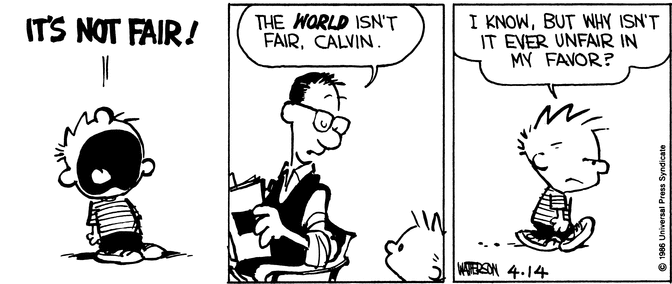
CALVIN: It’s not fair!
CALVIN’S DAD: The world isn’t fair, Calvin.
CALVIN: I know, but why isn’t it ever unfair in my favor?

It is my heart-warm and world-embracing Christmas hope and aspiration that all of us — the high, the low, the rich, the poor, the admired, the despised, the loved, the hated, the civilized, the savage — may eventually be gathered together in a heaven of everlasting rest and peace and bliss — except the inventor of the telephone.
Mark Twain (1835–1910) American writer [pseud. of Samuel Clemens]
Letter to the Editor of the New York World (23 Dec 1890)
(Source)