

A just society must strive with all its might to right wrongs even if righting wrongs is a highly perilous undertaking. But if it is to survive, a just society must be strong and resolute enough to deal swiftly and relentlessly with those who would mistake its good will for weakness.
Eric Hoffer (1902-1983) American writer, philosopher, longshoreman
First Things, Last Things, ch. 8 “Thoughts on the Present” (1971)
Quotations by:
Hoffer, Eric
We used to think that revolution is the cause of change. Actually, it is the other way around: revolution is a by-product of change. Change comes first, and it is the difficulties and irritations inherent in change that set the stage for revolution. To say that revolution is the cause of change is like saying juvenile delinquency is the cause of the change from boyhood to manhood.
Up to now, America has not been a good milieu for the rise of a mass movement. What starts out here as a mass movement ends up as a racket, a cult, or a corporation. Unlike those anywhere else, the masses in America have never despaired of the present and are not willing to sacrifice it for a new life and a new world.
Eric Hoffer (1902-1983) American writer, philosopher, longshoreman
“The Negro Revolution,” The Temper of Our Time (1967)
(Source)
Frequently misquoted as "Every great cause begins as a movement, becomes a business, and eventually degenerates into a racket."
Originally published in the New York Times Magazine (1964-11-29).
It is loneliness that makes the loudest noise. This is as true of men as of dogs.
Eric Hoffer (1902-1983) American writer, philosopher, longshoreman
“Thoughts of Eric Hoffer,” New York Times Magazine (1971-04-25)
(Source)
People who bite the hand that feeds them usually lick the boot that kicks them.
Eric Hoffer (1902-1983) American writer, philosopher, longshoreman
“Thoughts of Eric Hoffer,” New York Times Magazine (25 Apr 1971)
It is probably true that business corrupts everything it touches. It corrupts politics, sports, literature, art, labor unions and so on. But business also corrupts and undermines monolithic totalitarianism. Capitalism is at its liberating best in a noncapitalist environment.
Eric Hoffer (1902-1983) American writer, philosopher, longshoreman
“Thoughts of Eric Hoffer,” New York Times Magazine (25 Apr 1971)
Retribution often means that we eventually do to ourselves what we have done unto others.
Eric Hoffer (1902-1983) American writer, philosopher, longshoreman
“Thoughts of Eric Hoffer,” New York Times Magazine (25 Apr 1971)
There are similarities between absolute power and absolute faith: a demand for absolute obedience, a readiness to attempt the impossible, a bias for simple solutions — to cut the knot rather than unravel it, the viewing of compromise as surrender. Both absolute power and absolute faith are instruments of dehumanization. Hence, absolute faith corrupts as absolutely as absolute power.
Eric Hoffer (1902-1983) American writer, philosopher, longshoreman
“Thoughts of Eric Hoffer,” New York Times Magazine (25 Apr 1971)
It almost seems that nobody can hate America as much as native Americans. America needs new immigrants to love and cherish it.
Eric Hoffer (1902-1983) American writer, philosopher, longshoreman
“Thoughts of Eric Hoffer,” New York Times Magazine (25 Apr 1971)
We can remember minutely and precisely only the things which never really happened to us.
Eric Hoffer (1902-1983) American writer, philosopher, longshoreman
“Thoughts of Eric Hoffer,” The New York Times Magazine (25 Apr 1971)
How frighteningly few are the persons whose death would spoil our appetite and make the world seem empty.
Eric Hoffer (1902-1983) American writer, philosopher, longshoreman
“Thoughts of Eric Hoffer,” The New York Times Magazine (25 Apr 1971)
Intolerance is the “Do Not Disturb” sign on something that cannot bear touching. We do not mind having our hair ruffled, but we will not tolerate any familiarity with the toupee that covers our baldness.
Eric Hoffer (1902-1983) American writer, philosopher, longshoreman
(Attributed)
No matter what our achievements might be, we think well of ourselves only in rare moments. We need people to bear witness against our inner judge, who keeps book on our short-comings and transgressions. We need people to convince us that we are not as bad as we think we are.
Eric Hoffer (1902-1983) American writer, philosopher, longshoreman
(Attributed)
We are more ready to try the untried when what we do is inconsequential. Hence the remarkable fact that many inventions had their birth as toys.
Eric Hoffer (1902-1983) American writer, philosopher, longshoreman
(Attributed)
When cowardice becomes a fashion its adherents are without number, and it masquerades as forbearance, reasonableness and whatnot.
Eric Hoffer (1902-1983) American writer, philosopher, longshoreman
First Things, Last Things, ch. 8 “Thoughts on the Present” (1971)
A dissenter is to the absoluteness of power what an exception is to the validity of a formulated scientific rule — both must be dealt with and somehow eliminated.
Eric Hoffer (1902-1983) American writer, philosopher, longshoreman
Ordeal of Change, 15.4 (1964)
Animals often strike us as passionate machines.
Eric Hoffer (1902-1983) American writer, philosopher, longshoreman
Reflections on the Human Condition, Aphorism 7 (1973)
In a time of drastic change it is the learners who inherit the future. The learned usually find themselves equipped to live in a world that no longer exists.
Eric Hoffer (1902-1983) American writer, philosopher, longshoreman
Reflections on the Human Condition, ch. 1, § 32 (1973)
(Source)
The central task of education is to implant a will and facility for learning; it should produce not learned but learning people. The truly human society is a learning society, where grandparents, parents, and children are students together.
Eric Hoffer (1902-1983) American writer, philosopher, longshoreman
Reflections on the Human Condition, ch. 1, # 32 (1973)
(Source)
To the excessively fearful the chief characteristic of power is its arbitrariness. Man had to gain enormously in confidence before he could conceive an all-powerful God who obeys his own laws.
Eric Hoffer (1902-1983) American writer, philosopher, longshoreman
Reflections on the Human Condition, Sec. 163 (1973)
Nature has no compassion. Nature accepts no excuses and the only punishment it knows is death.
Eric Hoffer (1902-1983) American writer, philosopher, longshoreman
Reflections on the Human Condition, Sec. 36 (1973)
We take for granted the need to escape the self. Yet the self can also be a refuge. In totalitarian countries the great hunger is for private life. Absorption in the minutiae of an individual existence is the only refuge from the apocalyptic madhouse staged by maniacal saviors of humanity.
Eric Hoffer (1902-1983) American writer, philosopher, longshoreman
Reflections on the Human Condition, Sec. 55 (1973)
Our greatest weariness comes from work not done.
Eric Hoffer (1902-1983) American writer, philosopher, longshoreman
Reflections on the Human Condition, Section 178 (1973)
Nonconformists travel as a rule in bunches. You rarely find a nonconformist who goes it alone. And woe to him inside a nonconformist clique who does not conform with nonconformity.
Eric Hoffer (1902-1983) American writer, philosopher, longshoreman
Reflections on the Human Condition, Section 50 (1973)
If it is a virtue to love my neighbor as a human being, it must be a virtue — and not a vice — to love myself, since I am a human being, too.
Eric Hoffer (1902-1983) American writer, philosopher, longshoreman
The Art of Loving, 2.3d (1956)
The ruthlessness born of self-seeking is ineffectual compared with the ruthlessness sustained by dedication to a holy cause.
Eric Hoffer (1902-1983) American writer, philosopher, longshoreman
The Ordeal of Change
It needs inordinate self-confidence to face drastic change without inner trembling.
Eric Hoffer (1902-1983) American writer, philosopher, longshoreman
The Ordeal of Change (1963)
It is easier to love humanity as a whole than to love one’s neighbor. There may even be a certain antagonism between love of humanity and love of neighbor; a low capacity for getting along with those near us often goes hand in hand with a high receptivity to the idea of the brotherhood of men.
Eric Hoffer (1902-1983) American writer, philosopher, longshoreman
The Ordeal of Change, ch. 11 “Brotherhood” (1963)
Man’s only legitimate end in life is to finish God’s work — to bring to full growth the capacities and talents implanted in us.
Eric Hoffer (1902-1983) American writer, philosopher, longshoreman
The Ordeal of Change, ch. 11 (1964)
The corruption inherent in absolute power derives from the fact that such power is never free from the tendency to turn man into a thing, and press him back into the matrix of nature from which he has risen. For the impulse of power is to turn every variable into a constant, and give to commands the inexorableness and relentlessness of laws of nature. Hence absolute power corrupts even when exercised for humane purposes. The benevolent despot who sees himself as a shepherd of the people still demands from others the submissiveness of sheep. The taint inherent in absolute power is not its inhumanity but its anti-humanity.
Eric Hoffer (1902-1983) American writer, philosopher, longshoreman
The Ordeal of Change, ch. 15 “The Unnaturalness of Human Nature” (1963)
There must be in this world a task with an appeal so strong that were we to have a taste of it we would hold on and be rid for good of our restlessness.
Eric Hoffer (1902-1983) American writer, philosopher, longshoreman
The Ordeal of Change, ch. 16 (1964)
It has often been said that power corrupts. But it is perhaps equally important to realize that weakness, too, corrupts. Power corrupts the few, while weakness corrupts the many. Hatred, malice, rudeness, intolerance, and suspicion are the faults of weakness. The resentment of the weak does not spring from any injustice done to them but from the sense of inadequacy and impotence. We cannot win the weak by sharing our wealth with them. They feel our generosity as oppression. St. Vincent De Paul cautioned his disciples to deport themselves so that the poor “will forgive them the bread you give them.”
Eric Hoffer (1902-1983) American writer, philosopher, longshoreman
The Ordeal of Change, ch. 2 “The Awakening of Asia” (1963)
This passage uses phrases from his earlier work The Passionate State Of Mind, and Other Aphorisms (1955)
There is apparently no surer way of turning a thing into its opposite than by exaggerating it.
Eric Hoffer (1902-1983) American writer, philosopher, longshoreman
The Ordeal of Change, ch. 4 (1964)
Discontent is at the root of the creative process.
Eric Hoffer (1902-1983) American writer, philosopher, longshoreman
The Ordeal of Change, ch. 6 (1963)
When the intellectual comes into his own, he becomes a pillar of stability and finds all kinds of lofty reasons for siding with the strong against the weak.
Eric Hoffer (1902-1983) American writer, philosopher, longshoreman
The Ordeal of Change, ch. 6 (1964)
To believe that if we could have but this or that we would be happy is to suppress the realization that the cause of our unhappiness is in our inadequate and blemished selves. Excessive desire is thus a means of suppressing our sense of worthlessness.
Eric Hoffer (1902-1983) American writer, philosopher, longshoreman
The Passionate State of Mind, Aphorism 6 (1955)
(Source)
When people are free to do as we please, they usually imitate each other.
Eric Hoffer (1902-1983) American writer, philosopher, longshoreman
The Passionate State of Mind, Aphorism 33 (1955)
(Source)
Whenever we proclaim the uniqueness of a religion, a truth, a leader, a nation, a race, a part or a holy cause, we are also proclaiming our own uniqueness.
Eric Hoffer (1902-1983) American writer, philosopher, longshoreman
The Passionate State of Mind, Aphorism 37 (1955)
(Source)
It has often been said that power corrupts. But it is perhaps equally important to realize that weakness, too, corrupts. Power corrupts the few, while weakness corrupts the many. Hatred, malice, rudeness, intolerance, and suspicion are the faults of weakness. The resentment of the weak does not spring from any injustice done to them but from the sense of inadequacy and impotence. They hate not wickedness but weakness. When it is their power to do so, the weak destroy weakness wherever they see it.
Eric Hoffer (1902-1983) American writer, philosopher, longshoreman
The Passionate State of Mind, Aphorism 41 (1955)
(Source)
Far more crucial than what we know or do not know is what we do not want to know.
Eric Hoffer (1902-1983) American writer, philosopher, longshoreman
The Passionate State of Mind, Aphorism 58 (1955)
(Source)
The uncompromising attitude is more indicative of an inner uncertainty than of deep conviction. The implacable stand is directed more against the doubt than the assailant without.
Eric Hoffer (1902-1983) American writer, philosopher, longshoreman
The Passionate State of Mind, Aphorism 63 (1955)
(Source)
A doctrine insulates the devout not only against the realities around them but also against their own selves. The fanatical believer is not conscious of his envy, malice, pettiness and dishonesty. There is a wall of words between his consciousness and his real self.
Eric Hoffer (1902-1983) American writer, philosopher, longshoreman
The Passionate State of Mind, Aphorism 68 (1955)
(Source)
We lie loudest when we lie to ourselves.
Eric Hoffer (1902-1983) American writer, philosopher, longshoreman
The Passionate State of Mind, Aphorism 70 (1955)
(Source)
When we believe ourselves in possession of the only truth, we are likely to be indifferent to common everyday truths. Self-deception, credulity, and charlatanism are somehow linked together.
Eric Hoffer (1902-1983) American writer, philosopher, longshoreman
The Passionate State Of Mind, Aphorism 83 (1955)
(Source)
There is a powerful craving in most of us to see ourselves as instruments in the hands of others and thus free ourselves from the responsibility for acts which are prompted by our own questionable inclinations and impulses. Both the strong and the weak grasp at this alibi. The latter hide their malevolence under the virtue of obedience: they acted dishonorably because they had to obey orders. The strong, too, claim absolution by proclaiming themselves the chosen instrument of a higher power — God, history, fate, nation or humanity.
Eric Hoffer (1902-1983) American writer, philosopher, longshoreman
The Passionate State of Mind, Aphorism 85 (1955)
(Source)
When the weak want to give an impression of strength they hint meaningfully at their capacity for evil. It is by its promise of a sense of power that evil often attracts the weak.
Eric Hoffer (1902-1983) American writer, philosopher, longshoreman
The Passionate State of Mind, Aphorism 91 (1955)
(Source)
The remarkable thing is that we really love our neighbor as ourselves: we do unto others as we do unto ourselves. We hate others when we hate ourselves. We are tolerant toward others when we tolerate ourselves. We forgive others when we forgive ourselves. We are prone to sacrifice others when we are ready to sacrifice ourselves.
It is not love of self but hatred of self which is at the root of the troubles that afflict our world.
Eric Hoffer (1902-1983) American writer, philosopher, longshoreman
The Passionate State of Mind, Aphorism 100 (1955)
(Source)
The sick in soul insist that it is humanity that is sick, and they are the surgeons to operate on it. They want to turn the world into a sickroom. And once they get humanity strapped to the operating table, they operate on it with an ax.
Eric Hoffer (1902-1983) American writer, philosopher, longshoreman
The Passionate State of Mind, Aphorism 104 (1955)
(Source)
The real “haves” are they who can acquire freedom, self-confidence, and even riches without depriving others of them. They acquire all of these by developing and applying their potentialities. On the other hand, the real “have nots” are those who cannot have aught except by depriving others of it. They can feel free only by diminishing the freedom of others, self-confident by spreading fear and dependence among others, and rich by making others poor.
Eric Hoffer (1902-1983) American writer, philosopher, longshoreman
The Passionate State of Mind, Aphorism 115 (1955)
(Source)
It is futile to judge a kind deed by hits motives. Kindness can become its own motive. We are made kind by being kind.
Eric Hoffer (1902-1983) American writer, philosopher, longshoreman
The Passionate State of Mind, Aphorism 123 (1955)
(Source)
To find the cause of our ills in something outside ourselves, something specific that can be spotted and eliminated, is a diagnosis that cannot fail to appeal. To say that the cause of our troubles is not in us but in the Jews, and pass immediately to the extermination of the Jews, is a prescription likely to find a wide acceptance.
Eric Hoffer (1902-1983) American writer, philosopher, longshoreman
The Passionate State of Mind, Aphorism 126 (1955)
(Source)
Our credulity is greatest concerning the things we know least about. And since we know least about ourselves, we are ready to believe all that is said about us. Hence the mysterious power of both flattery and calumny.
Eric Hoffer (1902-1983) American writer, philosopher, longshoreman
The Passionate State of Mind, Aphorism 128 (1955)
(Source)
Compassion is probably the only antitoxin of the soul. Where there is compassion even the most poisonous impulses remain relatively harmless. One would rather see the world run by men who set their hearts on toys but are accessible to pity, than by men animated by lofty ideals whose dedication makes them ruthless. In the chemistry of man’s soul, almost all noble attributes — courage, honor, hope, faith, duty, loyalty, etc. — can be transmuted into ruthlessness. Compassion alone stands apart from the continuous traffic between good and evil proceeding within us.
Eric Hoffer (1902-1983) American writer, philosopher, longshoreman
The Passionate State of Mind, Aphorism 139 (1955)
(Source)
It is compassion rather than the principle of justice which can guard us against being unjust to our fellow men.
Eric Hoffer (1902-1983) American writer, philosopher, longshoreman
The Passionate State of Mind, Aphorism 140 (1955)
(Source)
Good judgment in our dealings with others consists not in seeing through deceptions and evil intentions but in being able to waken the decency dormant in every person.
Eric Hoffer (1902-1983) American writer, philosopher, longshoreman
The Passionate State of Mind, Aphorism 141 (1955)
(Source)
The only index by which to judge a government or a way of life is by the quality of the people it acts upon. No matter how noble the objectives of a government, if it blurs decency and kindness, cheapens human life, and breeds ill will and suspicion — it is an evil government.
Eric Hoffer (1902-1983) American writer, philosopher, longshoreman
The Passionate State of Mind, Aphorism 147 (1955)
(Source)
To become different from what we are, we must have some awareness of what we are.
Eric Hoffer (1902-1983) American writer, philosopher, longshoreman
The Passionate State of Mind, Aphorism 151 (1955)
(Source)
To have a grievance is to have a purpose in life. A grievance can almost serve as a substitute for hope; it not infrequently happens that those who hunger for hope give their allegiance to him who offers them a grievance.
Eric Hoffer (1902-1983) American writer, philosopher, longshoreman
The Passionate State of Mind, Aphorism 166 (1955)
(Source)
The basic test of freedom is perhaps less in what we are free to do than in what we are free not to do.
Eric Hoffer (1902-1983) American writer, philosopher, longshoreman
The Passionate State of Mind, Aphorism 176 (1955)
(Source)
There are many who find a good alibi far more attractive than an achievement. For an achievement does not settle anything permanently. We still have to prove our worth anew each day: we have to prove that we are as good today as we were yesterday. But when we have a valid alibi for not achieving anything we are fixed, so to speak, for life. Moreover, when we have an alibi for not writing a book, painting a picture, and so on, we have an alibi for not writing the greatest book and not painting the greatest picture. Small wonder that the effort expended and the punishment endured in obtaining a good alibi often exceed the effort and grief requisite for the attainment of a most marked achievement.
Eric Hoffer (1902-1983) American writer, philosopher, longshoreman
The Passionate State of Mind, Aphorism 181 (1955)
(Source)
Rabid suspicion has nothing in it of skepticism. The suspicious mind believes more than it doubts. It believes in a formidable and ineradicable evil lurking in every person.
Eric Hoffer (1902-1983) American writer, philosopher, longshoreman
The Passionate State of Mind, Aphorism 184 (1955)
(Source)
The real persuaders are our appetites, our fears, and above all our vanity. The skillful propagandist stirs and coaches these internal persuaders.
Eric Hoffer (1902-1983) American writer, philosopher, longshoreman
The Passionate State of Mind, Aphorism 218 (1955)
(Source)
To spell out the obvious is often to call it into question.
Eric Hoffer (1902-1983) American writer, philosopher, longshoreman
The Passionate State of Mind, Aphorism 220 (1955)
(Source)
You can discover what your enemy fears most by observing the means he uses to frighten you.
Eric Hoffer (1902-1983) American writer, philosopher, longshoreman
The Passionate State of Mind, Aphorism 222 (1955)
(Source)
We usually see only the things we are looking for — so much so that we sometimes see them where they are not.
Eric Hoffer (1902-1983) American writer, philosopher, longshoreman
The Passionate State of Mind, Aphorism 238 (1955)
(Source)
Rudeness is the weak man’s imitation of strength.
Eric Hoffer (1902-1983) American writer, philosopher, longshoreman
The Passionate State of Mind, Aphorism 241 (1955)
(Source)
Propaganda does not deceive people; it merely helps them to deceive themselves.
Eric Hoffer (1902-1983) American writer, philosopher, longshoreman
The Passionate State of Mind, Aphorism 260 (1955)
(Source)
Suffering cleanses only when it is free of resentment. Wholehearted contempt for our tormentors safeguards our soul from the mutilations of bitterness and hatred.
Eric Hoffer (1902-1983) American writer, philosopher, longshoreman
The Passionate State of Mind, Aphorism 263 (1955)
(Source)
Free men are aware of the imperfection inherent in human affairs, and they are willing to fight and die for that which is not perfect. They know that basic human problems can have no final solutions, that our freedom, justice, equality, etc. are far from absolute, and that the good life is compounded of half measures, compromises, lesser evils, and gropings toward the perfect. The rejection of approximations and the insistence on absolutes are the manifestation of a nihilism that loathes freedom, tolerance, and equity.
Eric Hoffer (1902-1983) American writer, philosopher, longshoreman
The Temper of Our Time (1967)
Glory is largely a theatrical concept. There is no striving for glory without a vivid awareness of an audience — the knowledge that our mighty deeds will come to the ears of our contemporaries or “of those who are to be.”
Eric Hoffer (1902-1983) American writer, philosopher, longshoreman
The True Believer, ch. 47 (1951)
To be effective a doctrine must not be understood, but has to be believed in. We can be absolutely certain only about things we do not understand. A doctrine that is understood is shorn of its strength.
Eric Hoffer (1902-1983) American writer, philosopher, longshoreman
The True Believer, ch. 57 (1951)
(Source)
The fanatic cannot be weaned away from his cause by an appeal to his reason or moral sense. … He cannot be convinced, but only converted.
Eric Hoffer (1902-1983) American writer, philosopher, longshoreman
The True Believer, ch. 61 (1951)
That hatred springs more from self-contempt than from a legitimate grievance is seen in the intimate connection between hatred and a guilty conscience.
Eric Hoffer (1902-1983) American writer, philosopher, longshoreman
The True Believer, ch. 69 (1951)
The most effective way to silence our guilty conscience is to convince ourselves and others that those we have sinned against are indeed depraved creatures, deserving every punishment, even extermination. We cannot pity those we have wronged, nor can we be indifferent toward them. We must hate and persecute them or else leave the door open to self-contempt.
Eric Hoffer (1902-1983) American writer, philosopher, longshoreman
The True Believer, ch. 71 (1951)
Proselytizing is more a passionate search for something not yet found than a desire to bestow upon the world something we already have. It is a search for a final and irrefutable demonstration that our absolute truth is indeed the one and only truth. The proselytizing fanatic strengthens his own faith by converting others.
Eric Hoffer (1902-1983) American writer, philosopher, longshoreman
The True Believer, ch. 88 (1951)
The opposite of the religious fanatic is not the fanatical atheist but the gentle cynic who cares not whether there is a god or not.
Eric Hoffer (1902-1983) American writer, philosopher, longshoreman
The True Believer, Part 3, ch. 13 “United Action and Self-Sacrifice” (1951)
The less justified a man is in claiming excellence for his own self, the more ready he is to claim all excellence for his nation, his religion, his race or his holy cause.
Eric Hoffer (1902-1983) American writer, philosopher, longshoreman
The True Believer, Part I, Sec 9 (1951)
A man is likely to mind his own business when it is worth minding. When it is not, he takes his mind off his own meaningless affairs by minding other people’s business.
Eric Hoffer (1902-1983) American writer, philosopher, longshoreman
The True Believer, Part I, Sec. 10 (1951)
When hopes and dreams are loose in the streets, it is well for the timid to lock doors, shutter windows and lie low until the wrath has passed. For there is often a monstrous incongruity between the hopes, however noble and tender, and the action which follows them. It is as if ivied maidens and garlanded youths were to herald the four horsemen of the apocalypse.
Eric Hoffer (1902-1983) American writer, philosopher, longshoreman
The True Believer, Part I, Sec. 5, ch. 2 “The Desire For Substitutes” (1951)
Faith in a holy cause is to a considerable extent a substitute for the lost faith in ourselves.
Eric Hoffer (1902-1983) American writer, philosopher, longshoreman
The True Believer, Part I, Sec. 8 (1951)
Unless a man has talents to make something of himself, freedom is an irksome burden. Of what avail is freedom to choose if the self be ineffectual? We join a mass movement to escape individual responsibility, or, in the words of the ardent young Nazi, “to be free from freedom.” It was not sheer hypocrisy when the rank-and-file Nazis declared themselves not guilty of all the enormities they had committed. They considered themselves cheated and maligned when made to shoulder responsibility for obeying orders. Had they not joined the Nazi movement in order to be free from responsibility?
Eric Hoffer (1902-1983) American writer, philosopher, longshoreman
The True Believer, Part II, Sec. 26 (1951)
They who clamor loudest for freedom are often the ones least likely to be happy in a free society. The frustrated, oppressed by their shortcomings, blame their failure on existing restraints. Actually, their innermost desire is for an end to the “free for all.” They want to eliminate free competition and the ruthless testing to which the individual is continually subjected in a free society.
Eric Hoffer (1902-1983) American writer, philosopher, longshoreman
The True Believer, Part II, sec. 28 (1951)
The truth seems to be that propaganda on its own cannot force its way into unwilling minds; neither can it inculcate something wholly new; nor can it keep people persuaded once they have ceased to believe. It penetrates only into minds already open, and rather than instill opinion it articulates and justifies opinions already present in the minds of its recipients. The gifted propagandist brings to a boil ideas and passions already simmering in the minds of his hearers. he echoes their innermost feelings. Where opinion is not coerced, people can be made to believe only in what they already “know.”
Eric Hoffer (1902-1983) American writer, philosopher, longshoreman
The True Believer, Part III (1951)
Self-contempt, however vague, sharpens our eyes for the imperfections of others. We usually strive to reveal in others the blemishes we hide in ourselves.
Eric Hoffer (1902-1983) American writer, philosopher, longshoreman
The True Believer, Part III, sec. 100 (1951)
Self-righteousness is a loud din raised to drown the voice of guilt within us.
Eric Hoffer (1902-1983) American writer, philosopher, longshoreman
The True Believer, Part III, Sec. 69 (1951)
Passionate hatred can give meaning and purpose to an empty life. Thus people haunted by the purposelessness of their lives try to find a new content not only by dedicating themselves to a holy cause but also by nursing a fanatical grievance. A mass movement offers them unlimited opportunities for both.
Eric Hoffer (1902-1983) American writer, philosopher, longshoreman
The True Believer, Part III, sec. 75 (1951)
The frustrated follow a leader less because of their faith that he is leading them to a promised land than because of their immediate feeling that he is leading them away from their unwanted selves. Surrender to a leader is not a means to an end but a fulfillment. Whither they are led is of secondary importance.
Eric Hoffer (1902-1983) American writer, philosopher, longshoreman
The True Believer, Part III, sec. 94 (1951)
Our frustration is greater when we have much and want more than when we have nothing and want some. We are less dissatisfied when we lack many things than when we seem to lack but one thing.
Eric Hoffer (1902-1983) American writer, philosopher, longshoreman
True Believer: Thoughts on the Nature of Mass Movements, Part 2, ch. 4, § 23 (1951)
(Source)
The fiercest fanatics are often selfish people who were forced, by innate shortcomings or external circumstances, to lose faith in their own selves. They separate the excellent instrument of their selfishness from their ineffectual selves and attach it to the service of some holy cause. And though it be a faith of love and humility they adopt, they can be neither loving nor humble.
Eric Hoffer (1902-1983) American writer, philosopher, longshoreman
True Believer: Thoughts on the Nature of Mass Movements, Part 2, ch. 7, § 38 (1951)
(Source)
Though they seem at opposite poles, fanatics of all kinds are actually crowded together at one end. It is the fanatic and the moderate who are poles apart and never meet. The fanatics of various hues eye each other with suspicion and are ready to fly at each other’s throat. But they are neighbors and almost of one family. They hate each other with the hatred of brothers.
Eric Hoffer (1902-1983) American writer, philosopher, longshoreman
True Believer: Thoughts on the Nature of Mass Movements, Part 3, ch. 13, § 62 (1951)
(Source)
The Americans are poor haters in international affairs because of their innate feeling of superiority over all foreigners. An American’s hatred for a fellow American (for Hoover or Roosevelt) is far more virulent than any antipathy he can work up against foreigners. […] Should Americans begin to hate foreigners wholeheartedly, it will be an indication that they have lost confidence in their own way of life.
Eric Hoffer (1902-1983) American writer, philosopher, longshoreman
True Believer: Thoughts on the Nature of Mass Movements, Part 3, ch. 14, § 73 (1951)
(Source)
There is also this: when we renounce the self and become part of a compact whole, we not only renounce personal advantage but are also rid of personal responsibility. There is no telling to what extremes of cruelty and ruthlessness a man will go when he is freed from the fears, hesitations, doubts and the vague stirrings of decency that go with individual judgement. When we lose our individual independence in the corporateness of a mass movement, we find a new freedom — freedom to hate, bully, lie, torture, murder and betray without shame and remorse. Herein undoubtedly lies part of the attractiveness of a mass movement.
Eric Hoffer (1902-1983) American writer, philosopher, longshoreman
True Believer: Thoughts on the Nature of Mass Movements, Part 3, ch. 14, § 77 (1951)
(Source)
Propaganda thus serves more to justify ourselves than to convince others; and the more reason we have to feel guilty, the more fervent our propaganda.
Eric Hoffer (1902-1983) American writer, philosopher, longshoreman
True Believer: Thoughts on the Nature of Mass Movements, Part 3, ch. 14, § 84 (1951)
(Source)
The practice of terror serves the true believer not only to cow and crush his opponents but also to invigorate and intensify his own faith.
Eric Hoffer (1902-1983) American writer, philosopher, longshoreman
True Believer: Thoughts on the Nature of Mass Movements, Part 3, ch. 14, § 85 (1951)
(Source)
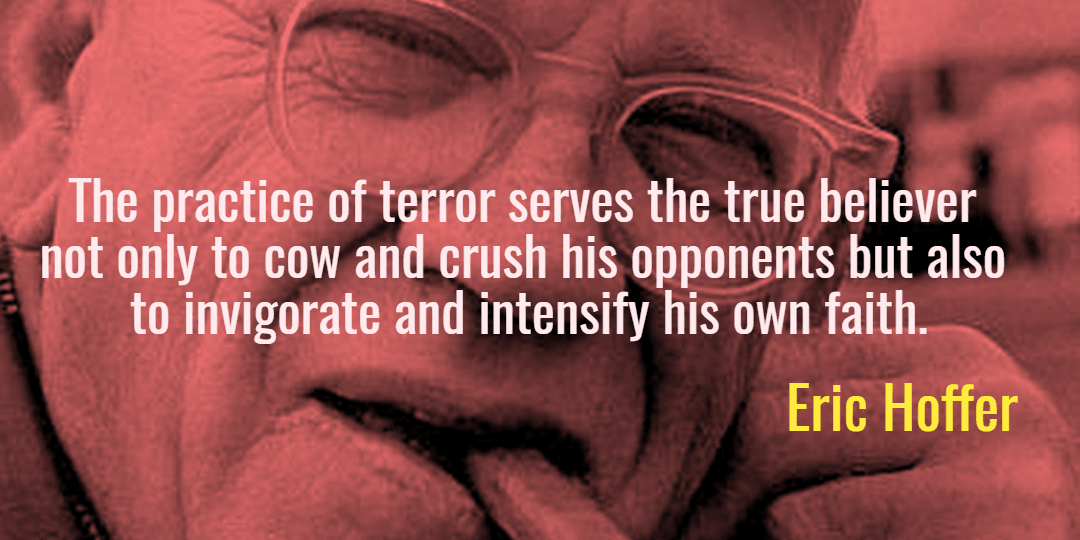
The awareness of their individual blemishes and shortcomings inclines the frustrated to detect ill will and meanness in their fellow men. Self-contempt, however vague, sharpens our eyes for the imperfections of others. We usually strive to reveal in others the blemishes we hide in ourselves.
Eric Hoffer (1902-1983) American writer, philosopher, longshoreman
True Believer: Thoughts on the Nature of Mass Movements, Part 3, ch. 14, § 100 (1951)
(Source)
Mass movements can rise and spread without belief in a God, but never without belief in a devil.
Eric Hoffer (1902-1983) American writer, philosopher, longshoreman
True Believer: Thoughts on the Nature of Mass Movements, Part 3, ch. 15, § 65 (1951)
(Source)
You accept certain unlovely things about yourself and manage to live with them. The atonement for such an acceptance is that you make allowances for others — that you cleanse yourself of the sin of self-righteousness.
Eric Hoffer (1902-1983) American writer, philosopher, longshoreman
Working and Thinking on the Waterfront (1969)
A society that refuses to strive for superfluities is likely to end up lacking in necessities. The readiness to work springs from trivial, questionable motives.
Eric Hoffer (1902-1983) American writer, philosopher, longshoreman
Working and Thinking on the Waterfront (1969)
The significant point is that people unfit for freedom — who cannot do much with it — are hungry for power. The desire for freedom is an attribute of a “have” type of self. It says: leave me alone and I shall grow, learn, and realize my capacities. The desire for power is basically an attribute of a “have-not” type of self. If Hitler had had the talents and the temperament of a genuine artist, if Stalin had had the capacity to become a first-rate theoretician, if Napoleon had had the makings of a great poet or philosopher they would hardly have developed the all-consuming lust for absolute power.
Freedom gives us a chance to realize our human and individual uniqueness. Absolute power can also bestow uniqueness: to have absolute power is to have the power to reduce all the people around us to puppets, robots, toys, or animals, and be the only man in sight. Absolute power achieves uniqueness by dehumanizing others.To sum up: Those who lack the capacity to achieve much in an atmosphere of freedom will clamor for power.
Eric Hoffer (1902-1983) American writer, philosopher, longshoreman
Working and Thinking on the Waterfront, Journal entry (28 March 1959)(1969)
How terribly hard and almost impossible it is to tell the truth. More than anything else, the artist in us prevents us from telling aught as it really happened. We deal with the truth as the cook deals with meat and vegetables.
Eric Hoffer (1902-1983) American writer, philosopher, longshoreman
Entry (1954) in “Eric Hoffer and the Art of the Notebook” by Tom Bethell, Harper’s Magazine (July 2005)
A multitude of words is probably the most formidable means of blurring and obscuring thought. There is no thought, however momentous, that cannot be expressed lucidly in 200 words.
Eric Hoffer (1902-1983) American writer, philosopher, longshoreman
Entry (1954) in “Eric Hoffer and the Art of the Notebook” by Tom Bethell, Harper’s Magazine (July 2005)
Our doubts about ourselves cannot be banished except by working at that which is the one and only thing we know we ought to do. Other people’s assertions cannot silence the howling dirge within us. It is our talents rusting unused within us that secrete the poison of self-doubt into our bloodstream.
Eric Hoffer (1902-1983) American writer, philosopher, longshoreman
Entry (1955) in “Eric Hoffer and the Art of the Notebook” by Tom Bethell, Harper’s Magazine (July 2005)
We are ready to die for an opinion but not for a fact: indeed, it is by our readiness to die that we try to prove the factualness of our opinion.
Eric Hoffer (1902-1983) American writer, philosopher, longshoreman
Entry (1955) in “Eric Hoffer and the Art of the Notebook” by Tom Bethell, Harper’s Magazine (July 2005)
Good writing, like gold, combines lustrous lucidity with high density. What this means is good writing is packed with hints.
Eric Hoffer (1902-1983) American writer, philosopher, longshoreman
Entry (1957) in “Eric Hoffer and the Art of the Notebook” by Tom Bethell, Harper’s Magazine (July 2005)
Some people have no original ideas because they do not think well enough of themselves to consider their ideas worth noticing and developing.
Eric Hoffer (1902-1983) American writer, philosopher, longshoreman
Entry (1967) in “Eric Hoffer and the Art of the Notebook” by Tom Bethell, Harper’s Magazine (July 2005)
There is not an idea that cannot be expressed in 200 words. But the writer must know precisely what he wants to say. If you have nothing to say and want badly to say it, then all the words in all the dictionaries will not suffice.
Eric Hoffer (1902-1983) American writer, philosopher, longshoreman
Letter to Mrs. Blumberg (27 Sep 1977)
Wordiness is a sickness of American writing. Too many words dilute and blur ideas.
Eric Hoffer (1902-1983) American writer, philosopher, longshoreman
Letter to Mrs. Blumberg (27 Sep 1977)
The sense of worth derived from creative work depends upon “recognition” by others, which is never automatic. As a result, the path of self-realization, even when it is the only open one, is taken with reluctance. Men of talent have to be goaded to engage in creative work. The groans and laments of even the most gifted and prolific echo through the ages.
Eric Hoffer (1902-1983) American writer, philosopher, longshoreman
Notebook Entry (1953)
In "Eric Hoffer and the Art of the Notebook" by Tom Bethell, Harper's Magazine (July 2005).
In products of the human mind, simplicity marks the end of a process of refining, while complexity marks a primitive stage. Michelangelo’s definition of art as the purgation of superfluities suggests that the creative effort consists largely in the elimination of that which complicates and confuses a pattern.
Eric Hoffer (1902-1983) American writer, philosopher, longshoreman
Notebook Entry (1954)
In "Eric Hoffer and the Art of the Notebook" by Tom Bethell, Harper's Magazine (July 2005)