

Where the environment is stupid or prejudiced or cruel, it is a sign of merit to be out of harmony with it.
Bertrand Russell (1872-1970) English mathematician and philosopher
Conquest of Happiness, Part 1, ch. 9 “Fear of Public Opinion” (1930)
(Source)
Quotations about:
cruelty
Note not all quotations have been tagged, so Search may find additional quotes on this topic.


Man is subject to innumerable pains and sorrows by the very condition of humanity, and yet, as if nature had not sown evils enough in life, we are continually adding grief to grief, and aggravating the common calamity by our cruel treatment of one another.
Joseph Addison (1672-1719) English essayist, poet, statesman
Essay (1711-09-13), The Spectator, No. 169
(Source)

O Fortune, cruellest of heavenly powers,
Why make such game of this poor life of ours?[Heu, Fortuna, quis est crudelior in nos
Te Deus? Ut semper gaudes illudere rebus
Humanis!]Horace (65–8 BC) Roman poet, satirist, soldier, politician [Quintus Horatius Flaccus]
Satires [Saturae, Sermones], Book 2, # 8, “Ut Nasidieni,” l. 61ff (2.8.61-63) (30 BC) [tr. Conington (1874)]
(Source)
When "disaster" befalls the dinner party of Nasidienus (Rufus), Nomentanus tries to snap him out of a funk by philosophically / melodramatically bemoaning how Fortune treats humanity.
(Source (Latin)). Alternate translations:Some mourne and blame their sorie fate, why Fortune shoulde be suche,
That they suche blouddes shoulde nothinge have, and others overmuche.
[tr. Drant (1567)]Fortune our Foe, thou art a scurvy Puss!
Ah what a cruel Vixen th' art! ah how
Do'st thou delight to mock us here below!
[tr. I. W. Esq.; ed. Brome (1666)]Unlucky Chance what God is so unkind,
Thou lov'st to break the measures Man design'd.
[tr. Creech (1684)]Fortune, thou cruelest of powers divine,
To joke poor mortals is a joke of thine.
[tr. Francis (1747)]Ah cruel Fortune, foe to human bliss!
Invidious power, it seems thy sole delight
All our enjoyments in the bud to blight.
[tr. Howes (1845)]Alas! O fortune, what god is more cruel to us than thou? How dost thou always take pleasure in sporting with human affairs!
[tr. Smart/Buckley (1853)]O Fortune, what divinity so cruel against us as thou? What joy to thee 'tis ever to frustrate the plans of men!
[tr. Millington (1870)]Ah Fortune, what divine power is more cruel towards us than thou! How thou delightest ever to make sport of human affairs!
[tr. Wickham (1903)]Ah, Fortune, what god is more cruel toward us than thou! How thou dost ever delight to make sport of the life of man!
[tr. Fairclough (Loeb) (1926)]Oh, Fortune, what god
Is more cruel to us than you are! You always have fun
Making fun of mankind!
[tr. Palmer Bovie (1959)]Ah, Fortune! What god more cruel to us than you?
You always like to play around with mankind’s hopes!
[tr. Fuchs (1977)]Ah, Fortune! Is there a crueler god?
How you love to toy with us, playing with our lives!
[tr. Raffel (1983)]What god,
O Fortune, is more cruel toward us than Thou?
How you rejoice in upsetting man’s hopes!
[tr. Alexander (1999)]Fortune, most cruel of all the gods, what
would you do for laughs without us humans?
[tr. Matthews (2002)]Shame on you Lady Luck!
No other god is so cruel. What pleasure you get from mocking
the plans of men!
[tr. Rudd (2005 ed.)]O Fortune, what deity treats us more
Cruelly than you? How you always delight in mocking
Human affairs!
[tr. Kline (2015)]
In civilised life domestic hatred usually expresses itself by saying things which would appear quite harmless on paper (the words are not offensive) but in such a voice, or at such a moment, that they are not far short of a blow in the face.
C. S. Lewis (1898-1963) English writer, literary scholar, lay theologian [Clive Staples Lewis]
The Screwtape Letters, Letter 3 (1942)
(Source)

Who can estimate the misery that has been caused by this most infamous doctrine of eternal punishment? Think of the lives it has blighted — of the tears it has caused — of the agony it has produced. Think of the millions who have been driven to insanity by this most terrible of dogmas. This doctrine renders God the basest and most cruel being in the universe. Compared with him, the most frightful deities of the most barbarous and degraded tribes are miracles of goodness and mercy. There is nothing more degrading than to worship such a god. Lower than this the soul can never sink. If the doctrine of eternal damnation is true, let me share the fate of the unconverted; let me have my portion in hell, rather than in heaven with a god infamous enough to inflict eternal misery upon any of the sons of men.
Robert Green Ingersoll (1833-1899) American lawyer, freethinker, orator
Lecture (1874-05-03), “Heretics and Heresies,” Free Religious Society, Kingsbury Hall, Chicago
(Source)
Collected in The Gods and Other Lectures (1876).

OPHELIA:Their perfume lost,
Take these again, for to the noble mind
Rich gifts wax poor when givers prove unkind.William Shakespeare (1564-1616) English dramatist and poet
Hamlet, Act 3, sc. 1, ll. 108 (3.1.109-110) (c. 1600)
(Source)
Returning to Hamlet gifts he gave her in the past.

It is my belief that no crime, however cowardly and however shameless and cruel, can be imagined which there isn’t somebody in Christendom willing to commit.
Mark Twain (1835-1910) American writer [pseud. of Samuel Clemens]
Autobiographical Dictation (1908-06-26)
(Source)
Published in Autobiography of Mark Twain, Vol. 3 (2015).
He was about to urge her to let well alone and trust heaven to do justice, but then he had a sudden vision of heaven’s justice as the Church sometimes applied it, in good but dreadful faith, with all the virtuous narrowness and pitilessness of minds blind and deaf to the infinite variety of humankind, its failings, and aspirations, and needs, and forgetful of all the Gospel reminders concerning publicans and sinners.
Ellis Peters (1913-1995) English writer, translator [pseud. of Edith Mary Pargeter, who also wrote under the names John Redfern, Jolyon Carr, Peter Benedict]
The Holy Thief, ch. 11 (1992)
(Source)

There is no cruelty so inexorable and unrelenting, as that which proceeds from a bigoted and presumptuous supposition of doing service to God. Under the influence of such hallucination, all common modes of reasoning are perverted, and all general principles are destroyed.
Charles Caleb "C. C." Colton (1780-1832) English cleric, writer, aphorist
Lacon: Or, Many Things in Few Words, Vol. 1, § 222 (1820)
(Source)

It is from the Bible that man has learned cruelty, rapine, and murder; for the belief of a cruel God makes a cruel man.
Thomas Paine (1737-1809) American political philosopher and writer
Letter (1797-05-12), “An Answer to a Friend” concerning The Age of Reason (1794)
(Source)
Sometimes paraphrased: "Belief in a cruel God makes a cruel man."

Cruel and savage as orthodoxies have always proved to be, the faithful seem able to convince themselves that the heretics, as they continue to crop up, get nothing worse than their due, and to rest with an easy conscience.
Learned Hand (1872-1961) American jurist
Speech (1955-01-29), “A Fanfare for Prometheus,” American Jewish Committee annual dinner, New York City
(Source)

We are afraid of having and showing a small mind, and we are not afraid of having and showing a small heart.
Joseph Joubert (1754-1824) French moralist, philosopher, essayist, poet
Pensées [Thoughts], 1805 entry [tr. Auster (1983)]
(Source)
I could not find an analog in other translations of the Pensées.

GLOUCESTER: As flies to wanton boys are we to th’ gods;
They kill us for their sport.William Shakespeare (1564-1616) English dramatist and poet
King Lear, Act 4, sc. 1, l. 41ff (4.1.41-42) (1606)
(Source)
It is the certainty that they possess the truth that makes men cruel.
[C’est la certitude qu’ils tiennent la vérité qui rend les hommes cruels.]
Anatole France (1844-1924) French poet, journalist, novelist, Nobel Laureate [pseud. of Jaques-Anatole-François Thibault]
(Misquotation)
Widely attributed (in French and English) to Anatole France, but not found in his works, including the one location it is sometimes cited from, Les Dieux Ont Soif [The Gods Are Thirsty, The Gods Are Athirst, The Gods Will Have Blood] (1912), in either English translation or, more importantly, in the original French.
While thematically keeping in the novel's depiction of the French Revolution and the Terror, the closest match to the quote I can find is this portion of ch. 22, talking about the expediting of the trials of those charged with counter-revolutionary crimes, eliminating the need to prove a misdeed by simply inquiring as to the accused's beliefs.Justice thus abbreviated satisfied them; the pace was quickened, and no obstacles were left to fret them. They limited themselves to an inquiry into the opinions of the accused, not conceiving it possible that anyone could think differently from themselves except in pure perversity. Believing themselves the exclusive possessors of truth, wisdom, the quintessence of good, they attributed to their opponents noting but error and evil. They felt themselves all-powerful; they envisaged God.
[tr. Allinson (1913), Jackson (1921)]Justice, thus curtailed, satisfied them; the pace was quickened and no obstacles were left to confuse them. They confined themselves to inquiring into the opinions of the accused, not conceiving it possible that anyone, except from pure perversity, could think differently from themselves. Believing themselves to possess a monopoly of truth, wisdom and goodness, they attributed to their opponents all error, stupidity and evil. They felt themselves omnipotent: their eyes had seen God.
[tr. Davies (1979)]La justice abrégée les contentait. Rien, dans sa marche accélérée, ne les troublait plus. Ils s’enquéraient seulement des opinions des accusés, ne concevant pas qu’on pût sans méchanceté penser autrement qu’eux. Comme ils croyaient posséder la vérité, la sagesse, le souverain bien, ils attribuaient à leurs adversaires l’erreur et le mal. Ils se sentaient forts : ils voyaient Dieu.
[Original]

Among the lessons taught by the French Revolution, there is none sadder or more striking than this — that you may make everything else out of the passions of men except a political system that will work, and that there is nothing so pitilessly and unconsciously cruel as sincerity formulated into dogma.
James Russell Lowell (1819-1891) American diplomat, essayist, poet
“Abraham Lincoln” (1864), My Study Windows (1871)
(Source)

My favorite word is “redemption.” I like both its meaning and the sound. My least favorite word is “maybe.” “Maybe” is almost always a “no” drawn out in cruel fashion.
Martha Elizabeth "Libba" Bray (b. 1964) American writer
“Twenty-One Things You Don’t Know About Me,” No. 4
(Source)
In her Amazon.com author biography.

A certain combination of incompetence and indifference can cause almost as much suffering as the most acute malevolence.
Bruce Catton (1899-1978) American historian and journalist
A Stillness at Appomattox (1953)
(Source)
Regarding prison camps during the US Civil War.

Crowley had always known that he would be around when the world ended, because he was immortal and wouldn’t have any alternative. But he hoped it was a long way off.
Because he rather liked people.
It was major failing in a demon. Oh, he did his best to make their short lives miserable, because that was his job, but nothing he could think up was half as bad as the stuff they thought up themselves. They seemed to have a talent for it. It was built into the design, somehow. They were born into a world that was against them in a thousand little ways, and then devoted most of their energies to making it worse. Over the years Crowley had found it increasingly difficult to find anything demonic to do which showed up against the natural background of generalized nastiness. There had been times, over the past millennium, when he’d felt like sending a message back Below saying, Look we may as well give up right now, we might as well shut down Dis and Pandemonium and everywhere and move up here, there’s nothing we can do to them that they don’t do to themselves and they do things we’ve never even thought of, often involving electrodes. They’ve got what we lack. They’ve got imagination. And electricity, of course.
One of them had written it, hadn’t he … “Hell is empty, and all the devils are here.”Terry Pratchett (1948-2015) English author
Good Omens, 2. “Eleven Years Ago” (1990) [with Neil Gaiman]
(Source)
The quote is from Shakespeare, The Tempest.

Christ by his crucifixion demonstrated exactly what the assault of cruelty on the innocent means; and the subsequent services devised by the early church commemorated the beauty of the virtue that was slain and the beastliness shown by the slayer, and reiterated the warning that this was the kind of crime man was inherently likely to commit unless he watched himself. There could be no more proper medicine for the human disease. But the church has poured as much of the draft as possible down the drain by its attempts to account for the crucifixion of Christ as an atonement for the sins of man instead of a demonstration of them.
Rebecca West (1892-1983) British author, journalist, literary critic, travel writer [pseud. for Cicily Isabel Fairfield]
“Pleasure Be Your Guide,” The Nation, “Living Philosophies” series #10 (25 Feb 1939)
(Source)
Adapted into Clifton Fadiman, I Believe: The Personal Philosophies of Certain Eminent Men and Women of Our Time (1952).

Out of instinct for self-preservation, and logically enough, [the mind] asks, “If it is a good and holy thing to be punished, must it not also be a good and holy thing to punish?” It answers that it is; and our earth becomes the hell it is. Thus we human beings plant in ourselves the perennial blossom of cruelty — the conviction that if we hurt other people we are doing good to ourselves and to life in general.
Rebecca West (1892-1983) British author, journalist, literary critic, travel writer [pseud. for Cicily Isabel Fairfield]
“Pleasure Be Your Guide,” The Nation, “Living Philosophies” series #10 (25 Feb 1939)
(Source)
Adapted into Clifton Fadiman, I Believe: The Personal Philosophies of Certain Eminent Men and Women of Our Time (1952).
But indeed we need no further argument in favor of taking pleasure as a standard when we consider the only alternative that faces us. If we do not live for pleasure we shall soon find ourselves living for pain. If we do not regard as sacred our own joys and the joys of others, we open the door and let into life the ugliest attribute of the human race, which is cruelty.
Rebecca West (1892-1983) British author, journalist, literary critic, travel writer [pseud. for Cicily Isabel Fairfield]
“Pleasure Be Your Guide,” The Nation, “Living Philosophies” series #10 (25 Feb 1939)
(Source)
Adapted into Clifton Fadiman, I Believe: The Personal Philosophies of Certain Eminent Men and Women of Our Time (1952).
I don’t think we injye other people’s suffin’, Hinnissy. It isn’t acshally injyement. But we feel betther f’r it.
[I don’t think we enjoy other people’s suffering, Hennessy. It isn’t actually enjoyment. But we feel better for it.]
Finley Peter Dunne (1867-1936) American humorist and journalist
Observations by Mr. Dooley, “Enjoyment” (1902)
(Source)

Where does discipline end? Where does cruelty begin? Somewhere between these, thousands of children inhabit a voiceless hell.
[Où finit la correction? Où commence le martyre? Dans l’entre-deux, des milliers d’enfants peuplent un enfer qui ne fait pas de bruit.]
François Mauriac (1885-1970) French author, critic, journalist
Second Thoughts: Reflections on Literature and on Life (1961) [tr. Foulke]

For nothing is more blamefull to a Knight,
That court’sie doth as well as armes professe,
However strong and fortunate in fight,
Then the reproch of pride and cruelnesse:
In vain he seeketh others to suppresse,
Who hath not learned himself first to subdue:
All flesh is frayle and full of ficklenesse,
Subject to fortunes chance, still chaunging new;
What haps to-day to me to-morrow may to you.Edmund Spenser (c. 1552-1599) English poet
The Faerie Queene, Book 6, canto 1, st. 41 (1590-96)
(Source)

I’ve seen the meanness of humans till I don’t know why God ain’t put out the sun and gone away.
Cormac McCarthy (1933-2023) American novelist, playwright, screenwriter
Outer Dark, ch. 17 (1968)
(Source)
We call them dumb animals, and so they are, for they cannot tell us how they feel, but they do not suffer less because they have no words.
Anna Sewell (1820-1878) English novelist
Black Beauty, Part 4, ch. 36 “Jakes and the Lady” (1877)
(Source)

There lies at the back of every creed something terrible and hard for which the worshipper may one day be required to suffer.
E. M. Forster (1879-1970) English novelist, essayist, critic, librettist [Edward Morgan Forster]
“What I Believe,” The Nation (16 Jul 1938)
(Source)
It can truly be said: Men are the devils of the earth, and the animals are the tormented souls.
[Man möchte wahrlich sagen: die Menschen sind die Teufel der Erde und die Tiere die geplagten Seelen]
Arthur Schopenhauer (1788-1860) German philosopher
Parerga and Paralipomena, Vol. 2, ch. 15 “On Religion [Ueber Religion], § 179 “The Christian System [Über das Christenthum]” (1851) [tr. Hollingdale (1970)]
(Source)
(Source (German)). Alternate translation:One might say with truth, Mankind are the devils of the earth, and the animals the souls they torment.
[tr. Saunders (1890)]

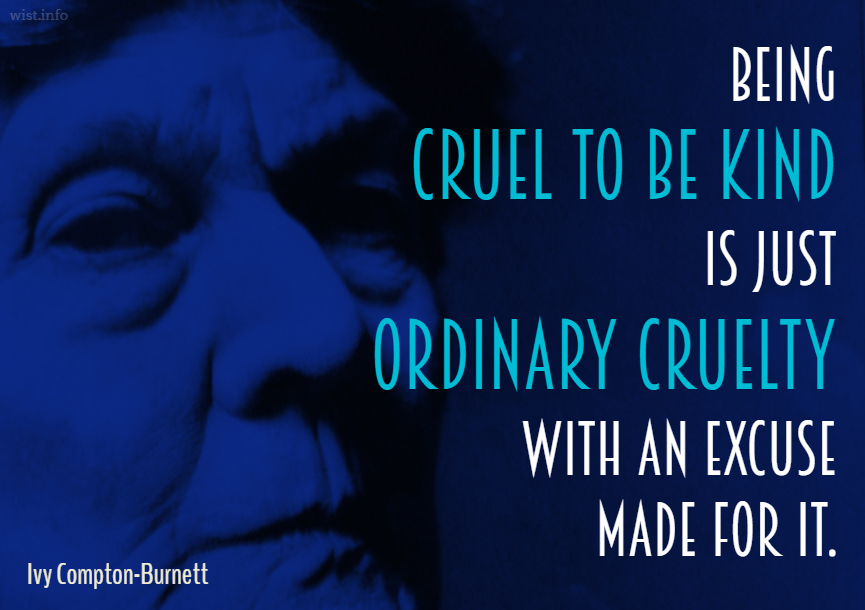
Being cruel to be kind is just ordinary cruelty with an excuse made for it.

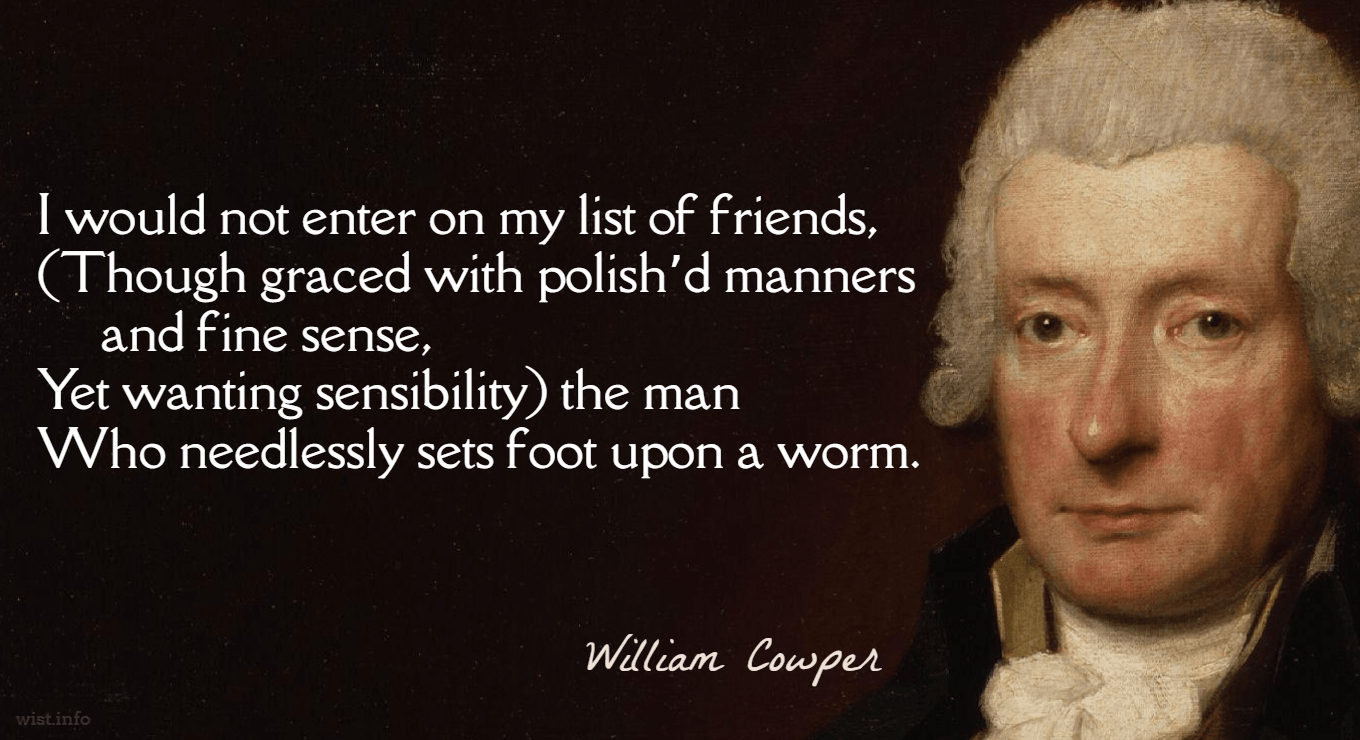
I would not enter on my list of friends,
(Though graced with polish’d manners and fine sense,
Yet wanting sensibility) the man
Who needlessly sets foot upon a worm.
William Cowper (1731-1800) English poet
“Winter Walk at Noon,” l. 560ff, The Task, Book 6 (1785)
(Source)

Love would put a new face on this weary old world in which we dwell as pagans and enemies too long.
Ralph Waldo Emerson (1803-1882) American essayist, lecturer, poet
“Man the Reformer,” lecture, Boston (1841-01-25)
(Source)

The greatest evil which fortune can inflict on men is to endow them with small talents and great ambition.
Luc de Clapiers, Marquis de Vauvenargues (1715-1747) French moralist, essayist, soldier
Reflections and Maxims [Réflexions et maximes], #562 [tr. Stevens] (1746)
(Source)

And, when you, looking on your fellow men
Behold them doomed to endless misery,
How can you talk of joy and rapture then?
May God withhold such cruel joy from me!Anne Brontë (1820-1849) British novelist, poet [pseud. Acton Bell]
“A Word to Calvinists” (28 May 1843)
(Source)

I love animals. Growing up, the two things that made my blood boil were religious intolerance and animal cruelty. I’ve never understood it. I can’t stand to have an animal in pain. I’ve got to get it out of my head. It makes me angry, I want to cry, I want to stab someone. I don’t know where that comes from, really.
Ricky Gervais (b. 1961) English comedian, actor, director, writer
Interview with Chris Heath, GQ (15 May 2013)
(Source)

It’s important to be kind. You can’t know all the times that you’ve hurt people in tiny, significant ways. It’s easy to be cruel without meaning to be. There’s nothing you can do about that. But you can choose to be kind. Be kind.

There is no occasion to trample upon the meanest reptile, nor to sneak to the greatest prince. Insolence and baseness are equally unmanly.
James Burgh (1714-1775) British politician and writer
The Dignity of Human Nature, Sec. 5 “Miscellaneous Thoughts on Prudence in Conversation” (1754)
(Source)

The curse of poverty has no justification in our age. It is socially as cruel and blind as the practice of cannibalism at the dawn of civilization, when men ate each other because they had not yet learned to take food from the soil or to consume the abundant animal life around them. The time has come for us to civilize ourselves by the total, direct and immediate abolition of poverty.
Martin Luther King, Jr. (1929-1968) American clergyman, civil rights leader, social activist, preacher
Where Do We Go From Here: Chaos or Community? ch. 5 “Where We Are Going?” (1967)
(Source)
Orthodoxy:
- In religion, that state of mind which congratulates itself on being absolutely right, and a belief that all who think otherwise are wholly wrong.
- A faith in the fixed — a worship of the static.
- The joy that comes from thinking that most everybody is lined up for Limbus with no return ticket.
- A condition brought about by the sprites of Humor, according to the rule that whom the gods would destroy they first make mad.
- The zenith of selfishness and the nadir of egotism.
- Mephisto with a lily in his hand.
- A corpse that does not know it is dead.
- Spiritual constipation.
- That peculiar condition where the patient can neither eliminate an old idea or absorb a new one.
Elbert Hubbard (1856-1915) American writer, businessman, philosopher
The Roycroft Dictionary (1914)
(Source)
We have enslaved the rest of the animal creation, and have treated our distant cousins in fur and feathers so badly that beyond doubt, if they were able to formulate a religion, they would depict the Devil in human form.
William Ralph Inge (1860-1954) English prelate [Dean Inge]
“The Idea of Progress,” Romanes Lecture (27 May 1920)
(Source)

“At this festive season of the year, Mr. Scrooge,” said the gentleman, taking up a pen, “it is more than usually desirable that we should make some slight provision for the Poor and Destitute, who suffer greatly at the present time. Many thousands are in want of common necessaries; hundreds of thousands are in want of common comforts, sir.”
“Are there no prisons?” asked Scrooge.
“Plenty of prisons,” said the gentleman, laying down the pen again.
“And the Union workhouses?” demanded Scrooge. “Are they still in operation?”
“They are. Still,” returned the gentleman, “I wish I could say they were not.”
“The Treadmill and the Poor Law are in full vigour, then?” said Scrooge.
“Both very busy, sir.”
“Oh! I was afraid, from what you said at first, that something had occurred to stop them in their useful course,” said Scrooge. “I’m very glad to hear it.”
“Under the impression that they scarcely furnish Christian cheer of mind or body to the multitude,” returned the gentleman, “a few of us are endeavouring to raise a fund to buy the Poor some meat and drink and means of warmth. We choose this time, because it is a time, of all others, when Want is keenly felt, and Abundance rejoices. What shall I put you down for?”
“Nothing!” Scrooge replied.
“You wish to be anonymous?”
“I wish to be left alone,” said Scrooge. “Since you ask me what I wish, gentlemen, that is my answer. I don’t make merry myself at Christmas and I can’t afford to make idle people merry. I help to support the establishments I have mentioned — they cost enough; and those who are badly off must go there.”
“Many can’t go there; and many would rather die.”
“If they would rather die,” said Scrooge, “they had better do it, and decrease the surplus population. Besides — excuse me — I don’t know that.”
“But you might know it,” observed the gentleman.
“It’s not my business,” Scrooge returned. “It’s enough for a man to understand his own business, and not to interfere with other people’s. Mine occupies me constantly. Good afternoon, gentlemen!”
Charles Dickens (1812-1870) English writer and social critic
A Christmas Carol, Stave 1 “Marley’s Ghost” (1843)
(Source)

ANGIOLINA: He hath been guilty, but there may be mercy.
BENINTENDE: Not in this case with justice.
ANGIOLINA:Alas! signor,
He who is only just is cruel; who
Upon the earth would live were all judged justly?George Gordon, Lord Byron (1788-1824) English poet
Marino Faliero, Doge of Venice, Act 5, sc. 1 (1821)
(Source)
The degree of civilization in a society can be judged by entering its prisons.
Fyodor Dostoyevsky (1821-1881) Russian novelist
(Attributed)
Sometimes cited to Dostoyevsky's The House of the Dead (1862) [tr. Garnett (1957)], which is a semi-autobiographical work about a Siberian prison camp, but the quotation cannot be found there.
See also Buck, Johnson.

As an atheist, I believe that all life is unspeakably precious, because it’s only here for a brief moment, a flare against the dark, and then it’s gone forever. No afterlives, no second chances, no backsies. So there can be nothing crueler than the abuse, destruction or wanton taking of a life. It is a crime no less than burning the Mona Lisa, for there is always just one of each.
So I cannot forgive. Which makes the notion of writing a character who CAN forgive momentarily attractive … because it allows me to explore in great detail something of which I am utterly incapable.
J. Michael (Joe) Straczynski (b. 1954) American screenwriter, producer, author [a/k/a "JMS"]
Usenet, rec.arts.sf.tv.babylon5, “JMS on Compuserve: Gesthemane Questions” (1995-12-04)
(Source)

A man of Cruelty is God’s enemy.
Thomas Fuller (1654-1734) English physician, preacher, aphorist, writer
Gnomologia: Adages and Proverbs (compiler), # 303 (1732)
(Source)

We do not go to cowards for tender dealing; there is nothing so cruel as panic; the man who has least fear for his own carcase, has most time to consider others.
Is it necessary that Heaven should borrow its light from the glare of Hell? Infinite punishment is infinite cruelty, endless injustice, immortal meanness. To worship an eternal gaoler hardens, debases, and pollutes even the vilest soul. While there is one sad and breaking heart in the universe, no good being can be perfectly happy.
Robert Green Ingersoll (1833-1899) American lawyer, freethinker, orator
“The Great Infidels” (1881)
(Source)
The Puritan hated bear-baiting, not because it gave pain to the bear, but because it gave pleasure to the spectators.
Thomas Babington Macaulay (1800-1859) English writer and politician
History of England, vol. 1, ch. 3 (1849)

Whenever people say “we mustn’t be sentimental,” you can take it they are about to do something cruel. And if they add, “we must be realistic,” they mean they are going to make money out of it.
Brigid Brophy (1929-1995) Anglo-Irish writer, novelist, playwright
Unlived Life
There are many humorous things in the world, among them the white man’s notion that he is less savage than the other savages.
Mark Twain (1835-1910) American writer [pseud. of Samuel Clemens]
Following the Equator, ch. 21 (1897)
(Source)