There were times that called for mindless, terror-filled panic, and times that called for measured, considered, thoughtful panic.
Quotations about:
thinking
Note not all quotations have been tagged, so Search may find additional quotes on this topic.

The boldest thinker may have his moments of languor and discouragement, when he feels as if he could willingly exchange faiths with the old beldame crossing herself at the cathedral-door, — nay, that, if he could drop all coherent thought, and lie in the flowery meadow with the brown-eyed solemnly unthinking cattle, looking up to the sky, and all their simple consciousness staining itself blue, then down to the grass, and life turning to a mere greenness, blended with confused scents of herbs, — no individual mind-movement such as men are teased with, but the great calm cattle-sense of all time and all places that know the milky smell of herds, — if he could be like these, he would be content to be driven home by the cow-boy, and share the grassy banquet of the king of ancient Babylon. Let us be very generous, then, in our judgment of those who leave the front ranks of thought for the company of the meek non-combatants who follow with the baggage and provisions. Age, illness, too much wear and tear, a half-formed paralysis, may bring any of us to this pass.
“I don’t see much sense in that,” said Rabbit.
“No,” said Pooh humbly, “there isn’t. But there was going to be when I began it. It’s just that something happened to it on the way.”A. A. Milne (1882-1956) English poet and playwright [Alan Alexander Milne]
House at Pooh Corner, ch. 7 “Tigger Is Unbounced” (1928)
(Source)
When we think what we do not feel, we lie to ourselves. We must always think with our whole being, soul and body.
[Penser ce que l’on ne sent pas, c’est mentir à soi-même. Tout ce qu’on pense, il faut le penser avec son être tout entier, âme et corps.]
Joseph Joubert (1754-1824) French moralist, philosopher, essayist, poet
Pensées [Thoughts], ch. 9 “De la Sagesse, de la Vertu, etc. [On Wisdom and Virtue],” ¶ 52, 1798 entry (1850 ed.) [tr. Collins (1928), ch. 8]
(Source)
(Source (French)). Alternate translations:To think what we do not feel, is to lie to ourselves. Whatever we think, we should think with our whole being, will and body.
[tr. Calvert (1866), ch. 9]To think what we do not feel is to lie to one's-self. Whatever we think should be thought by our whole being, soul and body.
[tr. Attwell (1896), ¶ 140]To think what we do not feel, is to lie to ourselves. Everything that we think we must think with our whole being, soul and body
[tr. Lyttelton (1899), ch. 8, ¶ 38]To think what we do not feel is to lie to ourselves, in the same way that we lie to others when we say what we do not think. Everything we think must be thought with our entire being, body and soul.
[tr. Auster (1983), 1798 entry]
You need to get used to winnowing your thoughts, so that if someone says, “What are you thinking about?” you can respond at once (and truthfully) that you are thinking this or thinking that. And it would be obvious at once from your answer that your thoughts were straightforward and considerate ones — the thoughts of an unselfish person, one unconcerned with pleasure and with sensual indulgence generally, with squabbling, with slander and envy, or anything else you’d be ashamed to be caught thinking.
[ἐθιστέον ἑαυτὸν μόνα φαντάζεσθαι, περὶ ὧν εἴ τις ἄφνω ἐπανέροιτο: τί νῦν διανοῇ; μετὰ παρρησίας παραχρῆμα ἂν ἀποκρίναιο ὅτι τὸ καὶ τό: ὡς ἐξ αὐτῶν εὐθὺς δῆλα εἶναι, ὅτι πάντα ἁπλᾶ καὶ εὐμενῆ καὶ ζῴου κοινωνικοῦ καὶ ἀμελοῦντος ἡδονικῶν ἢ καθάπαξ ἀπολαυστικῶν φαντασμάτων ἢ φιλονεικίας τινὸς ἢ βασκανίας καὶ ὑποψίας ἢ ἄλλου τινός, ἐφ̓ ᾧ ἂν ἐρυθριάσειας ἐξηγούμενος, ὅτι ἐν νῷ αὐτὸ εἶχες.]
Marcus Aurelius (AD 121-180) Roman emperor (161-180), Stoic philosopher
Meditations [To Himself; Τὰ εἰς ἑαυτόν], Book 3, ch. 4 (3.4) (AD 161-180) [tr. Hays (2003)]
(Source)
(Source (Greek)). Alternate translations:Thou must use thyself to think only of such things, of which if a man upon a sudden should ask thee, what it is that thou art now thinking, thou mayest answer This, and That, freely and boldly, that so by thy thoughts it may presently appear that in all thee is sincere, and peaceable; as becometh one that is made for society, and regards not pleasures, nor gives way to any voluptuous imaginations at all: free from all contentiousness, envy, and suspicion, and from whatsoever else thou wouldst blush to confess thy thoughts were set upon.
[tr. Casaubon (1634)]Let it be your way to think upon nothing, but what you could freely Discover, if the Question was put to you : So that if your Soul was thus laid open, there would nothing appear, but what was Sincere, Good-natur'd, and publick Spirited; not so much as one Libertine, or Luxurious Fancy, nothing of Litigiousness, Envy, or unreasonable Suspicion, or any thing else, which would not bear the Light, without Blushing.
[tr. Collier (1701)]We ought, therefore, to [...] enure ourselves to think on such things, as, if we were of a sudden examined, what are we now musing upon, we could freely answer, such or such matters: so that all within might appear simple and goodnatured, such as becomes a social being, who despises pleasure, and all sensual enjoyment, and is free from emulation, envy, suspicion, or any other passion that we would blush to own we were now indulging in our minds.
[tr. Hutcheson/Moor (1742)]Indeed you should regulate your thoughts in such a manner, that if any one should ask you, on a sudden, what is the subject of them, you may answer him without embarrassment; so that they may evidently appear to be all simplicity and benevolence, and such as become a being born for society; free from every idea of sensuality or lasciviousness; from rancour, envy, or suspicion; or from any other sentiment, which, if you were to confess it, would occasion a blush.
[tr. Graves (1792)]A man should use himself to think of those things only about which if one should suddenly ask, What hast thou now in thy thoughts? with perfect openness thou mightest immediately answer, This or That; so that from thy words it should be plain that everything in thee is simple and benevolent, and such as befits a social animal, and one that cares not for thoughts about pleasure or sensual enjoyments at all, nor has any rivalry or envy and suspicion, or anything else for which thou wouldst blush if thou shouldst say that thou hadst it in thy mind.
[tr. Long (1862)][A man] ought, therefore, not to work his mind to no purpose, nor throw a superfluous link into the chain of thought; and more especially, to avoid curiosity and malice in his inquiry. Accustom yourself, therefore, tot hink up on nothing but what you could freely reveal, if the question were put to you; so that if your soul were thus laid open, there would nothing appear but what was sincere, good-natured, and public-spirited -- not so much as one voluptuous or luxurious fancy, nothing of hatred, envy, or unreasonable suspicion, nor aught else which you could not bring to the light without blushing.
[tr. Collier/Zimmern (1887)]Limit yourself habitually to such regards, that if suddenly asked 'What is in your thoughts now?,' you could tell at once the candid and unhesitating truth -- a direct plain proof, that all your thoughts were simple and in charity, such as befit a social being, who eschews voluptuous or even self-indulgent fancies, or jealousy of any kind, or malice and suspicion, or any other mood which you would blush to own.
[tr. Rendall (1898)]Accustom yourself so, and only so, to think, that, if any one were suddenly to ask you, “Of what are you thinking-now?” you could answer frankly and at once, “Of so and so.” Then it will plainly appear that you are all simplicity and kindliness, as befits a social being who takes little thought for enjoyment or any phantom pleasure; who spurns contentiousness, envy, or suspicion; or any passion the harbouring of which one would blush to own.
[tr. Hutcheson/Chrystal (1902)]A man should accustom himself to think only of those things about which, if one were to ask on a sudden, What now in thy thoughts? thou couldst quite frankly answer at once, This or that; so that thine answer should immediately make manifest that all that is in thee is simple and kindly and worthy of a living being that is social and has no thought for pleasures or for the entire range of sensual images, or for any rivalry, envy, suspicion, or anything else, whereat thou wouldst blush to admit that thou hadst it in thy mind.
[tr. Haines (Loeb) (1916)]You must habituate yourself only to thoughts about which if some one were suddenly to ask: 'What is in your mind now?', you would at once reply, quite frankly, this or that; and so from the answer it would immediately be plain that all was simplicity and kindness, the thoughts of a social being, who disregards pleasurable, or to speak more generally luxurious imaginings or rivalry of any kind, or envy and suspicion or anything else about which you would blush to put into words that you had it in your head.
[tr. Farquharson (1944)]A man should habituate himself to such a way of thinking that if suddenly asked, "What is in your mind at this minute?" he could respond frankly and without hesitation; thus proving that all his thoughts were simple and kindly, as becomes a social being with no taste for the pleasures of sensual imaginings, jealousies, envies, suspicions, or any other sentiments that he would blush to acknowledge in himself.
[tr. Staniforth (1964)]You must train yourself only to think such thoughts that if somebody were suddenly to ask you, "What are you thinking of?" you could reply in all honesty and without hesitation of this or that, and so make it clear at once from your reply that all within you is simple and kindly, and worthy of a social being who has no thought for pleasure, or luxury in general, or contentiousness of any kind, or envy, or suspicion, or anything else that you would blush to admit if you had it in your mind.
[tr. Hard (1997 ed.)]Train yourself to think only those thoughts such that in answer to the sudden question ‘What is in your mind now?’ you could say with immediate frankness whatever it is, this or that: and so your answer can give direct evidence that all your thoughts are straightforward and kindly, the thoughts of a social being who has no regard for the fancies of pleasure or wider indulgence, for rivalry, malice, suspicion, or anything else that one would blush to admit was in one’s mind.
[tr. Hammond (2006)]You should accustom yourself to think only of those things which, if someone were suddenly to ask "What are you thinking?" you could openly answer this or that, so as to reveal straightaway that everything within yourself is straightforward and well disposed, appropriate to a communal being, and without care for base pleasures or even a single one of the delights we take in our experiences, or for any rivalry, slander, suspicion, or anything else which you would blush to answer that you had in your mind.
[tr. Needleman/Piazza (2008)]You must train yourself only to think such thoughts that if somebody were suddenly to ask you, ‘What are you thinking of?’ you could reply in all honesty and without hesitation, of this thing or that, and so make it clear at once from your reply that all within you is simple and benevolent, and worthy of a social being who has no thought for pleasure, or luxury in general, or contentiousness of any kind, or envy, or suspicion, or anything else that you would blush to admit if you had it in your mind.
[tr. Hard (2011 ed.)]You must train yourself only to think the kind of thoughts about which, if someone suddenly asked you, "what are you thinking now?" you would at once answer frankly, "this" or "that." So, from your reply it would immediately be clear that all your thoughts are straightforward and kind and express the character of a social being who has no concern with images of pleasure, or self-indulgence in general, or any kind of rivalry, malice, or suspicion, or anything else you would blush to admit you were thinking about.
[tr. Gill (2013)]
KING: I am wrapp’d in dismal thinkings.
William Shakespeare (1564-1616) English dramatist and poet
All’s Well That Ends Well, Act 5, sc. 3, ll. 147ff (5.3.147) (1602?)
(Source)

You never can tell what your thoughts may do,
In bringing you hate or love,
For thoughts are things, and their airy wings
Are swifter than carrier doves.
They follow the law of the universe —
Each thing must create its kind,
And they speed o’er the track to bring you back
Whatever went out of your mind.Ella Wheeler Wilcox (1850-1919) American author, poet, temperance advocate, spiritualist
Poem (1896), “You Never Can Tell,” st. 3, Custer and Other Poems
(Source)
We welcome passion, for the mind is briefly let off duty.
Mignon McLaughlin (1913-1983) American journalist and author
The Neurotic’s Notebook, ch. 1 (1963)
(Source)

So too with our minds. If we do not keep them busy with some particular subject which can serve as a bridle to rein them in, they charge ungovernably about, ranging to and fro over the wastelands of our thoughts. Then, there is no madness, no raving lunacy, which such agitations do not bring forth.
[Ainsi est-il des esprits, si on ne les occupe à certain sujet, qui les bride & contraigne, ils se jettent desreglez, par-ci par là, dans le vague champ des imaginations. Et n’est follie ny réverie, qu’ils ne produisent en cette agitation.]
Michel de Montaigne (1533-1592) French essayist
Essays, Book 1, ch. 8 (1.8), “Of Idleness [De l’Oisiveté]” (1572) [tr. Screech (1987)]
(Source)
This essay was in the 1st ed. (1595); though the essay was revised for later editions, this text was not. The Essays themselves were begun to cure the melancholy and unrestrained thoughts caused by Montaigne's moving to his country estates, retiring from public life, and isolating himself in the château library for some time. This essay speaks to that experience.
(Source (French)). Alternate translations:So is it of minds, which except they be busied about some subject, that may bridle and keepe them under, they will here and there wildely scatter themselves through the vaste field of imaginations. And there is no follie, or extravagant raving, they produce not in that agitation.
[tr. Florio (1603)]So it is with Wits, which if not applyed to some certain Study that may fix and restrain them, run into a thousand Extravagancies, and are eternally roving here and there in the inextricable Labyrinth of restless Imagination. In which wild and irregular Agitation, there is no Folly, nor idle Fancy they do not light upon.
[tr. Cotton (1686)]So it is with our minds, which, if not applied to some particular subject to check and restrain them, rove about confusedly in the vague expanse of imagination. In which agitation there is no folly nor idle fancy which they do not create.
[tr. Friswell (1868)]So it is with minds, which if not applied to some certain study that may fix and restrain them, run into a thousand extravagances, eternally roving here and there in the vague expanse of the imagination -- in which wild agitation there is no folly, nor idle fancy they do not light upon.
[tr. Cotton/Hazlitt (1877)]So it is with our minds. If we do not apply them to some sort of study that will fix and restrain them, they will drift into a thousand extravagances, and will sternly run here and there in an inextricable labyrinth of restless imagination. In this wild and irregular agitation there is no folly nor idle fancy they do not touch upon.
[tr. Rector (1899)]So it is with our minds: if we do not keep them occupied with a distinct subject, which curbs and restrains them, they run aimlessly to and fro, in the undefined field of imagination. And there is no folly or fantasy to which they do not give birth in this agitation.
[tr. Ives (1925)]So it is with minds. Unless you keep them busy with some definite subject that will bridle and control them, they throw themselves in disorder hither and yon in the vague field of imagination. And there is no mad or idle fancy that they do not bring forth in this agitation.
[tr. Frame (1943)]So it is with our minds. If we do not occupy them with some definite subject which curbs and restrains them, they rush wildly to and fro in the ill-defined field of the imagination. And there is no folly or fantasy that they will not produce in this restless state.
[tr. Cohen (1958)]If [minds] have no object to busy themselves with, something to check and restrain them, they will run free and ramble through the open field of their imagination. And in this state of excitement, minds will come up with all kinds of foolishness and fantasies.
[tr. HyperEssays (2025)]
To be lost in thought is not to be idle. There is visible work and invisible work. To contemplate is to toil, to think is to do.
[On n’est pas inoccupé parce qu’on est absorbé. Il y a le labeur visible et le labeur invisible.
Contempler, c’est labourer; penser, c’est agir.]Victor Hugo (1802-1885) French writer
Les Misérables, Part 2 “Cosette,” Book 7 “A Parenthesis,” ch. 8 (2.7.8) (1862) [tr. Donougher (2013)]
(Source)
(Source (French)). Alternate translations:A man is not idle, because he is absorbed in thought. There is a visible labour and there is an invisible labour.
To meditate is to labour; to think is to act.
[tr. Wilbour (1862); Wilbour/Fahnestock/MacAfee (1987)]To be absorbed is not to be unoccupied, there is an invisible as well as a visible labor.
To contemplate is to labor, to think is to act.
[tr. Wraxall (1862)]One is not unoccupied because one is absorbed. There is visible labor and invisible labor.
To contemplate is to labor, to think is to act.
[tr. Hapgood (1887)]One is not idle because one is absorbed. There is both visible and invisible labour. To contemplate is to toil, to think is to do.
[tr. Denny (1976)]
Thoughts are the shadows of our feelings — always darker, emptier, and simpler.
[Gedanken sind die Schatten unserer Empfindungen, — immer dunkler, leerer, einfacher, als diese.]
Friedrich Nietzsche (1844-1900) German philosopher and poet
The Gay Science [Die fröhliche Wissenschaft], Book 3, § 179 (1882) [tr. Kaufmann (1974)]
(Source)
Also known as La Gaya Scienza, The Joyful Wisdom, or The Joyous Science.
(Source (German)). Alternate translations:Thoughts are the shadows of our sentiments -- always, however, obscurer, emptier, and simpler.
[tr. Common (1911)]Thoughts are the shadows of our sensations -- always darker, emptier, simpler.
[tr. Nauckhoff (2001)]Thoughts are shadows of our feelings -- always darker, emptier and simpler than these.
[tr. Hill (2018)]
Although the proportion of those who do think be extremely small, yet every individual flatters himself that he is one of the number.
Charles Caleb "C. C." Colton (1780-1832) English cleric, writer, aphorist
Lacon: Or, Many Things in Few Words, Vol. 1, Preface (1820)
(Source)
One of the hardest lessons of young Sam’s life had been finding out that the people in charge weren’t in charge. It had been finding out that governments were not, on the whole, staffed by people who had a grip, and that plans were what people made instead of thinking.
Pedantry crams our heads with learned lumber, and takes out our brains to make room for it.
Charles Caleb "C. C." Colton (1780-1832) English cleric, writer, aphorist
Lacon: Or, Many Things in Few Words, Vol. 2, § 20 (1822)
(Source)
A thought is often original, though you have uttered it a hundred times. It has come to you over a new route, by a new and express train of associations.
Only if a child feels right can he think right.
Haim Ginott (1922-1973) Israeli-American school teacher, child psychologist, psychotherapist [b. Haim Ginzburg]
Teacher and Child, ch. 4 “Congruent Communication” (1972)
(Source)
And now I understand
something so frightening, and wonderful —
how the mind clings to the road it knows, rushing
through crossroads, sticking
like lint to the familiar.

Learning without thought ends in a blur. Thought without learning will soon totter.
[學而不思則罔、思而不學則殆。]Confucius (c. 551- c. 479 BC) Chinese philosopher, sage, politician [孔夫子 (Kǒng Fūzǐ, K'ung Fu-tzu, K'ung Fu Tse), 孔子 (Kǒngzǐ, Chungni), 孔丘 (Kǒng Qiū, K'ung Ch'iu)]
The Analects [論語, 论语, Lúnyǔ], Book 2, verse 15 (2.15) (6th C. BC – AD 3rd C.) [tr. Ware (1950)]
(Source)
Many (but not all) translators suggest that learning/study here is not general academics, but examining and maintaining the ancient traditions.
(Source (Chinese)). Alternate translations:Learning without thought is labour lost; thought without learning is perilous.
[tr. Legge (1861)]Learning with [sic] thought is a snare; thought without learning is a danger.
[tr. Jennings (1895)]Study without thinking is labour lost. Thinking without study is perilous.
[tr. Ku Hung-Ming (1898)]Learning without thought is useless. Thought without learning is dangerous.
[tr. Soothill (1910)]Education without meditation is useless. Meditation without education is risky.
[tr. Soothill (1910), alternate]Research without thought is a mere net and entanglement: thought without gathering data, a peril.
[tr. Pound (1933)]He who learns but does not think, is lost. He who thinks but does not learn is in great danger.
[tr. Waley (1938)]If one learns from others but does not think, one will be bewildered. If, on the other hand, one thinks but does not learn from others, one will be in peril.
[tr. Lau (1979)]If one studies but does not think, one is caught in a trap. If one thinks but does not study, one is in peril.
[tr. Dawson (1993)]To study without thinking is futile. To think without studying is dangerous.
[tr. Leys (1997)]Learning without thinking is fruitless; thinking without learning is perplexing.
[tr. Huang (1997); additional translations.]Studying but not thinking, it is confused; Thinking but not studying, it is dangerous.
[tr. Cai/Yu (1998)]Learning without due reflection leads to perplexity; reflection without learning leads to perilous circumstances.
[tr. Ames/Rosemont (1998)]If he studies and does not reflect, he will be rigid. If he reflects but does not study, he will be shaky.
[tr. Brooks/Brooks (1998)]To learn and never think -- that's delusion. But to think and never learn -- that is perilous indeed!
[tr. Hinton (1998)]If you learn without thinking about what you have learned, you will be lost. If you think without learning, however, you will fall into danger.
[tr. Slingerland (2003)]Learning without thought is pointless. Thought without learning is dangerous.
[tr. Watson (2007)]If you learn but do not think, you will be dazed. If you think but do not learn, you will be in danger.
[tr. Chin (2014)]Learning from books without critical thinking results in confusion. Thinking vacuously without learning from books is perilous.
[tr. Li (2020)]
For always the man in whom thought springs up over thought sets his mark farther off, for the one thought saps the force of the other.
[Ché sempre l’omo in cui pensier rampolla
sovra pensier, da sé dilunga il segno,
perché la foga l’un de l’altro insolla]Dante Alighieri (1265-1321) Italian poet
The Divine Comedy [Divina Commedia], Book 2 “Purgatorio,” Canto 5, l. 16ff (5.16-18) (1314) [tr. Sinclair (1939)]
(Source)
Virgil telling Dante he's overthinking things, letting himself be distracted.
(Source (Italian)). Alternate translations:He, that permits his Fancy thus to stray.
With every lure, will rarely find his way
To that great end, to which his soul is bent:
For gath'ring fancies warp the steady light
Of Reason's beam, and leave her whelm'd in night,
For ever baffled of her first intent.
[tr. Boyd (1802), st. 3]He, in whose bosom thought on thought shoots out,
Still of his aim is wide, in that the one
Sicklies and wastes to nought the other’s strength.
[tr. Cary (1814)]He in whose bosom thought springs up to thought,
Destroys himself the figures of his loom --
The birth of one prepares the others's tomb.
[tr. Bannerman (1850)]For evermore the man in whom is springing
Thought upon thought, removes from him the mark,
Because the force of one the other weakens.
[tr. Longfellow (1867)]For ever the man, in whom thought wells up over thought, removes far from himself his mark, because the rush of the second slackens the first.
[tr. Butler (1885)]Always the man in whom new thought doth grow
On previous thought, from his true course doth roam,
Because the one doth flag the other's glow.
[tr. Minchin (1885)]For always the man in whom thought on thought wells up removes from himself his aim, for the force of one weakens the other.
[tr. Norton (1892)]For ever the man in whom thought wells up on thought, sets back his mark, because the one saps the force of the other.
[tr. Okey (1901)]For always he in whom thought overtakes
The former thought, his goal less clearly sees.
Because the one the other must relax.
[tr. Binyon (1943)]He aims beside the mark whose fancies bubble
One on another, driving back and drumming
Each other out, so that his eye sees double.
[tr. Sayers (1955)]For when a man lets his attention range
toward every wisp, he loses true direction,
sapping his mind's force with continual change.
[tr. Ciardi (1961)]For always the man in whom thought wells
up on thought sets back his mark,
for one thought weakens the force of the other.
[tr. Singleton (1973)]The man who lets his thoughts be turned aside
by one thing or another, will lose sight
of his true goal, his mind sapped of its strength.
[tr. Musa (1981)]Because the man in whom thoughts bubble up
One after the other, goes wide of the mark,
Because one thought weakens the force of another.
[tr. Sisson (1981)]The man in whom thought thrusts ahead of thought
allows the goal he’s set to move far off --
the force of one thought saps the other’s force.
[tr. Mandelbaum (1982)]For always the man in whom one care sprouts above the other makes his target more distant, because the impulse of the one weakens the other.
[tr. Durling (2003)]Since the man, in whom thought rises on thought, sets himself back, because the force of the one weakens the other.
[tr. Kline (2002)]When thought is bred too rampantly from thought,
then, of himself, a man will miss the mark.
Each mental thrust debilitates the first.
[tr. Kirkpatrick (2007)]For any man who lets one thought --
and then another -- take him over
will soon lose track of his first goal.
[tr. Hollander/Hollander (2007)]A man whose mind is distracted lets thought after thought
Keep him from getting where he wants to go:
They hammer each other down; nothing can grow.
[tr. Raffel (2010)]

Truth that has been merely learned is like an artificial limb, a false tooth, a waxen nose; at best, like a nose made out of another’s flesh; it adheres to us only because it is put on. But truth acquired by thinking of our own is like a natural limb; it alone really belongs to us. This is the fundamental difference between the thinker and the mere man of learning.
[Hingegen klebt die bloß erlernte Wahrheit uns nur an, wie ein angeseßtes Glied, ein falscher Zahn, eine wächserne Nase, oder höchstens wie eine rhinoplastische aus fremdem Fleische. Die durch eigenes Denken erworbene Wahrheit aber gleicht dem natürlichen Gliede: fie allein gehört uns wirklich an. Darauf beruht der Unterschied zwischen dem Denker und dem bloßen Gelehrten.]Arthur Schopenhauer (1788-1860) German philosopher
Parerga and Paralipomena, Vol. 2, ch. 22 “On Thinking for Oneself [Selbstdenken],” § 260 (1851) [tr. Saunders (1890)]
(Source)
Source (German). Alternate translations:Truth that has been merely learned adheres to us like an artificial limb, a false tooth, a waxen nose, or at best like one made out of another's flesh; truth which is acquired by thinking for oneself is like a natural member: it alone really belongs to us. Here we touch upon the difference between the thinking man and the mere man of learning.
[tr. Dircks (1897)]Truth that has merely been learnt adheres to us only as an artificial limb, a false tooth, a was nose does, or at most like transplanted skin; but a truth won by thinking for ourself is like a natural limb: it alone really belongs to us. This is what determines the difference between a thinker and a mere scholar.
[tr. Hollingdale (1970)]... other hand, the truth acquired through our own thinking is like the natural limb; it alone really belongs to us. On this rests the distinction between the thinker and the mere scholar.
[tr. Payne (1974)]

Stuff yourself with food all day, never give your mind anything to do, and you’re a problem! There’s chess, isn’t there? There’s weiqi, isn’t there? — wiser at least to busy yourself with these.
[飽食終日、無所用心、難矣哉、不有博弈者乎、爲之猶賢乎已]
[饱食终日无所用心难矣哉不有博弈者乎为之犹贤乎已]Confucius (c. 551- c. 479 BC) Chinese philosopher, sage, politician [孔夫子 (Kǒng Fūzǐ, K'ung Fu-tzu, K'ung Fu Tse), 孔子 (Kǒngzǐ, Chungni), 孔丘 (Kǒng Qiū, K'ung Ch'iu)]
The Analects [論語, 论语, Lúnyǔ], Book 17, verse 22 (17.22) (6th C. BC – AD 3rd C.) [tr. Watson (2007)]
(Source)
There is varied discussion in footnotes as to the specific identity and nature of the game(s) Confucius references. The phrase bo yi or po yi (博弈) can be translated either as "to play chess" or "the game of bo and the game of yi." The game of bo was similar to weiqi (wei-ch'i) (or, in Japan, go; the game of yi was a game like chess, or a board game played with dice (shuanglu), the rules of which have been forgotten. There are also translators who assert it's the other way around, that bo or liubo is the game of chance, and yi was weiqi (go).
(Source (Chinese) 1, 2). Alternate translations:Hard is it to deal with him, who will stuff himself with food the whole day, without applying his mind to anything good! Are there not gamesters and chess players? To be one of these would still be better than doing nothing at all.
[tr. Legge (1861)]Ah, it is difficult to know what to make of those who are all day long cramming themselves with food and are without anything to apply their minds to! Are there no dice and chess players? Better, perhaps, join in that pursuit than do nothing at all!
[tr. Jennings (1895)]It is a really bad case when a man simply eats his full meals without applying his mind to anything at all during the whole day. Are there not such things as gambling and games of skill? To do one of those things even is better than to do nothing at all.
[tr. Ku Hung-Ming (1898)]How hard is the case of the man who stuffs himself with food the livelong day, never applying his mind to anything! Are there no checker or chess players? Even to do that is surely better than nothing at all.
[tr. Soothill (1910)]Stuffing in food all day, nothing that he puts his mind on, a hard case! Don't chess players at least do something and have solid merit by comparison?
[tr. Pound (1933)]Those who do nothing all day but cram themselves with food and never use their minds are difficult. Are there not games such as draughts? To play them would surely be better than doing nothing at all.
[tr. Waley (1938)]I really admire a fellow who goes about the whole day with a well-fed stomach and a vacuous mind. How can one ever do it? I would rather that he play chess, which would seem to me to be better.
[tr. Lin Yutang (1938)]To eat one’s full all day long without directing the mind to anything is, indeed, to be in difficulties! Even those who spend all their time at intricate games are to be reckoned of higher caliber.
[tr. Ware (1950), 17.20]It is no easy matter for a man who always has a full stomach to put his mind to some use. Are there not such things as po and yi? Even playing these games is better than being idle.
[tr. Lau (1979)]It is surely difficult to spend the whole day stuffing oneself with food and having nothing to use one's mind on. Are there not people who play bo and yi? Even such activity is definitely superior, is it not?
[tr. Dawson (1993), 17.20]I cannot abide these people who fill their bellies all day long, without ever using their minds! Why can't they play chess? At least it would be better than nothing.
[tr. Leys (1997)]Those who are stated with food all day without applying their minds to anything at all are difficult indeed! Are there no people who play double six and siege? Even doing those would be beter than to stop thinking altogether.
[tr. Huang (1997), 17.21]Eating all day without thinking about anything, such persons are hard to be trained. Are not there some games? Even if playing some games, it is also better than having nothing to do.
[tr. Cai/Yu (1998), No. 462]There are troubles ahead for those who spend their whole day filling their stomachs without ever exercising their heart-and-mind (xin). Are there not diversions such as the board games of bo and weiqi? Even playing those games would be better than nothing.
[tr. Ames/Rosemont (1998)]One who eats his fill all day long, and never uses his mind on anything, is a difficult case. Are there not such things as gammon and chess? Would it not be better to play them?
[tr. Brooks/Brooks (1998), 17.20]All day eating and never thinking: such people are serious trouble. Aren't there games to play, like go and chess? Even that is better than nothing. [tr. Hinton (1998), 17.21]Spending the entire day filling himself with food, never once exercising his mind -- someone like this is a hard case indeed! Do we not have the games Bo and Yi? Even playing these games would be better than doing nothing.
[tr. Slingerland (2003)]To spend the whole day stuffing yourself and not to put your mind to use at all -- this is hopeless behavior. Are there not such games as bo and yi? It would be better to play these games [than to do nothing at all].
[tr. Annping Chin (2014)]If a person is well fed the whole day and does not use his brain on anything, it will be difficult for him to be of value in life. Are there poker games and chess? Playing these games is still more beneficial than doing nothing.
[tr. Li (2020)]
Composition is a discipline; it forces us to think. If you want to “get in touch with your feelings,” fine — talk to yourself, we all do. But if you want to communicate with another thinking human being, get in touch with your thoughts. Put them in order; give them a purpose; use them to persuade, to instruct, to discover, to seduce.
William Safire (1929-2009) American author, columnist, journalist, speechwriter
Commencement Address, Syracuse University (13 May 1978)
(Source)
Reprinted in On Language, "Commencement Address" (1980).
Thinking is difficult, therefore let the herd pronounce judgment!
Carl Jung (1875-1961) Swiss psychologist
Flying Saucers: A Modern Myth of Things Seen in the Skies, ch. 2 (1959) [tr. Hull]
(Source)
The motto of the "relatively unconscious man" who "clings to the commonplace, the obvious, the probable, the collectively valid." Reprinted in the The Collected Works of C.G. Jung - Civilization in Transition, vol. 10, ¶ 653.
Probable source of the frequently-attributed (but unfound) "Thinking is difficult. That's why most people judge."
If we establish a standard of safe thinking, we will end up with no thinking at all. That is the only “safe” way, and that is, needless to say, the most precarious, dangerous, of all ways.
Truth gains more even by the errors of one who, with due study and preparation, thinks for himself, than by the true opinions of those who only hold them because they do not suffer themselves to think.
John Stuart Mill (1806-1873) English philosopher and economist
On Liberty, ch. 2 “Of the Liberty of Thought and Discussion” (1859)
(Source)
But feeling is so different from knowing. My common sense tells me all you can say, but there are times when common sense has no power over me. Common nonsense takes possession of my soul.
There are but few thinkers in the world but a great many people who think they think.
Clichés, stock phrases, adherence to conventional, standardized codes of expression and conduct have the socially recognized function of protecting us against reality, that is, against the claim on our thinking attention that all events and facts make by virtue of their existence.
Hannah Arendt (1906-1975) German-American philosopher, political theorist
Lecture (1971), “Thinking and Moral Considerations,” Social Research (1971 Fall)
(Source)
Referring to Adolf Eichmann's use of "cliché-ridden language" as a sign of his "thoughtlessness."
Collected in The Life of the Mind, Part 1 "Thinking," Introduction (1974).

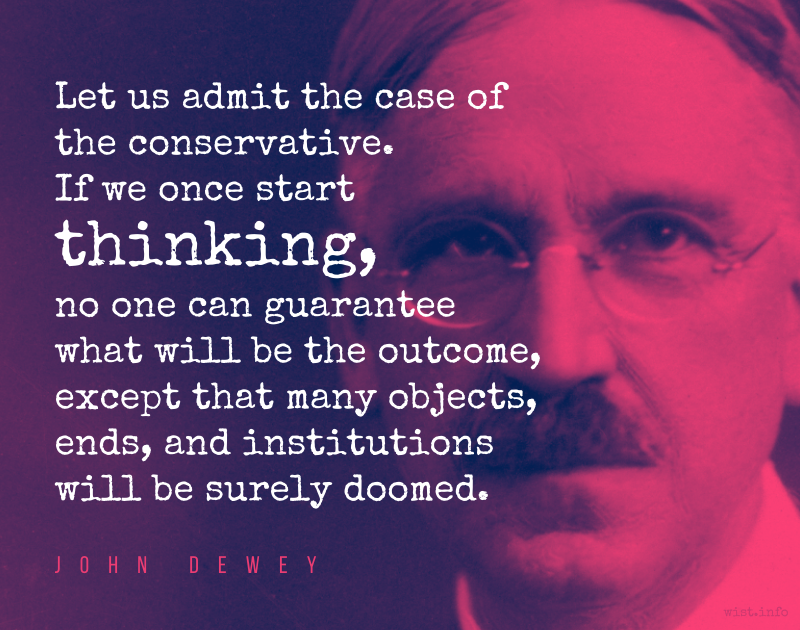
Let us admit the case of the conservative. If we once start thinking, no one can guarantee what will be the outcome, except that many objects, ends, and institutions will be surely doomed. Every thinker puts some portion of an apparently stable world in peril, and no one can wholly predict what will emerge in its place.
John Dewey (1859-1952) American teacher and philosopher
Experience and Nature, ch. 6 “Nature, Mind and the Subject” (1929)
(Source)
Book form of the inaugural Paul Carus lectures, given by Dewey in 1925.
If, as I suggested before, the ability to tell right from wrong should turn out to have anything to do with the ability to think, then we must be able to “demand” its exercise from every sane person, no matter how erudite or ignorant, intelligent or stupid, he may happen to be.
Hannah Arendt (1906-1975) German-American philosopher, political theorist
The Life of the Mind, Vol. 1 “Thinking,” Introduction (1977)
(Source)
Such as are thy habitual thoughts, such also will be the character of thy mind; for the soul is dyed by the thoughts.
[Οἷα ἂν πολλάκις φαντασθῇς, τοιαύτη σοι ἔσται ἡ διάνοια: βάπτεται γὰρ ὑπὸ τῶν φαντασιῶν ἡ ψυχή.]
Marcus Aurelius (AD 121-180) Roman emperor (161-180), Stoic philosopher
Meditations [To Himself; Τὰ εἰς ἑαυτόν], Book 5, ch. 16 (2.5) (AD 161-180) [tr. Long (1862)]
(Source)
(Source (Greek)). Alternate translations:Such as thy thoughts and ordinary cogitations are, such will thy mind be in time. For the soul doth as it were receive its tincture from the fancies, and imaginations.
[tr. Casaubon (1634), 5.15]Your Manners will depend very much upon the Quality of what you frequently think on; For the Soul is as it were Tinged with the Colour, and Complexion of Thought.
[tr. Collier (1701)]Such as the imaginations are which you frequently dwell upon, such will be the disposition of your soul. The soul receives a tincture from the imagination.
[tr. Hutcheson/Moor (1742)]Such as are the objects on which your thoughts are most frequently employed, such will be the state of your mind. For the soul takes a tincture from the usual current of its ideas.
[tr. Graves (1792)]Your manners will depend very much upon the quality of what you frequently think on; for the soul is as it were tinged with the color and complexion of thought.
[tr. Collier/Zimmern (1887)]Repeat impressions, and your understanding will assimilate itself to them; for the soul takes the dye of its impressions.
[tr. Rendall (1898)]The character of your most frequent impressions will be the character of your mind. The soul takes colour from its impressions.
[tr. Hutcheson/Chrystal (1902)]The character of thy mind will be such as is the character of thy frequent thoughts, for the soul takes its dye from the thoughts.
[tr. Haines (Loeb) (1916)]As are your repeated imaginations so will your mind be, for the soul is dyed by its imaginations.
[tr. Farquharson (1944)]Your mind will be like its habitual thoughts; for the soul becomes dyed with the colour of its thoughts.
[tr. Staniforth (1964)]As are your regular impressions, so will your mind be also; for the soul takes its colouring from its impressions.
[tr. Hard (1997 ed.)]The things you think about determine the quality of your mind. Your soul takes on the color of your thoughts.
[tr. Hays (2003)]Your mind will take on the character of your most frequent thoughts: souls are dyed by thoughts.
[tr. Hammond (2006)]Whatever kind of impressions you receive most often, so too will be your mind, for the soul is dyed with the color of one's impressions.
[tr. Needleman/Piazza (2008)]As are your habitual conceptions, so will your mind be also; for the soul takes its colouring from its conceptions.
[tr. Hard (2011 ed.)]As your most frequent impressions are, so will your mind be: your character is coloured by its impressions.
[tr. Gill (2013)]
Whenever government assumes to deliver us from the trouble of thinking for ourselves, the only consequences it produces are those of torpor and imbecility.
William Godwin (1756-1836) English journalist, political philosopher, novelist
Enquiry Concerning Political Justice, Vol. 2, bk. 6, ch. 1 (1793)
(Source)
A bookstore is one of the only pieces of physical evidence we have that people are still thinking.
Jerry Seinfeld (b. 1954) American comedian
SeinLanguage (1993)

The proper method for hastening the decay of error is not by brute force, or by regulation which is one of the classes of force, to endeavor to reduce men to intellectual uniformity, but on the contrary by teaching every man to think for himself.
William Godwin (1756-1836) English journalist, political philosopher, novelist
Enquiry Concerning Political Justice, Vol. 2, bk. 8, ch. 6 “Of the Enjoyment of Liberty” (1793)
(Source)
Then I went back to my hotel to think long thoughts. As is usual when I’m thinking long thoughts, I lay on the bed with my eyes closed. Susan says I often snore when thinking long thoughts.

A man may take to drink because he feels himself to be a failure, and then fail all the more completely because he drinks. It is rather the same thing that is happening to the English language. It becomes ugly and inaccurate because our thoughts are foolish, but the slovenliness of our language makes it easier for us to have foolish thoughts.
George Orwell (1903-1950) English journalist, essayist, writer [pseud. of Eric Arthur Blair]
Essay (1946-04), “Politics and the English Language,” Horizon Magazine
(Source)
Clarity in language depends on clarity in thought.
Arthur M. Schlesinger, Jr. (1917-2007) American historian, author, social critic
Interview with Brian Lamb, C-SPAN (10 May 1998)
I’m thinking on the fly, here. (Although now that I’m in middle management I think I’m supposed to call it “refactoring the strategic value proposition in real time with agile implementation,” or, if I’m being honest, “making it up as I go along.”)
Charles "Charlie" Stross (b. 1964) British writer
The Apocalypse Codex (2012)

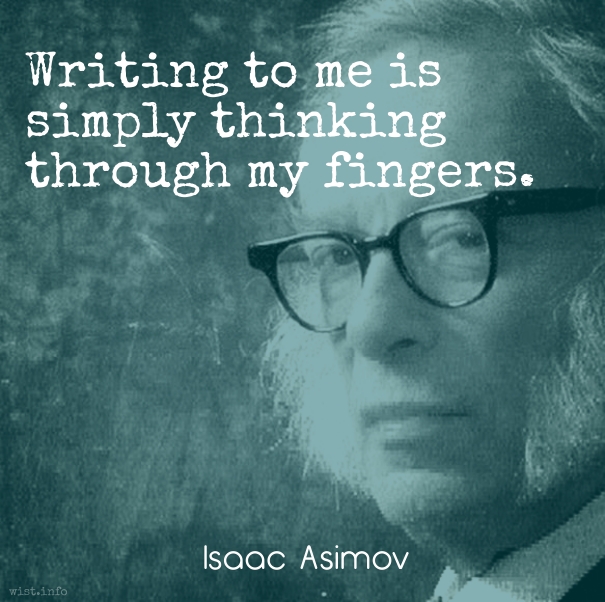
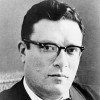
Thinking is the activity I love best, and writing to me is simply thinking through my fingers. I can write up to 18 hours a day. Typing 90 words a minute, I’ve done better than 50 pages a day. Nothing interferes with my concentration. You could put an orgy in my office and I wouldn’t look up — well, maybe once or twice.
Isaac Asimov (1920-1992) Russian-American author, polymath, biochemist
(Attributed)
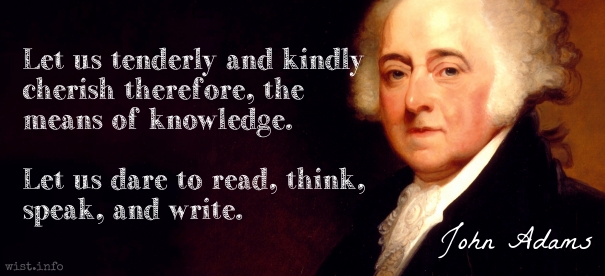
Let us tenderly and kindly cherish, therefore, the means of knowledge. Let us dare to read, think, speak and write.
John Adams (1735–1826) American lawyer, Founding Father, statesman, US President (1797–1801)
Essay (1765-10-21), “A Dissertation on the Canon and the Feudal Law,” No. 4, Boston Gazette
(Source)

I collected my thoughts. Someday I hope to have them all.
Steven Brust (b. 1955) American writer, systems programmer
Orca [Vlad] (1996)

For all but one in thousands the goal of their thinking is the point at which they have become tired of thinking.
[Tausenden für einen ist das Ziel ihres Nachdenkens die Stelle, wo sie des Nachdenkens müde geworden.]Gotthold Lessing (1729-1781) German playwright, philosopher, dramaturg, writer
Letter (1771-01-09), to Moses Mendelssohn
(Source)
(Source (German)). Alternate translations:In a thousand cases to one, the goal of reflection is set at the point where one gets tired of reflection.
(Source)For the vast majority of men, the object of their reflection lies at the point where they become tired of reflecting.
(Source)
There is a fire-fly in the southern clime
Which shineth only when upon the wing;
So it is with the mind: when once we rest,
We darken.Philip James Bailey (1816-1902) English poet, lawyer
Festus, Sc. “A Village Feast – Evening” [Festus] (1839)
(Source)
Usually paraphrased (earliest source (1872)):The firefly only shines when on the wing.
So is it with the mind -- when once we rest
We darken.
‘Tis the hardest thing in the world to be a good Thinker, without being a strong Self-Examiner.
Anthony Cooper, 3rd Earl of Shaftesbury (1671-1713) English politician and philosopher
Characteristicks of Men, Manners, Opinions, Times, Vol. 1, “Soliloquy: or Advice to an Author” (1711)

Concision in style, precision in thought, decision in life.
[Concision dans le style, précision dans la pensée, décision dans la vie.]
Victor Hugo (1802-1885) French writer
Victor Hugo’s Intellectual Autobiography [Postscriptum de ma Vie], “Thoughts,” sec. 3 (1901) [tr. O’Rourke (1907)]
(Source)
If most of us are ashamed of shabby clothes and shoddy furniture, let us be more ashamed of shabby ideas and shoddy philosophies.
Albert Einstein (1879-1955) German-American physicist
(Attributed)
Attributed to Einstein, but no definitive citation found. See here for more discussion.
A person who does not read cannot think. He may have good mental processes, but he has nothing to think about. You can feel for people or natural phenomena and react to them, but they are not ideas. You cannot think about them.
Rex Stout (1886-1975) American writer
In “Author Rex Stout vs. the FBI,” Interview with Sandra Schmidt, Life (10 Dec 1965)
Think before you speak. Read before you think. This will give you something to think about that you didn’t make up yourself — a wise move at any age, but most especially at seventeen, when you are in the greatest danger of coming to annoying conclusions.
Fran Lebowitz (b. 1950) American journalist, essayist
“Tips for Teens,” Social Studies (1981)
(Source)

Misery is almost always the result of thinking.
Joseph Joubert (1754-1824) French moralist, philosopher, essayist, poet
Pensées [Thoughts], ch. 5 “Des Passions et des Affections de l’Âme [On the Soul],” (1850 ed.) [tr. Collins (1928)]
(Source)
I could not find an analog in other translations of the Pensées, or in the published French.
Writing is closer to thinking than to speaking.
Joseph Joubert (1754-1824) French moralist, philosopher, essayist, poet
Pensées [Thoughts], 1791 entry [tr. Auster (1983)]
(Source)
I could not find an analog in other translations of the Pensées.
Orthodoxy means not thinking — not needing to think. Orthdoxy is unconsciousness.
George Orwell (1903-1950) English journalist, essayist, writer [pseud. of Eric Arthur Blair]
Nineteen Eighty-Four, Part 1, ch. 5 [Symes] (1949)
(Source)
The question is: Bad as I am, have I the right to think? And I think I have for two reasons: First, I cannot help it. And secondly, I like it.
Robert Green Ingersoll (1833-1899) American lawyer, freethinker, orator
“What Must We Do To Be Saved?” Sec. 1 (1880)
(Source)
Govern thy Life and Thoughts, as if the whole World were to see the one, and read the other.
Thomas Fuller (1654-1734) English physician, preacher, aphorist, writer
Introductio ad Prudentiam, Vol. 1, # 417 (1725)
(Source)
Life does not consist mainly — or even largely — of facts and happenings. It consists mainly of the storm of thoughts that is forever blowing through one’s head.
Mark Twain (1835-1910) American writer [pseud. of Samuel Clemens]
Autobiography, Part 1, sec. 28 “New York, January 10, 1906” (2003)
Full text.
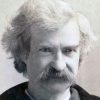
The secret thoughts of a man run over all things holy, prophane, clean, obscene, grave, and light, without shame, or blame.
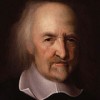
BERNARD: It’s one of those irregular verbs, isn’t it: I have an independent mind, you are eccentric, he is round the twist.
Jonathan Lynn (b. 1943) English actor, comedy writer, director
Yes, Prime Minister, 01×07 “The Bishop’s Gambit” (BBC2 Television) (1986-02-20) [with Antony Jay]
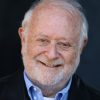
Standing in the presence of the Unknown, all have the same right to think, and all are equally interested in the great question of origin and destiny. All I claim, all I plead for, is liberty of thought and expression. That is all.
Robert Green Ingersoll (1833-1899) American lawyer, freethinker, orator
“The Liberty of Man, Woman, and Child” (1877)
Nothing so sharpens the thought process as writing down one’s arguments. Weaknesses overlooked in oral discussion become painfully obvious on the written page.
Hyman Rickover (1900-1986) American naval engineer, submariner, US Navy Admiral
Speech (1981-11-05), “Doing a Job,” Egleston Medal Award Dinner, Columbia School of Engineering and Applied Science, New York
(Source)
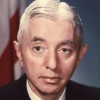
The first of the four cardinal virtues of the Roman Catholic Church is “prudentia,” which basically means damn good thinking. Christ came to take away our sins, not our minds.
William Sloane Coffin, Jr. (1924-2006) American minister, social activist
Credo, “Faith, Hope, Love” (2004)
(Source)
The man who does not do his own thinking is a slave, and is a traitor to himself and to his fellow-men.
Robert Green Ingersoll (1833-1899) American lawyer, freethinker, orator
“The Liberty of Man, Woman, and Child” (1877)
(Source)
Now we have come to the conclusion that every man has a right to think. Would God give a bird wings and make it a crime to fly? Would he give me brains and make it a crime to think? Any God that would damn one of his children for the expression of his honest thought wouldn’t make a decent thief. When I read a book and don’t believe it, I ought to say so. I will do so and take the consequences like a man.
Robert Green Ingersoll (1833-1899) American lawyer, freethinker, orator
Speech on Religious Intolerance, Pittsburgh Opera House (14 Oct 1879)

If two men agree on everything, you may be sure that one of them is doing the thinking.
Lyndon B. Johnson (1908-1973) American politician, educator, US President (1963-69)
(Attributed (c. 1964))
He, who will not reason, is a bigot; he, who cannot, is a fool; and he, who dares not, is a slave.
William Drummond of Logie-Almond (1770-1828) Scottish classical scholar, philosopher, diplomat, politician
Academical Questions, Preface (1805)
(Source)
Sometimes misattributed to Byron.


A new type of thinking is essential if mankind is to survive and move toward higher levels.
Albert Einstein (1879-1955) German-American physicist
“Atomic Education Urged by Einstein,” New York Times (25 May 1946)
This may be the source of some otherwise unsourced Einstein quotes:Einstein revisited this theme in "The Real Problem Is in the Hearts of Men," New York Times Magazine (23 Jun 1946): "Many persons have inquired concerning a recent message of mine that 'a new type of thinking is essential if mankind is to survive and move toward higher levels.' [...] Past thinking and methods did not prevent world wars. Future thinking must prevent wars."
- "The significant problems we face cannot be solved at the same level of thinking we were at when we created them"
- "The world we have created today as a result of our thinking thus far has problems which cannot be solved by thinking the way we thought when we created them."
- "The world we have created is a product of our thinking; it cannot be changed without changing our thinking."
- "This problem will not be solved by the same minds that created it."
- "We cannot solve our problems with the same thinking we used when we created them."
This is in fact the test and use of a man’s education, that he finds pleasure in the exercise of his mind.
Jacques Barzun (1907-2012) French-American historian, educator, polymath
Essay (1950-10-15), “The Educated Man,” Life Magazine
(Source)
More commonly given as "The test and use of a man's education is that he finds pleasure in the exercise of his mind."
Essay collected, under the same name, in Barzun, Begin Here: The Forgotten Conditions of Teaching and Learning, ch. 15 (1991).
The fatal tendency of mankind to leave off thinking about a thing when it is no longer doubtful is the cause of half their errors.
John Stuart Mill (1806-1873) English philosopher and economist
On Liberty, ch. 2 “Of the Liberty of Thought and Discussion” (1859)
(Source)
Thought is the work of the intellect, reverie is its self-indulgence. To substitute day-dreaming for thought is to confuse a poison with a source of nourishment.
[La pensée est le labeur de l’intelligence, la rêverie en est la volupté. Remplacer la pensée par la rêverie, c’est confondre un poison avec une nourriture.]
Victor Hugo (1802-1885) French writer
Les Misérables, Part 4 “Saint Denis,” Book 2 “Eponine,” ch. 1 (4.2.1) (1862) [tr. Denny (1976)]
(Source)
(Source (French)). Alternate translations:Thought is the labour of the intellect, reverie is its pleasure. To replace thought by reverie is to confound poison with nourishment.
[tr. Wilbour (1862)]Thought is the labor of the intellect, reveries its voluptuousness; substituting reverie for thought is like confounding poison with nutriment.
[tr. Wraxall (1862)]Thought is the toil of the intelligence, revery its voluptuousness. To replace thought with revery is to confound a poison with a food.
[tr. Hapgood (1887)]Thought is the labor of the intellect, reverie its pleasure. To replace thought with reverie is to confound poison with nourishment.
[tr. Wilbour/Fahnestock/MacAfee (1987)]Thought is the exertion of the intellect, daydreaming is its indulgence. To replace thought with daydreaming is to mistake a poison for sustenance.
[tr. Donougher (2013)]
I think and think for months and years. Ninety-nine times, the conclusion is false. The hundredth time I am right.
Albert Einstein (1879-1955) German-American physicist
(Attributed)
The happiness of your life depends upon the quality of your thoughts: therefore, guard accordingly, and take care that you entertain no notions unsuitable to virtue and reasonable nature.
[Τὴν ὑποληπτικὴν δύναμιν σέβε. ἐν ταύτῃ τὸ πᾶν, ἵνα ὑπόληψις τῷ ἡγεμονικῷ σου μηκέτι ἐγγένηται ἀνακόλουθος τῇ φύσει καὶ τῇ τοῦ λογικοῦ ζῴου κατασκευῇ]
Marcus Aurelius (AD 121-180) Roman emperor (161-180), Stoic philosopher
Meditations [To Himself; Τὰ εἰς ἑαυτόν], Book 3, ch. 9 (3.9) (AD 161-180) [tr. Collier (1701)]
(Source)
(Source (Greek)). Alternate translations:Use thine opiniative faculty with all honour and respect, for in her indeed is all: that thy opinion do not beget in thy understanding anything contrary to either nature, or the proper constitution of a rational creature.
[tr. Casaubon (1634), 3.10]Cultivate with all care that power which forms opinions: All depends on this, that no opinion thy soul entertains, be inconsistent with the nature and constitution of the rational animals.
[tr. Hutcheson/Moor (1742)]Pay a reverential regard to that faculty by which you form your opinions; for every thing depends on this, that no opinion be fostered in your breast that is not consonant to nature and to the condition of a rational being.
[tr. Graves (1792)]Reverence the faculty which produces opinion. On this faculty it entirely depends whether there shall exist in thy ruling part any opinion inconsistent with nature and the constitution of the rational animal.
[tr. Long (1862)]Hold in honor your opinionative faculty, for this alone is able to prevent any opinion from originating in your guiding principle that is contrary to Nature or the proper constitution of a rational creature.
[tr. Collier/Zimmern (1887)]Treat reverently your assumptive faculty: by it and it alone is your Inner Self secured against assumptions not in harmony with nature and with the constitution of a rational creature.
[tr. Rendall (1898)]Hold in honour the faculty which forms opinions. It depends on this faculty alone that no opinion your soul entertains be inconsistent with the nature and constitution of the rational being.
[tr. Hutcheson/Chrystal (1902)]Hold sacred thy capacity for forming opinions. With that it rests wholly that thy ruling Reason should never admit any opinion out of harmony with Nature, and with the constitution of a rational creature.
[tr. Haines (Loeb) (1916)]Reverence your faculty of judgement. On this it entirely rests that your governing self no longer has a judgement disobedient to Nature and to the estate of a reasonable being.
[tr. Farquharson (1944)]Treat with respect the power you have to form an opinion. By it alone can the helmsman within you avoid forming opinions that are at variance with nature and with the constitution of a reasonable being.
[tr. Staniforth (1964)]Venerate your faculty of judgement. For it depends entirely on this that there should never arise in your governing faculty any judgement that fails to accord with nature or with the constitution of a rational being.
[tr. Hard (1997 ed.)]Your ability to control your thoughts -- treat it with respect. It’s all that protects your mind from false perceptions -- false to your nature, and that of all rational beings. [tr. Hays (2003)]Revere your power of judgement. All rests on this to make sure that your directing mind no longer entertains any judgement which fails to agree with the nature or the constitution of a rational being.
[tr. Hammond (2006)]Revere your capacity for making decisions. Everything depends on this alone, so that your guiding part does not make a decision that is contrary either to Nature or to your makeup as a being endowed with reason.
[tr. Needleman/Piazza (2008)]Venerate your faculty of judgement. For it depends entirely on this that there should never arise in your ruling centre any judgement that fails to accord with nature or with the constitution of a rational being.
[tr. Hard (2011 ed.)]Revere your capacity for judgement. Everything depends on this to ensure that there no longer arises in your ruling centre a judgement which fails to follow nature and the constitution of a rational being.
[tr. Gill (2013)]
In the practice of art, as well as in morals, it is necessary to keep a watchful and jealous eye over ourselves; idleness, assuming the specious disguise of industry, will lull to sleep all suspicion of our want of an active exertion of strength. A provision of endless apparatus, a bustle of infinite enquiry and research, or even the mere mechanical labour of copying, may be employed, to evade and shuffle off real labour, — the real labour of thinking.
Joshua Reynolds (1723-1792) British painter, critic
Speech to the Royal Academy, London (10 Dec 1784)
(Source)Paraphrased over a long period of time (and still attributed to Reynolds) as: "There is no expedient to which a man will not resort to avoid the real labor of thinking."
The lecture was later described as the Twelfth Discourse in a 1797 collection of Reynolds' works.
Often attributed to Thomas Edison. More information here.
Thoughts, like fleas, jump from man to man. But they don’t bite everybody.
Stanislaw Lec (1909-1966) Polish aphorist, poet, satirist
Unkempt Thoughts [Myśli nieuczesane] (1957) [tr. Gałązka (1962)]
(Source)
“Eeyore, what are you doing there?” said Rabbit.
“I’ll give you three guesses, Rabbit. Digging holes in the ground? Wrong. Leaping from branch to branch of a young oak-tree? Wrong. Waiting for somebody to help me out of the river? Right. Give Rabbit time, and he’ll always get the answer.”A. A. Milne (1882-1956) English poet and playwright [Alan Alexander Milne]
House at Pooh Corner, ch. 6 “Eeyore Joins the Game” (1928)
(Source)