

And do you know, it is a splendid thing to think that the woman you really love will never grow old to you. Through the wrinkles of time, through the mask of years, if you really love her, you will always see the face you loved and won. And a woman who really loves a man does not see that he grows old; he is not decrepit to her; he does not tremble; he is not old; she always sees the same gallant gentleman who won her hand and heart. I like to think of it in that way; I like to think that love is eternal. And to love in that way and then go down the hill of life together, and as you go down, hear, perhaps, the laughter of grandchildren, while the birds of joy and love sing once more in the leafless branches of the tree of age.
Quotations about:
love
Note not all quotations have been tagged, so Search may find additional quotes on this topic.
I had rather live and love where death is king, than have eternal life where love is not. Another life is nought, unless we know and love again the ones who love us here.
Robert Green Ingersoll (1833–1899) American lawyer, freethinker, orator
Speech (1882-01-08), “At a Child’s Grave,” Congressional Cemetery, Washington, D. C.
(Source)
Eulogy at the burial of Harry Miller.
If we hate ourselves, we can never love others, for love is the gift of oneself. How will you make a gift of that which you hate?
William Sloane Coffin, Jr. (1924–2006) American minister, social activist
Credo, “Faith, Hope, Love” (2004)
(Source)

And then, do you know, I like to think that love is eternal; that if you really love the woman, for her sake, you will love her no matter what she may do; that if she really loves you, for your sake, the same; that love does not look at alterations, through the wrinkles of time, through the mask of years — if you really love her you will always see the face you loved and won. And I like to think of it. If a man loves a woman she does not ever grow old to him. And the woman who really loves a man does not see that he is growing older. He is not decrepit to her. He is not tremulous. He is not old. He is not bowed. She always sees the same gallant fellow that won her hand and heart. I like to think of it in that way, and as Shakespeare says: “Let Time reach with his sickle as far as ever he can; although he can reach ruddy cheeks and ripe lips, and flashing eyes, he can not quite reach love.” I like to think of it. We will go down the hill of life together, and enter the shadow one with the other, and as we go down we may hear the ripple of the laughter of our grandchildren, and the birds, and spring, and youth, and love will sing once more upon the leafless branches of the tree of age. I love to think of it in that way — absolute equals, happy, happy, and free, all our own.
Here is my secret. It is very simple. It is only with the heart that one can see rightly; What is essential is invisible to the eye.
[Voici mon secret. Il est très simple: on ne voit bien qu’avec le cœur. L’essentiel est invisible pour les yeux.]
Antoine de Saint-Exupéry (1900–1944) French writer, aviator
Le Petit Prince [The Little Prince] (1943)
Other translations:
- "Here is my secret. It is very simple: one sees well only with the heart. The essential is invisible to the eyes."
- "The essential things in life are seen not with the eyes, but with the heart."
Life has taught us that love does not consist of gazing at each other but in looking outward together in the same direction.
[L’expérience nous montre qu’aimer ce n’est point nous regarder l’un l’autre mais regarder ensemble dans la même direction.]
Antoine de Saint-Exupéry (1900–1944) French writer, aviator
Wind, Sand and Stars [Terre des Hommes], ch. 9 “Barcelona and Madrid (1936),” sec. 6 (1939) [US ed., tr. Galantiere]
(Source)
(Source (French)). Usually given as:Love does not consist of gazing at each other, but in looking together in the same direction.
[Aimer, ce n'est pas se regarder l'un l'autre, c'est regarder ensemble dans la même direction.]
Why is propaganda so much more successful when it stirs up hatred than when it tries to stir up friendly feeling?
Bertrand Russell (1872–1970) English mathematician and philosopher
Conquest of Happiness, Part 1, ch. 6 “Envy” (1930)
(Source)
Like everything else in the world, however, there is a price to pay for love, for the more happiness we derive from the existence and companionship of other human beings, the more vulnerable we are when there is any cause for apprehension. It takes courage to love, but pain through love is the purifying fire which those who live generously know. We all know people who are so much afraid of pain that they shut themselves up like clams in a shell and, giving out nothing, receive nothing and therefore shrink until life is a mere living death.
Eleanor Roosevelt (1884–1962) First Lady of the US (1933–1945), politician, diplomat, activist
Column (1939-04-01), “My Day”
(Source)
Written following the birth of her grandson, John Roosevelt Boettiger.
Once for all, then, a short precept is given thee: Love, and do what thou wilt: whether thou hold thy peace, through love hold thy peace; whether thou cry out, through love cry out; whether thou correct, through love correct; whether thou spare, through love do thou spare: let the root of love be within, of this root can nothing spring but what is good.
Augustine of Hippo (354–430) Christian church father, philosopher, saint [b. Aurelius Augustinus]
Homilies on the 1st Epistle of John Tractatus in epistulam Ioannis ad Parthos], Homily 7 [tr. Browne (1888)]
(Source)
Sermon on 1 John 4:4-12. "Love, and do what thou wilt" - Latin dilige et quod vis fac. Sometimes incorrectly given as "ama et fac quod vis."Another translation: "Love and then what you will, do." [tr. Fletcher]

Where there’s Marriage without Love, there will be Love without Marriage.
Benjamin Franklin (1706–1790) American statesman, scientist, philosopher, aphorist
Poor Richard (1734 ed.)
(Source)
Alcohol is like love: the first kiss is magic, the second is intimate, the third is routine. After that you just take the girl’s clothes off.
Raymond Chandler (1888–1959) American novelist
The Long Good-bye, ch. 12 (1954)
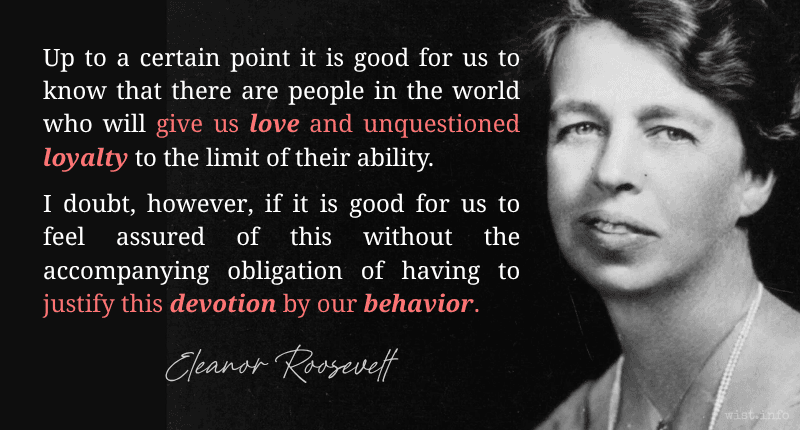
Up to a certain point it is good for us to know that there are people in the world who will give us love and unquestioned loyalty to the limit of their ability. I doubt, however, if it is good for us to feel assured of this without the accompanying obligation of having to justify this devotion by our behavior.
Eleanor Roosevelt (1884–1962) First Lady of the US (1933–1945), politician, diplomat, activist
Memoir (1937), This Is My Story, ch. 17 “Readjustment”
(Source)
The same passage is included in her compiled 1961 Autobiography, Part 1, ch. 10 "Readjustment."
True, we have to hate evil; else we’re sentimental. But if we hate evil more than we love the good, we become damn good haters, and of those the world already has too many.
William Sloane Coffin, Jr. (1924–2006) American minister, social activist
Credo, “Faith, Hope, and Love” (2004)
(Source)
It is bad religion to deify doctrines and creeds. While indispensable to religious life, doctrines and creeds are only so as signposts. Love alone is the hitching post. Doctrines, let’s not forget, supported slavery and apartheid; some still support keeping women in their places and gays and lesbians in limbo. Moreover, doctrines can divide while compassion can only unite. In other words, religious folk, all our lives, have both to recover tradition and to recover from it.
William Sloane Coffin, Jr. (1924–2006) American minister, social activist
Credo, “Faith, Hope, Love” (2004)
(Source)
DON JUAN: I can’t, in short, deny my heart to anything that strikes me as lovable, and the sight of a beautiful face so masters me that, if I had a thousand hearts, I’d give them all. There is, besides, an inexpressible charm in the first stirrings of a new passion, and the whole pleasure of love lies in change.
[DOM JUAN: Quoi qu’il en soit, je ne puis refuser mon cœur à tout ce que je vois d’aimable; et, dès qu’un beau visage me le demande, si j’en avais dix mille, je les donnerais tous. Les inclinations naissantes, après tout, ont des charmes inexplicables, et tout le plaisir de l’amour est dans le changement.]
Molière (1622–1673) French playwright, actor [stage name for Jean-Baptiste Poquelin]
Don Juan [Dom Juan], Act 1, sc. 2 (1665) [tr. Wilbur (2001)]
(Source)
(Source (French)). Other translations:However it is, I can't refuse my Heart to any lovely Creature I see, and from the Moment a handsome Face demands it, had I thousand Hearts I'd give 'em all. The rising Inclinations, after all, have inexplicable Charmes in 'em, and all the Pleasure of Love consists in the Variety.
[tr. Clitandre (1672)]However it may be, I cannot refuse my heart to any lovely creature I behold; and as soon as a handsome face asks it of me, if I had ten thousand hearts, I would give them all. Budding inclinations, after all, have a charm which is indescribable, and all the pleasure of love is in variety.
[tr. Van Laun (1876)]Whatever may have taken place before, I cannot refuse my love to any of the lovely women I behold; and, as soon as a handsome face asks it of me, if I had ten thousand hearts I would give them all away. The first beginnings of love have, besides, indescribable charms, and the true pleasure of love consists in its variety.
[tr. Wall (1879)]However it may be, I cannot refuse my heart to any lovely creature I see; and, as soon as a pretty face asks me, had I ten thousand hearts I would give them all. First beginnings, besides, have indescribable charms, and ll the pleasure of love consists in variety.
[tr. Waller (1904)]I cannot refuse my heart to any lovely creature I behold, and as soon as a fair face asks it, had I ten thousand hearts I'd give them all. Love at its birth hath unexpressible charms, and all the pleasure of it lies in change.
[tr. Page (1908)]Whatever my situation, I cannot refuse my heart to anyone I see to be lovable; and as soon as a fair face asks me for it, if I had ten thousand hearts I'd give them all. After all, budding inclinations have unaccountable charms, and the whole pleasure of love lies in change.
[tr. Frame (1967)]I can't withhold my love from everything I find lovable. What happens later -- happens. A beautiful face has only to ask for my heart. If I had ten thousand hearts, I'd give them all. There is something indescribable and thrilling in a fresh affair. The entire pleasure of love lies in how it changes.
[tr. Bermel (1987)]
The ultimate weakness of violence is that it is a descending spiral, begetting the very thing it seeks to destroy. Instead of diminishing evil, it multiplies it. Through violence you may murder the liar, but you cannot murder the lie, nor establish the truth. Through violence you may murder the hater, but you do not murder hate. In fact, violence merely increases hate. So it goes. Returning violence for violence multiplies violence, adding deeper darkness to a night already devoid of stars. Darkness cannot drive out darkness; only light can do that. Hate cannot drive out hate: only love can do that.
Martin Luther King, Jr. (1929–1968) American clergyman, civil rights leader, social activist, preacher
Where Do We Go from Here: Chaos or Community? (1967)
(Source)
I hold it true, whate’er befall;
I feel it, when I sorrow most;
‘Tis better to have loved and lost
Than never to have loved at all.Alfred, Lord Tennyson (1809–1892) English poet
“In Memoriam A. H. H.” , Part 27, st. 4 (1849)
Arthur Henry Hallam was the fiancé of Tennyson's sister Emily. Hallam died suddenly in September 1833.
Love is the magician, the enchanter, that changes worthless things to joy, and makes right royal kings and queens of common clay. It is the perfume of that wondrous flower, the heart, and without that sacred passion, that divine swoon, we are less than beasts; but with it, earth is heaven, and we are gods.

In my religion there would be no exclusive doctrine; all would be love, poetry and doubt.
Cyril Connolly (1903–1974) English intellectual, literary critic and writer.
The Unquiet Grave (1945)
The politician in my country seeks votes, affection and respect, in that order. This is not unique or surprising. […] The politician of necessity leads an isolated life, so far as his colleagues are concerned, because most of them are his rivals. Many of them are men of undoubted charm, ability and incredible energy, and yet too often they lack purpose or appetite for anything beyond their own careers. With few notable exceptions, they are simply men who want to be loved.
Edward R. Murrow (1908–1965) American journalist
Speech (1959-10-19), “Television and Politics,” British Association Granada Lectures, London Guildhall
(Source)
Love seems the swiftest, but it is the slowest of all growths. No man or woman really knows what perfect love is until they have been married a quarter of a century.
Mark Twain (1835–1910) American writer [pseud. of Samuel Clemens]
Mark Twain’s Notebook [ed. Paine (1935)]
I know a number of highly sensitive and intelligent people in my own communion who consider as a heresy my faith that God’s loving concern for his creation will outlast all our willfulness and pride. No matter how many eons it takes, he will not rest until all of creation, including Satan, is reconciled to him, until there is no creature who cannot return his look of love with a joyful response of love […] Some people feel it to be heresy because it appears to deny man his freedom to refuse to love God. But this, it seems to me, denies God his freedom to go on loving us beyond all our willfulness and pride. If the Word of God is the light of the world, and this light cannot be put out, ultimately it will brighten all the dark corners of our hearts and we will be able to see, and seeing, will be given the grace to respond with love — and of our own free will.
Madeleine L'Engle (1918–2007) American writer
The Irrational Season (1977)

Anger and jealousy can no more bear to lose sight of their objects than love.
George Eliot (1819–1880) English novelist [pseud. of Mary Ann Evans]
The Mill on the Floss (1860)
(Source)
On the necessary points, unity. On the questionable points, liberty. In everything, love.
[In necessariis unites, in non necessariis libertas, in omnibus caritas.]
Rupertus Meldenius (1582–1651) German writer [pseud. of Peter Meiderlin]
Paraenesis Votiva pro Pace Ecclesiae ad Theologos Augustanae Confessionis [Votive Counsel for the Peace of the Church, to the Theologians of the Augustan Confession] (1626)
Also translated as "essentials" and "non-essentials."
Paraphrase of final lines of the work:Verbo dicam: Si nos servaremus IN necesariis Unitatem, IN non-necessariis Libertatem, IN UTRISQUE Charitatem, optimo certe loco essent res nostrae.
[In a word, were we to observe unity in essentials, liberty in incidentals, and in all things charity, our affairs would be certainly in a most happy situation.]
Commonly attributed to St Augustine, but also to John Wesley, Richard Baxter, and several others.
He who knows the Truth is not equal to him who loves it, and he who loves it is not equal to him who delights in it.
[知之者、不如好之者、好之者、不如樂之者]
Confucius (c. 551- c. 479 BC) Chinese philosopher, sage, politician [孔夫子 (Kǒng Fūzǐ, K'ung Fu-tzu, K'ung Fu Tse), 孔子 (Kǒngzǐ, Chungni), 孔丘 (Kǒng Qiū, K'ung Ch'iu)]
The Analects [論語, 论语, Lúnyǔ], Book 6, verse 20 (6.20) (6th C. BC – 3rd C. AD) [tr. Soothill (1910), 6.18]
(Source)
Earlier translations use Legge's verse numbering, 6.18. The source material uses 之 (zhi, "it") without a clear antecedent. Soothill suggests it may refer to Truth, Virtue, or the Right. Some translations provide what they think is the reference; others leave it ambiguous or footnote it, as shown below.
(Source (Chinese)). Other translations:They who know the truth are not equal to those who love it, and they who love it are not equal to those who delight in it.
[tr. Legge (1861), 6.18]They who know it are not as those who love it, nor they who love it as those who rejoice in it.
[tr. Jennings (1895), 6.18]Those who know it are not as those who love it; those who love it are not as those who find their joy in it.
[tr. Ku Hung-Ming (1898), 6.18]Those who know aren't up to those who love; nor those who love, to those who delight in.
[tr. Pound (1933), 6.18]To prefer it is better than only to know it. To delight in it is better than merely to prefer it.
[tr. Waley (1938), 6.18; "the Way"]The man who loves truth (or learning) is better than the man who knows it, and the man who finds happiness in it is better than the man who loves it.
[tr. Lin Yutang (1938)]Being fond of The Right Way is better than just knowing it; and taking one’s delight in it is better than just being fond of it.
[tr. Ware (1950)]To be fond of something is better than merely to know it, and to find joy in it is better than merely to be fond of it.
[tr. Lau (1979), 6.20]Those who understand a thing are not equal to those who are fond of it, and those who are fond of it are not equal to those who delight in it.
[tr. Dawson (1993), 6.20]To know something is not as good as loving it; to love something is not as good as rejoicing in it.
[tr. Leys (1997), 6.20]Those who know it are not comparable to those who love it; those who love it are not comparable to thsoe who delight in it.
[tr. Huang (1997)]The persons who know something are not better than the persons who favor something; The persons who favor something are not better than the persons who enjoy something.
[tr. Cai/Yu (1998), 6.20, #140]To truly love it is better than just to understand it, and to enjoy it is better than simply to love it.
[tr. Ames/Rosemont (1998), 6.20; "knowledge and learning"]Knowing it is not as good as loving it; loving it is not as good as taking delight in it.
[tr. Brooks/Brooks (1998), 6.20; virtue]To understand something is nothing like loving it. And to love something is nothing like delighting in it.
[tr. Hinton (1998), 6.19]To know it is not as good as to approve it. To approve it is not as good as to find joy in it.
[tr. Watson (2007), 6.20]To know something is not as good as to have a love for it. To have a love for something is not as good as to find joy in it.
[tr. Annping Chin (2014), 6.20; learning, cf. 6.11 and 7.19]Learned people are inferior to those who are eager to learn. Those who are eager to learn are inferior to those who enjoy learning.
[tr. Li (2020), 6.20]Better than the one who knows what is right is he who loves what is right.
[Common English translation]

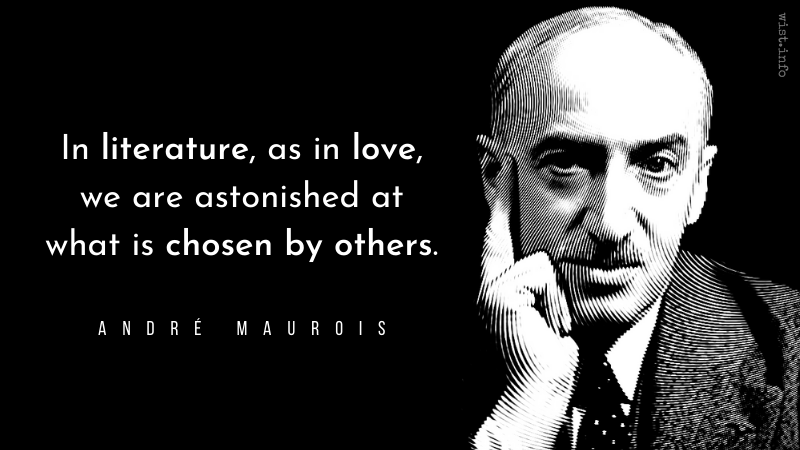
In literature, as in love, we are astonished at what is chosen by others.
[En littérature comme en amour, on est surpris par les choix des autres.]
André Maurois (1885–1967) French author [b. Émile Salomon Wilhelm Herzog]
The Art of Living [Un Art de Vivre], ch. 6 “The Art of Working” (1939) [tr. Whitall (1940)]
(Source)
(Source (French)). Sometimes cited to the New York Times, but only because it was reprinted there in the article “Reading Matter: Some Bookish Quotes” (1963-04-14).
THESEUS: Lovers and madmen have seething brains,
Such shaping fantasies, that apprehend
More than cool reason ever comprehends.William Shakespeare (1564–1616) English dramatist and poet
Midsummer Night’s Dream, Act 5, sc. 1, l. 4 (5.1.4-6) (1605)
(Source)

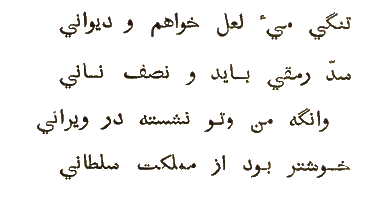
A Book of Verses underneath the Bough,
A Jug of Wine, a Loaf of Bread — and Thou
Beside me singing in the Wilderness —
Oh, Wilderness were Paradise enow.
Omar Khayyám (1048–1123) Persian poet, mathematician, philosopher, astronomer [عمر خیام]
Rubáiyát [رباعیات], Bod. # 149 [tr. FitzGerald, 3rd ed. (1872), # 12]
(Source)
Fitzgerald used the same translation for his 4th and 5th ed.
There are at least two close variants of this quatrain (Bodleian 149 and 153). Both introduce the wine, maybe the bread or meat, some verse, and a love interest.
In the first variant (149), in some cases, the setting is in the wilderness which is turned to a virtual Paradise by the accoutrements; in the second case, the other factors turn the writer's mind away from Paradise itself.
In the second variant (153), these items all brought together are valued more highly than the wealth of the Sultan.
Some translators blend these together, others break them out in two (or three!) quatrains. While concordances (especially in the 19th Century) draw connections, they sometimes contradict. I have included them all here, for the reader to discern their own differences.
Other translations:Some ruby wine and a diwan of poems,
A crust of bread to keep the breath in one's body,
And thou and I alone in a desert, --
Were a lot beyond a Sultan's throne.
[tr. Cowell (1858), # 13]Here with a Loaf of Bread beneath the Bough,
A Flask of Wine, a Book of Verse -- and Thou
Beside me singing in the Wilderness --
And Wilderness is Paradise enow.
[tr. FitzGerald, 1st ed. (1859), # 11]Here with a little Bread beneath the Bough,
A Flask of Wine, a Book of Verse -- and Thou
Beside me singing in the Wilderness --
Oh, Wilderness were Paradise enow!
[tr. FitzGerald, 2nd Ed (1868), # 12]In Spring time I love to sit in the meadow with a paramour perfect as a Houri and goodly jar of wine, and though I may be blamed for this, yet hold me lower than a dog if ever I dream of Paradise.
[tr. McCarthy (1888), # 177]When the hand possesses a loaf of wheaten bread, two measures of wine, and a piece of flesh, when seated with tulip-cheeks in some lonely spot, behold such joy as is not given to all sultans.
[tr. McCarthy (1888), # 398]Give me a flagon of red wine, a book of verses, a loaf of bread and a little idleness. If with such store I might sit by thy dear side in some lonely place, I should deem myself happier than a king in his kingdom.
[tr. McCarthy (1888), #449]In the sweet spring a grassy bank I sought
And thither wine and a fair Houri brought;
And, though the people called me graceless dog,
Gave not to Paradise another thought!
[tr. Whinfield (1883), # 84]Give me a skin of wine, a crust of bread,
A pittance bare, a book of verse to read;
With thee, love, to share my lowly roof,
I would not take the Sultan's realm instead!
[tr. Whinfield (1883), # 452]A Flask of Wine, a book, a Loaf of Bread, --
To every Care and Worldly Sorrow dead,
I covet not, when thou, oh Love, art near,
The Jeweled Crown upon the Sultan's Head.
[tr. Garner, 1.8 (1888)]Yes, Loved One, when the Laughing Spring is blowing,
With Thee beside me and the Cup o’erflowing,
I pass the day upon this Waving Meadow,
And dream the while, no thought on Heaven bestowing.
[tr. Garner, 1.20 (1888)]A flask of red wine, and a volume of song, together --
Half a loaf, -- just enough the ravage of Want to tether:
Such is my wish -- then, thou in the waste with me --
Oh! sweeter were this than a monarch's crown and feather!
[tr. M. K. (1888)]In the Springtime, biding with one who is houri-fair,
And a flask of wine, if 't is to be had -- somewhere
On the tillage's grassy skirt -- Alack ! though most
May think it a sin, I feel that my heaven is there!
[tr. M. K. (1888)]A book, a woman, and a flask of wine:
The three make heaven for me; it may be thine
Is some sour place of singing cold and bare --
But then, I never said thy heaven was mine.
[tr. Le Gallienne (1897)]A book, a flask of wine, a crust of bread,
To every care and worldly sorrow dead,
I covet not when thou, oh, Love, art near,
The jeweled turban on the sultan's head.
[tr. Garner (1898), # 8]A gugglet of wine and a book of poesy,
The haf of a loaf of bread and a penny fee,
And I in a nook of some ruin seated with thee,
Were better than king on a kingdom's throne to be.
[tr. Payne (1898), # 829]I desire a little ruby wine and a book of verses,
Just enough to keep me alive, and half a loaf is needful;
And then, that I and thou should sit in a desolate place
Is better than the kingdom of a sultan.
[tr. Heron-Allen (1898), # 149]If a loaf of wheaten-bread be forthcoming,
a gourd of wine, and a thigh-bone of mutton, and then,
if thou and I be sitting in the wilderness, --
that would be a joy to which no sultan can set bounds.
[tr. Heron-Allen (1898), # 155]A book of verses underneath the vine,
A loaf of bread, a jug of ruby wine,
And thou beside me, resting in the wild,
Would make the dreary wilderness divine!
[tr. Roe (1906), # 25]A skin of red wine, book of poesy.
Bread, a half loaf, enough for life give me.
Then sitting in some solitude with thee
Were sweeter than the Sultan's empery!
[tr. Thompson (1906), # 560]If bread you have made from the grain of wheat,
Two maunds of wine, a mutton joint for meat,
In some nook sitting with fair Tulip-cheeks,
Not every Sultan hath such joy complete!
[tr. Thompson (1906), # 586]Give me a scroll of verse, a little wine,
With half a loaf to fill thy needs and mine,
And with the desert sand our resting place,
For ne'er a Sultan's kingdom would we pine.
[tr. Talbot (1908), # 149]Let Fortune but provide me bread of wheat,
A gourd of wine, a bone of mutton sweet,
Then in the desert if we twain might sit,
Joys such as ours no Sultan could defeat.
[tr. Talbot (1908), # 155]If we get but a loaf of wheaten-bread, a gourd of wine
and a leg of mutton.
and if I and thou be sitting in the wilderness, that
were a treat beyond the powers of most sultans.
[tr. Christensen (1927), # 28]If you have a loaf made from the marrow of wheat,
Of wine two gallons and of lamb a joint,
And if you are sitting in the wilderness with one whose face is beautiful like the moon.
That would be bliss not attainable by a Sultan.
[tr. Rosen (1928), # 320]If one could find a loaf of grinded wheat,
And with a gourd of wine and chop of meat
Retires to ruined haunts with Beloved One,
What king can hope to find such joyous treat?
[tr. Tirtha (1941), # 7.131]The Word suffices and a book of songs,
A crumb will fill this what to earth belongs;
In solitude when I would pore on Tee,
I care no kingdoms, neither thrones nor throngs.
[tr. Tirtha (1941), # 8.131]Should our day's portion be one mancel loaf,
A haunch of mutton and a gourd of wine
Set for us two alone on the wide plain,
No Sultan's bounty could evoke such joy.
A gourd of red wine and a sheaf of poems --
A bare subsistence, half a loaf, not more --
Supplied us two alone in the free desert:
What Sultan could we envy on his throne?
[tr. Graves & Ali-Shah (1967), # 11-12]If one may have a loaf of the flower of wheat, a two-maund (jar) of wine, a thigh of mutton, seated with a heart's darling in a ruined place -- that is a pleasure that is not the attainment of any sultan.
[tr. Bowen (1976), # 12a]If we were seated in a desert place,
Where I alone might gaze upon your face,
These simple victuals would our needs suffice:
A thigh of mutton in a dish of rice;
A loaf of bread of finest wheaten flour;
A flagon tall from which cool wine to pour ...
There, in the day's long leisurely decline,
No Sultan's pleasures could compare with mine.
[tr. Bowen (1976), # 12b]I need a jug of wine and a book of poetry,
Half a loaf for a bite to eat,
Then you and I, seated in a deserted spot,
Will have more wealth than a Sultan's realm.
[tr. Avery/Heath-Stubbs (1979), # 98]If chance supplied a loaf of white bread,
Two casks of wine and a leg of mutton,
In the corner of a garden with a tulip-cheeked girl,
There'd be enjoyment no Sultan could outdo.
[tr. Avery/Heath-Stubbs (1979), # 234]In spring if a houri-like sweetheart
Gives me a cup of wine on the edge of a green cornfield,
Though to the vulgar this would be blasphemy,
If I mentioned any other Paradise, I'd be worse than a dog.
[tr. Ememai (1988), # 160]Ah, would there were a loaf of bread as fare,
A joint of lamb, a jug of vintage rare,
And you and I in wilderness encamped --
No Sultan's pleasure could with ours compare.
[tr. Saldi (1991), # 16]
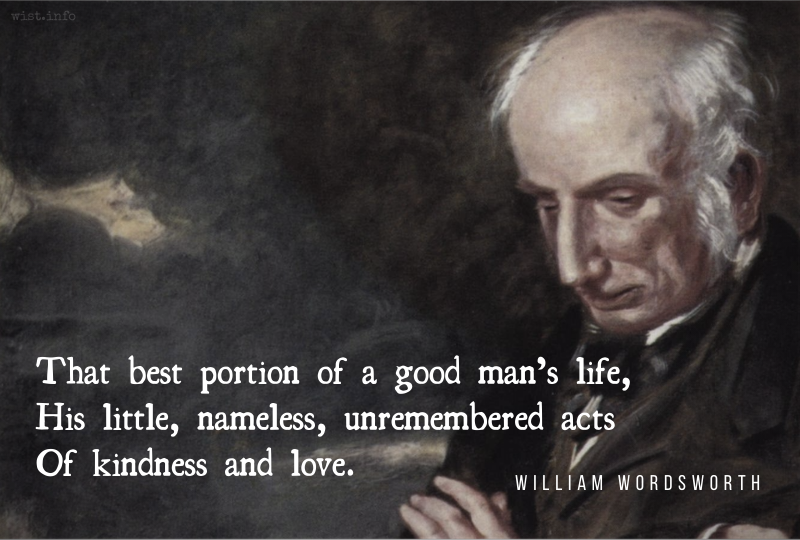
That best portion of a good man’s life,
His little, nameless, unremembered acts
Of kindness and love.
William Wordsworth (1770–1850) English poet
“Lines Composed a few Miles above Tintern Abbey” (13 Jul 1798)
(Source)
Often paraphrased into a sentence, e.g., "The best portion of a good man's life is his little, nameless, unremembered acts of kindness and of love."
The one thing we can never get enough of is love. And the one thing we never give enough is love.
Henry Miller (1891–1980) American novelist
Insomnia, or The Devil at Large (1971)
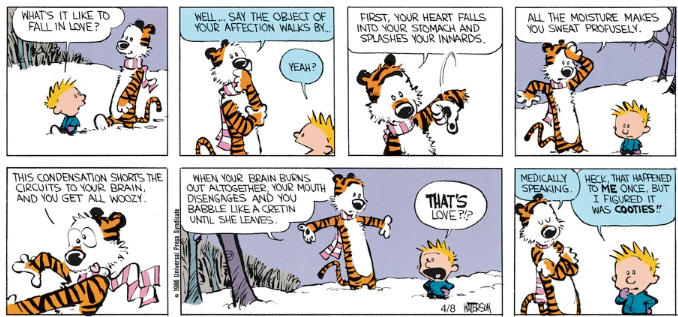
HOBBES: First, your heart falls into your stomach and splashes your innards. All the moisture makes you sweat profusely. This condensation shorts the circuits to your brain, and you get all woozy. When your brain burns out altogether, your mouth disengages and you babble like a cretin until she leaves.
CALVIN: That’s love?!?
HOBBES: Medically speaking.
CALVIN: Heck, that happened to me once, but I figured it was cooties!!

HARRIS: There is someone for everyone — even if you need a pickaxe, a compass, and night goggles to find them.
Steve Martin (b. 1945) American comedian, actor, writer, producer, musician
L. A. Story (1991)
(Source)
(Source (Video)). The IMDb entry reads "There's someone out there for everyone," but that does not line up with the soundtrack.

Never judge someone by who he’s in love with; judge him by his friends. People fall in love with the most appalling people. Take a cool, appraising glance at his pals.
Cynthia Heimel (1947–2018) American feminist, humorist, writer
But Enough about You (1986)
(Source)
A "Sister Soignée" quote.

He prayeth well, who loveth well
Both man and bird and beast.
He prayeth best, who loveth best
All things both great and small;
For the dear God who loveth us,
He made and loveth all.Samuel Taylor Coleridge (1772–1834) English poet and critic
Lyrical Ballads, “The Rime of the Ancient Mariner,” 615-618 (1798)
Chains do not hold a marriage together. It is threads, hundreds of tiny threads which sew people together through the years. That is what makes a marriage last — more than passion or even sex!
Simone Signoret (1921–1985) German-French actress [b. Simone Kaminker]
Daily Mail (London) (4 Jul 1978)
CALVIN: If Mom and Dad cared about me at all, they’d buy me some infra-red nighttime vision goggles.

Absence weakens ordinary passions, but inflames great ones, as the wind extinguishes a candle, but fans a fire.
[L’absence diminue les médiocres passions, et augmente les grandes, comme le vent éteint les bougies et allume le feu.]
François VI, duc de La Rochefoucauld (1613–1680) French epigrammatist, memoirist, noble
Réflexions ou sentences et maximes morales [Reflections; or Sentences and Moral Maxims], ¶276 (1665-1678) [tr. Stevens (1939)]
(Source)
Present in the 1st (1665) edition. The manuscript reads:L’absence fait que les médiocres passions diminuent, et que les grandes croissent, comme le vent éteint les bougies et allume le feu.
See Bussy-Rabutin (1660), and a related theme from Propertius (c. 20 BC).
(Source (French)). Other translations:Absence cools Moderate Passions, and Enflames Violent ones; Just as the Wind blows out Candles, but Kindles Fires.
[tr. Stanhope (1694), ¶277; (1706), ¶276]Absence destroys small passions, and increases great ones; as the wind extinguishes tapers, and kindles fires.
[pub. Donaldson (1783), ¶334; ed. Lepoittevin-Lacroix (1797), ¶257]Absence destroys small passions, and increases great ones; the wind extinguishes tapers, and kindles fires.
[ed. Carvill (1835), ¶295]Absence diminishes moderate passions and increases great ones, as the wind extinguishes tapers and adds fury to fire.
[ed. Gowens (1851), ¶286]Absence extinguishes small passions and increases great ones, as the wind will blow out a candle, and blow in a fire.
[tr. Bund/Friswell (1871), ¶276]The same wind snuffs candles yet kindles fires; so, where absence kills a little love, it fans a great one.
[tr. Heard (1917), ¶284]Absence diminishes small loves and increases great ones, as the wind blows out the candle and blows up the bonfire.
[tr. FitzGibbon (1957), ¶276]Absence weakens lukewarm feelings but intensifies great ones, as wind snuffs out candles but feeds fire.
[tr. Kronenberger (1959), ¶276]Absence lessens moderate passions and intensifies great ones, as the wind blows out a candle but fans up a fire.
[tr. Tancock (1959), ¶276]Absence diminishes mediocre passions and increases great ones, as the wind blows out candles and fans fire.
Bartlett's (1980), ¶276; < 1973?)]Absence diminishes moderate passions and magnifies great ones, as the wind blows out candles but kindles fire.
[tr. Whichello (2016) ¶276]
There is no religion without love, and people may talk as much as they like about their religion, but if it does not teach them to be good and kind to man and beast, it is all a sham.
Anna Sewell (1820–1878) English novelist
Black Beauty, Part 1, ch. 13 “The Devil’s Trade-Mark” (1877)
(Source)

Absence is to love what wind is to fire;
It extinguishes the small, it enkindles the great.[L’absence est a l’amour ce qu’est au feu le vent;
Il eteint le petit, il allume le grand.]Roger de Rabutin, Comte de Bussy (1618–1693) French soldier, libertine, writer [a.k.a. Roger Bussy-Rabutin]
Histoire amoureuse des Gaules, “Maximes d’amour [Maxims of Love]” (1660)

Happiness is someone to love, something to do, and something to hope for.
Proverbs, Sayings, and Adages
Chinese proverb
Also attributed to T. Bodett, S. Freud, A. Chalmers.

Oh, life is a glorious cycle of song,
A medley of extemporanea;
And love is a thing that can never go wrong;
And I am Marie of Roumania.Dorothy Parker (1893–1967) American writer, poet, wit
“Comment,” New York World (16 Aug 1925)
(Source)
Reprinted in Enough Rope (1926)
MALCOLM: Wife and child,
Those precious motives, those strong knots of love.William Shakespeare (1564–1616) English dramatist and poet
Macbeth, Act 4, sc. 3, l. 33ff (4.3.33-34) (1606)
(Source)
The first great step is to like yourself enough to pick someone who likes you, too.
(Other Authors and Sources)
Jane O’Reilly, Ms., “View from the Bed” (Apr 1973)

In necessary things, unity; in disputed things, liberty; in all things, charity.
Love is much like a wild rose, beautiful and calm, but willing to draw blood in its defense.
(Other Authors and Sources)
Mark A. Overby
Love anything and your heart will be wrung and possibly broken. If you want to make sure of keeping it intact you must give it to no one, not even an animal. Wrap it carefully round with hobbies and little luxuries; avoid all entanglements. Lock it up save in the casket or coffin of your selfishness. But in that casket — safe, dark, motionless, airless — it will change. It will not be broken; it will become unbreakable, impenetrable, irredeemable. To love is to be vulnerable.
C. S. Lewis (1898–1963) English writer, literary scholar, lay theologian [Clive Staples Lewis]
The Four Loves
The supreme happiness of life is the conviction that we are loved; loved for ourselves — say rather, loved in spite of ourselves.
[Le suprême bonheur de la vie, c’est la conviction qu’on est aimé; aimé pour soi-même, disons mieux, aimé malgré soi-même.]
Victor Hugo (1802–1885) French writer, journalist, human rights activist, politician
Les Misérables, Part 1 “Fantine,” Book 5 “The Descent,” ch. 4 (1.5.4) (1862) [tr. Wilbour (1862)]
(Source)
(Source (French)). Other translations:The supreme happiness of life is the conviction of being loved for yourself, or, more correctly speaking, loved in spite of yourself.
[tr. Wraxall (1862)]The greatest happiness of life is the conviction that we are loved -- loved for ourselves, or rather, loved in spite of ourselves.
[E.g. (1873)]The supreme happiness of life consists in the conviction that one is loved; loved for one's own sake -- let us say rather, loved in spite of one's self.
[tr. Hapgood (1887)]The supreme happiness in life is the assurance of being loved; of being loved for oneself, even in spite of oneself.
[tr. Denny (1976)]The supreme happiness of life is the conviction that we are loved; loved for ourselves -- say rather, loved in spite of ourselves.
[tr. Wilbour/Fahnestock/MacAfee (1987)]The supreme happiness of life is the conviction that you are loved, loved for yourself, better still, loved despite yourself.
[tr. Donougher (2013)]
The wise lover does not consider so much the lover’s gift, as the giver’s love. He pays more attention to the giver’s affection than to the gift’s value, and he places less value on all gifts than he does on the beloved.
[Prudens amator non tam donum amantis, quam dantis considerat amorem. Affectum potius attendit, quam censum, et infra dilectum omnia data ponit.]
Thomas à Kempis (c. 1380–1471) German-Dutch priest, author
The Imitation of Christ [De Imitatione Christi], Book 3, ch. 6, v. 2 (3.6.2) (c. 1418-27) [tr. Creasy (1989)]
(Source)
(Source (Latin)). Other translations:He that loves prudently, keeps his Eyes upon the Giver, considers the Kindness and Disposition of his Friend, and values the Gift by that, not by his own Quality and Instrinsick Worth.
[tr. Stanhope (1696; 1706 ed.), The Christian's Pattern]And he that loves with purity, considers not the gift of the lover, but the love of the giver: he values the affection more than the tokens of it: esteems his beloved infinitely beyond the benefits he confers.
[tr. Payne (1803), 3.5.1]A prudent lover considereth not so much the gift of his lover, as the love of the giver. He rather esteemeth the good will, then the value, and placeth all gifts under his beloved.
[tr. Page (1639), 3.6.5]He that loves prudently, keeps his eyes upon the giver, considers the kindness and disposition of his friend, and values the gift by that, not by its own quality and intrinsic worth.
[tr. Stanhope (1696; 1809 ed.), The Christian's Pattern]A considerate lover regardeth not so much the gift of Him who loves him, as the love of the Giver,He esteems the good will rather than the value [of the gift,] and sets all gifts below Him whom he loves.
[ed. Parker (1841)]He that loves with purity, considers not the gift of the lover, but the love of the giver: he values the affection more than the tokens of it, and places all gifts infinitely below the donor.
[tr. Dibdin (1851), 3.5]A wise lover considers not so much the gift of the lover as the love of the giver. He looks more at the goodwill than the value, and sets his beloved above all his gifts.
[ed. Bagster (1860)]A wise lover considereth not so much the gift of his lover as he doth the love of the giver. He regardeth more the love than the gift, and accounteth all gifts little in comparison of his Beloved, who giveth them to him.
[tr. Whitford/Raynal (1530/1871)]The prudent lover considereth not the gift of the lover so much as the love of the giver. He looketh for the affection more than the value, and setteth all gifts lower than the Beloved.
[tr. Benham (1874), 3.6.4]A considerate lover regardeth not so much the gift of him who loves him, as the love of the giver. He esteems the good will rather than the value of the gift, and sets all gifts below him whom he loves.
[tr. Anon. (1901)]The wise lover regards not so much the gift of Him Who loves as the love of Him Who gives. He regards the affection of the Giver rather than the value of the gift, and sets his Beloved above all gifts.
[tr. Croft/Bolton (1940)]The wise lover does not so much consider a gift from the beloved, as the love of the giver. He turns to the feeling rather than the value, and sets all gifts below the one loved.
[tr. Daplyn (1952)]A wise lover values not so much the gift of the lover, as the love of the giver. He esteems the affection above the gift, and values every gift far below the Beloved.
[tr. Sherley-Price (1952)]An experienced lover heeds not so much the gift of the lover as the love of him that gave it. What he looks for is affection, not money; his Beloved is higher in his eyes than any gift.
[tr. Knox-Oakley (1959)]A wise lover does not look at the gift of the one who loves him, but at the love of the giver. He weighs the affection and not the value; and he thinks more of the Beloved than of what the Beloved has to give.
[tr. Knott (1962)]The prudent lover considers not so much the lover's gift as the love of the giver. He looks at the love that gave the gift rather than the cost. He places the beloved above all.
[tr. Rooney (1979)]

I grant I never saw a goddess go:
My mistress when she walks treads on the ground.
And yet, by heaven, I think my love as rare
As any she belie with false compare.
Hate is not the opposite of love; apathy is.

There are scarcely any who are not ashamed of having loved, when they love no longer.
[Il n’y a guère de gens qui ne soient honteux de s’être aimés quand ils ne s’aiment plus.]
François VI, duc de La Rochefoucauld (1613–1680) French epigrammatist, memoirist, noble
Réflexions ou sentences et maximes morales [Reflections; or Sentences and Moral Maxims], ¶71 (1665-1678) [tr. Stevens (1939)]
(Source)
First appeared in the fifth (1678) edition.
(Source (French)). Other translations:There are few people who are not ashamed of their amours when the fit is over.
[pub. Donaldson (1783), ¶271; ed. Lepoittevin-Lacroix (1797), ¶69]Most people are ashamed of their amours when the fit is over.
[ed. Carville (1835), ¶232]There are very few people who, when their love is over, are not ashamed of having been in love.
[ed. Gowens (1851), ¶181]There are few people who would not be ashamed of being beloved when they love no longer.
[tr. Bund/Friswell (1871)]There are few of us who are not ashamed of a mutual passion when love has died.
[tr. Heard (1917), ¶177]When two people have ceased to love, the memory that remains is almost always one of shame.
[tr. FitzGibbon (1957)]Few people, when they love no longer, but feel shame for having loved.
[tr. Kronenberger (1959)]There are few people who, when their love for each other is dead, are not ashamed of that love.
[tr. Tancock (1959)]There are few people who are not ashamed of having loved each other when they no longer do so.
[tr. Whichello (2016)]
For one human being to love another: that is perhaps the hardest of all our tasks, the ultimate, the last test and proof, the work for which all other work is but preparation.
[Liebhaben von Mensch zu Mensch: das ist vielleicht das Schwerste, was uns aufgegeben ist, das Äußerste, die letzte Probe und Prüfung, die Arbeit, für die alle andere Arbeit nur Vorbereitung ist.]
Rainer Maria Rilke (1875–1963) German poet
Letter (1904-05-14) to Franz Xaver Kappus, Letters to a Young Poet [Briefe an einen jungen Dichter], No. 7 [tr. Norton (1934)]
(Source)
(Source (German)). Other translations:For one human being to love another human being: that is perhaps the most difficult task that has been entrusted to us, the ultimate task, the final test and proof, the work for which all other work is merely preparation.
[tr. Mitchell (1984)]For one person to love another: that is perhaps the most difficult thing we are asked to do, the ultimate task, the final test and proof, the work for which all other work is mere preparation.
[tr. Searls (2020)]For one human being to love another is perhaps the most difficult task of all, the epitome, the ultimate test. It is that striving for which all other striving is merely preparation.
[tr. Burnham]
To be beloved is all I need,
And whom I love, I love indeed.Samuel Taylor Coleridge (1772–1834) English poet and critic
“The Pains of Sleep,” l. 51-52 (1803)
Love, with very young people, is a heartless business. We drink at that age from thirst, or to get drunk; it is only later in life that we occupy ourselves with the individuality of our wine.
Isak Dinesen (1885–1962) Danish writer [pseud. of Karen Christence, Countess Blixen]
“The Old Chevalier,” Seven Gothic Tales (1934)
(Source)
KEATING: We don’t read and write poetry because it’s cute. We read and write poetry because we are members of the human race. And the human race is filled with passion. And medicine, law, business, engineering, these are noble pursuits and necessary to sustain life. But poetry, beauty, romance, love, these are what we stay alive for.

It is not lack of love but lack of friendship that makes unhappy marriages.
Friedrich Nietzsche (1844–1900) German philosopher and poet
(Attributed)
Among those whom I like or admire, I can find no common denominator, but among those whom I love, I can: all of them make me laugh.
W. H. Auden (1907–1973) Anglo-American poet [Wystan Hugh Auden]
The Dyer’s Hand and Other Essays, Part 7 “The Shield of Perseus,” “Notes on the Comic” (1962)
(Source)
True love, like a ghost, is much talked of but seldom seen.
[Il est du véritable amour comme de l’apparition des esprits tout le monde en parle, mais peu de gens en ont vu.]
François VI, duc de La Rochefoucauld (1613–1680) French epigrammatist, memoirist, noble
Réflexions ou sentences et maximes morales [Reflections; or Sentences and Moral Maxims], ¶76 (1665-1678) [tr. Stevens (1939)]
(Source)
Present in the 1st (1665) edition; in that edition, the first phrase read more globally as "Il est de l’amour comme de l’apparition ..."
(Source (French)). Other translations:It is with True Love, as with Ghosts and Apparitions, a thing that every body talks of, and scarce any body hath seen.
[tr. Stanhope (1694), ¶77]It is with true love as with apparitions. Every one talks of it, but few have ever seen it.
[ed. Gowens (1851), ¶80]There is real love just as there are real ghosts; every person speaks of it, few persons have seen it.
[tr. Bund/Friswell (1871)]True love is like a ghost; everyone talks of it, few have seen it.
[tr. Heard (1917)]True love is like psychic experience. Everybody tells ghost stories but few of us have ever seen a ghost.
[tr. FitzGibbon (1957)]True love is like seeing ghosts; we all talk about it, but few of us have ever seen one.
[tr. Kronenberger (1959)]True love is like ghostly apparitions: everybody talks about them but few have ever seen one.
[tr. Tancock (1959)]It is with true love as it is with ghosts: everybody talks about it, but few have seen it.
[tr. Whichello (2016)]