

A man’s worth and reputation lie in the mind and in the will: his true honour is found there. Bravery does not consist in firm arms and legs but in firm minds and souls: it is not a matter of what our horse or our weapons are worth but of what we are.
[L’estimation & le prix d’un homme consiste au cœur & en la volonté: c’est là ou gist son vray honneur: la vaillance c’est la fermeté, non pas des jambes & des bras, mais du courage & de l’ame: elle ne consiste pas en la valeur de nostre cheval, ny de nos armes, mais en la nostre.]
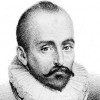
Michel de Montaigne (1533-1592) French essayist
Essays, Book 1, ch. 30 (1.30), “Of Cannibals [Des Cannibales]” (1578) [tr. Screech (1987), 1.31]
(Source)
Some translators use the 1588 sequence of chapters, not the 1595, and so identify this as ch. 31.
(Source (French)). Alternate translations:The reputation and worth of a man consisteth in his heart and will: therein consists true honour: Constancie is valour, not of armes and legs, but of minde and courage: it consisteth not in the spirit and courage of our horse, nor of our armes, but in ours.
[tr. Florio (1603)]The estimate and value of a man consist in the heart and in the will: there his true honour lies. Valour is stability, not of legs and arms, but of the courage and the soul; it does not lie in the goodness of our horse or our arms but in our own.
[tr. Cotton (1686)]The estimation and value of a man consist in the heart and the will; and therein lies his true honour. Valour is the stability, not of legs and arms, but of courage and the mind; it does not consist in the goodness of our horse, or our armour, but in ourselves.
[tr. Friswell (1868)]The estimate and value of a man consist in the heart and in the will: there his true honor lies. Valor is stability, not of legs and arms, but of the courage and the soul; it does not lie in the goodness of our horse or our arms: but in our own.
[tr. Cotton/Hazlitt (1877)]A man's estimation and value depend on his heart and his will; that is where his true honour lives; valour is strength, not of arms and legs, but of the mind and the soul; it does not depend upon the worth of our horse or of our armour, but upon our own.
[tr. Ives (1925), 1.31]The worth and value of a man is in his heart and his will; there lies his real honor. Valor is the strength, not of legs and arms, but of heart and soul; it consists not in the worth of our horse or our weapons, but in our own.
[tr. Frame (1943), 1.31]A man’s value and reputation depend on his heart and his resolution; there his true honour lies. Valour is strength, not of leg or arm, but of the heart and soul; it lies not in the goodness of our horse or our weapons, but in our own.
[tr. Cohen (1958), 1.31]A man's value and worth are to be found in his heart and will: that is where his true honor lies. Valor is strength not of legs and arms but of heart and mind; it is not a matter of our horse's or our weapons' value, but of our own.
[tr. Atkinson/Sices (2012)]
Quotations about:
heart
Note not all quotations have been tagged, so Search may find additional quotes on this topic.
The stars have not dealt me the worst they could do:
My pleasures are plenty, my troubles are two.
But oh, my two troubles they reave me of rest,
The brains in my head and the heart in my breast.A. E. Housman (1859-1936) English scholar and poet [Alfred Edward Housman]
“Additional Poems,” No. 17 (pub. 1937)
(Source)
So live, my boys, as brave men; and if fortune is adverse, front its blows with brave hearts.
[Quocirca vivite fortes
fortiaque adversis opponite pectora rebus.]Horace (65–8 BC) Roman poet, satirist, soldier, politician [Quintus Horatius Flaccus]
Satires [Saturae, Sermones], Book 2, # 2 “Quae virtus et quanta,” l. 135ff (2.2.135-136) (30 BC) [tr. Wickham (1903)]
(Source)
Often misattributed to Cicero.
(Source (Latin)). Alternate translations:Live bravely then,
And in all troubles quit your selves like men.
[tr. A. B.; ed. Brome (1666)]Then live Resolv'd, my Sons, refuse to yield,
And when Fates press make Constancy your shield.
[tr. Creech (1684)]Then be not with your present lot deprest,
And meet the future with undaunted breast
[tr. Francis (1747)]Bear up then, Boys! and stem the adverse tide,
Patience your stay and providence your guide!
[tr. Howes (1845)]Wherefore, live undaunted; and oppose gallant breasts against the strokes of adversity.
[tr. Smart/Buckley (1853)]So, then, live bravely on, and bravely stem adversity's opposing stream.
[tr. Millington (1870)]Then live like men of courage, and oppose
Stout hearts to this and each ill wind that blows.
[tr. Conington (1874)]Live, then, as brave men, and with brave hearts confront the strokes of fate.
[tr. Fairclough (Loeb) (1926)]SO LIVE BRAVE LIVES: STAND UP TO THE BLOWS OF FATE!
[tr. Palmer Bovie (1959)]So then, live, live and endure.
Meet life's difficulties with strong, enduring hearts.
[tr. Fuchs (1977)]Good reason whereby you should be
happy and confront adversity
with an undaunted soul.
[tr. Alexander (1999)]Live as brave men,
then, standing chest to chest with changeful fate.
[tr. Matthews (2002)]So be brave
and bravely throw out your chest to meet the force of fate!
[tr. Rudd (2005 ed.)]So live bravely, as men
With brave hearts do, and confront the vagaries of fate.
[tr. Kline (2015)]
Jesus said to them, ‘Do you not understand either? Can you not see that whatever goes into a man from outside cannot make him unclean, because it does not go into his heart but through his stomach and passes out into the sewer?’ (Thus he pronounced all foods clean.) And he went on, ‘It is what comes out of a man that makes him unclean. For it is from within, from men’s hearts, that evil intentions emerge: fornication, theft, murder, adultery, avarice, malice, deceit, indecency, envy, slander, pride, folly. All these evil things come from within and make a man unclean.’
[καὶ λέγει αὐτοῖς, Οὕτως καὶ ὑμεῖς ἀσύνετοί ἐστε; οὐ νοεῖτε ὅτι πᾶν τὸ ἔξωθεν εἰσπορευόμενον εἰς τὸν ἄνθρωπον οὐ δύναται αὐτὸν κοινῶσαι ὅτι οὐκ εἰσπορεύεται αὐτοῦ εἰς τὴν καρδίαν ἀλλ᾽ εἰς τὴν κοιλίαν, καὶ εἰς τὸν ἀφεδρῶνα ἐκπορεύεται, καθαρίζων πάντα τὰ βρώματα; ἔλεγεν δὲ ὅτι Τὸ ἐκ τοῦ ἀνθρώπου ἐκπορευόμενον, ἐκεῖνο κοινοῖ τὸν ἄνθρωπον. ἔσωθεν γὰρ ἐκ τῆς καρδίας τῶν ἀνθρώπων οἱ διαλογισμοὶ οἱ κακοὶ ἐκπορεύονται, πορνεῖαι, κλοπαί, φόνοι, μοιχεῖαι, πλεονεξίαι, πονηρίαι, δόλος, ἀσέλγεια, ὀφθαλμὸς πονηρός, βλασφημία, ὑπερηφανία, ἀφροσύνη· πάντα ταῦτα τὰ πονηρὰ ἔσωθεν ἐκπορεύεται καὶ κοινοῖ τὸν ἄνθρωπον.]
The Bible (The New Testament) (AD 1st - 2nd C) Christian sacred scripture
Mark 7: 18-23 (Jesus) [JB (1966)]
(Source)
This passage is paralleled in Matthew 15:17-20. See also Mark 7:15 (Matthew 15:11).
(Source (Greek)). Alternate translations:And he saith unto them, Are ye so without understanding also? Do ye not perceive, that whatsoever thing from without entereth into the man, it cannot defile him; because it entereth not into his heart, but into the belly, and goeth out into the draught, purging all meats? And he said, That which cometh out of the man, that defileth the man. For from within, out of the heart of men, proceed evil thoughts, adulteries, fornications, murders, thefts, covetousness, wickedness, deceit, lasciviousness, an evil eye, blasphemy, pride, foolishness: all these evil things come from within, and defile the man.
[KJV (1611)]“You are no more intelligent than the others,” Jesus said to them. “Don't you understand? Nothing that goes into you from the outside can really make you unclean, because it does not go into your heart but into your stomach and then goes on out of the body.” (In saying this, Jesus declared that all foods are fit to be eaten.)
And he went on to say, “It is what comes out of you that makes you unclean. For from the inside, from your heart, come the evil ideas which lead you to do immoral things, to rob, kill, commit adultery, be greedy, and do all sorts of evil things; deceit, indecency, jealousy, slander, pride, and folly -- all these evil things come from inside you and make you unclean.”
[GNT (1966)]Jesus said to them, 'Even you -- don't you understand? Can't you see that nothing that goes into someone from outside can make that person unclean, because it goes not into the heart but into the stomach and passes into the sewer? And he went on, 'It is what comes out of someone that makes that person unclean. For it is from within, from the heart, that evil intentions emerge: fornication, theft, murder, adultery, avarice, malice, deceit, indecency, envy, slander, pride, folly. All these evil things come from within and make a person unclean.'
[NJB (1985)]Jesus said to them, “Don’t you understand either? Don’t you know that nothing from the outside that enters a person has the power to contaminate? That’s because it doesn’t enter into the heart but into the stomach, and it goes out into the sewer.” By saying this, Jesus declared that no food could contaminate a person in God’s sight. “It’s what comes out of a person that contaminates someone in God’s sight,” he said. “It’s from the inside, from the human heart, that evil thoughts come: sexual sins, thefts, murders, adultery, greed, evil actions, deceit, unrestrained immorality, envy, insults, arrogance, and foolishness. All these evil things come from the inside and contaminate a person in God’s sight.”
[CEB (2011)]He said to them, “So, are you also without understanding? Do you not see that whatever goes into a person from outside cannot defile, since it enters not the heart but the stomach and goes out into the sewer?” (Thus he declared all foods clean.) And he said, “It is what comes out of a person that defiles. For it is from within, from the human heart, that evil intentions come: sexual immorality, theft, murder, adultery, avarice, wickedness, deceit, debauchery, envy, slander, pride, folly. All these evil things come from within, and they defile a person.”
[NRSV (2021 ed.)]
Do not store up riches for yourselves here on earth, where moths and rust destroy, and robbers break in and steal. Instead, store up riches for yourselves in heaven, where moths and rust cannot destroy, and robbers cannot break in and steal. For your heart will always be where your riches are.
[Μὴ θησαυρίζετε ὑμῖν θησαυροὺς ἐπὶ τῆς γῆς, ὅπου σὴς καὶ βρῶσις ἀφανίζει καὶ ὅπου κλέπται διορύσσουσιν καὶ κλέπτουσιν· θησαυρίζετε δὲ ὑμῖν θησαυροὺς ἐν οὐρανῷ, ὅπου οὔτε σὴς οὔτε βρῶσις ἀφανίζει καὶ ὅπου κλέπται οὐ διορύσσουσιν οὐδὲ κλέπτουσιν· ὅπου γάρ ἐστιν ὁ θησαυρός σου, ἐκεῖ ἔσται καὶ ἡ καρδία σου.]
The Bible (The New Testament) (AD 1st - 2nd C) Christian sacred scripture
Matthew 6: 19-21 (Jesus) [GNT (1966)]
(Source)
This passage is paralleled in Luke 12:33-34.
(Source (Greek)). Alternate translations:Lay not up for yourselves treasures upon earth, where moth and rust doth corrupt, and where thieves break through and steal: but lay up for yourselves treasures in heaven, where neither moth nor rust doth corrupt, and where thieves do not break through nor steal: for where your treasure is, there will your heart be also.
[KJV (1611)]Do not store up treasures for yourselves on earth, where moths and woodworms destroy them and thieves can break in and steal. But store up treasures for yourselves in heaven, where neither moth nor woodworms destroy them and thieves cannot break in and steal. For where your treasure is, there will your heart be also.
[JB (1966)]Do not store up treasures for yourselves on earth, where moth and woodworm destroy them and thieves can break in and steal. But store up treasures for yourselves in heaven, where neither moth nor woodworm destroys them and thieves cannot break in and steal. For wherever your treasure is, there will your heart be too.
[NJB (1985)]Stop collecting treasures for your own benefit on earth, where moth and rust eat them and where thieves break in and steal them. Instead, collect treasures for yourselves in heaven, where moth and rust don’t eat them and where thieves don’t break in and steal them. Where your treasure is, there your heart will be also.
[CEB (2011)]Do not store up for yourselves treasures on earth, where moth and rust consume and where thieves break in and steal, but store up for yourselves treasures in heaven, where neither moth nor rust consumes and where thieves do not break in and steal. For where your treasure is, there your heart will be also.
[NRSV (2021 ed.)]
In fact, were it given to our human eye to see into the consciences of others, we would judge a man much more surely from what he dreams than from what he thinks.
[En effet, s’il était donné à nos yeux de chair de voir dans la conscience d’autrui, on jugerait bien plus sûrement un homme d’après ce qu’il rêve que d’après ce qu’il pense.]
Victor Hugo (1802-1885) French writer
Les Misérables, Part 3 “Marius,” Book 5 “The Excellence of Misfortune,” ch. 5 (3.5.5) (1862) [tr. Wilbour/Fahnestock/MacAfee (1987)]
(Source)
(Source (French)). Alternate translations:In fact, were it given to our eye of flesh to see into the consciences of others, we should judge a man much more surely from what he dreams than from what he thinks.
[tr. Wilbour (1862)]In fact, if our eyes of the flesh were allowed to peer into the consciences of our neighbor, a man could be judged far more surely from what he dreams than from what he thinks.
[tr. Wraxall (1862)]In fact, had it been given to our eyes of the flesh to gaze into the consciences of others, we should be able to judge a man much more surely according to what he dreams, than according to what he thinks.
[tr. Hapgood (1887)]Indeed, if our earthly eyes possessed this power of seeing into the hearts of others, we would judge men far more surely by their dreams than by their thoughts.
[tr. Denny (1976)]For had it been given to our eyes of flesh to see into the conscience of others, our judgment of a man would be much sounder were it based on what he dreams rather than on what he thinks.
[tr. Donougher (2013)]
Love is but one thing with the gentle heart,
As in the saying of the sage we find;
Thus one from other cannot be apart,
More than the reason from the reasoning mind.[Amore e ’l cor gentil sono una cosa,
Si come il saggio in suo dittare pone,
E cosi esser I’un sanza altro osa
Com’alma razional sanza ragione.]Dante Alighieri (1265-1321) Italian poet
La Vita Nuova [Vita Nova; New Life], ch. 20, Sonnet 8, ll. 1-4 (c. 1294, pub. 1576) [tr. Norton (1867)]
(Source)
The wise man referenced is the poet Guido Guinizzelli (or Guinicelli).
(Source (Italian)). Alternate translations:Love and the gentle heart are but one thing,
As says the wise man in his apothegm;
And one can by itself no more exist
Than reason can without the reasoning soul.
[tr. Lyell (1845)]Love and the gentle heart are one same thing,
Even as the wise man in his ditty saith:
Each, of itself, would be such life in death
As rational soul bereft of reasoning.
[tr. Rossetti (c. 1847; 1899 ed.)]They are the same, Love and the gentle heart!
So runs the saw, which from the sage I stole;
Nor can they more abide, from each apart,
Than reason parted from the reasoning soul.
[tr. Martin (1862)]Love and the noble heart are but one thing,
Even as the wise man tells us in his rhyme,
The one without the other venturing
As well as reason from a reasoning mind.
[tr. Reynolds (1969)]Love and the gracious heart are but one thing,
As Guinizelli tells us in his rhyme;
As much can one without the other be
As without reason can the reasoning mind.
[tr. Musa (1971)]Love and the gracious heart are a single thing, as Guinizelli tells us in his poem: one can no more be without the other than can the reasoning mind without its reason.
[tr. Hollander (1997), sec. 3]Love and the gentle heart are one thing,
as the wise man puts it in his verse,
and each without the other would be dust,
as a rational soul would be without its reason.
[tr. Kline (2002)]Love and the noble heart are one and the same thing,
as the sage states in his poem,
and one of them dares as little to exist without the other
as does the rational soul without reasoning.
[tr. Appelbaum (2006)]Love and the open heart are always one,
the sage has written; neither love nor heart
can be until the other is begun,
as thought confirms a thinking counterpart.
[tr. Frisardi (2012), ch. 11]
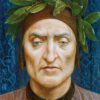
The moment I saw her I say in all truth that the vital spirit, which dwells in the inmost depths of the heart, began to tremble so violently that I felt the vibration alarmingly in all my pulses, even the weakest of them. As it trembled, it uttered these words: Ecce deus fortior me, qui veniens dominabitur mihi [Behold a god more powerful than I who comes to rule over me].
[In quello punto dico veracemente che lo spirito de la vita, lo quale dimora ne la secretissima camera de lo cuore, cominciò a tremare sì fortemente, che apparia ne li menimi polsi orribilmente; e tremando disse queste parole: «Ecce deus fortior me, qui veniens dominabitur michi»]Dante Alighieri (1265-1321) Italian poet
La Vita Nuova [Vita Nova; New Life], ch. 2 (c. 1294, pub. 1576) [tr. Reynolds (1969)]
(Source)
On first seeing his beloved Beatrice (when both were nine years old). Other body parts that react are his senses, particularly his sight, which will now know "bliss"; and his stomach, which fears it will always be knotted and suffering from indigestion.
(Source (Italian)). Alternate translations:At that moment, I say most truly that the spirit of life, which hath its dwelling in the secretest chamber of the heart, began to tremble so violently that the least pulses of my body shook therewith; and in trembling it said these words: Ecce deus fortior me, qui veniens dominabitur mihi [Here is a deity stronger than I; who, coming, shall rule over me].
[tr. Rossetti (c. 1847; 1899 ed.), ch. 1]At that moment (I speak it in all truth) the spirit of life, which abides in the most secret chamber of the heart, began to trumble with a violence that showed horribly in the minutest pulsations of my fram, and tremulously it spoke these words: -- "Ecce deus fortior me, qui veniens dominabitur mihi! Behold a god stronger than I, who cometh to triumph over me!"
[tr. Martin (1862), ch. 1]At that instant, I say truly that the spirit of life, which dwells in the most secret chamber of the heart, began to tremble with such violence that it appeared fearfully in the least pulses, and, trembling, said these words: Ecce deus fortior me, qui veniens dominabitur mihi [Behold a god stronger than I, who coming shall rule over me].
[tr. Norton (1867), ch. 2]At that moment, I say truly that the vital spirit, the one that dwells in the most secret chamber of the heart, began to tremble so violently that even the least pulses of my body were strangely affected; and trembling, it spoke these words: “Here is a god stronger than I, who shall come to rule over me.”
[tr. Musa (1971), ch. 2]At that very moment, and I speak the truth, the vital spirit, the one that dwells in the most secret chamber of the heart, began to tremble so violently that even the most minute veins of my body were strangely affected; and trembling, it spoke these words: Ecce deus fortior me, qui veniens dominabitur michi.
[tr. Hollander (1997), ch. 2]At that moment I say truly that the vital spirit, that which lives in the most secret chamber of the heart began to tremble so violently that I felt it fiercely in the least pulsation, and, trembling, it uttered these words: "Ecce deus fortior me, qui veniens dominabitur michi: Behold a god more powerful than I, who, coming, will rule over me."
[tr. Kline (2002), ch. 2]At that moment, I say truly, the vital spirit, which resides in the most secret chamber of the heart, began to tremble so strongly that it was terribly evident in my slightest heartbeats, and tremblingly it spoke these words: "Behold a god stronger than I, who is coming and will dominate me."
[tr. Appelbaum (2006), ch. 2]At that time, truly, I say, the vital spirit, which dwells in the innermost chamber of the heart, started to tremble so powerfully that its disturbance reached all the way to the slightest of my pulses. And trembling it spoke these words: “Ecce deus fortior me, qui veniens dominabitur michi” [Here is a god stronger than I, who comes to rule me].
[tr. Frisardi (2012), ch. 1]
When he left the bishop’s dwelling Jean Valjean, as we know, had been in a state of mind unlike anything he had ever experienced before and was quite unable to account for what was taking place within him. He had sought to harden his heart against the old man’s saintly act and moving words. “You have promised me to become an honest man. I am buying your soul. I am rescuing it from the spirit of perversity and giving it to God.” The words constantly returned to him and he sought to suppress them with arrogance, which in all of us is the stronghold of evil. Obscurely he perceived that the priest’s forgiveness was the most formidable assault he had ever sustained; that if he resisted it his heart would be hardened once and for all, and that if he yielded he must renounce the hatred which the acts of men had implanted in him during so many years, and to which he clung. He saw dimly that this time he must either conquer or be conquered, and that the battle was now joined, a momentous and decisive battle between the evil in himself and the goodness in that other man.
[Quand Jean Valjean était sorti de chez l’évêque, on l’a vu, il était hors de tout ce qui avait été sa pensée jusque-là. Il ne pouvait se rendre compte de ce qui se passait en lui. Il se roidissait contre l’action angélique et contre les douces paroles du vieillard. « Vous m’avez promis de devenir honnête homme. Je vous achète votre âme. Je la retire à l’esprit de perversité et je la donne au bon Dieu. » Cela lui revenait sans cesse. Il opposait à cette indulgence céleste l’orgueil, qui est en nous comme la forteresse du mal. Il sentait indistinctement que le pardon de ce prêtre était le plus grand assaut et la plus formidable attaque dont il eût encore été ébranlé ; que son endurcissement serait définitif s’il résistait à cette clémence ; que, s’il cédait, il faudrait renoncer à cette haine dont les actions des autres hommes avaient rempli son âme pendant tant d’années, et qui lui plaisait ; que cette fois il fallait vaincre ou être vaincu, et que la lutte, une lutte colossale et définitive, était engagée entre sa méchanceté à lui et la bonté de cet homme.]
Victor Hugo (1802-1885) French writer
Les Misérables, Part 1 “Fantine,” Book 2 “The Fall,” ch. 13 (1.2.13) (1862) [tr. Denny (1976)]
(Source)
(Source (French)). Alternate translations:When Jean Valjean left the bishop's house, as we have seen, his mood was one that he had never known before. He could understand nothing of what was passing within him. He set himself stubbornly in opposition to the angelic deeds and the gentle words of the old man, “you have promised me to become an honest man. I am purchasing your soul, I withdraw it from the spirit of perversity, and I give it to God Almighty." This came back to him incessantly. To this celestial tenderness, he opposed pride, which is the fortress of evil in man. He felt dimly that the pardon of this priest was the hardest assault, and the most formidable attack which he had yet sustained ; that his hardness of heart would be complete, if it resisted this kindness; that if he yielded, be must renounce that hatred with which the acts of other men had for so many years filled his soul, and in which he found satisfaction; that, this time, he must conquer or be conquered, and that the struggle, a gigantic and decisive struggle, had begun between his own wickedness, and the goodness of this man.
[tr. Wilbour (1862)]When Jean Valjean quitted the bishop’s house, he was lifted out of his former thoughts, and could not account for what was going on within him. He stiffened himself against the angelic deeds and gentle words of the old man: “You have promised me to become an honest man. I purchase your soul; I withdraw it from the spirit of perverseness, and give it to God.” This incessantly recurred to him, and he opposed to this celestial indulgence that pride which is within us as the fortress of evil. He felt instinctively that this priest’s forgiveness was the greatest and most formidable assault by which he had yet been shaken; that his hardening would be permanent if he resisted this clemency; that if he yielded he must renounce that hatred with which the actions of other men had filled his soul during so many years, and which pleased him; that this time he must either conquer or be vanquished, and that the struggle, a colossal and final struggle, had begun between his wickedness and that man’s goodness.
[tr. Wraxall (1862)]When Jean Valjean left the Bishop's house, he was, as we have seen, quite thrown out of everything that had been his thought hitherto. He could not yield to the evidence of what was going on within him. He hardened himself against the angelic action and the gentle words of the old man. "You have promised me to become an honest man. I buy your soul. I take it away from the spirit of perversity; I give it to the good God."
This recurred to his mind unceasingly. To this celestial kindness he opposed pride, which is the fortress of evil within us. He was indistinctly conscious that the pardon of this priest was the greatest assault and the most formidable attack which had moved him yet; that his obduracy was finally settled if he resisted this clemency; that if he yielded, he should be obliged to renounce that hatred with which the actions of other men had filled his soul through so many years, and which pleased him; that this time it was necessary to conquer or to be conquered; and that a struggle, a colossal and final struggle, had been begun between his viciousness and the goodness of that man.
[tr. Hapgood (1887)]When Jean Valjean left the bishop's house, as we saw, his thoughts were unlike any he had ever known before. He could understand nothing of what was going on inside him. He stubbornly resisted the angelic deeds and the gentle words of the old man, "You have promised me to become an honest man. I am purchasing your soul. I withdraw it from the spirit of perdition, and I give it to God!" This kept coming back to him. In opposition to this celestial tenderness, he summoned up pride, the fortress of evil in man. He dimly felt that this priest's pardon was the hardest assault, the most formidable attack he had ever sustained; that his hardness of heart would be complete, if it resisted this kindness; that if he yielded, he would have to renounce the hatred with which the acts of other men had for so many years filled his soul, and in which he found satisfaction; that, this time, he must conquer or be conquered, and that the struggle, a gigantic and decisive struggle, had begun between his own wrongs and the goodness of this man.
[tr. Wilbour/Fahnestock/MacAfee (1987)]When jean Valjean left the bishop's house he was, as we have seen, in what was to him an entirely different mental universe. He could not undersdtand what was going on inside him. He hardened himself against the old man's angelic deed and gentle words. "You promised to become an honest man. I'm buying your soul. I'm redeeming it from the spirit of iniquity and giving it to the good Lord." This kept coming back to him. This heavenly kindness he countered with pride -- the fortress of evil, as it were, within us. He had the indistinct feeling that this priest's forgiveness was the greatest assault and most tremendous attack he had ever experience. That if he resisted this clemency the hardening of his heart would be definitive. That if he yielded he would be obliged to renounce that hatred with which the deeds of other men had filled his soul over so many years, a hatred he relished. That this time he had to vanquish or be vanquished, and that the battle had been joined, a colossal and decisive battle, between his own wickedness and that man's goodness.
[tr. Donougher (2013)]
I won’t say, the more intellect, the less capacity for loving; for that would do wrong to the understanding and reason; — but, on the other hand, that the brain often runs away with the heart’s best blood, which gives the world a few pages of wisdom or sentiment or poetry, instead of making one other heart happy, I have no question.
Oliver Wendell Holmes, Sr. (1809-1894) American poet, essayist, scholar
Article (1858-04), “Autocrat of the Breakfast-Table,” Atlantic Monthly
(Source)
Collected in Autocrat of the Breakfast-Table, ch. 6 (1858).
You may choose your word like a connoisseur,
And polish it up with art,
But the word that sways, and stirs, and stays,
Is the word that comes from the heart.Ella Wheeler Wilcox (1850-1919) American author, poet, temperance advocate, spiritualist
Poem (1906), “The Word,” st. 2, New Thought Pastels
(Source)

The history of the world shows us that men are not to be counted by their numbers, but by the fire and vigour of their passions; by their deep sense of injury; by their memory of past glory; by their eagerness for fresh fame; by their clear and steady resolution of ceasing to live, or of achieving a particular object, which, when it is once formed, strikes off a load of manacles and chains, and gives free space to all heavenly and heroic feelings. All great and extraordinary actions come from the heart.
Sydney Smith (1771-1845) English clergyman, essayist, wit
Lecture (1804-1806), Moral Philosophy, No. 27 “On Habit, Part 2,” Royal Institution, London
(Source)
Collected in his Elementary Sketches of Moral Philosophy (1849).
Quoted by Theodore Roosevelt in his speech (1901-09-05), "Brotherhood and the Heroic Virtues," Grand Army of the Republic Veterans Reunion, Burlington, Vermont, collected in Roosevelt's The Strenuous LIfe (1902).
Her mind lives tidily, apart
From cold and noise and pain,
And bolts the door against her heart,
Out wailing in the rain.
We are afraid of having and showing a small mind, and we are not afraid of having and showing a small heart.
Joseph Joubert (1754-1824) French moralist, philosopher, essayist, poet
Pensées [Thoughts], 1805 entry [tr. Auster (1983)]
(Source)
I could not find an analog in other translations of the Pensées.
Where the heart is in the giving, there is no question of goods that are being traded thriftily. In giving, you throw a bridge across the chasm of your solitude.
Antoine de Saint-Exupéry (1900-1944) French writer, aviator
Citadelle [The Wisdom of the Sands], ch. 46 (1948) [tr. Gilbert (1950)]
(Source)
Anything you do from the heart enriches you, but sometimes not till years later.
Mignon McLaughlin (1913-1983) American journalist and author
The Neurotic’s Notebook, ch. 9 (1963)
(Source)

The Mediator between Brain and Hands must be the Heart.
[Der Mittler zwischen Hirn und Händen muss das Herz sein.]
Thea von Harbou (1888-1954) German screenwriter, novelist, film director, actress
Metropolis, ch. 5 [Maria] (1925) [tr. (1927)]
(Source)
The novel was written to be the basis for the film by Von Harbou's husband, Fritz Lang. She also collaborated with him on the script. The movie began shooting before the novel was published.
In talking with the growingly restless workers of the city, Maria adds, shortly after the above line:One will come, who will speak for you -- who will be the mediator between you, the Hands, and the man whose Brain and Will are over you all.
Von Harbau also included an epigraph at the beginning of the novel, which concludes (with a slightly different translation): "The mediator between brain and muscle must be the Heart."
To be kind is more important than to be right. Many times, what people need is not a brilliant mind that speaks but a special heart that listens.
F. Scott Fitzgerald (1896-1940) American writer [Francis Scott Key Fitzgerald]
(Attributed)
No actual citation found. Also often attributed (also without citation) to Menachem Mendel Schneerson.
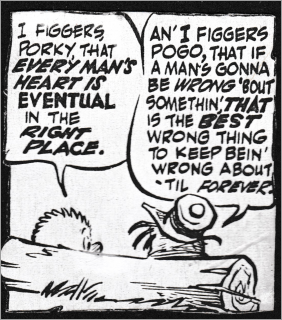
POGO: I figgers, Porky, that every man’s heart is eventual in the right place.
PORKY PINE: An’ I figgers, Pogo, that if a man’s gonna be wrong ’bout somethin’, that is the best wrong thing to keep bein’ wrong about til forever.
Walt Kelly (1913-1973) American animator and cartoonist [Walter Crawford Kelly, Jr.]
The Incompleat Pogo, ch. 20 “A Tiger Burns Bright” (1953)
(Source)
Many sources paraphrase this as:POGO: Eventual Porky, I figger ev'ry critter's heart's in the right place.
PORKY PINE: If you gotta be wrong 'bout somthin', that's 'bout the best thing they is to be wrong 'bout.
For life without life’s joys
Is living death; and such a life is his.
Riches and rank and show of majesty
And state, where no joy is, are empty, vain
And unsubstantial shadows, of no weight
To be compared with happiness of heart.[τὰς γὰρ ἡδονὰς
ὅταν προδῶσιν ἄνδρες, οὐ τίθημ᾽ ἐγὼ
ζῆν τοῦτον, ἀλλ᾽ ἔμψυχον ἡγοῦμαι νεκρόν.
πλούτει τε γὰρ κατ᾽ οἶκον, εἰ βούλει, μέγα
καὶ ζῆ τύραννον σχῆμ᾽ ἔχων: ἐὰν δ᾽ ἀπῇ
τούτων τὸ χαίρειν, τἄλλ᾽ ἐγὼ καπνοῦ σκιᾶς
οὐκ ἂν πριαίμην ἀνδρὶ πρὸς τὴν ἡδονήν]Sophocles (496-406 BC) Greek tragic playwright
Antigone, l. 1165ff [Messenger] (441 BC) [tr. Watling (1947), Epilogos, l. 977ff]
(Source)
Original Greek. Alternate translations:For him I reckon but
An animate corpse, and not a living man,
Whose life's delights are cast away. Thy house,
I grant thee, may be richly stored with wealth;
And thou may'st live in royal pomp: but if
Joy is not there the while, and I must lose
All happiness thereby, I would not give
Smoke's shadow as the price of all the rest.
[tr. Donaldson (1848)]For a life
Without life's joys I count a living death.
You'll tell me he has ample store of wealth,
The pomp and circumstance of kings; but if
These give no pleasure, all the rest I count
The shadow of a shade, nor would I weigh
His wealth and power 'gainst a dram of joy.
[tr. Storr (1859)]For when a man is lost to joy,
I count him not to live, but reckon him
A living corse. Riches belike are his,
Great riches and the appearance of a King;
But if no gladness come to him, all else
Is shadow of a vapour, weighed with joy.
[tr. Campbell (1873)]When a man has forfeited his pleasures, I do not reckon his existence as life, but consider him just a breathing corpse. Heap up riches in your house, if you wish! Live with a tyrant's pomp! But if there is no joy along with all of that, I would not pay even the shadow of smoke for all the rest, compared with joy.
[tr. Jebb (1891)]For when a man hath forfeited his pleasures, I count him not as living, -- I hold him but a breathing corpse. Heap up riches in thy house, if thou wilt; live in kingly state; yet, if there be no gladness therewith, I would not give the shadow of a vapour for all the rest, compared with joy.
[tr. Jebb (1917)]Who can say
That a man is still alive when his life’s joy fails?
He is a walking dead man. Grant him rich,
Let him live like a king in his great house:
If his pleasure is gone, I would not give
So much as the shadow of smoke for all he owns.
[tr. Fitts/Fitzgerald (1939), l. 910ff]Yes, when a man has lost all happiness,
he's not alive. Call him a breathing corpse.
Be very rich at home. Live as a king.
But once your joy has gone, though these are left
they are smoke's shadow to lost happiness.
[tr. Wyckoff (1954)]He who forfeits joy
Forfeits his life; he is a breathing corpse.
Heap treasures in your palace, if you will,
And wear the pomp of royalty; but if
You have no happiness, I would not give
A straw for all of it, compared with joy.
[tr. Kitto (1962)]Believe me,
when a man has squandered his true joys,
he's good as dead, I tell you, a living corpse.
Pile up riches in your house, as much as you like --
live like a king with a huge show of pomp,
but if real delight is missing from the lot,
I wouldn't give you a wisp of smoke for it,
not compared to joy. [tr. Fagles (1982), l. 1284ff]When every source of joy deserts a man,
I don't call him alive: he's an animated corpse.
For my money, you can get rich as you want,
You can wear the face of a tyrant,
But if you have no joy in this,
Your life's not worth the shadow of a puff of smoke.
[tr. Woodruff (2001)]Whenever men forfeit their pleasures, I do not regard
such a man as alive, but I consider him a living corpse.
Be very wealthy in your household, if you wish, and live
the style of absolute rulers, but should the enjoyment of these
depart, what is left, compared to pleasure,
I would not buy from a man for a shadow of smoke.
[tr. Tyrell/Bennett (2002)]When a man’s body has lost all sense of joy, you can say he’s not alive any more. He is a living corpse. You can have as much wealth in your house as you like and you can live like a king but when joy is missing then all those other things I wouldn’t exchange for the price of the shadow of smoke -- not against the sweetness of joy!
[tr. Theodoridis (2004), "Herald"]For when a man has lost
what gives him pleasure, I don’t include him
among the living -- he’s a breathing corpse.
Pile up a massive fortune in your home,
if that’s what you want -- live like a king.
If there’s no pleasure in it, I’d not give
to any man a vapour’s shadow for it,
not compared to human joy.
[tr. Johnston (2005), l. 1296ff]But when people lose their pleasures, I do not consider this life -- rather, it is just a corpse with a soul.
[tr. @sentantiq (2018)]
Hell is not in torture.
Hell is in an empty heart.Kahlil Gibran (1883-1931) Lebanese-American poet, writer, painter [Gibran Khalil Gibran]
“The Sayings of the Brook [Ma Taqul al-Saqiyah]” [tr. Sheban]
(Source)
I love not to be constrained to love; for love must only arise of the heart’s self, and not by no constraint.
Thomas Malory (c. 1415-1471) English writer
Le Morte d’Arthur, Book 18, ch. 20 (1485)
(Source)
Lancelot to Guinevere, of the Lady of Ascolat.

NEMO: What you fail to understand is the power of hate. It can fill the heart as surely as love can.
Earl Felton (1909-1972) American screenwriter
20,000 Leagues Under the Sea, screenplay (1954) [with Richard Fleischer]
(Source)
Explaining his campaign on wagers of war. Based on the novel by Jules Verne (1870). The words are not in the novel.
Sorrow is how we learn to love. Your heart isn’t breaking. It hurts because it’s getting larger. The larger it gets, the more love it holds.

I think our heart-strings were, like warp and woof
In some firm fabric, woven in and out;
Your golden filaments in fair design
Across my duller fibre.Edna St. Vincent Millay (1892-1950) American poet
“Interim,” Renascence and Other Poems (1917)
(Source)
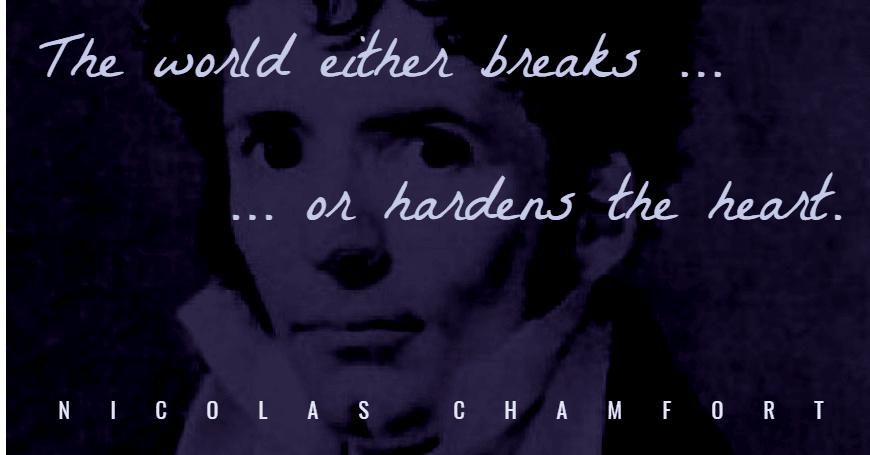
The world either breaks or hardens the heart.
[En vivant et en voyant les hommes, il faut que le cœur se briese ou se bronze.]
Nicolas Chamfort (1741-1794) French writer, epigrammist (b. Nicolas-Sébastien Roch)
Products of Perfected Civilization [Produits de la Civilisation Perfectionnée], Part 2 “Characters and Anecdotes [Caractères et Anecdotes],” ch. 3 (frag. 771) (1795) [tr. Finod (1880)]
(Source)
(Source (French))
Attributed by Chamfort as a statement in a philosophical debate, made by "M. D---". Finod's translation is very much a paraphrase, as is:Contact with the world either breaks or hardens the heart.
[ed. Ballou (1882)]
More literal translations:Living among men and observing them, the heart must either break or turn to bronze.
[tr. Merwin (1969)]In living and in seeing men, the heart must break or be bronzed.
[Source]
Though attributed by Chamfort to "M. D----," he also used the phrase himself, and it is usually attributed to him. Toward the end of his life, he wrote:Je m'en vais enfin, de ce monde où il faut que le cœur se briese ou se bronze.
[I am leaving at last from this world where the heart must break or become bronze.]
The heart never grows better by age; I fear rather worse; always harder. A young liar will be an old one; and a young knave will only be a greater knave as he grows older.
Lord Chesterfield (1694-1773) English statesman, wit [Philip Dormer Stanhope]
Letter to his son, #225 (17 May 1750)
(Source)
A generous heart suffers for the misfortunes of others as much as though it had caused them.
Luc de Clapiers, Marquis de Vauvenargues (1715-1747) French moralist, essayist, soldier
Reflections and Maxims [Réflexions et maximes], #173 (1746) [tr. Stevens (1940)]
Hearts can break. Yes. Hearts can break. Sometimes I think it would be better if we died when they did, but we don’t.
Stephen King (b. 1947) American author
Hearts in Atlantis (1999)

No man can tell whether he is rich or poor by turning to his ledger. It is the heart that makes a man rich. He is rich or poor according to what he is, not according to what he has.
Henry Ward Beecher (1813-1887) American clergyman and orator
Life Thoughts: Gathered from the Extemporaneous Discourses of Henry Ward Beecher (1858)
In matters of the heart, nothing is true except the improbable.
Germaine de Staël (1766-1817) Swiss-French writer, woman of letters, critic, salonist [Anne Louise Germaine de Staël-Holstein, Madame de Staël, Madame Necker]
Letter to Juliette Récamier (5 Oct 1810)

Why do men with little souls have to have big weapons?
Robert A. Heinlein (1907-1988) American writer
Friday [Friday Jones] (1982)
Nothing for preserving the body like having no heart.
Men, as well as women, are much oftener led by their hearts than by their understandings.
Lord Chesterfield (1694-1773) English statesman, wit [Philip Dormer Stanhope]
Letter to his son, #154 (21 Jan 1748)
(Source)
The ruling passion, be it what it will,
The ruling passion conquers reason still.Alexander Pope (1688-1744) English poet
Moral Essays 3.153 (1731-1735)
JULIET: My bounty is as boundless as the sea,
My love as deep; the more I give to thee,
The more I have, for both are infinite.William Shakespeare (1564-1616) English dramatist and poet
Romeo and Juliet, Act 2, sc. 2, l. 139ff (2.2.139-141) (c. 1594)
(Source)
HENRY: A speaker is but a prater, a rhyme is but a ballad, a good leg will fall, a straight back will stoop, a black beard will turn white, a curled pate will grow bald, a fair face will wither, a full eye will wax hollow, but a good heart, Kate, is the sun and the moon, or rather the sun and not the moon, for it shines bright and never changes but keeps his course truly. If thou would have such a one, take me.
The old woman took the umbrella, gratefully, and smiled her thanks. “You’ve a good heart,” she told him. “Sometimes that’s enough to see you safe wherever you go.” Then she shook her head. “But mostly, it’s not.”
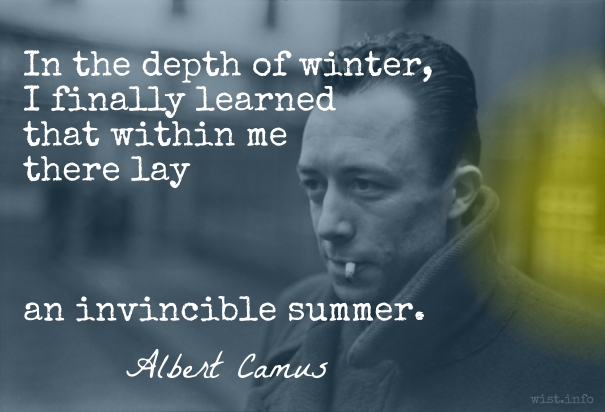
In the depth of winter, I finally learned that within me there lay an invincible summer.
Albert Camus (1913-1960) Algerian-French novelist, essayist, playwright
“Return to Tipasa,” Summer (1954)
Yet loneliness shall weary thee, and still
Love torture thee with longings nought can fill.
Absence makes passion’s tide have double sway,
Possession cloys the love of every day.[Nulla tamen lecto recipit se sola libenter:
Est quiddam, quod vos quaerere cogat Amor.
Semper in absentes felicior aestus amantes:
Elevat assiduos copia longa viros.]Propertius (50-16 BC) Roman elegiac poet [Sextus Propertius]
Elegies, Book 2, No. 33C, “To Cynthia,” ll. 41-44 [tr. Moore (1870); 3.25]
(Source)
This quote (the third line) appears to be the origin of the English proverb, "Absence makes the heart grow fonder." The first use of those exact words appear to be from a song by T. H. Bayly, "Isle of Beauty, Fare Thee Well" (1826?). For more discussion of the origin (and variants) of that phrase see etymology - Who is the author of "Absence makes the heart grow fonder"? - English Language & Usage Stack Exchange.
Not surprisingly, the idea of absence increasing (or decreasing) ardor is a a frequently discussed theme. See this English Proverb; Cervantes (1605); Rabutin (1660); La Rochefoucauld (1678); Johnson (1758); Mirabeau (1770); Ouida (1878); Antrim (1905); Shaw (1931); Bowen (1938); Stark (1953).
Propertius' elegies, as handed down, are something of a mess, and the assignment to them in particular books has been of sharp debate. This passage is currently considered a fragment, connected to 2.33 (and called 2.33A, or 2.33B, or 2.33C by different translators); similarly, the line numbering in sometimes carried across the entire 2.33, other times broken between the fragments. This fragmentary nature is also why the two couplets here appear in different order between different translations.
Nineteenth Century sources, based on the manuscript traditions of the time, assign this as 3.25.
(Source (Latin)). Other translations:Yet loath to bed her way lone maiden wends,
Love keeps her brooding o'er forbidden joys;
More deeply yearns the heart for absent friends:
Even of the leal [loyal] the long possession cloys.
[tr. Cranstoun (1875); 3.25]But no one retires with good will to her solitary couch. There is something that Love forces you to miss. There is always a more favourable disposition towards absent lovers; long possession lowers the value even of the devoted.
[tr. Gantillon (1880); 3.25]No woman takes herself cheerfully to bed alone though: there is something which Love makes you fain to look for.
Desire always burns kindlier toward absent lovers: long plenty of opportunity makes cheap the never-failing suitor.
[tr. Phillimore (1906); 2.33]Yet no woman ever betakes her willingly to a lonely bed; there is a somewhat that Love compels all to seek. Woman's heart is kinder always towards absent lovers; long possession takes from the worth of the persistent wooer.
[tr. Butler (1912); 2.33]Woman's heart is ever fonder towards an absent lover: long possession lessens the appeal of the persistent wooer. Yet no woman willingly retires to bed alone: there is something which Love compels you all to seek.
[tr. Goold (Loeb) (1990); frag. 2.33C]No girl ever willingly goes to bed alone: something there is desire leads us all to search for. Passion is often greater in absent lovers: endless presence reduces the man who’s always around.
[tr. Kline (2008); 2.33A]Passion helps the absent lover: long persistence
elevates the assiduous man.
No man gladly goes to bed alone, for Amor
gives us something all must seek.
[tr. Holcombe (2009); frag. 2.33C]
‘A good heart will help you to a bonny face, my lad,’ I continued, ‘if you were a regular black; and a bad one will turn the bonniest into something worse than ugly.’
Emily Brontë (1818-1848) British novelist, poet [pseud. Ellis Bell]
Wuthering Heights, ch. 7 [Nelly to Heathcliff] (1847)Full text.
Here is my secret. It is very simple. It is only with the heart that one can see rightly; What is essential is invisible to the eye.
[Voici mon secret. Il est très simple: on ne voit bien qu’avec le cœur. L’essentiel est invisible pour les yeux.]
Antoine de Saint-Exupéry (1900-1944) French writer, aviator
Le Petit Prince [The Little Prince] (1943)
Alternate translations:
- "Here is my secret. It is very simple: one sees well only with the heart. The essential is invisible to the eyes."
- "The essential things in life are seen not with the eyes, but with the heart."
DON JUAN: I can’t, in short, deny my heart to anything that strikes me as lovable, and the sight of a beautiful face so masters me that, if I had a thousand hearts, I’d give them all. There is, besides, an inexpressible charm in the first stirrings of a new passion, and the whole pleasure of love lies in change.
[DOM JUAN: Quoi qu’il en soit, je ne puis refuser mon cœur à tout ce que je vois d’aimable; et, dès qu’un beau visage me le demande, si j’en avais dix mille, je les donnerais tous. Les inclinations naissantes, après tout, ont des charmes inexplicables, et tout le plaisir de l’amour est dans le changement.]
Molière (1622-1673) French playwright, actor [stage name for Jean-Baptiste Poquelin]
Don Juan [Dom Juan], Act 1, sc. 2 (1665) [tr. Wilbur (2001)]
(Source)
(Source (French)). Other translations:However it is, I can't refuse my Heart to any lovely Creature I see, and from the Moment a handsome Face demands it, had I thousand Hearts I'd give 'em all. The rising Inclinations, after all, have inexplicable Charmes in 'em, and all the Pleasure of Love consists in the Variety.
[tr. Clitandre (1672)]However it may be, I cannot refuse my heart to any lovely creature I behold; and as soon as a handsome face asks it of me, if I had ten thousand hearts, I would give them all. Budding inclinations, after all, have a charm which is indescribable, and all the pleasure of love is in variety.
[tr. Van Laun (1876)]Whatever may have taken place before, I cannot refuse my love to any of the lovely women I behold; and, as soon as a handsome face asks it of me, if I had ten thousand hearts I would give them all away. The first beginnings of love have, besides, indescribable charms, and the true pleasure of love consists in its variety.
[tr. Wall (1879)]However it may be, I cannot refuse my heart to any lovely creature I see; and, as soon as a pretty face asks me, had I ten thousand hearts I would give them all. First beginnings, besides, have indescribable charms, and ll the pleasure of love consists in variety.
[tr. Waller (1904)]I cannot refuse my heart to any lovely creature I behold, and as soon as a fair face asks it, had I ten thousand hearts I'd give them all. Love at its birth hath unexpressible charms, and all the pleasure of it lies in change.
[tr. Page (1908)]Whatever my situation, I cannot refuse my heart to anyone I see to be lovable; and as soon as a fair face asks me for it, if I had ten thousand hearts I'd give them all. After all, budding inclinations have unaccountable charms, and the whole pleasure of love lies in change.
[tr. Frame (1967)]I can't withhold my love from everything I find lovable. What happens later -- happens. A beautiful face has only to ask for my heart. If I had ten thousand hearts, I'd give them all. There is something indescribable and thrilling in a fresh affair. The entire pleasure of love lies in how it changes.
[tr. Bermel (1987)]
Love is the magician, the enchanter, that changes worthless things to joy, and makes right royal kings and queens of common clay. It is the perfume of that wondrous flower, the heart, and without that sacred passion, that divine swoon, we are less than beasts; but with it, earth is heaven, and we are gods.

Tho’ much is taken, much abides; and tho’
We are not now that strength which in old days
Moved earth and heaven; that which we are, we are;
One equal temper of heroic hearts,
Made weak by time and fate, but strong in will
To strive, to seek, to find, and not to yield.
Too long a sacrifice
Can make a stone of the heart.
O when may it suffice?William Butler Yeats (1865-1939) Irish poet and dramatist
“Easter 1916,” st. 4, ll. 57-59, Michael Robartes and the Dancer (1921)
(Source)
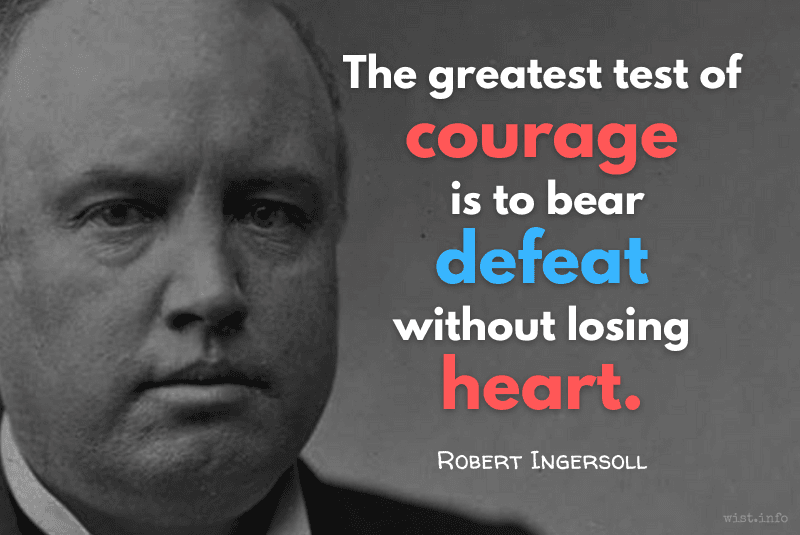
The greatest test of courage is to bear defeat without losing heart.
Robert Green Ingersoll (1833-1899) American lawyer, freethinker, orator
Speech (1876-07-04), “Centennial Oration [The Declaration of Independence],” Peoria, Illinois
(Source)
Love anything and your heart will be wrung and possibly broken. If you want to make sure of keeping it intact you must give it to no one, not even an animal. Wrap it carefully round with hobbies and little luxuries; avoid all entanglements. Lock it up save in the casket or coffin of your selfishness. But in that casket — safe, dark, motionless, airless — it will change. It will not be broken; it will become unbreakable, impenetrable, irredeemable. To love is to be vulnerable.
C. S. Lewis (1898-1963) English writer, literary scholar, lay theologian [Clive Staples Lewis]
The Four Loves
Just as water reflects the face,
so one human heart reflects another.The Bible (The Old Testament) (14th - 2nd C BC) Judeo-Christian sacred scripture [Tanakh, Hebrew Bible], incl. the Apocrypha (Deuterocanonicals)
Proverbs 27:19 [NRSV (2021 ed.)]
(Source)
Alternate translations:As in water face answereth to face, so the heart of man to man.
[KJV (1611)]As no two faces are ever alike, unlike, too, are the hearts of men.
[JB (1966)]A mirror reflects a man’s face, but what he is really like is shown by the kind of friends he chooses.
[TLB (1971)]It is your own face that you see reflected in the water and it is your own self that you see in your heart.
[GNT (1976)]As water reflects face back to face, so one human heart reflects another.
[NJB (1985)]As water reflects the face,
so one’s life reflects the heart.
[NIV (2011 ed.)]As water reflects the face,
so others reflect your heart back to you.
[NIV (2011 ed.), alternate]As water reflects the face,
so the heart reflects one person to another.
[CEB (2011)]As face answers to face in water,
So does one’s heart to another’s.
[RJPS (2023 ed.)]