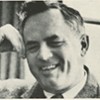
When we lose the right to be different, we lose the privilege to be free.
Charles Evans Hughes, Sr. (1862-1948) American statesman, politician, Supreme Court Justice (1910-1916, 1930-1941)
Speech (1925-06-17), Battle of Bunker Hill 150th Anniversary, Faneuil Hall, Boston Massachusetts
(Source)
Sometimes misquoted, "... the right to be free."When we lose the right to be different, we lose the right to be free.
Quotations about:
liberty
Note not all quotations have been tagged, so Search may find additional quotes on this topic.
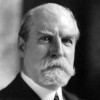
And I believe, too, in the gospel of Liberty, in giving to others what we claim for ourselves. I believe there is room everywhere for thought, and the more liberty you give away, the more you will have. In liberty extravagance is economy. Let us be just. Let us be generous to each other.
Robert Green Ingersoll (1833-1899) American lawyer, freethinker, orator
“What Must We Do To Be Saved?” Sec. 11 (1880)
(Source)
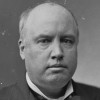
Whoso would be a man, must be a nonconformist. He who would gather immortal palms must not be hindered by the name of goodness, but must explore if it be goodness. Nothing is at last sacred but the integrity of your own mind.
Ralph Waldo Emerson (1803-1882) American essayist, lecturer, poet
Essay (1841), “Self-Reliance,” Essays: First Series, No. 2
(Source)
This essay was inspired by his reading of Walter Savage Landor in 1833, with passages pulled from his lecture "Individualism," last in his course on "The Philosophy of History" (1836–1837), with other passages from the lectures "School," "Genius," and "Duty" in his course on "Human Life" (1838–1839).
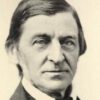
May it be to the world what I believe it will be, (to some parts sooner, to others later, but finally to all.) the Signal of arousing men to burst the chains, under which Monkish ignorance and superstition had persuaded them to bind themselves, and to assume the blessings & security of self government. The form which we have substituted restores the free right to the unbounded exercise of reason and freedom of opinion. All eyes are opened, or opening to the rights of man. The general spread of the light of science has already laid open to every view the palpable truth that the mass of mankind has not been born, with saddles on their backs, nor a favored few booted and spurred, ready to ride them legitimately, by the grace of god. These are grounds of hope for others.
Thomas Jefferson (1743-1826) American political philosopher, polymath, statesman, US President (1801-09)
Letter (1826-06-24) to Roger Chew Weightman
(Source)
The last letter he wrote.
[T]imid men […] prefer the calm of despotism to the boisterous sea of liberty.
Thomas Jefferson (1743-1826) American political philosopher, polymath, statesman, US President (1801-09)
Letter (1796-04-24) to Philip Mazzei
(Source)
The good citizen will demand liberty for himself, and as a matter of pride he will see to it that others receive the liberty which he thus claims as his own. Probably the best test of true love of liberty in any country is the way in which minorities are treated in that country.
Theodore Roosevelt (1858–1919) American politician, statesman, conservationist, writer, US President (1901–1909)
Speech (1910-04-23), “Citizenship in a Republic [The Man in the Arena],” Sorbonne, Paris
(Source)
In America the majority raises formidable barriers around the liberty of opinion; within these barriers an author may write what he pleases, but woe to him if he goes beyond them.
Alexis de Tocqueville (1805-1859) French writer, diplomat, politician
Democracy in America, Vol. 1, ch. 15 (1835)
How is it that we hear the loudest yelps for liberty among the drivers of negroes?
Samuel Johnson (1709-1784) English writer, lexicographer, critic
Essay (1775), “Taxation No Tyranny”
(Source)
On American (especially Virginian) demands for Independence.
Must a government, of necessity, be too strong for the liberties of its own people, or too weak to maintain its own existence?
Abraham Lincoln (1809-1865) American lawyer, politician, US President (1861-65)
Message (1861-07-04) to Congress, Special Message, Washington, D. C.
(Source)
Lincoln's Special Message to Congress was to discuss the Civil War that had broken out, its origins, and how it represented this fundamental question about representative government.
Lincoln repeated this phrasing at the beginning of his speech (1864-11-10) responding to serenaders celebrating his re-election.Franklin Roosevelt quoted Lincoln during a pre-WW2 Jackson Day radio address (1941-03-29).
As for the Republicans — how can one regard seriously a frightened, greedy, nostalgic huddle of tradesmen and lucky idlers who shut their yes to history and science, steel their emotions against decent human sympathy, cling to sordid and provincial ideals exalting sheer acquisitiveness and condoning artificial hardship for the non-materially-shrewd, dwell smugly and sentimentally in a distorted dream-cosmos of outmoded phrases and principles and attitudes based on the bygone agricultural-handicraft world, and revel in (consciously or unconsciously ) mendacious assumptions (such as the notion that real liberty is synonymous with the single detail of unrestricted economic license, or that a rational planning of resource-distribution would contravene some vague and mystical “American heritage” — economic oversight, price-fixing, “government in business”, etc. recur often in American colonial history) utterly contrary to fact and without the slightest foundation in human experience? Intellectually, the Republican idea deserves the tolerance and respect one gives to the dead.
H. P. Lovecraft (1890-1937) American fabulist [Howard Phillips Lovecraft]
Letter (1936-08) to Catherine L. Moore
(Source)
If a man has a genuine, sincere, hearty wish to get rid of his liberty, if he is really bent upon becoming a slave, nothing can stop him. And the temptation is to some natures a very great one.
Fetters of Gold are still Fetters; and silken Cords pinch.
Thomas Fuller (1654-1734) English physician, preacher, aphorist, writer
Gnomologia: Adages and Proverbs (compiler), # 1522 (1732)
(Source)
Those who won our independence by revolution were not cowards. They did not fear political change. They did not exalt order at the cost of liberty. To courageous, self-reliant men, with confidence in the power of free and fearless reasoning applied through the processes of popular government, no danger flowing from speech can be deemed clear and present, unless the incidence of the evil apprehended is so imminent that it may befall before there is opportunity for full discussion. If there be time to expose through discussion the falsehood and fallacies, to avert the evil by the processes of education, the remedy to be applied is more speech, not enforced silence.
Louis Brandeis (1856-1941) American lawyer, activist, Supreme Court Justice (1916-39)
Whitney v California, 274 US 357, 377 (1927) (concurring)
(Source)
The only freedom which deserves the name, is that of pursuing our own good in our own way, so long as we do not attempt to deprive others of theirs, or impede their efforts to obtain it. Each is the proper guardian of his own health, whether bodily, or mental and spiritual. Mankind are greater gainers by suffering each other to live as seems good to themselves, than by compelling each to live as seems good to the rest.
John Stuart Mill (1806-1873) English philosopher and economist
On Liberty, ch. 1 “Introductory” (1859)
(Source)
The individual is not accountable to society for his actions in so far as these concern the interests of no person but himself. Advice, instruction, persuasion, and avoidance by other people, if thought necessary by them for their own good, are the only measures by which society can justifiably express its dislike or disapprobation of his conduct.
John Stuart Mill (1806-1873) English philosopher and economist
On Liberty, ch. 5 “Applications” (1859)
(Source)
When opinions are free, either in matters of government or religion, truth will finally and powerfully prevail.
Thomas Paine (1737-1809) American political philosopher and writer
The Age of Reason, Closing Words (1796)
If there is any principle of the Constitution that more imperatively calls for attachment than any other, it is the principle of free thought — not free thought for those who agree with us but freedom for the thought that we hate.
Oliver Wendell Holmes, Jr. (1841-1935) American jurist, Supreme Court Justice
United States v. Schwimmer, 279 U.S. 644 (1929) [Dissent]
(Source)
Freedom is not a gift received from a State or a leader but a possession to be won every day by the effort of each and the union of all.
Albert Camus (1913-1960) Algerian-French novelist, essayist, playwright
“Bread and Freedom” (1957), Resistance, Rebellion, and Death [tr. O’Brien (1961)]
They who clamor loudest for freedom are often the ones least likely to be happy in a free society. The frustrated, oppressed by their shortcomings, blame their failure on existing restraints. Actually, their innermost desire is for an end to the “free for all.” They want to eliminate free competition and the ruthless testing to which the individual is continually subjected in a free society.
Eric Hoffer (1902-1983) American writer, philosopher, longshoreman
True Believer: Thoughts on the Nature of Mass Movements, Part 2, ch. 5, § 28 (2.5.28) (1951)
(Source)
I am unalterably opposed to communism because it exalts the state over the individual and the family, and because of the lack of freedom of speech, of protest, of religion, and of the press, which is the characteristic of totalitarian states. The way of opposition to communism is not to imitate its dictatorship, but to enlarge individual freedom, in our own countries and all over the globe. There are those in every land who would label as Communist every threat to their privilege. But as I have seen on my travels in all sections of the world, reform is not communism. And the denial of freedom, in whatever name, only strengthens the very communism it claims to oppose.
Robert Francis Kennedy (1925-1968) American politician
“Day of Affirmation,” address, University of Capetown, South Africa (6 Jun 1966)
(Source)
The first thing I want to teach is disloyalty. … This will beget independence — which is loyalty to one’s best self and principles, and this is often disloyalty to the general idols and fetishes.
Mark Twain (1835-1910) American writer [pseud. of Samuel Clemens]
Mark Twain’s Notebook [ed. Paine (1935)]
The show in general we feel like is a privilege. Even the idea that we can sit in the back of the country and make wise cracks … which is really what we do. We sit in the back and throw spitballs — but never forgetting that it is a luxury in this country that allows us to do that. That is, a country that allows for open satire, and I know that sounds basic and it sounds like it goes without saying. But that’s really what this whole situation is about. It’s the difference between closed and open. The difference between free and … burdened. And we don’t take that for granted here, by any stretch of the imagination.
Jon Stewart (b. 1962) American satirist, comedian, and television host. [b. Jonathan Stuart Leibowitz]
The Daily Show (2001-09-20)
(Source)

I will not attack your doctrines nor your creeds if they accord liberty to me. If they hold thought to be dangerous — if they aver that doubt is a crime, then I attack them one and all, because they enslave the minds of men.
Robert Green Ingersoll (1833-1899) American lawyer, freethinker, orator
“The Ghosts” (1877)
(Source)
Men who have offered their lives for their country know that patriotism is not the fear of something; it is the love of something. Patriotism with us is not the hatred of Russia; it is the love of this Republic and of the ideal of liberty of man and mind in which it was born, and to which this Republic is dedicated.
Adlai Stevenson (1900–1965) American diplomat, statesman
Speech (1952-08-27), “The Nature of Patriotism,” American Legion Convention, Madison Square Garden, New York City
(Source)
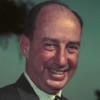
It matters not how strait the gate,
How charged with punishments the scroll,
I am the master of my fate:
I am the captain of my soul.
William Ernest Henley (1849-1903) English poet, critic, editor
“Invictus” (1875)

And his hands would plait the priest’s entrails,
For want of a rope, to strangle kings.[Et ses mains ourdiraient les entrailles du prêtre,
Au défaut d’un cordon pour étrangler les rois.]Denis Diderot (1713-1784) French editor, philosopher
Poésies Diverses, “Les Éleuthéromanes” (1875)
Alt. trans. "His hands would plait the priest’s guts, if he had no rope, to strangle kings."
Derived from a statement attributed (but not confirmed) to Jean Meslier: "I would like — and this would be the last and most ardent of my wishes — I would like the last of the kings to be strangled by the guts of the last priest."
Variant: "Let us strangle the last king with the guts of the last priest."
[Et des boyaux du dernier prêtre / Serrons le cou du dernier roi.]
This version was attributed to Diderot in Jean-François de La Harpe, Cours de Littérature Ancienne et Moderne (1840)
Sometimes paraphrased as, ""Men will never be free until the last king is strangled with the entrails of the last priest," etc.
No government has the right to decide on the truth of scientific principles, nor to prescribe in any way the character of the questions investigated. Neither may a government determine the aesthetic value of artistic creations, nor limit the forms of literacy or artistic expression. Nor should it pronounce on the validity of economic, historic, religious, or philosophical doctrines. Instead it has a duty to its citizens to maintain the freedom, to let those citizens contribute to the further adventure and the development of the human race.
Richard Feynman (1918-1988) American physicist
The Meaning of It All, “The Uncertainty of Values” (1999)
(Source)
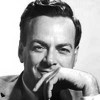
Standing in the presence of the Unknown, all have the same right to think, and all are equally interested in the great question of origin and destiny. All I claim, all I plead for, is liberty of thought and expression. That is all.
Robert Green Ingersoll (1833-1899) American lawyer, freethinker, orator
“The Liberty of Man, Woman, and Child” (1877)
We do not move forward by curtailing people’s liberty because we are afraid of what they may do or say. We move forward by assuring to all people protection in the basic liberties under a democratic form of government, and then making sure that our government serves the real needs of the people.
Eleanor Roosevelt (1884–1962) First Lady of the US (1933–1945), politician, diplomat, activist
Essay (1940-02-10), “Fear is the Enemy,” The Nation, Vol. 150, No. 6
(Source)

If ye love wealth better than liberty, the tranquility of servitude than the animated contest of freedom — go home from us in peace. We ask not your counsels or arms. Crouch down and lick the hands which feed you. May your chains sit lightly upon you, and may posterity forget that you were our countrymen!
Samuel Adams (1722-1803) American revolutionary, statesman
Speech, State House, Philadelphia (1776-08-01)
(Source)
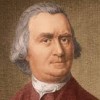
Let the human Mind loose. It must be loose; it will be loose. Superstition and Despotism cannot confine it.
John Adams (1735–1826) American lawyer, Founding Father, statesman, US President (1797–1801)
Letter (1816-11-13) to John Quincy Adams
(Source)
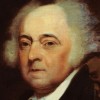
We must not conclude merely upon a man’s haranguing upon liberty, and using the charming sound, that he is fit to be trusted with the liberties of his country. It is not unfrequent to hear men declaim loudly upon liberty, who, if we may judge by the whole tenor of their actions, mean nothing else by it but their own liberty, — to oppress without control or the restraint of laws all who are poorer or weaker than themselves.
Obsta principiis, nip the shoots of arbitrary power in the bud, is the only maxim which can ever preserve the liberties of any people. When the people give way, their deceivers, betrayers, and destroyers press upon them so fast, that there is no resisting afterwards.
John Adams (1735–1826) American lawyer, Founding Father, statesman, US President (1797–1801)
Essay (1775-02-06), “Novanglus,” No. 3, Boston Gazette
(Source)
The Latin means to resist the first approaches or encroachments of a problem.
This series of essays was written by Adams under the pseudonym of "Novanglus" (Latin for "New England") responding to essays from his past friend Daniel Leonard as "Massachusettensis" on colonial leadership and what the proper relationship was between the American colonies and Britain.
Cities may be rebuilt, and a People reduced to Poverty, may acquire fresh Property: But a Constitution of Government once changed from Freedom, can never be restored. Liberty once lost is lost forever. When the People once surrender their share in the Legislature, and their Right of defending the Limitations upon the Government, and of resisting every Encroachment upon them, they can never regain it.
John Adams (1735–1826) American lawyer, Founding Father, statesman, US President (1797–1801)
Letter (1775-07-07) to Abigail Adams
(Source)
On standing up to the British after the burning of Charleston, South Carolina.
Will we ever learn to use reason instead of force in the world, and will people ever be wise enough to refuse to follow bad leaders or to take away the freedom of other people?
Eleanor Roosevelt (1884–1962) First Lady of the US (1933–1945), politician, diplomat, activist
Column (1939-10-16), “My Day”
(Source)
Power is so apt to be insolent and Liberty to be saucy, that they are very seldom upon good Terms.
George Savile, Marquis of Halifax (1633-1695) English politician and essayist
“Of Prerogative, Power and Liberty,” Political, Moral, and Miscellaneous Thoughts and Reflections (1750)
(Source)
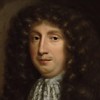
There is Danger from all Men. The only Maxim of a free Government, ought to be to trust no Man living, with Power to endanger the public Liberty.
John Adams (1735–1826) American lawyer, Founding Father, statesman, US President (1797–1801)
Diary (1772, Spring), “Notes for a Oration Braintree”
(Source)
The only thing that saves us from the bureaucracy is inefficiency. An efficient bureaucracy is the greatest threat to liberty.
Eugene McCarthy (1916-2005) American politician, poet, activist
Quoted (1979-02-12), “People: On the Record” section, Time Magazine
(Source)
There is only one cure for the evils which newly acquired freedom produces — and that cure is freedom!
Thomas Babington Macaulay (1800-1859) English writer and politician
“John Milton,” Edinburgh Review (Aug 1825)
(Source)
Review of John Milton, A Treatise on Christian Doctrine.
Why should my freedom be governed by somebody else’s conscience?
[ἱνατί γὰρ ἡ ἐλευθερία μου κρίνεται ὑπὸ ἄλλης συνειδήσεως]
The Bible (The New Testament) (AD 1st - 2nd C) Christian sacred scripture
Book 7. 1st Letter to the Corinthians 10:29 (1 Cor 10:29) [NJB (1985)]
(Source)
Paul on how it's okay to eat food that others think is religiously wrong to eat (but how you shouldn't be a dick about it, either).
(Source (Greek)). Alternate translations:For why is my liberty judged of another man's conscience?
[KJV (1611)]Why should my freedom depend on somebody else’s conscience?
[JB (1966)]“Well, then,” someone asks, “why should my freedom to act be limited by another person's conscience?"
[GNT (1976)]Why should my freedom be judged by someone else’s conscience?
[CEB (2011)]For why should my liberty be subject to the judgment of someone else’s conscience?
[NRSV (2021 ed.)]

You cannot change the conclusion of the brain by torture; nor by social ostracism. But I will tell you what you can do by these, and what you have done. You can make hypocrites by the million. You can make a man say that he has changed his mind; but he remains of the same opinion still. Put fetters all over him; crush his feet in iron boots; stretch him to the last gasp upon the holy rack; burn him, if you please, but his ashes will be of the same opinion still.
Robert Green Ingersoll (1833-1899) American lawyer, freethinker, orator
“The Liberty of Man, Woman, and Child” (1877)
(Source)
The man who does not do his own thinking is a slave, and is a traitor to himself and to his fellow-men.
Robert Green Ingersoll (1833-1899) American lawyer, freethinker, orator
“The Liberty of Man, Woman, and Child” (1877)
(Source)
What constitutes the bulwark of our own liberty and independence? It is not our frowning battlements, our bristling sea coasts, the guns of our war steamers, or the strength of our gallant and disciplined army. These are not our reliance against a resumption of tyranny in our fair land. All of them may be turned against our liberties, without making us stronger or weaker for the struggle. Our reliance is in the love of liberty which God has planted in our bosoms. Our defense is in the preservation of the spirit which prizes liberty as the heritage of all men, in all lands, every where. Destroy this spirit, and you have planted the seeds of despotism around your own doors.
Abraham Lincoln (1809-1865) American lawyer, politician, US President (1861-65)
Speech (1858-09-11), Edwardsville, Illinois
(Source)
As reported in the Alton Weekly Courier (1858-09-16).
And what is this liberty which must lie in the hearts of men and women? It is not the ruthless, the unbridled will; it is not freedom to do as one likes. That is the denial of liberty, and leads straight to its overthrow. A society in which men recognize no check upon their freedom soon becomes a society where freedom is the possession of only a savage few; as we have learned to our sorrow.
Learned Hand (1872-1961) American jurist
“The Spirit of Liberty,” speech, “I Am an American Day,” New York (1941-05-21)
(Source)
Yes, Gentlemen; if I am asked why we are free with servitude all around us, why our Habeas Corpus Act has not been suspended, why our press is still subject to no censor, why we still have the liberty of association, why our representative institutions still abide in all their strength, I answer, It is because in the year of revolutions we stood firmly by our government in its peril; and, if I am asked why we stood by our government in its peril, when men all around us were engaged in pulling governments down, I answer, It was because we knew that though our government was not a perfect government, it was a good government, that its faults admitted of peaceable and legal remedies, that it had never inflexibly opposed just demands, that we had obtained concessions of inestimable value, not by beating the drum, not by ringing the tocsin, not by tearing up the pavement, not by running to the gunsmiths’ shops to search for arms, but by the mere force of reason and public opinion.
Thomas Babington Macaulay (1800-1859) English writer and politician
Speech on re-election to Parliament, Edinburgh (2 Nov 1852)
(Source)
On the various revolutions and counter-revolutions in Europe in 1848.
Those of us who shout the loudest about Americanism in making character assassinations are all too frequently those who, by our own words and acts, ignore some of the basic principles of Americanism:
The right to criticize.
The right to hold unpopular beliefs.
The right to protest.
The right of independent thought.The exercise of these rights should not cost one single American citizen his reputation or his right to a livelihood, nor should he be in danger of losing his reputation or livelihood merely because he happens to know someone who holds unpopular beliefs. Who of us doesn’t? Otherwise none of us could call our souls our own. Otherwise thought control would have set in.
Margaret Chase Smith (1897-1965) American politician (US Senator, Maine)
“Declaration of Conscience” (1950-06-01)
(Source)
Speech given in the US Senate.
If the fires of freedom and civil liberties burn low in other lands, they must be made brighter in our own.
If in other lands the press and books and literature of all kinds are censored, we must redouble our efforts here to keep them free.
If in other lands the eternal truths of the past are threatened by intolerance we must provide a safe place for their perpetuation.Franklin Delano Roosevelt (1882–1945) American lawyer, politician, statesman, US President (1933–1945)
Speech (1938-06-30), National Education Association, World’s Fair, New York City
(Source)
This is a world of compensation; and he who would be no slave must consent to have no slave. Those who deny freedom to others deserve it not for themselves, and, under a just God, cannot long retain it.
Abraham Lincoln (1809-1865) American lawyer, politician, US President (1861-65)
Letter (1859-04-06) to Henry L. Pierce, et al.
(Source)
The letter is quoted in Charles Sumner's Eulogy to Lincoln, printed in the City of Boston''s A Memorial of Abraham Lincoln, Late President of the United States (1865).
The letter was in response to an invitation from Boston for the celebration of Thomas Jefferson's birthday. Lincoln praised Jefferson, and warned against those who would "overthrow" the principles of freedom Jefferson wrote of so eloquently. Lincoln apparently saw no irony in this passage, even given Jefferson being a slave-holder.
We hold these truths to be sacred & undeniable; that all men are created equal & independant, that from that equal creation they derive rights inherent & inalienable, among which are the preservation of life, & liberty, & the pursuit of happiness; that to secure these ends, governments are instituted among men, deriving their just powers from the consent of the governed; that whenever any form of government shall become destructive of these ends, it is the right of the people to alter or to abolish it, & to institute new government, laying it’s foundation on such principles & organising it’s powers in such form, as to them shall seem most likely to effect their safety & happiness.
Thomas Jefferson (1743-1826) American political philosopher, polymath, statesman, US President (1801-09)
Document (1776-06), “Declaration of Independence”
(Source)
Compare to the final version, as modified and adopted by the Continental Congress.
On the necessary points, unity. On the questionable points, liberty. In everything, love.
[In necessariis unites, in non necessariis libertas, in omnibus caritas.]
Rupertus Meldenius (1582-1651) German writer [pseud. of Peter Meiderlin]
Paraenesis Votiva pro Pace Ecclesiae ad Theologos Augustanae Confessionis [Votive Counsel for the Peace of the Church, to the Theologians of the Augustan Confession] (1626)
Also translated as "essentials" and "non-essentials."
Paraphrase of final lines of the work:Verbo dicam: Si nos servaremus IN necesariis Unitatem, IN non-necessariis Libertatem, IN UTRISQUE Charitatem, optimo certe loco essent res nostrae.
[In a word, were we to observe unity in essentials, liberty in incidentals, and in all things charity, our affairs would be certainly in a most happy situation.]
Commonly attributed to St Augustine, but also to John Wesley, Richard Baxter, and several others.
The history of liberty is the history of the observances of procedural safeguards.
Felix Frankfurter (1882-1965) US Supreme Court Justice, jurist and teacher
McNabb v. United States (1943)
I would remind you that extremism in the defense of liberty is no vice. And let me remind you also that moderation in the pursuit of justice is no virtue.
Barry Goldwater (1909-1998) American politician
Speech, accepting the GOP Presidential Nomination, San Francisco (16 Jul 1964)
(Source)
Goldwater believed the phrase originated in Cicero, though the source he used is questionable. Karl Hess was Goldwater's speech writer, and he said he derived the turn of phrase from Lincoln's "House Divided" speech. A closer match is this Thomas Paine passage.
More discussion of this quotation and its origins: On the Saying that "Extremism in Defense of Liberty is No Vice" - Niskanen Center
Every actual State is corrupt. Good men must not obey the laws too well.
Ralph Waldo Emerson (1803-1882) American essayist, lecturer, poet
“Politics,” Essays: Second Series (1844)
Peace indeed is both sweet in name and wholesome in reality; but there is all the difference in the world between peace and slavery. Peace is the calmness of freedom, slavery the worst of all evils, to be kept off at the cost not only of war, but even of life itself.
[Et nomen pacis dulce est et ipsa res salutaris; sed inter pacem et servitutem plurimum interest. Pax est tranquilla libertas, servitus postremum malorum omnium, non modo bello sed morte etiam repellendum.]
Marcus Tullius Cicero (106-43 BC) Roman orator, statesman, philosopher
Philippics [Philippicae; Antonian Orations], No. 2, ch. 44 / sec. 113 (2,44/2.113) (44-10-24 BC) [tr. King (1877)]
(Source)
(Source (Latin)). Alternate translations:And the name of peace is sweet, and the thing itself wholesome, but between peace and servitude the difference is great. Peace is tranquil liberty, servitude the last of all evils, one to be repelled, not only by war but even by death.
[tr. Ker (1926)]The name of peace is sweet, the thing itself is most salutary. But between peace and slavery there is a wide difference. Peace is liberty in tranquility; slavery is the worst of all evils, -- to be repelled, if need be, not only by war, but even by death.
[tr. Yonge (1903)]Peace indeed is both sweet in name and wholesome in reality; but there is all the difference between peace and slavery. Peace is the calmness of freedom, slavery the worst of all evils, to be kept off at the cost not only of war, but even of life itself.
[ed. Harbottle (1906)]Even the name of peace is sweet, and peace itself a blessing; but there is all the difference in the world between peace and servitude. Peace is the quiet enjoyment of freedom, whereas servitude is the greatest of all evils, something to be resisted not just with war, but even with death.
[tr. Berry (2006)]There is sweetness in the name of peace, and living in peace is beneficial, but there is a great difference between peace and slavery. Slavery is the worst of all evils and must be driven off by war -- or even by death.
[tr. McElduff (2011)]
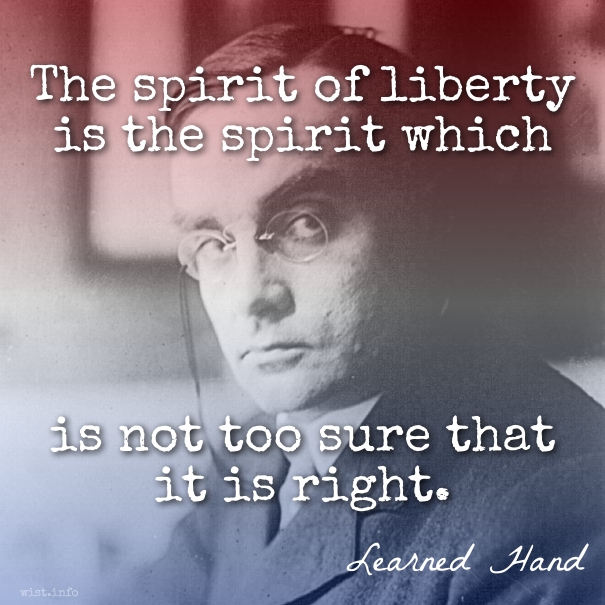
The spirit of liberty is the spirit which is not too sure that it is right; the spirit of liberty is the spirit which seeks to understand the mind of other men and women; the spirit of liberty is the spirit which weighs their interests alongside its own without bias; the spirit of liberty remembers that not even a sparrow falls to earth unheeded; the spirit of liberty is the spirit of Him who, near two thousand years ago, taught mankind that lesson it has never learned but never quite forgotten; that there may be a kingdom where the least shall be heard and considered side by side with the greatest.
Learned Hand (1872-1961) American jurist
“The Spirit of Liberty,” speech, “I Am an American Day,” New York (1941-05-21)
(Source)
But it’s no show just to protect the serious, the solemn, and the high-minded. We must protect the flippant, the zany, the heretical, and the downright queer. The Constitution gives every American the inalienable right to make a damn fool of himself.
What is so advantageous to the people as liberty? which is sought out and preferred to everything, not only by men, but even by the beasts.
[Quid tam populare quam libertas? Quam non solum ab hominibus verum etiam a bestiis expeti atque omnibus rebus anteponi videtis.]
Marcus Tullius Cicero (106-43 BC) Roman orator, statesman, philosopher
De Lege Agraria [On the Agrarian Law], Oration 2 “Contra Rullum,” sec. 9 (63 BC) [tr. Yonge (1856)]
(Source)
(Source (Latin)). Alternate translation:What is so beneficial to the people as liberty, which we see not only to be greedily sought after by men, but also by beasts, and to be preferred to all things.
[Source (1884)]
Freedom is not free.
Martin Luther King, Jr. (1929-1968) American clergyman, civil rights leader, social activist, preacher
Speech, Institute on Nonviolence and Social Change, Bethel Baptist Church (3 Dec 1959)
(Source)
If the First Amendment means anything, it means that a State has no business telling a man, sitting alone in his own house, what books he may read or what films he may watch.
Thurgood Marshall (1908-1993) American lawyer, US Supreme Court Justice (1967-1991)
Stanley v. Georgia 394 U.S. 557 (1969) [Unanimous Opinion]
Liberty without learning is always in peril; learning without liberty is always in vain.
John F. Kennedy (1917-1963) American politician, author, journalist, US President (1961–63)
Speech (1963-05-18), Convocation, Vanderbilt University, Nashville
(Source)
My definition of a free society is a society where it is safe to be unpopular.
Adlai Stevenson (1900–1965) American diplomat, statesman
Speech (1952-10-07), “Safeguards Against Communism,” Masonic Temple, Detroit, Michigan
(Source)
It is the common fate of the indolent to see their rights become a prey to the active. The condition upon which God hath given liberty to man is eternal vigilance; which condition if he break, servitude is at once the consequence of his crime and the punishment of his guilt.
John Philpot Curran (1750-1817) Irish lawyer and politician
Speech before Privy Council, Dublin (1790-07-10)
(Source)
On the right of election of the Lord Mayor of Dublin. Commonly paraphrases:More discussion (especially regarding attribution to Thomas Jefferson): Eternal vigilance is the price of liberty (Spurious Quotation) | Monticello.
- "Eternal vigilance is the price of liberty."
- "The price of liberty is eternal vigilance."
None are more hopelessly enslaved than those who falsely believe they are free.
[Niemand ist mehr Sklave als der sich für frei hält ohne es zu sein.]
Johann Wolfgang von Goethe (1749-1832) German poet, statesman, scientist
Elective Affinities [Die Wahlverwandtschaften], Part 2, ch. 5, “From Ottilie’s Journal [Aus Ottiliens Tagebuche]” (1809) [tr. Wenckstern (1853)]
(Source)
(Source (German)). Alternate translation:No one is more a slave than the man who thinks himself free while he is not.
[Niles ed. (1872)]No one is more a slave than he who thinks he is free without being so.
[tr. Hollingdale (1971)]
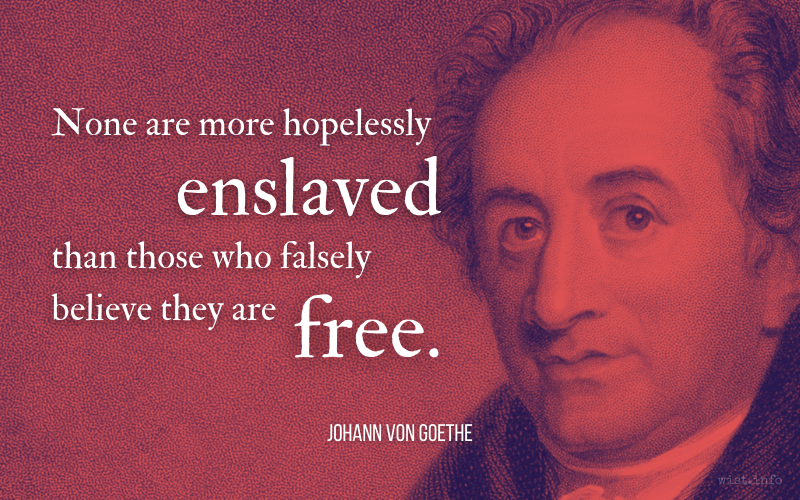
Let me give you a word of the philosophy of reform. The whole history of the progress of human liberty shows that all concessions yet made to her august claims, have been born of earnest struggle. The conflict has been exciting, agitating, all-absorbing, and for the time being, putting all other tumults to silence. It must do this or it does nothing. If there is no struggle, there is no progress.
Those who profess to favor freedom, and yet depreciate agitation, are men who want crops without plowing up the ground. They want rain without thunder and lightning. They want the ocean without the awful roar of its many waters. This struggle may be a moral one; or it may be a physical one; or it may be both moral and physical; but it must be a struggle.Frederick Douglass (1817-1895) American abolitionist, orator, writer
Speech (1857-08-04) on West India Emancipation, Ontario County Agricultural Society Fairgrounds, Canandaigua, New York
(Source)
Those who would give up essential Liberty, to purchase a little temporary Safety, deserve neither Liberty nor Safety.
Benjamin Franklin (1706-1790) American statesman, scientist, philosopher, aphorist
Letter (1755-11-11) to Royal Governor Robert Hunter Morris, from the Pennsylvania Assembly
(Source)
Also given as, "They that can give up essential liberty to obtain a little temporary safety deserve neither liberty nor safety" (cited in the Historical Review of Pennsylvania (1759)).
The actual "Reply to the Governor" letter, a response to Morris' rejection of the Assembly's proposals for frontier defense, was written by a committee of which Franklin was a member. He is usually credited as largely being the author, and he used this phrase subsequent to this.

Which is the best government? That which teaches us to govern ourselves.
[Welche Regierung die beste sei? Diejenige, die uns lehrt, uns selbst zu regieren.]
Johann Wolfgang von Goethe (1749-1832) German poet, statesman, scientist
Sprüche in Prosa: Maximen und Reflexionen [Proverbs in Prose: Maxims and Reflections] (1833) [tr. Saunders (1893), “Life and Characters,” #225]
(Source)
From Art and Antiquity, Vol. 5, #3, Individual Points (1826).
(Source (German)). Alternate translations:I am asked: which is the best government? That which teaches us to govern ourselves.
[tr. Rönnfeldt (1900)]You ask which form of government is the best? Whichever teaches us to govern ourselves.
[tr. Stopp (1995), #353]
I would rather be exposed to the inconveniencies attending too much liberty than those attending too small a degree of it.
Thomas Jefferson (1743-1826) American political philosopher, polymath, statesman, US President (1801-09)
Letter (1791-12-23) to Archibald Stuart
(Source)
Jefferson originally wrote "dangers" instead of "inconveniencies."
If liberty means anything at all it means the right to tell people what they do not want to hear.
George Orwell (1903-1950) English journalist, essayist, writer [pseud. of Eric Arthur Blair]
Animal Farm, unpublished preface (1945)
(Source)
The original essay was written in 1945 as an introduction to the first edition of the book, but was left unpublished It was rediscovered in 1971, and finally published under Orwell's name as "The Freedom of the Press," Times Literary Supplement [of London] (1972-09-15).
More history of this quotation here: If Liberty Means Anything At All It Means the Right To Tell People What They Do Not Want To Hear – Quote Investigator®.
Experience should teach us to be most on our guard to protect liberty when the government’s purposes are beneficial. Men born to freedom are naturally alert to repel invasion of their liberty by evil-minded rulers. The greater dangers to liberty lurk in insidious encroachment by men of zeal, well-meaning but without understanding.
Louis Brandeis (1856-1941) American lawyer, activist, Supreme Court Justice (1916-39)
Olmstead v. United States, 277 US 438 (1928) [Dissent]
(Source)
The most certain test by which we judge whether a country is really free is the amount of security enjoyed by minorities.
John Dalberg, Lord Acton (1834-1902) British historian, politician, writer
Speech (1877-02-28), “The History of Freedom in Antiquity,” Bridgenorth Institute
As I would not be a slave, so I would not be a master. This expresses my idea of democracy. Whatever differs from this, to the extent of the difference, is no democracy.
Abraham Lincoln (1809-1865) American lawyer, politician, US President (1861-65)
Fragment (1858-08-01?), “Definition of Democracy”
(Source)
The title of this writing fragment, in Lincoln's hand, is notional. It is sometimes referred to as "On Slavery and Democracy." The date is also conjectural, and the manuscript is not connected with any known speech or occasion. The scrap of paper this solitary paragraph is on was given to Mary Todd Lincoln by her friend, Myra Bradwell on Mary's release from the asylum. It was unsigned, but a signature clipped from another document was pasted below the text.
Liberty then I would say that, in the whole plenitude of it’s extent, it is unobstructed action according to our will: but rightful liberty is unobstructed action according to our will, within the limits drawn around us by the equal rights of others. I do not add ‘within the limits of the law’; because law is often but the tyrant’s will, and always so when it violates the right of an individual.
Thomas Jefferson (1743-1826) American political philosopher, polymath, statesman, US President (1801-09)
Letter (1819-04-04) to Isaac H. Tiffany
(Source)
Liberty is the only thing you cannot have unless you are willing to give it to others.
William Allen White (1868-1944) American writer and journalist
“A Free Press in a Machine Age,” speech, U. of Pennsylvania (2 May 1938)
Our progress in degeneracy appears to me to be pretty rapid. As a nation we began by declaring that “all men are created equal.” We now practically read it “all men are created equal, except negroes.” When the Know-Nothings get control, it will read “all men are created equal, except negroes, and foreigners, and catholics.” When it comes to this, I shall prefer emigrating to some country where they make no pretence of loving liberty — to Russia, for instance, where despotism can be taken pure, and without the base alloy of hypocrisy.
Abraham Lincoln (1809-1865) American lawyer, politician, US President (1861-65)
Letter (1854-08-24) to Joshua Speed
(Source)
We are not to expect to be translated from despotism to liberty, in a feather-bed.
Thomas Jefferson (1743-1826) American political philosopher, polymath, statesman, US President (1801-09)
Letter (1790-04-02) to Lafayette
(Source)
There is only one basic human right, the right to do as you damn well please. And with it comes the only basic human duty, the duty to take the consequences.
P. J. O'Rourke (b. 1947) American humorist, editor
“The Liberty Manifesto,” speech, Cato Institute, Washington, DC (1993-05-06)
(Source)
Reprinted in Age and Guile Beat Youth, Innocence, and a Bad Haircut (1995).

Since freedom of opinion can only exist when the government thinks itself secure, it is important that the government should have the approval of the great majority of the population and should deal with discontented minorities, wherever possible, in a manner calculated to allay their discontent. A government must possess force, but cannot be a satisfactory government unless force is seldom necessary.
Bertrand Russell (1872-1970) English mathematician and philosopher
“Freedom and Government,” in Ruth Nanda Anshen, ed., Freedom: Its Meaning (1940)
(Source)
In necessary things, unity; in disputed things, liberty; in all things, charity.
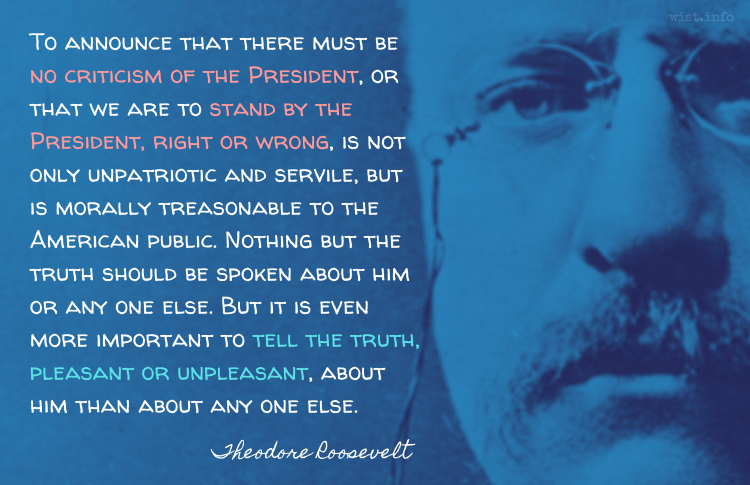
The President is merely the most important among a large number of public servants. He should be supported or opposed exactly to the degree which is warranted by his good conduct or bad conduct, his efficiency or inefficiency in rendering loyal, able, and disinterested service to the nation as a whole. Therefore it is absolutely necessary that there should be full liberty to tell the truth about his acts, and this means that it is exactly as necessary to blame him when he does wrong as to praise him when he does right. Any other attitude in an American citizen is both base and servile. To announce that there must be no criticism of the President, or that we are to stand by the President, right or wrong, is not only unpatriotic and servile, but is morally treasonable to the American public. Nothing but the truth should be spoken about him or any one else. But it is even more important to tell the truth, pleasant or unpleasant, about him than about any one else.
Theodore Roosevelt (1858–1919) American politician, statesman, conservationist, writer, US President (1901–1909)
Essay (1918-05-07), “Sedition, A Free Press, and Personal Rule,” Kansas City Star
(Source)
This passage was added to later editions of his essay, "Lincoln and Free Speech,", as printed in The Works of Theodore Roosevelt, vol. 21, The Great Adventure, ch. 7 (1925). It does not appear in the original version of the essay or book.
See also Roosevelt and Roosevelt.
Is life so dear, or peace so sweet, as to be purchased at the price of chains and slavery? Forbid it, Almighty God! I know not what course others may take, but as for me, give me liberty, or give me death!
The basic test of freedom is perhaps less in what we are free to do than in what we are free not to do.
Eric Hoffer (1902-1983) American writer, philosopher, longshoreman
Passionate State of Mind, Aphorism 176 (1955)
(Source)
The first measure of a free society is NOT that its government performs the will of the majority. That’s what we had in 1930s Germany, 1950s Georgia, and 1980s Iran. The FIRST measure of a free society is that its government protects the just freedoms of its minorities AGAINST the preferences, will and caprice of the majority.
Jim Warren (b. 1936) American mathematician, computer scientist, journalist, activist
(Attributed)

I often wonder whether we do not rest our hopes too much upon constitutions, upon laws and upon courts. These are false hopes; believe me, these are false hopes. Liberty lies in the hearts of men and women; when it dies there, no constitution, no law, no court can even do much to help it. While it lies there it needs no constitution, no law, no court to save it.
Learned Hand (1872-1961) American jurist
“The Spirit of Liberty,” speech, “I Am an American Day,” New York (1941-05-21)
(Source)
And can history produce an instance of a rebellion so honourably conducted? I say nothing of it’s motives. They were founded in ignorance, not wickedness. God forbid we should ever be 20. years without such a rebellion. The people can not be all, and always, well informed. The part which is wrong will be discontented in proportion to the importance of the facts they misconceive. If they remain quiet under such misconceptions it is a lethargy, the forerunner of death to the public liberty. We have had 13. states independant 11. years. There has been one rebellion. That comes to one rebellion in a century and a half for each state. What country before ever existed a century and half without a rebellion? And what country can preserve it’s liberties if their rulers are not warned from time to time that their people preserve the spirit of resistance?
Thomas Jefferson (1743-1826) American political philosopher, polymath, statesman, US President (1801-09)
Letter (1787-11-13) to William Stephens Smith
(Source)
Speaking of Shay's Rebellion.
Freedom of speech and freedom of action are meaningless without freedom to think. And there is no freedom of thought without doubt.
Bergen Evans (1904-1978) American educator, writer, lexicographer
The Natural History of Nonsense, ch. 19 (1946)