

Opera is when a guy gets stabbed in the back and instead of bleeding, sings.
Ed Gardner (1901–1963) American comic actor, writer and director
Duffy’s Tavern (1940s American radio show)
Oxford Dict of Modern Quotes

Where facts are few, experts are many.
(Other Authors and Sources)
Donald Gannon

You cannot shake hands with a clenched fist.
Indira Gandhi (1917–1984) Indian politician
Quoted in Christian Science Monitor (17 May 1982)

Rights that do not flow directly from duty well performed are not worth having.
Mohandas Gandhi (1869–1948) Indian lawyer, anti-colonial nationalist, political ethicist [Mahatma Gandhi]
Harijan (6-Jul-1947)
A “no” uttered from deepest conviction is better and greater than a “yes” merely uttered to please, or what is worse, to avoid trouble.
Mohandas Gandhi (1869–1948) Indian lawyer, anti-colonial nationalist, political ethicist [Mahatma Gandhi]
(Attributed)
To give pleasure to a single heart by a single act is better than a thousand heads bowing in prayer.
Mohandas Gandhi (1869–1948) Indian lawyer, anti-colonial nationalist, political ethicist [Mahatma Gandhi]
(Attributed)
The only tyrant I accept in this world is the ‘still small voice’ within me.
Mohandas Gandhi (1869–1948) Indian lawyer, anti-colonial nationalist, political ethicist [Mahatma Gandhi]
(Attributed)
It is the quality of our work which will please God and not the quantity.
Mohandas Gandhi (1869–1948) Indian lawyer, anti-colonial nationalist, political ethicist [Mahatma Gandhi]
(Attributed)
No culture can live, if it attempts to be exclusive.
Mohandas Gandhi (1869–1948) Indian lawyer, anti-colonial nationalist, political ethicist [Mahatma Gandhi]
(Attributed)
My non-violence does not admit of running away from danger and leaving dear ones unprotected. Between violence and cowardly flight, I can only prefer violence to cowardice. I can no more preach non-violence to a coward than I can tempt a blind man to enjoy healthy scenes. … Nonviolence is infinitely superior to violence. But the message of nonviolence is for those who know how to die, not for those who are afraid of death. If one has not that courage, I want him to cultivate the art of killing and being killed, rather than in a cowardly manner to flee from danger.
Mohandas Gandhi (1869–1948) Indian lawyer, anti-colonial nationalist, political ethicist [Mahatma Gandhi]
(Attributed)
He who cannot protect himself or his nearest and dearest or their honor by non-violently facing death, may and ought to do so by violently dealing with the oppressor. He who can do neither of the two is a burden.
Mohandas Gandhi (1869–1948) Indian lawyer, anti-colonial nationalist, political ethicist [Mahatma Gandhi]
Young India (10 Nov. 1928)
Human life is a series of compromises and it is not always easy to achieve in practice what one has found to be true in theory.
Mohandas Gandhi (1869–1948) Indian lawyer, anti-colonial nationalist, political ethicist [Mahatma Gandhi]
(Attributed)
In matters of conscience, the law of majority has no place.
Mohandas Gandhi (1869–1948) Indian lawyer, anti-colonial nationalist, political ethicist [Mahatma Gandhi]
Young India (4 Aug. 1920)
We must become the change we want to see.
Mohandas Gandhi (1869–1948) Indian lawyer, anti-colonial nationalist, political ethicist [Mahatma Gandhi]
(Attributed)
Variants:Almost always attributed to Gandhi, but not found in any of his published works. More discussion here.
- "Be the change you wish to see in the world."
- "You must be the change you wish to see in the world."
Whatever you do will be insignificant, but it is very important that you do it.
Mohandas Gandhi (1869–1948) Indian lawyer, anti-colonial nationalist, political ethicist [Mahatma Gandhi]
(Attributed)
It ill becomes us to invoke in our daily prayers the blessings of God, the Compassionate, if we in turn will not practice elementary compassion towards our fellow creatures.
Mohandas Gandhi (1869–1948) Indian lawyer, anti-colonial nationalist, political ethicist [Mahatma Gandhi]
The Moral Basis of Vegetarianism, Speech to the London Vegetarian Society (20 Nov. 1931)
Freedom is not worth having if it does not connote freedom to err. It passes my comprehension how human beings, be they ever so experienced and able, can delight in depriving other human beings of that precious right.
Mohandas Gandhi (1869–1948) Indian lawyer, anti-colonial nationalist, political ethicist [Mahatma Gandhi]
(Attributed)
I have learnt through bitter experience the one supreme lesson to conserve my anger, and as heat conserved is transmuted into energy, even so our anger controlled can be transmuted into a power which can move the world.
Mohandas Gandhi (1869–1948) Indian lawyer, anti-colonial nationalist, political ethicist [Mahatma Gandhi]
(Attributed)
One man cannot do right in one department of life whilst he is occupied in doing wrong in any other department. Life is one indivisible whole.
Mohandas Gandhi (1869–1948) Indian lawyer, anti-colonial nationalist, political ethicist [Mahatma Gandhi]
(Attributed)
Fear has its use but cowardice has none.
Mohandas Gandhi (1869–1948) Indian lawyer, anti-colonial nationalist, political ethicist [Mahatma Gandhi]
(Attributed)
First, they ignore you. Then they laugh at you. Then they fight you. Then you win.
Mohandas Gandhi (1869–1948) Indian lawyer, anti-colonial nationalist, political ethicist [Mahatma Gandhi]
Attributed
But I do not feel obliged to believe that the same God who has endowed us with senses, reason and intellect has intended us to forego their use and by some other means to give us knowledge which we can attain by them. He would not require us to deny sense and reason in physical matters which are set before our eyes and minds by direct experience or necessary demonstrations.
Galileo Galilei (1564–1642) Italian astronomer, physicist, engineer, polymath
Letter (1651) to Christina of Lorraine, Grand Duchess of Tuscany [tr. Drake (1957)]
(Source)

The sun, with all the planets revolving around it and depending on it can still ripen a bunch of grapes as though it had nothing else in the universe to do. Why then should I doubt His power?
Galileo Galilei (1564–1642) Italian astronomer, physicist, engineer, polymath
(Attributed)
The human condition is something at once horrible and marvelous. Estamos muy mal hechos, pero no estamos terminados. We are very badly made, but we are not finished.
Eduardo Galeano (1940–2015) Uruguayan journalist and novelist
Progressive, Interview by David Barsamian, closing sentences (Jul-1999)
The causes of the Great Depression are still far from certain. A lack of certainty, it may also be observed, is not evident in the contemporary writing on the subject. Much of it tells what went wrong and why with marked firmness. However, this paradoxically can itself be an indication of uncertainty. When people are least sure they are often most dogmatic.
John Kenneth Galbraith (1908–2006) Canadian-American economist, diplomat, author
The Great Crash, 1929, ch. 9 “Cause and Consequence,” sec. 3 (1954)
(Source)
Where humor is concerned there are no standards — no one can say what is good or bad, although you can be sure that everyone will.
John Kenneth Galbraith (1908–2006) Canadian-American economist, diplomat, author
Annals of an Abiding Liberal (1979)
There is something uniquely obscene about competition to promote weapons of mass destruction for the purposes of improving the stock market position of a corporation.
John Kenneth Galbraith (1908–2006) Canadian-American economist, diplomat, author
“The Big Defense Firms are Really Public Firms and Should Be Nationalized,” The New York Times Magazine (16 Nov 1969)
Under capitalism, man exploits man. Under communism, it’s just the opposite.
John Kenneth Galbraith (1908–2006) Canadian-American economist, diplomat, author
A Life in Our Times, ch. 22 (1981)
Variant: "Under capitalism, man exploits man. And under Communism it is just the reverse."Galbraith refers to it as an old Polish joke.
If all else fails, immortality can always be assured by adequate error.
John Kenneth Galbraith (1908–2006) Canadian-American economist, diplomat, author
Money: Whence It Came, Where It Went, ch. 13 “The Self Inflicted Wounds” (1975)
(Source)
Sometimes misquoted as "... by spectacular error".
In all life one should comfort the afflicted, but verily, also, one should afflict the comfortable, and especially when they are comfortably, contentedly, even happily wrong.
John Kenneth Galbraith (1908–2006) Canadian-American economist, diplomat, author
The Guardian (28 Jul 1989)
Also attributed to Clarence Darrow.
It is almost as important to know what is not serious as to know what is.
John Kenneth Galbraith (1908–2006) Canadian-American economist, diplomat, author
(Attributed)
Faced with the choice between changing one’s mind and proving there is no need to do so, almost everyone gets busy on the proof.
John Kenneth Galbraith (1908–2006) Canadian-American economist, diplomat, author
Economics, Peace and Laughter (1971)
(Source)
(also called "Galbraith's Law")
Most problems are either unimportant or impossible to solve.
Victor Galaz (b. 1976) Swedish political scientist
(Attributed)
on why it's smart to be silent during meetings

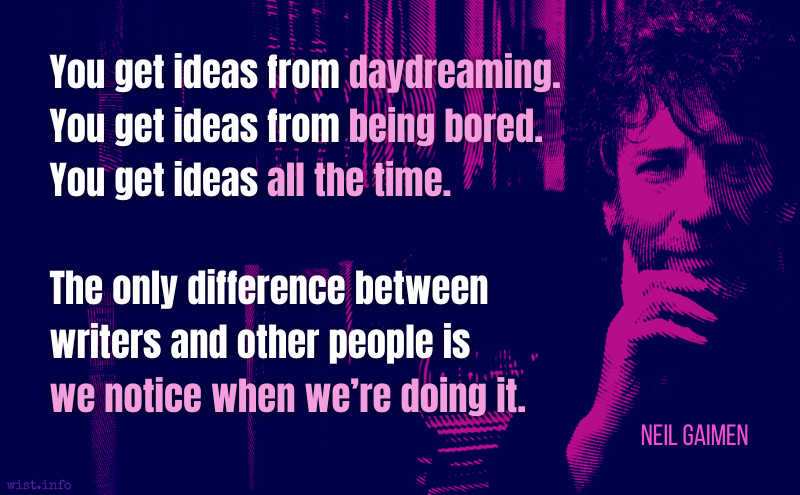
You get ideas from daydreaming. You get ideas from being bored. You get ideas all the time. The only difference between writers and other people is we notice when we’re doing it.
Neil Gaiman (b. 1960) British author, screenwriter, fabulist
“Where Do You Get Your Ideas?” (1997)
(Source)
I am a marvelous housekeeper. Every time I leave a man, I keep his house.
Zsa Zsa Gabor (1917–2016) Hungarian-American actress, socialite [b. Sári Gábor]
How to Catch a Man, Keep a Man, and Get Rid of a Man (1970)
(Source)
When actually given a citation, this quote is attributed to this book by Gabor, though I have been unable to find a fully visible copy of the book online to confirm. Two other attributions of similar sentiments to Gabor:He taught me housekeeping; when I divorce I keep the house.
]In Ned Sherrin, Cutting Edge (1984), regarding her fifth husband, George Sanders.]I'm a wonderful housekeeper. Every time I get a divorce, I keep the house.
[In Sam Staggs, Finding Zsa-Zsa (2019)]

Innovation is hard to schedule.
Dan Fylstra (b. 1952) American computer scientist, libertarian
(Attributed)
When everything is a priority, nothing is a priority.
Simon Fulleringer (contemp.) Canadian IT professional
(Attributed)
Give as thou wouldest receive, cheerfully and quickly, without hesitation, or bargaining.
Thomas Fuller (1654–1734) English physician, preacher, aphorist, writer
Introductio ad Prudentiam, Vol. 1, # 418 (1725)
(Source)

First get an absolute Conquest over thyself, and then thou wilt easily govern thy Wife.
Thomas Fuller (1654–1734) English physician, preacher, aphorist, writer
Introductio ad Prudentiam, Vol. 1, # 497 (1725)
(Source)
He that will not sail till all Dangers are over, must never put out to Sea.
Thomas Fuller (1654–1734) English physician, preacher, aphorist, writer
Gnomologia: Adages and Proverbs (compiler), # 2353 (1732)
(Source)
He that fears you present, will hate you absent.
Thomas Fuller (1654–1734) English physician, preacher, aphorist, writer
Gnomologia: Adages and Proverbs (compiler), # 2101 (1732)
(Source)
Cheat me in the Price, but not in the Goods.
Thomas Fuller (1654–1734) English physician, preacher, aphorist, writer
Gnomologia: Adages and Proverbs (compiler), # 1090 (1732)
(Source)
Act nothing in furious Passion; it’s putting to Sea in a Storm.
Thomas Fuller (1654–1734) English physician, preacher, aphorist, writer
Introductio ad Prudentiam, Vol. 1, # 365 (1725)
(Source)
Serving one’s own Passions is the greatest Slavery.
Thomas Fuller (1654–1734) English physician, preacher, aphorist, writer
Gnomologia: Adages and Proverbs (compiler), # 4103 (1732)
(Source)
A wise man turns Chance into good Fortune.
Thomas Fuller (1654–1734) English physician, preacher, aphorist, writer
Gnomologia: Adages and Proverbs (compiler), # 475 (1732)
(Source)
Heaven is a cheap Purchase, whatever it cost.
Thomas Fuller (1654–1734) English physician, preacher, aphorist, writer
Gnomologia: Adages and Proverbs (compiler), # 2481 (1732)
(Source)
Many would be Cowards if they had Courage enough.
Thomas Fuller (1654–1734) English physician, preacher, aphorist, writer
Gnomologia: Adages and Proverbs (compiler), # 3366 (1732)
(Source)
It is the Property of Fools, to be always judging.
Thomas Fuller (1654–1734) English physician, preacher, aphorist, writer
Gnomologia: Adages and Proverbs (compiler), # 3027 (1732)
(Source)
Lord, before I commit a sin, it seems to me so shallow that I may wade through it dry-shod from any guiltiness; but when I have committed it, it often seems so deep that I cannot escape without drowning.
Thomas Fuller (1608–1661) English churchman, historian
Good Thoughts in Bad Times, “Personal Meditations,” VII (1659)
Full text.

Sometimes I think we’re alone. Sometimes I think we’re not. In either case, the thought is staggering.
Buckminster Fuller (1895–1983) American architect, engineer
(Attributed)
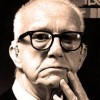
Don’t fight forces, use them.
Buckminster Fuller (1895–1983) American architect, engineer
Shelter Magazine (Nov 1932)
The motto of Shelter magazine, when renamed and repurposed by Fuller in 1932 from Philadelphia's old T-Square Club Journal.
Never forget that music is much too important to be left entirely in the hands of professionals.
Robert Fulghum (b. 1937) American author, minister
Maybe (Maybe Not) (1993)
The rapprochement of peoples is only possible when differences of culture and outlook are respected and appreciated rather than feared and condemned, when the common bond of human dignity is recognized as the essential bond for a peaceful world.
J. William Fulbright (1905–1995) American politician
upon receiving the Athinai International Prize, Athens, Greece (Apr. 1989)
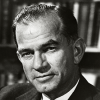
Families break up when people take hints you don’t intend and miss hints you do intend.
Robert Frost (1874–1963) American poet
Writers at Work: Second Series, Interview with Richard Poirier (1963)
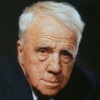
Hell is a half-filled auditorium.
Robert Frost (1874–1963) American poet
(Attributed)
In three words I can sum up everything I’ve learned about life: It goes on.
Robert Frost (1874–1963) American poet
(Attributed)
Anyone with an active mind lives on tentatives rather than tenets.
Robert Frost (1874–1963) American poet
(Attributed)
The best way out is always through.
When people can’t handle God any more, they turn to religion.
Erich Fromm (1900–1980) American psychoanalyst and social philosopher
(Attributed)

Who will tell whether one happy moment of love or the joy of breathing or walking on a bright morning and smelling the fresh air, is not worth all the suffering and effort which life implies
Erich Fromm (1900–1980) American psychoanalyst and social philosopher
The Sane Society (1955)
The great threat to freedom is the concentration of power.
Milton Friedman (1912–2006) American economist, intellectual
Introduction to Capitalism and Freedom (1962)
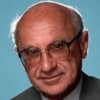
The scientific name for an animal that doesn’t either run from or fight its enemies is “lunch.”
(Other Authors and Sources)
Michael Friedman
What progress we are making. In the Middle Ages they would have burned me. Now they are content with burning my books.
Sigmund Freud (1856–1939) Austrian psychoanalyst and neurologist
Letter to Ernest Jones (Jan 1933)
(Source)
Regarding Nazi book burnings in Germany. Reprinted in Jones, Sigmund Freud: Life and Work, Vol. 3, Part 1, ch. 4 (1957).
The first human who hurled an insult instead of a stone was the founder of civilization.
Sigmund Freud (1856–1939) Austrian psychoanalyst and neurologist
(Attributed)
You may delay, but Time will not.
Benjamin Franklin (1706–1790) American statesman, scientist, philosopher, aphorist
(Attributed)
He that is of Opinion Money will do every Thing, may well be suspected of doing every Thing for Money.
Benjamin Franklin (1706–1790) American statesman, scientist, philosopher, aphorist
Poor Richard’s Almanack (1753)
See also Halifax.
Who has deceiv’d thee so oft as thy self?
Benjamin Franklin (1706–1790) American statesman, scientist, philosopher, aphorist
Poor Richard (1738 ed.)
(Source)
Content makes poor men rich; Discontent makes rich Men poor.
Benjamin Franklin (1706–1790) American statesman, scientist, philosopher, aphorist
Poor Richard Improved (1749 ed.)
(Source)
Be civil to all; sociable to many; familiar with few; friend to one; enemy to none.
Benjamin Franklin (1706–1790) American statesman, scientist, philosopher, aphorist
Poor Richard’s Almanack (1756)
Do good to thy friend to keep him, to thy enemy to gain him.
Benjamin Franklin (1706–1790) American statesman, scientist, philosopher, aphorist
Poor Richard (1734 ed.)
(Source)
The learned fool writes his nonsense in better language than the unlearned, but still ’tis nonsense.
Benjamin Franklin (1706–1790) American statesman, scientist, philosopher, aphorist
(Attributed)
We hear of the conversion of water into wine at the marriage in Cana, as of a miracle. But this conversion is, through the goodness of God, made every day before our eyes. Behold the rain which descends from heaven upon our vineyards, and which incorporates itself with the grapes to be changed into wine; a constant proof that God loves us, and loves to see us happy!
Benjamin Franklin (1706–1790) American statesman, scientist, philosopher, aphorist
Letter to Abbé Morallet (1779)
(Source)
Apparent origin of the misquote: "Beer is proof that God loves us and wants us to be happy."
The body of Benjamin Franklin, Printer (like the cover of an old book, its contents torn out and stripped of its lettering and gilding), lies here, food for worms; but the work shall not be lost, for it will (as he believed) appear once more in a new and more elegant edition, revised and corrected by the author.
Benjamin Franklin (1706–1790) American statesman, scientist, philosopher, aphorist
“Epitaph on Himself” (1778)
Variant words (and format):The body of
B. Franklin
Printer
Like the cover of an old book,
its contents torn out,
and stripped of its lettering and gilding,
lies here, food for worms.
But the work shall not be wholly lost;
for it will, as he believed, appear once more,
in a new and more perfect edition
corrected and amended
by the Author.
I haven’t failed, I’ve found ten thousand ways that don’t work.
Benjamin Franklin (1706–1790) American statesman, scientist, philosopher, aphorist
(Attributed)
(also attrib. Thomas Edison)
Work as if you were to live 100 years; pray as if you were to die tomorrow.
Benjamin Franklin (1706–1790) American statesman, scientist, philosopher, aphorist
Poor Richard’s Almanack (May 1757)
(Source)
There is no kind of dishonesty into which otherwise good people more easily and frequently fall than that of defrauding the government.
Benjamin Franklin (1706–1790) American statesman, scientist, philosopher, aphorist
(Attributed)
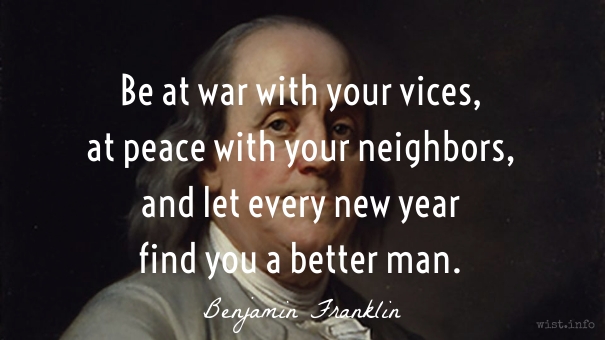
Be at War with your Vices, at Peace with your Neighbours, and let every New-Year find you a better Man.
Benjamin Franklin (1706–1790) American statesman, scientist, philosopher, aphorist
Poor Richard’s Almanack (1755)
More information on this quotation here.
If we take care of the minutes, the years will take care of themselves.
Benjamin Franklin (1706–1790) American statesman, scientist, philosopher, aphorist
(Attributed)
Many a little makes a mickle. Beware of small expenses; a small leak will sink a great ship.
Benjamin Franklin (1706–1790) American statesman, scientist, philosopher, aphorist
Poor Richard’s Almanack
Blame-all and Praise-all are two blockheads.
Benjamin Franklin (1706–1790) American statesman, scientist, philosopher, aphorist
Poor Richard (1734 ed.)
(Source)
Many a man thinks he is buying pleasure, when he is really selling himself to it.
Benjamin Franklin (1706–1790) American statesman, scientist, philosopher, aphorist
(Attributed)
Dost thou love Life? then do not squander Time; for that’s the Stuff Life is made of.
Benjamin Franklin (1706–1790) American statesman, scientist, philosopher, aphorist
Poor Richard (1746 ed.)
(Source)
Reprinted in Poor Richard Improved (1758 ed.). This edition was Franklin's final Poor Richard, and he had it prefaced (1757-07-07) by a new character, Father Abraham, who combined a hundred aphorisms from previous Poor Richard almanacs. This preface became reprinted and (often abridged) known separately as "The Way to Wealth."
Were it offered to my choice, I should have no objection to a repetition of the same life from its beginning, only asking the advantages authors have in a second edition to correct some faults in the first.
Benjamin Franklin (1706–1790) American statesman, scientist, philosopher, aphorist
Autobiography, ch. 1
He who multiplies Riches multiplies Cares.
Benjamin Franklin (1706–1790) American statesman, scientist, philosopher, aphorist
Poor Richard (1744 ed.)
(Source)
If Passion drives, let Reason hold the Reins.
Benjamin Franklin (1706–1790) American statesman, scientist, philosopher, aphorist
Poor Richard Improved (1749 ed.)
(Source)
The metaphor is not new with Franklin. Plato used a chariot allegory in his Phaedrus, where Reason is the charioteer, controlling a white horse of noble Passions and a black horse of unruly Passions. Buddha compared his mind to a wild elephant that once wandered where it wanted, but now was under control as if by a trainer.
Those who would give up essential Liberty, to purchase a little temporary Safety, deserve neither Liberty nor Safety.
Benjamin Franklin (1706–1790) American statesman, scientist, philosopher, aphorist
Letter (1755-11-11) to Royal Governor Robert Hunter Morris, from the Pennsylvania Assembly
(Source)
Also given as, "They that can give up essential liberty to obtain a little temporary safety deserve neither liberty nor safety" (cited in the Historical Review of Pennsylvania (1759)).
The actual "Reply to the Governor" letter, a response to Morris' rejection of the Assembly's proposals for frontier defense, was written by a committee of which Franklin was a member. He is usually credited as largely being the author, and he used this phrase subsequent to this.

Life is 10 percent what you make it and 90 percent how you take it.
Irving Berlin (1888–1989) American songwriter [b. Isidore Beilin]
(Attributed)
(Source)
Attributed as a comment made by Berlin during a performance of the show This is the Army, Mr. Jones at the Palladium in London in 1943.
Also sometimes attributed to Benjamin Franklin.

It is Ill-manners to silence a fool, and Cruelty to let him go on.
Benjamin Franklin (1706–1790) American statesman, scientist, philosopher, aphorist
Poor Richard’s Almanack

Genius without education is like silver in the mine.
Benjamin Franklin (1706–1790) American statesman, scientist, philosopher, aphorist
Poor Richard’s Almanack (Aug 1750)
Life ultimately means taking the responsibility to find the right answer to its problems and to fulfill the tasks which it constantly sets for each individual.
Viktor Frankl (1905–1997) German-American psychologist, writer
Man’s Search for Meaning (1959)
Humor is another of the soul’s weapons in the fight for self-preservation. It is well known that humor more than anything else in the human makeup, can afford an aloofness and an ability to rise above any situation, even if only for a few seconds.
Viktor Frankl (1905–1997) German-American psychologist, writer
Man’s Search for Meaning (1959)
We who lived in concentration camps can remember the men who walked through the huts comforting others, giving away their last piece of bread. They may have been few in number, but they offer sufficient proof that everything can be taken away from a man but one thing: the last of the human freedoms — to choose one’s attitude in any given set of circumstances, to choose one’s own way.
Viktor Frankl (1905–1997) German-American psychologist, writer
Man’s Search for Meaning, Part 1 (1959)
(Source)
What is to give light must endure burning.
Viktor Frankl (1905–1997) German-American psychologist, writer
(1963)
We had to learn ourselves and furthermore, we had to teach the despairing men, that it did not really matter what we expected from life but rather what life expected from us! We needed to stop asking about the meaning of life and instead to think of ourselves as those who were being questioned by life daily and hourly. Our answer must consist, not in talk and meditation, but in right action and in right conduct.
Viktor Frankl (1905–1997) German-American psychologist, writer
Man’s Search for Meaning (1959)
Since Auschwitz we know what man is capable of. And since Hiroshima we know what is at stake.
Viktor Frankl (1905–1997) German-American psychologist, writer
Man’s Search for Meaning (1959)
No man should judge unless he asks himself in absolute honesty whether in a similar situation he might not have done the same.
Viktor Frankl (1905–1997) German-American psychologist, writer
Man’s Search for Meaning (1959)
A clean desk is a sign of an empty mind.
Felix Frankfurter (1882–1965) American jurist, teacher; US Supreme Court Justice (1939–62)
(Attributed)
It is a fair summary of history to say that the safeguards of liberty have frequently been forged … [by] not very nice people.
Felix Frankfurter (1882–1965) American jurist, teacher; US Supreme Court Justice (1939–62)
United States v. Rabinowitz, 339 US 56, 69 (dissenting) (1950)
One of the prerogatives of American citizenship is the right to criticize public men and measures — and that means not only informed and responsible criticism, but the freedom to speak foolishly and without moderation.
Felix Frankfurter (1882–1965) American jurist, teacher; US Supreme Court Justice (1939–62)
Baumgartner v. United States, 322 U.S. 664 (1944) [majority opinion]
(Source)
Ruling that the government could not strip a naturalized citizen of their citizenship simply for expressing political views, such as admiration for Adolph Hitler.
The history of liberty is the history of the observances of procedural safeguards.
Felix Frankfurter (1882–1965) American jurist, teacher; US Supreme Court Justice (1939–62)
McNabb v. United States, 318 U.S. 332, 347 (1943) [majority opinion]
(Source)
The ruling determined a defendant's confession was inadmissible as evidence in federal court if the government had disregarded the legal requirement to bring them promptly before a judge or magistrate.
Anyone can be passionate, but it takes real lovers to be silly.
Rose Franken (1925–1966) American novelist and playwright
(Attributed)
HAWKINS: I’ve got it! I’ve got it! The pellet with the poison’s in the vessel with the pestle; the chalice from the palace has the brew that is true! Right?
GRISELDA: Right. But there’s been a change: they broke the chalice from the palace!
HAWKINS: They broke the chalice from the palace?
GRISELDA: And replaced it with a flagon.
HAWKINS: A flagon…?
GRISELDA: With the figure of a dragon.
HAWKINS: Flagon with a dragon.
GRISELDA: Right.
HAWKINS: But did you put the pellet with the poison in the vessel with the pestle?
GRISELDA: No! The pellet with the poison’s in the flagon with the dragon! The vessel with the pestle has the brew that is true!
HAWKINS: The pellet with the poison’s in the flagon with the dragon; the vessel with the pestle has the brew that is true.
GRISELDA: Just remember that.Melvin Frank (1913–1988) American screenwriter, director
The Court Jester (1956)
(with Norman Panama)

Parents can only give good advice or put them on the right paths, but the final forming of a person’s character lies in their own hands.
Anne Frank (1929–1945) German-Dutch Jewish diarist
Diary

In spite of everything I still believe that people are really good at heart.
Anne Frank (1929–1945) German-Dutch Jewish diarist
Diary (1944-07-15)
tr. B. M. Mooyart-Doubleday, 1952
I keep my ideals, because in spite of everything I still believe that people are really good at heart.
Anne Frank (1929–1945) German-Dutch Jewish diarist
Diary
How wonderful it is that nobody need wait a single moment before starting to improve the world.
Anne Frank (1929–1945) German-Dutch Jewish diarist
Diary
Fear is a greater evil than the evil itself.
François de Sales (1567–1622) French bishop, saint, writer [a.k.a. Francis de Sales, b. François de Boisy]
Letters to Persons in the World, 6,12

A brave man can easily bear with contempt, slander, and false accusations from an evil world; but to bear such injustice at the hands of good men, of friends and relations, is a great test of patience.
François de Sales (1567–1622) French bishop, saint, writer [a.k.a. Francis de Sales, b. François de Boisy]
Introduction to a Devout Life, Part III, no. 3, “On Patience” (1618)
Be patient with everyone, but above all with yourself.
François de Sales (1567–1622) French bishop, saint, writer [a.k.a. Francis de Sales, b. François de Boisy]
(Attributed)
Nothing is so strong as gentleness; nothing so gentle as real strength.
François de Sales (1567–1622) French bishop, saint, writer [a.k.a. Francis de Sales, b. François de Boisy]
(Attributed)
He prays well who is so absorbed with God that he does not know he is praying.
François de Sales (1567–1622) French bishop, saint, writer [a.k.a. Francis de Sales, b. François de Boisy]
(Attributed)
The deeds you do today may be the only sermon some people will hear today.
Francis of Assisi (1182–1226) Italian Franciscan mystic, reformer, saint [b. Giovanni di Pietro di Bunardone]
(Attributed)

Start by doing what’s necessary, then what’s possible and suddenly you are doing the impossible.
Francis of Assisi (1182–1226) Italian Franciscan mystic, reformer, saint [b. Giovanni di Pietro di Bunardone]
(Attributed)
Preach the Gospel at all times. If necessary, use words.
Francis of Assisi (1182–1226) Italian Franciscan mystic, reformer, saint [b. Giovanni di Pietro di Bunardone]
(Attributed)
Beware, my lord! Beware lest stern Heaven hate you enough to hear your prayers!
Anatole France (1844–1924) French poet, journalist, novelist, Nobel Laureate [pseud. of Jaques-Anatole-François Thibault]
The Crime of Sylvestre Bonnard (1881)
If fifty million people say a foolish thing, it is still a foolish thing.
[Si 50 millions de personnes disent une bêtise, c’est quand même une bêtise.]
Anatole France (1844–1924) French poet, journalist, novelist, Nobel Laureate [pseud. of Jaques-Anatole-François Thibault]
(Spurious)
Sometimes also misattributed to Bertrand Russell. The closest to this specific quotation comes from W. Somerset Maugham. More information about this quotation, including the source of this misattribution and an analogous phrase France did use: If Fifty Million People Say a Foolish Thing, It Is Still a Foolish Thing – Quote Investigator.
The law, in its majestic equality, forbids the rich as well as the poor to sleep under bridges, to beg in the streets, and to steal bread.
Anatole France (1844–1924) French poet, journalist, novelist, Nobel Laureate [pseud. of Jaques-Anatole-François Thibault]
The Red Lily, ch. 7 (1884)
An education isn’t how much you have committed to memory, or even how much you know. It’s being able to differentiate between what you do know and what you don’t. It’s knowing where to go to find out what you need to know, and it’s knowing how to use the information once you get it.
William Feather (1889–1981) American publisher, author
(Attributed)
The original source for this has not been found. It is quoted (without source) in Carman Fish, "The Safety Valve" column, National Safety News (1960-01). Prior to that, it is also quoted in Telephony Magazine, Vol. 150 (1956), p. 23 (but that article itself notes it is quoting from an issue of Copperweld Magazine).
The first two sentences are often credited to Anatole France, but this seems to be a fairly recent (1990s?) misattribution.
Another variant (attributed to France, uncited; e.g.): "True education is the ability to discern the difference between what you do know and what you don't."
I would rather live in a world where my life is surrounded by mystery than live in a world so small that my mind could comprehend it.
Harry Emerson Fosdick (1878–1969) American clergyman, author, teacher
Riverside Sermons, “The Mystery of Life” (1958)
He who chooses the beginning of a road chooses the place it leads to. It is the means that determines the end.
Harry Emerson Fosdick (1878–1969) American clergyman, author, teacher
(Attributed)
I hate the idea of causes, and if I had to choose between betraying my country and betraying my friend, I hope I should have the guts to betray my country.
E. M. Forster (1879–1970) English novelist, essayist, critic, librettist [Edward Morgan Forster]
“What I Believe,” The Nation (16 Jul 1938)
(Source)
Sometimes misquoted as: "If I had to choose between betraying my country and betraying my friend, I hope I should have the decency to betray my country."
The only books that influence us are those for which we are ready, and which have gone a little farther down our particular path than we have yet got ourselves.
E. M. Forster (1879–1970) English novelist, essayist, critic, librettist [Edward Morgan Forster]
Two Cheers for Democracy, “A Book That Influenced Me” (1951)
We’re like blind men on a corner
George Foreman (b. 1949) American boxer
Sports Illustrated, interview (1983)
It is easy enough to hold an opinion, but hard work to actually know what one is talking about.
Paul F. Ford (b. c. 1957) American theologian, liturgist, literary critic
(Attributed)
Failure is only the opportunity to more intelligently begin again.
Henry Ford (1863–1947) American industrialist
(Attributed)
Time and money spent in helping men do more for themselves is far better than mere giving.
Henry Ford (1863–1947) American industrialist
(Attributed)
Whether you think that you can, or that you can’t, you are usually right.
Henry Ford (1863–1947) American industrialist
(Attributed)
What we call evil is simply ignorance bumping its head in the dark.
Henry Ford (1863–1947) American industrialist
Observer (London), Interview (16 Mar. 1930)
He who has a thousand friends has not a friend to spare,
And he who has one enemy will meet him everywhere.'Ali ibn Abi-Talib (602–661) Fourth Caliph
One Hundred Sayings [Sad Kalimah / Mi’at Kalimah]
Quoted by (and thus frequently attributed to) Ralphg Waldo Emerson.

When you blame others, you give up your power to change.
Douglas Adams (1952–2001) English author, humorist, screenwriter
(Attributed)

For a moment, nothing happened. Then, after a second or so, nothing continued to happen.
Douglas Adams (1952–2001) English author, humorist, screenwriter
Hitchhiker’s Guide No. 1, The Hitchhiker’s Guide to the Galaxy, ch. 33 (1979)
(Source)
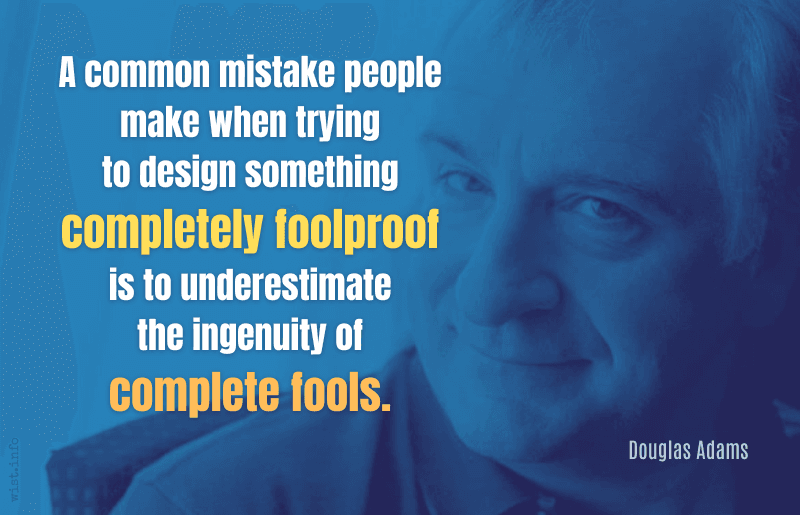
A common mistake people make when trying to design something completely foolproof is to underestimate the ingenuity of complete fools.
Douglas Adams (1952–2001) English author, humorist, screenwriter
Hitchhiker’s Guide No. 5, Mostly Harmless, ch. 12 (1992)
(Source)
FORD: And you’d better be prepared for the jump into hyperspace. It’s unpleasantly like being drunk.
ARTHUR: Well what’s so unpleasant about being drunk?
FORD: You ask a glass of water.
Douglas Adams (1952–2001) English author, humorist, screenwriter
Hitchhiker’s Guide to the Galaxy, Phase 1, “Fit the 1st” (BBC Radio) (1978-03-08)
(Source)
This was adapted into the novelization, The Hitchhiker's Guide to the Galaxy, ch. 6 (1979), in close to the same language:"No, don't move," he added as Arthur began to uncurl himself, "you'd better be prepared for the jump into hyperspace. It's unpleasantly like being drunk."
"What's so unpleasant about being drunk?"
"You ask a glass of water."
It can hardly be a coincidence that no language on Earth has ever produced the expression “as pretty as an airport.” Airports are ugly. Some are very ugly. Some attain a degree of ugliness that can only be the result of a special effort. This ugliness arises because airports are full of people who are tired, cross, and have just discovered that their luggage has landed in Murmansk (Murmansk airport is the only exception of this otherwise infallible rule), and architects have on the whole tried to reflect this in their designs.
Douglas Adams (1952–2001) English author, humorist, screenwriter
Dirk Gently No. 2, The Long Dark Tea-Time of the Soul, ch. 1 (1988)
(Source)
Opening words.
Variant: "It's no coincidence that in no known language does the phrase 'As pretty as an airport' appear."
Human beings, who are almost unique in having the ability to learn from the experiences of others, are also remarkable for their apparent disinclination to do so.
Douglas Adams (1952–2001) English author, humorist, screenwriter
Last Chance to See, ch. 4 (1990) [with Mark Carwardine]
(Source)
The source BBC Radio documentary (1989-10-04) can no longer be played at the BBC site.
Adams reading the 1992 audiobook can be heard here.
I find that a great part of the information I have was acquired by looking up something and finding something else on the way.
Franklin Pierce Adams (1881–1960) American journalist and humorist ["F. P. A."]
“Nods and Becks”
A good deal of so-called atheism is itself, from my point of view, theologically significant. It is the working of God in history, and judgement upon the pious. An authentic prophet can and should be a radical critic of spurious piety, of sham spirituality.
James Luther Adams (1901–1994) American theologian
Speech (Jan 1977)
The collection plate in the Sunday Service is sometimes objected to for aesthetic reasons, but it is an earnest, indeed a symbol, of the voluntary character of the association, and it should be interpreted in this fashion. It is a way of saying to the community, “This is our voluntary, independent enterprise, and under God’s mercy we who believe in it will support it. We do not for its support appeal to the coercive power of the state.”
James Luther Adams (1901–1994) American theologian
On Being Human Religiously (1976)
But what do We mean by the American Revolution? Do We mean the American War? The Revolution was effected before the War commenced. The Revolution was in the Minds and Hearts of the People. […] This radical Change in the Principles, Opinions Sentiments and Affection of the People, was the real American Revolution.
John Adams (1735–1826) American lawyer, Founder, statesman; US President (1797–1801)
Letter (1818-02-13) to Hezekiah Niles
(Source)

Facts are stubborn things; and whatever may be our wishes, our inclinations, or the dictates of our passions, they cannot alter the state of facts and evidence.
John Adams (1735–1826) American lawyer, Founder, statesman; US President (1797–1801)
Speech (1770-12-04), “Argument in Defence of the Soldiers in the Boston Massacre Trials”
(Source)
The fundamental Article of my political Creed is, that Despotism, or unlimited Sovereignty, or absolute Power is the Same in a Majority of a popular Assembly, an Aristocratical Counsel, an Oligarchical Junto and a Single Emperor. Equally arbitrary cruel bloody and in every respect, diabolical.
John Adams (1735–1826) American lawyer, Founder, statesman; US President (1797–1801)
Letter (1815-11-13) to Thomas Jefferson
(Source)
The United States of America have exhibited, perhaps, the first example of governments erected on the simple principles of nature; and if men are now sufficiently enlightened to disabuse themselves of artifice, imposture, hypocrisy, and superstition, they will consider this event as an era in their history. Although the detail of the formation of the American governments is at present little known or regarded either in Europe or in America, it may hereafter become an object of curiosity. It will never be pretended that any persons employed in that service had interviews with the gods, or were in any degree under the inspiration of Heaven, more than those at work upon ships or houses, or laboring in merchandise or agriculture; it will forever be acknowledged that these governments were contrived merely by the use of reason and the sense.
John Adams (1735–1826) American lawyer, Founder, statesman; US President (1797–1801)
A Defence of the Constitutions of Government of The United States of America, Vol. 1, Preface (1787)
(Source)
To believe all men honest would be folly. To believe none so is something worse.
John Quincy Adams (1767–1848) US President (1825–29)
(Attributed)
The influence of each human being on others in this life is a kind of immortality.
John Quincy Adams (1767–1848) US President (1825–29)
(Attributed)
I cannot ask of Heaven success, even for my Country, in a Cause where she should be in the wrong — Fiat Justitia, pereat Coelum — My toast would be, may our Country be always successful, but whether successful or otherwise, always right.
John Quincy Adams (1767–1848) US President (1825–29)
Letter (1816-08-01) to John Adams
(Source)
In response to Stephen Decatur's toast (1816-04, at a dinner in Norfolk, Virginia): "Our Country! In her intercourse with foreign nations may she always be in the right, but our country, right or wrong." The last part became a common nationalistic slogan.
The Latin translates as "Let justice be done though Heaven should fall."
Always vote for principle, though you may vote alone, and you may cherish the sweetest reflection that your vote is never lost.
John Quincy Adams (1767–1848) US President (1825–29)
(Attributed)
Capitalism and communism stand at opposite poles. Their essential difference is this: The communist, seeing the rich man and his fine home, says: “No man should have so much.” The capitalist, seeing the same thing, says: “All men should have as much.”
Phelps Adams (1902–1991) American journalist, executive
(Attributed)
One battle would do more towards a Declaration of Independence than a long chain of conclusive arguments in a provincial convention or the Continental Congress.
Samuel Adams (1722–1803) American revolutionary, statesman
Letter to Samuel Cooper (30 Apr. 1776)
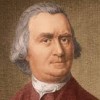
It requires time to bring honest men to think & determine alike even in important matters. Mankind are governed more by their feelings than by reason. Events which excite those feelings will produce wonderful effects.
Samuel Adams (1722–1803) American revolutionary, statesman
Letter to Samuel Cooper (30 Apr. 1776)
WALLY: Stupidity is like nuclear power; it can be used for good or evil.
DILBERT: And you don’t want to get any on you.Scott Adams (b. 1957) American cartoonist
Dilbert (11 Dec. 1995)

I value my garden more for being full of blackbirds than of cherries, and very frankly give them fruit for their songs.
Joseph Addison (1672–1719) English essayist, poet, statesman
Essay (1712-09-06), The Spectator, No. 477
(Source)

A man must be excessively stupid, as well as uncharitable, who believes that there is no virtue but on his own side, and that there are not men as honest as himself who may differ from him in political principles.
Joseph Addison (1672–1719) English essayist, poet, statesman
Essay (1711-12-08), The Spectator, No. 243
(Source)
PORTIUS: ‘Tis not in mortals to command success,
But we’ll do more, Sempronius; we’ll deserve it.Joseph Addison (1672–1719) English essayist, poet, statesman
Cato, Act 1, sc. 2, l. 43ff (1713)
(Source)
This passage was widely known to America's Founders; John Adams paraphrases it in a letter to his wife Abigail (1776-02-18), and George Washington in letters to Nicholas Cooke (1775-10-29) and, most famously, Benedict Arnold (1775-12-05).
Cheerfulness keeps up a kind of daylight in the mind, and fills it with a steady and perpetual serenity.
Joseph Addison (1672–1719) English essayist, poet, statesman
Essay (1712-05-17), The Spectator, No. 381
(Source)
My friend Sir Roger heard them both upon a round trot; and after having paused some time, told them with an air of a man who would not give his judgment rashly, that “much might be said on both sides.”
Joseph Addison (1672–1719) English essayist, poet, statesman
Essay (1711-07-20), The Spectator, No. 122
(Source)
An infallible method of conciliating a tiger is to allow oneself to be devoured.
Konrad Adenauer (1876–1967) German politician
(Attributed)
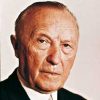
The truth is often a terrible weapon of aggression. It is possible to lie, and even to murder with the truth.
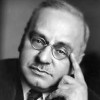
It is the individual who is not interested in his fellow men who has the greatest difficulties in life and provides the greatest injury to others. It is from among such individuals that all human failures spring.
Alfred Adler (1870–1937) Austrian psychologist
What Life Should Mean to You (1937)
It is always easier to fight for one’s principles than to live up to them.
Alfred Adler (1870–1937) Austrian psychologist
(Attributed)
(Source)
Comment to friend (1927). In Phyllis Bottome, Alfred Adler: A Biography, ch. 5 (1939)
No religion can long continue to maintain its purity when the church becomes the subservient vassal of the state.
Felix Adler (1851–1933) German-American educator
(Attributed)
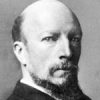
The hero is one who kindles a great light in the world, who sets up blazing torches in the dark streets of life for men to see by. The saint is the man who walks through the dark paths of the world, himself a light.
Felix Adler (1851–1933) German-American educator
(Attributed)
Tradition is what you resort to when you don’t have the time or the money to do it right.
Kurt Herbert Adler (1905–1988) Austrian-American conductor, opera director
(Attributed)
Death is a softer thing by far than tyranny.
Aeschylus (525–456 BC) Greek dramatist (Æschylus)
Agamemnon, I. 1364
Alt trans.: "Death is better, a milder fate than tyranny." "Death is softer by far than tyranny."
Not to engage in the pursuit of ideas is to live like ants instead of like men.
Mortimer J. Adler (1902–2001) American philosopher, educator, author
Saturday Review (22 Nov 1958)
Everyone’s quick to blame the alien.
Aeschylus (525–456 BC) Greek dramatist (Æschylus)
The Suppliant Maidens
It is not the oath that makes us believe the man, but the man the oath.
Aeschylus (525–456 BC) Greek dramatist (Æschylus)
Fragment 385
Any excuse will serve a tyrant.
Aesop (620?-560? BC) Legendary Greek storyteller
Fables [Aesopica], “The Wolf and the Lamb” (6th C BC) [tr. Jacobs (1894)]
(Source)
Other translations:
- "'Tis an Easie Matter to find a Staff to Beat a Dog." [tr. L'Estrange (1692)]
- "A tyrant never wants a plea." [tr. James (1848)]
- "The tyrant will always find a pretext for his tyranny." [tr. Townsend (1887)]
No act of kindness, no matter how small, is ever wasted.
Aesop (620?-560? BC) Legendary Greek storyteller
Fables [Aesopica], “The Lion and the Mouse” (6th C BC)
Another translation: "Kindness is seldom thrown away" [tr. James (1848)]
Don’t worry about people stealing your ideas. If your ideas are any good, you’ll have to ram them down people’s throats.
Howard Aiken (1900–1973) American mathematician
(Attributed)
Quoted in E. Weiss, A Computer Science Reader : Selections from Abacus (1988). Alternate: "Don't worry about people stealing an idea. If it's original, you will have to ram it down their throats." Quoted in R. Slater, Portraits in Silicon (1987)
Blessed is the person who is too busy to worry in the daytime and too sleepy to worry at night.
Leo Aikman (1908–1978) American writer, newspaper editor, humorist
Atlanta Journal-Constitution
Say not unto thyself, Behold, truth breedeth hatred, and I will avoid it; dissimulation raiseth friends, and I will follow it. Are not the enemies made by truth, better than the friends obtained by flattery?
Akhenaten (d. 1336 BC) King of Egypt (1353–36 BC), religious reformer [Akhenaton, Akhnaten, Amenhotep IV, Ikhn-aton]
(Attributed)
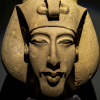
True wisdom is less presuming than folly. The wise man doubteth often, and changeth his mind; the fool is obstinate, and doubteth not; he knoweth all things but his own ignorance.
Akhenaten (d. 1336 BC) King of Egypt (1353–36 BC), religious reformer [Akhenaton, Akhnaten, Amenhotep IV, Ikhn-aton]
(Attributed)
Usually attributed to Akhenaten. Sometimes attributed as a writing of Noble Drew Ali (1886-1929), ostensibly from the Koran, or as an ancient Brahmin writing.
Know thyself as the pride of His creation, the link uniting divinity and matter; behold a part of God Himself within thee; remember thine own dignity nor dare descend to evil or meanness.
Akhenaten (d. 1336 BC) King of Egypt (1353–36 BC), religious reformer [Akhenaton, Akhnaten, Amenhotep IV, Ikhn-aton]
(Attributed)
Unsourced, sometimes given as a Brahminic writing.
The true teacher defends his pupils against his own personal influence. He inspires self-distrust. He guides their eyes from himself to the spirit that quickens him. He will have no disciple.
Amos Bronson Alcott (1799–1888) American transcendentalist, teacher, writer
Orphic Sayings, “The Teacher” (1840)
To be ignorant of one’s ignorance is the malady of the ignorant.
Amos Bronson Alcott (1799–1888) American transcendentalist, teacher, writer
Table Talk, “Discourse” (1877)
Nothing overshadows truth so much as authority.
Leon Battista Alberti (1404–1472) Genoan Renaissance Man [also "Leone"]
Momus, or De Principe (1520)
I am not afraid of storms for I am learning how to sail my ship.
Louisa May Alcott (1832–1888) American writer
Little Women, ch. 44 [Amy] (1868)
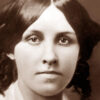
Far away in the sunshine are my highest aspirations. I may not reach them, but I can look up and see the beauty, believe in them and try to follow where they lead.
Louisa May Alcott (1832–1888) American writer
Work: A Story of Experience ch. 12 [Christie] (1875)
(Source)
Here’s my Golden Rule for a tarnished age: be fair with others, but then keep after them until they’re fair with you.
Alan Alda (b. 1936) American actor [b. Alphonso Joseph D'Abruzzo]
Commencement Speech, Connecticut College (1980)
Full text.

It isn’t necessary to be rich and famous to be happy. It’s only necessary to be rich.
Alan Alda (b. 1936) American actor [b. Alphonso Joseph D'Abruzzo]
(Attributed)
PERCHIK: Money is the world’s curse.
TEVYE: May the Lord smite me with it! And may I never recover!Sholem Aleichem (1859–1916) Russian-Jewish humorist [pseud. for Sholem Rabinowitz]
Fiddler on the Roof [with Joseph Stein] (1971)
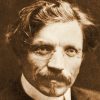
Civilization is the distance man has placed between himself and his excreta.
Brian Aldiss (1925–2017) English writer, editor
The Dark Light Years, ch. 5 (1964)

Better to abolish serfdom from above than wait till it begins to abolish itself from below.
Alexander II (1818–1881) Russian Czar (1867–81)
Speech in Moscow (30 Mar 1856)
The sad thing is that excellence makes people nervous.
Shana Alexander (1925–2005) American journalist
“Neglected Kids — the Bright Ones,” The Feminine Eye (1966)

The man who views the world at 50 the same as he did at 20 has wasted thirty years of his life.
Muhammad Ali (1942–2016) American boxer, activist [b. Cassius Clay]
Interview, Playboy (Nov 1975)
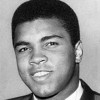
We give advice by the bucket, but take it by the grain.
William Rounseville Alger (1822–1905) American writer, minister, translator
(Attributed)
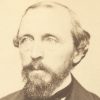
BRIAN: Screw Maximilian!
SALLY: I do!
BRIAN: So do I!Jay Presson Allen (1922–2006) American screenwriter, playwright
Cabaret (1972)
(screenplay with J. Masteroff, J. Van Druten, C. Isherwood)
They laughed at Joan of Arc, but she went right ahead and built it.
Gracie Allen (1906–1964) American comedian
(Attributed)
A conference is a gathering of important people who, singly, can do nothing, but together can decide that nothing can be done.
Fred Allen (1894–1956) American humorist [b. John Florence Sullivan]
Letter to William McChesney Martin (25 Jan 1940)
(Source)
The letter, to the then-President of the New York Stock Exchange, was written as an apology for a joke Allen had made about Wall Street, and was re-published in TIME magazine (4 Feb 1940).
Allen apparently used the line, and variations of it, at various times in his career. A variant more commonly quoted than the original shows up, without citation, in The Oxford Dictionary of Quotations:Committee -- A group of men who individually can do nothing but as a group decide that nothing can be done.
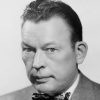
Change means movement. Movement means friction. Only in the frictionless vacuum of a nonexistent abstract world can movement or change occur without that abrasive friction of conflict.
Saul Alinsky (1909–1972) American community organizer, writer.
Rules for Radicals, “The Purpose” (1971)
(Source)

Men will take almost any kind of criticism except the observation that they have no sense of humor.
Steve Allen (1922–2000) American composer, entertainer, and wit.
(Attributed)
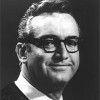
We are entitled to make almost any reasonable assumption, but should resist making conclusions until evidence requires that we do so.
Steve Allen (1922–2000) American composer, entertainer, and wit.
(Attributed)
One of the nice things about problems is that a good many of them do not exist except in our imaginations.
Steve Allen (1922–2000) American composer, entertainer, and wit.
(Attributed)
Quoted in Reader's Digest (Nov 1989)
Nothing is better than the unintended humor of reality.
Steve Allen (1922–2000) American composer, entertainer, and wit.
(Attributed)
It is no secret that organized crime in America takes in over forty billion dollars a year. This is quite a profitable sum, especially when one considers that the Mafia spends very little for office supplies.
Woody Allen (b. 1935) American comedian, writer, director [b. Allan Steward Konigsberg]
New Yorker, “A Look at Organized Crime” (1970)
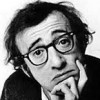
Money is better than poverty, if only for financial reasons.
Woody Allen (b. 1935) American comedian, writer, director [b. Allan Steward Konigsberg]
Without Feathers (1976)
The Early Essays
I’m astounded by people who want to ‘know’ the universe when it’s hard enough to find your way around Chinatown.
Woody Allen (b. 1935) American comedian, writer, director [b. Allan Steward Konigsberg]
Getting Even (1978)