

He that is of Opinion Money will do every Thing, may well be suspected of doing every Thing for Money.
Benjamin Franklin (1706-1790) American statesman, scientist, philosopher, aphorist
Poor Richard’s Almanack (1753)
See also Halifax.
Who has deceiv’d thee so oft as thy self?
Benjamin Franklin (1706-1790) American statesman, scientist, philosopher, aphorist
Poor Richard (1738 ed.)
(Source)
Contentment makes poor men rich; discontent makes rich men poor.
Benjamin Franklin (1706-1790) American statesman, scientist, philosopher, aphorist
Poor Richard’s Almanack
Be civil to all; sociable to many; familiar with few; friend to one; enemy to none.
Benjamin Franklin (1706-1790) American statesman, scientist, philosopher, aphorist
Poor Richard’s Almanack (1756)
Do good to thy friend to keep him, to thy enemy to gain him.
Benjamin Franklin (1706-1790) American statesman, scientist, philosopher, aphorist
Poor Richard (1734)
(Source)
The learned fool writes his nonsense in better language than the unlearned, but still ’tis nonsense.
Benjamin Franklin (1706-1790) American statesman, scientist, philosopher, aphorist
(Attributed)
We hear of the conversion of water into wine at the marriage in Cana, as of a miracle. But this conversion is, through the goodness of God, made every day before our eyes. Behold the rain which descends from heaven upon our vineyards, and which incorporates itself with the grapes to be changed into wine; a constant proof that God loves us, and loves to see us happy!
Benjamin Franklin (1706-1790) American statesman, scientist, philosopher, aphorist
Letter to Abbé Morallet (1779)
(Source)
Apparent origin of the misquote: "Beer is proof that God loves us and wants us to be happy."
The body of Benjamin Franklin, Printer (like the cover of an old book, its contents torn out and stripped of its lettering and gilding), lies here, food for worms; but the work shall not be lost, for it will (as he believed) appear once more in a new and more elegant edition, revised and corrected by the author.
Benjamin Franklin (1706-1790) American statesman, scientist, philosopher, aphorist
“Epitaph on Himself” (1778)
Variant words (and format):The body of
B. Franklin
Printer
Like the cover of an old book,
its contents torn out,
and stripped of its lettering and gilding,
lies here, food for worms.
But the work shall not be wholly lost;
for it will, as he believed, appear once more,
in a new and more perfect edition
corrected and amended
by the Author.
I haven’t failed, I’ve found ten thousand ways that don’t work.
Benjamin Franklin (1706-1790) American statesman, scientist, philosopher, aphorist
(Attributed)
(also attrib. Thomas Edison)
Work as if you were to live 100 years; pray as if you were to die tomorrow.
Benjamin Franklin (1706-1790) American statesman, scientist, philosopher, aphorist
Poor Richard’s Almanack (May 1757)
(Source)
There is no kind of dishonesty into which otherwise good people more easily and frequently fall than that of defrauding the government.
Benjamin Franklin (1706-1790) American statesman, scientist, philosopher, aphorist
(Attributed)
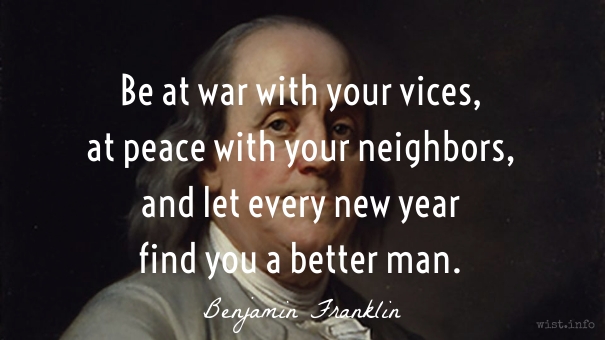
Be at War with your Vices, at Peace with your Neighbours, and let every New-Year find you a better Man.
Benjamin Franklin (1706-1790) American statesman, scientist, philosopher, aphorist
Poor Richard’s Almanack (1755)
More information on this quotation here.
If we take care of the minutes, the years will take care of themselves.
Benjamin Franklin (1706-1790) American statesman, scientist, philosopher, aphorist
(Attributed)
Many a little makes a mickle. Beware of small expenses; a small leak will sink a great ship.
Benjamin Franklin (1706-1790) American statesman, scientist, philosopher, aphorist
Poor Richard’s Almanack
Blame-all and Praise-all are two blockheads.
Benjamin Franklin (1706-1790) American statesman, scientist, philosopher, aphorist
Poor Richard (1734 ed.)
(Source)
Many a man thinks he is buying pleasure, when he is really selling himself to it.
Benjamin Franklin (1706-1790) American statesman, scientist, philosopher, aphorist
(Attributed)
Dost thou love Life? then do not squander Time; for that’s the Stuff Life is made of.
Benjamin Franklin (1706-1790) American statesman, scientist, philosopher, aphorist
Poor Richard (1746 ed.)
(Source)
Reprinted in Poor Richard Improved (1758 ed.). This edition was Franklin's final Poor Richard, and he had it prefaced (1757-07-07) by a new character, Father Abraham, who combined a hundred aphorisms from previous Poor Richard almanacs. This preface became reprinted and (often abridged) known separately as "The Way to Wealth."
Were it offered to my choice, I should have no objection to a repetition of the same life from its beginning, only asking the advantages authors have in a second edition to correct some faults in the first.
Benjamin Franklin (1706-1790) American statesman, scientist, philosopher, aphorist
Autobiography, ch. 1
He who multiplies Riches multiplies Cares.
Benjamin Franklin (1706-1790) American statesman, scientist, philosopher, aphorist
Poor Richard (1744 ed.)
(Source)
If Passion drives, let Reason hold the Reins.
Benjamin Franklin (1706-1790) American statesman, scientist, philosopher, aphorist
Poor Richard’s Almanack (May 1749)
Those who would give up essential Liberty, to purchase a little temporary Safety, deserve neither Liberty nor Safety.
Benjamin Franklin (1706-1790) American statesman, scientist, philosopher, aphorist
Letter (1755-11-11) to Royal Governor Robert Hunter Morris, from the Pennsylvania Assembly
(Source)
Also given as, "They that can give up essential liberty to obtain a little temporary safety deserve neither liberty nor safety" (cited in the Historical Review of Pennsylvania (1759)).
The actual "Reply to the Governor" letter, a response to Morris' rejection of the Assembly's proposals for frontier defense, was written by a committee of which Franklin was a member. He is usually credited as largely being the author, and he used this phrase subsequent to this.

Life is 10 percent what you make it and 90 percent how you take it.
Irving Berlin (1888-1989) American songwriter [b. Isidore Beilin]
(Attributed)
(Source)
Attributed as a comment made by Berlin during a performance of the show This is the Army, Mr. Jones at the Palladium in London in 1943.
Also sometimes attributed to Benjamin Franklin.
It is Ill-manners to silence a fool, and Cruelty to let him go on.
Benjamin Franklin (1706-1790) American statesman, scientist, philosopher, aphorist
Poor Richard’s Almanack

Genius without education is like silver in the mine.
Benjamin Franklin (1706-1790) American statesman, scientist, philosopher, aphorist
Poor Richard’s Almanack (Aug 1750)
Life ultimately means taking the responsibility to find the right answer to its problems and to fulfill the tasks which it constantly sets for each individual.
Viktor Frankl (1905-1997) German-American psychologist, writer
Man’s Search for Meaning (1959)
Humor is another of the soul’s weapons in the fight for self-preservation. It is well known that humor more than anything else in the human makeup, can afford an aloofness and an ability to rise above any situation, even if only for a few seconds.
Viktor Frankl (1905-1997) German-American psychologist, writer
Man’s Search for Meaning (1959)
We who lived in concentration camps can remember the men who walked through the huts comforting others, giving away their last piece of bread. They may have been few in number, but they offer sufficient proof that everything can be taken away from a man but one thing: the last of the human freedoms — to choose one’s attitude in any given set of circumstances, to choose one’s own way.
Viktor Frankl (1905-1997) German-American psychologist, writer
Man’s Search for Meaning, Part 1 (1959)
(Source)
What is to give light must endure burning.
Viktor Frankl (1905-1997) German-American psychologist, writer
(1963)
We had to learn ourselves and furthermore, we had to teach the despairing men, that it did not really matter what we expected from life but rather what life expected from us! We needed to stop asking about the meaning of life and instead to think of ourselves as those who were being questioned by life daily and hourly. Our answer must consist, not in talk and meditation, but in right action and in right conduct.
Viktor Frankl (1905-1997) German-American psychologist, writer
Man’s Search for Meaning (1959)
Since Auschwitz we know what man is capable of. And since Hiroshima we know what is at stake.
Viktor Frankl (1905-1997) German-American psychologist, writer
Man’s Search for Meaning (1959)
No man should judge unless he asks himself in absolute honesty whether in a similar situation he might not have done the same.
Viktor Frankl (1905-1997) German-American psychologist, writer
Man’s Search for Meaning (1959)
A clean desk is a sign of an empty mind.
Felix Frankfurter (1882-1965) US Supreme Court Justice, jurist and teacher
(Attributed)
It is a fair summary of history to say that the safeguards of liberty have frequently been forged … [by] not very nice people.
Felix Frankfurter (1882-1965) US Supreme Court Justice, jurist and teacher
United States v. Rabinowitz, 339 US 56, 69 (dissenting) (1950)
One of the prerogatives of American citizenship is the right to criticize public men and measures — and that means not only informed and responsible criticism, but the freedom to speak foolishly and without moderation.
Felix Frankfurter (1882-1965) US Supreme Court Justice, jurist and teacher
Baumgartner v. United States, 322 U.S. 665 (1944)
The history of liberty is the history of the observances of procedural safeguards.
Felix Frankfurter (1882-1965) US Supreme Court Justice, jurist and teacher
McNabb v. United States (1943)
Anyone can be passionate, but it takes real lovers to be silly.
Rose Franken (1925-1966) American novelist and playwright
(Attributed)
HAWKINS: I’ve got it! I’ve got it! The pellet with the poison’s in the vessel with the pestle; the chalice from the palace has the brew that is true! Right?
GRISELDA: Right. But there’s been a change: they broke the chalice from the palace!
HAWKINS: They broke the chalice from the palace?
GRISELDA: And replaced it with a flagon.
HAWKINS: A flagon…?
GRISELDA: With the figure of a dragon.
HAWKINS: Flagon with a dragon.
GRISELDA: Right.
HAWKINS: But did you put the pellet with the poison in the vessel with the pestle?
GRISELDA: No! The pellet with the poison’s in the flagon with the dragon! The vessel with the pestle has the brew that is true!
HAWKINS: The pellet with the poison’s in the flagon with the dragon; the vessel with the pestle has the brew that is true.
GRISELDA: Just remember that.Melvin Frank (1913-1988) American screenwriter, director
The Court Jester (1956)
(with Norman Panama)

Parents can only give good advice or put them on the right paths, but the final forming of a person’s character lies in their own hands.
Anne Frank (1929-1945) German-Dutch Jewish diarist
Diary

In spite of everything I still believe that people are really good at heart.
Anne Frank (1929-1945) German-Dutch Jewish diarist
Diary (1944-07-15)
tr. B. M. Mooyart-Doubleday, 1952
I keep my ideals, because in spite of everything I still believe that people are really good at heart.
Anne Frank (1929-1945) German-Dutch Jewish diarist
Diary
How wonderful it is that nobody need wait a single moment before starting to improve the world.
Anne Frank (1929-1945) German-Dutch Jewish diarist
Diary
Fear is a greater evil than the evil itself.
François de Sales (1567-1622) French bishop, saint, writer [a.k.a. Francis de Sales, b. François de Boisy]
Letters to Persons in the World, 6,12

A brave man can easily bear with contempt, slander, and false accusations from an evil world; but to bear such injustice at the hands of good men, of friends and relations, is a great test of patience.
François de Sales (1567-1622) French bishop, saint, writer [a.k.a. Francis de Sales, b. François de Boisy]
Introduction to a Devout Life, Part III, no. 3, “On Patience” (1618)
Be patient with everyone, but above all with yourself.
François de Sales (1567-1622) French bishop, saint, writer [a.k.a. Francis de Sales, b. François de Boisy]
(Attributed)
Nothing is so strong as gentleness; nothing so gentle as real strength.
François de Sales (1567-1622) French bishop, saint, writer [a.k.a. Francis de Sales, b. François de Boisy]
(Attributed)
He prays well who is so absorbed with God that he does not know he is praying.
François de Sales (1567-1622) French bishop, saint, writer [a.k.a. Francis de Sales, b. François de Boisy]
(Attributed)
The deeds you do today may be the only sermon some people will hear today.
Francis of Assisi (1182-1226) Italian Franciscan mystic, reformer, saint [b. Giovanni di Pietro di Bunardone]
(Attributed)

Start by doing what’s necessary, then what’s possible and suddenly you are doing the impossible.
Francis of Assisi (1182-1226) Italian Franciscan mystic, reformer, saint [b. Giovanni di Pietro di Bunardone]
(Attributed)
Preach the Gospel at all times. If necessary, use words.
Francis of Assisi (1182-1226) Italian Franciscan mystic, reformer, saint [b. Giovanni di Pietro di Bunardone]
(Attributed)
Beware, my lord! Beware lest stern Heaven hate you enough to hear your prayers!
Anatole France (1844-1924) French poet, journalist, novelist, Nobel Laureate [pseud. of Jaques-Anatole-François Thibault]
The Crime of Sylvestre Bonnard (1881)
If fifty million people say a foolish thing, it is still a foolish thing.
[Si 50 millions de personnes disent une bêtise, c’est quand même une bêtise.]
Anatole France (1844-1924) French poet, journalist, novelist, Nobel Laureate [pseud. of Jaques-Anatole-François Thibault]
(Spurious)
Sometimes also misattributed to Bertrand Russell. The closest to this specific quotation comes from W. Somerset Maugham. More information about this quotation, including the source of this misattribution and an analogous phrase France did use: If Fifty Million People Say a Foolish Thing, It Is Still a Foolish Thing – Quote Investigator.
The law, in its majestic equality, forbids the rich as well as the poor to sleep under bridges, to beg in the streets, and to steal bread.
Anatole France (1844-1924) French poet, journalist, novelist, Nobel Laureate [pseud. of Jaques-Anatole-François Thibault]
The Red Lily, ch. 7 (1884)
An education isn’t how much you have committed to memory, or even how much you know. It’s being able to differentiate between what you do know and what you don’t. It’s knowing where to go to find out what you need to know, and it’s knowing how to use the information once you get it.
William Feather (1889-1981) American publisher, author
(Attributed)
The original source for this has not been found. It is quoted (without source) in Carman Fish, "The Safety Valve" column, National Safety News (1960-01). Prior to that, it is also quoted in Telephony Magazine, Vol. 150 (1956), p. 23 (but that article itself notes it is quoting from an issue of Copperweld Magazine).
The first two sentences are often credited to Anatole France, but this seems to be a fairly recent (1990s?) misattribution.
Another variant (attributed to France, uncited; e.g.): "True education is the ability to discern the difference between what you do know and what you don't."
I would rather live in a world where my life is surrounded by mystery than live in a world so small that my mind could comprehend it.
Harry Emerson Fosdick (1878-1969) American clergyman, author, teacher
Riverside Sermons, “The Mystery of Life” (1958)
He who chooses the beginning of a road chooses the place it leads to. It is the means that determines the end.
Harry Emerson Fosdick (1878-1969) American clergyman, author, teacher
(Attributed)
I hate the idea of causes, and if I had to choose between betraying my country and betraying my friend, I hope I should have the guts to betray my country.
E. M. Forster (1879-1970) English novelist, essayist, critic, librettist [Edward Morgan Forster]
“What I Believe,” The Nation (16 Jul 1938)
(Source)
Sometimes misquoted as: "If I had to choose between betraying my country and betraying my friend, I hope I should have the decency to betray my country."
The only books that influence us are those for which we are ready, and which have gone a little farther down our particular path than we have yet got ourselves.
E. M. Forster (1879-1970) English novelist, essayist, critic, librettist [Edward Morgan Forster]
Two Cheers for Democracy, “A Book That Influenced Me” (1951)
We’re like blind men on a corner
George Foreman (b. 1949) American boxer
Sports Illustrated, interview (1983)
It is easy enough to hold an opinion, but hard work to actually know what one is talking about.
Paul F. Ford (b. c. 1957) American theologian, liturgist, literary critic
(Attributed)
Failure is only the opportunity to more intelligently begin again.
Henry Ford (1863-1947) American industrialist
(Attributed)
Time and money spent in helping men do more for themselves is far better than mere giving.
Henry Ford (1863-1947) American industrialist
(Attributed)
Whether you think that you can, or that you can’t, you are usually right.
Henry Ford (1863-1947) American industrialist
(Attributed)
What we call evil is simply ignorance bumping its head in the dark.
Henry Ford (1863-1947) American industrialist
Observer (London), Interview (16 Mar. 1930)
He who has a thousand friends has not a friend to spare,
And he who has one enemy will meet him everywhere.'Ali ibn Abi-Talib (602-661) Fourth Caliph
One Hundred Sayings [Sad Kalimah / Mi’at Kalimah]
Quoted by (and thus frequently attributed to) Ralphg Waldo Emerson.

When you blame others, you give up your power to change.
Douglas Adams (1952-2001) English author, humorist, screenwriter
(Attributed)

For a moment, nothing happened. Then, after a second or so, nothing continued to happen.
Douglas Adams (1952-2001) English author, humorist, screenwriter
Hitchhiker’s Guide No. 1, The Hitchhiker’s Guide to the Galaxy, ch. 33 (1979)
(Source)
A common mistake people make when trying to design something completely foolproof is to underestimate the ingenuity of complete fools.
Douglas Adams (1952-2001) English author, humorist, screenwriter
Mostly Harmless (1992)
FORD: And you’d better be prepared for the jump into hyperspace. It’s unpleasantly like being drunk.
ARTHUR: Well what’s so unpleasant about being drunk?
FORD: You ask a glass of water.
Douglas Adams (1952-2001) English author, humorist, screenwriter
Hitchhiker’s Guide to the Galaxy, Phase 1, “Fit the 1st” (BBC Radio) (1978-03-08)
(Source)
This was adapted into the novelization, The Hitchhiker's Guide to the Galaxy, ch. 6 (1979), in close to the same language:"No, don't move," he added as Arthur began to uncurl himself, "you'd better be prepared for the jump into hyperspace. It's unpleasantly like being drunk."
"What's so unpleasant about being drunk?"
"You ask a glass of water."
It can hardly be a coincidence that no language on Earth has ever produced the expression “as pretty as an airport.” Airports are ugly. Some are very ugly. Some attain a degree of ugliness that can only be the result of a special effort. This ugliness arises because airports are full of people who are tired, cross, and have just discovered that their luggage has landed in Murmansk (Murmansk airport is the only exception of this otherwise infallible rule), and architects have on the whole tried to reflect this in their designs.
Douglas Adams (1952-2001) English author, humorist, screenwriter
Dirk Gently No. 2, The Long Dark Tea-Time of the Soul, ch. 1 (1988)
(Source)
Opening words.
Variant: "It's no coincidence that in no known language does the phrase 'As pretty as an airport' appear."
Human beings, who are almost unique in having the ability to learn from the experiences of others, are also remarkable for their apparent disinclination to do so.
Douglas Adams (1952-2001) English author, humorist, screenwriter
Last Chance to See, ch. 4 (1991)
(Source)
I find that a great part of the information I have was acquired by looking up something and finding something else on the way.
Franklin Pierce Adams (1881-1960) American journalist and humorist ["F. P. A."]
“Nods and Becks”
A good deal of so-called atheism is itself, from my point of view, theologically significant. It is the working of God in history, and judgement upon the pious. An authentic prophet can and should be a radical critic of spurious piety, of sham spirituality.
James Luther Adams (1901-1994) American theologian
Speech (Jan 1977)
The collection plate in the Sunday Service is sometimes objected to for aesthetic reasons, but it is an earnest, indeed a symbol, of the voluntary character of the association, and it should be interpreted in this fashion. It is a way of saying to the community, “This is our voluntary, independent enterprise, and under God’s mercy we who believe in it will support it. We do not for its support appeal to the coercive power of the state.”
James Luther Adams (1901-1994) American theologian
On Being Human Religiously (1976)
But what do We mean by the American Revolution? Do We mean the American War? The Revolution was effected before the War commenced. The Revolution was in the Minds and Hearts of the People. […] This radical Change in the Principles, Opinions Sentiments and Affection of the People, was the real American Revolution.
John Adams (1735–1826) American lawyer, Founding Father, statesman, US President (1797–1801)
Letter (1818-02-13) to Hezekiah Niles
(Source)

Facts are stubborn things; and whatever may be our wishes, our inclinations, or the dictates of our passions, they cannot alter the state of facts and evidence.
John Adams (1735–1826) American lawyer, Founding Father, statesman, US President (1797–1801)
Speech (1770-12-04), “Argument in Defence of the Soldiers in the Boston Massacre Trials”
(Source)
The fundamental Article of my political Creed is, that Despotism, or unlimited Sovereignty, or absolute Power is the Same in a Majority of a popular Assembly, an Aristocratical Counsel, an Oligarchical Junto and a Single Emperor. Equally arbitrary cruel bloody and in every respect, diabolical.
John Adams (1735–1826) American lawyer, Founding Father, statesman, US President (1797–1801)
Letter (1815-11-13) to Thomas Jefferson
(Source)
The United States of America have exhibited, perhaps, the first example of governments erected on the simple principles of nature; and if men are now sufficiently enlightened to disabuse themselves of artifice, imposture, hypocrisy, and superstition, they will consider this event as an era in their history. Although the detail of the formation of the American governments is at present little known or regarded either in Europe or in America, it may hereafter become an object of curiosity. It will never be pretended that any persons employed in that service had interviews with the gods, or were in any degree under the inspiration of Heaven, more than those at work upon ships or houses, or laboring in merchandise or agriculture; it will forever be acknowledged that these governments were contrived merely by the use of reason and the sense.
John Adams (1735–1826) American lawyer, Founding Father, statesman, US President (1797–1801)
A Defence of the Constitutions of Government of The United States of America, Vol. 1, Preface (1787)
(Source)
To believe all men honest would be folly. To believe none so is something worse.
John Quincy Adams (1767-1848) US President (1825-29)
(Attributed)
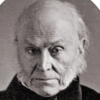
The influence of each human being on others in this life is a kind of immortality.
John Quincy Adams (1767-1848) US President (1825-29)
(Attributed)
I cannot ask of Heaven success, even for my Country, in a Cause where she should be in the wrong — Fiat Justitia, pereat Coelum — My toast would be, may our Country be always successful, but whether successful or otherwise, always right.
John Quincy Adams (1767-1848) US President (1825-29)
Letter (1816-08-01) to John Adams
(Source)
In response to Stephen Decatur's toast (and subsequent popular catch phrase), "Our Country! In her intercourse with foreign nations may she always be in the right, but our country, right or wrong."
The Latin translates as "Let justice be done though Heaven should fall."
Always vote for principle, though you may vote alone, and you may cherish the sweetest reflection that your vote is never lost.
John Quincy Adams (1767-1848) US President (1825-29)
(Attributed)
Capitalism and communism stand at opposite poles. Their essential difference is this: The communist, seeing the rich man and his fine home, says: “No man should have so much.” The capitalist, seeing the same thing, says: “All men should have as much.”
Phelps Adams (1902-1991) American journalist, executive
(Attributed)
One battle would do more towards a Declaration of Independence than a long chain of conclusive arguments in a provincial convention or the Continental Congress.
Samuel Adams (1722-1803) American revolutionary, statesman
Letter to Samuel Cooper (30 Apr. 1776)
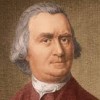
It requires time to bring honest men to think & determine alike even in important matters. Mankind are governed more by their feelings than by reason. Events which excite those feelings will produce wonderful effects.
Samuel Adams (1722-1803) American revolutionary, statesman
Letter to Samuel Cooper (30 Apr. 1776)
WALLY: Stupidity is like nuclear power; it can be used for good or evil.
DILBERT: And you don’t want to get any on you.Scott Adams (b. 1957) American cartoonist
Dilbert (11 Dec. 1995)

I value my garden more for being full of blackbirds than of cherries, and very frankly give them fruit for their songs.
Joseph Addison (1672-1719) English essayist, poet, statesman
Essay (1712-09-06), The Spectator, No. 477
(Source)

A man must be excessively stupid, as well as uncharitable, who believes that there is no virtue but on his own side, and that there are not men as honest as himself who may differ from him in political principles.
Joseph Addison (1672-1719) English essayist, poet, statesman
Essay (1711-12-08), The Spectator, No. 243
(Source)
PORTIUS: ‘Tis not in mortals to command success,
But we’ll do more, Sempronius; we’ll deserve it.Joseph Addison (1672-1719) English essayist, poet, statesman
Cato, Act 1, sc. 2, l. 43ff (1713)
(Source)
This passage was widely known to America's Founders; John Adams paraphrases it in a letter to his wife Abigail (1776-02-18), and George Washington in letters to Nicholas Cooke (1775-10-29) and, most famously, Benedict Arnold (1775-12-05).
Cheerfulness keeps up a kind of daylight in the mind, and fills it with a steady and perpetual serenity.
Joseph Addison (1672-1719) English essayist, poet, statesman
Essay (1712-05-17), The Spectator, No. 381
(Source)
My friend Sir Roger heard them both upon a round trot; and after having paused some time, told them with an air of a man who would not give his judgment rashly, that “much might be said on both sides.”
Joseph Addison (1672-1719) English essayist, poet, statesman
Essay (1711-07-20), The Spectator, No. 122
(Source)
An infallible method of conciliating a tiger is to allow oneself to be devoured.
Konrad Adenauer (1876-1967) German politician
(Attributed)
The truth is often a terrible weapon of aggression. It is possible to lie, and even to murder with the truth.
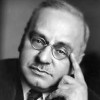
It is the individual who is not interested in his fellow men who has the greatest difficulties in life and provides the greatest injury to others. It is from among such individuals that all human failures spring.
Alfred Adler (1870-1937) Austrian psychologist
What Life Should Mean to You (1937)
It is always easier to fight for one’s principles than to live up to them.
Alfred Adler (1870-1937) Austrian psychologist
(Attributed)
(Source)
Comment to friend (1927). In Phyllis Bottome, Alfred Adler: A Biography, ch. 5 (1939)
No religion can long continue to maintain its purity when the church becomes the subservient vassal of the state.
Felix Adler (1851-1933) German-American educator
(Attributed)
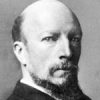
The hero is one who kindles a great light in the world, who sets up blazing torches in the dark streets of life for men to see by. The saint is the man who walks through the dark paths of the world, himself a light.
Felix Adler (1851-1933) German-American educator
(Attributed)
Tradition is what you resort to when you don’t have the time or the money to do it right.
Kurt Herbert Adler (1905-1988) Austrian-American conductor, opera director
(Attributed)
Death is a softer thing by far than tyranny.
Aeschylus (525-456 BC) Greek dramatist (Æschylus)
Agamemnon, I. 1364
Alt trans.: "Death is better, a milder fate than tyranny." "Death is softer by far than tyranny."
Not to engage in the pursuit of ideas is to live like ants instead of like men.
Mortimer J. Adler (1902-2001) American philosopher, educator, author
Saturday Review (22 Nov 1958)
Everyone’s quick to blame the alien.
Aeschylus (525-456 BC) Greek dramatist (Æschylus)
The Suppliant Maidens
It is not the oath that makes us believe the man, but the man the oath.
Aeschylus (525-456 BC) Greek dramatist (Æschylus)
Fragment 385
Any excuse will serve a tyrant.
Aesop (620?-560? BC) Legendary Greek storyteller
Fables [Aesopica], “The Wolf and the Lamb” (6th C BC) [tr. Jacobs (1894)]
(Source)
Alternate translations:
- "'Tis an Easie Matter to find a Staff to Beat a Dog." [tr. L'Estrange (1692)]
- "A tyrant never wants a plea." [tr. James (1848)]
- "The tyrant will always find a pretext for his tyranny." [tr. Townsend (1887)]
No act of kindness, no matter how small, is ever wasted.
Aesop (620?-560? BC) Legendary Greek storyteller
Fables [Aesopica], “The Lion and the Mouse” (6th C BC)
Alternate translation: "Kindness is seldom thrown away" [tr. James (1848)]
Don’t worry about people stealing your ideas. If your ideas are any good, you’ll have to ram them down people’s throats.
Howard Aiken (1900-1973) American mathematician
(Attributed)
Quoted in E. Weiss, A Computer Science Reader : Selections from Abacus (1988). Alternate: "Don't worry about people stealing an idea. If it's original, you will have to ram it down their throats." Quoted in R. Slater, Portraits in Silicon (1987)
Blessed is the person who is too busy to worry in the daytime and too sleepy to worry at night.
Leo Aikman (1908-1978) American writer, newspaper editor, humorist
Atlanta Journal-Constitution
Say not unto thyself, Behold, truth breedeth hatred, and I will avoid it; dissimulation raiseth friends, and I will follow it. Are not the enemies made by truth, better than the friends obtained by flattery?
Akhenaten (d. 1336 BC) King of Egypt (1353-36 BC), religious reformer [Akhenaton, Akhnaten, Amenhotep IV, Ikhn-aton]
(Attributed)
True wisdom is less presuming than folly. The wise man doubteth often, and changeth his mind; the fool is obstinate, and doubteth not; he knoweth all things but his own ignorance.
Akhenaten (d. 1336 BC) King of Egypt (1353-36 BC), religious reformer [Akhenaton, Akhnaten, Amenhotep IV, Ikhn-aton]
(Attributed)
Usually attributed to Akhenaten. Sometimes attributed as a writing of Noble Drew Ali (1886-1929), ostensibly from the Koran, or as an ancient Brahmin writing.
Know thyself as the pride of His creation, the link uniting divinity and matter; behold a part of God Himself within thee; remember thine own dignity nor dare descend to evil or meanness.
Akhenaten (d. 1336 BC) King of Egypt (1353-36 BC), religious reformer [Akhenaton, Akhnaten, Amenhotep IV, Ikhn-aton]
(Attributed)
Unsourced, sometimes given as a Brahminic writing.
The true teacher defends his pupils against his own personal influence. He inspires self-distrust. He guides their eyes from himself to the spirit that quickens him. He will have no disciple.
Amos Bronson Alcott (1799-1888) American transcendentalist, teacher, writer
Orphic Sayings, “The Teacher” (1840)
To be ignorant of one’s ignorance is the malady of the ignorant.
Amos Bronson Alcott (1799-1888) American transcendentalist, teacher, writer
Table Talk, “Discourse” (1877)
Nothing overshadows truth so much as authority.
Leon Battista Alberti (1404-1472) Genoan Renaissance Man [also "Leone"]
Momus, or De Principe (1520)
I am not afraid of storms for I am learning how to sail my ship.
Louisa May Alcott (1832-1888) American writer
Little Women, ch. 44 [Amy] (1868)
Far away in the sunshine are my highest aspirations. I may not reach them, but I can look up and see the beauty, believe in them and try to follow where they lead.
Louisa May Alcott (1832-1888) American writer
Work: A Story of Experience ch. 12 [Christie] (1875)
(Source)
Here’s my Golden Rule for a tarnished age: be fair with others, but then keep after them until they’re fair with you.
Alan Alda (b. 1936) American actor [b. Alphonso Joseph D'Abruzzo]
Commencement Speech, Connecticut College (1980)
Full text.

It isn’t necessary to be rich and famous to be happy. It’s only necessary to be rich.
Alan Alda (b. 1936) American actor [b. Alphonso Joseph D'Abruzzo]
(Attributed)
PERCHIK: Money is the world’s curse.
TEVYE: May the Lord smite me with it! And may I never recover!Sholem Aleichem (1859-1916) Russian-Jewish humorist [pseud. for Sholem Rabinowitz]
Fiddler on the Roof [with Joseph Stein] (1971)
Civilization is the distance man has placed between himself and his excreta.
Brian Aldiss (1925-2017) English writer, editor
The Dark Light Years, ch. 5 (1964)

Better to abolish serfdom from above than wait till it begins to abolish itself from below.
Alexander II (1818-1881) Russian Czar (1867-81)
Speech in Moscow (30 Mar 1856)
The sad thing is that excellence makes people nervous.
Shana Alexander (1925-2005) American journalist
“Neglected Kids — the Bright Ones,” The Feminine Eye (1966)

The man who views the world at 50 the same as he did at 20 has wasted thirty years of his life.
Muhammad Ali (1942-2016) American boxer, activist [b. Cassius Clay]
Interview, Playboy (Nov 1975)
We give advice by the bucket, but take it by the grain.
William Rounseville Alger (1822-1905) American writer, minister, translator
(Attributed)
BRIAN: Screw Maximilian!
SALLY: I do!
BRIAN: So do I!Jay Presson Allen (1922-2006) American screenwriter, playwright
Cabaret (1972)
(screenplay with J. Masteroff, J. Van Druten, C. Isherwood)
They laughed at Joan of Arc, but she went right ahead and built it.
Gracie Allen (1906-1964) American comedian
(Attributed)
A conference is a gathering of important people who, singly, can do nothing, but together can decide that nothing can be done.
Fred Allen (1894-1956) American humorist [b. John Florence Sullivan]
Letter to William McChesney Martin (25 Jan 1940)
(Source)
The letter, to the then-President of the New York Stock Exchange, was written as an apology for a joke Allen had made about Wall Street, and was re-published in TIME magazine (4 Feb 1940).
Allen apparently used the line, and variations of it, at various times in his career. A variant more commonly quoted than the original shows up, without citation, in The Oxford Dictionary of Quotations:Committee -- A group of men who individually can do nothing but as a group decide that nothing can be done.
Change means movement. Movement means friction. Only in the frictionless vacuum of a nonexistent abstract world can movement or change occur without that abrasive friction of conflict.
Saul Alinsky (1909-1972) American community organizer, writer.
Rules for Radicals, “The Purpose” (1971)
(Source)
Men will take almost any kind of criticism except the observation that they have no sense of humor.
Steve Allen (1922-2000) American composer, entertainer, and wit.
(Attributed)
We are entitled to make almost any reasonable assumption, but should resist making conclusions until evidence requires that we do so.
Steve Allen (1922-2000) American composer, entertainer, and wit.
(Attributed)
One of the nice things about problems is that a good many of them do not exist except in our imaginations.
Steve Allen (1922-2000) American composer, entertainer, and wit.
(Attributed)
Quoted in Reader's Digest (Nov 1989)
Nothing is better than the unintended humor of reality.
Steve Allen (1922-2000) American composer, entertainer, and wit.
(Attributed)
It is no secret that organized crime in America takes in over forty billion dollars a year. This is quite a profitable sum, especially when one considers that the Mafia spends very little for office supplies.
Woody Allen (b. 1935) American comedian, writer, director [b. Allan Steward Konigsberg]
New Yorker, “A Look at Organized Crime” (1970)
Money is better than poverty, if only for financial reasons.
Woody Allen (b. 1935) American comedian, writer, director [b. Allan Steward Konigsberg]
Without Feathers (1976)
The Early Essays
I’m astounded by people who want to ‘know’ the universe when it’s hard enough to find your way around Chinatown.
Woody Allen (b. 1935) American comedian, writer, director [b. Allan Steward Konigsberg]
Getting Even (1978)
There are two types of people in this world, good and bad. The good sleep better, but the bad seem to enjoy the waking hours much more.
Woody Allen (b. 1935) American comedian, writer, director [b. Allan Steward Konigsberg]
Side Effects (1989)
New Yorker Essays, 1970s
To YOU I’m an atheist; to God, I’m the Loyal Opposition.
Woody Allen (b. 1935) American comedian, writer, director [b. Allan Steward Konigsberg]
Stardust Memories (1980)
I think you should defend to the death their right to march, and then go down and meet them with baseball bats.
Woody Allen (b. 1935) American comedian, writer, director [b. Allan Steward Konigsberg]
On the KKK Skokie march
I don’t want to achieve immortality through my work. I want to achieve it through not dying.
Woody Allen (b. 1935) American comedian, writer, director [b. Allan Steward Konigsberg]
Without Feathers (1975)
Sex without love is an empty experience, but as empty experiences go, it’s one of the best.
Woody Allen (b. 1935) American comedian, writer, director [b. Allan Steward Konigsberg]
(Attributed)
I’d call him a sadistic, hippophilic necrophile, but that would be beating a dead horse.
Woody Allen (b. 1935) American comedian, writer, director [b. Allan Steward Konigsberg]
What’s up, Tiger Lily? (1966)
The difference between sex and death is that with death you can do it alone and no one is going to make fun of you.
Woody Allen (b. 1935) American comedian, writer, director [b. Allan Steward Konigsberg]
New York Tribune (1975)
(quoted)
Love is the answer; but while you re waiting for the answer, sex raises some pretty good questions.
Woody Allen (b. 1935) American comedian, writer, director [b. Allan Steward Konigsberg]
(Attributed)
People who are aware of, and ashamed of, their prejudices are well on the road to eliminating them.
Gordon Allport (1897-1967) American psychology professor
(Attributed)
As the Sun colours flowers, so art colours life.
Lawrence Alma-Tadema (1836-1912) Dutch-British painter
Inscription on his seal
A man who has bought a theory will fight a furious rear guard action against the facts.
Joseph R. Alsop, Jr. (1910-1989) American journalist
(Attributed)
To get maximum attention, it’s hard to beat a good, big mistake.
Joseph R. Alsop, Jr. (1910-1989) American journalist
(Attributed)
(also attrib. David D. Hewitt)
They do greatly err who acknowledge that the flesh of man was taken on Himself by Christ, but deny that the affections of man were taken; and they contravene the purpose of the Lord Jesus Himself, since thus they take away from man what constitutes man, for man cannot be man without human affections.
Ambrose of Milan (339-397) Roman theologian, statesman, Christian prelate, saint, Doctor of the Church [Aurelius Ambrosius]
“On Psalm 61”
Look around the table. If you don’t see a sucker, get up, because you’re the sucker.
"Amarillo Slim" Preston (1928-2012) American gambler [Thomas Austin Preston, Jr.]
(Attributed)
Though he used the phrase, he did not take credit for it. More information here.Variants:
- "If after ten minutes at the poker table you do not know who the patsy is -- you are the patsy."
- "If you sit in on a poker game and don't see a sucker, get up. You're the sucker."
- "If you enter a poker game and you don't see a sucker, get up and leave -- you’re it."
PAIGE: I tell you, Nicole, when the cafeteria has pizza for lunch, it’s like all my troubles disappear. I mean, who cares about a dumb Shakespeare quiz?! Who cares that I’ve got a lab report due?! Who cares that I left my book bag at home?! I’m going to have pizza! Well, I’d better get in line.
NICOLE: Don’t you keep your wallet in your book bag? You can have my yogurt …
PAIGE: The Irony Gods must be rolling on the floor.Bill Amend (b. 1962) American cartoonist
Foxtrot
When I am in Rome, I fast as the Romans do; when I am at Milan, I do not fast. So likewise you, whatever church you come to, observe the custom of the place.
[Cum Romanum venio, ieiuno Sabbato; cum hic sum, non ieiuno: sic etiam tu, ad quam forte ecclesiam veneris, eius morem serva, si cuiquam non vis esse scandalum nec quemquam tibi.]
Ambrose of Milan (339-397) Roman theologian, statesman, Christian prelate, saint, Doctor of the Church [Aurelius Ambrosius]
In Augustine, Epistulae, Letter 36 (c. AD 400)
Alt trans.:Various Augustine citations described:
- Popularly, "When in Rome, do as the Romans do."
- "When I am at Rome, I fast on a Saturday; when I am at Milan, I do not. Follow the custom of the church where you are."
- "When I am here, I do not fast on the Sabbath; when I am in Rome, I fast on the Sabbath."
- Alternately given as "If you are at Rome, live in the Roman style; if you are elsewhere, live as they live there. [Si fueris Romae, Romano vivito more; / Si fueris alibi, vivito sicut ibi.]" in J. Taylor, Ductor Dubitantium, or the Rule of Conscience, I.i.5 (1660).
- Epistulae 36, 14 or 32
- Letter 54 to Januarius
- Epistle to Januarius, 2, sec. 18
- Epistle to Casualanus, 36, sec. 32
Conquering any difficulty always gives one a secret joy, for it means pushing back a boundary-line and adding to one’s liberty.
Henri-Frédéric Amiel (1821-1881) Swiss philosopher, poet, critic
Journal Intime
We are always making God our accomplice so that we may legalize our own inequities. Every successful massacre is consecrated by a Te Deum, and the clergy have never been wanting in benedictions for any victorious enormity.
Henri-Frédéric Amiel (1821-1881) Swiss philosopher, poet, critic
Journal Intime (6 Oct. 1866)
A belief is not true because it is useful.
Henri-Frédéric Amiel (1821-1881) Swiss philosopher, poet, critic
Entry, Journal (15 Nov 1876)
(Source)
Written laws are like spider’s webs; they will catch, it is true, the weak and poor, but would be torn in pieces by the rich and powerful.
Anacharsis (fl. 6th C BC) Scythian traveler and philosopher
In Plutarch’s Parallel Lives “Solon” bk. 5, sec. 2.
Alt trans.: "These decrees of yours are no different from spiders' webs. They'll restrain anyone weak and insignificant who gets caught in them, but they'll be torn to shreds by people with power and wealth." [tr. by R. Waterfield, Plutarch's Greek Lives (1998)]
A man’s felicity consists not in the outward and visible blessing of fortune, but in the inward and unseen perfections and riches of the mind.
Anacharsis (fl. 6th C BC) Scythian traveler and philosopher
in Plutarch, “The Banquet of the Seven Wise Men”
You’re just an empty cage, girl, if you kill the bird.
Tori Amos (b. 1963) American singer/songwriter [b. Myra Ellen Amos]
Little Earthquakes, “Crucify” (1991)
I think NASCAR would be much more exciting if, like in a skating rink, every 15 minutes someone announced it was time to reverse direction.
(Other Authors and Sources)
Jeffrey Anbinder (Attributed)

All men’s lives are fairy tales written by the fingers of God.
Hans Christian Anderson (1805-1875) Danish author
(Attributed)
In real love you want the other person’s good. In romantic love you want the other person.
Margaret C. Anderson (1886-1973) American editor, memoirist
The Fiery Fountains (1951)

After all my time here, I’ve yet to see any problem, however complicated, which, when you looked at it in the right way, didn’t become still more complicated.
Poul Anderson (1926-2001) American writer
Call Me Joe [Arne Viken] (1957)
Sometimes attributed to Arthur Koestler (who attributed the quote to Anderson). See here for more details (and a reference to WIST).
It was a joke, okay? If we thought it would actually be used, we wouldn’t have written it!
Marc Andreessen (b. 1971) American software engineer, entrepreneur
(Attributed)
On the creation of the BLINK tag in HTML.

So often we look at a calendar of days as merely a symbol of the passage of time. We forget why we are on this earth. We forget that there is a reason for all of the pain and all of the struggle. We forget that we were put on earth to learn something. If everything were perfect in this life, we would never learn anything new. We would not be able to elevate our spirits through the events that happen to us.
Lynn V. Andrews (b. 1940) American author, spiritualist, counselor
Walk in Balance (1994)
If everything seems under control, you’re just not going fast enough.
Mario Andretti (b. 1940) Italian-American auto racer
(Attributed)
The key to leadership is having people willing to follow you if only out of curiosity to see what’s going to happen.
Marc Andreessen (b. 1971) American software engineer, entrepreneur
Fast Company, “Marc Andreessen, Act II,” interview by George Anders (Feb. 2001)
You have to decide at the end of the day if you can live with yourself.
Anne (b. 1950) British Princess Royal
(Attributed)

Most people would rather be certain they’re miserable, than risk being happy.
Robert Anthony (contemp.) American psychologist, author
Think, Think On and Think Again

The opposite of bravery is not cowardice, but conformity.
Robert Anthony (contemp.) American psychologist, author
The Ultimate Secrets of Total Self-Confidence, ch. 2 “Bondage or Liberty” (2007)
Full text.
Some people drink from the fountain of knowledge, others just gargle.
Robert Anthony (contemp.) American psychologist, author
Think, Think On and Think Again
Live as though it were your last day on earth. Some day you will be right.
Robert Anthony (contemp.) American psychologist, author
Think, Think On and Think Again
Courage is simply the willingness to be afraid and act anyway.
Robert Anthony (contemp.) American psychologist, author
Think, Think On and Think Again
Sooner or later we all discover that the important moments in life are not the advertised ones, not the birthdays, the graduations, the weddings, not the great goals achieved. The real milestones are less prepossessing. They come to the door of memory unannounced, stray dogs that amble in, sniff around a bit and simply never leave. Our lives are measured by these.
Susan B. Anthony (1820-1906) American reformer, aboltionist, sufferagist
(Attributed)

I tell them I have worked 40 years to make the W.S. platform broad enough for Atheists and Agnostics to stand upon, and now if need be I will fight the next 40 to keep it Catholic enough to permit the straightest Orthodox religionist to speak or pray and count her beads upon.
Susan B. Anthony (1820-1906) American reformer, aboltionist, sufferagist
(Attributed)
What you should say to outsiders is that a Christian has neither more nor less rights in our Association than an atheist. When our platform becomes too narrow for people of all creeds and of no creeds, I myself shall not stand upon it.
Susan B. Anthony (1820-1906) American reformer, aboltionist, sufferagist
Address to National American Woman Suffrage Association, Washington (23 Jan 1896)
Quoted in Susan B. Anthony and Ida Husted Harper, History of Woman Suffrage, vol. 4, ch. 16 (1902).
The religious persecution of the ages has been done under what was claimed to be the command of God. I distrust those people who know so well what God wants them to do, because I notice that it always coincides with their own desires.
Susan B. Anthony (1820-1906) American reformer, aboltionist, sufferagist
Address to National American Woman Suffrage Association, Washington (23-28 Jan 1896)
(Source)
The media’s power is frail. Without the people’s support, it can be shut off with the ease of turning a light switch.
Corazon Aquino (1933-2009) Filipino political leader [María Corazón Sumulong Cojuangco-Aquino]
Speech, Time Magazine Distinguished Speakers Series (Sep. 1986)
All political parties die at last of swallowing their own lies.
John Arbuthnot (1667-1735) English physician
(1735)
quoted in Richard Garnett, Life of Emerson, ch. 7 (1888)
The church must never become a government factory, carrying on a nationalized industry of religion with the people as the bolts and nuts; with God reduced to the role of cramped advocate of current national policy. Surely the pages of history are replete and the examples in many a foreign country convincing that this kind of church-state union — whatever the original motives, or however noble the original purposes — winds up with a state that is less than stable and a church that is less than sanctified, and with the poor still hungry.
Glenn L. Archer, Jr. (1929-2011) American jurist
Speech, Kansas City (Aug. 1956)
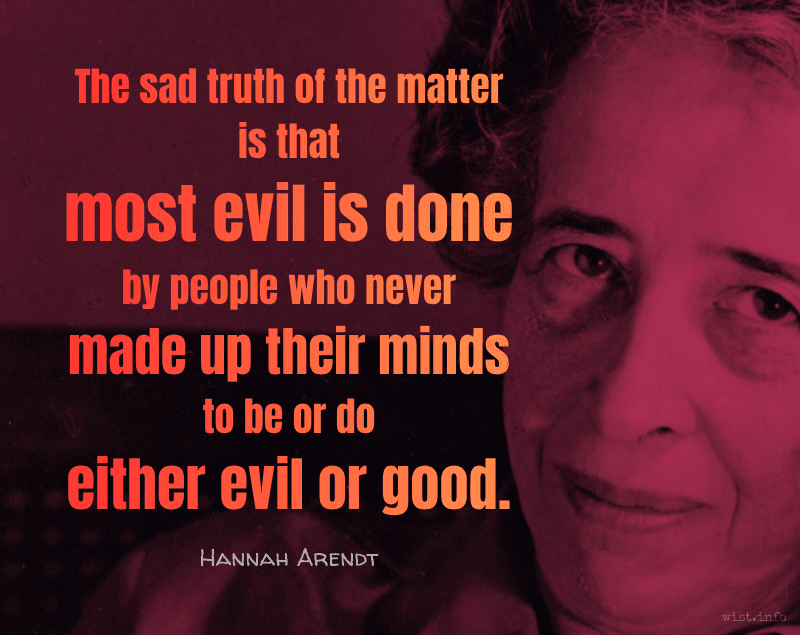
The sad truth of the matter is that most evil is done by people who never made up their minds to be or do either evil or good.
Hannah Arendt (1906-1975) German-American philosopher, political theorist
Life of the Mind, Vol. 1 “Thinking,” Part 3, ch. 18 “The two-in-one” (1977)
(Source)
Sometimes shortened as: "The sad truth is that most evil is done by people who never make up their minds to be good or evil."
Originally printed as an essay (1977-11-28), "Thinking -- III," The New Yorker (1977-12-05). That version is slightly longer:The sad truth of the matter is that most evil is done by people who never made up their minds to be either good or bad or to do either good or evil.
It is well known that the most radical revolutionary will become a conservative the day after the revolution.
Hannah Arendt (1906-1975) German-American philosopher, political theorist
Essay (1970-09-12), “Civil Disobedience,” The New Yorker
(Source)
Revised and collected in Crises of the Republic (1972).
EPOPS: You’re mistaken: men of sense often learn from their enemies. Prudence is the best safeguard. This principle cannot be learned from a friend, but an enemy extorts it immediately. It is from their foes, not their friends, that cities learn the lesson of building high walls and ships of war. And this lesson saves their children, their homes, and their properties.
Aristophanes (c. 450-c. 388 BC) Athenian comedic playwright
The Birds, l. 375 (414 BC) [tr. Anon. (1812)]Full text.
Alt trans. [Hickie (1853)]: "Yet, certainly, the wise learn many things from their enemies; for caution preserves all things. From a friend you could not learn this, but your foe immediately obliges you to learn it. For example, the states have learned from enemies, and not from friends, to build lofty walls, and to possess ships of war. And this lesson preserves children, house, and possessions."
Alt trans. [O'Neill (1938)] : "The wise can often profit by the lessons of a foe, for caution is the mother of safety. It is just such a thing as one will not learn from a friend and which an enemy compels you to know. To begin with, it's the foe and not the friend that taught cities to build high walls, to equip long vessels of war; and it's this knowledge that protects our children, our slaves and our wealth."
Alt trans. [Goldstein-Jackson (1983)]: "A man may learn wisdom even from a foe."
Wise people, even though all laws were abolished, would still live the same life.
Aristophanes (c. 450-c. 388 BC) Athenian comedic playwright
(Attributed)
Alt trans: "Wise men, though all laws were abolished, would lead the same lives."
There is a foolish corner in the brain of the wisest man.
Aristotle (384-322 BC) Greek philosopher
(Attributed)
Not found anywhere except modern books of inspiring aphorisms and sites of citationless quotations. It also doesn't sound very Aristotelian.
How many a debate could have been deflated into a single paragraph if the disputants had dared to define their terms?
William James (Will) Durant (1885-1981) American historian, teacher, philosopher
The Story of Philosophy, ch. 2 “Aristotle and Greek Science,” sec. 3 “The Foundation of Logic” (1926)
(Source)
This quotation is frequently misattributed (without citation) to Aristotle (sometimes using "dispute" instead of "debate"), but none of the sources pre-date this passage by Durant. Durant is speaking of Aristotle's development of logic, and his focus on definitions, but the full passage in context is clearly not a quotation:There was a hint of this new science in Socrates’ maddening insistence on definitions, and in Plato’s constant refining of every concept. Aristotle’s little treatise on Definitions shows how his logic found nourishment at this source. “If you wish to converse with me,” said Voltaire, “define your terms.” How many a debate would have been deflated into a paragraph if the disputants had dared to define their terms! This is the alpha and omega of logic, the heart and soul of it, that every important term in serious discourse shall be subjected to strictest scrutiny and definition. It is difficult, and ruthlessly tests the mind; but once done it is half of any task.
The least initial deviation from the truth is multiplied later a thousandfold.
There is no great genius without a touch of madness.
[Nullum magnum ingenium sine mixtura dementiae fuit.]
Aristotle (384-322 BC) Greek philosopher
(Attributed)
Attributed to Aristotle in Seneca the Younger, "On Tranquility of Mind [De Tranquillitate Animi]" (17.10) (c. AD 60). (Source (Latin)).
Alternate translations:This quotation as such is not found in surviving Aristotle. It may either represent something from Aristotle that has been lost since Seneca, or else Seneca fabricating a quote, quoting something spurious, or paraphrasing something Aristotle did write, e.g., his comments about madness/melancholy and poets/prominent talents (here and here). See also the Pseudo-Aristotle, Problemata, Book 30, ch. 1:
- "There is no great genius without a mixture of madness." [Example (1851)]
- "No great genius was without a mixture of insanity." [tr. Langsdorf (1900)]
- "No great genius has ever been without a touch of insanity." [tr. Stewart (1900), "On Peace of Mind"]
- "No excellent soul is exempt from a mixture of madness." [Example (1906)]
- "No great genius has ever existed without some touch of madness." [tr. Basore (1932)]
- "No great genius has ever existed without a dash of lunacy." [tr. Davie (2007)]
- "There was never any great genius without a tincture of insanity." [tr. @sentantiq (2018)]
- "There was never a genius without a tincture of madness."
- "No great mind has ever existed without a touch of madness."
Why is it that all those who have become eminent in philosophy or politics or poetry or the arts are clearly of an atrabilious temperament, and some of them to such an extent as to be affected by diseases caused by black bile, as is said to have happened to Heracles among the heroes? [tr. Forster (1927)]
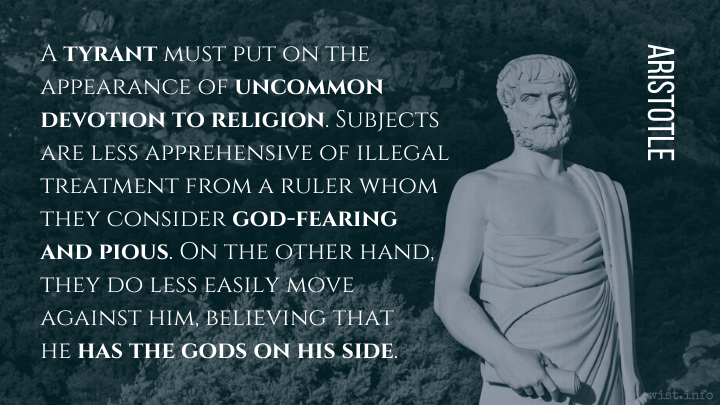
A tyrant must put on the appearance of uncommon devotion to religion. Subjects are less apprehensive of illegal treatment from a ruler whom they consider god-fearing and pious. On the other hand, they do less easily move against him, believing that he has the gods on his side.
Aristotle (384-322 BC) Greek philosopher
Politics [Πολιτικά], Book 5, ch. 11 / 1314b.39
Alt. trans.:
- "Also he should appear to be particularly earnest in the service of the Gods; for if men think that a ruler is religious and has a reverence for the Gods, they are less afraid of suffering injustice at his hands, and they are less disposed to conspire against him, because they believe him to have the very Gods fighting on his side. At the same time his religion must not be thought foolish." [tr. Jowett (1885)]
- "And, moreover, always to seem particularly attentive to the worship of the gods; for from persons of such a character men entertain less fears of suffering anything illegal while they suppose that he who governs them is religious and reverences the gods; and they will be less inclined to raise insinuations against such a one, as being peculiarly under their protection: but this must be so done as to give no occasion for any suspicion of hypocrisy." [tr. Ellis (1912)]
- "And further he must be seen always to be exceptionally zealous as regards religious observances (for people are less afraid of suffering any illegal treatment from men of this sort, if they think that their ruler has religious scruples and pays regard to the gods, and also they plot against him less, thinking that he has even the gods as allies), though he should not display a foolish religiosity." [tr. Rackham (1932)]
- "Further, he must always show himself to be seriously attentive to the things pertaining to the gods. For men are less afraid fo being treated in some respect contrary to the law by such persons, if they consider the ruler a god-fearing sort who takes thought for the gods, and they are less ready to conspire against him as one who has the gods too as allies. In showing himself of this sort, however, he must avoid silliness." [tr. Lord (1984)]
It is manifestly possible to be a good citizen without possessing the goodness that constitutes a good man.
[ὅτι μὲν οὖν ἐνδέχεται πολίτην ὄντα σπουδαῖον μὴ κεκτῆσθαι τὴν ἀρετὴν καθ᾽ ἣν σπουδαῖος ἀνήρ, φανερόν.]
Aristotle (384-322 BC) Greek philosopher
Politics [Πολιτικά], Book 3, ch. 4 / 1276b.34 [tr. Rackham (1932)]
(Source)
Note that a similar passage can be found at 1277a12.
(Source (Greek)). Alternate translations:An excellent citizen does not possess that virtue which constitutes a good man.
[tr. Ellis (1776)]It is quite possible that a citizen, though good as such, should not possess the excellence which characterizes a the good man.
[tr. Bolland (1877)]The good citizen need not of necessity possess the virtue which makes a good man.
[tr. Jowett (1885)]That it is possible for a citizen to be excellent yet not possess the virtue in accordance with which he is an excellent man, therefore, is evident.
[tr. Lord (1984)]Evidently, then, it is possible to be a good citizen without having acquired the virtue expressed by a good man.
[tr. Reeve (1998)]
So also anybody can become angry — that is easy, and so it is to give and spend money; but to be angry with or give money to the right person, and to the right amount, and at the right time, and for the right purpose, and in the right way — this is not within everybody’s power and is not easy; so that to do these things properly is rare, praiseworthy, and noble.
[οὕτω δὲ καὶ τὸ μὲν ὀργισθῆναι παντὸς καὶ ῥᾴδιον, καὶ τὸ δοῦναι ἀργύριον καὶ δαπανῆσαι: τὸ δ᾽ ᾧ καὶ ὅσον καὶ ὅτε καὶ οὗ ἕνεκα καὶ ὥς, οὐκέτι παντὸς οὐδὲ ῥᾴδιον: διόπερ τὸ εὖ καὶ σπάνιον καὶ ἐπαινετὸν καὶ καλόν.]
Aristotle (384-322 BC) Greek philosopher
Nicomachean Ethics [Ἠθικὰ Νικομάχεια], Book 2, ch. 9 (2.9, 1109a.27) (c. 325 BC) [tr. Rackham (1934)]
(Source)
(Source (Greek)). Alternate translations:Just so to be angry, to give money, and be expensive, is what any man can do, and easy: but to do these to the right person, in due proportion, at the right time, with a right object, and in the right manner, this is not as before what any man can do, nor is it easy; and for this cause goodness is rare, and praiseworthy, and noble.
[tr. Chase (1847)]And so, too, to get angry is an easy matter, and in any man's power; or to give away money or to spend it: but to decide to whom to give it, and how large a sum, and when, and for what purpose, and how, is neither in every many's power, nor an easy matter. And hence it is that excellence herein is rare and praiseworthy and noble.
[tr. Williams (1869), sec. 37]So too anybody can get angry -- that is an easy matter -- and anybody can give or spend money, but to give it to the right persons, to give the right amount of it and to give it at the right time and for the right cause and in the right way, this is not what anybody can do, nor is it easy. That is the reason why it is rare and laudable and noble to do well.
[tr. Welldon (1892)]Thus anyone can be angry -- that is quite easy; anyone can give money away or spend it: but to do these things to the right person, to the right extent, at the right time, with the right object, and in the right manner, is not what everybody can do, and is by no means easy; and that is the reason why right doing is rare and praiseworthy and noble.
[tr. Peters (1893)]So, too, anyone can get angry -- that is easy -- or give or spend money; but to do this to the right person, to the right extent, at the right time, with the right motive, and in the right way, that is not for everyone, nor is it easy; wherefore goodness is both rare and laudable and noble.
[tr. Ross (1908)]In the same way, getting angry is also something everyone can do and something easy, as is giving or spending money. Determining whom to give it to, though, and how much, when, for the sake of what, and in what way -- that is no longer something everyone can do or something easy. That is why doing it well is a rare thing and a praiseworthy and noble one.
[tr. Reeve (1948)]So, too, anyone can get angry or give money or spend it, and it is easy. But to give to the right person, the right amount, at the right time, for the right purpose, and in the right manner, this is not something anyone can do nor is it easy to do; and it is in view of this that excellence is rare and praiseworthy and noble.
[tr. Apostle (1975)]So too it is easy to get angry -- anyone can do that -- or to give and spend money; but to feel or act towards the right person to the right extent at the right time for the right reason in the right way -- that is not easy, and it is not everyone that can do it. Hence to do these things well is a rare, laudable, and fine achievement.
[tr. Thomson/Tredennick (1976)]So too anyone can get angry, or give and spend money -- these are easy, but doing them in relation to the right person, in the right amount, at the right time, with the right aim in view, and in the right way -- that is not something anyone can do, nor is it easy. This is why excellence in these things is rare, praiseworthy, and noble.
[tr. Crisp (2000)]And so too, to become angry belongs to everyone and is an easy thing, as is also giving and spending money; but to whom [one ought to do so], how much, when for the sake fo what, and how -- these no longer belong to everyone nor are easy. Thus in fact acting well is rare, praiseworthy, and noble.
[tr. Bartlett/Collins (2011)]
Note that some translations paraphrase this only to speak of anger, e.g., Edith M. Leonard, et al., The Child: At Home and School (1944):Anybody can become angry, that is easy; but to be angry with the right person, and to the right degree, and at the right time, for the right purpose, and in the right way, that is not within everybody's power and is not easy.
Well begun is half done.
Aristotle (384-322 BC) Greek philosopher
Politics [Πολιτικά], Book 5, ch. 4 / 1303b30 [tr. Jowett (1885)]
(Source)
People attribute this to Aristotle largely because Jowett used a contemporary proverb in lieu of what Aristotle wrote: "As the proverb says -- 'Well begun is half done.'" The following alternative translations capture his original meaning more closely:
Dignity does not consist in possessing honors, but in deserving them.
Aristotle (384-322 BC) Greek philosopher
(Attributed)
Variant: "Dignity consists not in possessing honors, but in the consciousness that we deserve them."
Citation not identified. Earliest reference found in 1854.
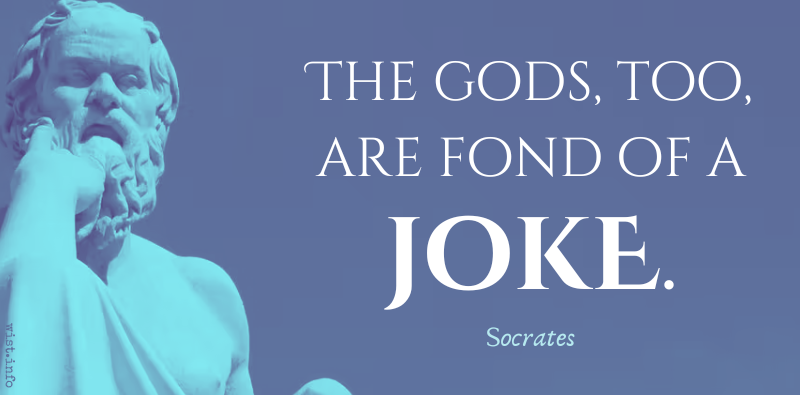
For the name of these gods there is both a serious and a humorous explanation; the serious explanation is not to be had from me, but there is no hindrance to my offering the humorous one, for the gods too are fond of a joke.
[ἀλλὰ ἔστι γὰρ καὶ σπουδαίως εἰρημένος ὁ τρόπος τῶν ὀνομάτων τούτοις τοῖς θεοῖς καὶ παιδικῶς. τὸν μὲν οὖν σπουδαῖον ἄλλους τινὰς ἐρώτα, τὸν δὲ παιδικὸν οὐδὲν κωλύει διελθεῖν: φιλοπαίσμονες γὰρ καὶ οἱ θεοί.]
Socrates (c.470-399 BC) Greek philosopher
In Plato, Cratylus [Κρατύλος], ch. 23 / 406c [tr. Hyers (1969)]
(Source)
The final phrase, "The gods, too, are fond of a joke," is broadly misattributed to Aristotle, without any citation. It is also sometimes misattributed to Edward Albee.
Cratylus is dialogue about the nature of names. Socrates, here, has been asked about the origins of the names of the gods, Dionysus and Aphrodite. Burges (below) notes that Plato had been "partly initiated into the mysteries of Demeter and Dionysus," part of which dealt seriously with the meanings of those deities' names; his avoiding the "serious explanation" is not betray his oath of secrecy to the cult.
(Source (Greek)). Alternate translations:But the mode of nomination, belonging to these divinities, is both serious and jocose. Ask therefore others about the serious mode; but nothing hinders us from relating the jocose; for these deities are lovers of jesting and sport.
[tr. Taylor (1804)]But the manner of the appellations given to these divinities, has been said to be both serious and jocose. Ask therefore others about the serious manner; but nothing hinders us from relating the jocose; for these deities are lovers of jesting and sport.
[tr. Burges (1850)]There is a serious and also a facetious explanation of both these names; the serious explanation is not to be had from me, but there is no objection to your hearing the facetious one; for the Gods too love a joke.
[tr. Jowett (1892)]You see there is both a serious and a facetious account of the form of the name of these deities. You will have to ask others for the serious one; but there is nothing to hinder my giving you the facetious account, for the gods also have a sense of humor.
[tr. Fowler (1926)]
So, whatsoever that be within us which feels, thinks, desires, and animates us, it is something celestial, divine, and, consequently, imperishable.
Aristotle (384-322 BC) Greek philosopher
(Attributed)
(Source)
The earliest reference to this text that I can find is in Louis Alphonse Cahagnet, Magnétisme: The Celestial Telegraph (1850), who attributes it to Cicero's "Explanation of the Doctrines of Aristotle." It is unclear which of Cicero's actual works this refers to, and it doesn't come across as Aristotelian (or even Ciceronian), and, given the source, may be distorted, poorly translated, or bogus.
‘Twas the saying of an ancient Sage, “That Humour was the only Test of Gravity, and Gravity of Humour. For a Subject which would not bear Raillery is suspicious; and a Jest which would not bear a serious Examination is certainly false Wit.”
Anthony Cooper, 3rd Earl of Shaftesbury (1671-1713) English politician and philosopher
Sensus Communis: An Essay on the Freedom of Wit and Humour, Part 1, Sec. 5 (1709)
(Source)
Often incorrectly attributed to Aristotle. Shaftesbury, according to his footnote, is paraphrasing from Aristotle quoting Gorgias Leontinus. The Latin translation is "Seria risu, risum seriis discutere" ("In arguing one should meet serious pleading with humor, and humor with serious pleading"). Shaftesbury's second sentence is his own commentary.
In Lord Chesterfield, in a letter to his son (6 Feb 1752), rendered it, "Ridicule is the best test of truth."

We are what we repeatedly do. Excellence, therefore, is not an act but a habit.
Aristotle (384-322 BC) Greek philosopher
Nicomachean Ethics [Ἠθικὰ Νικομάχεια] (c. 325 BC) (paraphrase)
(Source)
Variants:Not actually Aristotle, but a summary by Will Durant, The Story of Philosophy: The Lives and Opinions of the World's Greatest Philosophers (1926), ch. 2 "Aristotle and Greek Science," sec. 7 "Ethics and the Nature of Happiness" (1926):
- "We are what we repeatedly do. Excellence, then, is not an act, but a habit."
- "We are what we repeatedly do, therefore excellence is not an act, but a habit."
Excellence is an art won by training and habituation: we do not act rightly because we have virtue or excellence, but we rather have these because we have acted rightly; "these virtues are formed in man by his doing the actions"; we are what we repeatedly do. Excellence, then, is not an act but a habit: "the good of man is a working of the soul in the way of excellence in a complete life ... for as it is not one swallow or one fine day that makes a spring, so it is not one day or a short time that makes a man blessed and happy."
The quoted phrases are from the Nicomachean Ethics, Book 2, ch. 4; Book 1, ch. 7.
It is the mark of an educated mind to be able to entertain a thought without accepting it.
Aristotle (384-322 BC) Greek philosopher
(Spurious)
First attributed to Aristotle in Lowell L. Bennion, Religion and the Pursuit of Truth (1959). Unfound as such.
Sometimes thought (though I feel it's a bit of a stretch) a misinterpretation of Nicomachean Ethics 1.3.4 (1094b): "For it is the mark of an educated person to search for the same kind of clarity in each topic to the extent that the nature of the matter accepts it."
More discussion of this quotation:
Now and then a blinde man may hit a crow.
Robert Armin (c.1568-1615) English comic actor, playwright
A Nest of Ninnies (1608)
Full text.
If I were in the President’s place I would not get a chance to resign. I would be lying in a pool of my own blood hearing Mrs. Armey standing over me saying, “How do I reload this damn thing?”
Dick Armey (b. 1940) American politician, economist
Press Conference (15 Sep. 1998)
When asked during the Monica Lewinsky scandal if President Clinton should resign. More information.

You cannot get ahead while you are getting even.
Dick Armey (b. 1940) American politician, economist
(Attributed)
The world isn’t interested in the storms you encountered, but whether or not you brought in the ship.
(Other Authors and Sources)
Raul Armesto