

Lying to ourselves is more deeply ingrained than lying to others.
Fyodor Dostoyevsky (1821-1881) Russian novelist
“Celebrating a Lie”
Originality and the feeling of one’s own dignity are achieved only through work and struggle.
Fyodor Dostoyevsky (1821-1881) Russian novelist
Diary of a Writer (1877)
Man has such a predilection for systems and abstract deductions that he is ready to distort the truth intentionally, he is ready to deny the evidence of his senses only to justify his logic.
Fyodor Dostoyevsky (1821-1881) Russian novelist
Notes from the Underground (1864)
Every man has some reminiscences which he would not tell to everyone, but only to his friends. He has others which he would not reveal even to his friends, but only to himself, and that in secret. But finally there are still others which a man is even afraid to tell himself, and every decent man has a considerable number of such things stored away. That is, one can even say that the more decent he is, the greater the number of such things in his mind.
Fyodor Dostoyevsky (1821-1881) Russian novelist
Notes from the Underground (1864)
But men love abstract reasoning and neat systematization so much that they think nothing of distorting the truth, closing their eyes and ears to contrary evidence to preserve their logical constructions.
Fyodor Dostoyevsky (1821-1881) Russian novelist
(Attributed)
If a man harbors any sort of fear, it percolates through all his thinking, damages his personality, makes him landlord to a ghost.
Lloyd Douglas (1877-1951) American Congregationalist clergyman and novelist
(Attributed)
If you want to know about a man you can find out an awful lot by looking at who he married.
Kirk Douglas (1916-2020) American actor
The Daily Mail (London) (9 Sep. 1988)
What is all wisdom save a collection of platitudes? But the man who orders his life according to their teachings cannot go far wrong.
Norman Douglas (1868-1952) Austro-British writer
South Wind, ch. 16 (1917)
The right to be let alone is indeed the beginning of all freedom.
William O. Douglas (1898–1980) American jurist, US Supreme Court justice (1939–75)
Roth vs. United States, 354 U.S. 476, dissenting opinion (1957)
Justice is too good for some people and not good enough for the rest.
Norman Douglas (1868-1952) Austro-British writer
Good-bye to Western Culture (1930)
Living in Los Angeles is not blameworthy per se.
William O. Douglas (1898–1980) American jurist, US Supreme Court justice (1939–75)
Lambert v. California (1958)
Government should be concerned with anti-social conduct, not with utterances.
William O. Douglas (1898–1980) American jurist, US Supreme Court justice (1939–75)
Roth vs. United States, 354 U.S. 476, dissenting opinion (1957)
Marriage is a coming together for better or for worse, hopefully enduring, and intimate to the degree of being sacred.
William O. Douglas (1898–1980) American jurist, US Supreme Court justice (1939–75)
Griswold v. Connecticut, 381 US 470 (1965) (7 Jun 1965)
As nightfall does not come all at once, neither does oppression. In both instances, there is a twilight. And it is in such twilight that we all must be aware of change in the air — however slight — lest we become unwitting victims of the darkness.
William O. Douglas (1898–1980) American jurist, US Supreme Court justice (1939–75)
Speech to Young Lawyers Section of the Washington State Bar Association (10 Sep. 1976)
Restriction of free thought and free speech is the most dangerous of all subversions. It is the one un-American act that could most easily defeat us.
William O. Douglas (1898–1980) American jurist, US Supreme Court justice (1939–75)
The Nieman Reports, vol. 7, no. 1, “The One Un-Amercan Act” (Jan. 1953)
No man can put a chain about the ankle of his fellow man without at last finding the other end fastened about his own neck.
Frederick Douglass (1817-1895) American abolitionist, orator, writer
Speech, Civil Rights Mass Meeting, Washington, D.C. (1883)
Let me give you a word of the philosophy of reform. The whole history of the progress of human liberty shows that all concessions yet made to her august claims, have been born of earnest struggle. The conflict has been exciting, agitating, all-absorbing, and for the time being, putting all other tumults to silence. It must do this or it does nothing. If there is no struggle, there is no progress.
Those who profess to favor freedom, and yet depreciate agitation, are men who want crops without plowing up the ground. They want rain without thunder and lightning. They want the ocean without the awful roar of its many waters. This struggle may be a moral one; or it may be a physical one; or it may be both moral and physical; but it must be a struggle.Frederick Douglass (1817-1895) American abolitionist, orator, writer
Speech (1857-08-04) on West India Emancipation, Ontario County Agricultural Society Fairgrounds, Canandaigua, New York
(Source)
How often have I said to you that when you have eliminated the impossible, whatever remains, however improbable, must be the truth?
Arthur Conan Doyle (1859-1930) British writer and physician
Story (1890-02), “The Sign of the Four,” ch. 6 [Holmes], Lippincott’s Monthly Magazine, Vol. 45 (US) / 1 (UK)
(Source)
The first appearance of the phrase in its most quoted form. However, earlier in the story, chapter 1, Holmes tells Watson:Eliminate all other factors, and the one which remains must be the truth.
Similar expressions occur in The Adventures of Sherlock Holmes ("The Adventure of the Beryl Coronet"), The Memoirs of Sherlock Holmes ("Silver Blaze"), The Return of Sherlock Holmes ("The Adventure of the Priory School"), His Last Bow ("The Adventure of the Bruce-Partington Plans"), and The Case-Book of Sherlock Holmes ("The Adventure of the Blanched Soldier").
The original publication, and Doyle's manuscript (along with many other iterations across media) use "The Sign of the Four" as the title, while others (including the first book publications) use "The Sign of Four." The five-word form is used most commonly in the story, but the four-word form does show up. (More info.)
Published in novel form as The Sign of Four (1890-10).
The dogge waggeth his tayle, not for you, but for your bread.
Thomas Draxe (d. 1618) English writer [also Thomas Drake]
Bibliotheca Scholastica Instructissima (1633)
earlier ed. 1616?
Do not believe that it is very much of an advance to do the unnecessary three times as fast.
Peter F. Drucker (1909-2005) Austrian-American business consultant
(1969)
On computers
Plans are only good intentions unless they immediately degenerate into hard work.
Peter F. Drucker (1909-2005) Austrian-American business consultant
(Attributed)
The understanding that underlies the right decision grows out of the clash and conflict of opinions and out of the serious consideration of competing alternatives.
Peter F. Drucker (1909-2005) Austrian-American business consultant
Management: Tasks, Responsibilities, Practices, ch. 29 (1974)
Wherever you see a successful business, someone once made a courageous decision.
Peter F. Drucker (1909-2005) Austrian-American business consultant
(Attributed)
The most important thing in communication is to hear what isn’t being said.
Peter F. Drucker (1909-2005) Austrian-American business consultant
(Attributed)
Efficiency is doing things right. Effectiveness is doing the right things.
Peter F. Drucker (1909-2005) Austrian-American business consultant
Management: Tasks, Responsibilities, Practices, ch. 2 (1974)
Sometimes quoted as "Management" and "Leadership"; also attrib. Warren Bennis
There is nothing so useless as doing efficiently that which should not be done at all.
Peter F. Drucker (1909-2005) Austrian-American business consultant
(Attributed)
So much of what we call management consists in making it difficult for people to work.
Peter F. Drucker (1909-2005) Austrian-American business consultant
(Attributed)
My greatest strength as a consultant is to be ignorant and ask a few questions.
Peter F. Drucker (1909-2005) Austrian-American business consultant
(Attributed)
He, who will not reason, is a bigot; he, who cannot, is a fool; and he, who dares not, is a slave.
William Drummond of Logie-Almond (1770-1828) Scottish classical scholar, philosopher, diplomat, politician
Academical Questions, Preface (1805)
(Source)
Sometimes misattributed to Byron.


To get to heaven we must take it with us.
Henry Drummond (1851-1897) Scottish cleric, naturalist
(Attributed)
Beware the fury of a patient man.
John Dryden (1631-1700) English poet, dramatist, critic
Absalom and Achitophel, Part I, l. 1005 (1681)

How can finite grasp infinity?
John Dryden (1631-1700) English poet, dramatist, critic
(Attributed)
Errors like straws upon the surface flow:
Who would search for pearls must dive below.John Dryden (1631-1700) English poet, dramatist, critic
All for Love, Prologue (1677)
A capacity to change is indispensable. Equally indispensable is the capacity to hold fast to that which is good.
John Foster Dulles (1888-1959) American politician and diplomat
(Attributed)
The cost of liberty is less than the price of repression.
W. E. B. Du Bois (1868-1963) American writer, historian, social reformer [William Edward Burghardt Du Bois]
John Brown (1909)
Efficiency is intelligent laziness.
David Dunham (contemp.) American computer programmer, game designer
(Attributed)
http://lists.trolltech.com/qt-interest/2002-01/thread00788-0.html

Don’t let them tame you!
Isadora Duncan (1877-1927) American dancer, choreographer
Curtain speech, Symphony Hall, Boston (1922)

If I could tell you what it meant, there would be no point in dancing it.
Isadora Duncan (1877-1927) American dancer, choreographer
(Attributed)
And that’s the world in a nutshell, an appropriate receptacle.
(Other Authors and Sources)
Stan Dunn

A fanatic is a man who does what he thinks th’ Lord wud do if He knew th’ facts iv the case.
[A fanatic is a man who does what he thinks the Lord would do if He knew the facts of the case.]
Finley Peter Dunne (1867-1936) American humorist and journalist
“Casual Observations,” Mr. Dooley’s Opinions (1901)
Trust everyone, but cut the cards.
Finley Peter Dunne (1867-1936) American humorist and journalist
Mr. Dooley’s Opinions, “Casual Observations” (1901)
‘Twas founded be th’ Puritans to give thanks f’r bein’ presarved fr’m th’ Indyans, an’ … we keep it to give thanks we are presarved fr’m th’ Puritans.
[It was founded by the Puritans to give thanks for being preserved from the Indians, and … we keep it to give thanks we are preserved from the Puritans.]
Finley Peter Dunne (1867-1936) American humorist and journalist
Mr. Dooley’s Opinions, “Thanksgiving” (1900)
Th’ past always looks better thin it was. It’s only pleasant because it isn’t here.
[The past always looks better than it was. It’s only pleasant because it isn’t here.]
Finley Peter Dunne (1867-1936) American humorist and journalist
A Family Union, “Mr. Dooley”
Education is the transmission of civilization.
Ariel Durant (1898-1981) American writer
(Attributed)
The conservative who resists change is as valuable as the radical who proposes it.
William James (Will) Durant (1885-1981) American historian, teacher, philosopher
The Lessons of History, ch. 5, “Character & History” (1968)
Inquiry is fatal to certainty.
William James (Will) Durant (1885-1981) American historian, teacher, philosopher
The Age of Faith, ch. 38 “The Age of Romance” (1950)
(Source)
One of the lessons of history is that nothing is often a good thing to do and always a clever thing to say.
William James (Will) Durant (1885-1981) American historian, teacher, philosopher
NY World-Telegram & Sun (6 Jun 1958)
The trouble with most people is that they think with their hopes or fears or wishes rather than with their minds.
William James (Will) Durant (1885-1981) American historian, teacher, philosopher
Recalled on his death (7 Nov. 1981)
http://www.bartleby.com/63/83/4983.html
Most of us spend too much time on the last twenty-four hours and too little on the last six thousand years.
William James (Will) Durant (1885-1981) American historian, teacher, philosopher
(Attributed)
A little rule, a little sway,
A sunbeam in a winter’s day,
Is all the proud and mighty have
Between the cradle and the grave.John Dyer (1699-1757) British poet
“Grongar Hill,” ll. 88-91
Just because you like my stuff doesn’t mean I owe you anything.
Bob Dylan (b. 1941) American singer, songwriter
(1965)

Enthusiasm for one’s goal lessens the disagreeableness of working toward it.
Thomas Eakins (1844-1916) American artist, educator
(Attributed)
Recognizing the need is the primary condition for design.
Charles Eames (1907-1978) American architect, industrial designer
(1969)
It is the ability to take a joke, not make one, that proves you have a sense of humor.
Max Eastman (1883-1969) American writer and editor
Enjoyment of Laughter (1936)
You can’t let one bad moment spoil a bunch of good ones.
Dale Earnhardt (1951-2001) American auto racer
(Attributed)
I’m interested in the fact that the less secure a man is, the more likely he is to have extreme prejudice.
Clint Eastwood (b. 1930) American actor, politician
(Attributed)
Men and nations behave wisely when they have exhausted all other resources.
Abba Eban (1915-2002) Israeli politician and diplomat [b. Aubrey Solomon Eban]
Speech, Japan (19 Mar 1967)
Regarding the problems between Israel and her neighborsOther references by Eban:Eban used the phrases in various ways, but generically for all nations, for many years.Variants referencing America are usually attributed starting in the early 1980s to Winston Churchill, but not found in his writings or attributions to him at the time:
- "Nations do behave wisely once they have exhausted all other alternatives." (6 Jun 1967)
- "The question is whether there is any reason to believe that such a new era may yet come to pass. If I am sanguine on this point, it is because of a conviction that men and nations do behave wisely once they have exhausted all other alternatives. Surely the other alternatives of war and belligerency have now been exhausted." (Speech, United Nations, 16 Jun 1967)
For more info, see here.
- "Americans can always be counted on to do the right thing, after they have exhausted all other possibilities."
- "The Americans can always be trusted to do the right thing, once all other possibilities have been exhausted."
- "You can always count on the Americans to do the right thing after they have tried everything else."
- "The Americans will always do the right thing, after they've exhausted all the alternatives."
A statesman who keeps his ear permanently glued to the ground will have neither elegance of posture nor flexibility of movement.
Abba Eban (1915-2002) Israeli politician and diplomat [b. Aubrey Solomon Eban]
(Attributed)
There is a little immaturity stuck away in the crannies of even the most judicious of us, and we should treasure it.
Roger Ebert (1942-2013) American film critic, journalist, screenwriter
Review of The Mummy (May 1999)
Some people want to see God with their eyes as they see a cow, and to love Him as they love their cow — for the milk and cheese and profit it brings them. This is how it is with people who love God for the sake of outward wealth or inward comfort. They do not rightly love God, when they love Him for their own advantage.
Meister Eckhart (c. 1260-1328?) German theologian, philosopher, mystic [a.k.a. Johannes Eckhart von Hochheim; Eckhart; Eckehart]
(Attributed)

We must not in trying to think about how we can make a big difference, ignore the small daily differences we can make which, over time, add up to big differences that we often cannot foresee.
Marian Wright Edelman (b. 1939) American social reformer, lawyer, author
Families in Peril (1987)

The brain can be developed just the same as the muscles can be developed, if one will only take the pains to train the mind to think. Why do so many men never amount to anything? Because they don’t think.
Thomas Edison (1847-1931) American inventor and businessman
“They Won’t Think” (1921)

Opportunity is missed by most people because it is dressed in overalls and looks like work.
Thomas Edison (1847-1931) American inventor and businessman
(Spurious)
The quotation is first recorded anonymously in 1921, but is not attributed to Edison until 1962. More discussion here: Opportunity Is Missed Because It Is Dressed in Overalls and Looks Like Work – Quote Investigator.
What you are will show in what you do.
Thomas Edison (1847-1931) American inventor and businessman
(Attributed)
Too many men drift lazily into any job, suited or unsuited for them; and when they don’t get along well they blame everybody and everything but themselves. Grouches are nearly always pinheads, small men who have never made any effort to improve their mental capacity.
Thomas Edison (1847-1931) American inventor and businessman
“They Won’t Think” (1921)
As a cure for worrying, work is better than whiskey.
Thomas Edison (1847-1931) American inventor and businessman
(Attributed)
Results! Why, man, I have gotten a lot of results! I know several thousand things that won’t work.
Thomas Edison (1847-1931) American inventor and businessman
(Attributed)
(Source)
When told by an associate, Walter S. Mallory, that it was a shame that several months of work on new battery technology hadn't yielded any results. Recorded in Dyer and Martin, Edison: His Life and Inventions, Vol. 2, ch. 24 (1910) as an anecdote by Mallory.
More discussion about this quotation's origins and variants: I Have Gotten a Lot of Results! I Know Several Thousand Things That Won’t Work – Quote Investigator.
If we did the things we are capable of doing, we would literally astound ourselves.
Thomas Edison (1847-1931) American inventor and businessman
(Attributed)
Just because something doesn’t do what you planned it to do doesn’t mean it’s useless.
Thomas Edison (1847-1931) American inventor and businessman
(Attributed)
You know gang, when you’re a superhero, you never know where the day will take you. You may find yourself halfway around the world in the shark-infested waters of true-to-life living. Or you may find yourself going down to the store for a lozenge. You can’t know, can you? No! You gotta ride that wave, You gotta suck that lozenge! Cause if you don’t, who will?
Ben Edlund (b. 1968) American cartoonist, writer, producer
The Tick

Everybody was a baby once, Arthur. Oh, sure, maybe not today, or even yesterday. But once! Babies, chum: tiny, dimpled, fleshy mirrors of our us-ness, that we parents hurl into the future, like leathery footballs of hope! And you’ve got to get a good spiral on that baby, or evil will make an interception!
Ben Edlund (b. 1968) American cartoonist, writer, producer
The Tick
INTERVIEWER: Can you destroy the Earth?
THE TICK: Egad, I hope not! That’s where I keep all my stuff!Ben Edlund (b. 1968) American cartoonist, writer, producer
The Tick, Ep. 1, “The Tick vs. The Idea Men” (1994)
Life is a big wild crazy tossed salad, but you don’t eat it, no sir! You live it! Isn’t it great?
Ben Edlund (b. 1968) American cartoonist, writer, producer
The Tick, Ep. 6, “The Tick vs. El Seed” (1994)
I’m betting that I’m just abnormal enough to survive.
Ben Edlund (b. 1968) American cartoonist, writer, producer
The Tick, Ep. 5, “The Tick vs. The Breadmaster” (1994)
Arthur, I just had the strangest dream. I was taking some math test I hadn’t studied for … and then you tried to saw off my head. Weird, huh?
Ben Edlund (b. 1968) American cartoonist, writer, producer
The Tick, Ep. 8, “The Tick vs. The Uncommon Cold” (1994)
Yes, evil comes in many forms, whether it be a man-eating cow or Joseph Stalin, but you can’t let the package hide the pudding! Evil is just plain bad! You don’t cotton to it. You gotta smack it in the nose with the rolled-up newspaper of goodness! Bad dog! Bad dog!
Ben Edlund (b. 1968) American cartoonist, writer, producer
The Tick
Destiny has her hand on my back, and she’s pushing!
Ben Edlund (b. 1968) American cartoonist, writer, producer
The Tick, Ep. 13, “The Tick vs. Arthur’s Bank Account” (1995)
I don’t know the meaning of the word surrender! I mean, I know it, I’m not dumb. Just not in this context.
Ben Edlund (b. 1968) American cartoonist, writer, producer
The Tick, Ep. 8, “The Tick vs. The Uncommon Cold” (1994)
Falling in love with a supervillain is Trouble with a capital Troub.
Ben Edlund (b. 1968) American cartoonist, writer, producer
The Tick, “The Tick vs. the Ottoman Empire”
You’re not going crazy, you’re going sane in a crazy world!
Ben Edlund (b. 1968) American cartoonist, writer, producer
The Tick, Ep. 1, “The Tick vs. The Idea Men” (1994)
THE TICK: And isn’t sanity really just a one-trick pony anyway? I mean, all of you get is one trick, rational thinking. But when you’re good and crazy, oohoo-hoo-hoo-hoo, the sky’s the limit!
Ben Edlund (b. 1968) American cartoonist, writer, producer
The Tick (cartoon), 02×09 “Ants in the Pants!” (1995-11-18) [w. Ralph Soll]
(Source)
Oh what a goofy work is man!
Ben Edlund (b. 1968) American cartoonist, writer, producer
The Tick
On justice and on friendship, there is no price, but there are established credit limits.
Ben Edlund (b. 1968) American cartoonist, writer, producer
The Tick, Ep. 13, “The Tick vs. Arthur’s Bank Account” (1995)
Destiny’s powerful hand has made the bed of my future and it’s up to me to lie in it. I am destined to be a superhero to right wrongs and pound two-fisted justice into the hearts of evil-doers everywhere. You don’t fight destiny, no sir! And you don’t eat crackers in the bed of your future or you get all … scratchy. Hey, I’m narrating here!
Ben Edlund (b. 1968) American cartoonist, writer, producer
The Tick, Ep. 1, “The Tick vs. The Idea Men” (1994)
Well, once again my friend, we find that science is a two-headed beast. One head is nice, it gives us aspirin and other modern conveniences … but the other head of science is bad! Oh beware the other head of science, Arthur, it bites!
Ben Edlund (b. 1968) American cartoonist, writer, producer
The Tick, Ep. 3, “The Tick vs. Dinosaur Neil” (1994)
And so, may evil beware and may good dress warmly and eat lots of fresh vegetables.
Ben Edlund (b. 1968) American cartoonist, writer, producer
The Tick
It’s starting to smell a little like danger in here — or heavily fried food.
Ben Edlund (b. 1968) American cartoonist, writer, producer
The Tick, Ep. 12, “The Tick vs. Proto Clown” (1995)
Perhaps one of the only pieces of advice that I was ever given was that supplied by an old courtier who observed: Only two rules really count. Never miss an opportunity to relieve yourself; never miss a chance to sit down and rest your feet.
Edward VIII (1894-1972) King of England [Edward, Duke of Windsor]
A King’s Story (1951)
Right actions for the future are the best apologies for wrong ones in the past.
Tryon Edwards (1809-1894) American theologian, writer, lexicographer
(Attributed)
He that never changes his opinions, never corrects his mistakes, will never be wiser on the morrow than he is today.
Tryon Edwards (1809-1894) American theologian, writer, lexicographer
(Attributed)
The most beautiful experience we can have is the mysterious. It is the fundamental emotion that stands at the cradle of true art and true science. Whoever does not know it and can no longer wonder, no longer marvel, is as good as dead, and his eyes are dimmed. It was the experience of mystery — even if mixed with fear — that engendered religion. A knowledge of the existence of something we cannot penetrate, our perceptions of the profoundest reason and the most radiant beauty, which only in their most primitive forms are accessible to our minds: it is this knowledge and this emotion that constitute true religiosity. In this sense, and only this sense, I am a deeply religious man.
Albert Einstein (1879-1955) German-American physicist
The World As I See It, Title Essay (1931) (1949)
(Source)
The essay is also known as "Mein Weltbild" or "My Worldview." Alternate translation: "The fairest thing we can experience is the mysterious. It is the fundamental emotion which stands at the cradle of true art and true science. He who knows it not and can no longer wonder, no longer feel amazement, is as good as dead, a snuffed-out candle. It was the experience of mystery -- even if mixed with fear -- that engendered religion. A knowledge of the existence of something we cannot penetrate, of the manifestations of the profoundest reason and the most radiant beauty, which are only accessible to our reason in their most elementary forms -- it is this knowledge and this emotion that constitute the truly religious attitude; in this sense, and in this alone, I am a deeply religious man."
Few people are capable of expressing with equanimity opinions which differ from the prejudices of their social environment. Most people are even incapable of forming such opinions.
[Wenige sind imstande, von den Vorurteilen der Umgebung abweichende Meinungen gelassen auszusprechen; die Meisten sind sogar unfähig, überhaupt zu solchen Meinungen zu gelangen.]
Albert Einstein (1879-1955) German-American physicist
“Neun Aphorismen” (23 May 1953), Essays Presented to Leo Baeck on the Occasion of His Eightieth Birthday (1954) [Einstein Archives 28-962]
(Source)
People like us, who believe in physics, know that the distinction between past, present, and future is only a stubbornly persistent illusion.
Albert Einstein (1879-1955) German-American physicist
Letter to the family of Michele Besso after learning of his death (Mar. 1955)
Quoted in Science and the Search for God Disturbing the Universe (1979) by Freeman Dyson. Probable source of the common attribution: "Reality is merely an illusion, albeit a very persistent one."
God does not care about our mathematical difficulties. He integrates empirically.
Albert Einstein (1879-1955) German-American physicist
(Attributed)
quoted in Quest by L. Infeld (1942)
A new type of thinking is essential if mankind is to survive and move toward higher levels.
Albert Einstein (1879-1955) German-American physicist
Letter (1946-05-25), quoted in “Atomic Education Urged by Einstein,” New York Times
(Source)
This may be the source of some otherwise unsourced Einstein quotes:The missive was sent by telegram to "several hundred prominent Americans."
- "The significant problems we face cannot be solved at the same level of thinking we were at when we created them"
- "The world we have created today as a result of our thinking thus far has problems which cannot be solved by thinking the way we thought when we created them."
- "The world we have created is a product of our thinking; it cannot be changed without changing our thinking."
- "This problem will not be solved by the same minds that created it."
- "We cannot solve our problems with the same thinking we used when we created them."
- "We can't solve problems by using the same kind of thinking that created them."
Einstein revisited (alt. source) this theme in "The Real Problem Is in the Hearts of Men," New York Times Magazine (1946-06-23): "Many persons have inquired concerning a recent message of mine that 'a new type of thinking is essential if mankind is to survive and move toward higher levels.' [...] Past thinking and methods did not prevent world wars. Future thinking must prevent wars."
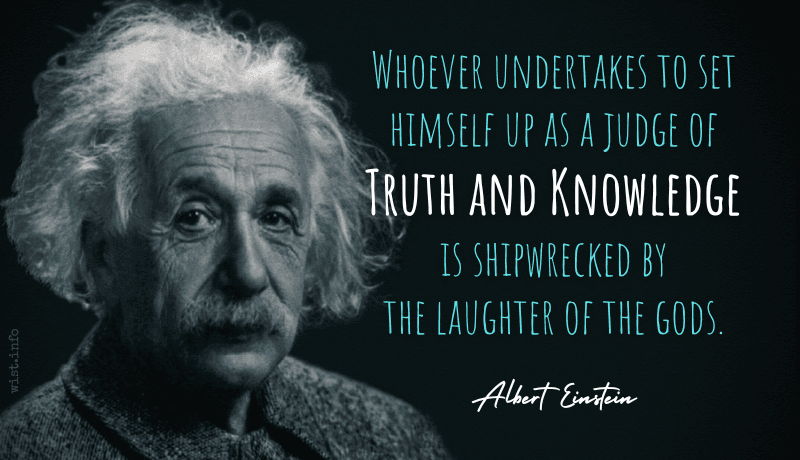
Whoever undertakes to set himself up as a judge of Truth and Knowledge is shipwrecked by the laughter of the gods.
[Wer es unternimmt, auf dem Gebiet der Wahrheit und der Erkenntnis als Autoritat aufzutreten, scheitert am Gelachter der Gotter.]
Albert Einstein (1879-1955) German-American physicist
Essay (1953-05-23), “Aphorisms for Leo Baeck [Neun Aphorismen], No. 8, Essays Presented to Leo Baeck on the Occasion of His Eightieth Birthday (1954) [Einstein Archives 28-962]
(Source)
Leo Baeck (1873-1956) was a noted a German rabbi, scholar, and theologian.
(Source (German)). Another translation:He who endeavors to present himself as an authority in matters of truth and cognition, will be wrecked by the laughter of the gods.
[Source]
This subject brings me to that vilest offspring of the herd mind — the odious militia. The man who enjoys marching in line and file to the strains of music falls below my contempt; he received his great brain by mistake — the spinal cord would have been amply sufficient. This heroism at command, this senseless violence, this accursed bombast of patriotism — how intensely I despise them! War is low and despicable, and I had rather be smitten to shreds than participate in such doings.
Albert Einstein (1879-1955) German-American physicist
“What I Believe,” Forum and Century (Oct 1930)
(Source)
Einstein crafted and recrafted his credo multiple times in this period, and specifics are often muddled by differing translations and by his reuse of certain phrases in later writing. The Forum and Century entry appears to be the earliest. Some important variants:This topic brings me to that worst outcrop of herd life, the military system, which I abhor. That a man cant take pleasure in marching in fours to the strains of a band is enough to make me despise him. He has only been given his big brain by mistake; unprotected spinal marrow was all he needed. This plague-spot of civilization ought to be abolished with all possible speed. Heroism on command, senseless violence, and all the loathsome nonsense that goes by the name of patriotism -- how passionately I hate them! How vile and despicable seems war to me! I would rather be hacked in pieces than take part in such an abominable business.
— "The World As I See It [Mein Weltbild] [tr. Bargmann (1954)]This topic brings me to that worst outcrop of the herd nature, the military system, which I abjor. That a man can take pleasure in marching in formation to the strains of a band is enough to make me despise him. He has only been given his big brain by mistake; a backbone was all he needed. This plague-spot of civilization ought to be abolished with all possible speed. Heroism by order, senseless violence, and all the pestilent nonsense that does by the name of patriotism -- how I hate them! War seems to me a mean, contemptible thing: I would rather be hacked in pieces than take part in such an abominable business.
— "The World As I See It [Mein Weltbild] [tr. Harris (1934)]
I would rather be an optimist and a fool than be a pessimist and correct.
Albert Einstein (1879-1955) German-American physicist
(Attributed)
Not everything that counts can be counted, and not everything that can be counted counts.
Albert Einstein (1879-1955) German-American physicist
Sign in Einstein’s Princeton office
It's not established this was original to Einstein. Sometimes quoted in reverse: "Not everything that can be counted counts, and not everything that counts can be counted."
A man’s ethical behavior should be based effectually on sympathy, education, and social ties and needs; no religious basis is necessary. Man would indeed be in a poor way if he had to be restrained by fear of punishment and hopes of reward after death.
Albert Einstein (1879-1955) German-American physicist
“Religion and Science,” New York Times Magazine (9 Nov 1930)
(Source)
Strange is our situation here upon the earth. Each of us comes for a short visit, not knowing why, yet sometimes seeming to divine a purpose.
Albert Einstein (1879-1955) German-American physicist
(Attributed)
quoted from James A. Haught, ed., 2000 Years of Disbelief
Common sense is the collection of prejudices acquired by age eighteen.
Albert Einstein (1879-1955) German-American physicist
(Spurious)
Not found in Einstein's writings. There is no evidence of Einstein saying or writing anything like this. It's deemed probably not an Einstein quotation by Einstein scholar Alice Calaprice, The Expanded Quotable Einstein (2000).
Variants:As Einstein has pointed out, common sense is actually nothing more than a deposit of prejudices laid down in the mind prior to the age of eighteen.
[Lincoln Barnett, "The Universe and Dr. Einstein, Part 2," Harper's Magazine (May 1948), reprinted in The Universe and Dr. Einstein (1950); Einstein wrote the foreword to the book.]Common sense is that layer of prejudices which we acquire before we are sixteen.
[E. T. Bell, Mathematics, Queen and Servant of the Sciences (1951)]
More discussion of this quotation: Common Sense Is Nothing More Than a Deposit of Prejudices Laid Down in the Mind Before Age Eighteen – Quote Investigator.
It can scarcely be denied that the supreme goal of all theory is to make the irreducible basic elements as simple and as few as possible without having to surrender the adequate representation of a single datum of experience.
Albert Einstein (1879-1955) German-American physicist
Lecture (1933-06-10), “On the Method of Theoretical Physics,” Herbert Spencer Lecture, Oxford
(Source)
Often shortened down, as "Einstein's Law," to something like "Make everything as simple as possible, but not simpler" or "Everything should be made as simple as possible, but not simpler."
This in turn appears to first come from an article "How a 'Difficult' Composer Gets That Way," by Roger Sessions, New York Times (1950-01-08), where he says (clearly paraphrasing):I also remember a remark of Albert Einstein, which certainly applies to music. He said, in effect, that everything should be as simple as it can be but not simpler!
Shortly after that, other references were made elsewhere treating the phrase as an actual quotation by Einstein.
For more about this quotation and its origin, see:
- Quote Origin: Everything Should Be Made as Simple as Possible, But Not Simpler – Quote Investigator®.
- Alice Calaprice, ed., The Quotable Einstein, "Attributed to Einstein" (2005 ed.).
The most important human endeavor is striving for morality in our actions. Our inner balance and even our very existence depends on it. Only morality in our actions can give beauty and dignity to our lives.
Albert Einstein (1879-1955) German-American physicist
(Attributed)
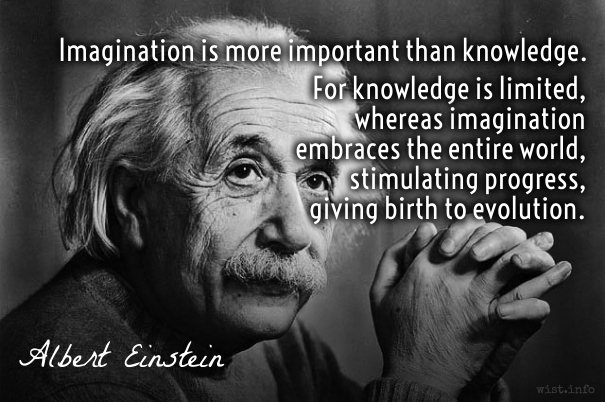
I am enough of an artist to draw freely upon my imagination. Imagination is more important than knowledge. For knowledge is limited, whereas imagination embraces the entire world, stimulating progress, giving birth to evolution.
Albert Einstein (1879-1955) German-American physicist
“What Life Means to Einstein,” Interview with G. Viereck, Saturday Evening Post (26 Oct 1929)
(Source)
Quoted as "I am enough of an artist to draw freely upon my imagination. Imagination is more important than knowledge. Knowledge is limited. Imagination encircles the world," in Viereck, Glimpses of the Great (1930).
Try not to become a success, but rather try to become a man of value.
Albert Einstein (1879-1955) German-American physicist
(Attributed)
Quoted by LIFE magazine (2 May 1955)
Insofar as statements of mathematics refer to reality, they are uncertain, and insofar as they are certain, they do not refer to reality.
[Insofern sich die Sätze der Mathematik auf die Wirklichkeit beziehen, sind sie nicht sicher, und insofern sie sicher sind, beziehen sie sich nicht auf die Wirklichkeit.]
Albert Einstein (1879-1955) German-American physicist
“Geometry and Experience [Geometrie und Erfahrung],” lecture (27 Jan 1921)
(Source)
Sometimes given as "Insofar as the statements of geometry speak about reality, they are not certain, and in so far as they are certain, they do not speak about reality. [Sofern die Sätze der Geometrie streng gültig sind, beziehen sie sich nicht auf de Wirklichkeit; sofern sie sich auf dei Wirklichkeit beziehen, sind sie nicht streng gültig.]" -- this version was popularized by Karl Popper, but it was from a misquote by Morris Schlick.
I think and think for months and years. Ninety-nine times, the conclusion is false. The hundredth time I am right.
Albert Einstein (1879-1955) German-American physicist
(Attributed)
Subtle is God, but malicious He is not.
[Raffiniert ist der Herr Gott, aber boshaft ist er nicht.]
Albert Einstein (1879-1955) German-American physicist
Remark at Princeton University (Apr. 1921)
Later inscribed in Fine Hall, Princeton University. Quoted in Einstein, ch. 14, R.W. Clark (1973). Einstein in 1946 gave a looser translation: "God is slick, but he ain’t mean."
The important thing is not to stop questioning. Curiosity has its own reason for existing. One cannot help but be in awe when he contemplates the mysteries of eternity, of life, of the marvelous structure of reality. It is enough if one tries merely to comprehend a little of this mystery every day.
Albert Einstein (1879-1955) German-American physicist
Memoirs of William Miller, quoted in Life (2 May 1955)
(Source)
Perfection of means and confusion of ends seem to characterize our age.
Albert Einstein (1879-1955) German-American physicist
Out of My Later Years, ch. 14 (1950)
We should take care not to make the intellect our god; it has, of course, powerful muscles, but no personality.
Albert Einstein (1879-1955) German-American physicist
Out of My Later Years, ch. 51 (1950)
You don’t promote the cause of peace by talking only to people with whom you agree.
Dwight David Eisenhower (1890-1969) American general, US President (1953-61)
News conference (20 Jan 1957)
History does not long entrust the care of freedom to the weak or the timid.
Dwight David Eisenhower (1890-1969) American general, US President (1953-61)
Inaugural Address (20 Jan 1953)
As quickly as you start spending federal money in large amounts, it looks like free money.
Dwight David Eisenhower (1890-1969) American general, US President (1953-61)
(Attributed)
Peace and justice are two sides of the same coin.
Dwight David Eisenhower (1890-1969) American general, US President (1953-61)
News conference, Washington (6-Feb-1957)
The world moves and ideas that were good once are not always good.
Dwight David Eisenhower (1890-1969) American general, US President (1953-61)
Press Conference. Washington. D.C. (31 Aug. 1955)
The best morale exists when you never hear the word mentioned. When you hear a lot of talk about it, it’s usually lousy.
Dwight David Eisenhower (1890-1969) American general, US President (1953-61)
(Attributed)
Don’t join the book burners. Don’t think you are going to conceal thoughts by concealing evidence that they ever existed. Don’t be afraid to go in your library and read every book, as long as that document does not offend your own ideas of decency. That should be the only censorship.
Dwight David Eisenhower (1890-1969) American general, US President (1953-61)
Commencement Speech, Dartmouth College (14 Jun 1953)
A people that values its privileges above its principles soon loses both.
Dwight David Eisenhower (1890-1969) American general, US President (1953-61)
Inaugural Address (20 Jan 1953)
You don’t lead by hitting people over the head — that’s assault, not leadership.
Dwight David Eisenhower (1890-1969) American general, US President (1953-61)
(Attributed)
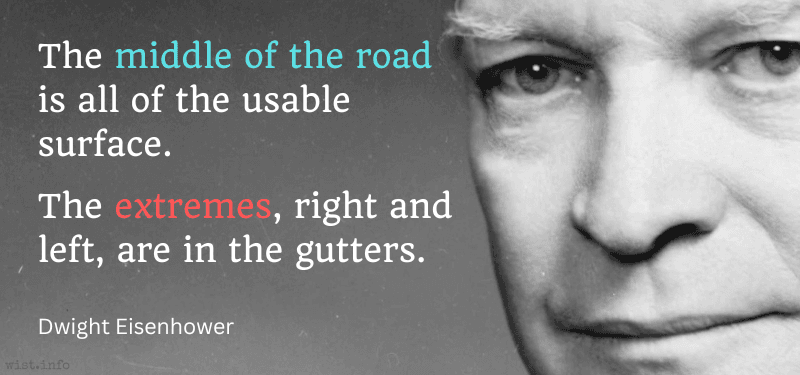
People talk about the middle of the road as though it were unacceptable. Actually, all human problems, excepting morals, come into the gray areas. Things are not all black and white. There have to be compromises. The middle of the road is all of the usable surface. The extremes, right and left, are in the gutters.
Dwight David Eisenhower (1890-1969) American general, US President (1953-61)
Note (Nov 1963)
(Source)
The earliest reference I could find was second-hand, in William Safire, The New Language of Politics, "middle of the road" (1968) (later published as Safire's Political Dictionary, and including the entry through the 2008 edition).
Unless each day can be looked back upon by an individual as one in which he has had some fun, some joy, some real satisfaction, that day is a loss.
Dwight David Eisenhower (1890-1969) American general, US President (1953-61)
(1963)
The ideals men die for often become the prejudices their descendents kill for.
Paul Eldridge (1888-1982) American educator, novelist, poet
Maxims for a Modern Man (1965)
I’m not denyin’ the women are foolish; God Almighty made ’em to match the men.
George Eliot (1819-1880) English novelist [pseud. of Mary Ann Evans]
Adam Bede (1859)
Blows are sarcasms turned stupid: wit is a form of force that leaves the limbs at rest.
George Eliot (1819-1880) English novelist [pseud. of Mary Ann Evans]
Felix Holt, the Radical (1866)
For the growing good of the world is partly dependent on unhistoric acts; and that things are not so ill with you and me as they might have been, is half owing to the number who lived faithfully a hidden life, and rest in unvisited tombs.
George Eliot (1819-1880) English novelist [pseud. of Mary Ann Evans]
Middlemarch (1871)
(last sentence of the book)
Half the harm that is done in this world
Is due to people who want to feel important.
They don’t mean to do harmT. S. Eliot (1888-1965) American-British poet, critic, playwright [Thomas Stearns Eliot]
“The Cocktail Party” (1949)
Blessed is the man who, having nothing to say, abstains from giving us wordy evidence of the fact.
George Eliot (1819-1880) English novelist [pseud. of Mary Ann Evans]
The Impressions of Theophrastus Such, ch. 4 (1879)
(Source)
To do the useful thing, to say the courageous thing, to contemplate the beautiful thing: that is enough for one man’s life.
T. S. Eliot (1888-1965) American-British poet, critic, playwright [Thomas Stearns Eliot]
(Attributed)
Where is the wisdom we have lost in knowledge?
Where is the knowledge we have lost in information?T. S. Eliot (1888-1965) American-British poet, critic, playwright [Thomas Stearns Eliot]
The Rock, Chorus (1934)
The responsibility of tolerance lies in those who have the wider vision.
T. S. Eliot (1888-1965) American-British poet, critic, playwright [Thomas Stearns Eliot]
“The Cocktail Party” (1949)
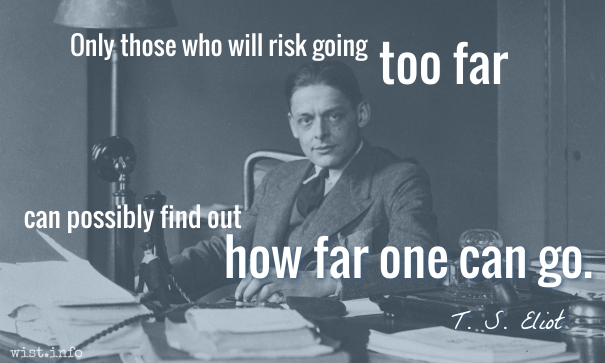
Only those who will risk going too far can possibly find out how far one can go.
T. S. Eliot (1888-1965) American-British poet, critic, playwright [Thomas Stearns Eliot]
Preface to Transit of Venus: Poems by Harry Crosby (1931)
No! I am not Prince Hamlet, nor was meant to be;
Am an attendant lord, one that will do
To swell a progress, start a scene or two,
Advise the prince; no doubt, an easy tool,
Deferential, glad to be of use,
Politic, cautious, and meticulous;
Full of high sentence, but a bit obtuse;
At times, indeed, almost ridiculous —
Almost, at times, the Fool.T. S. Eliot (1888-1965) American-British poet, critic, playwright [Thomas Stearns Eliot]
“The Love Song of J. Alfred Prufrock” (1917)
I think laughter may be a form of courage. As humans we sometimes stand tall and look into the sun and laugh, and I think we are never more brave than when we do that.
Linda Ellerbee (b. 1944) American broadcast journalist
McCall’s (Jan. 1993)
on cancer treatment

The problem with the future is that it’s boring. Its big secret is that it’s the present, and the present is never as attractive as the future. It should be, but it’s not.
Warren Ellis (b. 1968) English writer
www.warrenellis.com (16 Jan 2001)

The two most abundant things in the universe are Hydrogen and stupidity.
Harlan Ellison (1934-2018) American writer
(Attributed)
used in Who's Who bio entry

My philosophy of life is that the meek shall inherit nothing but debasement, frustration, and ignoble deaths
Harlan Ellison (1934-2018) American writer
The Harlan Ellison Hornbook (9 Aug. 1973)
The only reward of virtue is virtue; the only way to have a friend is to be one.
Ralph Waldo Emerson (1803-1882) American essayist, lecturer, poet
Essay (1841), “Friendship,” Essays: First Series, No. 6
(Source)
The human soul, the world, the universe are laboring on to their magnificent consummation. We are not fashioned
Ralph Waldo Emerson (1803-1882) American essayist, lecturer, poet
Journal (1820-12-05)
Every actual State is corrupt. Good men must not obey the laws too well.
Ralph Waldo Emerson (1803-1882) American essayist, lecturer, poet
“Politics,” Essays: Second Series (1844)
Nothing can bring you peace but yourself. Nothing can bring you peace but the triumph of principles.
Ralph Waldo Emerson (1803-1882) American essayist, lecturer, poet
Essay (1841), “Self-Reliance,” Essays: First Series, No. 2
(Source)
Closing words.
This essay was inspired by his reading of Walter Savage Landor in 1833, with passages pulled from his lecture "Individualism," last in his course on "The Philosophy of History" (1836–1837), with other passages from the lectures "School," "Genius," and "Duty" in his course on "Human Life" (1838–1839).
All great masters are chiefly distinguished by the power of adding a second, a third, and perhaps a fourth step in a continuous line. Many a man had taken the first step. With every additional step you enhance immensely the value of your first.
Ralph Waldo Emerson (1803-1882) American essayist, lecturer, poet
“Powers and Laws of Thought,” Natural History of Intellect, Lecture 1, Harvard (1870, Spring)
(Source)
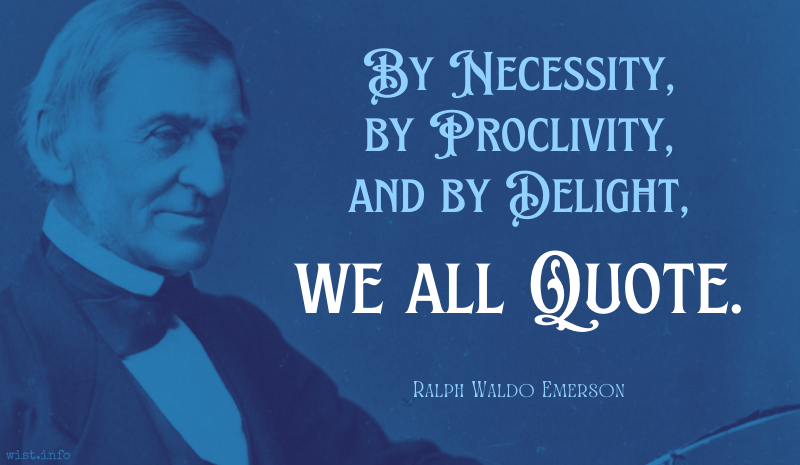
Our debt to tradition through reading and conversation is so massive, our protest or private addition so rare and insignificant, — and this commonly on the ground of other reading or hearing, — that, in a large sense, one would say there is no pure originality. All minds quote. Old and new make the warp and woof of every moment. There is no thread that is not a twist of these two strands. By necessity, by proclivity, and by delight, we all quote.
Ralph Waldo Emerson (1803-1882) American essayist, lecturer, poet
“Quotation and Originality,” Letters and Social Aims (1876)
(Source)
Shallow men believe in luck, believe in circumstances — it was somebody’s name, or he happened to be there at the time, or it was so then, and another day would have been otherwise. Strong men believe in cause and effect.
Ralph Waldo Emerson (1803-1882) American essayist, lecturer, poet
Essay (1860), “Worship,” The Conduct of Life, ch. 6
(Source)
Based on a course of lectures, "The Conduct of Life," delivered in Pittsburg (1851-03).
Trust men and they will be true to you; treat them greatly and they will show themselves great.
Ralph Waldo Emerson (1803-1882) American essayist, lecturer, poet
Essay (1841), “Prudence,” Essays: First Series, No. 7
(Source)
Based on a lecture (winter 1837-1838), Boston, the seventh in his course on "Human Culture."
We aim above the mark to hit the mark.
Ralph Waldo Emerson (1803-1882) American essayist, lecturer, poet
“Nature,” Essays: Second Series (1844)
(Source)
Life is a perpetual instruction in cause and effect.
Ralph Waldo Emerson (1803-1882) American essayist, lecturer, poet
“Natural Religion” (1861-02-03)
It is one of the most beautiful compensations of this life that no man can sincerely try to help another without helping himself.
Charles Dudley Warner (1829–1900) American essayist and novelist
Backlog Studies, Fifth Study, sec. 3 (1872)
(Source)
Originally published in Scribner's Monthly (Apr 1872). Frequently misattributed to Ralph Waldo Emerson.
A friend is a person with whom I may be sincere. Before him, I may think aloud.
Ralph Waldo Emerson (1803-1882) American essayist, lecturer, poet
Essay (1841), “Friendship,” Essays: First Series, No. 6
(Source)
The purpose of life is not to be happy. It is to be useful, to be honorable, to be compassionate, to have it make some difference that you have lived and lived well.
Ralph Waldo Emerson (1803-1882) American essayist, lecturer, poet
(Misattributed)
Though widely credited to Emerson, this appears to be a misattributed variation of a Leo Rosten quotation. More discussion of the connection here: The Purpose of Life Is Not To Be Happy But To Matter – Quote Investigator.
Every observation of history inspires a confidence that we shall not go far wrong; that things will mend.
Ralph Waldo Emerson (1803-1882) American essayist, lecturer, poet
“The Young American,” lecture, Mercantile Library Association, Boston (1844-02-07)
(Source)
Life is not so short but that there is always time enough for courtesy.
Ralph Waldo Emerson (1803-1882) American essayist, lecturer, poet
“Social Aims,” lecture, Boston (1864-12-04), Letters and Social Aims (1875)
No member of a crew is praised for the rugged individuality of his rowing.
Alfred North Whitehead (1861-1947) English mathematician and philosopher
“Harvard: The Future,” sec. 5, The Atlantic Monthly (Sep 1936)
(Source)
Reprinted in Essays in Science and Philosophy, Part 3 (1947). Often misattributed to Ralph Waldo Emerson.
We must trust the perfection of the creation so far, as to believe that whatever curiosity the order of things has awakened in our minds, the order of things can satisfy.
Ralph Waldo Emerson (1803-1882) American essayist, lecturer, poet
“Nature,” Introduction, Nature: Addresses and Lectures (1849)
(Source)
The ornament of a house is the friends who frequent it. There is no event greater in life than the appearance of new persons about our hearth, except it be the progress of the character which draws them.
Ralph Waldo Emerson (1803-1882) American essayist, lecturer, poet
“Domestic Life,” Society and Solitude (1870)
(Source)
What you do speaks so loudly that I cannot hear what you say to the contrary.
Ralph Waldo Emerson (1803-1882) American essayist, lecturer, poet
“Social Aims,” lecture, Boston (1864-12-04), Letters and Social Aims (1875)
Whatever games are played with us, we must play no games with ourselves, but deal in our privacy with the last honesty and truth.
Ralph Waldo Emerson (1803-1882) American essayist, lecturer, poet
Essay (1860), “Illusions,” The Conduct of Life, ch. 9
(Source)
Based on a course of lectures by that name first delivered in Pittsburg (1851-03).
Culture is one thing — and varnish another.
Ralph Waldo Emerson (1803-1882) American essayist, lecturer, poet
Journal (1868)
You shall have joy, or you shall have power, said God; you shall not have both.
Ralph Waldo Emerson (1803-1882) American essayist, lecturer, poet
Journal (1842-10)
Nature is too thin a screen, — the glory of the One breaks in everywhere.
Ralph Waldo Emerson (1803-1882) American essayist, lecturer, poet
“Religion,” The Present Age Lecture 7, Boston (1840-01-29)
(Source)
Lecture series initially presented 4 Dec 1839 - 12 Feb 1840. This particular phrase can be found in Emerson's writing going back to 1837. It also was reused in his Cambridge lecture, "The Preacher" (5 May 1879), in a somewhat different context.
The phrase is also rendered "Nature is too thin a screen; the glory of the omnipresent God bursts through everywhere."
A foolish consistency is the hobgoblin of little minds, adored by little statesmen and philosophers and divines.
Ralph Waldo Emerson (1803-1882) American essayist, lecturer, poet
Essay (1841), “Self-Reliance,” Essays: First Series, No. 2
(Source)
This thought continues here.
This essay was inspired by his reading of Walter Savage Landor in 1833, with passages pulled from his lecture "Individualism," last in his course on "The Philosophy of History" (1836–1837), with other passages from the lectures "School," "Genius," and "Duty" in his course on "Human Life" (1838–1839).
A hero is no braver than an ordinary man, but he is braver five minutes longer.
Ralph Waldo Emerson (1803-1882) American essayist, lecturer, poet
(Spurious)
Frequently ascribed to him, especially in recent decades, but not found in his works.
More discussion about this quotation:
Do not be too timid and squeamish about your actions. All life is an experiment. The more experiments you make the better. What if they are a little coarse, and you may get your coat soiled or torn? What if you do fail, and get fairly rolled in the dirt once or twice. Up again, you shall never be so afraid of a tumble.
Though we travel the world over to find the beautiful, we must carry it with us or we find it not.
Ralph Waldo Emerson (1803-1882) American essayist, lecturer, poet
Essay (1841), “Art,” Essays: First Series, No. 12
(Source)
Part of a paragraph taken from the course "Human Culture," lecture "Eye and Ear."
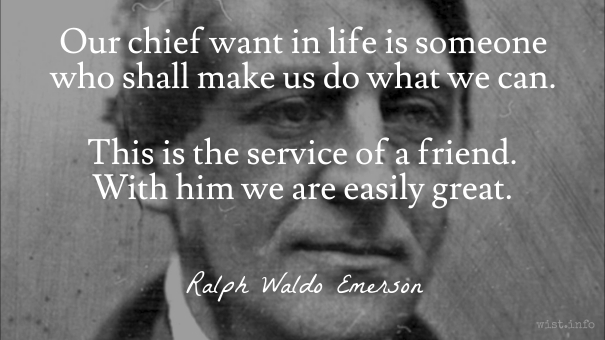
Our chief want in life is someone who shall make us do what we can. This is the service of a friend. With him we are easily great.
Ralph Waldo Emerson (1803-1882) American essayist, lecturer, poet
Essay (1860), “Considerations by the Way,” The Conduct of Life, ch. 7
(Source)
Based on a course of lectures by that name first delivered in Pittsburg, 1851-03.
The glory of friendship is not the outstretched hand, nor the kindly smile nor the joy of companionship; it is the spiritual inspiration that comes to one when he discovers that someone else believes in him and is willing to trust him with his friendship.
Ralph Waldo Emerson (1803-1882) American essayist, lecturer, poet
(Attributed)
A man builds a fine house; and now he has a master, and a task for life; he is to furnish, watch, show it, and keep it in repair, the rest of his days.
Ralph Waldo Emerson (1803-1882) American essayist, lecturer, poet
“Works and Days,” Society and Solitude, ch. 7 (1870)
(Source)
It is one of the blessings of old friends that you can afford to be stupid with them.
Let us treat men and women well; treat them as if they were real; perhaps they are.
Ralph Waldo Emerson (1803-1882) American essayist, lecturer, poet
“Experience,” Essays: Second Series (1844)
With consistency a great soul has simply nothing to do. He may as well concern himself with his shadow on the wall. Speak what you think to-day in words as hard as cannon-balls and to-morrow speak what to-morrow thinks in hard words again, though it contradict every thing you said to-day.
Ralph Waldo Emerson (1803-1882) American essayist, lecturer, poet
Essay (1841), “Self-Reliance,” Essays: First Series, No. 2
(Source)
Inspired by his reading of Walter Savage Landor in 1833, with passages pulled from his lecture "Individualism," last in his course on "The Philosophy of History" (1836–1837), with other passages from the lectures "School," "Genius," and "Duty" in his course on "Human Life" (1838–1839).
Nothing astonishes men so much as common sense and plain dealing.
Ralph Waldo Emerson (1803-1882) American essayist, lecturer, poet
Essay (1841), “Art,” Essays: First Series, No. 12
(Source)
The reward of a thing well done, is to have done it.
Ralph Waldo Emerson (1803-1882) American essayist, lecturer, poet
“New England Reformers,” lecture, Boston (1844-03-03), Essays: Second Series (1844)
(Source)
Reprinted in Essays: Second Series (1844).
I stir in it for the sad reason that no other mortal will move, and if I do not, why, it is left undone. The amount of it, be sure, is merely a Scream; but sometimes a scream is better than a thesis.
Ralph Waldo Emerson (1803-1882) American essayist, lecturer, poet
Journal (1838)
Referring to his attempts to stop the US Government's forced expulsion of the Cherokee from their land.
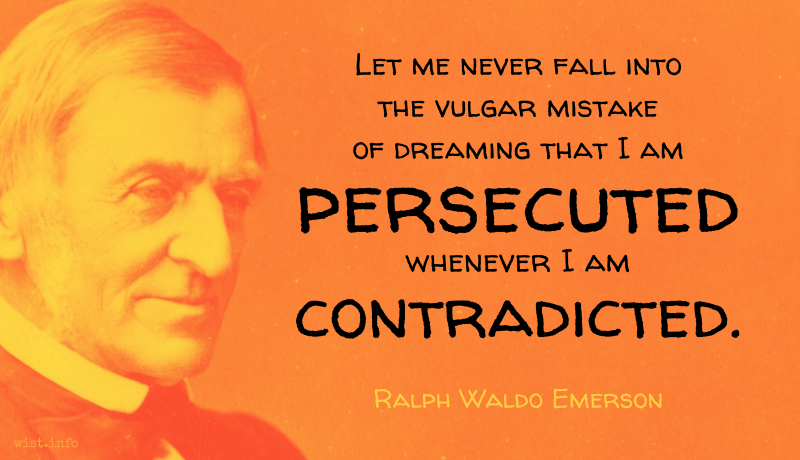
Let me never fall into the vulgar mistake of dreaming that I am persecuted whenever I am contradicted.
I could never think well of a man’s intellectual or moral character, if he was habitually unfaithful to his appointments.
Nathaniel Emmons (1745-1840) American Calvinist preacher
(Attributed)
Traditionally, most of Australia’s imports come from overseas.
Keppel "Kep" Enderbery (1926-2015) Australian politician and jurist
(Attributed)
The rate at which a person can mature is directly proportional to the embarrassment he can tolerate.
Douglas Engelbart (1925-2013) American computer scientist, pioneer
(Attributed)
http://www.bootstrap.org/chronicle/press/tiaobrian/part1.htm
No, folks don’t like the truth. … It’s easier lyin’. Stops us havin’ to fess up to trouble when it comes along. To do right insteada wrong. … But I hate a lie, Cass. My own most of all. They keep us crawlin’ in the dust when we could an’ should be climbin’ for the stars.
Garth Ennis (b. 1970) Irish writer
Preacher, #31, “Underworld”
What is the first business of one who studies philosophy? To part with self-conceit. For it is impossible for any one to begin to learn what he thinks that he already knows.
Epictetus (c. 55-c. 135 AD) Greek (Phrygian) Stoic philosopher [Ἐπίκτητος, Epíktētos]
The Discourses, ch. 17, “How To Apply General Principles to Particular Cases” (c. AD 101-108)
Alt. trans.: "It is impossible for a man to begin to learn what he thinks he knows." [tr. Long (1890)]
In my sex fantasy, nobody ever loves me for my mind.
Nora Ephron (1941-2012) American screenwriter, author, journalist, director
(Attributed)

First say to yourself what you would be; and then do what you have to do.
Epictetus (c. 55-c. 135 AD) Greek (Phrygian) Stoic philosopher [Ἐπίκτητος, Epíktētos]
The Discourses, ch. 23, “Concerning Such as Read and Dispute Ostentatiously” (c. AD 101-108)
Men are disturbed, not by things, but by the principles and notions which they form concerning things.
Epictetus (c. 55-c. 135 AD) Greek (Phrygian) Stoic philosopher [Ἐπίκτητος, Epíktētos]
The Enchiridion (c. 135)
Alt. trans.: "We suffer not from the events in our lives, but from our judgment about them."
The impious one is not the one who takes away the gods of the masses, but rather the one who imposes the ideas of the masses on the gods.
Epicurus (341-270 BC) Greek philosopher
Letter to Menoeceus
Do not spoil what you have by desiring what you have not; but remember that what you now have was once among the things you only hoped for.
Epicurus (341-270 BC) Greek philosopher
The Vatican Sayings
Your anxiety is directly proportional to your forgetfulness of nature, for you bring on yourself unlimited fears and desires.
Epicurus (341-270 BC) Greek philosopher
Fragment
It is not so much our friends’ help that helps us as the confidence of their help.
Epicurus (341-270 BC) Greek philosopher
The Vatican Sayings
Alt. trans.: "It is not so much our friends' help that helps us as the confident knowledge that they will help us."
For me, writing is foremost a mode of thinking and, when it works well, an act of discovery.
Joseph Epstein (b. 1937) American writer
The Bedford Reader, “Postscript on Process” (ed. Kennedy and Kennedy, 2d ed.) (1985)
When I get a little money, I buy books; and if any is left, I buy food and clothes.
Desiderius Erasmus (1465-1536) Dutch humanist philosopher and scholar
(Attributed)

Money is what people without talent use to keep score.
(Other Authors and Sources)
Jeremy C. Epworth
It is part of the highest civility if, while never erring yourself, you ignore the errors of others.
Desiderius Erasmus (1465-1536) Dutch humanist philosopher and scholar
(Attributed)
It is the chiefest point of happiness that a man is willing to be what he is.
Desiderius Erasmus (1465-1536) Dutch humanist philosopher and scholar
(Attributed)
Whatever the form, whether prose or verse, or whatever the theme, write, write, and again write.
Desiderius Erasmus (1465-1536) Dutch humanist philosopher and scholar
De Ratione Studii (1511)
You and I want our lives to matter. We want our lives to make a real difference — to be of genuine consequence in the world. We know that there is no satisfaction in merely going through the motions, even if those motions make us successful, or even if we have arranged to make those motions pleasant. We want to know we have made some impact on the world. In fact, you and I want to contribute to the quality of life. We want to make the world work.
Werner Erhard (b. 1935) American self-improvement teacher [b. John (Jack) Paul Rosenberg]
(Attributed)
Prevention is better than cure.
Desiderius Erasmus (1465-1536) Dutch humanist philosopher and scholar
(Attributed)
There are none so blind as those who think they can see.
Graham Ericsson (b. 1947) American writer, aphorist
(Attributed)

Aesthetics are not morality. Don’t confuse Taste for Truth, Icky for Evil, or Preference for Perfection.
Graham Ericsson (b. 1947) American writer, aphorist
My So-Called Deep Thoughts (2002)
Poverty, when voluntary, is quite probably a virtue. But few can blame those subjected to it involuntarily for wishing to be done with it.
Graham Ericsson (b. 1947) American writer, aphorist
Heaven and Earth (2002)
To say, “You’re angry over such a little thing,” is like saying, “The fire started with just a little match.” It may well be true, but it does nothing to alleviate the present situation.
Graham Ericsson (b. 1947) American writer, aphorist
Fragments Few and Free (1999)