

Smiles are contagious; so are tears; to see
Another sobbing, brings a sob from me.
No, no, good Peleus; set the example, pray,
And weep yourself; then weep perhaps I may.[Ut ridentibus adrident, ita flentibus adflent
humani voltus. Si vis me flere, dolendum est
primum ipsi tibi: tum tua me infortunia laedent,
Telephe vel Peleu.]Horace (65–8 BC) Roman poet, satirist, soldier, politician [Quintus Horatius Flaccus]
Epistles [Epistularum, Letters], Book 2, ep. 3 “Art of Poetry [Ars Poetica; To the Pisos],” l. 101ff (2.3.101-103) (19 BC) [tr. Conington (1874)]
(Source)
Telephus and Peleus were mythic figures in well-known Greek tragedies. The advice is offered up to those who write of or act/declaim the roles of such characters.
(Source (Latin)). Other translations:The cheares of men as these will smerke on those that use to smyle:
So are theye wrinchd, when theye do weepe and chaungd within a whyle.
If thou wouldste have me weepe for the firste muste thou pensyfe be.
Thy harmes shall hitte me, when I spy that they have harmed thee.
[tr. Drant (1567)]To worke the hearers minds, still to the plight.
Mens count'nances, with such as laugh, are prone
To laughter: so they grieve with those that mone:
If thou wouldst have mee weep, bee thou first dround
Thy selfe in tears, then me thy harms will wound,
[tr. Jonson (1640); l. 145ff]We Weep and Laugh as we see others doe,
He only makes me sad who shews the way,
And first is sad himself, then (Telephus)
I feel the weight of your Calamities,
And fancy all your miseries my Own.
[tr. Roscommon (1680)]With them, who laugh, our social joy appears;
With them, who mourn, we sympathise in tears;
If you would have me weep, begin the strain,
Then I shall feel your sorrows, feel your pain.
[tr. Francis (1747)]With those that smile, our face in smiles appears;
With those that weep, our cheeks are bath'd in tears:
To make me grieve, be first your anguish shown,
And I shall feel your sorrows like my own.
[tr. Coleman (1783)]From face to face as smiles contagious creep,
so weeps the according eye with those that weep.
Who claims my tears, must first display his own;
Then shall I catch his pangs and share his moan.
[tr. Howes (1845)]As the human countenance smiles on those that smile, so does it sympathize with those that weep. If you would have me weep you must first express the passion of grief yourself; then, Telephus or Peleus, your misfortunes hurt me.
[tr. Smart/Buckley (1853)]A face all smiles makes other faces smile,
A face all tears will tears from others wile.
Unless, then, in your voice a sob I hear,
You will not wring from me a single tear.
[tr. Martin (1881)]As human countenances laugh with those who laugh so they weep with those who weep. If you desire me to weep, O Telephus or Peleus, yourself must first lead the way; then you thrill through me.
[tr. Elgood (1893)]As men's faces smile on those who smile, so they respond to those who weep. If you would have me weep, you must first feel grief yourself: then, O Telephus or Peleus, will your misfortunes hurt me.
[tr. Fairclough (Loeb) (1926)]As the human face answers a smile with a smile, so does it wait upon tears; if you would have me weep, you must first of all feel grief yourself; then and not till then will your misfortunes, Telephus or Peleus, touch me.
[tr. Blakeney; ed. Kramer, Jr. (1936)]A man’s face is wreathed in smiles when he sees someone smile;
It twists when he sees someone cry; if you expect me
To burst into tears, you have to feel sorrow yourself.
Then your woes will fasten on me, O Telephus, Peleus.
[tr. Palmer Bovie (1959)]Just as laughter inspires laughter, tears bring tears
to human faces; if you want my tears, you first must
weep yourself. Then your agonies will hurt me too.
[tr. Fuchs (1977)]We smile when we see smiling, weep at tears:
Ask me to sob
when you can sob
yourself --
Then (ah) tragic heroes are tragic
(To me).
[tr. Raffel (1983 ed.)]Men smile if the language smiles;
They weep if the language truly weeps. If you
Desire to hear me weep, you must truly grieve,
O Peleus or Telephus, and I
Grieve as if I suffered your cause of grief.
[tr. Ferry (2001)]When a person smiles, people's faces smile in return;
when he weeps, they show concern. Before you can move me to tears,
you must grieve yourself. Only then will your woes distress me.
[tr. Rudd (2005 ed.)]As the human face smiles at a smile, so it echoes
Those who weep: if you want to move me to tears
You must first grieve yourself: then Peleus or Telephus
Your troubles might pain me.
[tr. Kline (2015)]
Quotations about:
reaction
Note not all quotations have been tagged, so Search may find additional quotes on this topic.
THE DOCTOR: Oh, marvelous. You’re going to kill me. What a finely-tuned response to the situation.
Doctor Who (1963-1989) British science fiction television series, original run (BBC)
21×03 “Frontios,” Part 2 (1984-01-27) [w. Christopher Bidmead]
(Source)

Not only do I not know what’s going on, I wouldn’t know what to do about it if I did.
George Carlin (1937-2008) American comedian
Book (1997), Brain Droppings, “Sometimes A Little Brain Damage Can Help”
(Source)
Certainly the influence of the past is very strong at the present time; it is reviving, and this rejuvenation of a corpse is surprising. It is on the march, and it seems to be winning — a dead thing yet a conqueror! It comes with its army of superstitions, its sword, which is despotism, its banner, which is ignorance, and in recent years it has won ten battles. It advances, laughs, and threatens; it is at our door.
[Le passé, il est vrai, est très fort à l’heure où nous sommes. Il reprend. Ce rajeunissement d’un cadavre est surprenant. Le voici qui marche et qui vient. Il semble vainqueur ; ce mort est un conquérant. Il arrive avec sa légion, les superstitions, avec son épée, le despotisme, avec son drapeau, l’ignorance ; depuis quelque temps il a gagné dix batailles. Il avance, il menace, il rit, il est à nos portes.]
Victor Hugo (1802-1885) French writer
Les Misérables, Part 4 “St. Denis,” Book 7 “Argot,” ch. 4 (4.7.4) (1862) [tr. Denny (1976)]
(Source)
(Source (French)). Alternate translations:The past, it is true, is very strong at the present hour. It is reviving. This revivification of a corpse is surprising. Here it is walking and advancing. It seems victorious; this dead man is a conqueror. He comes with his legion, the superstitions, with his sword, despotism, with his banner, ignorance; within a little time he has won ten battles. He advances, he threatens, he laughs, he is at our doors.
[tr. Wilbour (1862)]The past, we grant, is very powerful at the present hour, and is beginning again. This rejuvenescence of a corpse is surprising, yet here it is, marching straight toward us. The dead man appears a victor, and is a conqueror; he arrives with his legion, superstitions; with his sword, despotism; with his banner, ignorance; and during sometime past he has gained ten battles. He advances, he threatens, he laughs, he is at our gates.
[tr. Wraxall (1862)]The past is very strong, it is true, at the present moment. It censures. This rejuvenation of a corpse is surprising. Behold, it is walking and advancing. It seems a victor; this dead body is a conqueror. He arrives with his legions, superstitions, with his sword, despotism, with his banner, ignorance; a while ago, he won ten battles. He advances, he threatens, he laughs, he is at our doors.
[tr. Hapgood (1887)]The past, it is true, is very strong right now. It is reviving. This revivification of a corpse is surprising. Here it is walking and advancing. It seems victorious; this dead man is a conqueror. He comes with his legion, superstitions, with his sword, despotism, with his banner, ignorance; within a little time he has won ten battles. He advances, he threatens, he laughs, he is at our door.
[tr. Wilbour/Fahnestock/MacAfee (1987)]At the moment, it is true, the past is very strong. It is reviving. This rejuvenation of a corpse is astounding. Back on its feet again, here it comes. It looks victorious. This defunct is a conqueror, it arrives with its legion -- superstitions -- with its sword -- despotism -- with its banner -- ignorance. Recently, it has won a dozen battles. It is advancing, threatening, laughing, it is at our gates.
[tr. Donougher (2013)]

The object of education for that mind should be the teaching itself how to react with vigor and economy. No doubt the world at large will always lag so far behind the active mind as to make a soft cushion of inertia to drop upon, as it did for Henry Adams; but education should try to lessen the obstacles, diminish the friction, invigorate the energy, and should train minds to react, not at haphazard, but by choice, on the lines of force that attract their world. What one knows is, in youth, of little moment; they know enough who know how to learn.
Henry Adams (1838-1918) American journalist, historian, academic, novelist
The Education of Henry Adams, ch. 21 (1907)
(Source)
What we do is never understood but always only praised or censured.
[Was wir thun, wird nie verstanden, sondern immer nur gelobt und getadelt.]
Friedrich Nietzsche (1844-1900) German philosopher and poet
The Gay Science [Die fröhliche Wissenschaft], Book 3, § 264 (1882) [tr. Kaufmann (1974)]
(Source)
Also known as La Gaya Scienza, The Joyful Wisdom, or The Joyous Science.
(Source (German)). Alternate translations:What we do is never understood, but only praised and blamed.
[tr. Common (1911)]What we do is never understood but always merely praised and reproached.
[tr. Nauckhoff (2001)]
Nothing is so silly as the expression of a man who is being complimented.
André Gide (1869-1951) French author, Nobel laureate
Journal (1906-02-13) [tr. O’Brien (1947)]
(Source)
Perhaps I know best why man alone laughs: he alone suffers so deeply that he had to invent laughter.
[Vielleicht weiss ich am besten, warum der Mensch allein lacht: er allein leidet so tief, dass er das Lachen erfinden musste.]
Friedrich Nietzsche (1844-1900) German philosopher and poet
The Will to Power [Der Wille zur Macht], Book 1, Part 2, ch. 2/b, § 91 (1901) [ed. Elisabeth Förster-Nietzsche] [tr. Kaufmann/Hollingdale (1967)]
(Source)
(Source (German)). Alternate translations:Perhaps I know best why man is the only animal that laughs : he alone suffers so excruciatingly that he was compelled to invent laughter.
[tr. Ludovici (1910)]Perhaps I know best why it is man alone who laughs; he alone suffers so deeply that he had to invent laughter.
[Common, e.g.]Perhaps I know best why man alone laughs: only he suffers so profoundly that he was bound to invent laughter.
[tr. Hill/Scarpitti (2017)]
Bad reviews jar me down to the instep. I will never become philosophically resigned to a negative reaction to something I’ve written.
Rod Serling (1924-1975) American screenwriter, playwright, television producer, narrator
Patterns, Introduction (1957)
(Source)
He is as great a fool that laughs at all as he that weeps at all
[Tan necio es el que se ríe de todo como el que se pudre de todo.]
Baltasar Gracián y Morales (1601-1658) Spanish Jesuit priest, writer, philosopher
The Art of Worldly Wisdom [Oráculo Manual y Arte de Prudencia], § 209 (1647) [tr. Jacobs (1892)]
(Source)
(Source (Spanish)). Alternate translations:He is as great a Fool that laughs at all things, as he that vexes at every thing.
[Flesher ed. (1685)]As great a fool he who laughs at everything, as he who weeps over everything.
[tr. Fischer (1937)]The person who laughs at everything is just as foolish as the one made wretched by everything.
[tr. Maurer (1992)]

When a people are confronted with problems that are both incomprehensible and unbearable, they lash out not at those who contrived the problems but at those who expose them. When they are confronted by moral problems that they find insoluble, or perhaps intolerable, they blame the moralists. The anxieties, tensions, revulsions of our day create an atmosphere in which it is almost impossible to think clearly and dispassionately about just those problems which most imperatively require reason and objectivity — problems of adjustment to fundamental change.
Henry Steele Commager (1902-1998) American historian, writer, activist
Speech (1971-04-10), “The University and the Community of Learning,” Kent State University, Ohio
(Source)
Very few people have no opinions about cats. Even those who have never known a cat personally, scarcely even spoken to one, feel strongly and sometimes hysterically on the subject.

Act like the person you are, not the way they make you act.
[Cada uno ha de obrar como quien es, no como le obligan.]
Baltasar Gracián y Morales (1601-1658) Spanish Jesuit priest, writer, philosopher
The Art of Worldly Wisdom [Oráculo Manual y Arte de Prudencia], § 165 (1647) [tr. Maurer (1992)]
(Source)
On waging war honorably. (Source (Spanish)). Alternate translation:All men ought to act according to what they themselves are, and not to what others are.
[Flesher ed. (1685)]Every one must needs act as he is, not as others would make him to be.
[tr. Jacobs (1892)]Each must act for what he is, and not for what he is held.
[tr. Fischer (1937)]
One cloud is enough to eclipse all the sun.
Thomas Fuller (1654-1734) English physician, preacher, aphorist, writer
Gnomologia: Adages and Proverbs (compiler), # 3743 (1732)

Life is political, not because the world cares about how you feel, but because the world reacts to what you do.
Timothy Snyder (b. 1969) American historian, author
On Tyranny: Twenty Lessons from the Twentieth Century (2017)
(Source)

“When it comes to strangers with guns,” I told her, “I think suspicion is more likely to keep you alive than trust.”

Sometimes you laugh because you’ve got no more room for crying. Sometimes you laugh because table manners on a beach are funny. And sometimes you laugh because you’re alive, when you really shouldn’t be.
Terry Pratchett (1948-2015) English author
Nation, ch. 4 “Bargains, Covenants and Promises” (2009)
(Source)

It’s one of those weird truths you learn early on as police that quite a high percentage of the public have all the survival instinct of a moth in a candle factory. They run the wrong way, they refuse to move, some will run toward the danger, and others will instantly whip out their phones and take footage.

Confront a child, a puppy, and a kitten with a sudden danger; the child will turn instinctively for assistance, the puppy will grovel in abject submission, the kitten will brace its tiny body for a frantic resistance.
H. H. Munro (1870-1916) Scottish writer [Hector Hugh Munro; pseud. Saki]
“The Achievement of the Cat” (1924)
(Source)
Humor is the most honest of emotions. Applause for a speech can be insincere, but with humor, if the audience doesn’t like it there’s no faking it.
Robert Orben (1927-2023) American comedy writer, magician, speechwriter
In “A Little Night Humor,” Washington Post (28 Jan 1982)
(Source)
How unhappy are women! Their own sex their most inveterate enemy. An husband tyrannizes; a lover dishonors and despises them. Watched on all sides, thwarted in all things; ever in fear and in constraint; without support or succour; with a number of lovers but not one friend. Is it then to be wondered at that they should become a compound of humor, dissimulation, and caprice?
Anne "Ninon" de l'Enclos (1620-1705) French author, courtesan, patron of the arts [Ninon de Lenclos, Ninon de Lanclos]
The Memoirs of Ninon de L’Enclos, Vol. 1, “Life and Character” (1761)
(Source)

Lesbian: Any uppity woman, regardless of sexual preference. If they don’t call you a lesbian, you’re probably not accomplishing anything.
Marie Shear (1940-2017) American writer and feminist activist
“Media Watch: Celebrating Women’s Words,” New Directions for Women (May/Jun 1986)
(Source)

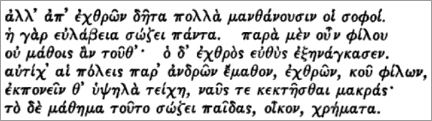
EPOPS: You’re mistaken: men of sense often learn from their enemies. Prudence is the best safeguard. This principle cannot be learned from a friend, but an enemy extorts it immediately. It is from their foes, not their friends, that cities learn the lesson of building high walls and ships of war. And this lesson saves their children, their homes, and their properties.
CHORUS [LEADER]: It appears then that it will be better for us to hear what they have to say first; for one may learn something at times even from one’s enemies.
Aristophanes (c. 450-c. 388 BC) Athenian comedic playwright
The Birds, l. 375ff (414 BC) [tr. Anon. (1812), Ramage (1864)]
(Source)
Alt. trans. [Hickie (1853)]:
EPOPS: Yet, certainly, the wise learn many things from their enemies; for caution preserves all things. From a friend you could not learn this, but your foe immediately obliges you to learn it. For example, the states have learned from enemies, and not from friends, to build lofty walls, and to possess ships of war. And this lesson preserves children, house, and possessions.
CHORUS [LEADER]: It is useful, as it appears to me, to hear their arguments first; for one might learn some wisdom even from one's foes.
Alt. trans. [O'Neill (1938)]:
EPOPS: The wise can often profit by the lessons of a foe, for caution is the mother of safety. It is just such a thing as one will not learn from a friend and which an enemy compels you to know. To begin with, it's the foe and not the friend that taught cities to build high walls, to equip long vessels of war; and it's this knowledge that protects our children, our slaves and our wealth.
LEADER OF THE CHORUS: Well then, I agree, let us first hear them, for that is best; one can even learn something in an enemy's school.
The very act of trying to run counter to the culture is what creates the next wave of culture people will in turn attempt to counter.
David McRaney (contemp.) American journalist, author, lecturer
You Are Not So Smart, ch. 27 “Selling Out” (2011)
(Source)

Just for the record, darling, not all positive change feels positive in the beginning.
(Other Authors and Sources)
S. C. Lourie

A life of reaction is a life of slavery, intellectually and spiritually. One must fight for a life of action, not reaction.
Rita Mae Brown (b. 1944) American author, playwright
(Attributed)

If you can’t change your fate, change your attitude.

Abuse is a proof that you are felt. If they praise you, you will work no revolution.
Revolutions, as a long and bitter experience reveals, are apt to take their colour from the régime which they overthrow. Is it any wonder that the creed which affirms the absolute rights of property should sometimes be met with a counter-affirmation of the absolute rights of labour, less anti-social, indeed, and inhuman, but almost as dogmatic, almost as intolerant and thoughtless as itself.
R. H. Tawney (1880-1962) English writer, economist, historian, social critic [Richard Henry Tawney]
The Acquisitive Century, ch. 3 “The Acquisitive Society” (1920)
(Source)
We begin to notice, besides our particular sinful acts, our sinfulness; begin to be alarmed not only about what we do, but about what we are. This may sound rather difficult, so I will try to make it clear from my own case. When I come to my evening prayers and try to reckon up the sins of the day, nine times out of ten the most obvious one is some sin against charity; I have sulked or snapped or sneered or snubbed or stormed. And the excuse that immediately springs to my mind is that the provocation was so sudden and unexpected; I was caught off my guard, I had not time to collect myself.
Now that may be an extenuating circumstance as regards those particular acts: they would obviously be worse if they had been deliberate and premeditated. On the other hand, surely what a man does when he is taken off his guard is the best evidence for what sort of a man he is? Surely what pops out before the man has time to put on a disguise is the truth? If there are rats in a cellar you are most likely to see them if you go in very suddenly. But the suddenness does not create the rats: it only prevents them from hiding. In the same way the suddenness of the provocation does not make me an ill-tempered man; it only shows me what an ill-tempered man I am. The rats are always there in the cellar, but if you go in shouting and noisily they will have taken cover before you switch on the light.
C. S. Lewis (1898-1963) English writer, literary scholar, lay theologian [Clive Staples Lewis]
Mere Christianity, “Let’s Pretend” (1952)
(Source)
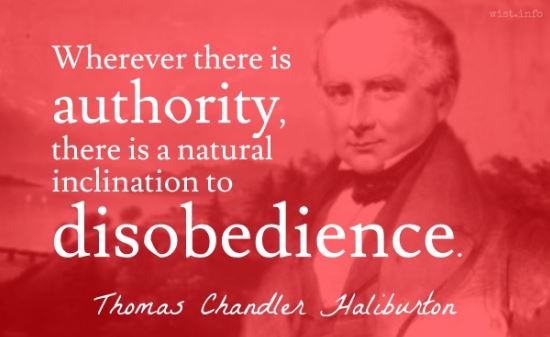
Wherever there is authority, there is a natural inclination to disobedience.
Thomas Chandler Haliburton (1796-1865) Canadian politician, judge, humorist
Sam Slick’s Wise Saws and Modern Instances (1853)
It is a dear and lovely disposition, and a most valuable one, that can brush away indignities and discourtesies and seek and find the pleasanter features of an experience.
Mark Twain (1835-1910) American writer [pseud. of Samuel Clemens]
In The North American Review (1906)
(Source)
There are few mortals so insensible that their affections cannot be gained by mildness; their confidence by sincerity; their hatred by scorn or neglect.
Johann Georg Zimmermann (1728-1795) Swiss philosophical writer, naturalist, physician
Aphorisms and Reflections on Men, Morals and Things (1800)
(Source)
He’s suffering from Politicians’ Logic. Something must be done, this is something, therefore we must do it.
Antony Jay (1930-2016) English writer, broadcaster, director
Yes, Prime Minister, 2×05 “Power to the People” (7 Jan 1988)
Variant: "There is this great idea about the logic of a politician, along the lines of: 'Something must be done, this is something, therefore we must do it.'"

Always behave as if nothing had happened, no matter what has happened.
Arnold Bennett (1867-1931) English writer, novelist, journalist
Denry the Audacious, ch. 10 “His Infamy” (1911)

Never complain and never explain.
Benjamin Disraeli (1804-1881) English politician and author
(Attributed)
(Source)
Most often cited to John Morley, Life of William Ewart Gladstone, Vol. 1, Book 2, ch. 2, sec. 1 (1903). This was Disraeli's distillation of advice that Lord High Chancellor John Copley, Lord Lyndhurst, gave at a January 1835 dinner attended both a young Gladstone and Disraeli:Never defend yourself before a popular assemblage, except with and by retorting the attack; the hearers, in the pleasure which the assault gives them, will forget the previous charge.
The phrase is also attributed to Benjamin Jowett, Henry Ford II, and Charles Stewart Parnell.
Terrorism’s goal is to commit frightening, high-profile crimes that scare people into making rash, expensive decisions that make the world look like the terrorists would like to see it.
Cory Doctorow (b. 1971) Canadian-British blogger, journalist, activist, author
“How terrorists trick Western governments in doing their work for them,” Boingboing.net (16 Nov 2015)
(Source)


He failed to realized that the public is bored by foreign affairs until a crisis arises; and that then it is guided by feelings rather than thoughts.
Harold Nicolson (1886-1968) English diplomat, author, diarist, politician
The Evolution of Diplomacy, 4.3 (1954)
There isn’t a way things should be. There’s just what happens, and what we do.
Terry Pratchett (1948-2015) English author
Discworld No. 32, A Hat Full of Sky [Miss Level] (2004)
(Source)
There is (usually) no crime in performing a jerk maneuver, or acting like a jerk. Everyone can, and has, acted like a jerk from time to time. It’s a regrettable but natural part of the human experience. But most people have the good sense to understand that acting like a jerk should not be a lifestyle choice, and that if you make it one, people will respond to you based on your choices.
John Scalzi (b. 1969) American writer
“Being a Jerk About the Hugos: Not as Effective a Strategy as You Might Think”, Whatever (blog) (24 Aug 2015)
(Source)

In reactive problem solving we walk into the future facing the past — we move away from, rather than toward, something. This often results in unforeseen consequences that are more distasteful than the deficiencies removed.
Russell L. Ackoff (1919-2009) American organizational theorist, consultant, management scientist
The Art of Problem Solving (1978)
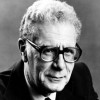
You will usually find that the enemy has three courses open to him, and of these he will adopt the fourth.
Helmuth von Moltke (1800-1891) Prussian soldier
(Attributed)
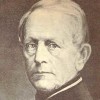
The greatest remedy for anger is delay.
Seneca the Younger (c. 4 BC-AD 65) Roman statesman, philosopher, playwright [Lucius Annaeus Seneca]
Moral Essays, “Of Anger [De ira]”
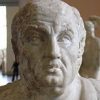
In my head there is a permanent opposition-party; and whenever I take any step or come to any decision — though I may have given the matter mature consideration — it afterward attacks what I have done, without, however, being each time necessarily in the right. This is, I suppose, only a form of rectification on the part of the spirit of scrutiny; but it often reproaches me when I do not deserve it.
[In meinem Kopfe giebt es eine stehende Oppositionspartei, die gegen Alles, was ich, wenn auch mit reiflicher Überlegung, gethan, oder beschlossen habe, nachträglich polemisirt, ohne jedoch darum jedesmal Recht zu haben. Sie ist wohl nur eine Form des berichtigenden Prüfungsgeistes, macht mir aber oft unverdiente Vorwürfe.]
Arthur Schopenhauer (1788-1860) German philosopher
Parerga and Paralipomena, Vol. 2, ch. 26 “Psychological Observations [Psychologische Bemerkungen],” § 345 (1851) [tr. Saunders (1890)]
(Source)
(Source (German)). Alternate translation:There is in my mind a standing opposition party which subsequently attacks everything I have done or decided, even after mature consideration, yet without its always being right on that account. It is, I suppose, only a form of the corrective spirit of investigation; but it often casts an unmerited slur on me.
[tr. Payne (1974)]

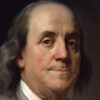
Take this remark from Richard poor and lame,
Whate’er’s begun in anger ends in shame.Benjamin Franklin (1706-1790) American statesman, scientist, philosopher, aphorist
Poor Richard (1734 ed.)
(Source)
If you are patient in one moment of anger, you will escape a hundred days of sorrow.
Proverbs, Sayings, and Adages
Chinese proverb
What is character but the determination of incident? What is incident but the illustration of character?
Henry James (1843-1916) American writer
“The Art of Fiction,” Longman’s Magazine (4 Sep 1884)
(Source)

I don’t believe in kickin’,
It aint apt to bring one peace;
But the wheel what squeaks the loudest
is the one what gets the grease.Cal Stewart (1856-1919) American vaudevillian, monologuist [stage character "Uncle Josh" Weathersby]
Uncle Josh Weathersby’s “Punkin’ Centre” Stories, Epigraph (1903)
(Source)
Likely origin of the phrase, "The squeaky wheel gets the grease." "Kicking" was period slang for complaining (only surviving to the present in a phrase like "You've got no kick coming").
The phrase is sometimes attributed to Josh Billings, in a similar poem dated around 1870 called "The Kicker":I hate to be a kicker,
I always long for peace,
But the wheel that does the squeaking,
Is the one that gets the grease.
However, this poem has not actually been verified to exist. The unfounded attribution was included in the 1937 Bartlett's Familiar Quotations (11th Ed.), and has remained popular since.
The (likely) misattribution to the more well-known Billings may be a confusion between the names and folksy talking of both of the fictional characters "Josh Billings" and "Josh Weathersby."
For more discussion, see:Note: this epigraph does not appear in the Project Gutenberg copy of this work.
- Quote Origin: The Squeaky Wheel Gets the Grease – Quote Investigator®.
- Doyle, Mieder, Shapiro (eds.), The Dictionary of Modern Proverbs (2012).

BRUTUS: There is a tide in the affairs of men
Which, taken at the flood, leads on to fortune;
Omitted, all the voyage of their life
Is bound in shallows and in miseries.
On such a full sea are we now afloat,
And we must take the current when it serves
Or lose our ventures.William Shakespeare (1564-1616) English dramatist and poet
Julius Caesar, Act 4, sc. 3, l. 249ff (4.3.249-255) (1599)
(Source)

Without being forgiven, released from the consequences of what we have done, our capacity to act would, as it were, be confined to one single deed from which we could never recover; we would remain the victims of its consequences forever, not unlike the sorcerer’s apprentice who lacks the magic formula to break the spell.
Hannah Arendt (1906-1975) German-American philosopher, political theorist
The Human Condition, Part 5, ch. 33 “Irreversibility and the Power to Forgive” (1958)
(Source)

In matters of national security emotion is no substitute for intelligence, nor rigidity for prudence. To act coolly, intelligently and prudently in perilous circumstances is the test of a man — and also a nation.
Adlai Stevenson (1900-1965) American diplomat, statesman
Speech (1955-04-11), “New China Policy” (radio address)
(Source)
But in our flowing affairs a decision must be made, — the best, if you can, but any is better than none. There are twenty ways of going to a point, and one is the shortest; but set out at once on one. A man who has that presence of mind which can bring to him on the instant all he knows, is worth for action a dozen men who know as much but can only bring it to light slowly.
Ralph Waldo Emerson (1803-1882) American essayist, lecturer, poet
Essay (1860), “Power,” The Conduct of Life, ch. 2
(Source)
Based on a course of lectures by that name first delivered in Pittsburg (1851-03).
A man who does not possess himself enough to hear disagreeable things without visible marks of anger and change of countenance, or agreeable ones without sudden bursts of joy and expansion of countenance, is at the mercy of every artful knave or pert coxcomb.
Lord Chesterfield (1694-1773) English statesman, wit [Philip Dormer Stanhope]
Letter to his son, #183 (22 May 1749)

If you suffer distress because of some external cause, it is not the thing itself that troubles you but your judgment on it, and it is within your power to cancel that judgment at any moment.
[Εἰ μὲν διά τι τῶν ἐκτὸς λυπῇ, οὐκ ἐκεῖνό σοι ἐνοχλεῖ, ἀλλὰ τὸ σὸν περὶ αὐτοῦ κρῖμα, τοῦτο δὲ ἤδη ἐξαλεῖψαι ἐπὶ σοί ἐστιν.]
Marcus Aurelius (AD 121-180) Roman emperor (161-180), Stoic philosopher
Meditations [To Himself; Τὰ εἰς ἑαυτόν], Book 8, ch. 47 (8.47) (AD 161-180) [tr. Hard (1997 ed.)]
(Source)
(Source (Greek)). Alternate translations:If therefore it be a thing external that causes thy grief, know, that it is not that properly that doth cause it, but thine own conceit and opinion concerning the thing: which thou mayest rid thyself of, when thou wilt.
[tr. Casaubon (1634), 8.45]If externals put you into the spleen, take notice 'tis not the thing which disturbs you, but your notion about it: which notion you may dismiss if you please.
[tr. Collier (1701)]If you are grieved about anything external, ’tis not the thing itself that afflicts you, but your judgment about it; and it is in your power to correct this judgment and get quit of it.
[tr. Hutcheson/Moor (1742)]If you are uneasy on account of anything external, be assured, it is not the thing itself that disturbs you, but your opinion concerning it. Now this opinion is in your own power to get rid of, if you please.
[tr. Graves (1792), 8.46]If thou art pained by any external thing, it is not this thing that disturbs thee, but thy own judgment about it. And it is in thy power to wipe out this judgment now.
[tr. Long (1862), original]If you are pained by external things, it is not they that disturb you, but your own judgment of them. And it is in your power to wipe out that judgment now.
[tr. Long (1862), modernized]If anything external vexes you, take notice that it is not the thing which disturbs you, but your notion about it, which notion you may dismiss at once if you please.
[tr. Collier/Zimmern (1887)]If you are pained by anything without, it is not the thing agitates you, but your own judgment concerning the thing; and this it is in your own power to efface.
[tr. Rendall (1898)]When you are grieved about anything external it is not the thing itself which afflicts you, but your judgment about it. This judgment it is in your power to efface.
[tr. Hutcheson/Chrystal (1902)]When thou art vexed at some external cross, it is not the thing itself that troubles thee, but thy judgment on it. And this thou canst annul in a moment.
[tr. Haines (Loeb) (1916)]If you suffer pain because of some external cause, what troubles you is not the thing but your decision about it, and this it is in your power to wipe out at once.
[tr. Farquharson (1944)]If you are distressed by anything external, the pain is not due to the thing yourself but to your estimate of it; and this you have the power to revoke at any moment.
[tr. Staniforth (1964)]External things are not the problem. It’s your assessment of them. Which you can erase right now.
[tr. Hays (2003)]If your distress has some external cause, it is not the thing itself that troubles you, but your own judgement of it -- and you can erase this immediately.
[tr. Hammond (2006)]If you suffer distress because of some external cause, it is not the thing itself that troubles you but your judgement about it, and it is within your power to cancel that judgement at any moment.
[tr. Hard (2011 ed.)]

Life is 10 percent what you make it and 90 percent how you take it.
Irving Berlin (1888-1989) American songwriter [b. Isidore Beilin]
(Attributed)
(Source)
Attributed as a comment made by Berlin during a performance of the show This is the Army, Mr. Jones at the Palladium in London in 1943.
Also sometimes attributed to Benjamin Franklin.

The degree of one’s emotions varies inversely with one’s knowledge of the facts — the less you know the hotter you get.
Bertrand Russell (1872-1970) English mathematician and philosopher
(Attributed)
Widely attributed to Russell, but not found in any of his online published works or cited to any source.
Men are disturbed, not by things, but by the principles and notions which they form concerning things.
Epictetus (c. 55-c. 135 AD) Greek (Phrygian) Stoic philosopher [Ἐπίκτητος, Epíktētos]
The Enchiridion (c. 135)
Alt. trans.: "We suffer not from the events in our lives, but from our judgment about them."
Every body and every thing conspire to make me as contented as possible in it; yet I have seen too much of the vanity of human affairs, to expect felicity from the splendid scenes of public life. I am still determined to be cheerful and to be happy, in whatever situation I may be; for I have also learnt, from experience, that the greater part of our happiness or misery depends upon our dispositions, and not upon our circumstances. We carry the seeds of the one or the other about with us, in our minds, wheresoever we go.
Martha Washington (1731-1802) American socialite, wife of George Washington, First Lady (1789-1797)
Letter to Mercy Otis Warren (1789-12-26)
(Source)

Life is made up of constant calls to action, and we seldom have time for more than hastily contrived answers; to follow one’s hunch is usually better than lying doggo, and rough generalizations that have worked well in the past easily easily take on the authority of universals. It does violence to our inner being to be obliged to give a hearing to opinions widely at variance with those we are accustomed to, and to come to a conclusion unweighted by desire.
Learned Hand (1872-1961) American jurist
“At Fourscore,” speech, Harvard Club of New York (1952-01-18)
(Source)
First published in the Harvard Alumni Bulletin (23 Feb 1952).
The meaning of things lies not in the things themselves but in our attitude towards them.
Antoine de Saint-Exupéry (1900-1944) French writer, aviator
Citadelle [The Wisdom of the Sands], ch. 5 (1948) [tr. Gilbert (1950)]
(Source)
When Miss Manners observes people behaving rudely, she never steps in to correct them. She behaves politely to them, and then goes home and snickers about them afterward. That is what the well-bred person does.
Judith Martin (b. 1938) American author, journalist, etiquette expert [a.k.a. Miss Manners]
Miss Manners’ Guide to Excruciatingly Correct Behavior, Introduction (1983)
(Source)

In the midst of great joy, do not promise anyone anything. In the midst of great anger, do not answer anyone’s letter.
Proverbs, Sayings, and Adages
Chinese proverb
Act nothing in furious Passion; it’s putting to Sea in a Storm.
Thomas Fuller (1654-1734) English physician, preacher, aphorist, writer
Introductio ad Prudentiam, Vol. 1, # 365 (1725)
(Source)
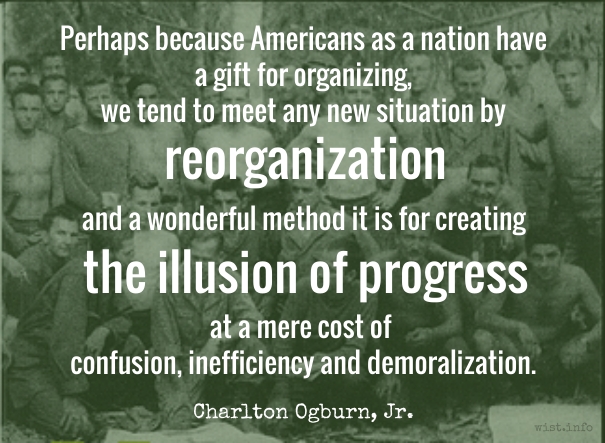
We trained hard, but it seemed that every time we were beginning to form up into teams we would be reorganized. Presumably the plans for our employment were being changed. I was to learn later in life that, perhaps because we are so good at organizing, we tend as a nation to meet any new situation by reorganizing; and a wonderful method it can be for creating the illusion of progress while producing confusion, inefficiency and demoralization.
Charlton Ogburn, Jr. (1911-1998) American journalist, author
“Merrill’s Marauders: The truth about an incredible adventure,” Harper’s Magazine (Jan 1957)
In his 1959 book, The Marauders, Ogburn rephrased this as: "As a result, I suppose, of high-level changes of mind about how we were to be used, we went through several reorganizations. Perhaps because Americans as a nation have a gift for organizing, we tend to meet any new situation by reorganization, and a wonderful method it is for creating the illusion of progress at a mere cost of confusion, inefficiency and demoralization."
Sometimes incorrectly cited to Gaius Petronius Arbiter. For more on this quotation, see here.
We cannot prevent the birds of sorrow from flying over our heads, but we can refuse to let them build their nests in our hair.
Proverbs, Sayings, and Adages
Chinese proverb
People who like this sort of thing will find this the sort of thing they like.
Abraham Lincoln (1809-1865) American lawyer, politician, US President (1861-65)
(Attributed)
One of the earliest references to something like this was in an 1863 newspaper ad for Lincoln’s favorite humorist, Artemus Ward, that included this faux testimonial (possibly written by Ward): “I have never heard any of your lectures, but from what I can learn I should say that for people who like the kind of lectures you deliver, they are just the kind of lectures such people like. Yours respectfully, O. Abe.”
Quoted in G.W.E. Russell, Collections and Recollections, ch. 30 (1898), regarding “an unreadably sentimental book.”
According to Anthony Gross, Lincoln’s Own Stories (1902), Lincoln’s was speaking to Robert Dale Owen, who had insisted on reading to Lincoln a long manuscript on spiritualism. "Well, for those who like that sort of thing, I should think it is just about the sort of thing they would like."
In Emanual Hertz, ed., "Father Abraham," Lincoln Talks: A Biography in Anecdote (1939), the response was to a young poet asking him about his newly published poems.
More discussion of this quotation: Ralph Keyes, The Quote Verifier.

HENRY: Are these things then necessities?
Then let us meet them like necessities.William Shakespeare (1564-1616) English dramatist and poet
Henry IV, Part 2, Act 3, sc. 1, l. 94ff (3.1.94-95) (c. 1598)
(Source)