When despair for the world grows in me
and I wake in the night at the least sound
in fear of what my life and my children’s lives may be,
I go and lie down where the wood drake
rests his beauty on the water, and the great heron feeds.
I come into the peace of wild things
who do not tax their lives with forethought
of grief. I come into the presence of still water.
And I feel above me the day-blind stars
waiting with their light. For a time
I rest in the grace of the world, and am free.Wendell Berry (b. 1934) American farmer, educator, poet, conservationist
Poem (1968-11), “The Peace of Wild Things,” Green River Review, Vol. 1, No. 1
(Source)
Collected in his Openings (1968).
Quotations about:
anxiety
Note not all quotations have been tagged, so Search may find additional quotes on this topic.
If evils come not, then our fears are vain:
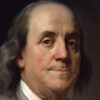
And if they do, Fear but augments the pain.Benjamin Franklin (1706-1790) American statesman, scientist, philosopher, aphorist
Poor Richard (1741 ed.)
(Source)
Don’t let the future disturb you. You will meet it, if you have to, with the same weapons of reason which today arm you against the present.
[Τὰ μέλλοντα μὴ ταρασσέτω· ἥξεις γὰρ ἐπ᾿ αὐτά, ἐὰν δεήσῃ, φέρων τὸν αὐτὸν λόγον, ᾧ νῦν πρὸς τὰ παρόντα χρᾷ.]
Marcus Aurelius (AD 121-180) Roman emperor (161-180), Stoic philosopher
Meditations [To Himself; Τὰ εἰς ἑαυτόν], Book 7, ch. 8 (7.8) (AD 161-180) [tr. Coker (2022)]
(Source)
(Source (Greek)). Alternate translations:Let not things future trouble thee. For if necessity so require that they come to pass, thou shalt (whensoever that is) be provided for them with the same reason, by which whatsoever is now present, is made both tolerable and acceptable unto thee.
[tr. Casaubon (1634), 7.6]Be not disturb'd about the Future; for if ever you come to it, you'll have the same Reason for your Guide, and Protection, which preserves you at present.
[tr. Collier (1701)]Be not disturbed about futurity: You shall come to encounter with future events, possessed of the same reason you now employ in your present affairs.
[tr. Hutcheson/Moor (1742)]Be not solicitous about future possibilities. You will encounter them when they approach, under the conduct of the same reason which you make use of on every present emergency.
[tr. Graves (1792)]Let not future things disturb thee, for thou wilt come to them, if it shall be necessary, having with thee the same reason which now thou usest for present things.
[tr. Long (1862)]Be not disturbed about the future, for if ever you come to it, you will have the same reason for your guide, which preserves you at the present.
[tr. Collier/Zimmern (1887)]Let not the future perturb you. You will face it, if so be, with the same reason which is yours to meet the present.
[tr. Rendall (1898)]Be not troubled about the future. You will come to it, if need be, with the same power to reason, as you use upon your present business.
[tr. Hutcheson/Chrystal (1902)]Be not disquieted about the future. If thou must come thither, thou wilt come armed with the same reason which thou appliest now to the present.
[tr. Haines (Loeb) (1916)]Let not the future trouble you; for you will come to it, if come you must, bearing with you the same reason which you are using now to meet the present.
[tr. Farquharson (1944)]Never let the future disturb you. You will meet it, if you have to, with the same weapons of reason which today arm you against the present.
[tr. Staniforth (1964)]Do not allow the future to trouble your mind; for you will come to it, if come you must, bringing with you the same reason that you now apply to the affairs of the present.
[tr. Hard (1997 ed.)]Forget the future. When and if it comes, you’ll have the same resources to draw on -- the same logos.
[tr. Hays (2003)]Do not let the future trouble you. You will come to it (if that is what you must) possessed of the same reason that you apply now to the present.
[tr. Hammond (2006)]Do not allow the future to trouble your mind; for you will come to it, if come you must, bringing with you the same reason that you now apply to the affairs of the present.
[tr. Hard (2011 ed.)]
And now, ladies and gentlemen, that we’ve enjoyed some good times this evening, and enjoyed some laughter together, I feel it is my obligation to remind you of some of the negative, depressing, dangerous, life-threatening things that life is really all about; things you have not been thinking about tonight, but which will be waiting for you as soon as you leave the theater or as soon as you turn off your television sets. Anal rape, quicksand, body lice, evil spirits, gridlock, acid rain, continental drift, labor violence, flash floods, rabies, torture, bad luck, calcium deficiency, falling rocks, cattle stampedes, bank failure, evil neighbors, killer bees, organ rejection, lynching, toxic waste, unstable dynamite, religious fanatics, prickly heat, price fixing, moral decay, hotel fires, loss of face, stink bombs, bubonic plague, neo-Nazis, friction, cereal weevils, failure of will, chain reaction, soil erosion, mail fraud, dry rot, voodoo curse, broken glass, snake bite, parasites, white slavery, public ridicule, faithless friends, random violence, breach of contract, family scandals, charlatans, transverse myelitis, structural defects, race riots, sunspots, rogue elephants, wax buildup, killer frost, jealous coworkers, root canals, metal fatigue, corporal punishment, sneak attacks, peer pressure, vigilantes, birth defects, false advertising, ungrateful children, financial ruin, mildew, loss of privileges, bad drugs, ill-fitting shoes, widespread chaos, Lou Gehrig’s disease, stray bullets, runaway trains, chemical spills, locusts, airline food, shipwrecks, prowlers, bathtub accidents, faulty merchandise, terrorism, discrimination, wrongful cremation, carbon deposits, beef tapeworm, taxation without representation, escaped maniacs, sunburn, abandonment, threatening letters, entropy, nine-mile fever, poor workmanship, absentee landlords, solitary confinement, depletion of the ozone layer, unworthiness, intestinal bleeding, defrocked priests, loss of equilibrium, disgruntled employees, global warming, card sharks, poisoned meat, nuclear accidents, broken promises, contamination of the water supply, obscene phone calls, nuclear winter, wayward girls, mutual assured destruction, rampaging moose, the greenhouse effect, cluster headaches, social isolation, Dutch elm disease, the contraction of the universe, paper cuts, eternal damnation, the wrath of God, and PARANOIA!!
George Carlin (1937-2008) American comedian
Show (1986-05-02/03), Playin’ with Your Head, “Things to Watch Out For,” Beverly Theater, Los Angeles
(Source)
The wise man thinks about his troubles only when there is some purpose in doing so; at other times he thinks about other things, or, if it is night, about nothing at all.
Bertrand Russell (1872-1970) English mathematician and philosopher
Conquest of Happiness, Part 1, ch. 5 “Fatigue” (1930)
(Source)
A great many worries can be diminished by realizing the unimportance of the matter which is causing the anxiety.
Bertrand Russell (1872-1970) English mathematician and philosopher
Conquest of Happiness, Part 1, ch. 5 “Fatigue” (1930)
(Source)
Yet however grim circumstances are, human beings, if they really are human, occasionally relax.
[Homines quamvis in turbidis rebus sint, tamen, si modo homines sunt, interdum animis rexantur.]
Marcus Tullius Cicero (106-43 BC) Roman orator, statesman, philosopher
Philippics [Philippicae; Antonian Orations], No. 2, ch. 16 / sec. 39 (2.16/2.39) (44-10-24 BC) [tr. Grant (1960)]
(Source)
To Antony's accusations of his inappropriately telling jokes while in camp with Pompey's army.
(Source (Latin)). Other translations:Men, so long as they are men, relax at times even amid the heaviest perplexities.
[tr. King (1877)]Men, in whatever anxiety they may be, if they are men, sometimes indulge in relaxation.
[ed. Hoyt (1896)]But men, in however troublous times -- if only they are human -- sometimes relax their minds.
[tr. Ker (Loeb) (1926)]Although men are in great difficulties, still, provided they are men, they sometimes relax their minds.
[tr. Yonge (1903)]In whatever trouble men may be, yet so long as they are men, they must occasionally have their moments of cheerfulness.
[ed. Harbottle (1906)]Human beings, even in times of crisis, do sometimes unwind, if they are human at all.
[tr. Berry (2006)]Even when they are in troubled situations, men, if they are human, still relax their minds from time to time.
[tr. McElduff (2011)]
It is amazing how much both happiness and efficiency can be increased by the cultivation of an orderly mind, which thinks about a matter adequately at the right time rather than inadequately at all times.
Bertrand Russell (1872-1970) English mathematician and philosopher
Conquest of Happiness, Part 1, ch. 5 “Fatigue” (1930)
(Source)
Forecasting by bureaucrats tends to be used for anxiety relief rather than for adequate policy making.
Nassim Nicholas Taleb (b. 1960) Lebanese-American essayist, statistician, risk analyst, aphorist
The Black Swan, Part 2, ch. 10 “The Scandal of Prediction” (2007)
(Source)

But to go mad with watching, nights and days,
To stand in dread of thieves, fires, runaways
Who filch and fly, — in these if wealth consist,
Let me rank lowest on the paupers’ list.[An vigilare metu exanimem, noctesque diesque
formidare malos fures, incendia, servos,
ne te conpilent fugientes, hoc iuvat? Horum
semper ego optarim pauperrimus esse bonorum.]Horace (65-8 BC) Roman poet, satirist, soldier, politician [Quintus Horatius Flaccus]
Satires [Saturae, Sermones], Book 1, # 1, “Qui fit, Mæcenas,” l. 76ff (1.1.76-79) (35 BC) [tr. Conington (1874)]
(Source)
(Source (Latin)). Alternate translations:To wake all nyghte with shiveryng corpse, both nighte and day to quake,
To sit in dreade, and stande in awe of theeves, leste they should breake
Perforce thy dores, and robb thy chests, and carve thy weasaunte pype:
Leste flickeryng fyer should stroye thy denne, and sease with wastefull grype
Uppon thyne house, leste runagats should pilfer ought from thee,
Be these thy gaines, by rytches repte? then this beheste to me
O Iove betake, that I may be devoyde of all those gooddes
That brews such baneful broyles, or brings of feare suche gastfull fluddes.
[tr. Drant (1567)]To sit up and to watch whole dayes and nights,
To be out of thy wits with constant frights,
To fear that thieves will steal, or fire destroy,
Or servants take thy wealth, and run away.
Is this delightful to thee? then I will
Desire to live without those Riches still.
[tr. A. B.; ed. Brome (1666)]But now to watch all day, and wake all night,
Fear Thieves and Fire, and be in constant fright,
If These are Goods, if these are a delight:
I am content, Heavens grant me sleep and ease,
If These are Goods, I would be poor of These.
[tr. Creech (1684)]But, with continual watching almost dead,
House-breaking thieves, and midnight fires to dread,
Or the suspected slave's untimely flight
With the dear pelf; if this be thy delight,
Be it my fate, so heaven in bounty please,
Still to be poor of blessings such as these!
[tr. Francis (1747)]But what are your indulgencies? All day,
All night, to watch and shudder with dismay,
Lest ruffians fire your house, or slaves by stealth
Rifle your coffers, and abstract your wealth?
If this be affluence -- this her boasted fruit,
Of all such joys may I live destitute!
[tr. Howes (1845)]What, to watch half dead with terror, night and day, to dread profligate thieves, fire, and your slaves, lest they should run away and plunder you; is this delightful? I should always wish to be very poor in possessions held upon these terms.
[tr. Smart/Buckley (1853)]Or, pray, is this your joy? To dread thieves' villainy, the firing of your house, or lest your slaves should steal your stores and run away? I'd ever pray to be extremely poor in blessings such as these.
[tr. Millington (1870)]What, to lie awake half-dead with fear, to be in terror night and day of wicked thieves, of fire, of slaves, who may rob you and run away -- is this so pleasant? In such blessings I could wish ever to be poorest of the poor.
[tr. Fairclough (Loeb) (1926)]Would you rather stand guard, half-dead with fright, and tremble
Day and night over sneak thieves, fire, or slaves
Running off with your loot? If this craven type seems to lead
The more abundant life, I prefer to be poor.
[tr. Palmer Bovie (1959)]Staying awake half-dead with terror, living night and day
in fear of ogreish theives, of fires, of slaves who might
rob you as they run away -- you like this life? Of such
advantages I hope I'll always be thoroughly deprived.
[tr. Fuchs (1977)]Is it pleasant, lying half dead with fear,
Day and night dreading thieves, and fire, and slaves
Who might rob you and run? With wealth
Like that, I'd choose to be poorer than poor!
[tr. Raffel (1983)]Half dead with fear,
night and day sitting vigil on your loot
to frighten off wicked thieves, arsonists,
slaves fleeing after having robbed you.
Does that please you? Of such benefits
I would always prefer to be most poor.
[tr. Alexander (1999)]Instead, you lie awake in bed half-dead and stiff
as a plank from fear of broad-daylight thieves,
dead-if-night thieves, fire, vengeful and fleeing slaves --
is this the bounty you foreswore pleasure for?
If so, let me be poorest of the poor.
[tr. Matthews (2002)]Or maybe you prefer to lie awake half dead with fright,
to spend your days and nights in dread of burglars or fire
or your own slaves, who may fleece you and then disappear? For myself,
I think I can always do without blessing like those!
[tr. Rudd (2005 ed.)]Does it give you pleasure to lie awake half dead of fright,
Terrified night and day of thieves or fire or slaves who rob
You of what you have, and run away? I’d always wish
To be poorest of the poor when it comes to such blessings.
[tr. Kline (2015)]
The only real difference between Anxiety and Excitement was my willingness to let go of Fear.
Barbara Brown Taylor (b. 1951) American minister, academic, author
Learning to Walk in the Dark, ch. 4 (2014)
(Source)

Anxiety is love’s greatest killer. It creates the failures. It makes others feel as you might when a drowning man holds on to you. You want to save him, but you know he will strangle you with his panic.

Many teenagers are tormented by terrors they deem private and personal. They do not know that their anxieties and doubts are universal.
Haim Ginott (1922-1973) Israeli-American school teacher, child psychologist, psychotherapist [b. Haim Ginzburg]
Between Parent and Teenager, ch. 2 “Rebellion and Response” (1969)
(Source)
The way the neurotic sees it: bars on his door mean that he’s locked in; bars on your door mean that he’s locked out.
Mignon McLaughlin (1913-1983) American journalist and author
The Second Neurotic’s Notebook, ch. 5 (1966)
(Source)

GHOST, n. The outward and visible sign of an inward fear.
Ambrose Bierce (1842-1914?) American writer and journalist
“Ghost,” The Cynic’s Word Book (1906)
(Source)
A play on the traditional Christian (from St Augustine) definition of sacrament: "an outward and visible sign of inward and spiritual grace."
Included in The Devil's Dictionary (1911). Originally published in the "Devil's Dictionary" column in the San Francisco Wasp (1885-02-28).

The neurotic longs to touch bottom, so at least he won’t have that to worry about anymore.
Mignon McLaughlin (1913-1983) American journalist and author
The Neurotic’s Notebook, ch. 10 (1963)
(Source)
Study has always been for me the sovereign remedy against life’s unpleasantness, since I have never experienced any sorrow that an hour’s reading did not eliminate.
[L’étude a été pour moi le souverain remède contre les dégoûts de la vie, n’ayant jamais eu de chagrin qu’une heure de lecture n’ait dissipé.]
Charles-Lewis de Secondat, Baron de Montesquieu (1689-1755) French political philosopher
Pensées Diverses [Assorted Thoughts], # 213 (1720-1755) [tr. Clark (2012)]
(Source)
(Source (French)). Alternate translations:Study has been my sovereign remedy against the worries of life. I have never had a care that an hour's reading could not dispel.
[Source (1826)]Study is a sovereign remedy against the troubles of life; there is no vexation which an hour's reading cannot mitigate.
[E.g. (1877)]Study has been to me a sovereign remedy against the vexations of life, having never had an annoyance that one hour's reading did not dissipate.
[E.g. (1905)]Study has been my sovereign remedy against life's disappointment; I have never known any distress that an hour's reading did not relieve.
[ed. Guterman (1963)]
The neurotic doesn’t know how to cope with his emotional bills; some he keeps paying over and over, others he never pays at all.
Mignon McLaughlin (1913-1983) American journalist and author
The Neurotic’s Notebook, ch. 9 (1963)
(Source)
SEMPRONIUS: Oh! think what anxious moments pass between
The birth of plots, and their last fatal periods,
Oh! ’tis a dreadful interval of time,
Filled up with horror all, and big with death!
Destruction hangs on every word we speak,
On every thought, till the concluding stroke
Determines all, and closes our design.Joseph Addison (1672-1719) English essayist, poet, statesman
Cato, Act 1, sc. 3, l. 50ff (1713)
(Source)

According to Oscar Wilde, all that experience teaches us is that history repeats itself, and that the sin we do once and with loathing we will do many times and with pleasure. But the neurotic knows that the sin he does once and with loathing he will do many times and with loathing.
Are you happy now? Are you likely to remain so till this evening? or next week? or next month? or next year? Then why destroy present happiness by a distant misery, which may never come at all, or you may never live to see it? for ever substantial grief has twenty shadows, and most of them shadows of your own making.
Sydney Smith (1771-1845) English clergyman, essayist, wit
Memoir of the Reverend Sydney Smith, by His Daughter, Lady Holland, Vol. 1, ch. 11 (1855)
(Source)
Advice for fighting melancholy / depression / anxiety by "taking short views of life" and not borrowing trouble.

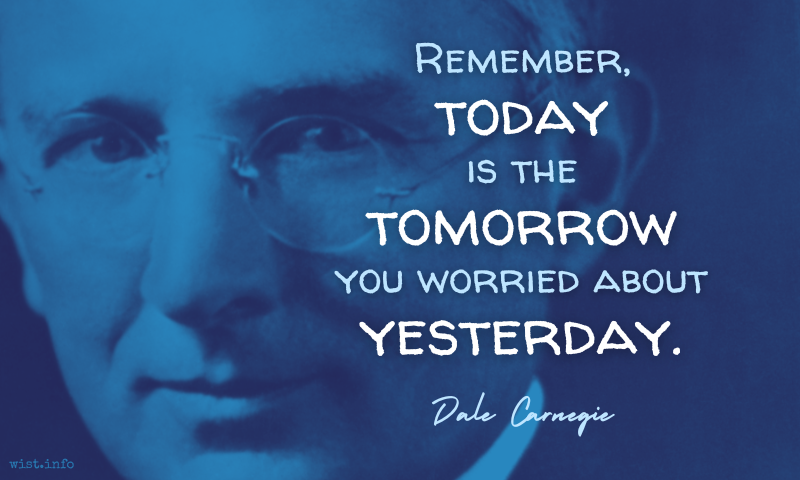
Remember, today is the tomorrow you worried about yesterday.
Dale Carnegie (1888-1955) American writer, lecturer
How to Stop Worrying and Start Living, Part 10 “How I Conquered Worry” (1948)
(Source)
Final note by Carnegie on the story "Six Major troubles Hit Me All At Once" by C. I. Blackwood of Oklahoma City.
The phrase was a "rule" Carnegie taught in his adult courses, and he collected many reports from students about how the various rules taught in the course actually worked in their lives. Thus the "remember" above and how the phrase is also mentioned, quoted in the past tense, in the story "I Now Look for the Green Light," by Joseph M. Cotter of Chicago: "I was told over and over that 'today was the tomorrow I had worried about yesterday.'"
But the rich man is tortured by fears, wasted with griefs, aflame with greed, never free from care, always restless and uneasy, out of breath from unending struggles with his enemies. It is true enough that he increases his holdings beyond measure by going through these miseries; but at the same time, thanks to that very increase, he also multiples his bitter cares. In contrast, the individual of moderate means is satisfied with his small and limited property; he is loved by family and friends; he enjoys sweet peace with his relations, neighbors, and friends; he is devout in his piety, benevolent of mind, sound of body, moderate in his style of life, unblemished in character, and untroubled in conscience. I do not know whether anyone would be so foolish as to have any doubt about which of the two to prefer.
[Alium praediuitem cogitemus; sed diuitem timoribus anxium, maeroribus tabescentem, cupiditate flagrantem, numquam securum, semper inquietum, perpetuis inimicitiarum contentionibus anhelantem, augentem sane his miseriis patrimonium suum in inmensum modum atque illis augmentis curas quoque amarissimas aggerantem; mediocrem uero illum re familiari parua atque succincta sibi sufficientem, carissimum suis, cum cognatis uicinis amicis dulcissima pace gaudentem, pietate religiosum, benignum mente, sanum corpore, uita parcum, moribus castum, conscientia securum. Nescio utrum quisquam ita desipiat, ut audeat dubitare quem praeferat.]
Augustine of Hippo (354-430) Christian church father, philosopher, saint [b. Aurelius Augustinus]
City of God [De Civitate Dei], Book 4, ch. 3 (4.3) (AD 412-416) [tr. Babcock (2012)]
(Source)
On wealth and power as the foundation for happiness.
(Source (Latin)). Alternate translations:Let my wealthy man take with him fears, sorrows, covetousness, suspicion, disquiet, contentions, making immense additions to his estate only by adding to his heap of most bitter cares; and let my poor man take with him sufficiency with little, love of kindred, neighbours, friends, joyous peace, peaceful religion, soundness of body, sincereness of heart, abstinence of diet, chastity of carriage, and security of conscience. Where should a man find any one so sottish as would make a doubt which of these to prefer in his choice?
[tr. Healey (1610)]But the rich man is anxious with fears, pining with discontent, burning with covetousness, never secure, always uneasy, panting from the perpetual strife of his enemies, adding to his patrimony indeed by these miseries to an immense degree, and by these additions also heaping up most bitter cares. But that other man of moderate wealth is contented with a small and compact estate, most dear to his own family, enjoying the sweetest peace with his kindred neighbors and friends, in piety religious, benignant in mind, healthy in body, in life frugal, in manners chaste, in conscience secure. I know not whether any one can be such a fool, that he dare hesitate which to prefer.
[ed. Dods (1871)]But, our wealthy man is haunted by fear, heavy with cares, feverish with greed, never secure, always restless, breathless from endless quarrels with his enemies. By these miseries, he adds to his possessions beyond measure, but he also piles up for himself a mountain of distressing worries. The man of modest means is content with a small and compact patrimony. He is loved by his own, enjoys the sweetness of peace, in his relations with kindred, neighbors, and friends, is religious and pious, of kindly disposition, healthy in body, self-restrained, chaste in morals, and at peace with his conscience. I wonder if there is anyone so senseless as to hesitate over which of the two to prefer.
[tr. Zema/Walsh (1950)]Let us suppose that the rich man is troubled by fears, pining with grief, burning with desire, never secure, always restless, panting in ceaseless struggles with his foes, though he does, to be sure, by dint of such suffering accumulate great additions to his estate even beyond measure, these additions adding also their quota of corrosive anxieties. Let the man of modest means, on the other hand, be self-sufficient on his trim and tiny property, beloved by his family, enjoying the most agreeable relations with his kindred, neighbours and friends, devoutly religious, kindly disposed, in good physical condition, leading a simple life, free from vice and untroubled in conscience. I don’t suppose that there is anyone so foolish as to think of doubting which one he would prefer.
[tr. Green (Loeb) (1963)]But the rich man is tortured by fears, worn out with sadness, burnt up with ambition, never knowing serenity of repose, always panting and sweating in his struggles with opponents. It may be true that he enormously swells his patrimony, but at the cost of those discontents, while by this increase he heaps up a load of further anxiety and bitterness. The other man, the ordinary citizen, is content with his strictly limited resources. He is loved by family and friends; he enjoys the blessing of peace with his relations, neighbours, and friends; he is loyal, compassionate, and kind, healthy in body, temperate in habits, of unblemished character, and enjoys the serenity of a good conscience. I do not think anyone would be fool enough to hesitate about which he would prefer.
[tr. Bettenson (1972)]The wealthy man, however, is troubled by fears; he pines with grief; he burns with greed. He is never secure; he is always unquiet and panting from endless confrontations with his enemies. To be sure, he adds to his patrimony in immense measure by these miseries; but alongside these additions he also heaps up the most bitter cares. By contrast, the man of moderate means is self-sufficient on his small and circumscribed estate. He is of his own family, and rejoices in the most sweet peace with kindred, neighbours and friends. He is devoutly religious, well disposed in mind, healthy in body, frugal in life, chaste in morals, untroubled in conscience. I do not know if anyone could be such a fool as to dare to doubt which to prefer.
[tr. Dyson (1998)]

If I knew what I was so anxious about, I wouldn’t be so anxious.
Mignon McLaughlin (1913-1983) American journalist and author
The Second Neurotic’s Notebook, ch. 5 (1966)
(Source)
Trouble, like the hill ahead, straightens out when you advance upon it.
Marcelene Cox (1900-1998) American writer, columnist, aphorist
“Ask Any Woman” column, Ladies’ Home Journal (1953-05)
(Source)

The neurotic feels as though strapped in a gas-filled room where at any moment someone, probably himself, will strike a match.
Mignon McLaughlin (1913-1983) American journalist and author
The Second Neurotic’s Notebook, ch. 4 (1966)
(Source)
If one burdens the future with one’s worries, it cannot grow organically. I am filled with confidence, not that I shall succeed in worldly things, but that even when things go badly for me I shall still find life good and worth living.
Esther "Etty" Hillesum (1914-1943) Dutch Jewish law graduate, writer, diarist
Diary (1942-06-11)
(Source)
Collected in An Interrupted Life [Het Verstoorde Leven] (1981) [tr. Pomerans (1983)].

I have just now come from a party where I was its life and soul; witticisms streamed from my lips, everyone laughed and admired me, but I went away — yes, the dash should be as long as the radius of the earth’s orbit ——————————— and wanted to shoot myself.
Søren Kierkegaard (1813-1855) Danish philosopher, theologian
Journal (1836-04) [tr. Hannay (1982)]
(Source)
Papieren: 1 A 161; KJN: NB 2:53. Alternate translations:I have just returned from a party of which I was the life and soul; wit poured from my lips, everyone laughed and admired me -- but I went away -- and the dash should be as long as the earth's orbit ——————————— and wanted to shoot myself.
[tr. Dru (1938)]I have just come back from a party where I was the life and soul. Witticisms flowed from my lips. Everyone laughed and admired me -- but I left, yes, that dash should be as long as the radii of the earth's orbit ——————————— and wanted to shoot myself.
[tr. Hannay (1996)]

Possess your soul without fussing; your guardian angel does not lose half the sleep over you you think he does.
Austin O'Malley (1858-1932) American ophthalmologist, professor of literature, aphorist
Keystones of Thought (1914)
(Source)
Write it on your heart that every day is the best day in the year. He is rich who owns the day, and no one owns the day who allows it to be invaded with fret and anxiety. Finish every day and be done with it. You have done what you could. Some blunders and absurdities, no doubt crept in. Forget them as soon as you can, tomorrow is a new day; begin it well and serenely, with too high a spirit to be cumbered with your old nonsense. This new day is too dear, with its hopes and invitations, to waste a moment on the yesterdays.
Ralph Waldo Emerson (1803-1882) American essayist, lecturer, poet
(Spurious)
This widely spread inspirational quotation is actually a piecing-together of multiple phrases from different sources, some not even Emerson. It includes bits from his essay "Works and Days" (here and here), observations on Emerson by Lillian Whiting, and fragments from a letter by him to his daughter Ellen.
The result sounds much like Emerson, but would require more ellipses than text to qualify as a quotation of him. It would be a great candidate for an AI "quotation" except that references to it can be found back in the 2010s, so it is almost certainly of human origin.
More detailed discussion: poetry - From which book or essay are these words by Ralph Waldo Emerson? "Write it on your heart that every day is the best day in the year..." - Literature Stack Exchange.
Worry is like sand in an oyster: a little produces a pearl, too much kills the animal.
Marcelene Cox (1900-1998) American writer, columnist, aphorist
“Ask Any Woman” column, Ladies’ Home Journal (1955-10)
(Source)
Money is a singular thing. It ranks with love as man’s greatest source of joy. And with death as his greatest source of anxiety.
John Kenneth Galbraith (1908-2006) Canadian-American economist, diplomat, author
The Age of Anxiety, ch. 6 “The Rise and Fall of Money” (1977)
(Source)
When we are children we seldom think of the future. This innocence leaves us free to enjoy ourselves as few adults can. The day we fret about the future is the day we leave our childhood behind.
Patrick Rothfuss (b. 1973) American author
The Name of the Wind, ch. 12 “Puzzle Pieces Fitting” (2007)
(Source)

Each day, futurity our bosom fills
With constant terror, for to think of woes
That are to come, is worse than to endure them.Euripides (485?-406? BC) Greek tragic dramatist
Andromeda [Ἀνδρομέδα], fragment (412 BC) [tr. Wodhall (1809)]
(Source)
Barnes frag. 40, Musgrave frag. 18.
I think that the successful genres of a particular period are reflections of the needs and thoughts and social struggles of that time. When you see a bunch of similar projects meeting with success, you’ve found a place in the social landscape where a particular story (or moral or scenario) speaks to readers. You’ve found a place where the things that stories offer are most needed. And since the thing that stories most often offer is comfort, you’ve found someplace rich with anxiety and uncertainty. (That’s what I meant when I said to Melinda Snodgrass that genre is where fears pool.)
Daniel Abraham (b. 1969) American writer [pseud. James S. A. Corey (with Ty Franck), M. L. N. Hanover]
“100 Aspects of Genre: Learning from the Dead and the Dying,” blog entry (19 Oct 2010)
(Source)

When a people are confronted with problems that are both incomprehensible and unbearable, they lash out not at those who contrived the problems but at those who expose them. When they are confronted by moral problems that they find insoluble, or perhaps intolerable, they blame the moralists. The anxieties, tensions, revulsions of our day create an atmosphere in which it is almost impossible to think clearly and dispassionately about just those problems which most imperatively require reason and objectivity — problems of adjustment to fundamental change.
Henry Steele Commager (1902-1998) American historian, writer, activist
Speech (1971-04-10), “The University and the Community of Learning,” Kent State University, Ohio
(Source)
Laughter is a tranquilizer with no side effects.
Arnold H. Glasow (1905-1998) American publisher, humorist, aphorist
(Attributed (1974))
More discussion of this quotation: The Big Apple: “Laughter is a tranquilizer with no side effects”.
Few bothersome things are important enough to bother with. It is folly to take to heart what you should turn your back on. Many things that were something are nothing if left alone, and others that were nothing turn into much because we pay attention to them.
[Pocas cosas de enfado se han de tomar de propósito, que sería empeñarse sin él. Es trocar los puntos tomar a pechos lo que se ha de echar a las espaldas. Muchas cosas que eran algo, dejándolas, fueron nada; y otras que eran nada, por haber hecho caso de ellas, fueron mucho.]Baltasar Gracián y Morales (1601-1658) Spanish Jesuit priest, writer, philosopher
The Art of Worldly Wisdom [Oráculo Manual y Arte de Prudencia], § 121 (1647) [tr. Maurer (1992)]
(Source)
(Source (Spanish)). Alternate translations:Few of those things that occasion trouble, are to be minded: else we shall torment our selves much in vain. It's to act the clean contrary way, to lay that to heart, which we should throw behind our backs. Many things that were of some consequence, have signified nothing at all, because men troubled not themselves about them; and others which signified nothing, have become matters of importance, because of the value that was put upon them.
[Flesher ed. (1685)]Troublesome things must not be taken too seriously if they can be avoided. It is preposterous to take to heart that which you should throw over your shoulders. Much that would be something has become nothing by being left alone and what was nothing has become of consequence by being made much of.
[tr. Jacobs (1892)]To convert petty annoyances into matters of importance, is to become seriously involved in nothing. It is to miss the point, to carry on the chest what has been cast from the shoulders. Many things which were something, by being left alone became nothing; and others which were nothing, became much because messed into.
[tr. Fischer (1937)]

Earthly possessions dazzle our eyes and delude us into thinking that they can provide security and freedom from anxiety. Yet all the time they are the very source of anxiety. If our hearts are set on them, our reward is an anxiety whose burden is intolerable. Anxiety creates its own treasures, and they in turn beget further care. When we seek for security in possessions, we are trying to drive out care with care, and the net result is the precise opposite of our anticipations. The fetters that bind us to our possessions prove to be the cares themselves.
Dietrich Bonhoeffer (1906-1945) German Lutheran pastor, theologian, martyr
The Cost of Discipleship, Part 2, ch. 16 (1959)
(Source)
Wretchedness is caused by emotional disturbances, and the happy life by calmness, and disturbance takes two forms — anxiety and fear in expecting evils, ecstatic joy and lustful thoughts in misunderstanding good things, all of which are at variance with with wisdom and reason. Accordingly, if a man possesses self-control and consistency, and is without fear, distress, excitability, or lust, is he not happy? But this is the nature of the wise man always, so he is happy always.
[Atque cum perturbationes animi miseriam, sedationes autem vitam efficiant beatam, duplexque ratio perturbationis sit, quod aegritudo et metus in malis opinatis, in bonorum autem errore laetitia gestiens libidoque versetur, quae omnia cum consilio et ratione pugnent, his tu tam gravibus concitationibus tamque ipsis inter se dissentientibus atque distractis quem vacuum solutum liberum videris, hunc dubitabis beatum dicere? atqui sapiens semper ita adfectus est; semper igitur sapiens beatus est.]
Marcus Tullius Cicero (106-43 BC) Roman orator, statesman, philosopher
Tusculan Disputations [Tusculanae Disputationes], Book 5, ch. 15 (5.15) / sec. 43 (45 BC) [tr. Davie (2017)]
(Source)
(Source (Latin)). Alternate translations:Now since the Disturbances of the Soul render the Life miserable, but the composure of them happy; and there is a double rank of Passions; in that, Discontent and Fear are terminated on Evils conceiv'd; but excessive Mirth and Lust arise from the misapprehension of good things, since all are inconsistent with Advice and Reason, if you shall see any one clear, emancipated, free from these emotions so vehement, so discordant one with the other, and so distracting, can you make any question of calling him Happy? But the Wise man is always so dispos'd, therefore the Wise man is always Happy.
[tr. Wase (1643)]But as the perturbations of the mind make life miserable, and tranquility renders it happy: and as these perturbations are of two sorts; grief and fear, proceeding from imagined evils, immoderate joy and lust, from the mistake of what is good; and all these are in opposition to reason and counsel; when you see a man at ease, quite free and disengaged from such troublesome commotions, which are so much at variance with one another, can you hesitate to pronounce such a one a happy man? Now the wise man is always in such a disposition: therefore the wise man is always happy.
[tr. Main (1824)]But when the perturbations render life unhappy, while their repose makes it happy -- and since the mode of perturbation is twofold -- sorrow and fear having birth from reputed evils -- the delirium of joy and desire, from the delusion of good, -- when all these are repugnant to counsel and reason, and you see a man void, exempt, free from these excitements, so vehement, so discordant, so distracted by mutual conflicts, -- will you hesitate to pronounce him happy? But the wise man is always thus, and therefore always happy.
[tr. Otis (1839)]But as the perturbations of the mind make life miserable, and tranquillity renders it happy; and as these perturbations are of two sorts, grief and fear, proceeding from imagined evils, and as immoderate joy and lust arise from a mistake about what is good, and as all these feelings are in opposition to reason and counsel; when you see a man at ease, quite free and disengaged from such troublesome commotions, which are so much at variance with one another can you hesitate to pronounce such an one a happy man? Now the wise man is always in such a disposition, therefore the wise man is always happy.
[tr. Yonge (1853)]Now since perturbations of mind create misery, while quietness of mind makes life happy, and since there are two kinds of perturbations, grief and fear having their scope in imagined evils, inordinate joy and desire in mistaken notions of the good, all being repugnant to wise counsel and reason, will you hesitate to call him happy whom you see relieved, released, free from these excitements so oppressive, and so at variance and divided among themselves? Indeed one thus disposed is always happy. Therefore the wise man is always happy.
[tr. Peabody (1886)]
“Darkness” is shorthand for anything that scares me — that I want no part of — either because I am sure that I do not have the resources to survive it or because I do not want to find out. The absence of God is in there, along with the fear of dementia and the loss of those nearest and dearest to me. So is the melting of polar ice caps, the suffering of children, and the nagging question of what it will feel like to die. If I had my way, I would eliminate everything from chronic back pain to the fear of the devil from my life and the lives of those I love — if I could just find the right night-lights to leave on.
At least I think I would. The problem is this: when, despite all my best efforts, the lights have gone off in my life (literally or figuratively, take your pick), plunging me into the kind of darkness that turns my knees to water, nonetheless I have not died. The monsters have not dragged me out of bed and taken me back to their lair. The witches have not turned me into a bat. Instead, I have learned things in the dark that I could never have learned in the light, things that have saved my life over and over again, so that there is really only one logical conclusion. I need darkness as much as I need light.Barbara Brown Taylor (b. 1951) American minister, academic, author
Learning to Walk in the Dark, Introduction (2014)
(Source)
For one’s emotional state is always determined by the oddest and most accidental things, and it is precisely the most superficial factors that often fortify or diminish our courage.
Stefan Zweig (1881-1942) Austrian novelist, playwright, journalist, biographer
Beware of Pity (1939)
(Source)
If one were to write a book called “The Best Remedy against Self-Torment,” it would be very brief: “Let each day have trouble enough of its own.”
Søren Kierkegaard (1813-1855) Danish philosopher, theologian
Christian Discourses (Christelige Taler), Part 1 “The Cares of the Pagans,” ch. 6 (1848) [tr. Hong (1997)]
(Source)
To ruminate upon evils, to make critical notes upon injuries, and be too acute in their apprehensions, is to add unto our own Tortures, to feather the Arrows of our Enemies, to lash our selves with the Scorpions of our Foes, and to resolve to sleep no more.
Thomas Browne (1605-1682) English physician and author
Christian Morals, Part 3, sec. 12 (1716)
(Source)

But the great hero himself tossed and turned.
It was like a man roasting a paunch
Stuffed with fat and blood over a fire.
He can’t wait for it to be done
And so keeps turning it over and over.[ἀτὰρ αὐτὸς ἑλίσσετο ἔνθα καὶ ἔνθα.
ὡς δ᾽ ὅτε γαστέρ᾽ ἀνὴρ πολέος πυρὸς αἰθομένοιο,
ἐμπλείην κνίσης τε καὶ αἵματος, ἔνθα καὶ ἔνθα
αἰόλλῃ, μάλα δ᾽ ὦκα λιλαίεται ὀπτηθῆναι,
ὣς ἄρ᾽ ὅ γ᾽ ἔνθα καὶ ἔνθα ἑλίσσετο]Homer (fl. 7th-8th C. BC) Greek author
The Odyssey [Ὀδύσσεια], Book 20, l. 24ff (20.24) (c. 700 BC) [tr. Lombardo (2000)]
(Source)
(Source (Greek)). Alternate translations:But from side to side
It made him toss apace. You have not tried
A fellow roasting of a pig before
A hasty fire, his belly yielding store
Of fat and blood, turn faster, labour more
To have it roast, and would not have it burn,
Than this and that way his unrest made turn
His thoughts and body ....
[tr. Chapman (1616)]He lay restlessly.
As one that has raw flesh upon the fire,
And hungry is, is ever turning it;
So turneth he himself ....
[tr. Hobbes (1675), l. 20ff]Restless his body rolls, to rage resign'd
As one who long with pale-eyed famine pined,
The savoury cates on glowing embers cast
Incessant turns, impatient for repast.
[tr. Pope (1725)]Yet he turn’d from side to side.
As when some hungry swain turns oft a maw
Unctuous and sav’ry on the burning coals,
Quick expediting his desired repast ....
[tr. Cowper (1792), l. 26ff]But ever he rolled tossing to and fro.
As when a man beside a blazing fire
Turneth a rich fat goat-paunch to and fro,
Over and over, with intense desire
Quickly to roast it ....
[tr. Worsley (1861), st. 4]But himself tossed to and fro.
As when a wight a'front a blazing fire
A savoury haggis full of fat and gravy
Restlessly turns and tumbles to and fro --
In hope right well and quickly for to roast it.
[tr. Bigge-Wither (1869), l. 24ff]But, ev'n as when a man at some fierce fire
A savoury paunch with fat and blood replete
From side to side turns oft, intent with speed
Most prompt to roast it; -- so, from right to left
Ulysses swaying lay.
[tr. Musgrave (1869), l. 36ff]But Odysseus himself lay tossing this way and that. And as when a man by a great fire burning takes a paunch full of fat and blood, and turns it this way and that and longs to have it roasted most speedily, so Odysseus tossed from side to side.
[tr. Butcher/Lang (1879)]But he himself in meanwhile was tossing here and there.
As when a man hath gotten by a great fire blazing out
A paunch of fat and of blood, and turneth it oft about
Hither and thither, all eager to roast it speedily.
[tr. Morris (1887)]Yet he himself kept tossing to and fro. As when a man near a great glowing fire turns to and fro a sausage, full of fat and blood, anxious to have it quickly roast.
[tr. Palmer (1891)]He tossed about as one who turns a paunch full of blood and fat in front of a hot fire, doing it first on one side and then on the other, that he may get it cooked as soon as possible, even so did he turn himself about from side to side ....
[tr. Butler (1898)]But he himself lay tossing this way and that. And as when a man before a great blazing fire turns swiftly this way and that a paunch full of fat and blood, and is very eager to have it roasted quickly, so Odysseus tossed from side to side ....
[tr. Murray (1919)]But the strain tossed his body about, like the basting paunch stuffed with blood and fat that a man who wants it immediately cooked will turn over and over before a blazing fire. In such fashion did Odysseus roll to this side and to that ....
[tr. Lawrence (1932)]Odysseus nevertheless could not help tossing to and fro on his bed, just as a paunch stuffed with fat and blood is tossed this way and that in the blaze of the fire by a cook who wants to get it quickly roasted, twisting and turning thus to one side and the other ....
[tr. Rieu (1946)]He himself rocked, rolling from side to side, as a cook turns a sausage, big with blood and fat, at a scorching blaze, without a pause, to broil it quick.
[tr. Fitzgerald (1961)]The man himself was twisting and turning.
And as a man with a paunch pudding, that has been filled with
blood and fat, tosses it back and forth over a blazing
fire, and the pudding itself strains hard to be cooked quickly;
so he was twisting and turning back and forth.
[tr. Lattimore (1965)]Yet Odysseus' own self thrashed this way and that. Just as a man before a blazing fire who's skewered a paunch that's stuffed with blood and fat will swiftly turn ths spit this way and that, eager to have it roasted fast.
[tr. Mandelbaum (1990)]But he himself kept tossing, turning,
intent as a cook before some white-hot blazing fire
who rolls his sizzling sausage back and forth,
packed with fat and blood -- keen to broil it quickly,
tossing, turning it, this way, that way.
[tr. Fagles (1996)]He himself kept twisting one way and the other. As when a man keeps shifting a paunch that has been stuffed full with suet and blood, in a huge fire's blaze, one way and the other turning it over, and wishes for it to be rapidly roasted, so did he twist one way and the other.
[tr. Merrill (2002)]Nevertheless, he could not help twisting and turning, just as a paunch stuffed with fat and blood is turned this way and that in the blaze of the roaring fire by a man who wants to get it quickly roasted.
[tr. DCH Rieu (2002)]But Odysseus himself kept tossing back and forth. As when a man has stuffed a paunch full of fat and blood, and keeps turning it back and forth on a blazing-hot fire, because he wants it to be cooked as soon as possible, so Odysseus kept turning back and forth ....
[tr. Verity (2016)]He writhed around, as when a man rotates a sausage full of fat and blood; the huge fire blazes, and he longs to have the roasting finished.
[tr. Wilson (2017)]But he himself kept tossing and turning. As a man cooking a paunch chockful of fat and blood on a fierce blazing fire will turn it to and fro, determined to get it cooked through as fast as he can, so Odysseus tossed this way and that.
[tr. Green (2018)]He still tossed and turned, back and forth. Just as a man
eager to roast a stomach stuffed with fat and blood
turns it quickly round and round on a blazing fire,
that is how lord Odysseus tossed and turned ....
[tr. Johnston (2019), l. 25ff]
For he says that evils are neither diminished by time nor lightened by being premeditated; that meditation on evil to come, or, it may be, on that which will never come, is foolish; that every evil is sufficiently annoying when it comes; that to him who has always thought that something adverse may happen to him that very thought is a perpetual evil; that if the expected evil should not happen, he would have incurred voluntary misery in vain; that thus one would be always in distress, either in suffering evil or in thinking of it.
[Nam neque vetustate minui mala nec fieri praemeditata leviora, stultamque etiam esse meditationem futuri mali aut fortasse ne futuri quidem: satis esse odiosum malum omne, cum venisset; qui autem semper cogitavisset accidere posse aliquid adversi, ei fieri illud sempiternum malum; si vero ne futurum quidem sit, frustra suscipi miseriam voluntariam; ita semper angi aut accipiendo aut cogitando malo.]
Marcus Tullius Cicero (106-43 BC) Roman orator, statesman, philosopher
Tusculan Disputations [Tusculanae Disputationes], Book 3, ch. 15 (3.15) / sec. 32 (45 BC) [tr. Peabody (1886)]
(Source)
Discussing the teachings of Epicurus (fr. U444). Source (Latin). Alternate translations:For that neither are Evils abated by long time, nor yet alleviated by foresight of them; and that the poring on Evils not yet come, and perhaps that never will come, is foolish. For that all Evil is Vexation enough, when it is come; but he that is always thinking that some Adversity may possibly befall him, to him it becometh an everlasting Evil; but if it shall never actually come upon him, a voluntary Disquiet is taken up on false grounds; so the mind is always vex'd, either with enduring, or expecting Evil.
[tr. Wase (1643)]Evils are not the less by reason of their continuance, nor the oighter for having been foreseen; and it is folly to ruminate on evils to come, or that, perhaps, may never come; every evil is disagreeable enough when it doth come: but he who is constantly considering that some evil may befall him, charges himself with a perpetual evil, for should such eve never light on him, he voluntarily takes to himself unnecessary misery, so that he is under constant uneasiness, whether he meets any evil or only thinks of it.
[tr. Main (1824)]For evil ls not diminished by time, nor alleviated by premeditation: that it is folly itself to brood upon evil that is future, or indeed, perhaps, is not to be at all: that evil is hateful enough when it comes: that, to the man, who is always musing upon that which is to come, his meditation itself becomes an eternal evil; and, should it prove that his apprehensions have been groundless, he burdens himself with a voluntary misery; and thus, between the encounter and contemplation of evil, he is always in trouble.
[tr. Otis (1839)]Evils are not the less by reason of their continuance, nor the lighter for having been foreseen; and it is folly to ruminate on evils to come, or such as, perhaps, never may come; every evil is disagreeable enough when it does come; but he who is constantly considering that some evil may befall him, is loading himself with a perpetual evil, and even should such evil never light on him, he voluntarily takes upon himself unnecessary misery, so that he is under constant uneasiness, whether he actually suffers any evil, or only thinks of it.
[tr. Yonge (1853)]Evils are not diminished by the passage of time, nor made easier by pre-rehearsal. In fact it is foolish to rehearse misfortunes which have not yet happened and which may not happen at all. Each of our misfortunes is distasteful enough, he says, when it is already here: those who have constantly been thinking about what disagreeable things are on the way simply make their evils perpetual. And those things may not happen at all, in which case all their voluntary misery goes for nothing. The result is that they are always in anxiety, either from the evils they undergo or from those they anticipate.
[tr. Graver (2002)]
Fear, born of that stern matron, Responsibility, sits on one’s shoulders like some heavy imp of darkness, and one is preoccupied and, possibly, cantankerous.
Americans are the only people in the world known to me whose status anxiety prompts them to advertise their college and university affiliations in the rear window of their automobiles.
Paul Fussell (1924-2012) American cultural and literary historian, author, academic
Class: A Guide Through the American Status System, ch. 4 (1983)
(Source)
Helpless lust and unreasoning anxiety were just part of growing up.

Loneliness, insomnia, and change: the fear of these is even worse than the reality.
Mignon McLaughlin (1913-1983) American journalist and author
The Second Neurotic’s Notebook, ch. 10 (1966)
This is love, and the trouble with it: it can make you embarrassed. Love is really liking someone a whole lot and not wanting to screw that up. Everybody’s chewed over this. This unites us, this part of love.
Lemony Snicket (b. 1970) American author, screenwriter, musician (pseud. for Daniel Handler)
Adverbs, “Collectively” (2006)

I don’t know whether my life has been a success or a failure But not having any anxiety about becoming one instead of the other, and just taking things as they come along, I’ve had a lot of extra time to enjoy life.
Arthur "Harpo" Marx (1888-1964) American comedian, actor, mime, musician [b. Adolph Marx]
Harpo Speaks!, ch. 1, opening words (1961) [with Rowland Barber]
(Source)

I will leave it for the present, as this letter is already pretty long. Such is my desire, my anxiety for your perfection, that I never think I have said enough, though you may possibly think I have said too much; and though, in truth, if your own good sense is not sufficient to direct you, in many of these plain points, all that I or anybody else can say will be insufficient.
Lord Chesterfield (1694-1773) English statesman, wit [Philip Dormer Stanhope]
Letter to his son, #168 (18 Nov 1748)
(Source)
Chesterfield repeats the sentiment in a later letter, #194 (22 Sep 1749):This letter is a very long, and so possibly a very tedious one; but my anxiety for your perfection is so great, and particularly at this critical and decisive period of your life, that I am only afraid of omitting, but never of repeating or dwelling too long upon anything that I think may be of the least use to you.
I have now but one anxiety left, which is concerning you. I would have you be, what I know nobody is, perfect. As that is impossible, I would have you as near perfection as possible. I know nobody in a fairer way toward it than yourself, if you please. Never were so much pains taken for anybody’s education as for yours; and never had anybody those opportunities of knowledge and improvement which you have had, and still have. I hope, I wish, I doubt, and I fear alternately. This only I am sure of, that you will prove either the greatest pain, or the greatest pleasure of, Yours Always Truly.
Lord Chesterfield (1694-1773) English statesman, wit [Philip Dormer Stanhope]
Letter to his son, #141 (16 Feb 1748)
(Source)
I don’t kno as i want tew bet enny money, and giv odds, on the man, who iz alwus anxious tew pray out loud, every chance he kan git.
[I don’t know as I want to bet any money, and give odds, on the man who is always anxious to pray out loud, every chance he can get.]
Josh Billings (1818-1885) American humorist, aphorist [pseud. of Henry Wheeler Shaw]
Everybody’s Friend, Or; Josh Billing’s Encyclopedia and Proverbial Philosophy of Wit and Humor, “Mollassis Kandy” (1874)
(Source)

What some call health, if purchased by perpetual anxiety about diet, isn’t much better than tedious disease.
But reassurance can be the cruellest antidote to anxiety. Our rosy predictions both leave the anxious unprepared for the worst, and unwittingly imply that it would be disastrous if the worst came to pass. Seneca more wisely asks us to consider that bad things probably will occur, but adds that they are unlikely ever to be as bad as we fear.
Alain de Botton (b. 1969) Swiss-British author
The Consolations of Philosophy, ch. 3 “Consolation for Frustration” (2000)
(Source)

Anxiety is the unwillingness to play even when you know the odds are for you. Courage is the willingness to play even when you know the odds are against you.
Thomas Szasz (1920-2012) Hungarian-American psychiatrist, educator
The Second Sin (1973)
Anxiety is love’s greatest killer. It creates the failures. It makes others feel as you might when a drowning man holds on to you. You want to save him, but you know he will strangle you with his panic.

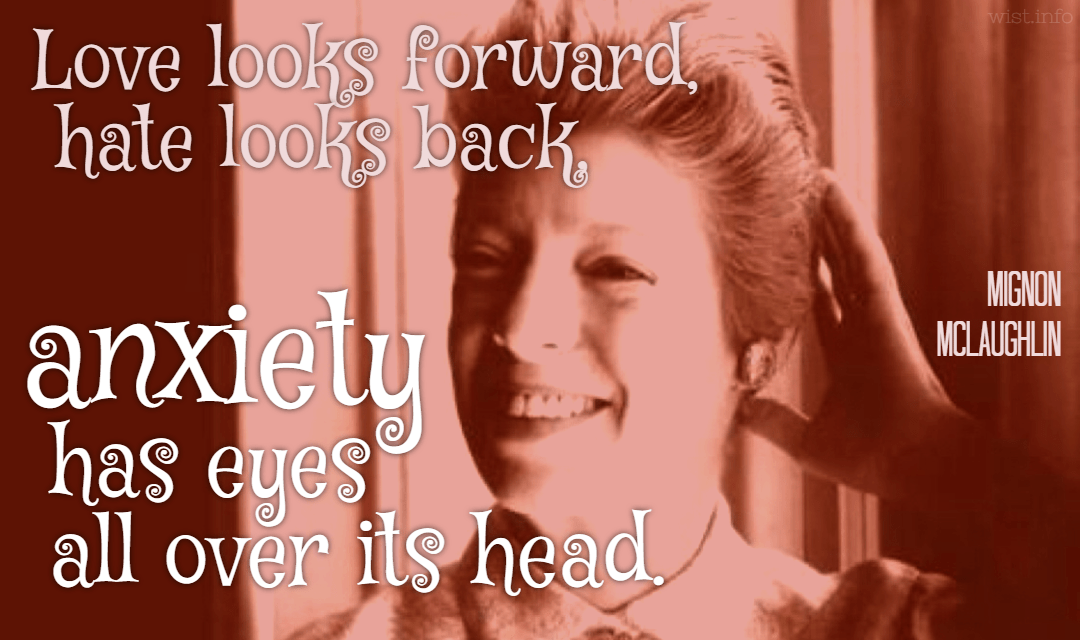
Love looks forward, hate looks back, anxiety has eyes all over its head.
Mignon McLaughlin (1913-1983) American journalist and author
The Neurotic’s Notebook, ch. 1 (1963)
(Source)
I define anxiety as experiencing failure in advance.

Anxiety is the handmaiden of contemporary ambition.
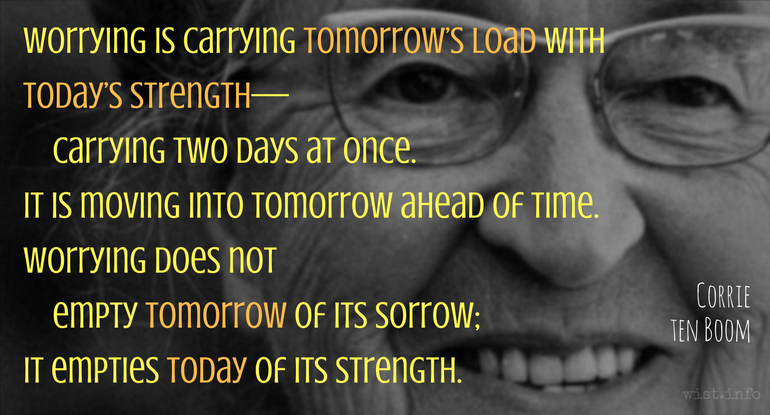
Worrying is carrying tomorrow’s load with today’s strength — carrying two days at once. It is moving into tomorrow ahead of time. Worrying does not empty tomorrow of its sorrow; it empties today of its strength.
There is no such thing as inner peace. There is only nervousness or death.
Suspicion begets suspicion.
Publilius Syrus (d. 42 BC) Assyrian slave, writer, philosopher [less correctly Publius Syrus]
Sententiae [Moral Sayings], # 928 [tr. Lyman (1862)]
But I must submit all my Hopes and Fears, to an overruling Providence, in which, unfashionable as the Faith may be, I firmly believe.
John Adams (1735-1826) American lawyer, Founding Father, statesman, US President (1797-1801)
Letter (1776-07-03) to Abigail Adams
(Source)
On the approval of the resolution for Independence, approved the day before, and his worries over the the future held for the new United States.

But the greatest gift in the power of loneliness to bestow is the realization that life does not consist either of wallowing in the past or of peering anxiously at the future; and it is appalling to contemplate the great number of often painful steps by which one arrives at a truth so old, so obvious, and so frequently expressed. It is good for one to appreciate that life is now. Whether it offers little or much, life is now — this day — this hour — and is probably the only experience of the kind one is to have.
Charles Macomb Flandrau (1871-1938) American author and essayist
Viva Mexico!, ch. 7 (1908)
When thinking about life, remember this: no amount of guilt can change the past, and no amount of anxiety can change the future.
(Other Authors and Sources)
Anonymous

Why worry? If you’ve done the very best you can, worrying won’t make it any better.
Walt Disney (1901-1966) American entrepreneur, animator, film producer, showman
In “The Amazing Secret of Walt Disney,” Interview by Don Eddy, The American Magazine (Aug 1955)
(Source)
The secret of health for both mind and body is not to mourn for the past, worry about the future, or anticipate troubles, but to live in the present moment wisely and earnestly.
Buddha (c.563-483 BC) Indian mystic, philosopher [b. Siddharta Gautama]
In Bukkyõ Dendõ Kyõkai, The Teaching of Buddha (1966)
Likely a paraphrase of a variety of the Buddha's teachings.
Do not imagine you can exorcise what oppresses you in life by giving vent to it in art.
Gustave Flaubert (1821-1880) French writer, novelist
Letter to Louise Colet (25 Nov 1853)
It is said that our anxiety does not empty tomorrow of its sorrows, but only empties today of its strength.
Charles Spurgeon (1834-1892) British Baptist preacher, author [Charles Haddon (C.H.) Spurgeon]
The Salt-Cellars (1889)
(Source)

Most people today don’t want honest answers insofar as honest means unpleasant or disturbing. They want a soft answer that turneth away anxiety. They want answers that are, in effect, escapes.
Louis Kronenberger (1904-1980) American critic, novelist, biographer
“Unbrave New World,” The Cart and the Horse (1964)
An allusion to Proverbs 15:1 "A soft answer turneth away wrath."

He who fears he shall suffer, already suffers what he fears.
[Qui craint de souffrir, il souffre desja de ce qu’il craint.]
Michel de Montaigne (1533-1592) French essayist
Essays, Book 3, ch. 13 (3.13), “Of Experience [De l’Experience] (1587) [tr. Cotton/Hazlitt (1877)]
(Source)
This essay first appeared in the 2nd edition (1588); this passage was added for the 3rd edition (1595).
(Source (French)). Alternate translations:Who feareth to suffer, suffereth alreadie, because he feareth.
[tr. Florio (1603)]Who fears to suffer, does already suffer what he fears.
[tr. Cotton (1686)]He who dreads suffering already suffers what he dreads.
[tr. Ives (1925)]He who fears he shall suffer, already suffers because of his fear.
[tr. Zeitlin (1934)]He who fears he will suffer, already suffers from his fear.
[tr. Frame (1943)]He who is afraid of suffering already suffers from his own fears.
[tr. Cohen (1958)]A man who fears suffering is already suffering from what he fears.
[Source (1958)]Anyone who is afraid of suffering suffers already of being afraid.
[tr. Screech (1987)]

Never give way to melancholy; resist it steadily, for the habit will encroach.
Sydney Smith (1771-1845) English clergyman, essayist, wit
Memoir of the Reverend Sydney Smith, by His Daughter, Lady Holland, Vol. 1, ch. 10 (1855)
(Source)
In chapter 11 is a parallel quotation from Smith: "Never give way to melancholy: nothing encroaches more; I fight against it vigorously."
But Lady Holland observes that in Smith's notebook he also wrote, "I wish I were of a more sanguine temperament; I always anticipate the worst."
Better beans and bacon in peace than cakes and ale in fear.
Aesop (620?-560? BC) Legendary Greek storyteller
Fables [Aesopica], “The Town Mouse and the Country Mouse” (6th C BC) [tr. Jacobs (1894)]
(Source)
Alternate translations:Compare to Proverbs 17:1 "Better is a dry morsel with quiet than a house full of feasting with strife."
- "The Difference betwixt a Court and a Country Life. The Delights, Innocence, and Security of the One, Compar'd with the Anxiety, the Lewdness, and the Hazards of the Other." [tr. L'Estrange (1692)]
- "Give me my barley-bread in peace and security before the daintiest feast where Fear and Care are in waiting." [tr. James (1848)]
- "A crust eaten in peace is better than a banquet partaken in anxiety."
Evils in the journey of life are like the hills which alarm travelers on their road. Both appear great at a distance, but when we approach them we find they are far less insurmountable than we had conceived.
Charles Caleb "C. C." Colton (1780-1832) English cleric, writer, aphorist
Lacon: Or, Many Things in Few Words, Vol. 2, § 241 (1822)
(Source)
Worry — Interest paid on trouble before it falls due.
Harry "H. A." Thompson (1867-1936) American magazine editor, publisher
Article (1905-11-25), “Sense and Nonsense: Some Definitions,” Saturday Evening Post, Vol. 178
(Source)
Often given as "Worry is the interest paid on trouble before it falls due."
Collected in Thompson's The Cynic's Dictionary (1906). (This should not to be confused with the column by the same name (and similar theme) by Ambrose Bierce, who had to change the column name and the name of his collected book to The Cynic's Word Book, and, later, The Devil's Dictionary.)
Variants (mix and match the parts):This (or its variants), are often misattributed to Mark Twain; there is no record of it in his writings, and the earliest attribution found, is from 1936, a quarter century after Twain's death.
- Worry is interest paid on trouble before it falls due.
- Worry is interest paid in advance on a debt you may never owe.
- Worrying is like paying a debt you don’t owe.
- Worrying about something is like paying interest on a debt you don’t even know if you owe.
The phrase was used, but well after it was in circulation, by William Ralphe Inge.
For more discussion and history see Quote Origin: Worry Is Like Paying Interest On a Debt You Don’t Owe – Quote Investigator®.
A timid person is frightened before a danger, a coward during the time, and a courageous person afterward.
Jean Paul Richter (1763-1825) German writer, art historian, philosopher, littérateur [Johann Paul Friedrich Richter; pseud. Jean Paul]
(Attributed)
(Source)
Quoted in Edward Parsons Day, Day's Collacon: an Encyclopaedia of Prose Quotations, "Danger" (1884), without citation.

The first rule is, to keep an untroubled spirit; for all things must bow to Nature’s law, and soon enough you must vanish into nothingness, like Hadrian and Augustus. The second is to look things in the face and know them for what they are, remembering that it is your duty to be a good man. Do without flinching what man’s nature demands; say what seems to you most just — though with courtesy, modesty, and sincerity.
[Τὸ πρῶτον μὴ ταράσσου: πάντα γὰρ κατὰ τὴν τοῦ ὅλου φύσιν καὶ ὀλίγου χρόνου οὐδεὶς οὐδαμοῦ ἔσῃ, ὥσπερ οὐδὲ Ἁδριανὸς οὐδὲ Αὔγουστος. ἔπειτα ἀτενίσας εἰς τὸ πρᾶγμα ἴδε αὐτὸ καὶ συμμνημονεύσας ὅτι ἀγαθόν σε ἄνθρωπον εἶναι δεῖ καὶ τί τοῦ ἀνθρώπου ἡ φύσις ἀπαιτεῖ, πρᾶξον τοῦτο ἀμεταστρεπτὶ καὶ εἰπέ, ὡς δικαιότατον φαίνεταί σοι: μόνον εὐμενῶς καὶ αἰδημόνως καὶ ἀνυποκρίτως.]
Marcus Aurelius (AD 121-180) Roman emperor (161-180), Stoic philosopher
Meditations [To Himself; Τὰ εἰς ἑαυτόν], Book 8, ch. 5 (8.5) (AD 161-180) [tr. Staniforth (1964)]
(Source)
This translation was adapted (and significantly shortened) by Norman Vincent Peale in You Can If You Think You Can (1974): "The first rule is to keep an untroubled spirit. The second is to look things in the face and know them for what they are."
Peale's paraphrase significantly changes the meaning (by removing the fatalism and the sense of duty in the face of the actions of great men from the past, and turning it into a general call for calm and clarity). Nonetheless, Peale's version of this translation shows up all over the place, and generally without reference to him.
Original Greek. Alternate translations:First; let it not trouble thee. For all things both good and evil come to pass according to the nature and general condition of the universe, and within a very little while, all things will be at an end; no man will be remembered: as now of Africanus (for example) and Augustus it is already come to pass. Then secondly; fix thy mind upon the thing itself; look into it, and remembering thyself, that thou art bound nevertheless to be a good man, and what it is that thy nature requireth of thee as thou art a man, be not diverted from what thou art about, and speak that which seemeth unto thee most just: only speak it kindly, modestly, and without hypocrisy.
[tr. Casaubon (1634), 8.4]In the first place , keep your self easie, for all things are govern'd by the Laws, and Order of Providence: Besides, you'l quickly go the way of all Flesh, as Augustus, Adrian, and the rest of the Emperours have done before you. Farther, Examine the matter to the bottom , and remember, that the top of your business is to be a Good Man : Therefore whatever the Dignity of Humane Nature requires of you, set about it presently , without Ifs, or Ands : And speak always according to your Conscience , but let it be done in the Terms of Good Nature and Civility.
[tr. Collier (1701)]In the first place, be not disturbed or put into confusion. All things happen according to the nature of the whole. In a little time you shall be gone, as Hadrian, and Augustus. And, then, attentively consider the nature of what occurs to you: Remember you must persist in the purpose of being a good man. Act, then, inflexibly what suits the nature of a man, and speak always what appears to you just, and yet with calm good-nature and modesty; and without Hypocrisy.
[tr. Hutcheson/Moor (1742)]Let it be a principal part of your philosophy to preserve your tranquility: for all things come to pass by the direction of Providence. And, in a few years, you yourself must leave this world, as Hadrian and Augustus have done before you.
In the next place, consider the affair in its proper light, and you will find, that your whole business here is to be a good man. Whatever teh nature of man therefore requires of you, perform it strenuously and with assiduity; and whatever justice dictates on every occasion, speak it boldly, but with good-nature, modesty, and sincerity.
[tr. Graves (1792)]This is the chief thing: Be not perturbed, for all things are according to the nature of the universal; and in a little time thou wilt be nobody and nowhere, like Hadrianus and Augustus. In the next place, having fixed thy eyes steadily on thy business, look at it, and at the same time remembering that it is thy duty to be a good man, and what man's nature demands, do that without turning aside; and speak as it seems to thee most just, only let it be with a good disposition and with modesty and without hypocrisy.
[tr. Long (1862)]In the first place, keep yourself easy, for all things are governed by the universal nature. Besides, you'll quickly go the way of all flesh, as Augustus and Hadrian have done before you. Farther, examine the matter from top to bottom, and remember that your business is to be a good man. Therefore, whatever the dignity of human nature requires of you, set about it at once, without "ifs" or "ands"; and speak always according to your conscience, but let it be done in the terms of good nature and modesty and sincerity.
[tr. Collier/Zimmern (1887)]First and foremost, keep unperturbed. For all things follow the law of Nature: and in a little while you will vanish and be nought, even as are Hadrian and Augustus. Secondly, face facts open-eyed, bearing in mind that it is your duty to be a man and to do good; what man's nature demands, that you do without swerving; so speak, as seems to you most just; only be it considerately, modestly, and with sincerity.
[tr. Rendall (1898)]Before all things, be not perturbed. Everything comes to pass as directed by universal Nature, and in a little time you will be departed and gone, like Hadrianus and Augustus. Then, scan closely the nature of what has befallen, remembering that it is your duty to be a good man. Do unflinchingly whatever man’s nature requires, and speak as seems most just, yet in kindliness, modesty, and sincerity.
[tr. Hutcheson/Chrystal (1902)]Firstly, fret not thyself, for all things are as the Nature of the Universe would have them, and within a little thou shalt be non-existent, and nowhere, like Hadrianus and Augustus. Secondly, look steadfastly at the thing, and see it as it is and, remembering withal that thou must be a good man, and what the Nature of man calls for, do this without swerving, and speak as seemeth to thee most just, only be it graciously, modestly, and without feigning.
[tr. Haines (Loeb) (1916)]In the first place, be not troubled; for all things are according to Universal Nature, and in a little while you will be no one and nowhere, even as Hadrian and Augustus are no more. Next, looking earnestly at the question, perceive its essence, and reminding yourself that your duty is to be a good man, and what it is that man's nature demands, do that without swerving, and speak the thing that appears to you to be most just, provided only that it is with kindness and modesty, and without hypocrisy
. [tr. Farquharson (1944)]First of all, be untroubled in your mind; for all things come about as universal nature would have them, and in a short while you will be no one and nowhere, as are Hadrian and Augustus. And next, keep your eyes fixed on the matter in hand and observe it well, remembering that it is your duty to be a good person, and that whatever human nature demands, you must fulfil without the slightest deviation and in the manner that seems most just to you; only do so with kindness and modesty, and without false pretences.
[tr. Hard (1997 ed.), Hard (2011 ed.)]The first step: Don't be anxious. Nature controls it all. And before long you'll be no one, nowhere -- like Hadrian, like Augustus. The second step: Concentrate on what you have to do. Fix your eyes on it. Remind yourself that your task is to be a good human being; remind yourself what nature demands of people. Then do it, without hesitation, and speak the truth as you see it. But with kindness. With humility. Without hypocrisy.
[tr. Hays (2003)]First, do not be upset: all things follow the nature of the Whole, and in a little while you will be no one and nowhere, as is true now even of Hadrian and Augustus. Next, concentrate on the matter in hand and see it for what it is. Remind yourself of your duty to be a good man and rehearse what man’s nature demands: then do it straight and unswerving, or say what you best think right. Always, though, in kindness, integrity, and sincerity.
[tr. Hammond (2006)]
Worry is interest paid on trouble before it falls due.
William Ralph Inge (1860-1954) English prelate [Dean Inge]
Sermon (1932-02-09), St. Paul’s Cathedral, London
(Source)
As reported in The Shields Daily News, "Far and Near: Dean Inge on Worry," Northumberland, England (1932-02-10). In context:Christ condemned worry as a sin -- perhaps He was the first to do so. And what good advice this was! "I have had many troubles," said someone, looking back on his life. "Most of them never happened." Worry is interest paid on trouble before it falls due.
Though Inge employed the phrase, it was in wide use already, having been crafted in 1905 by H. A. Thompson. See more here: Quote Origin: Worry Is Like Paying Interest On a Debt You Don’t Owe – Quote Investigator®.
LUCIO: Our doubts are traitors
And make us lose the good we oft might win,
By fearing to attempt.William Shakespeare (1564-1616) English dramatist and poet
Measure for Measure, Act 1, sc. 4, l. 85ff (1.4.85-87) (1604)
(Source)

Take no thought for the morrow: for the morrow shall take thought for the things of itself. Sufficient unto the day is the evil thereof.
[μὴ οὖν μεριμνήσητε εἰς τὴν αὔριον, ἡ γὰρ αὔριον μεριμνήσει ἑαυτῆς· ἀρκετὸν τῇ ἡμέρᾳ ἡ κακία αὐτῆς.]
The Bible (The New Testament) (AD 1st - 2nd C) Christian sacred scripture
Matthew 6:34 (Jesus) [KJV (1611)]
(Source)
This overall passage (Matt. 6:25-34) is paralleled in Luke 12:22-32, but this particular verse is unique to Matthew.
(Source (Greek)). Alternate translations:So do not worry about tomorrow: tomorrow will take care of itself. Each day has enough trouble of its own.
[JB (1966)]So do not worry about tomorrow; it will have enough worries of its own. There is no need to add to the troubles each day brings.
[GNT (1976)]So do not worry about tomorrow: tomorrow will take care of itself. Each day has enough trouble of its own.
[NJB (1985)]Therefore, stop worrying about tomorrow, because tomorrow will worry about itself. Each day has enough trouble of its own.
[CEB (2011)]Therefore do not worry about tomorrow, for tomorrow will worry about itself. Each day has enough trouble of its own.
[NIV (2011 ed.)]So do not worry about tomorrow, for tomorrow will bring worries of its own. Today’s trouble is enough for today.
[NRSV (2021 ed.)]

IAGO: Poor and content is rich, and rich enough;
But riches fineless is as poor as winter
To him that ever fears he shall be poor.William Shakespeare (1564-1616) English dramatist and poet
Othello, Act 3, sc. 3, l. 202ff (3.3.202-204) (1603)
(Source)
His religion at best is an anxious wish, — like that of Rabelais, a great Perhaps.
Thomas Carlyle (1795-1881) Scottish essayist and historian
“Burns,” Edinburgh Review No. 96, Art. 1 (1828-12)
(Source)
A review of Lockhart, The Life of Robert Burns (1828).
CALVIN: Tigers don’t worry about much, do they?
HOBBES: Nope. That’s one of the perks of being feral.